AI Generated Quiz
Secondary 3 Physics Modern Physics Quiz
Free Sec 3 Physics Modern Physics quiz, LongCat AI version, with questions, answers, and O Level-style practice for Singapore students.
These static practice materials are generated from the site's syllabus and paper-generation workflow, with source and model context shown so students and parents can evaluate the material before use.
Questions
Free quiz and exam paper access
Enter your details to view this paper
Your access is remembered on this device.
Answers
Secondary 3 Physics Quiz - Modern Physics
Answer Key
Note: This quiz is syllabus-aligned practice content generated to complement the Secondary 3 Physics curriculum. It is not derived directly from past-year exam papers.
Section A: Multiple Choice
1. B
- Radioactivity is the spontaneous emission of radiation from an unstable nucleus. It is not related to electron transitions (which produce light/X-rays) or nuclear collisions (which are induced reactions).
- Common mistake: Choosing A — students sometimes confuse radioactivity with electron emission from electron shells.
[1]
2. B
- An alpha particle is identical to a helium-4 nucleus: 2 protons and 2 neutrons, giving it a charge of +2 and a mass number of 4.
- Common mistake: Choosing A (confusing alpha with beta) or C (confusing alpha with gamma).
[1]
3. C
- Gamma rays are high-energy electromagnetic waves with no charge and very high penetrating power. Alpha particles are the least penetrating (stopped by paper), and beta particles are moderately penetrating (stopped by a few mm of aluminium).
[1]
4. B
- 18 hours ÷ 6 hours = 3 half-lives.
- After 1 half-life: 80 ÷ 2 = 40 g
- After 2 half-lives: 40 ÷ 2 = 20 g
- After 3 half-lives: 20 ÷ 2 = 10 g
- Common mistake: Students may divide 80 by 3 (the number of half-lives) instead of halving three times.
[1]
5. C
- In nuclear fission, the total mass of the products is slightly less than the mass of the original nucleus. This "mass defect" is converted into energy according to Einstein's equation E = mc². This is the principle behind nuclear power.
- Common mistake: Choosing A — students may not appreciate that mass is lost (converted to energy).
[1]
Section B: Short Answer and Structured Response
6. Any two of the following:
- It is a high-energy electron (₋₁⁰e or ₋₁⁰β). [1]
- It has a charge of −1 (or −1.6 × 10⁻¹⁹ C). [1]
- It has negligible mass compared to a proton/neutron (mass number ≈ 0). [1]
- It is emitted from the nucleus when a neutron converts into a proton. [1]
- It is moderately penetrating (stopped by a few mm of aluminium). [1]
- It is deflected by electric and magnetic fields (because it is charged). [1]
[2] — 1 mark per correct property
7. The half-life of a radioactive substance is the time taken for half of the radioactive nuclei in a sample to decay. [1] Equivalently: the time taken for the count rate (or activity) of a sample to fall to half its original value. [1]
[2] — Both marks for a complete definition. Award 1 mark for a partially correct definition (e.g., only mentioning "time for half to decay" without specifying nuclei or count rate).
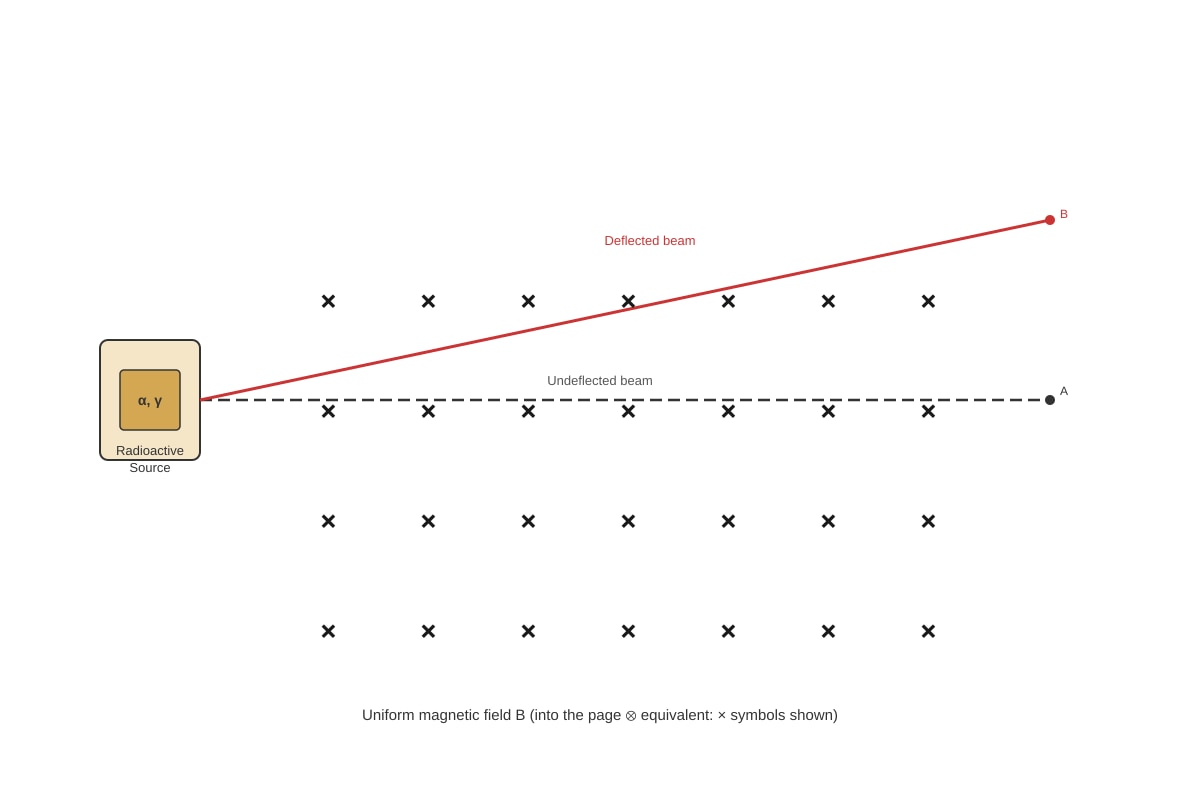
8. (a) The undeflected beam represents gamma radiation. [1]
- Gamma radiation has no charge, so it is not deflected by a magnetic field.
(b) The deflected beam represents alpha radiation. [1]
- Alpha particles are positively charged (helium nuclei), so they experience a force in a magnetic field and are deflected. [1]
- (By Fleming's left-hand rule, the direction of deflection confirms the positive charge.)
[3] — 1 mark for correct identification in (a); 1 mark for identifying alpha in (b); 1 mark for explaining the deflection due to charge.
9.
- Mass number: 226 − 4 = 222
- Atomic number: 88 − 2 = 86
- Element with Z = 86 is Rn (radon)
[2] — 1 mark for correct mass number (222); 1 mark for correct atomic number and element symbol (₈₆Rn). Award 1 mark if only one of A or Z is correct.
10. (a) Number of half-lives = 24 ÷ 8.0 = 3 half-lives [1]
- After 1 half-life: 16 ÷ 2 = 8 mg
- After 2 half-lives: 8 ÷ 2 = 4 mg
- After 3 half-lives: 4 ÷ 2 = 2 mg [1]
(b) Any suitable reason, e.g.:
- Radioactive materials emit ionising radiation that can damage living cells/DNA. [1]
- Prolonged exposure can cause radiation sickness or increase cancer risk. [1]
[3] — 2 marks for calculation; 1 mark for explanation.
11. Use: Any one of:
- To trace blood flow / detect blockages in blood vessels. [1]
- To monitor the function of organs (e.g., thyroid, kidneys).
- To detect tumours / cancer.
Explanation: A short half-life means the radioactivity decays quickly, [1] so the patient is exposed to radiation for only a short time, reducing the risk of cell damage / harmful side effects. [1]
[2] — 1 mark for a valid use; 1 mark for explanation linking short half-life to reduced exposure/risk.
12.
| Feature | Nuclear Fission | Nuclear Fusion |
|---|---|---|
| Definition | A heavy nucleus splits into two or more lighter nuclei. [1] | Two light nuclei combine to form a heavier nucleus. [1] |
| Typical fuel | Uranium-235 or Plutonium-239 [1] | Hydrogen isotopes (deuterium, tritium) [1] |
| Where it occurs naturally | Does not occur naturally on Earth (occurs in nuclear reactors / bombs) [1] | Occurs in the core of stars / the Sun [1] |
[3] — 1 mark per correct row. Award marks independently for each correct cell.
13. (a) From the table:
- At t = 0, count rate = 800 cpm
- At t = 2, count rate = 400 cpm (= ½ × 800) [1]
- The count rate halves every 2 hours, so the half-life is 2 hours. [1]
(b) At t = 8, count rate = 50 cpm. After one more half-life (2 hours), at t = 10:
- Count rate = 50 ÷ 2 = 25 counts per minute [1]
[3] — 2 marks for (a) (1 for showing the halving, 1 for the answer); 1 mark for (b).
14. Gamma radiation has very high penetrating power, [1] so it can pass through packaging and the medical equipment itself to kill bacteria and viruses on all surfaces and inside the equipment. [1] Alpha radiation has very low penetrating power (stopped by paper/skin) and would not be able to penetrate the packaging or reach all surfaces of the equipment. [1]
[2] — Award marks for: (1) gamma has high penetrating power; (2) alpha has low penetrating power / cannot penetrate packaging. Both comparison points needed for full marks.
15. Fraction remaining = 1/8 = (1/2)³, so 3 half-lives have passed. [1]
- Age = 3 × 5730 = 17 190 years (or approximately 17 200 years) [1]
[2] — 1 mark for determining 3 half-lives; 1 mark for the correct calculation. Accept 17 190 or 17 200.
Section C: Application and Extended Response
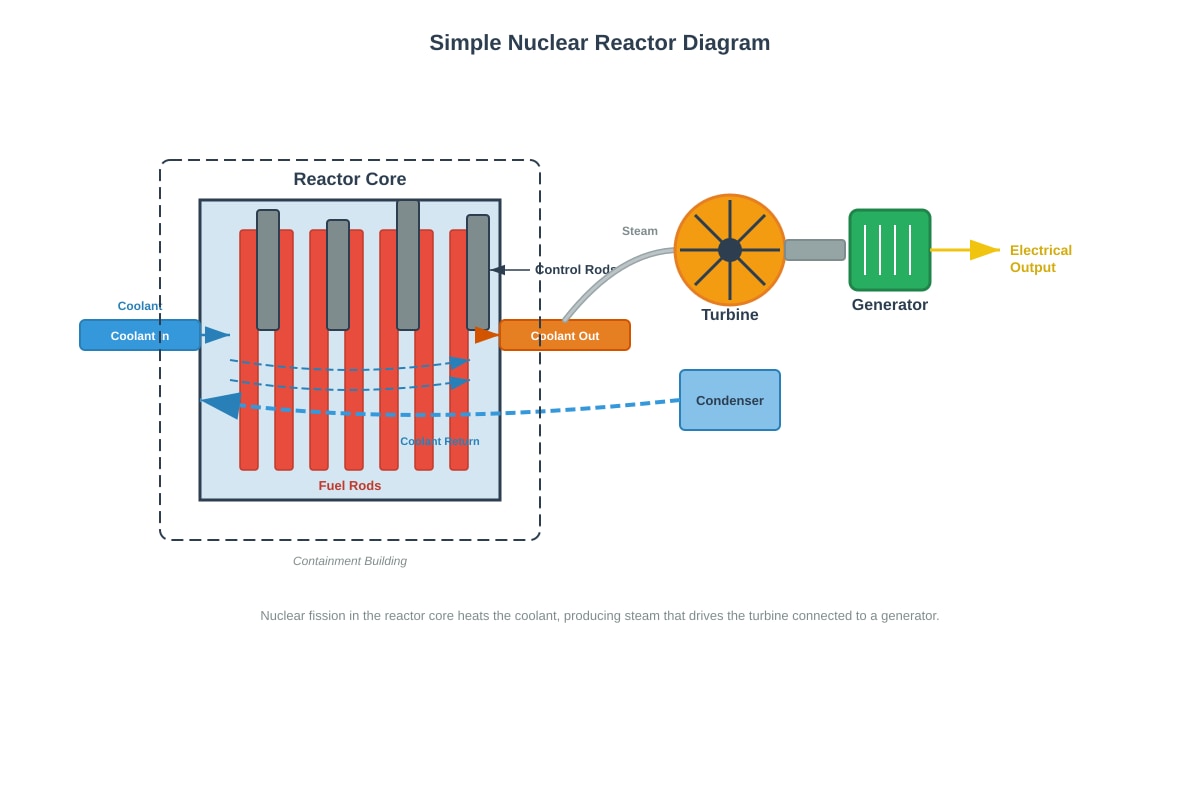
16. (a) Control rods absorb neutrons [1] to control the rate of the chain reaction (by absorbing excess neutrons to prevent the reaction from becoming too fast / runaway).
(b) Function: The moderator slows down fast neutrons [1] so that they are more likely to cause further fission of uranium-235 nuclei. Material: Graphite or water (heavy water / light water). [1]
(c) Energy transfers:
- Nuclear energy (from fission) is converted into thermal energy (heat) in the reactor core. [1]
- The coolant carries this thermal energy away from the core to produce steam. [1]
- The steam drives the turbine, converting thermal energy into kinetic energy. [1]
- The turbine drives the generator, converting kinetic energy into electrical energy. [1]
[5] — 1 mark for (a); 2 marks for (b) (1 for function, 1 for material); 2 marks for (c) (award 1 mark per correct energy transfer step, maximum 2).
17. (a) Years = 20 mSv ÷ 2.0 mSv/year = 10 years [1]
(b) Any two of:
- Wearing lead aprons / lead shielding. [1]
- Using tongs / remote handling tools to keep distance from sources. [1]
- Wearing personal dosimeters to monitor exposure. [1]
- Limiting time spent near radioactive sources. [1]
- Working behind lead/concrete shielding walls. [1]
[3] — 1 mark for (a); 2 marks for (b) (1 per correct safety measure).
18. (a) Conservation of mass number:
- Left side: 235 + 1 = 236
- Right side: 141 + 92 + X(1) = 233 + X
- 236 = 233 + X
- X = 3 [2]
(b) The fission reaction releases neutrons. [1] These neutrons can go on to cause further fission reactions in other uranium-235 nuclei, which release more neutrons, creating a self-sustaining chain reaction. [1]
[4] — 2 marks for (a) (1 for setting up the equation, 1 for the answer); 2 marks for (b) (1 for mentioning neutrons are released, 1 for explaining the chain reaction).
19. Natural sources (any two):
- Radon gas from the ground / rocks / soil. [1]
- Cosmic rays from outer space. [1]
- Radioactive materials in food and drink (e.g., potassium-40 in bananas). [1]
- Radioactive materials in building materials. [1]
Artificial source (any one):
- Medical X-rays / medical procedures. [1]
- Fallout from nuclear weapons testing.
- Nuclear power plant waste / emissions.
[2] — 1 mark per correct source, maximum 2 marks (need at least 1 natural and 1 artificial for full marks; if only natural sources given, maximum 1 mark).
20. (a) Source P emits alpha and beta radiation. [1]
- Paper reduces the count rate significantly (600 → 150), indicating alpha particles are present (alpha is stopped by paper). [1]
- Aluminium further reduces the count rate (150 → 50), indicating beta particles are also present (beta is stopped by aluminium). [1]
- Lead stops all remaining radiation (50 → 0), confirming no gamma emission.
(b) Source Q emits gamma radiation only. [1]
- Paper, aluminium, and even thick lead do not significantly reduce the count rate (600 → 200 with lead), which is consistent with the high penetrating power of gamma rays. [1]
- Gamma rays are not charged, so they are not completely stopped by moderate shielding.
(c) Gamma radiation has very high penetrating power. [1] Even thick lead can only reduce (attenuate) the gamma radiation but cannot completely absorb it all; some gamma photons pass through.
[5] — (a): 2 marks (1 for identifying alpha + beta, 1 for reasoning); (b): 2 marks (1 for identifying gamma, 1 for reasoning); (c): 1 mark for explanation.
Mark Summary
| Section | Questions | Marks |
|---|---|---|
| A: Multiple Choice | 1–5 | 10 |
| B: Short Answer / Structured | 6–15 | 20 |
| C: Application / Extended | 16–20 | 10 |
| Total | 20 questions | 40 |
End of Answer Key