AI Generated Quiz
Secondary 3 Physics Mechanics Quiz
Free Sec 3 Physics Mechanics quiz, Nemo3 AI version, with questions, answers, and O Level-style practice for Singapore students.
These static practice materials are generated from the site's syllabus and paper-generation workflow, with source and model context shown so students and parents can evaluate the material before use.
Questions
Secondary 3 Physics Quiz - Mechanics
Name: ________________________
Class: ________________________
Date: ________________________
Score: ______ / 40
Duration: 45 minutes
Total Marks: 40
Instructions:
- Answer all questions.
- Write your answers in the spaces provided.
- Show all working for calculation questions.
- Use unless otherwise stated.
- The number of marks is given in brackets [ ] at the end of each question or part question.
Section A: Multiple Choice Questions (10 marks)
Answer all questions. Choose the correct option and write the letter (A, B, C, or D) in the box provided.
1. [1 mark]
A car accelerates uniformly from rest to a speed of in . What is the acceleration of the car?
☐ A.
☐ B.
☐ C.
☐ D.
2. [1 mark]
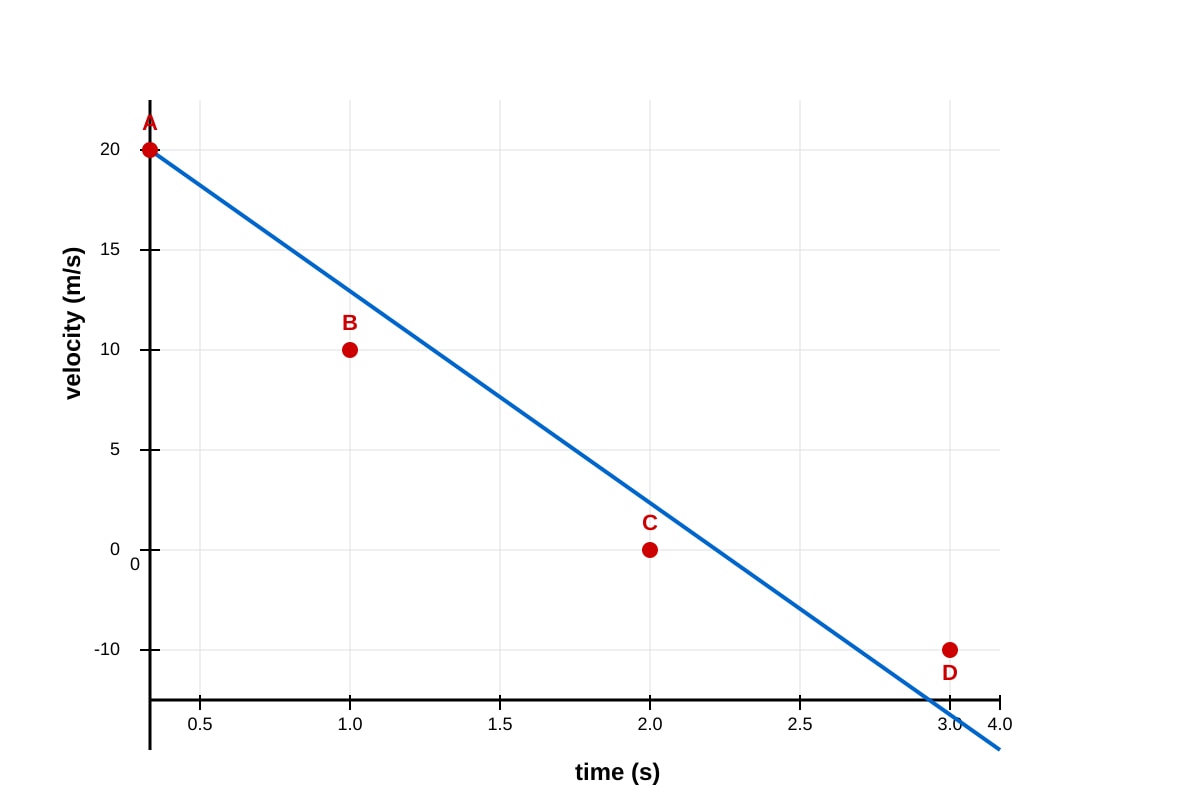
The velocity-time graph below shows the motion of a ball thrown vertically upwards. Which point on the graph represents the maximum height reached by the ball?
<image_placeholder> id: Q2-fig1 type: graph linked_question: Q2 description: Velocity-time graph for a ball thrown vertically upwards. Axes: velocity (m/s) on y-axis from -10 to 20, time (s) on x-axis from 0 to 4. Graph is a straight line with negative gradient starting at (0, 20) and crossing the time axis at (2, 0), continuing to (4, -20). Points labelled A at (0, 20), B at (1, 10), C at (2, 0), D at (3, -10). labels: A, B, C, D on the line; velocity (m/s), time (s) values: Initial velocity = 20 m/s, crosses zero at t = 2 s, final velocity = -20 m/s at t = 4 s must_show: Straight line with negative gradient, labelled points A, B, C, D, axes with units </image_placeholder>
☐ A. Point A
☐ B. Point B
☐ C. Point C
☐ D. Point D
3. [1 mark]
A block of mass is pulled across a horizontal surface by a horizontal force of . The frictional force acting on the block is . What is the acceleration of the block?
☐ A.
☐ B.
☐ C.
☐ D.
4. [1 mark]
Which of the following statements about Newton's Third Law is correct?
☐ A. Action and reaction forces act on the same object.
☐ B. Action and reaction forces are always equal in magnitude and opposite in direction.
☐ C. Action and reaction forces can be of different types (e.g., gravitational and contact).
☐ D. Action force occurs before the reaction force.
5. [1 mark]
A ball is dropped from a height of . Ignoring air resistance, what is the kinetic energy of the ball just before it hits the ground? ()
☐ A.
☐ B.
☐ C.
☐ D.
6. [1 mark]
A force of is applied to a box at an angle of to the horizontal. The box moves horizontally by . What is the work done by the force?
☐ A.
☐ B.
☐ C.
☐ D.
7. [1 mark]
Two objects of masses and are moving towards each other with speeds and respectively. They collide and stick together. What is their common velocity after the collision?
☐ A. in the direction of the object
☐ B. in the direction of the object
☐ C. in the direction of the object
☐ D. in the direction of the object
8. [1 mark]
A satellite orbits the Earth in a circular orbit. Which of the following provides the centripetal force for the satellite?
☐ A. Gravitational force
☐ B. Tension in a string
☐ C. Frictional force
☐ D. Normal reaction force
9. [1 mark]
A car of mass travels at a constant speed of around a circular bend of radius . What is the centripetal force acting on the car?
☐ A.
☐ B.
☐ C.
☐ D.
10. [1 mark]
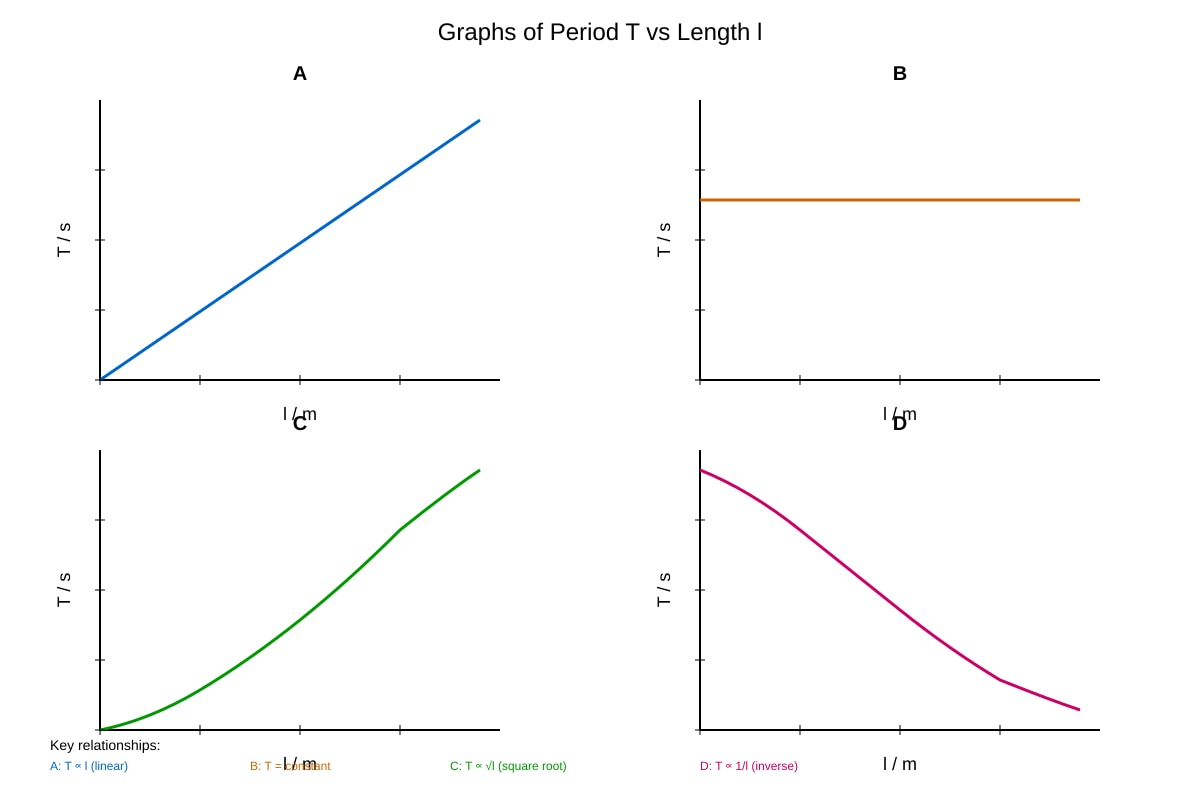
A student measures the period of a simple pendulum for different lengths. Which graph correctly shows the relationship between period and length ?
<image_placeholder> id: Q10-fig1 type: graph linked_question: Q10 description: Four sketch graphs showing T vs l relationships. Graph A: straight line through origin (T ∝ l). Graph B: horizontal line (T constant). Graph C: curve increasing with decreasing gradient (T ∝ √l). Graph D: curve decreasing (T ∝ 1/l). labels: T (period) on y-axis, l (length) on x-axis for all graphs values: Qualitative shapes only must_show: Four distinct graph shapes labelled A, B, C, D with axes labelled </image_placeholder>
☐ A. Graph A
☐ B. Graph B
☐ C. Graph C
☐ D. Graph D
Section B: Structured Questions (30 marks)
Answer all questions in the spaces provided.
11. [3 marks]
A cyclist starts from rest and accelerates uniformly at for . He then continues at a constant speed for before decelerating uniformly to rest in .
(a) Calculate the maximum speed reached by the cyclist.
[1 mark]
(b) Calculate the total distance travelled by the cyclist.
[2 marks]
12. [4 marks]
A block of mass rests on a rough horizontal table. A horizontal force of is applied to the block. The coefficient of friction between the block and the table is .
(a) Calculate the weight of the block.
[1 mark]
(b) Calculate the maximum frictional force between the block and the table.
[1 mark]
(c) Determine whether the block will move. If it moves, calculate its acceleration.
[2 marks]
13. [3 marks]
A ball of mass is dropped from a height of onto a hard floor. It rebounds to a height of . The ball is in contact with the floor for . Take .
(a) Calculate the speed of the ball just before it hits the floor.
[1 mark]
(b) Calculate the speed of the ball just after it leaves the floor.
[1 mark]
(c) Calculate the average force exerted by the floor on the ball during the impact.
[1 mark]
14. [4 marks]
A car is travelling at on a horizontal road. The driver applies the brakes and the car comes to rest in a distance of .
(a) Calculate the kinetic energy of the car before braking.
[1 mark]
(b) Calculate the average braking force acting on the car.
[2 marks]
(c) Explain what happens to the kinetic energy of the car during braking.
[1 mark]
15. [3 marks]
A rocket of mass (including fuel) is launched vertically upwards. The rocket engine produces a constant upward thrust of for . Assume the mass of the rocket remains constant and ignore air resistance. Take .
(a) Calculate the resultant force acting on the rocket during the thrust period.
[1 mark]
(b) Calculate the acceleration of the rocket during this period.
[1 mark]
(c) Calculate the velocity of the rocket at the end of the thrust period.
[1 mark]
16. [4 marks]
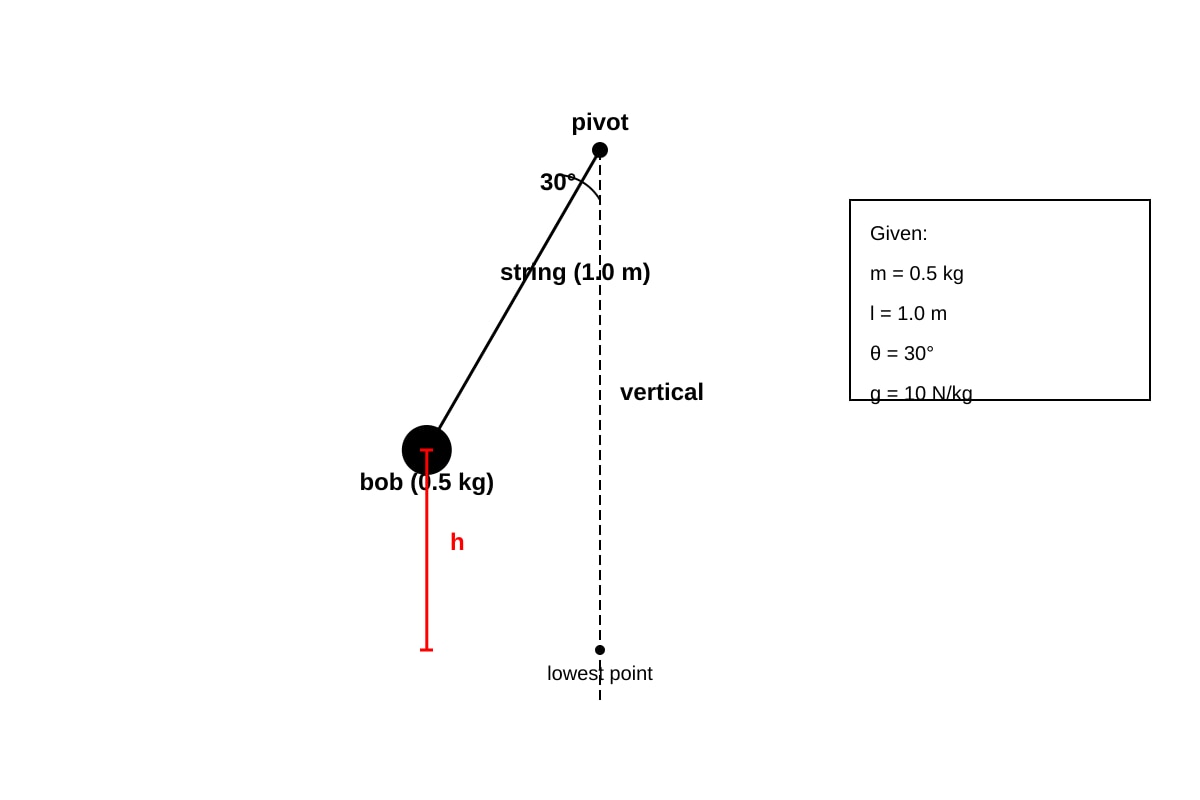
A pendulum consists of a bob of mass attached to a light string of length . The bob is pulled aside until the string makes an angle of with the vertical and then released from rest. Take .
<image_placeholder> id: Q16-fig1 type: diagram linked_question: Q16 description: Simple pendulum diagram showing bob at 30° to vertical. String length labelled 1.0 m, angle labelled 30°, vertical line through pivot shown, height difference h labelled between lowest point and release point. labels: pivot, string (1.0 m), bob (0.5 kg), angle 30°, vertical, height h values: m = 0.5 kg, l = 1.0 m, θ = 30°, g = 10 N/kg must_show: Pendulum at 30° displacement, vertical reference line, height difference h clearly marked </image_placeholder>
(a) Calculate the vertical height through which the bob falls from the release point to the lowest point.
[1 mark]
(b) Calculate the maximum kinetic energy of the bob.
[1 mark]
(c) Calculate the maximum speed of the bob.
[1 mark]
(d) State the energy conversion that takes place as the bob swings from the release point to the lowest point.
[1 mark]
17. [3 marks]
Two ice skaters, A and B, stand facing each other on a frictionless ice rink. Skater A has mass and skater B has mass . Skater A pushes skater B, causing skater B to move away with a velocity of .
(a) State the principle of conservation of momentum.
[1 mark]
(b) Calculate the velocity of skater A after the push.
[2 marks]
18. [3 marks]
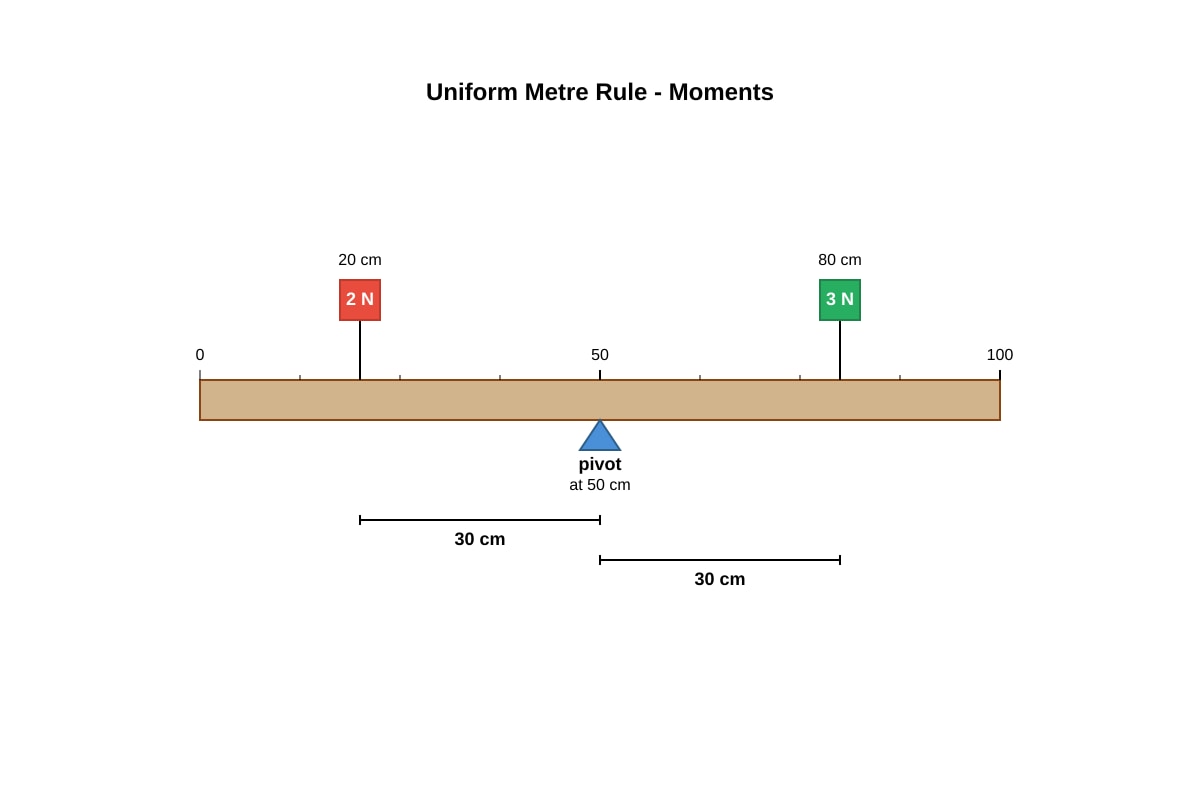
A uniform metre rule is pivoted at the mark. A weight of is suspended at the mark. A second weight of is suspended at the mark.
<image_placeholder> id: Q18-fig1 type: diagram linked_question: Q18 description: Metre rule pivoted at 50 cm mark. Weight 2 N at 20 cm mark (30 cm from pivot). Weight 3 N at 80 cm mark (30 cm from pivot). Pivot shown as triangle. Distances from pivot labelled. labels: pivot at 50 cm, 2 N at 20 cm, 3 N at 80 cm, distances 30 cm each side values: 2 N at 30 cm left of pivot, 3 N at 30 cm right of pivot must_show: Metre rule horizontal, pivot at centre, two weights at specified positions with distances from pivot labelled </image_placeholder>
(a) Calculate the clockwise moment about the pivot.
[1 mark]
(b) Calculate the anticlockwise moment about the pivot.
[1 mark]
(c) State whether the metre rule is in equilibrium. If not, state the direction it will rotate.
[1 mark]
19. [3 marks]
A satellite of mass orbits the Earth at a height of above the Earth's surface. The radius of the Earth is . The gravitational field strength at this height is .
(a) Calculate the gravitational force acting on the satellite.
[1 mark]
(b) Calculate the centripetal acceleration of the satellite.
[1 mark]
(c) Calculate the orbital speed of the satellite.
[1 mark]
20. [3 marks]
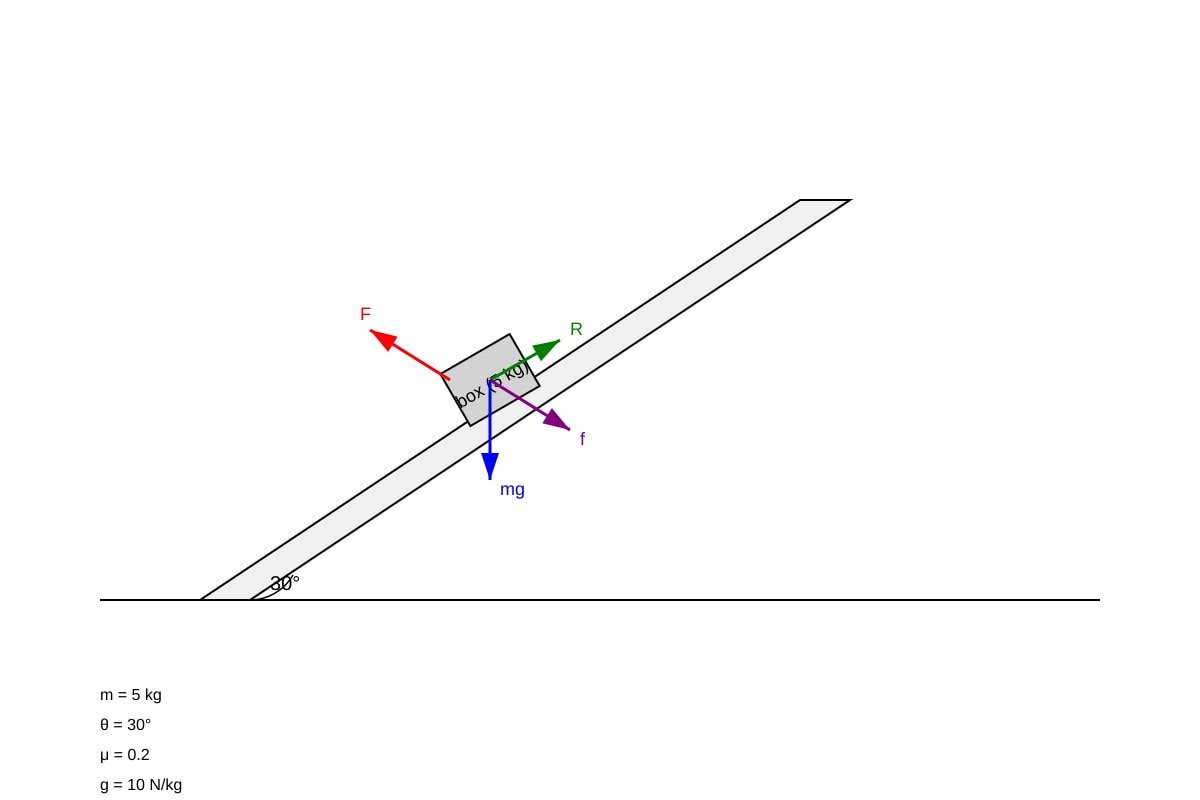
A box of mass is pulled up a rough inclined plane at a constant speed by a force parallel to the plane. The plane is inclined at to the horizontal. The coefficient of friction between the box and the plane is . Take .
<image_placeholder> id: Q20-fig1 type: diagram linked_question: Q20 description: Box on inclined plane at 30°. Force F pulling up the plane parallel to surface. Weight mg vertically down. Normal reaction R perpendicular to plane. Friction f down the plane opposing motion. Angle 30° labelled. labels: box (5 kg), incline 30°, force F up plane, weight mg down, normal reaction R, friction f down plane values: m = 5 kg, θ = 30°, μ = 0.2, g = 10 N/kg must_show: Inclined plane at 30°, box on plane, all forces labelled with arrows, angle clearly marked </image_placeholder>
(a) Calculate the component of the weight acting down the plane.
[1 mark]
(b) Calculate the frictional force acting on the box.
[1 mark]
(c) Calculate the magnitude of the force required to pull the box up at constant speed.
[1 mark]
End of Quiz
Answers
Secondary 3 Physics Quiz - Mechanics (Answer Key)
Total Marks: 40
Section A: Multiple Choice Questions (10 marks)
1. [1 mark] — B
Working:
Explanation: Acceleration is the rate of change of velocity. The car starts from rest () and reaches in . Using gives .
2. [1 mark] — C
Explanation: At maximum height, the vertical velocity of a projectile is momentarily zero. On a velocity-time graph, this corresponds to where the line crosses the time axis (velocity = 0). Point C is at , where velocity is zero.
Common mistake: Choosing point A (initial velocity) or point D (maximum downward velocity).
3. [1 mark] — B
Working:
Resultant force
Explanation: Newton's Second Law: . The net force is the applied force minus the opposing friction force.
4. [1 mark] — B
Explanation: Newton's Third Law states: "For every action, there is an equal and opposite reaction." The action-reaction pair:
- Are equal in magnitude
- Are opposite in direction
- Act on different objects
- Are of the same type (e.g., both gravitational or both contact)
Why others are wrong:
A: They act on different objects.
C: They must be the same type of force.
D: They occur simultaneously, not sequentially.
5. [1 mark] — C
Working:
Loss in GPE = Gain in KE (conservation of energy)
Explanation: The gravitational potential energy at the start () is converted entirely to kinetic energy just before impact (ignoring air resistance). Mass = , , .
6. [1 mark] — B
Working:
Explanation: Work done = force component in direction of displacement × displacement. Only the horizontal component () does work since displacement is horizontal.
7. [1 mark] — A
Working:
Take direction of object as positive.
Total momentum before =
Combined mass =
(positive, so in direction of object)
Explanation: Conservation of momentum for perfectly inelastic collision. The positive result means the combined mass moves in the original direction of the object.
8. [1 mark] — A
Explanation: For a satellite in orbit, the gravitational force between the Earth and the satellite provides the necessary centripetal force to keep it in circular motion. No string, friction, or normal reaction is involved.
9. [1 mark] — B
Working:
Explanation: Centripetal force formula . The force is provided by friction between tyres and road.
10. [1 mark] — C
Explanation: For a simple pendulum, , so . Graph C shows a curve that increases with decreasing gradient, characteristic of a square root relationship.
Section B: Structured Questions (30 marks)
11. [3 marks]
(a) [1 mark]
Answer:
(b) [2 marks]
Distance during acceleration:
Distance at constant speed:
Distance during deceleration:
Total distance =
Answer:
Mark breakdown: 1 mark for correct method (area under v-t graph or equations of motion), 1 mark for correct total.
12. [4 marks]
(a) [1 mark]
Answer:
(b) [1 mark]
Answer:
(c) [2 marks]
Applied force () > Maximum friction (), so block will move.
Net force =
Answer: Yes, it moves. Acceleration =
Mark breakdown: 1 mark for correct comparison and conclusion, 1 mark for correct acceleration.
13. [3 marks]
(a) [1 mark]
(downwards)
Answer:
(b) [1 mark]
(upwards)
Answer: (or )
(c) [1 mark]
Take upward as positive.
Change in momentum =
Average force = (upwards)
Answer: upwards
Alternative using impulse:
14. [4 marks]
(a) [1 mark]
Answer: (or )
(b) [2 marks]
Work done by braking force = Loss in KE
Answer:
Mark breakdown: 1 mark for work-energy principle, 1 mark for correct calculation.
(c) [1 mark]
The kinetic energy is converted into heat energy (and some sound energy) due to friction between the brake pads and discs/drums, and between tyres and road.
15. [3 marks]
(a) [1 mark]
Weight = (downwards)
Resultant force = Thrust - Weight = (upwards)
Answer: upwards
(b) [1 mark]
(upwards)
Answer: upwards
(c) [1 mark]
Answer: upwards
16. [4 marks]
(a) [1 mark]
Answer: (or )
(b) [1 mark]
Max KE = Loss in GPE =
Answer:
(c) [1 mark]
Answer:
(d) [1 mark]
Gravitational potential energy → Kinetic energy
17. [3 marks]
(a) [1 mark]
The total momentum of a closed system remains constant if no external resultant force acts on the system.
(b) [2 marks]
Initial momentum = 0 (both at rest)
Final momentum =
Answer: in the opposite direction to skater B (i.e., away from skater B)
Mark breakdown: 1 mark for conservation of momentum equation, 1 mark for correct magnitude and direction.
18. [3 marks]
(a) [1 mark]
Clockwise moment =
Answer:
(b) [1 mark]
Anticlockwise moment =
Answer:
(c) [1 mark]
Not in equilibrium. Clockwise moment () > Anticlockwise moment ().
The metre rule will rotate clockwise.
19. [3 marks]
(a) [1 mark]
Answer: (towards Earth's centre)
(b) [1 mark]
Centripetal acceleration = gravitational field strength =
Answer: (towards Earth's centre)
Explanation: For a satellite, the gravitational force provides the centripetal force: , so , giving .
(c) [1 mark]
Orbital radius
Answer: (or )
20. [3 marks]
(a) [1 mark]
Component down plane =
Answer:
(b) [1 mark]
Normal reaction
Friction
Answer: (acting down the plane)
(c) [1 mark]
Constant speed → resultant force = 0
Answer: (or ) up the plane
Mark breakdown: 1 mark for resolving forces correctly and equating to zero net force.
End of Answer Key