AI Generated Quiz
Secondary 3 Physics Mechanics Quiz
Free Kimi AI-generated Sec 3 Physics Mechanics quiz with questions, answers, and O Level-style practice for Singapore students preparing for school assessments.
These static practice materials are generated from the site's syllabus and paper-generation workflow, with source and model context shown so students and parents can evaluate the material before use.
Questions
Secondary 3 Physics Quiz - Mechanics
Name: _________________________ Class: _________ Date: _________
Duration: 50 minutes
Total Marks: 50
Score: _______ / 50
Instructions:
- Answer all questions.
- Write your answers in the spaces provided.
- Show all working for calculation questions.
- Use g = 10 N/kg where required.
Section A: Multiple Choice (Questions 1–10) [10 marks]
Choose the correct answer for each question.
1. Which of the following is a vector quantity?
| A | mass |
|---|---|
| B | speed |
| C | displacement |
| D | time |
Answer: _______ [1]
2. A car accelerates from rest at 2.0 m/s² for 5.0 s. What is its final velocity?
| A | 0.40 m/s |
|---|---|
| B | 2.5 m/s |
| C | 10 m/s |
| D | 25 m/s |
Answer: _______ [1]
3. An object moves with constant velocity. Which statement is correct?
| A | A net force acts on the object |
|---|---|
| B | No forces act on the object |
| C | The net force on the object is zero |
| D | The object must be moving vertically |
Answer: _______ [1]
4. A ball is thrown vertically upward. At the highest point of its motion:
| A | velocity and acceleration are both zero |
|---|---|
| B | velocity is zero and acceleration is downward |
| C | velocity is upward and acceleration is zero |
| D | velocity and acceleration are both upward |
Answer: _______ [1]
5. The gravitational field strength on the Moon is about 1/6 that on Earth. An astronaut has a weight of 600 N on Earth. What would be their weight on the Moon?
| A | 0 N |
|---|---|
| B | 100 N |
| C | 600 N |
| D | 3600 N |
Answer: _______ [1]
6. A box of mass 10 kg is pushed across a floor with a force of 20 N. The box moves at constant velocity. What is the frictional force?
| A | 0 N |
|---|---|
| B | 2 N |
| C | 20 N |
| D | 200 N |
Answer: _______ [1]
7. Which graph shows an object decelerating uniformly to rest?
(5 second time interval, velocity decreasing linearly from 10 m/s to 0)
Answer: _______ [1]
8. A pendulum bob swings from point X to point Y. Which energy conversion takes place as it moves from the highest point to the lowest point?
| A | gravitational potential energy to kinetic energy |
|---|---|
| B | kinetic energy to gravitational potential energy |
| C | chemical energy to kinetic energy |
| D | elastic potential energy to kinetic energy |
Answer: _______ [1]
9. Two forces of 3 N and 4 N act at right angles to each other. What is the magnitude of their resultant?
| A | 1 N |
|---|---|
| B | 5 N |
| C | 7 N |
| D | 25 N |
Answer: _______ [1]
10. A crane lifts a load of 500 kg vertically through 8 m in 10 s. What is the power output of the crane? (g = 10 N/kg)
| A | 400 W |
|---|---|
| B | 625 W |
| C | 4000 W |
| D | 40 000 W |
Answer: _______ [1]
Section B: Structured Questions (Questions 11–20) [40 marks]
11. Define the term acceleration. State its SI unit. [2]
12. A cyclist travels 1200 m north, then turns and travels 800 m south. The total time taken is 200 s.
(a) Calculate the total distance travelled. [1]
(b) Calculate the displacement of the cyclist from the starting point. [2]
(c) Calculate the average speed of the cyclist. [2]
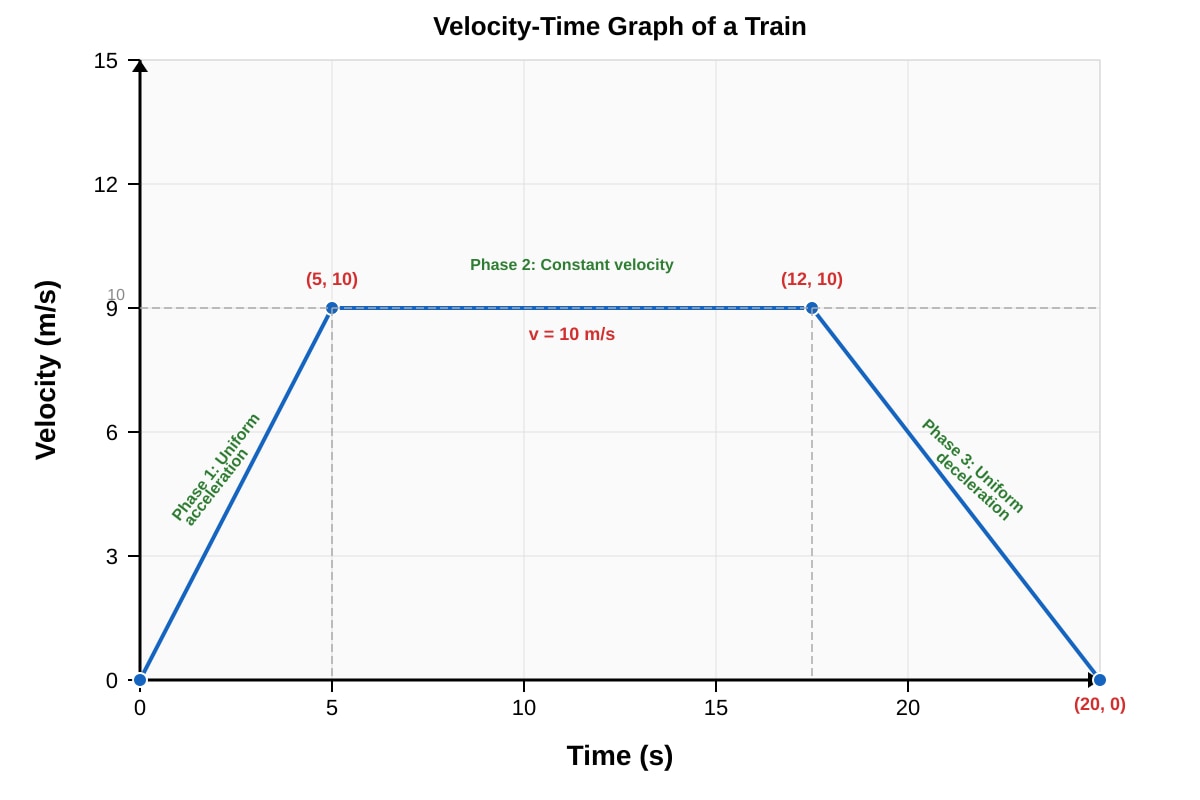
13. The velocity-time graph below shows the motion of a train over 20 seconds.
<image_placeholder> id: Q13-fig1 type: graph linked_question: Q13 description: Velocity-time graph showing motion of a train. The graph has a horizontal time axis (0 to 20 s) and vertical velocity axis (0 to 15 m/s). Phase 1 (0 to 5 s): straight line from origin to (5, 10), showing uniform acceleration. Phase 2 (5 to 12 s): horizontal line at v = 10 m/s, showing constant velocity. Phase 3 (12 to 20 s): straight line from (12, 10) to (20, 0), showing uniform deceleration to rest. labels: Time (s) on horizontal axis, Velocity (m/s) on vertical axis, points labelled at (5, 10), (12, 10), (20, 0) values: t = 0, 5, 12, 20 s; v = 0, 10, 0 m/s for phases respectively must_show: Clear straight-line segments for acceleration, constant velocity, and deceleration phases; labelled time values at transitions; velocity value for constant velocity phase; axes with units </image_placeholder>
(a) Calculate the acceleration during the first 5 seconds. [2]
(b) Calculate the total distance travelled by the train in 20 seconds. [3]
(c) Describe the motion of the train during the final 8 seconds. [1]
14. A skydiver of mass 70 kg jumps from an aircraft. At one point during the descent, the skydiver falls with constant velocity.
(a) State the name given to this constant velocity. [1]
(b) Calculate the weight of the skydiver. (g = 10 N/kg) [1]
(c) Explain why the skydiver falls with constant velocity, using Newton's laws of motion. [3]
15. A car of mass 1200 kg accelerates from 5 m/s to 25 m/s in 10 seconds.
(a) Calculate the change in kinetic energy of the car. [3]
(b) Calculate the average power required to produce this change in kinetic energy. [2]
16. A block of weight 50 N rests on a rough horizontal surface. A horizontal force of 15 N is applied to the block, but it does not move.
(a) Calculate the resultant force on the block. Explain your answer. [2]
(b) State the magnitude and direction of the frictional force acting on the block. [2]
(c) The applied force is gradually increased to 22 N, and the block begins to slide with constant acceleration of 0.5 m/s². Calculate the resultant force on the block when it is accelerating. [2]
17. A projectile is launched horizontally from the top of a cliff 45 m high with an initial horizontal velocity of 20 m/s. (g = 10 N/kg)
(a) Calculate the time taken for the projectile to reach the ground. [2]
(b) Calculate the horizontal distance travelled by the projectile before hitting the ground. [2]
(c) State how the horizontal velocity of the projectile changes during the flight, if air resistance is negligible. [1]
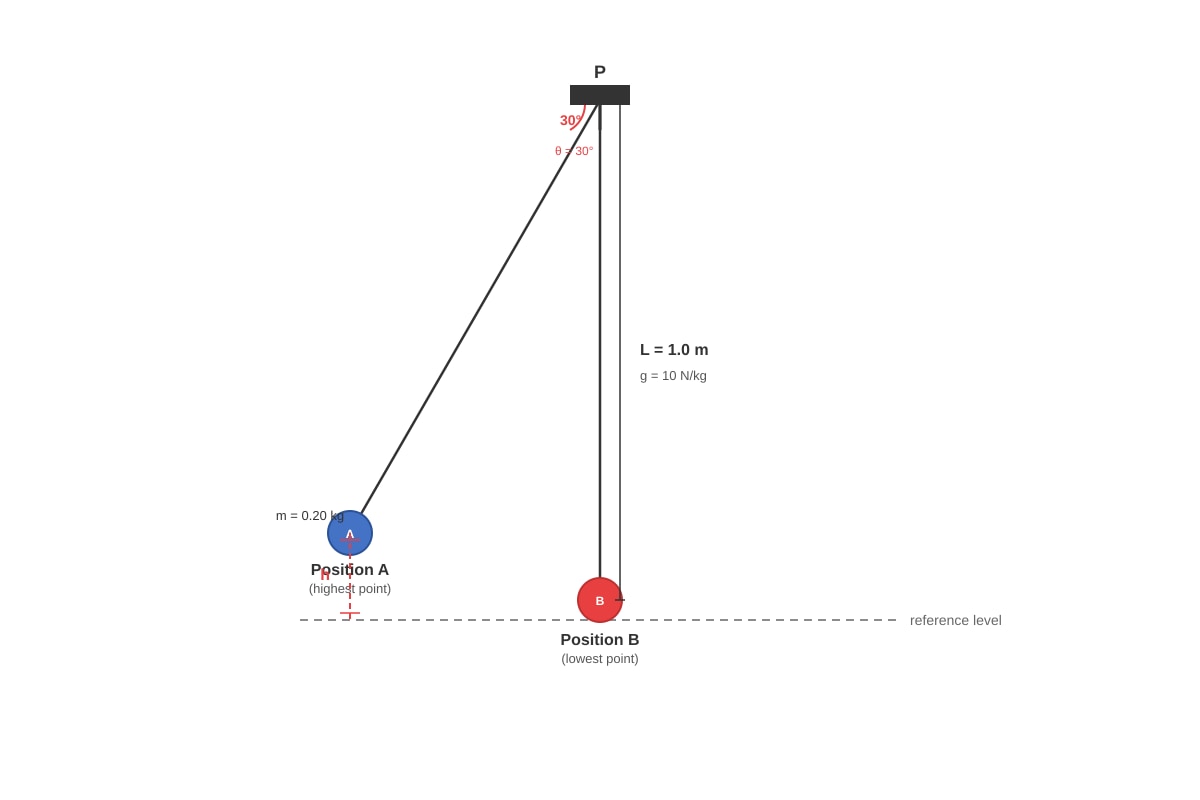
18. A simple pendulum consists of a small metal bob of mass 0.20 kg suspended by a light string of length 1.0 m. The bob is displaced sideways until the string makes an angle of 30° with the vertical, then released.
<image_placeholder> id: Q18-fig1 type: diagram linked_question: Q18 description: Diagram of a simple pendulum showing a bob at two positions. Position A: bob displaced to the left, string at 30° to vertical, height h above lowest position. Position B: bob at lowest point of swing. A horizontal dashed line indicates the reference level for height measurement. A vertical dashed line shows the pendulum at rest. labels: Position A (highest point), Position B (lowest point), angle 30°, height h, length L = 1.0 m, mass m = 0.20 kg, pivot point P values: L = 1.0 m, m = 0.20 kg, θ = 30°, g = 10 N/kg must_show: Clear pendulum geometry with string length, angle to vertical, height difference h, mass label at bob, pivot point, reference level for height </image_placeholder>
(a) Calculate the vertical height h through which the bob falls from position A to position B. [2]
(b) Calculate the gravitational potential energy lost by the bob in falling through this height. [2]
(c) Assuming no energy losses, calculate the speed of the bob as it passes through position B. [3]
19. A uniform metre rule is balanced at its midpoint. A mass of 0.30 kg is placed at the 20 cm mark. An unknown mass m is placed at the 70 cm mark to maintain balance. (g = 10 N/kg)
(a) Calculate the weight of the 0.30 kg mass. [1]
(b) By taking moments about the pivot, calculate the value of m. [3]
(c) State what would happen to the rule if the unknown mass were moved to the 80 cm mark. Explain your answer. [2]
20. Two trolleys A and B are placed on a frictionless horizontal track. Trolley A has mass 2.0 kg and moves at 3.0 m/s towards stationary trolley B (mass 4.0 kg). After collision, trolley A rebounds with velocity 1.0 m/s in the opposite direction.
(a) State the principle of conservation of linear momentum. [2]
(b) Calculate the velocity of trolley B after the collision. [3]
(c) Determine whether the collision is elastic or inelastic, showing your working. [3]
END OF QUIZ
Answers
Secondary 3 Physics Quiz - Mechanics: Answer Key
Total Marks: 50
Section A: Multiple Choice
1. C — displacement [1]
Displacement is a vector quantity because it has both magnitude and direction. Mass, speed, and time are scalar quantities with magnitude only.
2. C — 10 m/s [1]
Using , where , m/s², s: m/s.
3. C — The net force on the object is zero [1]
Newton's First Law: constant velocity (including rest) means zero net force. Frictional forces may balance applied forces.
4. B — velocity is zero and acceleration is downward [1]
At the highest point, instantaneous velocity is zero (momentarily at rest), but acceleration due to gravity (g = 10 m/s² downward) continues to act throughout the flight.
5. B — 100 N [1]
Weight on Moon = N = 100 N. Weight depends on gravitational field strength; mass stays constant.
6. C — 20 N [1]
Constant velocity means zero acceleration, so net force is zero (Newton's First Law). Therefore frictional force equals applied force: 20 N, acting opposite to motion.
7. (Accept: graph showing straight line with negative gradient from positive velocity to zero) [1]
Deceleration to rest is represented by a straight line with negative slope reaching v = 0. The gradient of a velocity-time graph equals acceleration.
8. A — gravitational potential energy to kinetic energy [1]
As the bob falls, its height decreases (GPE decreases) and speed increases (KE increases). Total mechanical energy is conserved if air resistance is negligible.
9. B — 5 N [1]
Using Pythagoras: N. The resultant of perpendicular vectors is found using .
10. C — 4000 W [1]
Work done = force × distance = mg × h = (500)(10)(8) = 40 000 J. Power = = 4000 W.
Section B: Structured Questions
11. Acceleration is the rate of change of velocity with respect to time. [1]
The SI unit is m/s² (metres per second squared). [1]
Key concept: Acceleration measures how quickly velocity changes, including changes in speed or direction. The unit comes from (m/s) ÷ s = m/s².
12. (a) Total distance = 1200 + 800 = 2000 m [1]
Distance is the total path length travelled, regardless of direction.
(b) Displacement = 1200 m (north) − 800 m (south) = 400 m north [2]
Displacement is the straight-line distance from start to finish with direction. North is positive; south subtracts. [1 mark for magnitude 400 m, 1 mark for direction north]
(c) Average speed = = 10 m/s [2]
[1 mark for formula/state use of total distance not displacement, 1 mark for correct answer with unit]
13. (a) Acceleration = gradient = = 2 m/s² [2]
[1 mark for identifying gradient method or correct substitution, 1 mark for answer with unit]
(b) Distance = area under graph
= Area of triangle (0–5 s) + Area of rectangle (5–12 s) + Area of triangle (12–20 s) [1]
=
= 25 + 70 + 40 [1]
= 135 m [1]
Each phase: acceleration phase = triangle, constant velocity = rectangle, deceleration = triangle. Area under velocity-time graph equals displacement/distance for linear motion.
(c) The train is decelerating uniformly (at constant rate) to rest. [1]
Velocity decreases linearly from 10 m/s to 0 in 8 s. The negative gradient indicates negative acceleration (deceleration).
14. (a) Terminal velocity [1]
(Accept: constant velocity in free fall when air resistance equals weight)
(b) Weight = = 700 N [1]
(c) By Newton's First Law: constant velocity means zero resultant force [1]
The upward air resistance equals the downward weight (700 N) [1]
These two forces balance, so there is no acceleration [1]
At terminal velocity, the skydiver is in dynamic equilibrium. Initially, air resistance < weight, so acceleration downward. As speed increases, air resistance increases until it equals weight.
15. (a) Initial KE = J [1]
Final KE = J [1]
Change in KE = 375 000 − 15 000 = 360 000 J (or 360 kJ) [1]
(b) Power = = 36 000 W (or 36 kW) [2]
[1 mark for correct formula and substitution, 1 mark for answer with unit]
16. (a) Resultant force = 0 N [1]
The block is at rest (not accelerating), so by Newton's First/Second Law, net force must be zero [1]
(b) Frictional force = 15 N, acting horizontally opposite to the applied force (to the left) [2]
[1 mark for magnitude 15 N, 1 mark for correct direction]
(c) Resultant force = — Wait: mass not stated in Q16. Using F = ma with given acceleration...
Recalculating: The question states block weight 50 N, so mass = 5 kg.
Resultant force = = 2.5 N [2]
[1 mark for correct mass from weight, 1 mark for F = ma calculation]
Common error: Using 1200 kg from Q15. Each question is independent.
17. (a) Vertical motion:
45 = [1]
, so = 3.0 s [1]
Vertical initial velocity is zero (launched horizontally). Only gravity acts vertically.
(b) Horizontal distance = horizontal velocity × time = = 60 m [2]
[1 mark for identifying horizontal velocity is constant, 1 mark for calculation]
(c) The horizontal velocity remains constant (at 20 m/s). [1]
No horizontal force (air resistance negligible), so by Newton's First Law, horizontal velocity is unchanged. Vertical and horizontal motions are independent.
18. (a) Using geometry: [1]
= 0.134 m (or 0.13 m) [1]
Height difference comes from the vertical component: at angle θ, vertical drop from maximum height is L(1 − cos θ).
(b) GPE lost = = 0.268 J (or 0.27 J) [2]
[1 mark for correct weight/mg, 1 mark for calculation]
(c) By conservation of energy: GPE lost = KE gained
[1]
[1]
= 1.64 m/s (or 1.63 m/s using g = 10 exactly) [1]
Alternative: . Using exact values, accept 1.6–1.7 m/s range.
19. (a) Weight = = 3.0 N [1]
(b) Taking moments about pivot (50 cm mark): [1]
Clockwise moment = anticlockwise moment
[1]
= 0.45 kg [1]
Moment = force × perpendicular distance from pivot. The 0.30 kg mass is 30 cm from pivot; unknown mass is 20 cm from pivot.
(c) The rule would rotate clockwise (tip down on the right side) [1]
The clockwise moment would increase (greater distance from pivot), making it larger than the anticlockwise moment [1]
At 80 cm: moment arm = 30 cm vs 20 cm. Clockwise moment = 4.5 N × 0.30 m = 1.35 Nm; anticlockwise = 3.0 N × 0.30 m = 0.90 Nm. Not balanced.
20. (a) Principle of conservation of linear momentum:
The total linear momentum of a system remains constant provided no external resultant force acts on the system. [2]
[1 mark for statement about constant total momentum, 1 mark for condition about no external force]
(b) Taking direction of A's initial motion as positive:
Total momentum before = total momentum after [1]
[1]
= 2.0 m/s in the original direction of trolley A [1]
A rebounds (negative velocity), so momentum is conserved by B moving forward. Direction must be stated.
(c) KE before = J [1]
KE after = J [1]
Since total KE before = total KE after, the collision is elastic [1]
In elastic collisions, both momentum and kinetic energy are conserved. Inelastic collisions lose KE to other forms (heat, sound, deformation).
END OF ANSWER KEY