AI Generated Quiz
Secondary 3 Physics Mechanics Quiz
Free Sec 3 Physics Mechanics quiz, HY3 AI version, with questions, answers, and O Level-style practice for Singapore students.
These static practice materials are generated from the site's syllabus and paper-generation workflow, with source and model context shown so students and parents can evaluate the material before use.
Questions
Secondary 3 Physics Quiz - Mechanics
Name: ________________________
Class: ________________________
Date: ________________________
Score: _________ / 40
Duration: 50 minutes
Total Marks: 40
Instructions:
- Answer all 20 questions.
- Show your working clearly where calculations are required.
- Use g=10 m s−2 unless stated otherwise.
- Write units in your final answers.
- This quiz is generated from syllabus-first templates and is not derived from any specific past-year exam.
Section A: Kinematics (Questions 1–5)
1. A bus travels 240 m in 20 s at a constant speed. Calculate its average speed. [2 marks]
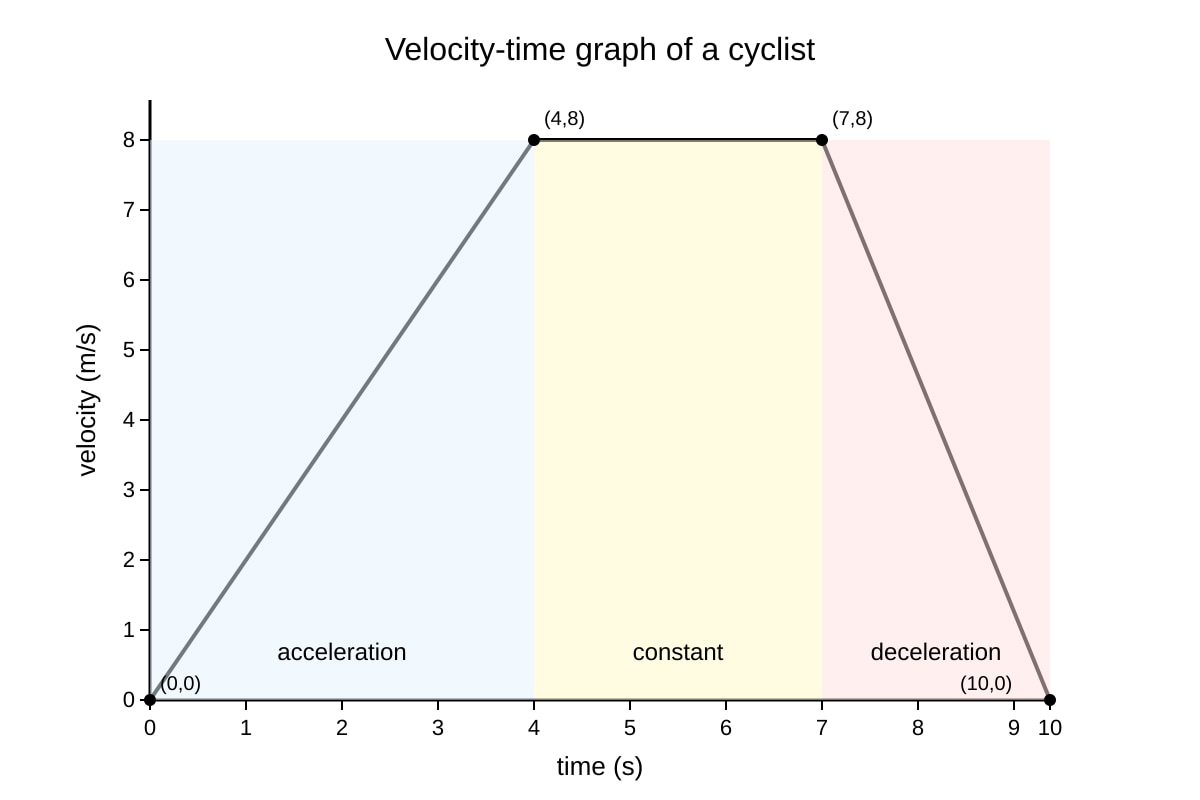
2. The velocity-time graph below shows the motion of a cyclist.
Image pending generation: graph for Q2.
(a) Calculate the acceleration during the first 4 s. [1 mark]
(b) Calculate the total distance travelled. [2 marks]
3. A car accelerates uniformly from rest to 20 m s−1 in 5 s. What is its acceleration? [1 mark]
4. An object is dropped from rest near Earth. State its acceleration ignoring air resistance. [1 mark]
5. A train moves with uniform velocity of 15 m s−1 for 8 s. Find the displacement. [1 mark]
Section B: Dynamics and Forces (Questions 6–11)
6. A child of mass 30 kg slides down a vertical rope with acceleration 2 m s−2. Calculate the frictional force between the child and the rope. [2 marks]
7. State Newton’s First Law of Motion. [1 mark]
8. A block of mass 4 kg is pushed with a net force of 12 N. Calculate its acceleration. [1 mark]
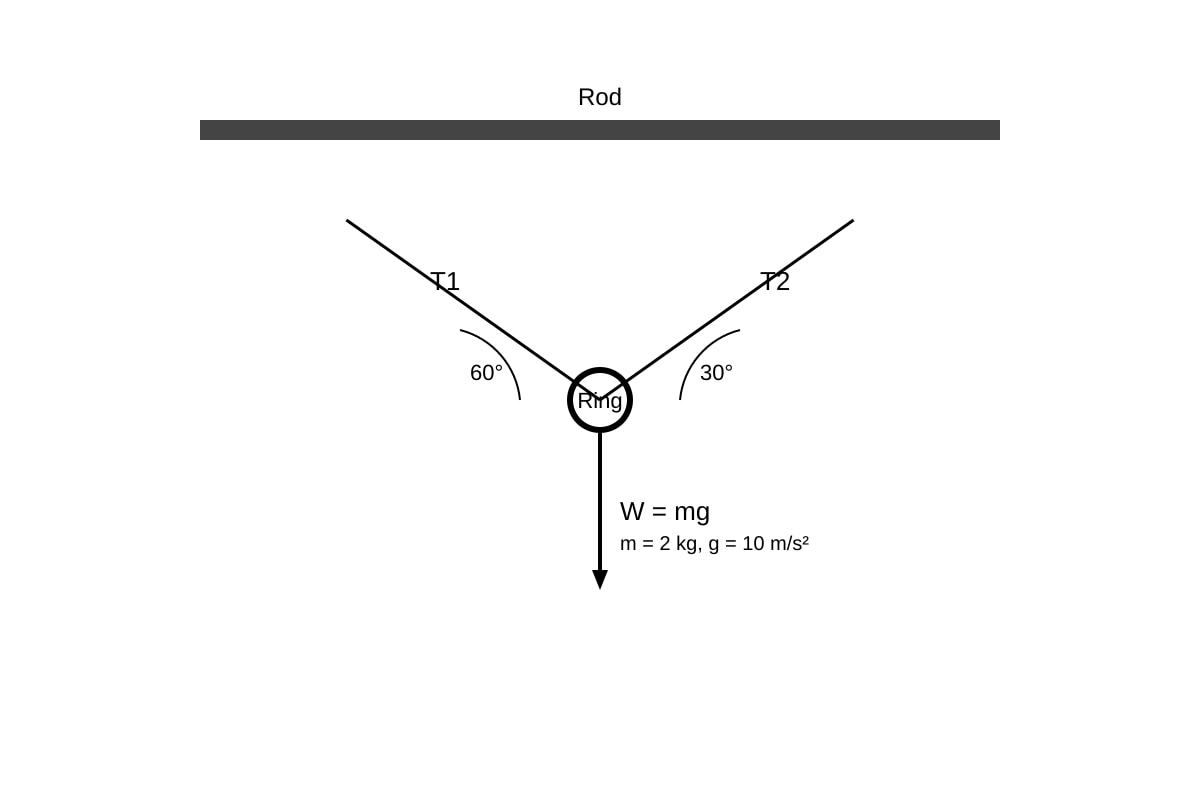
9. A ring of mass 2 kg is suspended by two strings as shown.
Image pending generation: diagram for Q9.
Calculate the tension T1 in the left string. [3 marks]
10. Distinguish between mass and weight. [2 marks]
11. A parachutist reaches terminal velocity. Describe the force balance at this point. [2 marks]
Section C: Turning Effect, Pressure, Energy (Questions 12–16)
12. A force of 10 N is applied at a perpendicular distance of 0.5 m from a pivot. Calculate the moment. [1 mark]
13. A uniform rod of length 2 m is pivoted at its centre. A 5 N weight is placed 0.6 m to the left of the pivot. Where must a 3 N weight be placed on the right to balance it? [2 marks]
14. Define pressure and state its SI unit. [2 marks]
15. A block of mass 2 kg is lifted vertically by 3 m. Calculate the increase in gravitational potential energy. [2 marks]
16. A 500 N force moves an object 4 m in 10 s. Calculate the power developed. [2 marks]
Section D: Applied and Graphical (Questions 17–20)
17. A block of mass 5 kg is on a rough inclined plane at 30° to horizontal. Coefficient of friction is 0.4.
(a) Calculate the component of weight parallel to the plane. [1 mark]
(b) Determine if the block slides. Show working. [2 marks]
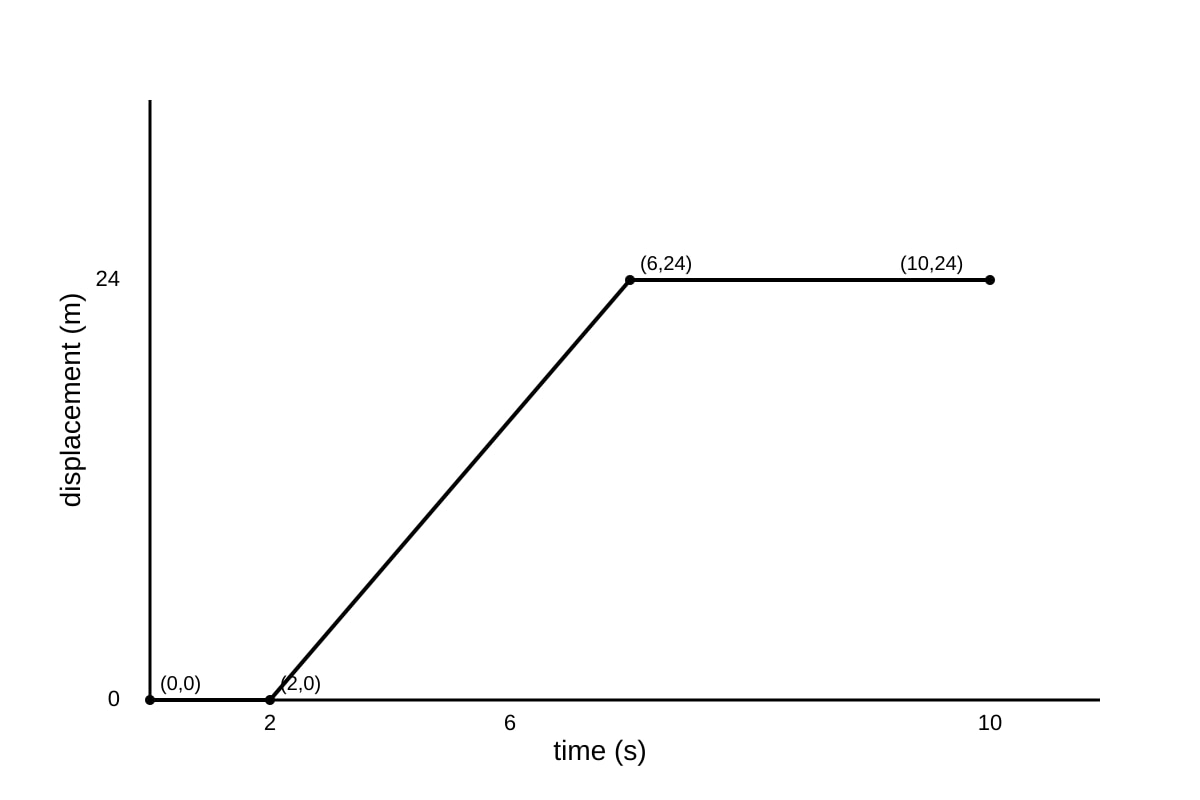
18. The displacement-time graph of a runner is shown.
Image pending generation: graph for Q18.
(a) Describe the motion from 2 s to 6 s. [1 mark]
(b) Calculate the average speed over 10 s. [1 mark]
19. A wooden block of mass 3 kg is pulled up a rough plane at constant speed by a 40 N force. Distance along plane = 5 m, height gain = 2 m. Calculate work done against friction. [3 marks]
20. Two masses 2 kg and 6 kg are 2 m apart. Using G=6.67×10⁻¹¹ N m2 kg−2, calculate the gravitational force between them. [2 marks]
Answers
Secondary 3 Physics Quiz - Mechanics: Answer Key
Total Marks: 40
Note: Syllabus-first generated content; not from specific past papers.
1. [2 marks]
Average speed = distance / time = 240/20=12 m s−1.
Teaching: Speed is scalar; divide total distance by total time.
2. [3 marks total]
(a) [1] Acceleration = gradient = (8−0)/(4−0)=2 m s−2.
(b) [2] Distance = area under graph = triangle (0–4): 21×4×8=16; rectangle (4–7): 3×8=24; triangle (7–10): 21×3×8=12; total = 16+24+12=52 m.
Teaching: Gradient = acceleration; area = displacement.
3. [1 mark]
a=(20−0)/5=4 m s−2.
4. [1 mark]
Acceleration = 10 m s−2 downward (free fall near Earth).
5. [1 mark]
Displacement = 15×8=120 m.
6. [2 marks]
Weight = mg=30×10=300 N down.
Net: mg−f=ma⇒300−f=30×2=60⇒f=240 N.
Teaching: Friction opposes motion (upward).
7. [1 mark]
An object remains at rest or in uniform motion unless acted on by a resultant force.
8. [1 mark]
a=F/m=12/4=3 m s−2.
9. [3 marks]
W=2×10=20 N.
Horizontal: T1cos60∘=T2cos30∘.
Vertical: T1sin60∘+T2sin30∘=20.
From first: 0.5T1=0.866T2⇒T2=0.577T1.
Sub: 0.866T1+0.5(0.577T1)=20⇒1.155T1=20⇒T1=17.3 N.
Teaching: Resolve forces; equilibrium ⇒ sums zero.
10. [2 marks]
Mass: amount of matter (kg), scalar, constant. Weight: force due to gravity (N), vector, W=mg.
11. [2 marks]
At terminal velocity, drag force equals weight; resultant force zero, acceleration zero, constant speed.
12. [1 mark]
Moment = F×d=10×0.5=5 N m.
13. [2 marks]
Clockwise = 5×0.6=3 N m.
Anticlockwise = 3×x=3⇒x=1.0 m right of pivot.
14. [2 marks]
Pressure = Force / Area; SI unit = pascal (Pa) or N m−2.
15. [2 marks]
ΔPE=mgh=2×10×3=60 J.
16. [2 marks]
Work = 500×4=2000 J; Power = 2000/10=200 W.
17. [3 marks]
(a) [1] mgsin30∘=5×10×0.5=25 N.
(b) [2] N=mgcos30∘=43.3 N; max friction =0.4×43.3=17.3 N. Since 25>17.3, block slides.
18. [2 marks]
(a) [1] Uniform acceleration (straight line displacement-time ⇒ constant velocity increase).
(b) [1] Avg speed = 24/10=2.4 m s−1.
19. [3 marks]
Work applied = 40×5=200 J.
PE gain = 3×10×2=60 J.
Friction work = 200−60=140 J.
20. [2 marks]
F=Gm1m2/r2=(6.67×10−11×2×6)/4=2.0×10−10 N.
Free quiz and exam paper access
Enter your details to view this paper
Your access is remembered on this device.