AI Generated Quiz

Secondary 3 Physics Energy Power Quiz

Free Sec 3 Physics Energy Power quiz with questions, answers, and O Level-style practice for Singapore students preparing for school assessments.

These static practice materials are generated from the site's syllabus and paper-generation workflow, with source and model context shown so students and parents can evaluate the material before use.

Secondary 3 Physics AI Generated Generated by Kimi K2.6 Free Updated 2026-06-10

Questions

<!-- TuitionGoWhere generation metadata: stage=5-1; model=moonshotai/kimi-k2.6:free; model_label=Kimi K2.6 Free; generated=2026-06-10; Sources: Stage 4-0 LLM templates, syllabus context, and Stage 2 evidence where available. -->

Secondary 3 Physics Quiz - Energy Power

Name: _________________________________ Class: __________ Date: __________

Score: _______ / 40 marks

Duration: 45 minutes

Instructions: Answer all questions. Write your answers in the spaces provided. Show all working for calculation questions.


Section A: Multiple Choice (Questions 1-8) [8 marks]

Choose the correct answer for each question.

1. Which of the following is a correct unit for power?

  • A. joule (J)
  • B. watt (W)
  • C. newton (N)
  • D. kilogram (kg)

Answer: _____________ [1]


2. A student of mass 50 kg climbs a staircase of vertical height 4 m in 8 seconds. What is his average power output? (Take g=10 N/kgg = 10 \text{ N/kg})

  • A. 25 W
  • B. 200 W
  • C. 250 W
  • D. 2000 W

Answer: _____________ [1]


3. Which form of energy is stored in a stretched spring?

  • A. Chemical energy
  • B. Elastic potential energy
  • C. Gravitational potential energy
  • D. Kinetic energy

Answer: _____________ [1]


4. A ball is thrown vertically upwards. At the highest point of its motion, which statement is correct?

  • A. Its kinetic energy is maximum and its gravitational potential energy is zero.
  • B. Its kinetic energy is zero and its gravitational potential energy is maximum.
  • C. Both its kinetic and gravitational potential energies are zero.
  • D. Both its kinetic and gravitational potential energies are maximum.

Answer: _____________ [1]


5. A motor lifts a load of 200 N through a vertical height of 5 m in 4 seconds. Due to friction, only 80% of the electrical energy supplied is converted to useful mechanical work. What is the total electrical energy supplied to the motor?

  • A. 800 J
  • B. 1000 J
  • C. 1250 J
  • D. 2500 J

Answer: _____________ [1]


6. The efficiency of a machine is defined as:

  • A. total energy inputuseful energy output×100%\frac{\text{total energy input}}{\text{useful energy output}} \times 100\%
  • B. useful energy outputtotal energy input×100%\frac{\text{useful energy output}}{\text{total energy input}} \times 100\%
  • C. wasted energytotal energy input×100%\frac{\text{wasted energy}}{\text{total energy input}} \times 100\%
  • D. useful energy outputwasted energy×100%\frac{\text{useful energy output}}{\text{wasted energy}} \times 100\%

Answer: _____________ [1]


7. Which of the following energy conversions takes place when a battery-powered torch is switched on?

  • A. Chemical \rightarrow electrical \rightarrow light and thermal
  • B. Electrical \rightarrow chemical \rightarrow light and thermal
  • C. Chemical \rightarrow light \rightarrow electrical and thermal
  • D. Light \rightarrow electrical \rightarrow chemical and thermal

Answer: _____________ [1]


8. A car traveling at speed vv has kinetic energy EE. If the mass of the car is halved and its speed is doubled, what is its new kinetic energy?

  • A. E2\frac{E}{2}
  • B. EE
  • C. 2E2E
  • D. 4E4E

Answer: _____________ [1]


Section B: Short Answer and Structured Questions (Questions 9-14) [16 marks]

9. State the principle of conservation of energy.


___________________________________________________________________________ [2]


10. (a) Define power in terms of work done and time taken.

___________________________________________________________________________ [1]

(b) Explain why a car with a more powerful engine can accelerate faster than a car with a less powerful engine of the same mass.


___________________________________________________________________________ [2]


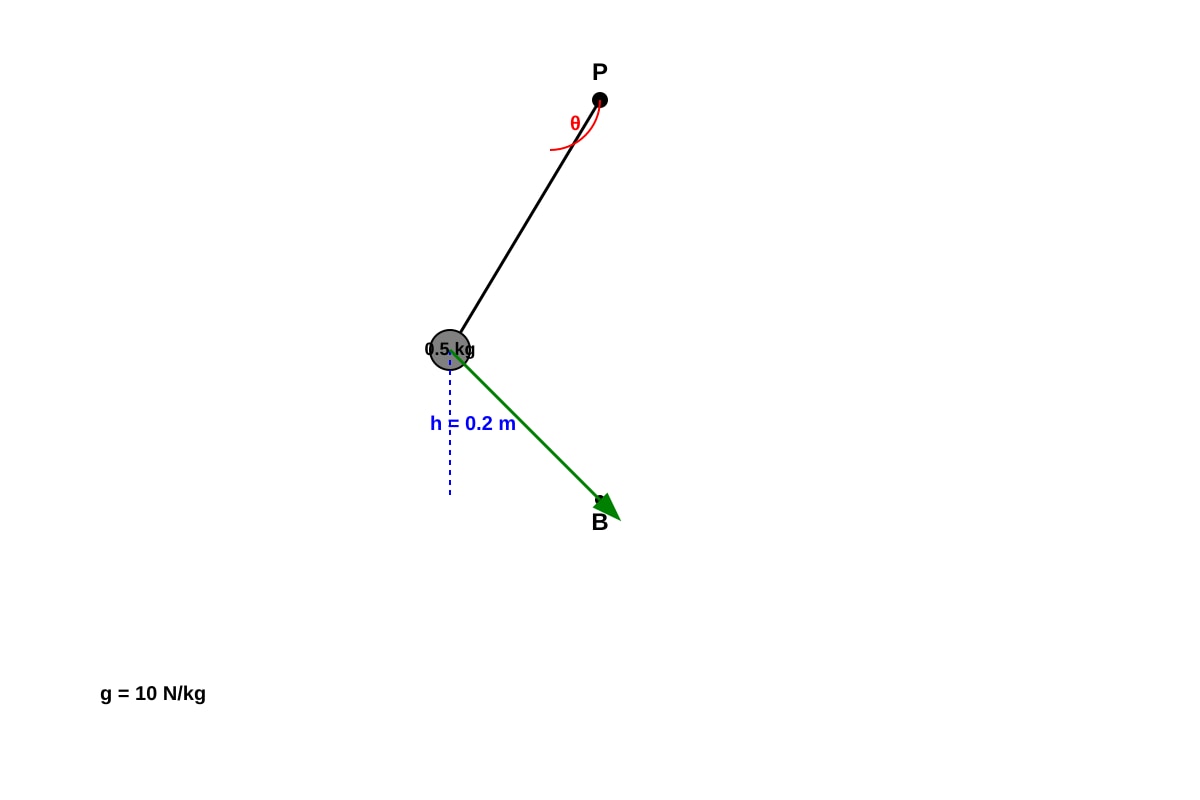
11. A pendulum bob of mass 0.5 kg is released from rest at a height of 0.2 m above its lowest position.

<image_placeholder> id: Q11-fig1 type: diagram linked_question: Q11 description: Simple pendulum showing bob at maximum displacement labels: pivot point P, string length L, bob mass 0.5 kg, vertical height h = 0.2 m from lowest point to current position, lowest point labelled B, angle of displacement θ shown values: mass = 0.5 kg, height h = 0.2 m, g = 10 N/kg must_show: the initial raised position, lowest position B, vertical height difference clearly marked, direction of motion indicated by arrow </image_placeholder>

(a) Calculate the gravitational potential energy of the bob relative to point B. (Take g=10 N/kgg = 10 \text{ N/kg})

___________________________________________________________________________ [2]

(b) Assuming negligible air resistance, calculate the maximum speed of the bob at point B.

___________________________________________________________________________ [2]


12. An electric kettle rated at 2.0 kW takes 3 minutes to boil water.

(a) Calculate the electrical energy supplied to the kettle, in joules.

___________________________________________________________________________ [2]

(b) If 15% of the energy is lost to the surroundings, calculate the useful energy transferred to the water.

___________________________________________________________________________ [2]


13. A hydroelectric power station converts the gravitational potential energy of water into electrical energy. Water falls from a height of 80 m at a rate of 500 kg per second.

(a) Calculate the gravitational potential energy lost by the water each second. (Take g=10 N/kgg = 10 \text{ N/kg})

___________________________________________________________________________ [2]

(b) If the overall efficiency of the power station is 60%, calculate the electrical power output.

___________________________________________________________________________ [2]


14. A 60 W filament lamp is left on for 5 hours.

(a) Calculate the energy consumed by the lamp, in kilowatt-hours (kWh).

___________________________________________________________________________ [2]

(b) If electricity costs $0.25 per kWh, calculate the cost of running the lamp for this period.

___________________________________________________________________________ [2]


Section C: Longer Structured Questions (Questions 15-20) [16 marks]

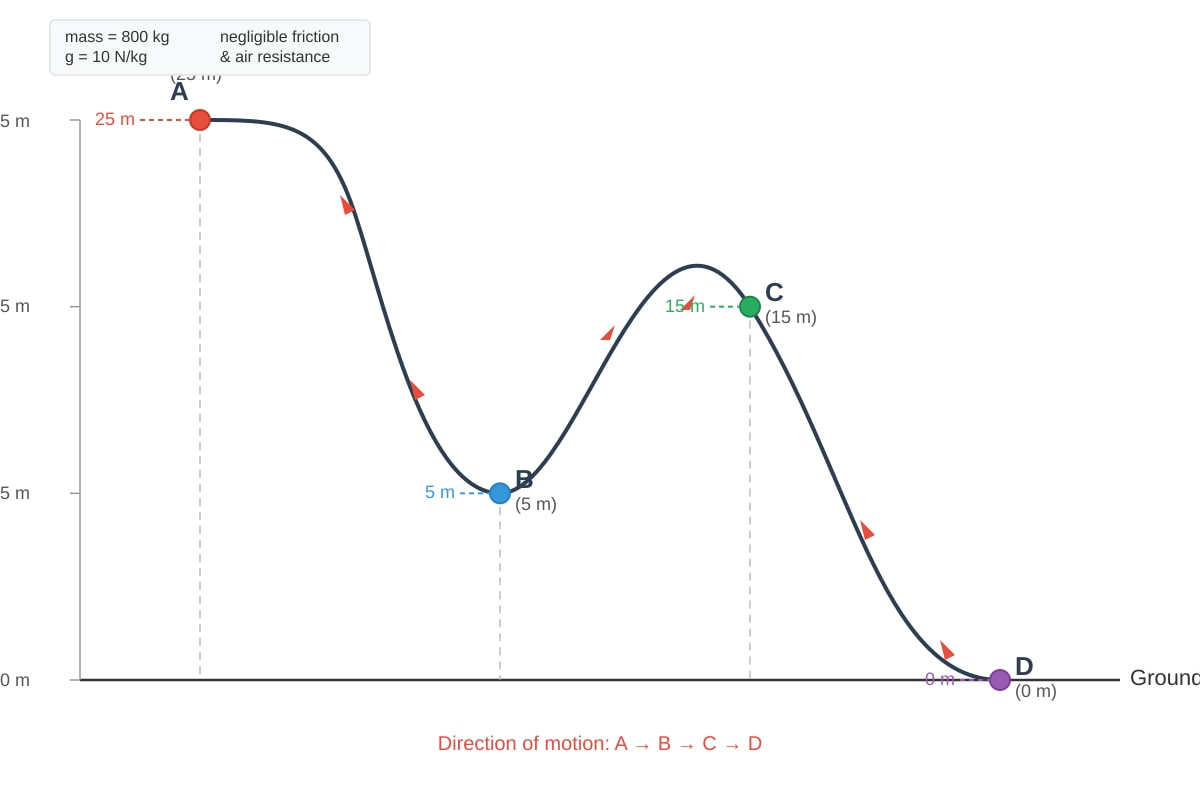
15. A roller coaster car of total mass 800 kg is released from rest at point A, which is 25 m above the ground. It descends to point B (5 m above ground), then rises to point C (15 m above ground). Point D is the lowest point at ground level. Assume negligible friction and air resistance.

<image_placeholder> id: Q15-fig1 type: diagram linked_question: Q15 description: Roller coaster track profile showing four points A, B, C, D at different heights labels: point A at top left (25 m), point B at middle right (5 m), point C at upper middle (15 m), point D at bottom (0 m), ground level horizontal reference line, vertical heights marked with dashed lines values: heights: A=25m, B=5m, C=15m, D=0m; mass = 800 kg; g = 10 N/kg must_show: all four labelled points, ground reference, height measurements clearly indicated, direction of motion from A to B to C to D shown with arrows </image_placeholder>

(a) Calculate the gravitational potential energy of the car at point A (relative to ground level). [2]

(b) Calculate the speed of the car at point B. [3]

(c) Explain why the car can reach point C even though it is higher than point B. [2]

(d) Calculate the maximum possible speed of the car (state at which point this occurs). [3]


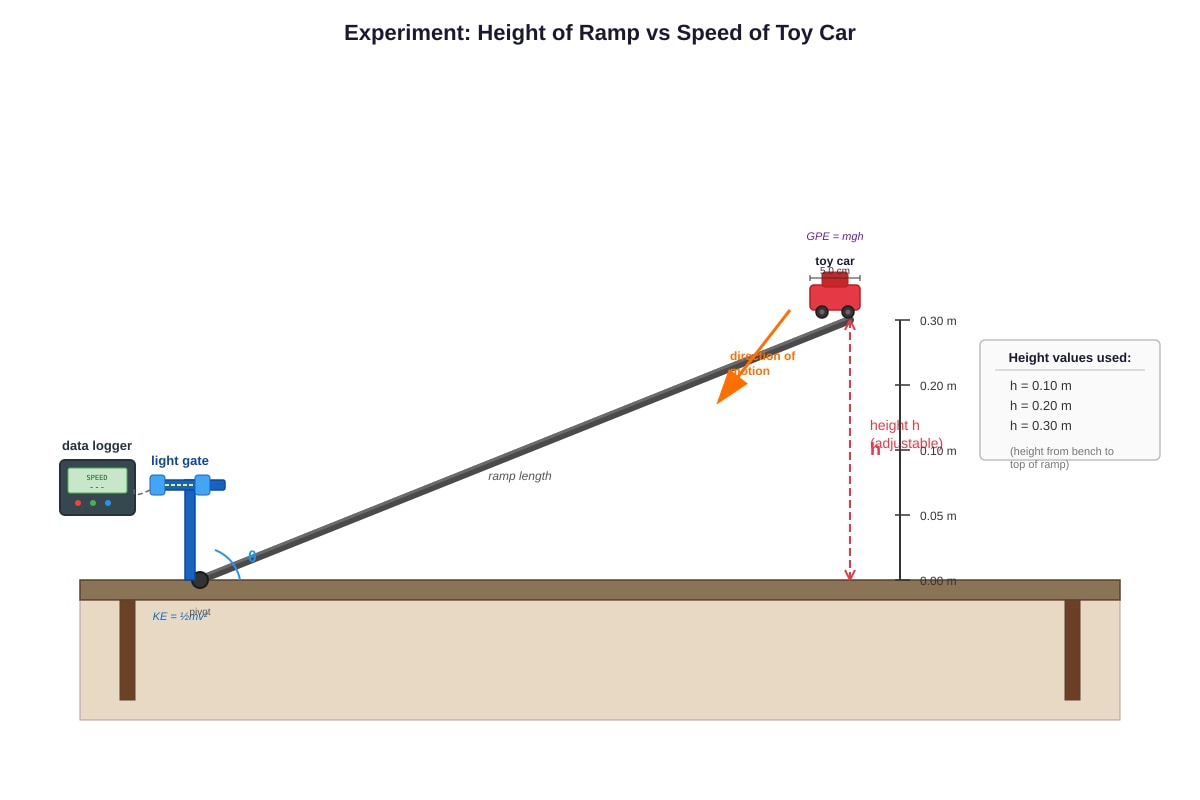
16. A student designs an experiment to investigate how the height of a ramp affects the speed of a toy car at the bottom.

<image_placeholder> id: Q16-fig1 type: experimental_setup linked_question: Q16 description: Toy car on ramp with measuring equipment labels: ramp with adjustable height h, toy car at top, light gate at bottom, data logger, measure of height h from bench to top of ramp values: height h can be varied (e.g. 0.10 m, 0.20 m, 0.30 m), length of toy car = 5.0 cm must_show: ramp angle θ, height h clearly marked, light gate positioned at bottom of ramp, toy car at starting position, direction of motion indicated </image_placeholder>

(a) State the independent variable, dependent variable, and one control variable in this experiment. [3]

(b) Using energy principles, explain why increasing the height of the ramp increases the speed of the car at the bottom. [2]

(c) The student finds that the measured speed is always slightly less than predicted by theory. Suggest two reasons for this. [2]


17. A wind turbine has blades that sweep out an area of 5000 m25000 \text{ m}^2. The kinetic energy of the air passing through this area per second is 7.5×10⁵ J7.5 \times 10^5 \text{ J}. The turbine converts this to electrical energy with an efficiency of 40%.

(a) Calculate the power output of the turbine. [2]

(b) On a particular day, the wind speed decreases by 20%. Explain why the power output decreases by more than 20%. (Hint: consider how kinetic energy depends on speed.) [3]


18. A falling object reaches terminal velocity.

(a) Explain what is meant by terminal velocity. [2]

(b) Describe the energy changes that occur as the object accelerates towards terminal velocity, and after it has reached terminal velocity. [3]


19. A pump is used to raise water from a well to a storage tank 12 m above the water surface. The pump raises 240 kg of water in 2 minutes.

(a) Calculate the increase in gravitational potential energy of the water. [2]

(b) Calculate the minimum power rating of the pump. [2]

(c) In practice, the pump must be rated at a higher power than this minimum. Suggest two reasons why. [2]


20. A car of mass 1200 kg is traveling at 20 m/s20 \text{ m/s}. The driver applies the brakes and the car comes to rest in a distance of 50 m.

(a) Calculate the initial kinetic energy of the car. [2]

(b) Calculate the average braking force. [2]

(c) Explain what happens to the kinetic energy of the car during braking. [2]

END OF QUIZ

Answers

<!-- TuitionGoWhere generation metadata: stage=5-1; model=moonshotai/kimi-k2.6:free; model_label=Kimi K2.6 Free; generated=2026-06-10; Sources: Stage 4-0 LLM templates, syllabus context, and Stage 2 evidence where available. -->

Secondary 3 Physics Quiz - Energy Power (Answer Key)

Total Marks: 40


Section A: Multiple Choice

1. B [1]

Explanation: Power is defined as the rate of doing work, and its SI unit is the watt (W), where 1 W=1 J/s1 \text{ W} = 1 \text{ J/s}. The joule (J) is the unit of energy or work, newton (N) is the unit of force, and kilogram (kg) is the unit of mass.


2. C [1]

Working:

  • Work done = gain in GPE = mgh=50×10×4=2000 Jmgh = 50 \times 10 \times 4 = 2000 \text{ J}
  • Power = work donetime=20008=250 W\frac{\text{work done}}{\text{time}} = \frac{2000}{8} = 250 \text{ W}

Common mistake: Forgetting to divide by time and selecting 2000 J (option D), or using incorrect formula.


3. B [1]

Explanation: A stretched spring stores elastic potential energy due to the deformation of its material. This is a form of potential energy that can be recovered when the spring returns to its original shape.


4. B [1]

Explanation: At the highest point, the ball momentarily comes to rest before falling back down, so its speed (and hence kinetic energy, which depends on speed) is zero. Its height is maximum, so its gravitational potential energy (mghmgh) is at its maximum value. Note: total mechanical energy is conserved (assuming no air resistance), so KE + GPE = constant.


5. C [1]

Working:

  • Useful work done = F×d=200×5=1000 JF \times d = 200 \times 5 = 1000 \text{ J}
  • Efficiency = 80% = 0.80, so: useful output = 0.80 × total input
  • Total electrical energy = 10000.80=1250 J\frac{1000}{0.80} = 1250 \text{ J}

Common mistake: Multiplying by efficiency instead of dividing, or assuming 100% efficiency.


6. B [1]

Explanation: Efficiency is always defined as the ratio of useful output to total input, expressed as a percentage. This reflects that real machines always have some energy losses (to friction, sound, heat, etc.).


7. A [1]

Explanation: In a battery-powered torch: the battery stores chemical energy → this is converted to electrical energy when the circuit is complete → the electrical energy is then converted to light energy (useful output) and thermal energy (wasted, as the bulb and circuit heat up).


8. C [1]

Working:

  • Original: E=12mv2E = \frac{1}{2}mv^2
  • New: Enew=12(m2)(2v)2=12×m2×4v2=12mv2×2=2EE_{new} = \frac{1}{2}\left(\frac{m}{2}\right)(2v)^2 = \frac{1}{2} \times \frac{m}{2} \times 4v^2 = \frac{1}{2}mv^2 \times 2 = 2E

Key insight: Kinetic energy depends on speed squared (v2v^2), so doubling speed increases KE by factor of 4, while halving mass halves it. Net effect: 4×12=24 \times \frac{1}{2} = 2.


Section B: Short Answer and Structured Questions

9. [2 marks]

Answer: Energy cannot be created or destroyed, but can only be converted from one form to another [1], or transferred from one body to another [1]. The total energy in an isolated system remains constant.

Teaching note: This is the fundamental principle underlying all energy calculations. Students should understand that "lost" energy is not destroyed but transferred to the surroundings (usually as thermal energy).


10. (a) [1 mark]

Answer: Power is defined as the rate of doing work, or P=WtP = \frac{W}{t} where WW is work done and tt is time taken. Equivalently, P=EtP = \frac{E}{t} for energy transferred.

(b) [2 marks]

Answer: Power = work done/time = force × distance/time = force × velocity [1]. For the same mass, the more powerful engine can do more work per unit time, meaning it can provide a greater driving force at a given speed, or achieve the same force in less time [1]. Alternatively: with greater power, more kinetic energy can be transferred to the car per second, resulting in greater acceleration (a=F/ma = F/m).


11. (a) [2 marks]

Working:

  • GPE = mghmgh [1 mark for formula]
  • GPE = 0.5×10×0.2=1.0 J0.5 \times 10 \times 0.2 = 1.0 \text{ J} [1 mark]

Teaching note: The zero of potential energy is arbitrary; here we define it at point B (lowest point).

(b) [2 marks]

Working:

  • By conservation of energy: loss in GPE = gain in KE
  • 12mv2=mgh\frac{1}{2}mv^2 = mgh [1 mark for energy conservation principle]
  • v=2gh=2×10×0.2=4=2.0 m/sv = \sqrt{2gh} = \sqrt{2 \times 10 \times 0.2} = \sqrt{4} = 2.0 \text{ m/s} [1 mark]

Alternative using (a): 12×0.5×v2=1.0\frac{1}{2} \times 0.5 \times v^2 = 1.0, so v2=4v^2 = 4, v=2.0 m/sv = 2.0 \text{ m/s}


12. (a) [2 marks]

Working:

  • P=2.0 kW=2000 WP = 2.0 \text{ kW} = 2000 \text{ W}; t=3 min=180 st = 3 \text{ min} = 180 \text{ s} [1 mark for unit conversion]
  • E=Pt=2000×180=360000 J=3.6×10⁵ JE = Pt = 2000 \times 180 = 360000 \text{ J} = 3.6 \times 10^5 \text{ J} [1 mark]

(b) [2 marks]

Working:

  • Energy lost = 15%×360000=54000 J15\% \times 360000 = 54000 \text{ J} [1 mark]
  • Useful energy = 36000054000=306000 J360000 - 54000 = 306000 \text{ J} [1 mark]

Alternative: Useful energy = 85%×360000=0.85×360000=306000 J85\% \times 360000 = 0.85 \times 360000 = 306000 \text{ J}


13. (a) [2 marks]

Working:

  • Mass flow rate = 500 kg/s500 \text{ kg/s}, so in 1 second, m=500 kgm = 500 \text{ kg}
  • GPE lost per second = mgh=500×10×80mgh = 500 \times 10 \times 80 [1 mark for formula]
  • =400000 J=4.0×10⁵ J= 400000 \text{ J} = 4.0 \times 10^5 \text{ J} [1 mark]

(b) [2 marks]

Working:

  • Power input = 4.0×10⁵ W4.0 \times 10^5 \text{ W} (since this is energy per second)
  • Efficiency = 60% = 0.60 [1 mark]
  • Electrical power output = 0.60×4.0×105=2.4×10⁵ W=240 kW0.60 \times 4.0 \times 10^5 = 2.4 \times 10^5 \text{ W} = 240 \text{ kW} [1 mark]

14. (a) [2 marks]

Working:

  • P=60 W=0.060 kWP = 60 \text{ W} = 0.060 \text{ kW}; t=5 ht = 5 \text{ h} [1 mark for unit conversion]
  • Energy = 0.060×5=0.30 kWh0.060 \times 5 = 0.30 \text{ kWh} [1 mark]

(b) [2 marks]

Working:

  • Cost = 0.30 \times 0.25 = \0.075$ [2 marks]

Or express as: 7.5 cents, or approximately $0.08 (2 d.p.)


Section C: Longer Structured Questions

15. (a) [2 marks]

Working:

  • GPE = mgh=800×10×25mgh = 800 \times 10 \times 25 [1 mark]
  • =200000 J=2.0×10⁵ J= 200000 \text{ J} = 2.0 \times 10^5 \text{ J} [1 mark]

(b) [3 marks]

Working:

  • By conservation of energy: loss in GPE from A to B = gain in KE at B
  • GPE at B = 800×10×5=40000 J800 \times 10 \times 5 = 40000 \text{ J} [1 mark]
  • KE at B = GPE at A − GPE at B = 20000040000=160000 J200000 - 40000 = 160000 \text{ J} [1 mark]
  • 12mv2=160000\frac{1}{2}mv^2 = 160000
  • v=2×160000800=400=20 m/sv = \sqrt{\frac{2 \times 160000}{800}} = \sqrt{400} = 20 \text{ m/s} [1 mark]

(c) [2 marks]

Answer: At point B, the car has kinetic energy (160000 J160000 \text{ J}). As it rises to C, some of this kinetic energy is converted to gravitational potential energy [1]. Since the total mechanical energy at B (160000 J160000 \text{ J} KE + 40000 J40000 \text{ J} GPE = 200000 J200000 \text{ J}) exceeds the GPE needed at C (800×10×15=120000 J800 \times 10 \times 15 = 120000 \text{ J}), the car retains enough kinetic energy to reach C [1]. Alternatively: by conservation of energy, since 200000 J>120000 J200000 \text{ J} > 120000 \text{ J}, the car still has 80000 J80000 \text{ J} of KE at C and continues moving.

(d) [3 marks]

Answer: Maximum speed occurs at point D (lowest point, ground level) [1 mark]

  • All GPE at A is converted to KE at D [1 mark]
  • 12×800×v2=200000\frac{1}{2} \times 800 \times v^2 = 200000
  • v=2×200000800=500=22.4 m/s (2 s.f.)v = \sqrt{\frac{2 \times 200000}{800}} = \sqrt{500} = 22.4 \text{ m/s (2 s.f.)} or 105 m/s10\sqrt{5} \text{ m/s} [1 mark]

16. (a) [3 marks]

Answer:

  • Independent variable: height of the ramp (hh) [1]
  • Dependent variable: speed of the car at the bottom (or time to travel down, from which speed is calculated) [1]
  • Control variable (any one): mass of the toy car, angle/surface of ramp, same starting position, same type of car [1]

(b) [2 marks]

Answer: Increasing the height increases the gravitational potential energy of the car at the top (ΔGPE=mgh\Delta GPE = mgh) [1]. By conservation of energy, this greater GPE is converted to more kinetic energy at the bottom (12mv2\frac{1}{2}mv^2), resulting in greater speed [1].

(c) [2 marks]

Answer: (Any two of:)

  • Friction between the car and the ramp [1]
  • Air resistance acting on the car [1]
  • Rotational kinetic energy of wheels not accounted for [1]
  • Energy losses due to sound/vibration [1]

17. (a) [2 marks]

Working:

  • Useful power output = efficiency × power input = 0.40×7.5×1050.40 \times 7.5 \times 10^5 [1 mark]
  • =3.0×10⁵ W=300 kW= 3.0 \times 10^5 \text{ W} = 300 \text{ kW} [1 mark]

(b) [3 marks]

Answer: Kinetic energy of moving air is 12mv2\frac{1}{2}mv^2, and since mass of air passing through per second also depends on speed (more air passes when speed is higher), the kinetic energy available is proportional to v3v^3 (cubed) [2 marks].

Reasoning: If speed decreases by 20%, new speed = 0.8v0.8v. Since power depends on v3v^3, new power (0.8)3=0.512\propto (0.8)^3 = 0.512, i.e., about 51% of original, so power decreases by about 49%, much more than 20% [1 mark].

Alternative explanation: The mass of air hitting blades per second decreases by 20%, and each unit of mass has 36% less KE (0.82=0.640.8^2 = 0.64), so total decreases by 0.8×0.64=0.5120.8 \times 0.64 = 0.512.


18. (a) [2 marks]

Answer: Terminal velocity is the constant maximum speed reached by a falling object [1] when the upward drag (air resistance) force equals the downward weight force, resulting in zero net force and therefore zero acceleration [1].

(b) [3 marks]

Answer:

  • As object accelerates: Gravitational potential energy is converted to kinetic energy [1], but also increasingly to thermal energy (and some sound) due to work done against air resistance [1]
  • At terminal velocity: GPE continues to be lost as the object falls, but speed (and hence KE) is constant [1]. Therefore all the lost GPE is converted to thermal energy in the air and the object; no further increase in KE.

19. (a) [2 marks]

Working:

  • ΔGPE=mgh=240×10×12\Delta GPE = mgh = 240 \times 10 \times 12 [1 mark]
  • =28800 J=2.88×10⁴ J= 28800 \text{ J} = 2.88 \times 10^4 \text{ J} [1 mark]

(b) [2 marks]

Working:

  • Minimum work done = 28800 J28800 \text{ J} (assuming 100% efficiency)
  • t=2 min=120 st = 2 \text{ min} = 120 \text{ s}
  • Minimum power = 28800120=240 W\frac{28800}{120} = 240 \text{ W} [2 marks, or 1 mark if time not converted]

(c) [2 marks]

Answer: (Any two of:)

  • The pump is not 100% efficient; some energy is wasted as heat/sound [1]
  • Friction in the pump mechanism requires additional energy [1]
  • Water may need to be accelerated, not just raised (kinetic energy as well as GPE) [1]
  • Some energy is lost to turbulence and viscous effects in the water [1]

20. (a) [2 marks]

Working:

  • KE=12mv2=12×1200×202KE = \frac{1}{2}mv^2 = \frac{1}{2} \times 1200 \times 20^2 [1 mark]
  • =600×400=240000 J=2.4×10⁵ J= 600 \times 400 = 240000 \text{ J} = 2.4 \times 10^5 \text{ J} [1 mark]

(b) [2 marks]

Working:

  • Work done by braking force = initial KE (object comes to rest)
  • F×d=12mv2F \times d = \frac{1}{2}mv^2
  • F×50=240000F \times 50 = 240000 [1 mark]
  • F=24000050=4800 NF = \frac{240000}{50} = 4800 \text{ N} [1 mark]

(c) [2 marks]

Answer: The kinetic energy is converted to other forms [1], primarily thermal energy (heat) in the brake discs/pads and tyres due to friction, and also some sound energy [1]. The total energy is conserved but becomes less useful (dissipated to surroundings).

Teaching note: Emphasize that "lost" energy means transferred to the thermal energy store of the environment—energy is never destroyed.


For Q11 and Q15 visual elements: The answer key assumes the diagrams show the heights and configurations as specified in the <image_placeholder> tags. Students should be able to answer from the values given in text; the diagrams are for confirmation and visualization.

END OF ANSWER KEY