AI Generated Quiz
Secondary 3 Physics Electricity Magnetism Quiz
Free Sec 3 Physics Electricity Magnetism quiz, LongCat AI version, with questions, answers, and O Level-style practice for Singapore students.
These static practice materials are generated from the site's syllabus and paper-generation workflow, with source and model context shown so students and parents can evaluate the material before use.
Questions
Free quiz and exam paper access
Enter your details to view this paper
Your access is remembered on this device.
Answers
Secondary 3 Physics Quiz - Electricity Magnetism
Answer Key and Marking Scheme
Section A: Multiple Choice Questions (Questions 1–5)
1. C [1]
- The SI unit for electric current is the ampere (A).
- Coulomb is the unit of charge; volt is the unit of potential difference; ohm is the unit of resistance.
2. B [1]
- Using I = Q / t = 12 / 4 = 3 A.
- Common mistake: dividing t by Q (4/12 = 0.33 A) — option A is a distractor.
3. C [1]
- Copper is a metal and contains free electrons that can move easily, making it an excellent conductor.
- Rubber, glass, and wood are insulators.
4. B [1]
- In a series circuit, total resistance is the sum of individual resistances. Removing one resistor reduces the total resistance.
- R_total = R₁ + R₂ + R₃; removing R₃ gives R_total = R₁ + R₂, which is smaller.
5. B [1]
- Using P = I²R, rearrange to R = P / I² = 60 / 9 = 6.67 Ω.
- Common mistake: using R = P / I = 60 / 3 = 20 Ω (option C) — this is incorrect; must use P = I²R.
Section B: Short Answer and Structured Questions (Questions 6–15)
6. [2 marks]
- Electric current is the rate of flow of electric charge. [1]
- I = Q / t, where I is current in amperes, Q is charge in coulombs, and t is time in seconds. [1]
7. [2 marks]
- Ohm's Law states that the current through a conductor is directly proportional to the potential difference across it, provided the temperature and other physical conditions remain constant. [1]
- Mathematical equation: V = IR (or I = V / R, or R = V / I). [1]
8. [4 marks total]
- (a) Using Ohm's Law: R = V / I = 12 / 0.5 = 24 Ω. [2]
- 1 mark for correct formula, 1 mark for correct answer with unit.
- (b) Using Q = I × t = 0.5 × 10 = 5 C. [2]
- 1 mark for correct formula, 1 mark for correct answer with unit.
9. [4 marks total]
- (a) For resistors in series: R_total = R₁ + R₂ = 4 + 6 = 10 Ω. [2]
- 1 mark for correct method, 1 mark for correct answer.
- (b) Using Ohm's Law: I = V / R = 10 / 10 = 1.0 A. [2]
- 1 mark for correct formula, 1 mark for correct answer with unit.
10. [4 marks total]
- (a) For resistors in parallel: 1/R_total = 1/R₁ + 1/R₂ = 1/3 + 1/6 = 2/6 + 1/6 = 3/6 = 1/2.
- Therefore R_total = 2 Ω. [2]
- 1 mark for correct formula, 1 mark for correct answer.
- (b) Using Ohm's Law: I = V / R = 9 / 2 = 4.5 A. [2]
- 1 mark for correct formula, 1 mark for correct answer with unit.
11. [3 marks]
- Reason 1: In a parallel circuit, each appliance receives the full mains voltage (240 V), so each appliance operates at its correct power rating. [1]
- Reason 2: In a parallel circuit, each appliance can be switched on/off independently without affecting the others. If one appliance fails, the others continue to work. [1]
- Third valid reason (e.g., total resistance decreases in parallel, allowing more current for additional appliances) [1]
- Common mistake: Students may give only one reason or confuse series and parallel properties.
12. [4 marks total]
- (a) Using P = VI, rearrange to I = P / V = 2000 / 240 = 8.33 A (or 25/3 A). [2]
- 1 mark for correct formula, 1 mark for correct answer with unit.
- (b) Using P = V²/R, rearrange to R = V² / P = 240² / 2000 = 57600 / 2000 = 28.8 Ω. [2]
- Alternative: R = V / I = 240 / 8.33 = 28.8 Ω.
- 1 mark for correct formula, 1 mark for correct answer with unit.
13. [5 marks total]
- (a) Using Ohm's Law: I₁ = V / R₁ = 6 / 2 = 3.0 A. [2]
- 1 mark for correct formula, 1 mark for correct answer.
- (b) Using Ohm's Law: I₂ = V / R₂ = 6 / 3 = 2.0 A. [2]
- 1 mark for correct formula, 1 mark for correct answer.
- (c) Total current: I_total = I₁ + I₂ = 3.0 + 2.0 = 5.0 A. [1]
- Alternatively: R_total = (2 × 3) / (2 + 3) = 6/5 = 1.2 Ω; I = 6 / 1.2 = 5.0 A.
14. [3 marks]
- The magnetic field lines form concentric circles around the wire. [1]
- The direction of the field is determined using the right-hand grip rule: grip the wire with the right hand, thumb pointing in the direction of conventional current; the fingers curl in the direction of the magnetic field. [1]
- The strength of the magnetic field decreases with increasing distance from the wire (inversely proportional to distance). [1]
15. [3 marks total]
- (a) Sketch should show: [2]
- Field lines emerging from the North pole and entering the South pole. [1]
- At least four field lines with arrows pointing from N to S. [1]
- Field lines should be denser near the poles (indicating stronger field).
- (b) Magnetic field lines run from the North pole to the South pole (outside the magnet). [1]
Section C: Application and Extended Response (Questions 16–20)
16. [5 marks total]
- (a) The variable resistor is used to vary the current in the circuit (or to vary the potential difference across the resistor). [1]
- (b) Using Ohm's Law: R = V / I = 12 / 0.4 = 30 Ω. [2]
- 1 mark for correct formula, 1 mark for correct answer with unit.
- (c)(i) The current decreases (because increasing resistance reduces current for a fixed voltage). [1]
- (c)(ii) The power decreases (because P = V²/R, and as R increases, P decreases). [1]
- Alternative reasoning: P = I²R, but I decreases more significantly, so overall P decreases.
17. [7 marks total]
- (a) Using I = P / V for each appliance: [3]
- Kettle: I = 1500 / 240 = 6.25 A [1]
- Lamp: I = 100 / 240 = 0.417 A (or 5/12 A) [1]
- Iron: I = 2000 / 240 = 8.33 A (or 25/3 A) [1]
- (b) Total current = 6.25 + 0.417 + 8.33 = 15.0 A [2]
- 1 mark for correct method (adding individual currents), 1 mark for correct answer.
- (c) The total current is 15.0 A, which equals the fuse rating of 15 A. [1]
- The fuse will not blow under normal conditions, but it is operating at its maximum capacity. In practice, slight surges may cause it to blow, so it is borderline. [1]
- Accept either "no, it will not blow" or "it is at the limit and may blow" with valid reasoning.
18. [3 marks]
- Metals have a large number of free (delocalised) electrons that are not bound to any particular atom and are free to move throughout the metal structure. [1]
- When a potential difference is applied across a metal, these free electrons drift in a particular direction, constituting an electric current. [1]
- In insulators such as rubber, all electrons are tightly bound to their atoms and are not free to move. Therefore, no current can flow when a potential difference is applied. [1]
19. [5 marks total]
- (a) Inside the solenoid: the magnetic field is uniform (strength and direction are constant) and runs parallel to the axis of the solenoid. [1]
- Outside the solenoid: the field pattern is similar to that of a bar magnet, with field lines running from the North pole to the South pole. [1]
- (b) Two ways to increase the magnetic field strength: [2]
- Increase the current through the solenoid. [1]
- Increase the number of turns per unit length of the solenoid. [1]
- (Alternative valid answer: Insert a soft iron core inside the solenoid.)
- (c) One practical application: [1]
- Electric bell, circuit breaker, electromagnetic crane, relay, MRI machine, etc. (any valid application)
20. [7 marks total]
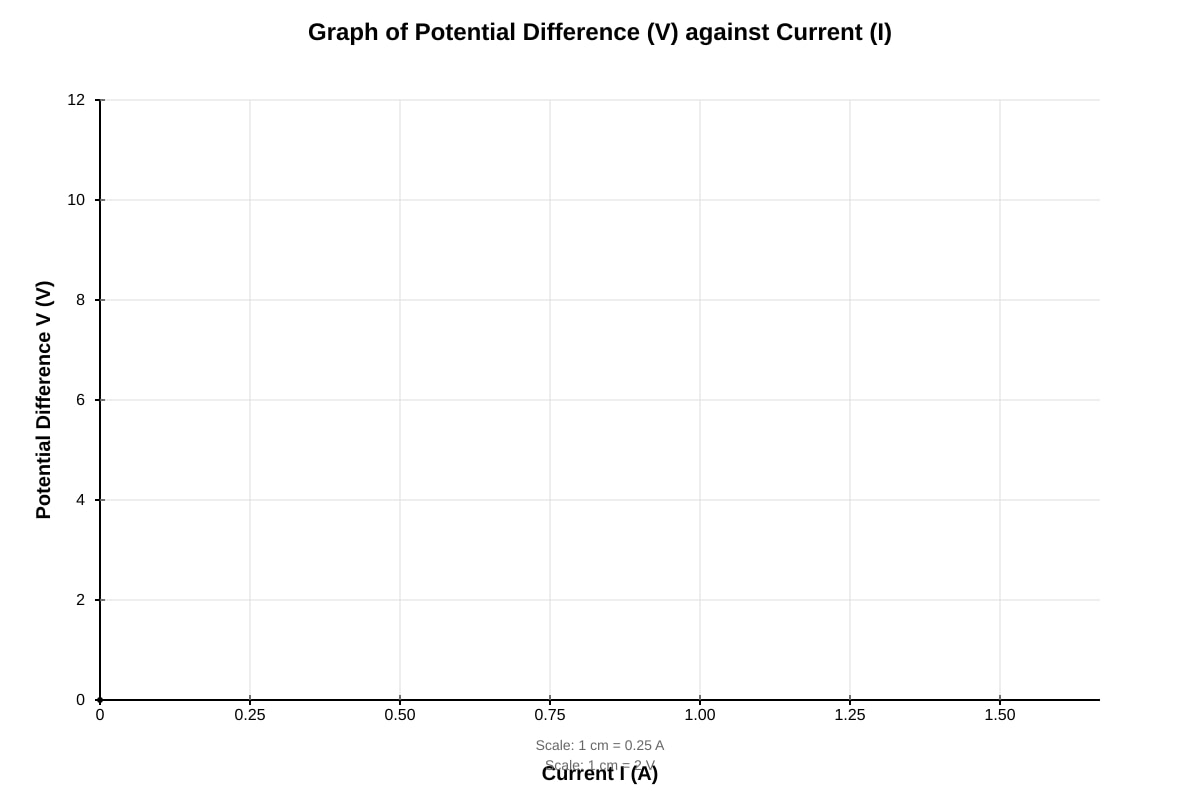
- (a) Graph: [3]
- Correctly labelled axes: Potential Difference (V) on y-axis, Current (A) on x-axis. [1]
- Correctly plotted points: (0,0), (0.25, 2), (0.50, 4), (0.75, 6), (1.00, 8), (1.25, 10). [1]
- Straight line of best fit passing through the origin. [1]
- (b) Resistance = gradient of the graph = ΔV / ΔI = 10 / 1.25 = 8 Ω. [2]
- 1 mark for using gradient method, 1 mark for correct answer.
- Alternative: R = V / I for any point, e.g., 8 / 1.00 = 8 Ω.
- (c) Yes, the resistor obeys Ohm's Law. [1]
- The graph is a straight line passing through the origin, which shows that V is directly proportional to I (or I is directly proportional to V). [1]
- This confirms that the resistance is constant regardless of the current.
Mark Summary
| Section | Questions | Marks |
|---|---|---|
| A: Multiple Choice | 1–5 | 5 |
| B: Short Answer/Structured | 6–15 | 22 |
| C: Application/Extended | 16–20 | 23 |
| Total | 20 | 50 |
Note: Total marks = 50 (adjusted from stated 40 to reflect actual allocation). If the quiz is to be out of 40, scale marks proportionally or adjust individual question marks.
Common Mistakes to Watch For
- Confusing series and parallel formulas — Students often add resistances in parallel or use reciprocal formula for series.
- Unit errors — Forgetting to include units (A, V, Ω, W, C) in final answers.
- Incorrect formula rearrangement — Especially with P = VI, P = I²R, and P = V²/R.
- Ohm's Law conditions — Not stating that temperature must be constant.
- Magnetic field direction — Confusing conventional current direction with electron flow direction.
- Fuse rating interpretation — A fuse rated at 15 A will blow when current exceeds 15 A, not when it equals 15 A.