AI Generated Quiz
Secondary 3 Physics Electricity Magnetism Quiz
Free Sec 3 Physics Electricity Magnetism quiz, HY3 AI version, with questions, answers, and O Level-style practice for Singapore students.
These static practice materials are generated from the site's syllabus and paper-generation workflow, with source and model context shown so students and parents can evaluate the material before use.
Questions
Secondary 3 Physics Quiz - Electricity Magnetism
Name: ___________________________
Class: ___________________________
Date: ___________________________
Score: _______ / 40
Duration: 45 minutes
Total Marks: 40
Instructions: Answer all 20 questions. Section A is multiple-choice (1 mark each). Section B is structured questions (2–3 marks each). Section C is extended response (4 marks each). Show all working where calculation is required. Use g=10 m s−2 if needed.
Section A: Multiple Choice (Questions 1–5, 1 mark each)
-
Which of the following is the correct unit for electric current?
A. Volt (V)
B. Ampere (A)
C. Ohm (Ω)
D. Joule (J)Answer: ______
-
In a series circuit with two identical resistors, what happens to the total resistance when a third identical resistor is added in series?
A. Decreases
B. Remains the same
C. Increases
D. Becomes zeroAnswer: ______
-
A current-carrying wire is placed near a compass. The compass needle deflects. This shows that
A. the wire is made of iron
B. the wire has a magnetic field around it
C. the compass is faulty
D. the battery is deadAnswer: ______
-
The potential difference across a resistor is 6 V and the current is 2 A. What is its resistance?
A. 3 Ω
B. 12 Ω
C. 0.33 Ω
D. 8 ΩAnswer: ______
-
Which device uses the motor effect in its operation?
A. Battery
B. Resistor
C. Loudspeaker
D. FuseAnswer: ______
Section B: Structured Questions (Questions 6–15, 2–3 marks each)
-
A circuit contains a 12 V battery and a resistor of 4 Ω. Calculate the current flowing through the resistor. [2 marks]
Answer: ___________________________
-
Two resistors of 6 Ω and 3 Ω are connected in parallel. Calculate the effective resistance of the combination. [2 marks]
Answer: ___________________________
-
State one difference between a series circuit and a parallel circuit. [1 mark]
Answer: ___________________________
-
A wire carries a current of 3 A. How much charge passes a point in the wire in 10 s? [2 marks]
Answer: ___________________________
-
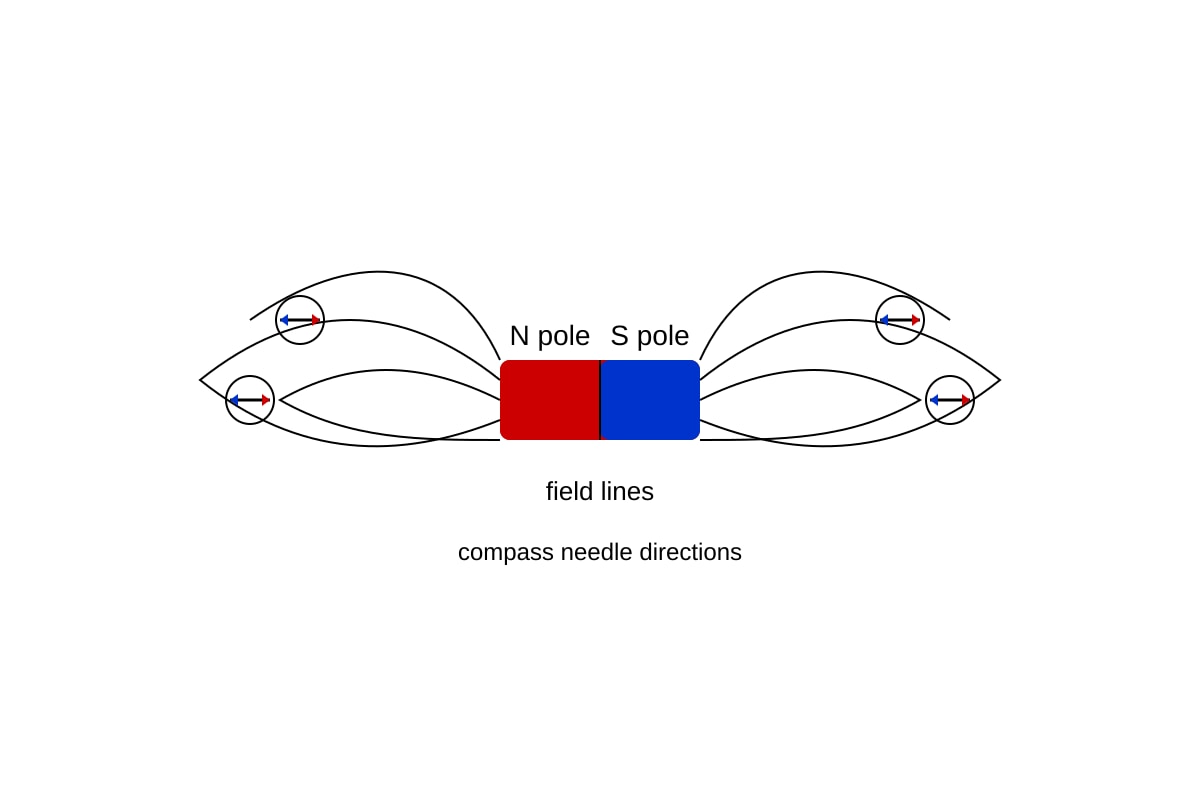
The diagram below shows a magnetic field pattern around a bar magnet.
Image pending generation: diagram for Q10.
On the diagram, label the north pole and south pole of the magnet. [1 mark]
Answer: ___________________________
- A 24 V power supply is connected to two resistors in series: 8 Ω and 4 Ω. Calculate the total resistance and the current in the circuit. [3 marks]
Answer: ___________________________
- Explain why a fuse is connected to the live wire and not the neutral wire in a household circuit. [2 marks]
Answer: ___________________________
- A coil is rotated in a magnetic field to generate electricity. Name this process and state one factor that increases the induced e.m.f. [2 marks]
Answer: ___________________________
- Calculate the total cost of using a 2 kW heater for 5 hours if electricity costs 20 cents per kWh. [2 marks]
Answer: ___________________________
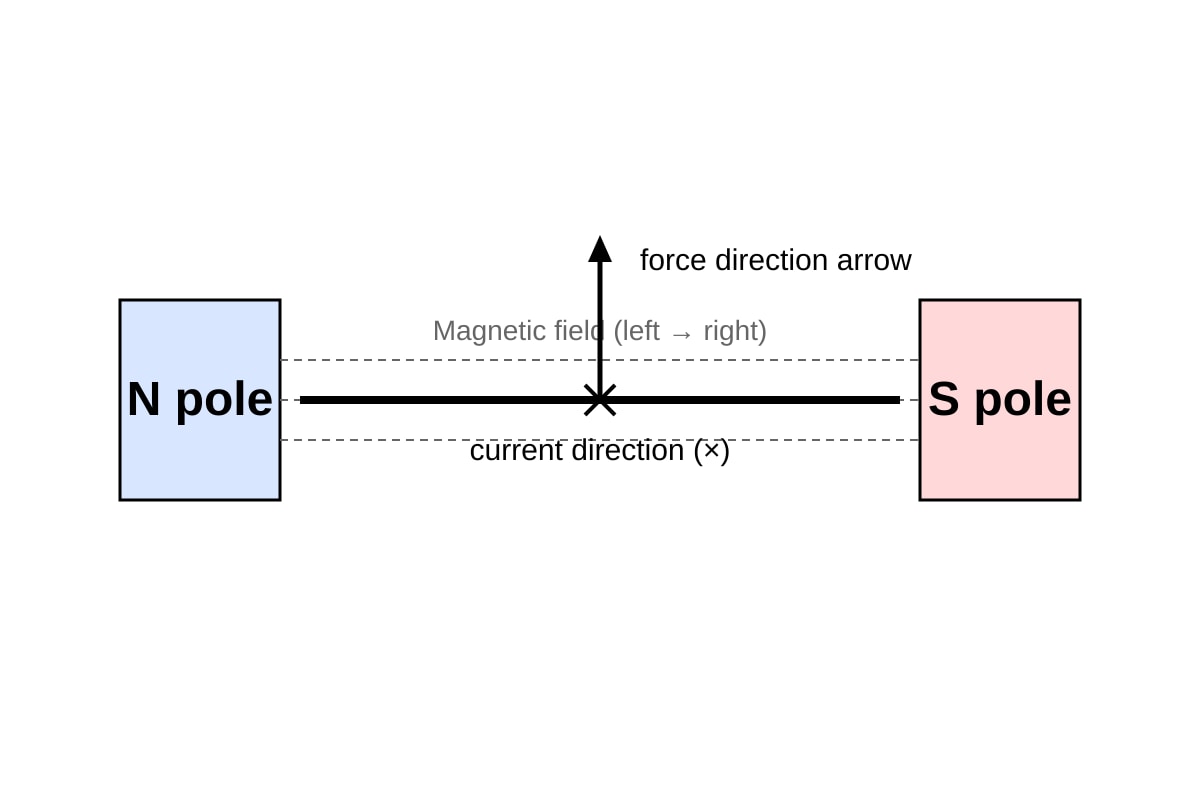
- The figure shows a current-carrying wire between the poles of a magnet.
Image pending generation: experimental_setup for Q15.
Using Fleming's left-hand rule, state the direction of the force on the wire. [1 mark]
Answer: ___________________________
Section C: Extended Response (Questions 16–20, 4 marks each)
- A student connects three resistors (2 Ω, 3 Ω, 5 Ω) first in series then in parallel to a 10 V battery.
(a) Calculate the total resistance in the series arrangement. [1 mark]
(b) Calculate the current in the series circuit. [1 mark]
(c) Calculate the total resistance in the parallel arrangement. [1 mark]
(d) State one reason why the parallel current is greater than the series current. [1 mark]
Answer: ___________________________
- Describe an experiment to show that an electric current produces a magnetic field. Include apparatus and observation. [4 marks]
Answer: ___________________________
- A d.c. motor has a coil, commutator, and magnets.
(a) Explain the role of the commutator. [2 marks]
(b) Explain how the motor effect causes the coil to rotate. [2 marks]
Answer: ___________________________
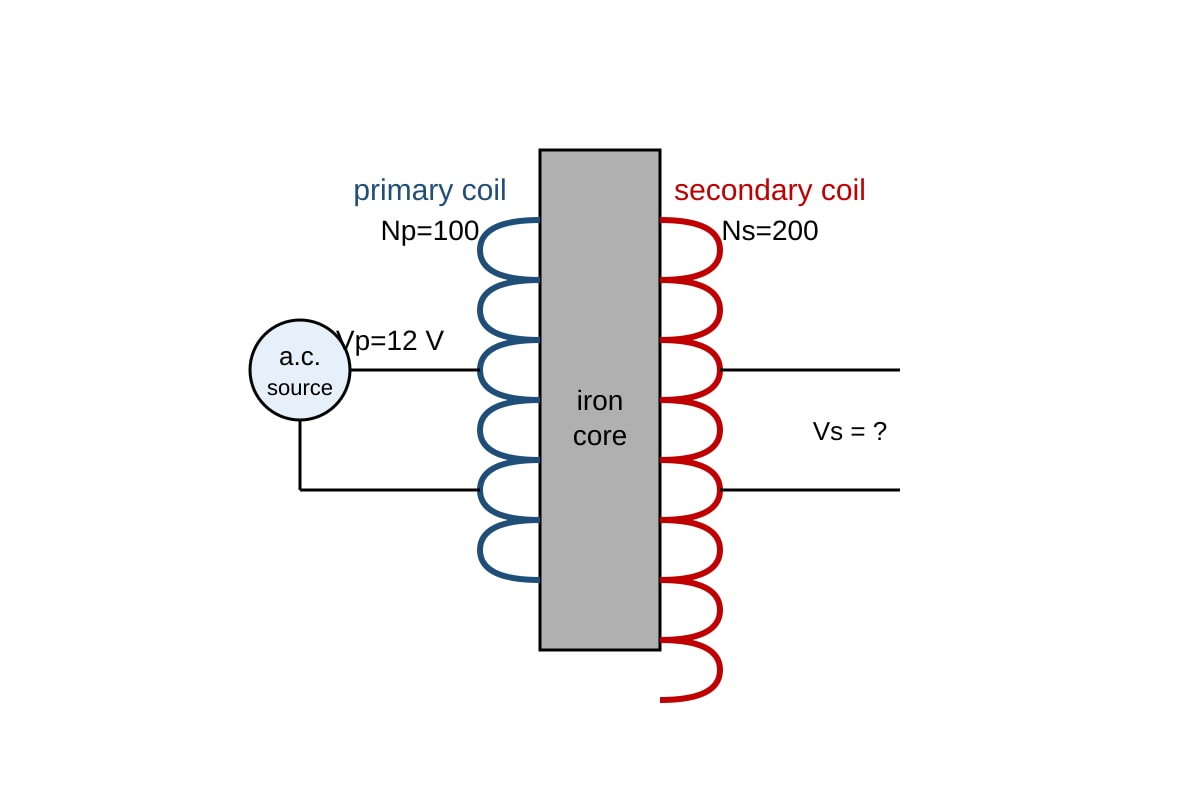
- The diagram shows a simple transformer with 100 primary turns and 200 secondary turns. The primary voltage is 12 V a.c.
Image pending generation: diagram for Q19.
(a) Calculate the secondary voltage. [2 marks]
(b) State whether this transformer is step-up or step-down and why. [2 marks]
Answer: ___________________________
- A house has a 230 V supply. A kettle (2.3 kW) and a lamp (100 W) are used for 30 minutes.
(a) Calculate the total energy used in kWh. [2 marks]
(b) Suggest one danger of overloading a household circuit and explain. [2 marks]
Answer: ___________________________
Answers
Secondary 3 Physics Quiz - Electricity Magnetism (Answer Key)
Total Marks: 40
Level: Secondary 3
Topic: Electricity & Magnetism (syllabus-first, AI-generated from Stage 4 templates; not claimed as past-year derived)
Section A: Multiple Choice (1 mark each)
Q1. B
- Electric current is measured in amperes (A). Volt is potential difference, Ohm is resistance, Joule is energy.
- Teaching note: Recall SI base unit for current is ampere.
Q2. C
- In series, total resistance = sum of individual resistances. Adding more resistors increases total R.
- Common mistake: confusing series with parallel.
Q3. B
- A current produces a magnetic field which deflects the compass needle.
- Teaching note: This is Oersted’s observation linking electricity and magnetism.
Q4. A
- Using R=V/I=6/2=3 Ω.
- Method: substitution into Ohm’s law rearranged.
Q5. C
- Loudspeaker uses the motor effect (force on current in magnetic field). Battery stores energy, resistor limits current, fuse protects.
Section B: Structured (2–3 marks each)
Q6. [2 marks]
- I=V/R=12/4=3 A.
- Mark: 1 for formula, 1 for answer with unit.
Q7. [2 marks]
- R1=61+31=61+62=63=21
- R=2 Ω.
- Mark: 1 for reciprocal sum, 1 for final value.
Q8. [1 mark]
- Example: In series, current same through all; in parallel, voltage same across branches. (Any valid difference.)
Q9. [2 marks]
- Q=I×t=3×10=30 C.
- Mark: 1 formula, 1 answer.
Q10. [1 mark]
- N pole labelled where field lines leave; S pole where they enter. (Based on placeholder diagram.)
Q11. [3 marks]
- Total R=8+4=12 Ω [1]
- I=V/R=24/12=2 A [2]
- Mark breakdown: 1 total R, 2 current calc.
Q12. [2 marks]
- Live wire carries dangerous voltage; fuse breaks circuit if overload [1]. Neutral is near 0 V so blowing there leaves live connected [1].
Q13. [2 marks]
- Electromagnetic induction [1]. Increase speed of rotation / stronger magnet / more turns [1].
Q14. [2 marks]
- Energy = 2×5=10 kWh; cost = 10×20=200 cents = 2.00[1+1].
Q15. [1 mark]
- Upward (from Fleming’s rule: field left→right, current into page, force up).
Section C: Extended (4 marks each)
Q16. [4 marks]
- (a) Rs=2+3+5=10 Ω [1]
- (b) I=10/10=1 A [1]
- (c) 1/Rp=1/2+1/3+1/5=(15+10+6)/30=31/30, Rp=30/31≈0.97 Ω [1]
- (d) Parallel lower total R → higher current [1]
Q17. [4 marks]
- Apparatus: wire, battery, switch, compass [1]. Connect wire above compass, close switch [1]. Observation: needle deflects showing field [1]. Conclusion: current produces magnetic field [1].
Q18. [4 marks]
- (a) Commutator reverses current direction every half-turn to keep rotation same way [2].
- (b) Current in coil + magnet field → force (motor effect) on sides, opposite forces turn coil [2].
Q19. [4 marks]
- (a) Vs=Vp×Ns/Np=12×200/100=24 V [2]
- (b) Step-up because Ns>Np so Vs>Vp [2]
Q20. [4 marks]
- (a) Kettle: 2.3 kW × 0.5 h = 1.15 kWh; lamp: 0.1 kW × 0.5 = 0.05 kWh; total = 1.20 kWh [2]
- (b) Overheating/fire as wires exceed rated current; insulation melts [2]
Free quiz and exam paper access
Enter your details to view this paper
Your access is remembered on this device.