AI Generated Quiz
Secondary 3 Physics Electricity Magnetism Quiz
Free Sec 3 Physics Electricity Magnetism quiz, DeepSeek AI version, with questions, answers, and O Level-style practice for Singapore students.
These static practice materials are generated from the site's syllabus and paper-generation workflow, with source and model context shown so students and parents can evaluate the material before use.
Questions
Free quiz and exam paper access
Enter your details to view this paper
Your access is remembered on this device.
Answers
Secondary 3 Physics Quiz - Electricity Magnetism — Answer Key
Total Marks: 40
Section A: Static Electricity and Electric Fields (Questions 1–4)
1. (a) Answer: When the polythene rod is rubbed with the woollen cloth, electrons are transferred from the cloth to the rod [1 mark]. The rod gains excess electrons and therefore becomes negatively charged [1 mark].
(b) Answer: The woollen cloth becomes positively charged [½ mark] because it has lost electrons to the rod, leaving it with a deficit of electrons (more protons than electrons) [½ mark].
2. (a) Answer: Sphere B (uncharged) is attracted towards sphere A [1 mark]. This occurs because the positive charge on sphere A repels the positive nuclei in sphere B and attracts the free electrons in sphere B towards the side nearest A (electrostatic induction). The side of sphere B nearest A becomes negatively charged, resulting in a net attractive force [1 mark].
(b) Answer: When they touch, electrons flow from sphere B to sphere A to neutralise some of the positive charge [1 mark]. After separation, both spheres carry the same sign of charge (positive) and share the total charge equally since they are identical. Each sphere ends up with half the original positive charge [1 mark].
3. (a) Answer: [Radial field lines pointing outward from the positive charge, with arrows directed away from the charge. Lines should be symmetric and evenly spaced around the charge.] [1 mark for correct pattern with outward arrows]
(b) Answer: [Field lines starting from the positive charge and ending on the negative charge. Lines curve from positive to negative, forming a dipole pattern. Arrows point from positive to negative.] [1 mark for correct dipole pattern]
4. Answer: The error is that an electric field is a region where an electric charge experiences a force, not a mass [½ mark]. Correct definition: An electric field is a region of space in which an electric charge experiences an electric force [½ mark].
Section B: Current, Voltage, and Resistance (Questions 5–8)
5. Answer: Electric current is the rate of flow of electric charge [1 mark]. Its SI unit is the ampere (A) [1 mark].
6. (a) Answer:
I = Q / t [½ mark]
t = 2 × 60 = 120 s [½ mark]
I = 48 / 120 = 0.40 A [1 mark]
(b) Answer:
V = W / Q, so W = V × Q [½ mark]
W = 6 × 48 [½ mark]
= 288 J [1 mark]
7. (a) Answer: Resistance is the ratio of the potential difference across a conductor to the current flowing through it. It is a measure of the opposition to current flow. [1 mark]
(b) Answer: The resistance will be greater than 3.4 Ω [½ mark].
Resistance R = ρL/A. Doubling the length doubles the resistance (R ∝ L). Halving the cross-sectional area also doubles the resistance (R ∝ 1/A). The combined effect is 2 × 2 = 4 times the original resistance [1 mark]. Therefore, R = 4 × 3.4 = 13.6 Ω [½ mark].
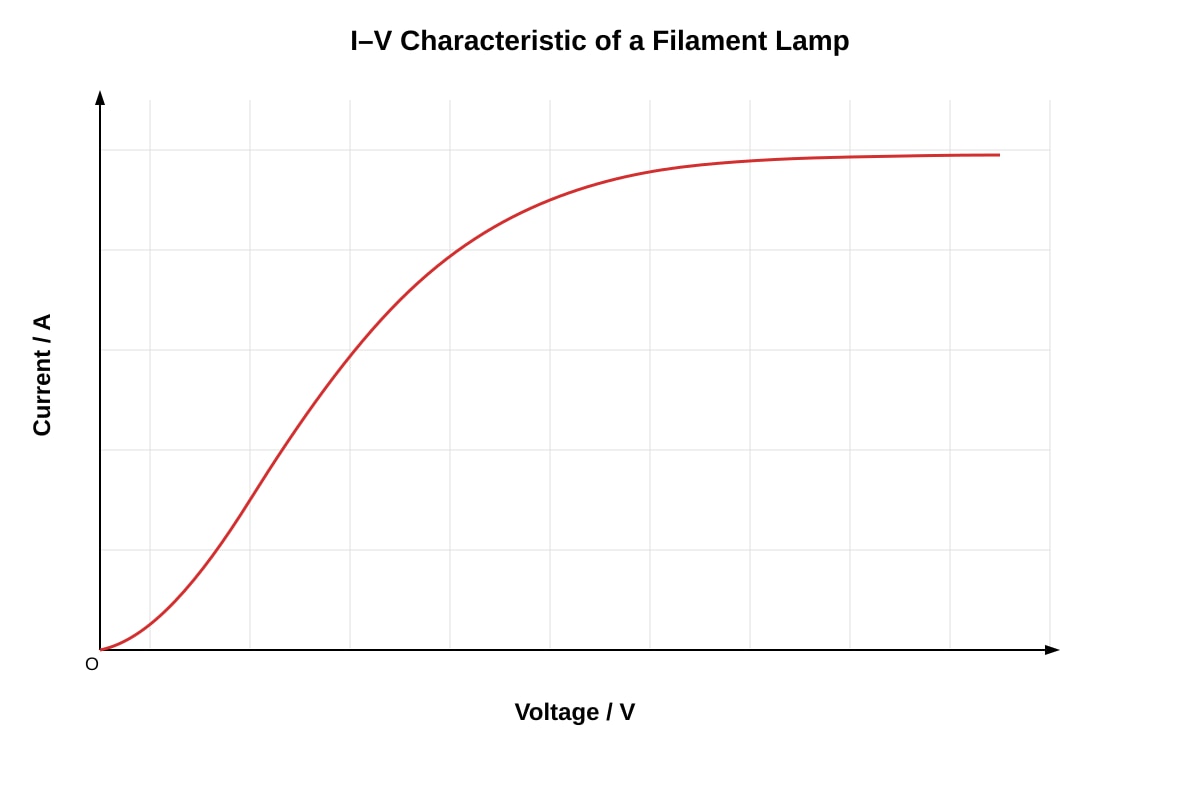
8. (a) Answer: The resistance of the filament lamp increases as the voltage increases. [1 mark]
(b) Answer: As the voltage (and hence current) increases, the filament gets hotter [½ mark]. The increased temperature causes the metal ions in the filament to vibrate more vigorously [½ mark]. This increased vibration makes it more difficult for the free electrons to flow through the filament, as they collide more frequently with the vibrating ions [½ mark]. This increased opposition to current flow means the resistance increases [½ mark].
Section C: D.C. Circuits (Questions 9–11)
9. (a) Answer:
For parallel resistors: 1/R_total = 1/R₁ + 1/R₂ + 1/R₃ [½ mark]
1/R_total = 1/2 + 1/3 + 1/6 = 3/6 + 2/6 + 1/6 = 6/6 = 1 [½ mark]
R_total = 1 Ω [1 mark]
(b) Answer:
I_total = V / R_total = 12 / 1 = 12 A [1 mark]
(c) Answer:
In parallel, voltage across each resistor = 12 V [½ mark]
I₃ = V / R₃ = 12 / 3 = 4 A [½ mark]
10. (a) Answer: [Circuit diagram showing a battery (10 V) with two resistors R₁ (4 kΩ) and R₂ (6 kΩ) in series. V_out is labelled as the voltage across R₂, with output terminals connected across R₂.] [2 marks for correct diagram with all labels]
(b) Answer:
V_out = V_supply × [R₂ / (R₁ + R₂)] [1 mark]
V_out = 10 × [6 / (4 + 6)] = 10 × (6/10) = 6 V [1 mark]
11. Answer: In a series circuit, if one lamp goes out (e.g., the filament breaks), the circuit is broken and current cannot flow, so all lamps would go out [1 mark]. The observation that one lamp remains lit indicates that there is still a complete path for current through that lamp, which is only possible if the lamps are connected in parallel, providing independent current paths [1 mark].
Section D: Magnetism and Electromagnetism (Questions 12–15)
12. (a) Answer: [Sketch showing a bar magnet with field lines emerging from the north pole, curving around, and entering the south pole. Lines are closer together near the poles (stronger field) and spread out further away. Arrows point from N to S outside the magnet.] [2 marks for correct pattern with poles labelled]
(b) Answer: Iron filings are small pieces of ferromagnetic material. When placed in a magnetic field, each filing becomes an induced magnet [½ mark]. The filings align themselves along the field lines because they experience a torque that rotates them until they are parallel to the local field direction, minimising their potential energy in the field [½ mark].
13. (a) Answer: The compass needle deflects from its north–south alignment and points in a direction tangential to the circular magnetic field around the wire. When the current is switched off, the needle returns to pointing north–south. [1 mark]
(b) Answer: The Right-Hand Grip Rule. [1 mark]
14. (a) Answer: Any two of: [1 mark each, max 2 marks]
- The magnitude of the current flowing through the conductor
- The strength of the magnetic field (magnetic flux density)
- The length of the conductor within the magnetic field
- The angle between the conductor and the magnetic field (force is maximum when perpendicular)
(b) Answer: Fleming's Left-Hand Rule. [1 mark]
15. Answer: Soft iron is a magnetically soft material, meaning it is easily magnetised and easily demagnetised [1 mark]. When the current in the electromagnet is switched off, the soft iron core loses most of its magnetism quickly. Steel is magnetically hard, meaning it retains magnetism after the current is removed, which is undesirable for an electromagnet that needs to be switched on and off [1 mark].
Section E: Electromagnetic Induction (Questions 16–20)
16. (a) Answer: The galvanometer pointer deflects to one side (e.g., to the right) as the magnet enters the coil, indicating an induced current. When the magnet stops moving, the pointer returns to zero. [1 mark]
(b) Answer: As the magnet moves into the coil, the magnetic flux (magnetic field lines) passing through the coil changes [1 mark]. According to Faraday's law of electromagnetic induction, a changing magnetic flux through a coil induces an electromotive force (e.m.f.), which drives a current through the circuit. The direction of the induced current is such that it opposes the change in magnetic flux (Lenz's law) [1 mark].
17. Answer: Any two of: [1 mark each, max 2 marks]
- Increase the speed of relative motion between the magnet and coil
- Use a stronger magnet (increase magnetic field strength)
- Increase the number of turns on the coil
- Insert a soft iron core into the coil to concentrate the magnetic flux
18. (a) Answer:
V_s / V_p = N_s / N_p [½ mark]
V_s / 240 = 50 / 200 [½ mark]
V_s = 240 × (50/200) = 240 × 0.25 [½ mark]
V_s = 60 V [½ mark]
(b) Answer: This is a step-down transformer [½ mark] because the secondary voltage (60 V) is less than the primary voltage (240 V), and the number of secondary turns is less than the number of primary turns [½ mark].
19. Answer: A transformer operates on the principle of electromagnetic induction, which requires a changing magnetic flux to induce an e.m.f. in the secondary coil [1 mark]. An alternating current in the primary coil produces a continuously changing magnetic field, which induces an e.m.f. in the secondary coil. A direct current produces a steady magnetic field with no change in flux, so no e.m.f. is induced in the secondary coil [1 mark].
20. Answer: [2 marks for each loss with explanation of minimisation, max 4 marks]
Loss 1: Heating of coils (copper losses / I²R losses) [1 mark]
Current flowing through the resistance of the copper windings generates heat. This can be minimised by using thicker copper wire to reduce the resistance of the coils [1 mark].
Loss 2: Eddy currents in the iron core [1 mark]
Changing magnetic fields induce circulating currents in the iron core, which dissipate energy as heat. This can be minimised by laminating the core — building it from thin sheets of iron insulated from each other, which restricts the paths available for eddy currents [1 mark].
Alternative acceptable answers:
- Hysteresis loss: Energy is lost in repeatedly magnetising and demagnetising the core. Minimised by using a magnetically soft material (e.g., soft iron) for the core.
- Flux leakage: Not all magnetic flux from the primary coil links with the secondary coil. Minimised by winding the secondary coil directly over the primary coil or using a more efficient core design.
END OF ANSWER KEY