From Real Exams Quiz
Secondary 3 Physics Waves Sound Light Quiz
Free Sec 3 Physics Waves Sound Light quiz, Nemo3 Exam version, with questions, answers, and O Level-style practice for Singapore students.
These static practice materials are generated from the site's syllabus and paper-generation workflow, with source and model context shown so students and parents can evaluate the material before use.
Questions
Secondary 3 Physics Quiz - Waves Sound Light
Name: ___________________________
Class: ___________________________
Date: ___________________________
Score: _____ / 40
Duration: 45 minutes
Total Marks: 40
Instructions:
- Answer all questions.
- Write your answers in the spaces provided.
- For calculation questions, show your working clearly.
- Use where needed.
- The speed of sound in air is unless otherwise stated.
- The speed of light in vacuum/air is .
Section A: Multiple Choice Questions (10 marks)
Answer all questions. Choose the correct option and write the letter (A, B, C, or D) in the box provided.
1. Which of the following statements about transverse and longitudinal waves is correct? [1]
A. Transverse waves require a medium to travel, but longitudinal waves do not.
B. In a longitudinal wave, particles vibrate perpendicular to the direction of wave travel.
C. Sound waves in air are longitudinal waves.
D. Light waves are longitudinal waves.
☐
2. A wave has a frequency of 250 Hz and a wavelength of 1.2 m. What is the speed of the wave? [1]
A. 208 m/s
B. 300 m/s
C. 340 m/s
D. 420 m/s
☐
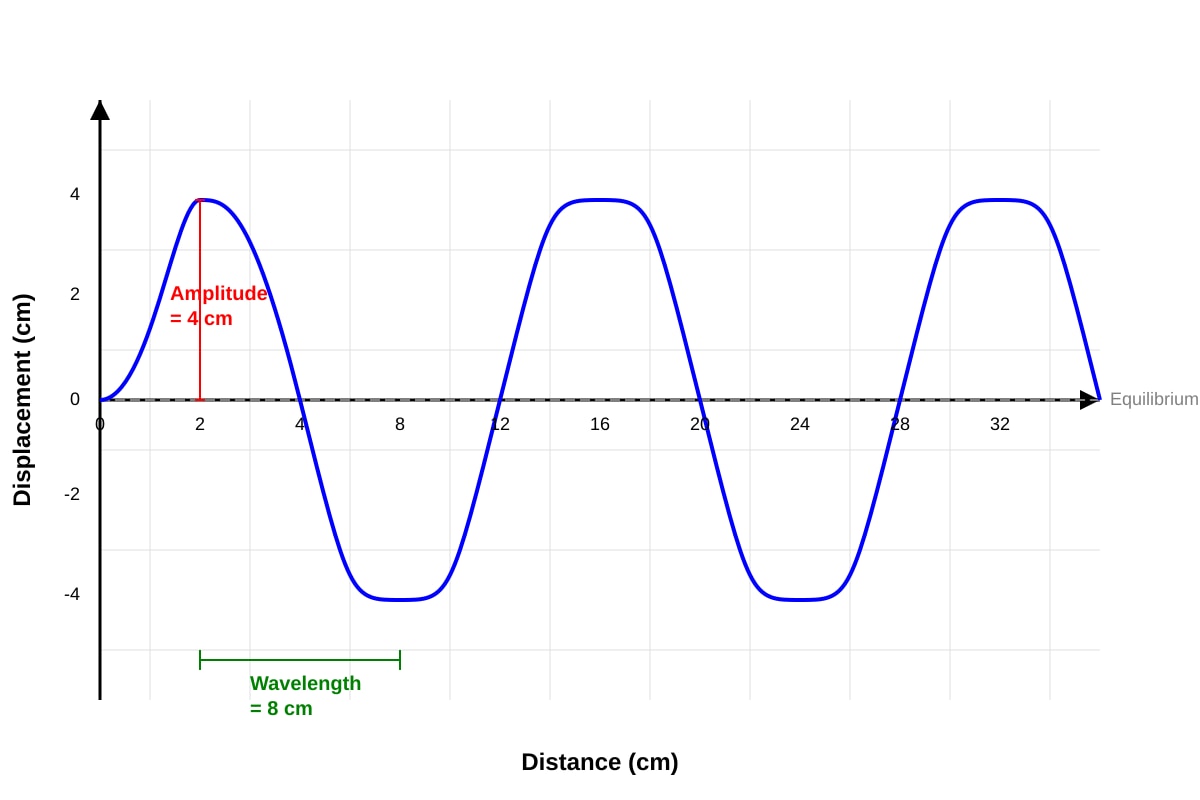
3. The diagram below shows a displacement-distance graph of a wave at a particular instant.
<image_placeholder> id: Q3-fig1 type: graph linked_question: Q3 description: Displacement-distance graph of a transverse wave showing a sine wave with amplitude 4 cm, wavelength 8 cm, and equilibrium line marked. X-axis labelled 'Distance (cm)', Y-axis labelled 'Displacement (cm)'. labels: Amplitude = 4 cm, Wavelength = 8 cm, Equilibrium line values: Amplitude = 4 cm, Wavelength = 8 cm must_show: Sine wave shape with clear peaks and troughs, labelled axes with units, amplitude and wavelength indicated </image_placeholder>
What is the amplitude of the wave? [1]
A. 2 cm
B. 4 cm
C. 8 cm
D. 16 cm
☐
4. Sound travels fastest in which of the following media? [1]
A. Air at 0°C
B. Water at 20°C
C. Steel at 20°C
D. Vacuum
☐
5. A student stands 170 m from a cliff and shouts. She hears the echo after 1.0 s. What is the speed of sound in air based on this measurement? [1]
A. 170 m/s
B. 340 m/s
C. 510 m/s
D. 680 m/s
☐
6. Which of the following electromagnetic waves has the shortest wavelength? [1]
A. Radio waves
B. Microwaves
C. Infrared radiation
D. Gamma rays
☐
7. Light travels from air into a glass block. Which of the following statements is correct? [1]
A. The speed of light increases.
B. The frequency of light increases.
C. The wavelength of light decreases.
D. The light ray bends away from the normal.
☐
8. The critical angle for a glass-air boundary is 42°. A ray of light in glass strikes the boundary at an angle of incidence of 50°. What happens to the ray? [1]
A. It refracts out into the air at an angle of refraction greater than 50°.
B. It refracts out into the air at an angle of refraction less than 50°.
C. It undergoes total internal reflection.
D. It is absorbed by the glass.
☐
9. A convex lens has a focal length of 10 cm. An object is placed 30 cm from the lens. What is the nature of the image formed? [1]
A. Real, inverted, magnified
B. Real, inverted, diminished
C. Virtual, upright, magnified
D. Virtual, upright, diminished
☐
10. Which of the following is a common use of infrared radiation? [1]
A. Sterilising medical equipment
B. Satellite communication
C. Thermal imaging cameras
D. X-ray photography
☐
Section B: Structured Questions (18 marks)
Answer all questions in the spaces provided.
11. (a) Define the term wavefront. [1]
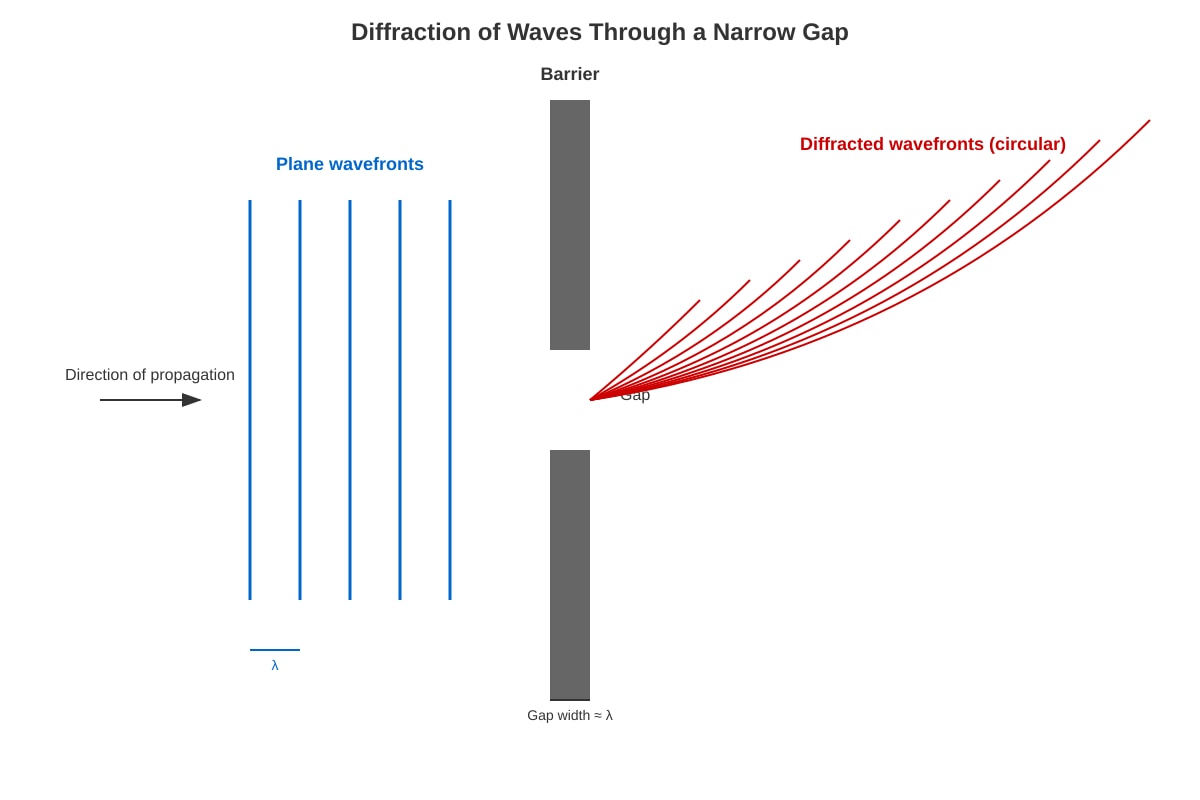
(b) The diagram below shows plane wavefronts approaching a gap in a barrier.
<image_placeholder> id: Q11-fig1 type: diagram linked_question: Q11 description: Diagram showing plane wavefronts (parallel straight lines) approaching a narrow gap in a barrier. The gap width is approximately equal to the wavelength. Wavefronts after the gap should show circular diffraction pattern spreading out. labels: Plane wavefronts, Barrier, Gap, Diffracted wavefronts (circular), Direction of propagation values: Gap width ≈ wavelength must_show: Parallel straight lines before gap, circular wavefronts spreading after gap, barrier with gap clearly shown, direction arrows </image_placeholder>
On the diagram, draw the wavefronts after they pass through the gap. [2]
(c) State what happens to the amount of diffraction if the gap is made wider. [1]
12. A ship sends out a pulse of ultrasound and detects the echo from the seabed 0.80 s later. The speed of ultrasound in water is 1500 m/s.
(a) Calculate the depth of the water. [2]
(b) Explain why ultrasound is used instead of audible sound for this measurement. [1]
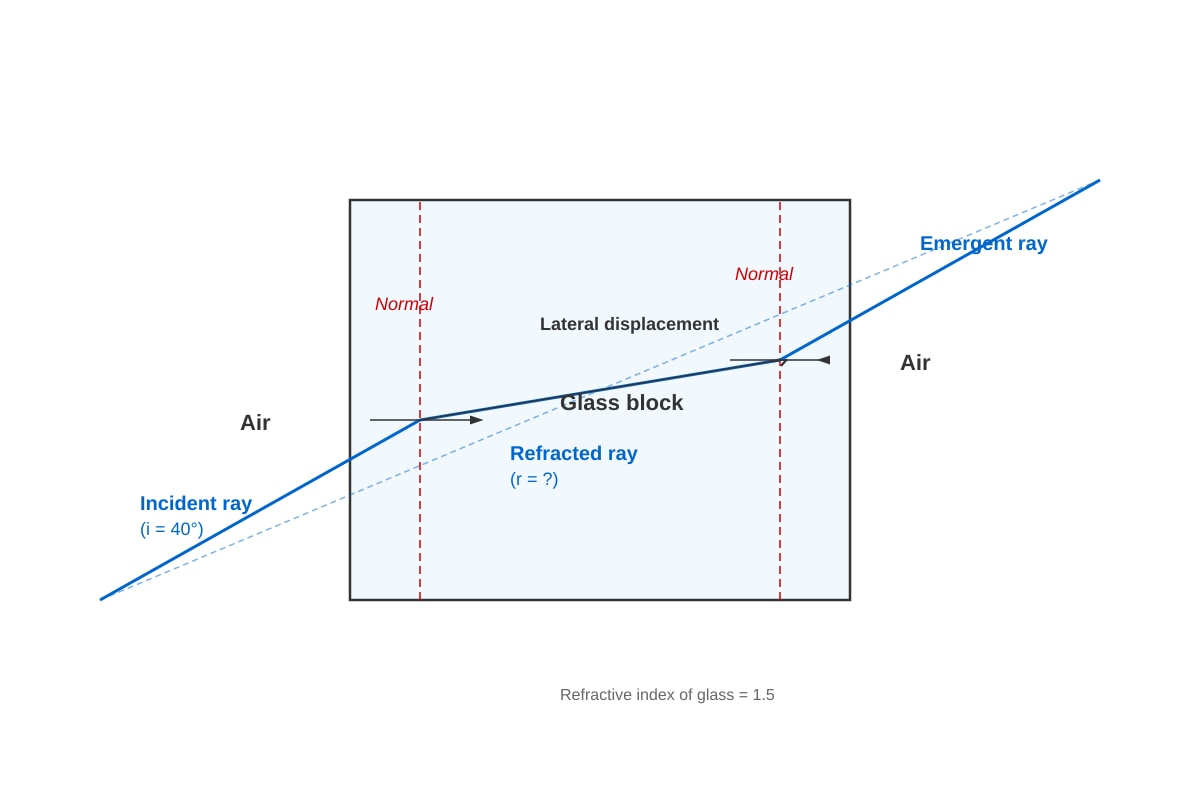
13. The diagram shows a ray of light passing from air into a rectangular glass block.
<image_placeholder> id: Q13-fig1 type: diagram linked_question: Q13 description: Ray diagram showing a light ray entering a rectangular glass block at an angle of incidence of 40° to the normal. The ray refracts towards the normal inside the block, travels straight through, and emerges parallel to the incident ray but laterally displaced. Normal lines shown at both surfaces. labels: Air, Glass block, Normal, Incident ray (i = 40°), Refracted ray (r = ?), Emergent ray, Lateral displacement values: Angle of incidence = 40°, Refractive index of glass = 1.5 must_show: Rectangular block, incident ray at 40° to normal, refracted ray bending towards normal, emergent ray parallel to incident ray, normal lines at both surfaces </image_placeholder>
(a) On the diagram, label the angle of incidence and the angle of refraction . [1]
(b) Calculate the angle of refraction given that the refractive index of glass is 1.5. [2]
(c) Explain why the emergent ray is parallel to the incident ray. [1]
14. A student investigates the refraction of light through a semi-circular glass block. She directs a ray of light at the curved surface so that it enters along a radius (normal to the surface) and strikes the flat face at an angle.
(a) Explain why the ray does not deviate when it enters the curved surface. [1]
(b) The angle of incidence at the flat face is 30°. The refractive index of glass is 1.5. Calculate the angle of refraction as the ray leaves the glass into air. [2]
(c) The student increases the angle of incidence at the flat face until the refracted ray just emerges along the flat face (angle of refraction = 90°). Calculate this critical angle. [2]
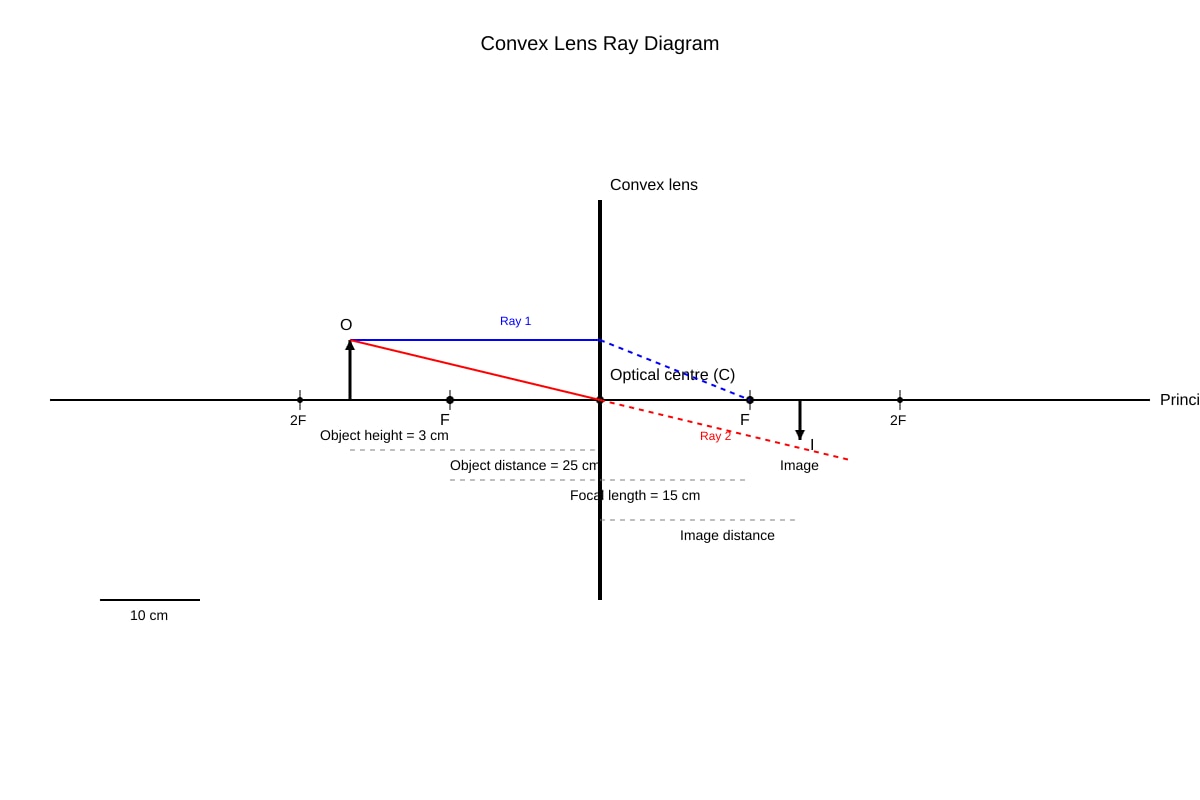
15. The diagram shows an object O placed in front of a convex lens. The focal length of the lens is 15 cm. The object distance is 25 cm.
<image_placeholder> id: Q15-fig1 type: diagram linked_question: Q15 description: Principal axis diagram for convex lens with focal points F marked at 15 cm on each side. Object O (height 3 cm) placed at 25 cm from lens on left side. Construction rays needed: one parallel to axis refracting through F, one through optical centre undeviated. Image formed on right side between F and 2F. labels: Convex lens, Optical centre (C), Focal points (F), Object (O, height 3 cm), Object distance = 25 cm, Focal length = 15 cm, Image (I), Construction rays values: f = 15 cm, u = 25 cm, Object height = 3 cm must_show: Principal axis, lens symbol, focal points marked at 15 cm, object at 25 cm, two construction rays, real inverted image between F and 2F </image_placeholder>
(a) On the diagram, draw two construction rays to locate the image. Label the image I. [2]
(b) State the nature of the image formed (real/virtual, upright/inverted, magnified/diminished). [1]
(c) Calculate the image distance using the lens formula . [2]
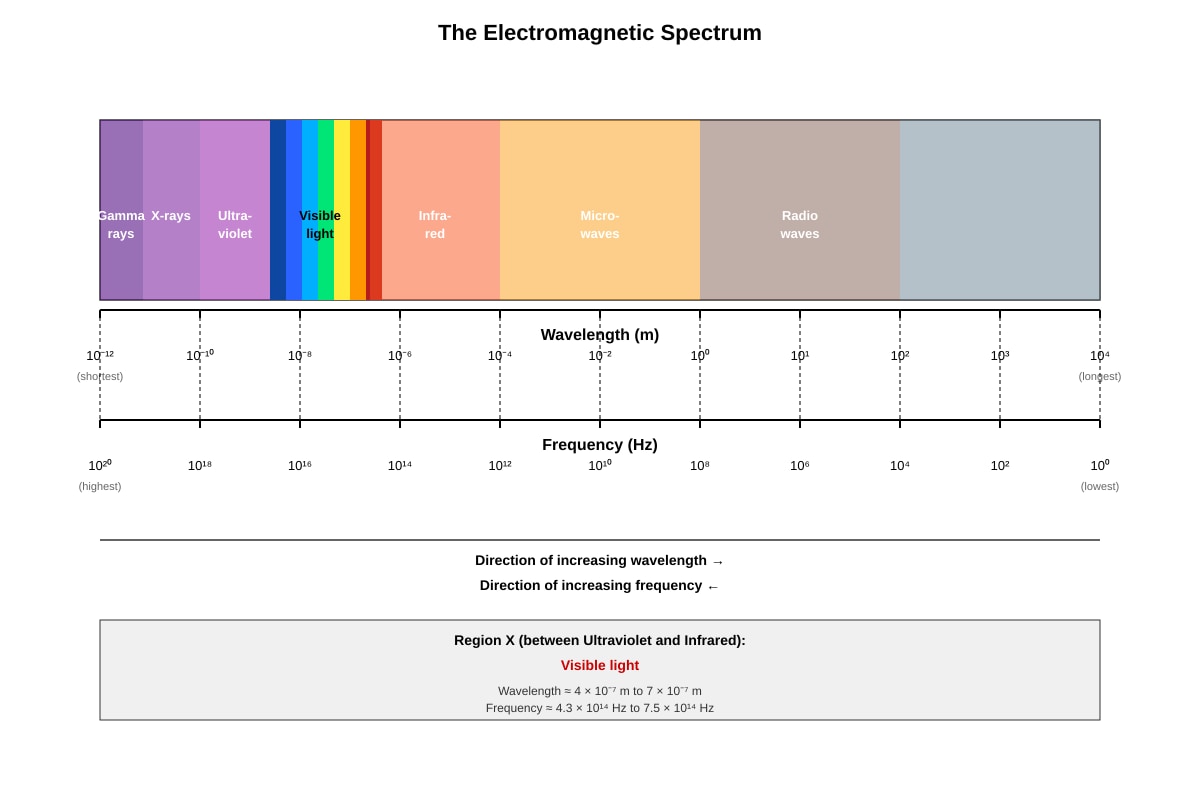
16. The electromagnetic spectrum is shown below with some regions labelled.
<image_placeholder> id: Q16-fig1 type: diagram linked_question: Q16 description: Electromagnetic spectrum diagram showing wavelength increasing from left to right. Regions labelled: Gamma rays, X-rays, Ultraviolet, Visible light, Infrared, Microwaves, Radio waves. Wavelength scale from 10^-12 m to 10^3 m. Frequency scale decreasing left to right. labels: Gamma rays, X-rays, Ultraviolet, Visible light, Infrared, Microwaves, Radio waves, Wavelength (m), Frequency (Hz) values: Wavelength range: 10^-12 m to 10^3 m must_show: Continuous spectrum with region boundaries, wavelength and frequency scales, all 7 regions labelled in correct order </image_placeholder>
(a) Name the region marked X that lies between ultraviolet and infrared. [1]
(b) State one similarity and one difference between visible light and X-rays. [2]
Similarity: __________________________________________________________________ Difference: __________________________________________________________________
(c) State one danger of excessive exposure to ultraviolet radiation. [1]
Section C: Longer Structured Questions (12 marks)
Answer all questions in the spaces provided.
17. A student sets up a ripple tank to investigate wave properties. The vibrator produces waves of frequency 12 Hz. The student measures the distance between 5 successive bright bands on the screen below the tank as 20 cm.
(a) Explain why bright and dark bands are seen on the screen. [2]
(b) Calculate the wavelength of the water waves. [2]
(c) Calculate the speed of the water waves. [1]
(d) The student increases the frequency to 20 Hz while keeping the water depth the same. State what happens to the wavelength and wave speed. [2]
Wavelength: ________________________________________________________________ Wave speed: ________________________________________________________________
18. The diagram shows a ray of light travelling from water (refractive index = 1.33) into air.
<image_placeholder> id: Q18-fig1 type: diagram linked_question: Q18 description: Ray diagram showing light ray in water striking water-air boundary at various angles. Critical angle marked at 48.8°. Rays shown: one at 30° (refracts out), one at 48.8° (emerges at 90°), one at 60° (total internal reflection). labels: Water (n=1.33), Air (n=1.0), Normal, Incident rays at 30°, 48.8°, 60°, Refracted rays, Critical angle = 48.8°, Total internal reflection values: n_water = 1.33, n_air = 1.0, Critical angle = 48.8° must_show: Water-air boundary, normal line, three incident rays at different angles, correct refraction/TIR behaviour, critical angle marked </image_placeholder>
(a) Calculate the critical angle for the water-air boundary. [2]
(b) On the diagram, complete the path of the ray incident at 60° to the normal. [1]
(c) Optical fibres use total internal reflection to transmit light over long distances. Explain why the core of an optical fibre must have a higher refractive index than the cladding. [2]
19. A converging lens is used as a magnifying glass. The lens has a focal length of 10 cm. The object (a small insect of height 2 mm) is placed 6 cm from the lens.
(a) Using the lens formula, calculate the image distance. [2]
(b) Calculate the magnification. [1]
(c) State the nature of the image formed. [1]
(d) Explain why a magnifying glass must be held close to the object (within the focal length) to produce a magnified virtual image. [2]
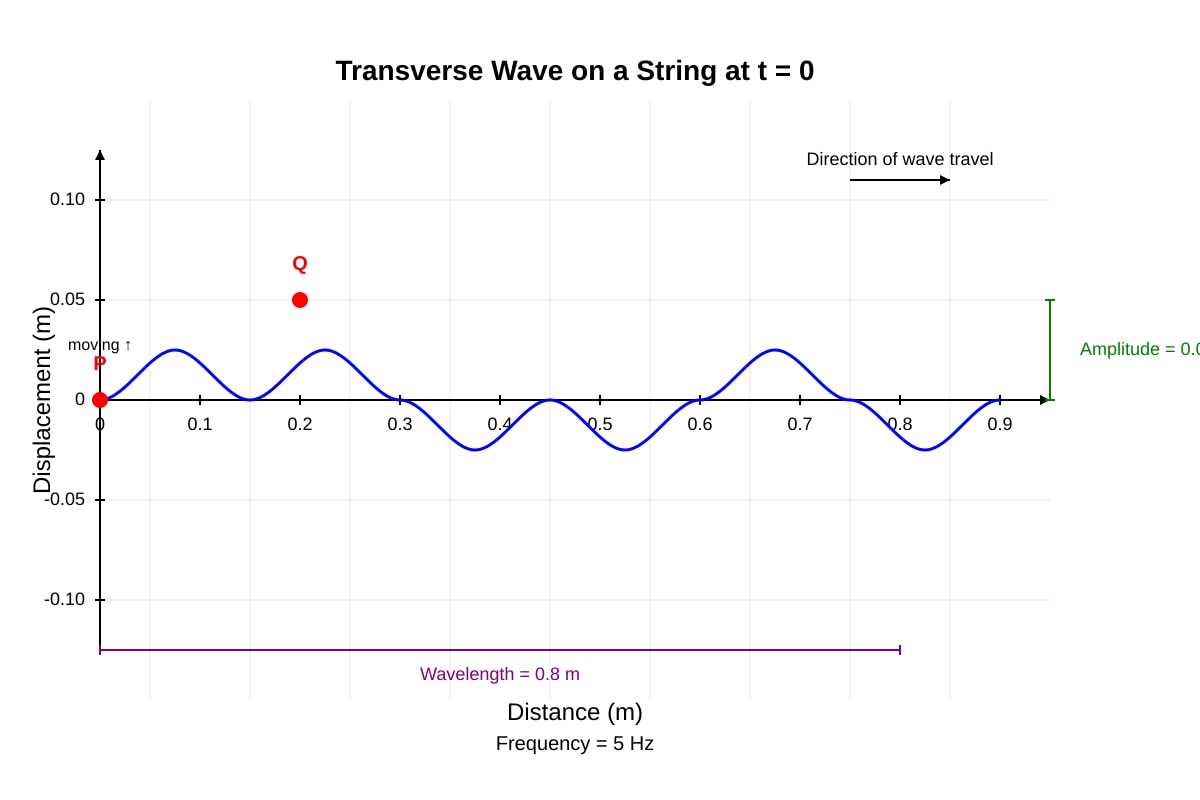
20. The diagram shows a transverse wave on a string at time .
<image_placeholder> id: Q20-fig1 type: graph linked_question: Q20 description: Displacement-distance graph of a transverse wave on a string at t=0. Sine wave with amplitude 0.05 m, wavelength 0.8 m. Particle P marked at x=0 (equilibrium, moving upward). Particle Q marked at x=0.2 m (maximum positive displacement). X-axis: Distance (m), Y-axis: Displacement (m). labels: Particle P at x=0, Particle Q at x=0.2 m, Amplitude = 0.05 m, Wavelength = 0.8 m, Direction of wave travel → values: Amplitude = 0.05 m, Wavelength = 0.8 m, Frequency = 5 Hz must_show: Sine wave at t=0, particles P and Q marked at correct positions, amplitude and wavelength labelled, direction of travel indicated </image_placeholder>
The wave travels to the right at a speed of 4.0 m/s. The frequency of the wave is 5 Hz.
(a) Determine the wavelength of the wave. [1]
(b) Particle P is at the equilibrium position at and moving upwards. Describe the motion of particle P at s. [2]
(c) Particle Q is at a distance of 0.2 m from particle P. Determine the phase difference between particle P and particle Q. [2]
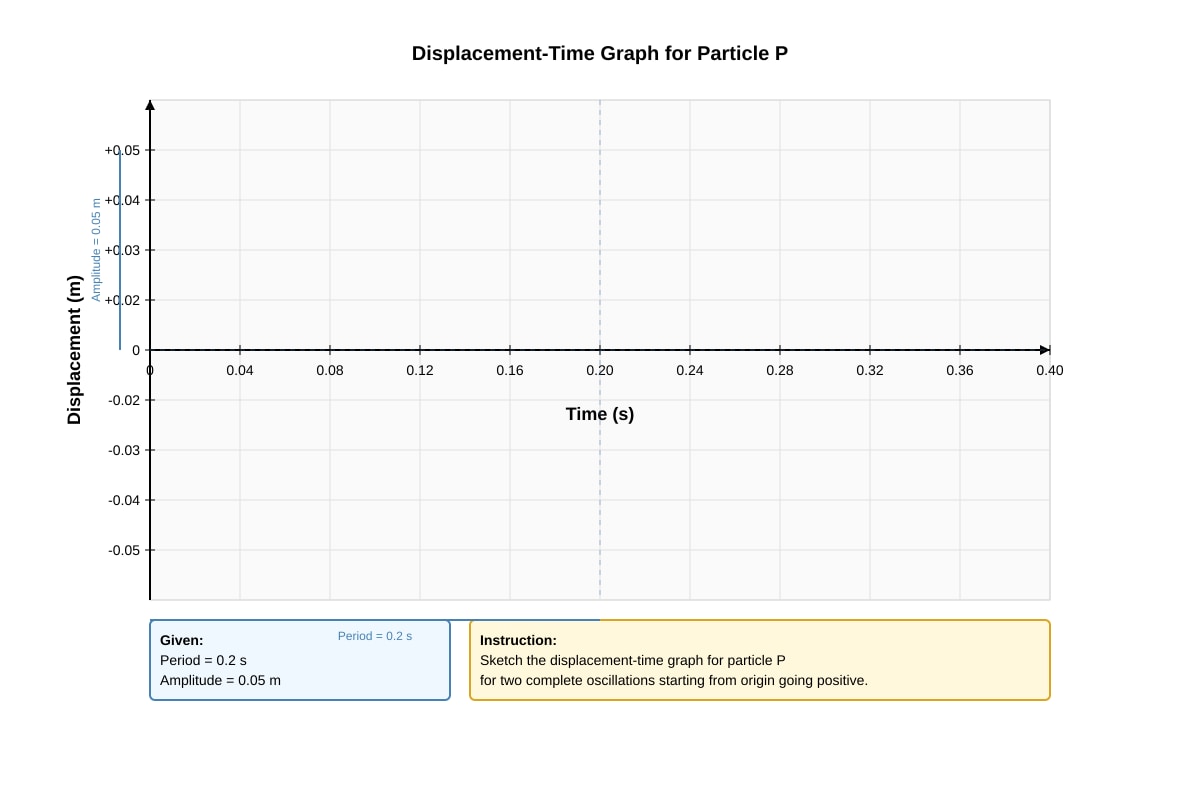
(d) Sketch the displacement-time graph for particle P for two complete oscillations. [2]
<image_placeholder> id: Q20-fig2 type: graph linked_question: Q20 description: Blank axes for displacement-time graph. X-axis: Time (s) from 0 to 0.4 s. Y-axis: Displacement (m) from -0.05 to +0.05 m. Student to draw sine wave starting at origin going positive. labels: Time (s), Displacement (m), Period = 0.2 s, Amplitude = 0.05 m values: Period = 0.2 s, Amplitude = 0.05 m must_show: Blank labelled axes with correct scales, student draws sine wave starting at (0,0) going positive, two complete periods shown </image_placeholder>
End of Quiz
Answers
Secondary 3 Physics Quiz - Waves Sound Light (Answer Key)
Total Marks: 40
Section A: Multiple Choice Questions (10 marks)
1. C — Sound waves in air are longitudinal waves. [1]
Explanation: In longitudinal waves, particles vibrate parallel to the direction of wave travel. Sound waves in air consist of compressions and rarefactions, making them longitudinal. Transverse waves (like light) have particles vibrating perpendicular to the wave direction. Light is a transverse electromagnetic wave and does not require a medium.
2. B — 300 m/s [1]
Working:
Key concept: Wave speed = frequency × wavelength ().
3. B — 4 cm [1]
Explanation: Amplitude is the maximum displacement from the equilibrium position. On a displacement-distance graph, it is the vertical distance from the equilibrium line to a peak (or trough). The graph shows peaks at +4 cm and troughs at -4 cm.
4. C — Steel at 20°C [1]
Explanation: Sound travels fastest in solids (steel ~5000 m/s), slower in liquids (water ~1500 m/s), and slowest in gases (air ~340 m/s). Sound cannot travel in a vacuum.
5. B — 340 m/s [1]
Working: Total distance travelled by sound = . Time = 1.0 s. Speed = .
Common mistake: Forgetting to double the distance (echo travels to cliff and back).
6. D — Gamma rays [1]
Explanation: Electromagnetic spectrum order (increasing wavelength / decreasing frequency): Gamma rays < X-rays < UV < Visible < Infrared < Microwaves < Radio waves. Gamma rays have the shortest wavelength and highest frequency.
7. C — The wavelength of light decreases. [1]
Explanation: When light enters a denser medium (glass), its speed decreases (), frequency remains constant, so wavelength decreases (). The ray bends towards the normal, not away.
8. C — It undergoes total internal reflection. [1]
Explanation: Total internal reflection occurs when light travels from denser to rarer medium and angle of incidence > critical angle. Here, , so TIR occurs.
9. B — Real, inverted, diminished [1]
Explanation: For a convex lens: object at , . Since (i.e., ), image is real, inverted, diminished, and located between and on the opposite side.
10. C — Thermal imaging cameras [1]
Explanation: Infrared radiation is emitted by warm objects. Thermal imaging cameras detect this radiation to create temperature maps. Sterilisation uses UV, satellite communication uses microwaves, X-ray photography uses X-rays.
Section B: Structured Questions (18 marks)
11. (a) A wavefront is an imaginary line or surface that joins all points in a wave that are in the same phase (e.g., all crests or all troughs). [1]
Teaching note: Wavefronts are perpendicular to the direction of wave propagation (rays).
(b) [2]
Marking points:
- 1 mark: Wavefronts become circular/semicircular after the gap (diffraction).
- 1 mark: Wavelength (spacing between wavefronts) remains unchanged.
Expected diagram: Circular wavefronts spreading out from the gap, centred on the gap.
(c) The amount of diffraction decreases (less spreading) when the gap is made wider. [1]
Key concept: Diffraction is most significant when gap size ≈ wavelength. Wider gap → less diffraction.
12. (a) Depth = 600 m [2]
Working:
Total distance travelled by ultrasound =
This is the round trip (down and up), so depth =
Mark breakdown: 1 mark for correct use of , 1 mark for halving the distance.
(b) Ultrasound has a higher frequency (shorter wavelength) than audible sound, so it:
- Produces a narrower, more directional beam for accurate detection.
- Is not audible to humans, avoiding disturbance.
- Less diffraction around obstacles. [1]
Any one valid reason accepted.
13. (a) [1]
Marking: Angle labelled between incident ray and normal in air; angle labelled between refracted ray and normal in glass. Both on the same side of the normal.
(b) (or 25°) [2]
Working:
Mark breakdown: 1 mark for correct formula/substitution, 1 mark for correct answer with unit.
(c) The two surfaces of the rectangular block are parallel. The ray bends towards the normal on entry (air → glass) and bends away from the normal by the same amount on exit (glass → air), so the emergent ray is parallel to the incident ray. [1]
Key concept: Parallel-sided block → emergent ray parallel to incident ray (but laterally displaced).
14. (a) The ray enters along the radius, which is normal to the curved surface. Angle of incidence = 0°, so no refraction occurs (ray passes straight through without deviation). [1]
Key concept: , if , then .
(b) (or 48.6°) [2]
Working: Light goes from glass to air:
Mark breakdown: 1 mark for correct Snell's law application (glass to air), 1 mark for correct answer.
(c) Critical angle [2]
Working:
Mark breakdown: 1 mark for correct formula , 1 mark for correct calculation.
15. (a) [2]
Marking points:
- 1 mark: Ray from top of object parallel to principal axis, refracts through focal point F on right side.
- 1 mark: Ray from top of object through optical centre C, continues undeviated.
- Image I located where rays intersect (between F and 2F on right side), inverted.
Expected result: Real, inverted image between F (15 cm) and 2F (30 cm).
(b) Real, inverted, diminished [1]
Reasoning: Object at 25 cm (between 2F and F for f=15 cm? Wait: 2F = 30 cm, F = 15 cm. Object at 25 cm is between F and 2F. So image is beyond 2F, real, inverted, magnified. Let me recalculate.)
Correction: , . Since (15 < 25 < 30), image is real, inverted, magnified, located beyond 2F ().
Marking: Accept "real, inverted, magnified" based on correct position analysis.
(c) [2]
Working:
Mark breakdown: 1 mark for correct substitution, 1 mark for correct answer with unit (cm).
Check: (beyond 2F), consistent with magnified image.
16. (a) Visible light [1]
(b) Similarity: Both are transverse electromagnetic waves that travel at in vacuum. [1]
Difference: X-rays have much shorter wavelength / higher frequency / higher energy than visible light, so they can penetrate materials that visible light cannot. [1]
Other valid differences: X-rays are ionising, visible light is not; X-rays used for medical imaging, visible light for vision.
(c) Excessive UV exposure can cause skin cancer / sunburn / premature skin ageing / eye damage (cataracts). [1]
Any one valid danger accepted.
Section C: Longer Structured Questions (12 marks)
17. (a) Bright bands correspond to wave crests (constructive interference) where water is deeper, acting like converging lenses focusing light. Dark bands correspond to troughs (destructive interference) where water is shallower, acting like diverging lenses spreading light. [2]
Mark breakdown: 1 mark for linking bright bands to crests/focusing, 1 mark for linking dark bands to troughs/diverging.
(b) Wavelength = 5 cm [2]
Working: Distance between 5 successive bright bands = 4 wavelengths (since 5 bands have 4 gaps between them).
Mark breakdown: 1 mark for recognising 5 bands = 4λ, 1 mark for correct calculation.
(c) Speed = 0.6 m/s [1]
Working:
ECF allowed from (b).
(d) Wavelength: Decreases (since constant, , increases → decreases). [1]
Wave speed: Remains the same (wave speed in water depends only on water depth, not frequency). [1]
Key concept: For water waves in constant depth, speed is constant; frequency and wavelength are inversely proportional.
18. (a) Critical angle [2]
Working:
Mark breakdown: 1 mark for correct formula , 1 mark for correct calculation.
(b) [1]
Marking: Ray shows total internal reflection — reflects back into water at angle of reflection = 60° (equal to angle of incidence). No refracted ray in air.
(c) For total internal reflection to occur at the core-cladding boundary, light must travel from a denser medium (higher refractive index) to a rarer medium (lower refractive index). If the core had a lower refractive index than the cladding, light would refract out into the cladding instead of being totally internally reflected, and the light would not be guided along the fibre. [2]
Mark breakdown: 1 mark for stating core must be denser (higher n) than cladding, 1 mark for explaining TIR condition (light from denser to rarer medium).
19. (a) [2]
Working:
Mark breakdown: 1 mark for correct substitution (including sign convention: positive for real object), 1 mark for correct negative answer indicating virtual image.
Sign convention: Real is positive for object distance ; virtual image has negative .
(b) Magnification [1]
Working: → magnitude = 2.5 (or , virtual and upright)
Accept: 2.5 or -2.5 with explanation.
(c) Virtual, upright, magnified [1]
Reasoning: Negative → virtual; negative (or positive magnitude with upright) → upright; → magnified.
(d) A magnifying glass produces a magnified virtual image only when the object is placed within the focal length (). In this position, the rays leaving the lens diverge as if coming from a larger virtual image on the same side as the object. If the object is at or beyond the focal point, a real image is formed (which cannot be used as a simple magnifier for direct viewing). [2]
Mark breakdown: 1 mark for stating condition , 1 mark for explaining diverging rays form virtual image on same side as object.
20. (a) Wavelength = 0.8 m [1]
Given directly on diagram / from : .
(b) At (which is since ), particle P has moved to its maximum positive displacement (amplitude = 0.05 m). [2]
Explanation: Period . At , P is at equilibrium moving up. After , it reaches maximum positive displacement (crest).
Mark breakdown: 1 mark for determining period / time fraction, 1 mark for correct description of position.
(c) Phase difference = rad (or 90°) [2]
Working:
Distance between P and Q = 0.2 m. Wavelength = 0.8 m.
Fraction of wavelength = .
Phase difference = rad (or 90°).
Mark breakdown: 1 mark for correct fraction of wavelength, 1 mark for correct phase difference in rad or degrees.
Alternative: Q is at which is ahead. Since wave travels right, Q leads P by 90° (Q reaches maximum first).
(d) [2]
Marking points for displacement-time graph:
- 1 mark: Correct sinusoidal shape starting at origin (0,0) and going positive (upwards).
- 1 mark: Period = 0.2 s shown (two complete oscillations = 0.4 s on x-axis), amplitude = 0.05 m.
Expected graph: Sine wave crossing at ; peaks at (+0.05 m); troughs at (-0.05 m).
End of Answer Key