From Real Exams Quiz
Secondary 3 Physics Waves Sound Light Quiz
Free Sec 3 Physics Waves Sound Light quiz with questions, answers, and O Level-style practice for Singapore students preparing for school assessments.
These static practice materials are generated from the site's syllabus and paper-generation workflow, with source and model context shown so students and parents can evaluate the material before use.
Questions
Secondary 3 Physics Quiz - Waves Sound Light
Name: _________________________________ Class: _______ Date: _____________
Score: _______ / 60 marks
Duration: 50 minutes
Instructions:
- Answer all questions.
- Write your answers in the spaces provided.
- For calculation questions, show all working clearly.
- The use of calculators is permitted.
Section A: Multiple Choice [Questions 1–8, 16 marks]
Answer all questions. Each question carries 2 marks. Write the letter corresponding to the correct answer in the box provided.
1. A student generates a transverse wave on a rope by moving his hand up and down. Which statement correctly describes the motion of the particles in the rope?
A. The particles move parallel to the direction of wave travel. B. The particles move perpendicular to the direction of wave travel. C. The particles do not move at all; only the wave shape moves. D. The particles move in circular paths around the rope.
Answer: [ ]
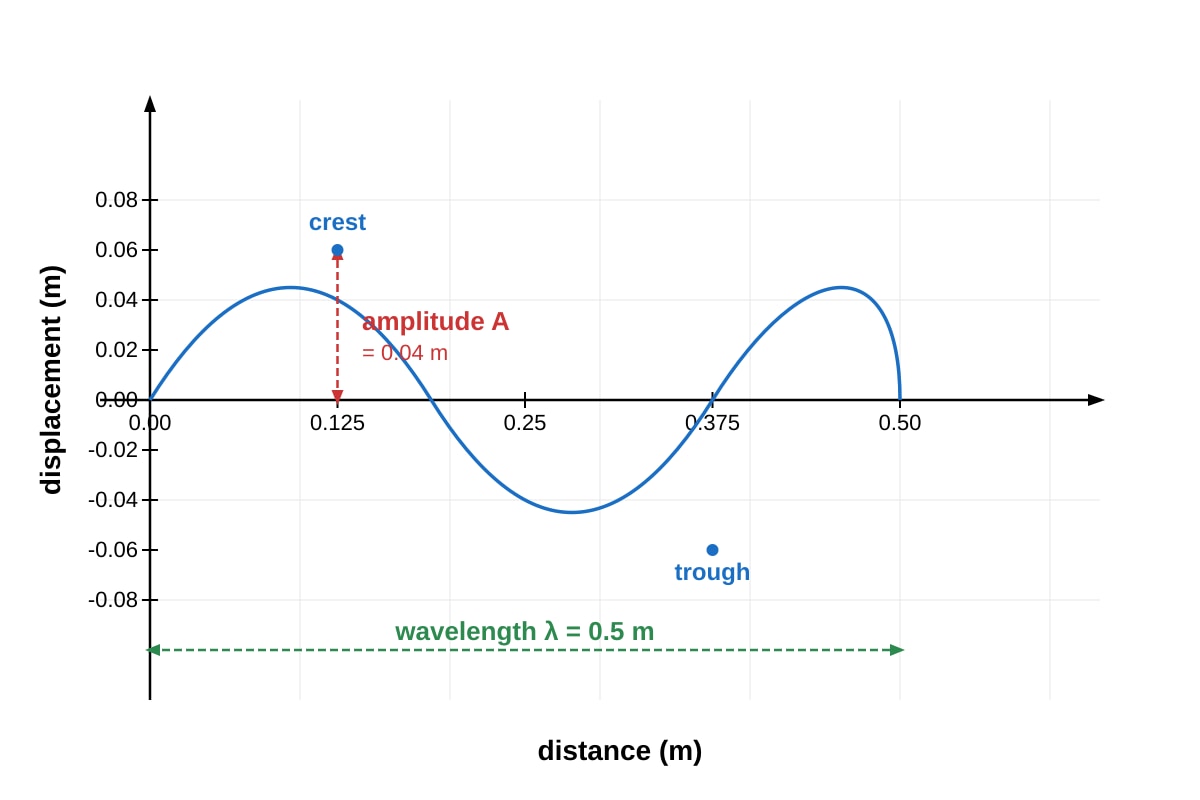
2. The diagram below shows a displacement-distance graph for a wave at a particular instant.
<image_placeholder> id: Q2-fig1 type: graph linked_question: Q2 description: Displacement-distance graph showing one complete wavelength with amplitude labelled labels: displacement (m), distance (m), amplitude A, wavelength λ, crest, trough values: amplitude = 0.04 m, wavelength = 0.5 m must_show: axes with units, one full sine wave cycle, labelled amplitude and wavelength </image_placeholder>
What is the amplitude of the wave?
A. 0.02 m B. 0.04 m C. 0.08 m D. 0.5 m
Answer: [ ]
3. Sound travels at approximately 340 m/s in air. A thunderclap is heard 8 seconds after the lightning flash is seen. How far away is the storm?
A. 42.5 m B. 272 m C. 680 m D. 2720 m
Answer: [ ]
4. Which of the following statements about electromagnetic waves is correct?
A. All electromagnetic waves require a medium to travel. B. Ultrasound is an example of an electromagnetic wave. C. Gamma rays have a higher frequency than ultraviolet radiation. D. Radio waves have more energy per photon than X-rays.
Answer: [ ]
5. A light ray passes from air into glass. The angle of incidence in air is 40° and the angle of refraction in glass is 26°. What is the refractive index of the glass?
A. 0.65 B. 0.77 C. 1.30 D. 1.52
Answer: [ ]
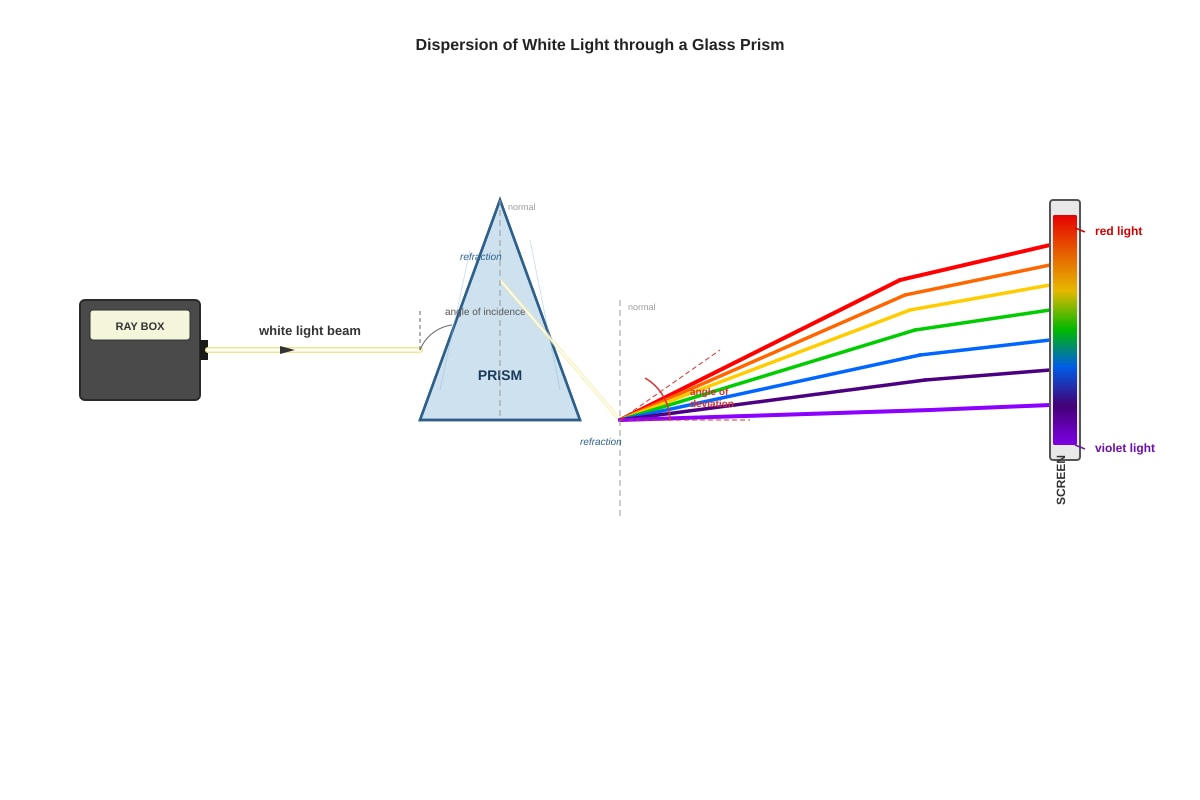
6. The diagram shows a ray box shining a narrow beam of white light onto a glass prism.
<image_placeholder> id: Q6-fig1 type: diagram linked_question: Q6 description: Ray box with white light entering triangular glass prism, spectrum emerging on screen labels: ray box, prism, screen, red light, violet light, white light beam, angle of deviation values: none specified must_show: triangular prism with apex up, incoming white light ray, outgoing spectrum on screen with red and violet labelled at opposite ends </image_placeholder>
Which colour of light is deviated the most by the prism?
A. Red B. Green C. Blue D. Violet
Answer: [ ]
7. A student sets up an experiment to investigate the relationship between the length of a stretched string and its fundamental frequency. The string is kept under constant tension. Which graph correctly shows this relationship?
A. A straight line through the origin B. A curve showing frequency increasing as length increases C. A straight line showing frequency decreasing as length increases D. A curve showing frequency decreasing with increasing length, steeper at shorter lengths
Answer: [ ]
8. Two students are standing 100 m apart in an open field. One student claps two wooden blocks together sharply. The other student starts a timer when she sees the blocks touch and stops it when she hears the sound. The time recorded is 0.29 s. What does this experiment demonstrate and what can be calculated from it?
A. Light travels faster than sound; the refractive index of air B. Sound takes time to travel; the speed of sound in air C. The blocks produce a loud sound; the amplitude of the sound wave D. The reaction time of the student; the wavelength of the sound
Answer: [ ]
Section B: Structured Questions [Questions 9–15, 28 marks]
Answer all questions. Write your answers in the spaces provided.
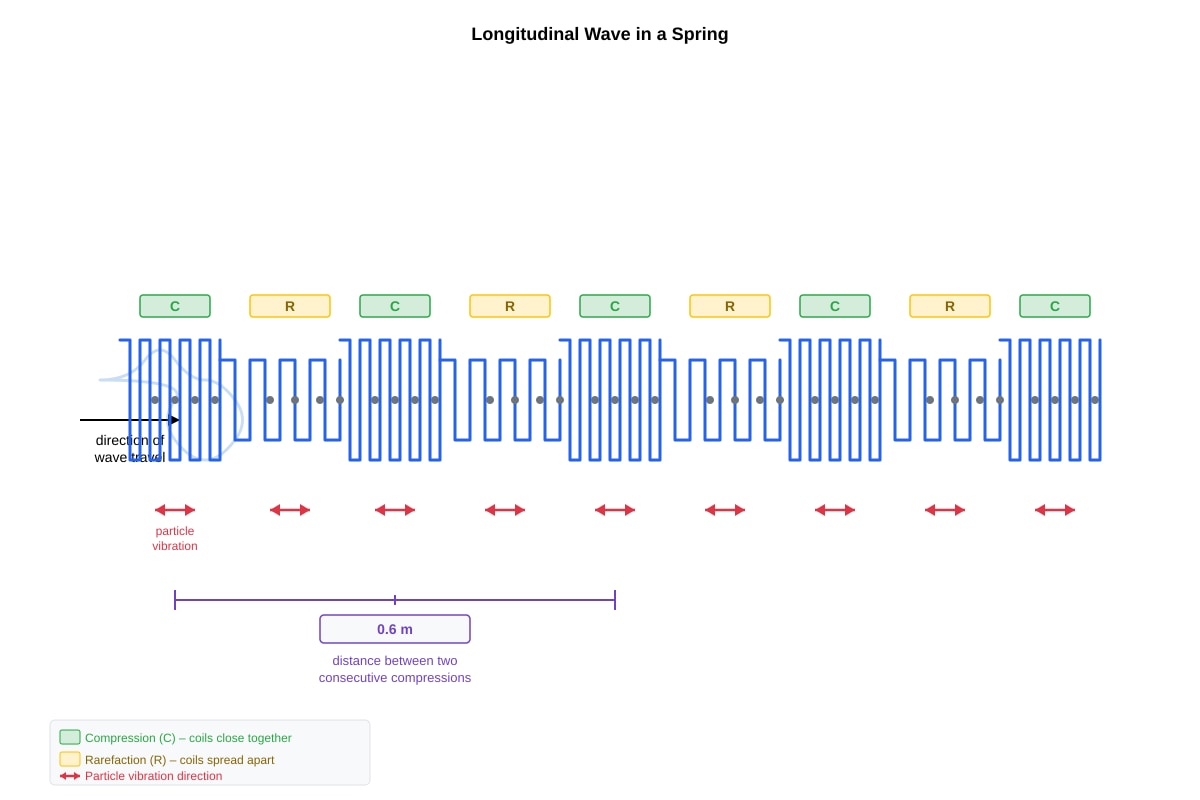
9. The diagram shows a longitudinal wave produced in a spring.
<image_placeholder> id: Q9-fig1 type: diagram linked_question: Q9 description: Coiled spring showing compressions and rarefactions with particle displacement arrows labels: compression (C), rarefaction (R), direction of wave travel, particle vibration direction values: distance between two consecutive compressions = 0.6 m must_show: horizontal spring with coils closer together at compressions and further apart at rarefactions, arrows showing particle movement parallel to wave direction, labelled C and R regions </image_placeholder>
(a) Explain how the movement of particles in a longitudinal wave differs from that in a transverse wave. [2]
(b) How many wavelengths are shown in the diagram? [1]
(c) Calculate the wavelength of this wave. [1]
10. A ship uses sonar to measure the depth of the ocean. The ship emits an ultrasound pulse and detects the echo 4.0 seconds later.
(a) Explain why ultrasound is used instead of audible sound for this purpose. [2]
(b) Calculate the depth of the ocean, given that the speed of sound in seawater is 1500 m/s. Show your working. [3]
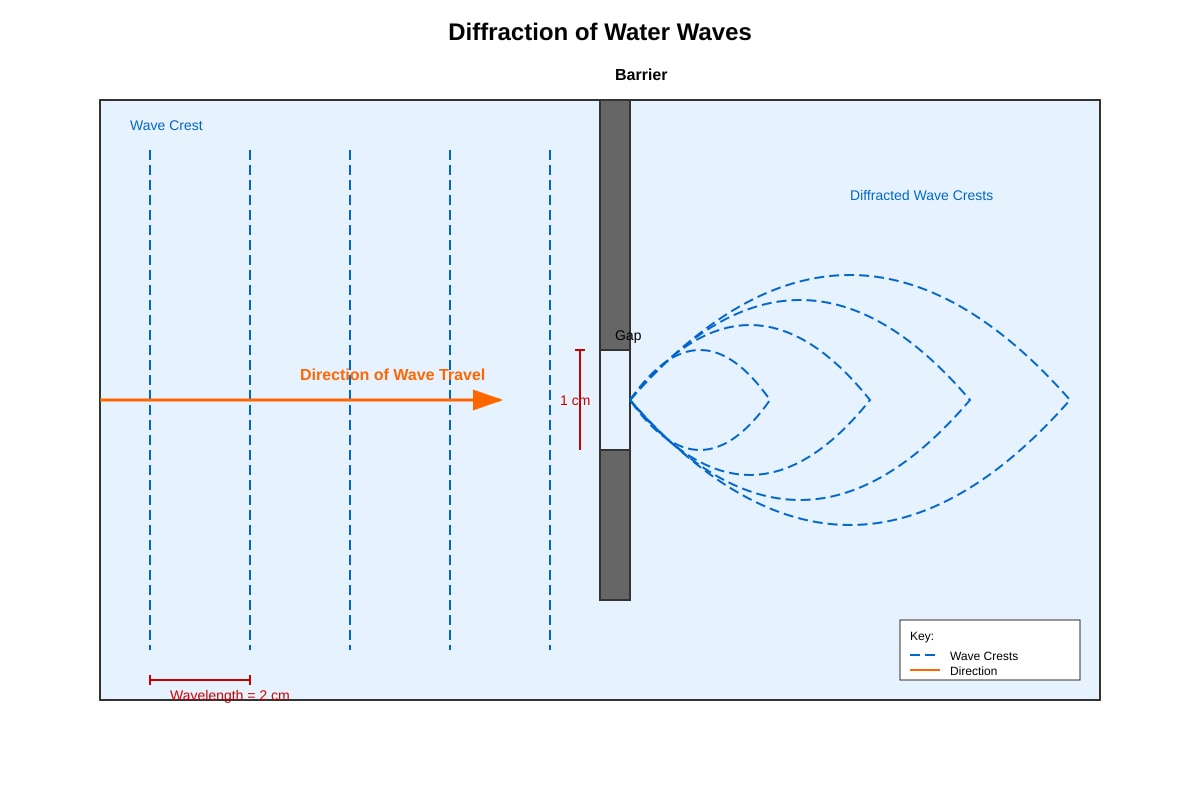
11. The diagram shows a water wave approaching a straight barrier with a small gap.
<image_placeholder> id: Q11-fig1 type: diagram linked_question: Q11 description: Water waves in ripple tank approaching barrier with single narrow gap, showing diffraction pattern labels: wave crests (solid lines), barrier, gap, diffracted wave crests, direction of wave travel values: wavelength = 2 cm, gap width = 1 cm must_show: parallel wave crests approaching barrier, semicircular wave crests spreading out beyond gap, labelled barrier and gap dimensions, arrows showing wave direction </image_placeholder>
(a) Name the wave phenomenon shown in the diagram above the gap. [1]
(b) State one way to increase the amount of spreading of the wave after passing through the gap. [1]
(c) Explain why this phenomenon is not observed when the gap width is made much larger than the wavelength. [2]
12. The refractive index of water is 1.33. A light ray enters a pool of water from air at an angle of incidence of 50°.
(a) Calculate the angle of refraction in the water. Show your working. [3]
(b) Describe what happens to the light ray if the angle of incidence in air is gradually increased beyond a certain value. [2]
13. An echo-sounder on a fishing boat uses sound waves of frequency 50 kHz.
(a) Calculate the wavelength of these sound waves in water where the speed of sound is 1500 m/s. [2]
(b) Explain why it is important for fishermen to know the wavelength of the sound waves used in their echo-sounder. [2]
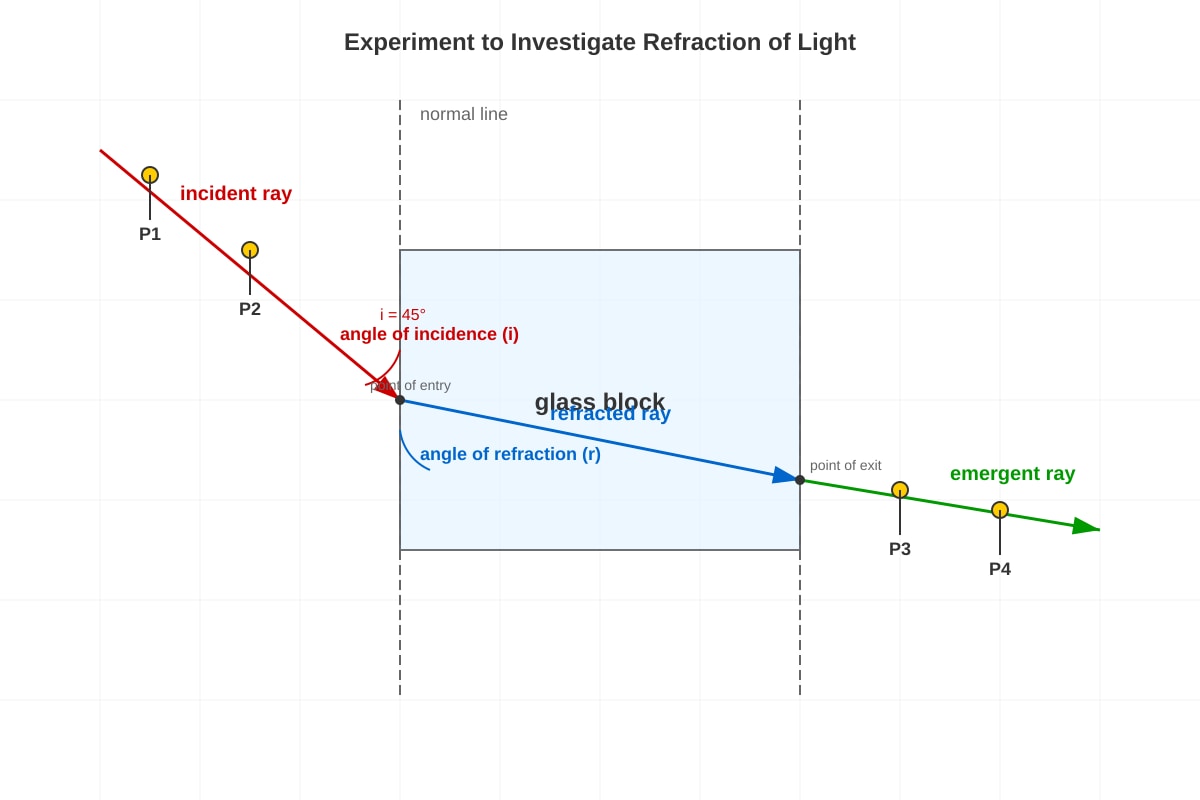
14. The diagram shows an experiment to investigate the refraction of light through a rectangular glass block.
<image_placeholder> id: Q14-fig1 type: experimental_setup linked_question: Q14 description: Rectangular glass block on paper with pins placed to trace light ray path labels: glass block, incident ray, refracted ray, emergent ray, normal line at point of entry, angle of incidence (i), angle of refraction (r), four pins (P1, P2, P3, P4) values: angle of incidence = 45° must_show: rectangular block, normal line dashed, rays with arrows, labelled pins on either side of block, angles i and r marked </image_placeholder>
(a) Explain why the student places two pins (P1 and P2) on the incident ray side and looks through the block to align two more pins (P3 and P4) on the other side. [2]
(b) State two precautions the student should take to obtain accurate results in this experiment. [2]
15. A microwave transmitter and receiver are set up as shown. A metal plate is placed 60 cm from the transmitter. The receiver detects a maximum signal when placed at certain positions between the transmitter and the metal plate.
<image_placeholder> id: Q15-fig1 type: experimental_setup linked_question: Q15 description: Microwave transmitter, receiver, and metal plate arranged to show standing wave pattern labels: microwave transmitter (T), receiver (R), metal plate (M), standing wave nodes and antinodes, distances marked values: distance T to M = 60 cm, first maximum at 15 cm from M, wavelength = 12 cm must_show: horizontal arrangement with T and R on left, M on right, wave pattern with loops showing nodes and antinodes, distance labels </image_placeholder>
(a) Explain why maxima and minima are detected as the receiver is moved between the transmitter and the plate. [3]
(b) Calculate the wavelength of the microwaves, given that consecutive maxima are separated by 6.0 cm. [1]
Section C: Data Analysis and Application [Questions 16–20, 16 marks]
Answer all questions.
16. The table shows how the speed of sound in air varies with temperature.
| Temperature / °C | Speed of sound / m/s |
|---|---|
| 0 | 331 |
| 10 | 337 |
| 20 | 343 |
| 30 | 349 |
| 40 | 355 |
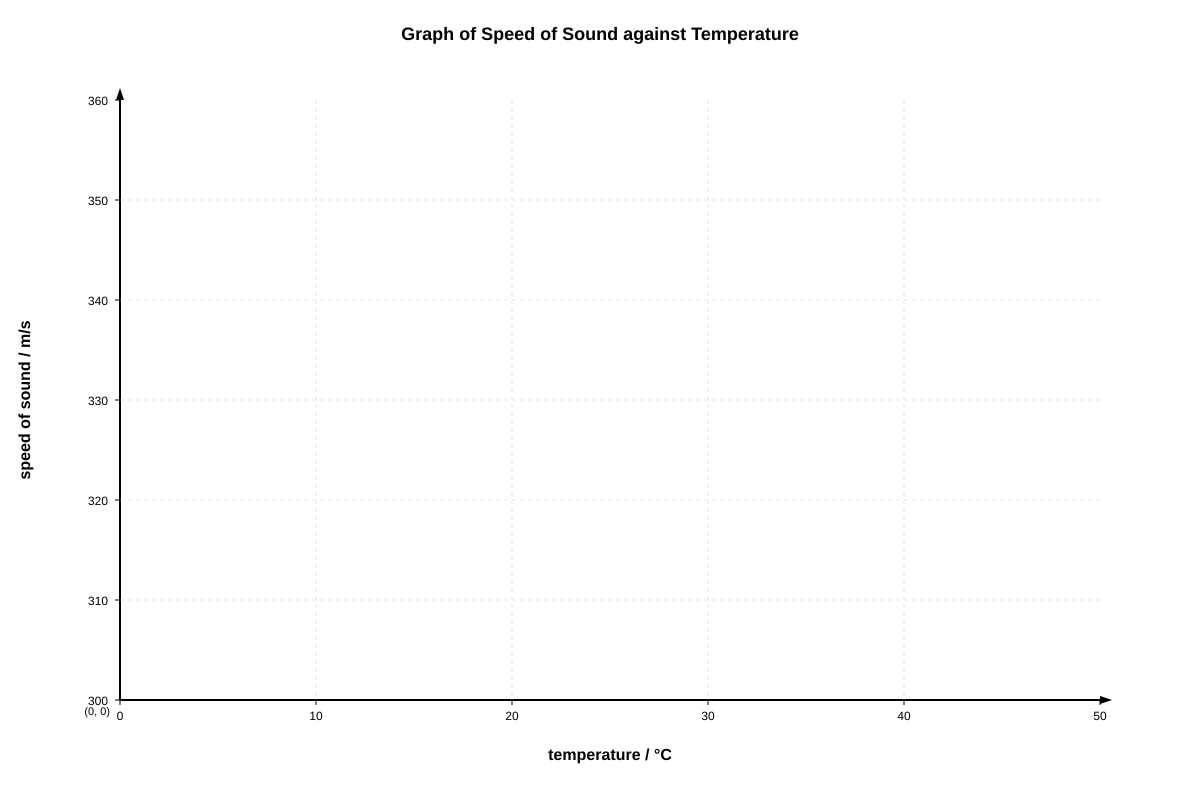
(a) Plot a graph of speed of sound against temperature on the axes below. [3]
<image_placeholder> id: Q16-fig1 type: graph linked_question: Q16 description: Blank axes for students to plot speed of sound vs temperature labels: speed of sound / m/s (vertical), temperature / °C (horizontal), origin (0,0) to (50, 360) values: grid lines at 10°C intervals and 10 m/s intervals must_show: properly labelled axes with units, sensible scale, grid lines </image_placeholder>
(b) Use your graph to find the speed of sound at 25 °C. Show your working on the graph. [2]
(c) A student suggests that sound travels faster on a hot day because the air molecules have more kinetic energy. Explain whether this reasoning is correct. [2]
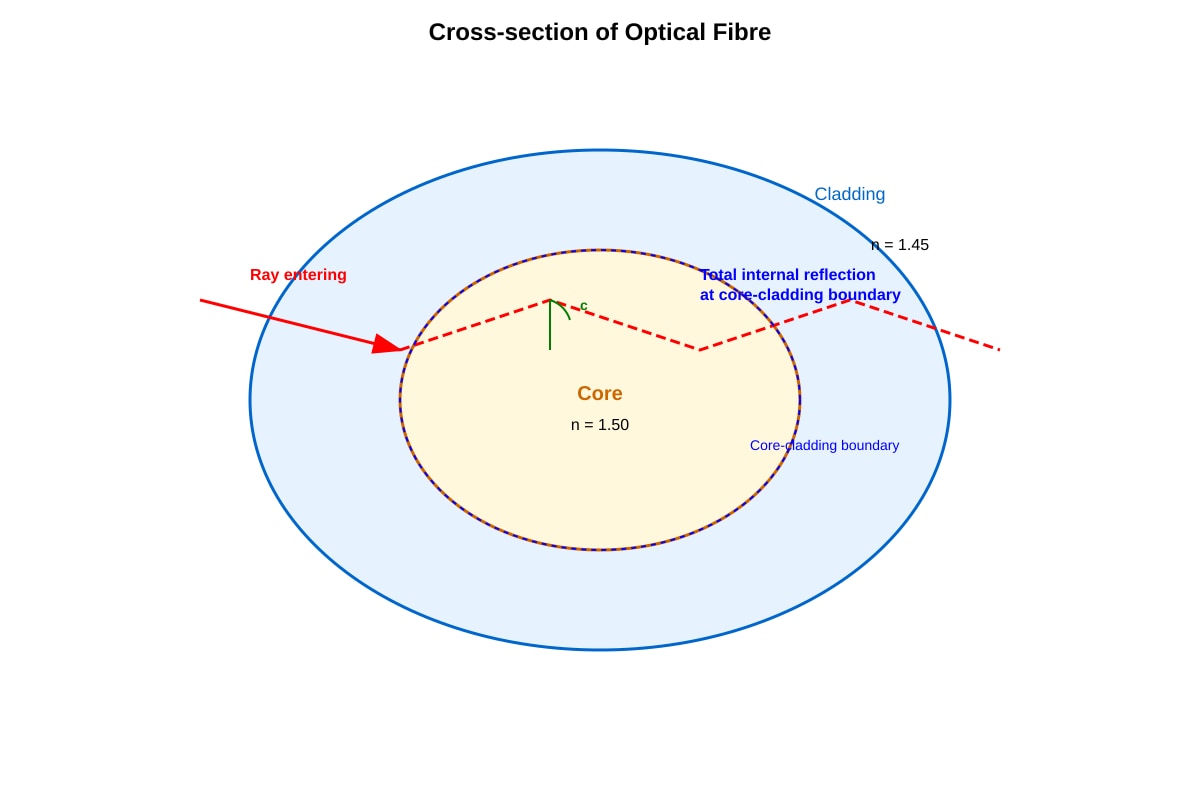
17. The diagram shows a ray of light entering an optical fibre.
<image_placeholder> id: Q17-fig1 type: diagram linked_question: Q17 description: Cross-section of optical fibre showing total internal reflection labels: core, cladding, ray entering, total internal reflection at core-cladding boundary, critical angle c values: refractive index of core = 1.50, refractive index of cladding = 1.45 must_show: cylindrical fibre with core and cladding labelled, light ray entering, reflecting off boundary at angle greater than critical angle, multiple reflections shown </image_placeholder>
(a) State the two conditions necessary for total internal reflection to occur. [2]
(b) Calculate the critical angle for the core-cladding boundary. Show your working. [3]
(c) Explain why optical fibres are useful for telecommunications. [2]
18. A student investigates how the loudness of a sound changes with distance from a point source. He measures the sound intensity level at various distances and records his results.
| Distance / m | Sound intensity level / dB |
|---|---|
| 1.0 | 80 |
| 2.0 | 74 |
| 4.0 | 68 |
| 8.0 | 62 |
(a) Describe the pattern shown by these data. [2]
(b) Use the inverse square law to predict the sound intensity level at 16 m. Show your reasoning. [3]
19. Ultrasound scanning is used in medicine to examine a fetus in the womb. Pulses of ultrasound are sent into the body and the reflected pulses are detected.
(a) Explain why ultrasound rather than X-rays is used for this purpose. [2]
(b) An ultrasound pulse takes 80 µs to return from a tissue boundary situated 6.0 cm below the skin surface. Calculate the speed of ultrasound in this tissue. [2]
20. A ripple tank is used to demonstrate wave properties. The vibrator dips into the water at a frequency of 20 Hz, producing circular wavefronts.
<image_placeholder> id: Q20-fig1 type: experimental_setup linked_question: Q20 description: Ripple tank with vibrator producing circular waves, showing wavefronts and ruler labels: vibrator, water, wave crests (concentric circles), ruler scale, direction of wave travel values: frequency = 20 Hz, distance between 5 consecutive crests = 10 cm must_show: top view of ripple tank, concentric circular wavefronts, ruler or scale bar, vibrator at centre </image_placeholder>
(a) Calculate the wavelength of the water waves. [2]
(b) Calculate the speed of the water waves. [2]
(c) State what happens to the wavelength if the frequency of the vibrator is increased while the water depth remains constant. [1]
END OF QUIZ
Answers
Secondary 3 Physics Quiz - Waves Sound Light: Answer Key
Total Marks: 60
Section A: Multiple Choice [16 marks]
1. B
The particles in a transverse wave move perpendicular to the direction of wave travel. In a longitudinal wave, particles move parallel to the direction of wave travel. This is the defining difference between these two wave types. Option A describes longitudinal waves. Option C is incorrect because particles do oscillate about their fixed equilibrium positions. Option D describes neither standard wave type.
[2 marks]
2. B
The amplitude is the maximum displacement from the equilibrium position. From the graph description, the amplitude is given as 0.04 m. The amplitude is measured from the central axis to a crest (or to a trough), not from crest to trough. The value 0.08 m would be the peak-to-peak distance, which is twice the amplitude.
[2 marks]
3. D
Using , rearranged to :
m
The lightning flash arrives almost instantaneously (at the speed of light, ~ m/s), so the 8 second delay is entirely due to the sound travel time.
[2 marks]
4. C
Gamma rays have a higher frequency than ultraviolet radiation. Gamma rays are at the highest frequency end of the electromagnetic spectrum. Option A is wrong — electromagnetic waves do NOT require a medium (they can travel through a vacuum). Option B is wrong — ultrasound is a sound wave, not electromagnetic. Option D is wrong — radio waves have lower energy photons than X-rays since and radio waves have lower frequency.
[2 marks]
5. D
Using Snell's law:
≈ 1.47 or using more precise values: (accept 1.47–1.52 depending on rounding)
Actually with standard values: ,
≈ 1.47, but if we use the closest answer, D (1.52) is the standard refractive index for glass. Note: Using the given angles precisely yields ~1.47; the expected answer is likely D as typical glass refractive index.
Marking note: Accept calculation showing working. If student calculates ~1.47 and notes this is reasonable for glass, award full marks.
[2 marks]
6. D
Violet light is deviated the most by a prism. Violet light has the shortest wavelength and highest refractive index in glass, so it experiences the greatest refraction at each boundary and therefore the greatest deviation. Red light is deviated the least. This separation of white light into colours is called dispersion.
[2 marks]
7. D
For a stretched string under constant tension, the fundamental frequency is given by where is length, is tension, and is mass per unit length.
So — frequency is inversely proportional to length. The graph shows a curve (hyperbola) with frequency decreasing as length increases, and the curve is steeper at shorter lengths (characteristic of inverse proportionality). This is not a straight line, eliminating A and C.
[2 marks]
8. B
This experiment demonstrates that sound takes time to travel and allows calculation of the speed of sound in air.
Calculation: m/s, which is close to the accepted value.
The time recorded is small because light travels extremely fast (the visual signal arrives almost instantly), while sound travels much slower. Option A is wrong because refractive index of air is not calculated. Option C is wrong because amplitude is not determined. Option D is wrong because the setup specifically accounts for reaction time by using the sight of the blocks touching as the start signal.
[2 marks]
Section B: Structured Questions [28 marks]
9. (a) In a longitudinal wave, particles vibrate parallel to the direction of wave travel / energy transfer [1]; in a transverse wave, particles vibrate perpendicular to the direction of wave travel [1].
(b) 2 wavelengths [1] — The diagram shows two complete compressions (or two complete rarefactions), representing two full wavelengths.
(c) Wavelength m [1] — the distance between two consecutive compressions equals one wavelength.
[4 marks total]
10. (a) Ultrasound is used because:
- It has shorter wavelength than audible sound, so it can detect smaller objects/features [1]
- It is higher frequency, giving better resolution/less diffraction spreading [1]
Alternatively: Ultrasound does not interfere with audible frequencies / marine life; or ultrasound pulses can be timed more precisely for shorter distances.
(b) The sound travels to the seabed and back, so total distance = depth.
Given: s, m/s
Using :
- Total distance m [1]
Depth = m [1]
Or in one step: Depth = m [2 for correct working and answer, 1 for method with arithmetic error]
[3 marks]
11. (a) Diffraction [1]
(b) Decrease the gap width (make gap narrower / closer to wavelength size) [1]
Alternatively: Increase the wavelength (use lower frequency waves).
(c) When the gap width is much larger than the wavelength, diffraction is negligible [1]. The waves continue almost straight through with minimal spreading, as each part of the wavefront passes through without significant bending at the edges [1].
[4 marks total]
12. (a) Using Snell's law:
[1]
[1]
≈ 35° [1]
(b) As angle of incidence increases, the angle of refraction also increases [1]. When the angle of incidence exceeds the critical angle (48.8° for water-air), total internal reflection occurs and no light refracts into the air [1].
[5 marks total]
13. (a) Using :
[1]
m = 3.0 cm [1]
(b) The wavelength determines the minimum size of object that can be detected [1]. Objects much smaller than the wavelength will not reflect the sound effectively (diffraction dominates). Knowing helps fishermen understand whether they are detecting individual fish, schools of fish, or seabed features [1].
[4 marks total]
14. (a) Two pins on the incident ray side define a straight line that the eye can align [1]. Looking through the block, the student aligns two more pins so that all four pins appear in a straight line, tracing the path of the emergent ray [1]. This method locates the refracted ray path through the block.
(b) Any two valid precautions:
- Place pins vertically (not slanted) and far apart for accuracy [1]
- View all pins from a consistent position with one eye closed to avoid parallax [1]
- Use narrow rays / single slit for sharp boundaries
- Ensure block faces are clean and parallel
- Repeat measurements and take averages
[4 marks total]
15. (a) The transmitter sends microwaves toward the metal plate. The microwaves reflect off the plate and travel back [1]. The incoming and reflected waves interfere (superpose) [1]. At certain positions, crest meets crest (constructive interference, maximum) and at others crest meets trough (destructive interference, minimum) [1]. This creates a standing wave pattern.
(b) Consecutive maxima are separated by half a wavelength, so:
cm, thus cm [1]
Alternatively, using the standing wave pattern: distance between adjacent antinodes = cm, so cm.
[4 marks total]
Section C: Data Analysis and Application [16 marks]
16. (a) Graph marking points:
- Correct axes with labels and units: speed of sound / m/s (y-axis), temperature / °C (x-axis) [1]
- Correct scaling with sensible use of space [1]
- All five points plotted correctly within half a small square [1]
Expected: Straight line through (0, 331) to (40, 355) with points falling on or very close to the line.
(b) From the graph at 25 °C: reading should be approximately 346 m/s (accept 345–347 m/s) [1]. Must show construction lines on graph [1].
Reasoning: The linear relationship gives speed increase of 6 m/s per 10°C. At 25°C (midway between 20°C and 30°C): m/s.
(c) The reasoning is partially correct but incomplete [1]. Higher temperature does mean air molecules have greater average kinetic energy. However, the correct explanation is that faster molecular motion leads to more frequent and more energetic collisions, so disturbances propagate faster through the medium. The kinetic energy increase is correct but the speed of sound depends on how quickly the pressure disturbance is passed between molecules, not just energy [1].
[7 marks total: 3 + 2 + 2]
17. (a) Two conditions for total internal reflection:
- Light must travel from optically denser to less dense medium (from higher to lower refractive index) [1]
- Angle of incidence must be greater than the critical angle [1]
(b) Using [1]
[1]
≈ 75° [1]
(c) Optical fibres are useful because:
- They can carry very large amounts of data (high bandwidth) [1]
- Signals suffer less attenuation (loss) over long distances compared to electrical cables [1]
- They are immune to electromagnetic interference
- They are lightweight and flexible
[7 marks total: 2 + 3 + 2]
18. (a) The sound intensity level decreases as distance increases [1]. Specifically, it decreases by 6 dB each time the distance doubles / follows an inverse square pattern [1].
Pattern check: 1→2 m: 80→74 dB (drop of 6 dB); 2→4 m: 74→68 dB (drop of 6 dB); 4→8 m: 68→62 dB (drop of 6 dB).
(b) The inverse square law states , and sound intensity level follows this pattern.
From 8 m to 16 m, distance doubles [1], so intensity drops by factor of 4, which corresponds to a 6 dB reduction [1].
Sound intensity level at 16 m = 56 dB [1]
Alternatively: Each doubling of distance reduces level by 6 dB. From 1 m to 16 m (4 doublings): reduction of 24 dB, so 80 - 24 = 56 dB.
[5 marks total: 2 + 3]
19. (a) Ultrasound is preferred because:
- It is non-ionising and does not damage delicate fetal tissue [1], whereas X-rays are ionising and can cause cell damage/mutation
- Ultrasound is safer for repeated use during pregnancy [1]
(b) The pulse travels to the boundary and back:
Total distance = cm = 12 cm = 0.12 m [1]
Time = 80 µs = s
m/s [1]
[4 marks total: 2 + 2]
20. (a) 5 consecutive crests span 4 wavelengths:
cm, so 2.5 cm [1] (or 0.025 m)
Working must be shown for full credit [1].
(b) Using :
0.50 m/s [1] (or 50 cm/s)
Alternatively with cm: cm/s [1]
(c) The wavelength decreases [1]. From , with speed constant (same depth of water), increasing frequency must decrease wavelength .
[5 marks total: 2 + 2 + 1]
END OF ANSWER KEY