From Real Exams Quiz
Secondary 3 Physics Waves Sound Light Quiz
Free Sec 3 Physics Waves Sound Light quiz, HY3 Exam version, with questions, answers, and O Level-style practice for Singapore students.
These static practice materials are generated from the site's syllabus and paper-generation workflow, with source and model context shown so students and parents can evaluate the material before use.
Questions
Secondary 3 Physics Quiz - Waves Sound Light
Name: ___________________________
Class: ____________
Date: ____________
Score: ____________ / 40
Duration: 60 minutes
Total Marks: 40
Instructions:
- Answer all 20 questions.
- Section A: Multiple Choice (1 mark each)
- Section B: Structured Questions (2–3 marks each)
- Section C: Extended Response (4 marks)
- Show your working where calculation is required.
- Use g=10 m s−2 if needed.
Section A: Multiple Choice (Questions 1–5)
-
Which of the following best describes a transverse wave?
A. Particles vibrate parallel to the direction of energy transfer
B. Particles vibrate perpendicular to the direction of energy transfer
C. The wave requires a material medium to travel
D. The wave cannot transfer energy
[1 mark]
-
Sound waves are classified as
A. transverse waves in air
B. longitudinal waves in a vacuum
C. longitudinal waves requiring a medium
D. electromagnetic waves
[1 mark]
-
The speed of light in air is approximately
A. 3.0×10⁸ m s−1
B. 340 m s−1
C. 1500 m s−1
D. 3.0×10⁶ m s−1
[1 mark]
-
When light travels from air into glass, it bends towards the normal because
A. its frequency increases
B. its speed decreases
C. its wavelength increases
D. its amplitude decreases
[1 mark]
-
The phenomenon of two sound waves combining to produce a louder sound is called
A. diffraction
B. refraction
C. constructive interference
D. polarization
[1 mark]
Section B: Structured Questions (Questions 6–15)
-
A ripple tank produces water waves of frequency 5.0 Hz and wavelength 0.12 m. Calculate the wave speed.
[2 marks]
-
State one difference between a longitudinal wave and a transverse wave, and give one example of each.
[2 marks]
-
A student places a tuning fork of frequency 512 Hz near a tube and hears the first loud sound when the air column length is 16.5 cm. Estimate the speed of sound in air using this result.
[2 marks]
-
Light enters a glass block at an angle of incidence of 40∘ and refracts at 25∘. Calculate the refractive index of the glass.
[2 marks]
-
Explain why we hear thunder after we see lightning even though both are produced at the same time.
[2 marks]
-
A string is fixed at both ends and vibrates to show three loops. The length of the string is 1.2 m. What is the wavelength of the standing wave?
[2 marks]
-
The diagram below shows wavefronts of sound passing through a gap.

Generated diagram for Q12.
Name this wave behaviour and state one condition for it to be noticeable.
[2 marks]
___________________________________________________________
13. A sonar pulse sent from a ship returns after 0.40 s. If sound travels at 1500 m s−1 in water, calculate the depth of the seabed below the ship.
[2 marks]
___________________________________________________________
-
State what is meant by the term "critical angle" in refraction.
[2 marks]
-
A student shines a red laser through two narrow slits and observes bright and dark bands on a screen. Identify the wave property demonstrated and explain why dark bands form.
[3 marks]
Section C: Extended Response (Questions 16–20)
-
A plane mirror is used to reflect a ray of light.
(a) State the law of reflection.
(b) If the angle between the incident ray and the mirror surface is 30∘, calculate the angle of reflection.
[4 marks]
-
A sound wave of frequency 256 Hz has a wavelength of 1.33 m in air.
(a) Calculate the speed of sound from these values.
(b) Explain how the speed would change if the wave entered water, and why.
[4 marks]
-
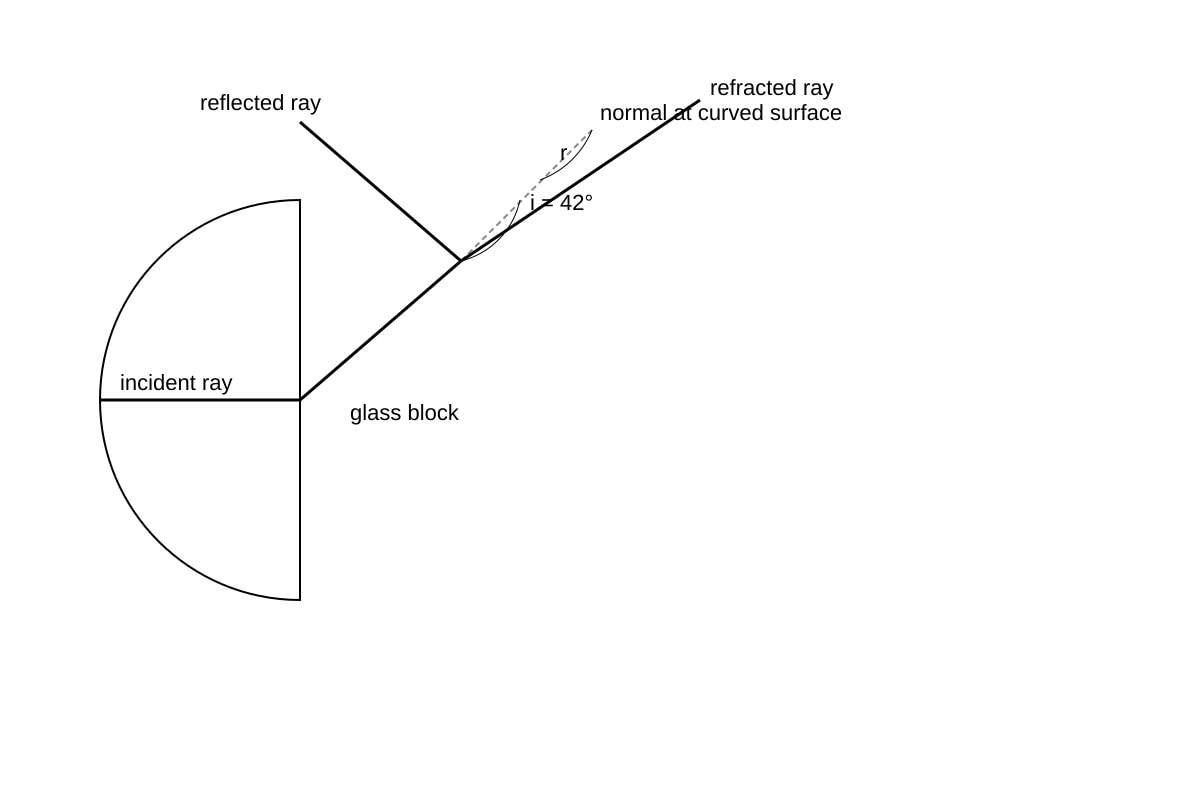
The diagram shows a ray of light entering a semicircular glass block at the centre of the flat side and leaving at the curved side.

Generated diagram for Q18.
(a) Explain why the ray enters without bending at the flat side.
(b) Define critical angle and state what happens when $i$ exceeds it.
[4 marks]
___________________________________________________________
19. A student investigates waves on a slinky. She moves her hand up and down 4 times in 2 seconds and measures the distance between two crests as 0.50 m.
(a) Calculate the frequency and wave speed.
(b) State whether this is longitudinal or transverse and give a reason.
[4 marks]
___________________________________________________________
- Describe an experiment to show that light travels in straight lines using a simple apparatus. Include the expected observation and conclusion.
[4 marks]
Answers
Secondary 3 Physics Quiz - Waves Sound Light (Answer Key)
Total Marks: 40
Topic: Waves, Sound & Light
Section A: Multiple Choice
Q1. B [1]
Teaching note: In a transverse wave, particle displacement is perpendicular to the direction of energy travel (e.g. water waves, light). A describes longitudinal waves.
Q2. C [1]
Teaching note: Sound is a longitudinal wave; it needs a medium (air, water, solids) and cannot travel in vacuum.
Q3. A [1]
Teaching note: Speed of light in air ≈3.0×10⁸ m s−1. 340 m s−1 is sound in air.
Q4. B [1]
Teaching note: Light slows down in glass; bending toward normal is due to lower speed, not frequency change (frequency constant).
Q5. C [1]
Teaching note: Constructive interference = crests meet crests, louder sound. Diffraction = spreading; refraction = bending; polarization = transverse-only.
Section B: Structured Questions
Q6. [2]
Formula: v=fλ
Substitute: v=5.0×0.12=0.60 m s−1
Marking: 1 mark substitution, 1 mark answer with unit.
Q7. [2]
Difference: Longitudinal – particles vibrate parallel to direction of travel; transverse – perpendicular.
Examples: Longitudinal – sound; transverse – water wave / light.
1 mark for difference, 1 mark for examples.
Q8. [2]
First resonance λ≈4L=4×0.165=0.66 m
v=fλ=512×0.66=338 m s−1 (approx 340 m s−1)
1 mark for λ, 1 mark for v.
Q9. [2]
n=sinrsini=sin25∘sin40∘=0.4230.643≈1.52
1 mark formula, 1 mark answer.
Q10. [2]
Light speed (∼3×10⁸ m s−1) much greater than sound (340 m s−1). Same distance covered in far less time by light. 1 mark speed difference, 1 mark conclusion.
Q11. [2]
Three loops = 1.5λ=1.2 m⇒λ=0.80 m.
1 mark relation, 1 mark answer.
Q12. [2]
Behaviour: diffraction. Condition: gap width similar to or smaller than wavelength. 1 mark each.
Q13. [2]
Total distance = vt=1500×0.40=600 m; depth = 300 m.
1 mark total distance, 1 mark depth.
Q14. [2]
Critical angle = angle of incidence in denser medium for which refracted angle in less dense medium is 90∘. 1 mark denser→less dense, 1 mark 90∘ refracted.
Q15. [3]
Property: interference / diffraction (accept interference). Dark bands: destructive interference where path difference = (n+21)λ, crests meet troughs.
1 mark property, 2 marks explanation.
Section C: Extended Response
Q16. [4]
(a) Law: angle of incidence = angle of reflection; incident ray, normal, reflected ray in same plane. [2]
(b) Angle to surface = 30∘ → angle to normal = 60∘ → reflection = 60∘. [2]
Q17. [4]
(a) v=fλ=256×1.33=340.5≈341 m s−1. [2]
(b) Speed higher in water because particles closer, better transmission; sound travels faster in liquids than gases. [2]
Q18. [4]
(a) Enters flat side perpendicular to normal → no bending (i=0). [2]
(b) Critical angle: in denser medium when refracted ray is 90∘; if exceeded → total internal reflection. [2]
Q19. [4]
(a) f=4/2=2.0 Hz; v=fλ=2.0×0.50=1.0 m s−1. [2]
(b) Transverse – hand moves up/down, wave travels along slinky perpendicular. [2]
Q20. [4]
Apparatus: candle, three cardboard screens with holes aligned, observer.
Procedure: place screens with holes in line, light candle behind; view through. Misalign one → no light.
Observation: light seen only when holes aligned. Conclusion: light travels straight.
1 mark apparatus, 1 mark procedure, 1 mark observation, 1 mark conclusion.
Free quiz and exam paper access
Enter your details to view this paper
Your access is remembered on this device.