From Real Exams Quiz

Secondary 3 Physics Thermal Physics Quiz

Free Sec 3 Physics Thermal Physics quiz, Nemo3 Exam version, with questions, answers, and O Level-style practice for Singapore students.

These static practice materials are generated from the site's syllabus and paper-generation workflow, with source and model context shown so students and parents can evaluate the material before use.

Secondary 3 Physics From Real Exams Generated by NVIDIA Nemotron 3 Ultra 550B A55B Free Updated 2026-06-18

Questions

<!-- TuitionGoWhere generation metadata: stage=3-0; model=nvidia/nemotron-3-ultra-550b-a55b:free; model_label=NVIDIA Nemotron 3 Ultra 550B A55B Free; generated=2026-06-18; Sources: Stage 2-1 real exam-derived templates and Stage 2-2 exam-enriched syllabus. -->

Secondary 3 Physics Quiz - Thermal Physics

Name: ___________________________
Class: ___________________________
Date: ___________________________
Score: ________ / 40

Duration: 45 minutes
Total Marks: 40

Instructions:

  • Answer all questions.
  • Write your answers in the spaces provided.
  • Show all working for calculation questions.
  • Use g=10 N/kgg = 10 \text{ N/kg} where needed.
  • The number of marks is given in brackets [ ] at the end of each question or part question.

Section A: Multiple Choice Questions (10 marks)

Answer all questions. Choose the correct option and write the letter (A, B, C, or D) in the box provided.

1. Which of the following statements about internal energy is correct? [1]

A. Internal energy is the sum of kinetic energy of all molecules only.
B. Internal energy increases when a substance melts at constant temperature.
C. Internal energy depends only on the temperature of the substance.
D. Internal energy is zero at 0°C.

2. A 200 g block of metal at 100°C is placed into 300 g of water at 20°C. Assuming no heat loss to the surroundings, which of the following expressions correctly represents the final temperature TfT_f? [1]

A. Tf=mmcm(100)+mwcw(20)mmcm+mwcwT_f = \frac{m_m c_m (100) + m_w c_w (20)}{m_m c_m + m_w c_w}
B. Tf=mmcm(10020)mmcm+mwcwT_f = \frac{m_m c_m (100 - 20)}{m_m c_m + m_w c_w}
C. Tf=mmcm(100)mwcw(20)mmcmmwcwT_f = \frac{m_m c_m (100) - m_w c_w (20)}{m_m c_m - m_w c_w}
D. Tf=mmcm(100)+mwcw(20)mmcmmwcwT_f = \frac{m_m c_m (100) + m_w c_w (20)}{m_m c_m - m_w c_w}

3. The specific latent heat of vaporisation of water is 2260 kJ/kg. What does this mean? [1]

A. 2260 kJ of energy is needed to raise the temperature of 1 kg of water by 1°C.
B. 2260 kJ of energy is needed to convert 1 kg of water at 100°C to steam at 100°C.
C. 2260 kJ of energy is released when 1 kg of steam condenses to water at 0°C.
D. 2260 kJ of energy is needed to convert 1 kg of ice at 0°C to water at 0°C.

4. A student heats a beaker of water using a Bunsen burner. The water is heated from 25°C to 75°C. Which method of heat transfer is the main method transferring heat through the water? [1]

A. Conduction
B. Convection
C. Radiation
D. Evaporation

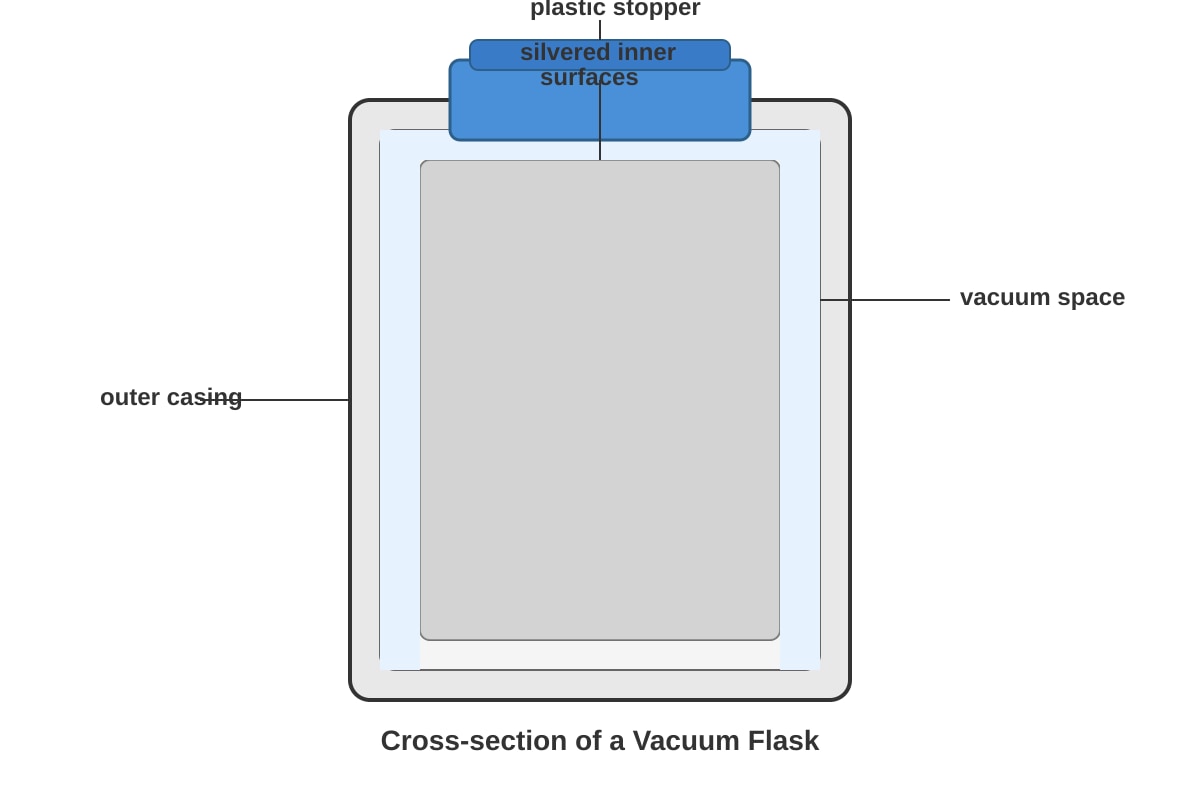
5. The diagram below shows a vacuum flask.

<image_placeholder> id: Q5-fig1 type: diagram linked_question: Q5 description: Cross-section of a vacuum flask showing double-walled glass container with vacuum between walls, silvered surfaces, plastic stopper, and outer casing. Labels required: vacuum space, silvered inner surfaces, plastic stopper, outer casing. labels: vacuum space, silvered inner surfaces, plastic stopper, outer casing values: none must_show: Double walls with vacuum gap, silvered surfaces facing vacuum, stopper at top </image_placeholder>

Which feature of the vacuum flask reduces heat loss by radiation? [1]

A. The vacuum between the double walls
B. The silvered surfaces of the inner walls
C. The plastic stopper
D. The outer casing

6. A 500 W immersion heater is used to heat 2 kg of water for 3 minutes. The specific heat capacity of water is 4200 J/(kg·°C). Assuming no heat loss, what is the temperature rise of the water? [1]

A. 1.07°C
B. 10.7°C
C. 21.4°C
D. 107°C

7. During boiling, the temperature of a liquid remains constant. What happens to the energy supplied? [1]

A. It increases the kinetic energy of the molecules.
B. It increases the potential energy of the molecules.
C. It is lost to the surroundings.
D. It increases both kinetic and potential energy equally.

8. Two identical metal blocks, one at 80°C and one at 20°C, are placed in good thermal contact in an insulated container. After a long time, what is the final temperature of the blocks? [1]

A. 30°C
B. 40°C
C. 50°C
D. 60°C

9. Which of the following is a poor conductor of heat? [1]

A. Copper
B. Aluminium
C. Air
D. Iron

10. A student measures the specific heat capacity of a metal block using an electrical method. The block has a mass of 1 kg and is heated by a 100 W heater for 5 minutes. The temperature rises from 20°C to 60°C. Assuming no heat loss, what is the specific heat capacity of the metal? [1]

A. 375 J/(kg·°C)
B. 500 J/(kg·°C)
C. 750 J/(kg·°C)
D. 1500 J/(kg·°C)


Section B: Short Answer and Structured Questions (18 marks)

11. Define the term specific heat capacity. [2]


12. Explain why the temperature of a pure substance remains constant during melting, even though heat is continuously supplied. [2]


13. A 0.5 kg aluminium block at 150°C is placed into 1.0 kg of water at 25°C in an insulated container. The specific heat capacity of aluminium is 900 J/(kg·°C) and that of water is 4200 J/(kg·°C). Calculate the final equilibrium temperature of the mixture. [3]


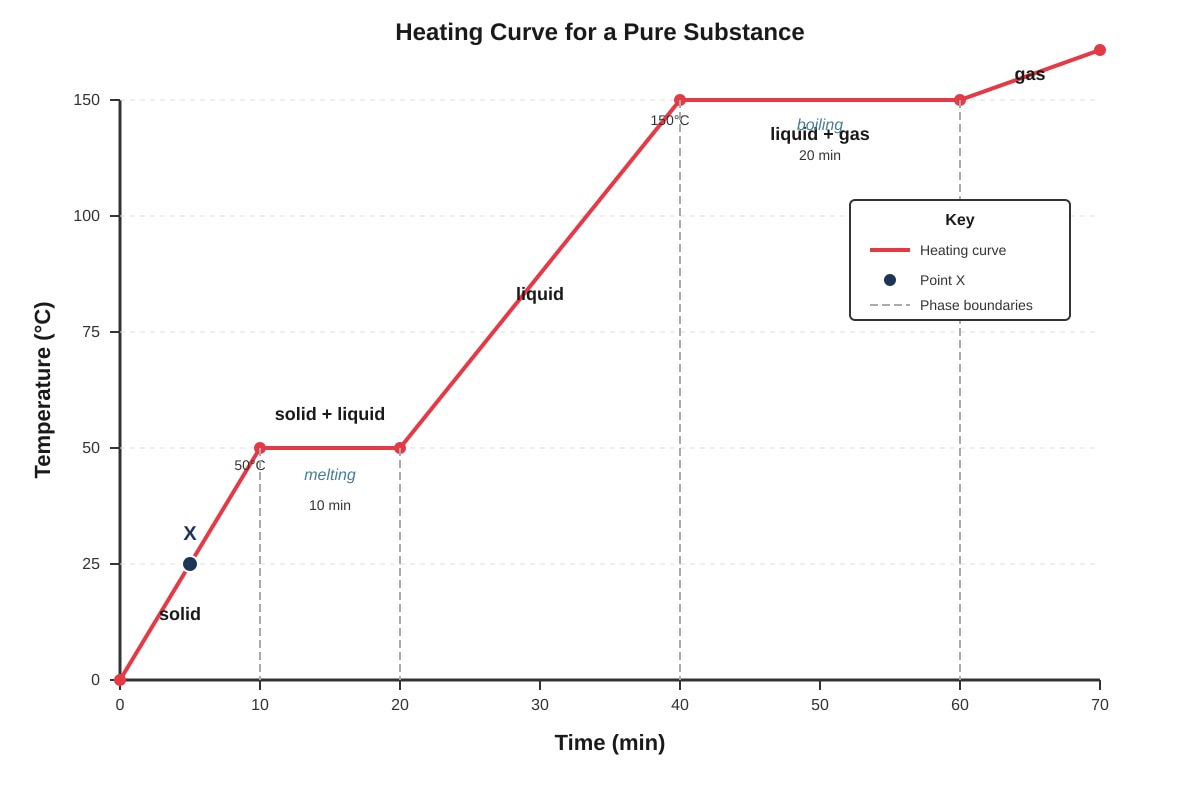
14. The diagram below shows a heating curve for a pure substance.

<image_placeholder> id: Q14-fig1 type: graph linked_question: Q14 description: Heating curve graph with temperature on y-axis and time on x-axis. Shows three sloped sections (solid heating, liquid heating, gas heating) and two flat sections (melting, boiling). Labels required: solid, liquid, gas, melting, boiling, temperature, time. labels: solid, liquid, gas, melting, boiling, temperature (°C), time (min) values: Melting point at 50°C, boiling point at 150°C. Flat sections at 50°C for 10 min, 150°C for 20 min. must_show: Clear plateaus at melting and boiling points, sloped sections for temperature changes </image_placeholder>

(a) State the physical state of the substance at point X (on the first sloped section). [1]


(b) Explain why the temperature remains constant during the flat section at 50°C. [2]


(c) If the mass of the substance is 2.0 kg and the heater supplies energy at a constant rate of 500 W, calculate the specific latent heat of fusion of the substance. [2]


15. A double-glazed window consists of two glass panes separated by a layer of air. Explain how the air layer reduces heat loss from a warm room to the cold outside. [2]


16. The specific latent heat of vaporisation of ethanol is 840 kJ/kg. Calculate the energy required to convert 50 g of ethanol at its boiling point to vapour at the same temperature. [2]


17. A student carries out an experiment to determine the specific heat capacity of oil using an electrical heater. The student records the following data:

  • Mass of oil = 0.2 kg
  • Heater power = 60 W
  • Time = 4 minutes
  • Initial temperature = 20°C
  • Final temperature = 50°C

(a) Calculate the specific heat capacity of the oil, assuming no heat loss. [2]


(b) In practice, the calculated value is higher than the true specific heat capacity of the oil. Explain why. [1]


Section C: Longer Structured Questions (12 marks)

18. A solar water heater uses a black metal panel to absorb radiation from the Sun. Water flows through pipes attached to the panel.

<image_placeholder> id: Q18-fig1 type: diagram linked_question: Q18 description: Solar water heater diagram showing black metal panel with water pipes, insulated backing, glass cover, cold water inlet, hot water outlet. Sun rays shown incident on panel. labels: black metal panel, water pipes, insulated backing, glass cover, cold water inlet, hot water outlet, Sun rays values: Panel area = 2.0 m², solar intensity = 800 W/m², water flow rate = 0.05 kg/s, specific heat capacity of water = 4200 J/(kg·°C) must_show: Panel with pipes, glass cover, insulation, flow direction, Sun rays </image_placeholder>

(a) Explain why the metal panel is painted black. [1]


(b) The solar intensity is 800 W/m² and the panel area is 2.0 m². The water flows through the panel at a rate of 0.05 kg/s. Assuming all solar energy absorbed is transferred to the water, calculate the temperature rise of the water as it passes through the panel. [3]


(c) The glass cover reduces heat loss from the panel. Explain how the glass cover reduces heat loss by convection. [2]


19. An electric kettle rated at 2.0 kW is used to heat 1.5 kg of water from 25°C to 100°C. The specific heat capacity of water is 4200 J/(kg·°C). The kettle takes 4 minutes 30 seconds to heat the water to boiling point.

(a) Calculate the energy supplied by the kettle in this time. [1]


(b) Calculate the energy required to heat the water from 25°C to 100°C. [2]


(c) Suggest a reason for the difference between your answers to (a) and (b). [1]


(d) After the water reaches boiling point, the kettle continues to boil for 2 minutes before switching off. Calculate the mass of water that evaporates during this time. The specific latent heat of vaporisation of water is 2260 kJ/kg. [2]


20. The diagram below shows a cooling curve for naphthalene.

<image_placeholder> id: Q20-fig1 type: graph linked_question: Q20 description: Cooling curve graph with temperature on y-axis and time on x-axis. Shows sloped sections for gas cooling, liquid cooling, solid cooling, and flat sections for condensation and freezing. Labels required: gas, liquid, solid, condensation, freezing, temperature, time. labels: gas, liquid, solid, condensation, freezing, temperature (°C), time (min) values: Condensation at 218°C for 5 min, freezing at 80°C for 10 min. Initial temperature 250°C, final temperature 30°C. must_show: Clear plateaus at condensation and freezing points, sloped sections for cooling </image_placeholder>

(a) State the freezing point of naphthalene from the graph. [1]


(b) During the flat section at 80°C, the substance is freezing. Describe the arrangement and motion of the particles in the solid state compared to the liquid state. [2]


(c) The mass of naphthalene is 100 g. The heater was removed and the substance cools by losing heat to the surroundings at an average rate of 50 W. Calculate the specific latent heat of fusion of naphthalene. [3]


(d) Explain why the temperature remains constant during freezing even though heat is being lost to the surroundings. [2]


End of Quiz

Answers

<!-- TuitionGoWhere generation metadata: stage=3-0; model=nvidia/nemotron-3-ultra-550b-a55b:free; model_label=NVIDIA Nemotron 3 Ultra 550B A55B Free; generated=2026-06-18; Sources: Stage 2-1 real exam-derived templates and Stage 2-2 exam-enriched syllabus. -->

Secondary 3 Physics Quiz - Thermal Physics (Answer Key)

Total Marks: 40


Section A: Multiple Choice Questions (10 marks)

1. Answer: B [1]
Explanation: Internal energy is the sum of kinetic and potential energy of all molecules. During melting at constant temperature, the supplied latent heat increases the potential energy of molecules (overcoming intermolecular forces), so internal energy increases.
Common mistake: Option A is incorrect because internal energy includes potential energy. Option C is incorrect because internal energy also depends on mass and state. Option D is incorrect because 0°C is not absolute zero.

2. Answer: A [1]
Explanation: By conservation of energy (heat lost by metal = heat gained by water):
mmcm(100Tf)=mwcw(Tf20)m_m c_m (100 - T_f) = m_w c_w (T_f - 20)
Rearranging: Tf=mmcm(100)+mwcw(20)mmcm+mwcwT_f = \frac{m_m c_m (100) + m_w c_w (20)}{m_m c_m + m_w c_w}

3. Answer: B [1]
Explanation: Specific latent heat of vaporisation is the energy required to change 1 kg of a substance from liquid to gas at its boiling point without temperature change. For water, this is 2260 kJ/kg at 100°C.

4. Answer: B [1]
Explanation: In fluids (liquids and gases), convection is the main method of heat transfer. Hot water rises, cold water sinks, creating convection currents that distribute heat throughout the water.

5. Answer: B [1]
Explanation: Silvered surfaces reflect infrared radiation, reducing heat loss by radiation. The vacuum reduces conduction and convection. The plastic stopper reduces convection and conduction at the top.

6. Answer: B [1]
Working:
Energy supplied = Power × Time = 500 W × (3 × 60 s) = 90,000 J
Q=mcΔθQ = mc\Delta\theta
90,000=2×4200×Δθ90,000 = 2 \times 4200 \times \Delta\theta
Δθ=90,0008400=10.7C\Delta\theta = \frac{90,000}{8400} = 10.7^\circ\text{C}

7. Answer: B [1]
Explanation: During boiling, energy supplied (latent heat) increases the potential energy of molecules by overcoming intermolecular forces to separate them into gas. Kinetic energy (temperature) remains constant.

8. Answer: C [1]
Explanation: Identical blocks with same mass and specific heat capacity. Heat lost by hot block = heat gained by cold block.
mc(80Tf)=mc(Tf20)mc(80 - T_f) = mc(T_f - 20)
80Tf=Tf2080 - T_f = T_f - 20
2Tf=1002T_f = 100
Tf=50CT_f = 50^\circ\text{C}

9. Answer: C [1]
Explanation: Air is a poor conductor of heat (good insulator). Metals like copper, aluminium, and iron are good conductors.

10. Answer: C [1]
Working:
Energy supplied = 100 W × (5 × 60 s) = 30,000 J
Q=mcΔθQ = mc\Delta\theta
30,000=1×c×(6020)30,000 = 1 \times c \times (60 - 20)
c=30,00040=750 J/(kg⋅°C)c = \frac{30,000}{40} = 750 \text{ J/(kg·°C)}


Section B: Short Answer and Structured Questions (18 marks)

11. Answer: [2]
Specific heat capacity of a substance is the amount of thermal energy required to raise the temperature of 1 kg of the substance by 1°C (or 1 K).
Mark breakdown: 1 mark for "energy required to raise temperature of 1 kg by 1°C", 1 mark for correct unit reference (J/(kg·°C) or J/(kg·K)).

12. Answer: [2]
During melting, the supplied heat energy (latent heat of fusion) is used to overcome the intermolecular forces holding the particles in a fixed lattice structure. This increases the potential energy of the molecules, not their kinetic energy. Since temperature is proportional to average kinetic energy, the temperature remains constant.
Mark breakdown: 1 mark for "energy used to overcome intermolecular forces / increase potential energy", 1 mark for "kinetic energy/temperature unchanged".

13. Answer: [3]
Heat lost by aluminium = Heat gained by water
mAlcAl(150Tf)=mwcw(Tf25)m_{Al} c_{Al} (150 - T_f) = m_w c_w (T_f - 25)
0.5×900×(150Tf)=1.0×4200×(Tf25)0.5 \times 900 \times (150 - T_f) = 1.0 \times 4200 \times (T_f - 25)
450(150Tf)=4200(Tf25)450(150 - T_f) = 4200(T_f - 25)
67,500450Tf=4200Tf105,00067,500 - 450T_f = 4200T_f - 105,000
172,500=4650Tf172,500 = 4650T_f
Tf=37.1CT_f = 37.1^\circ\text{C}
Mark breakdown: 1 mark for correct heat balance equation, 1 mark for correct substitution, 1 mark for correct final answer with unit.

14. (a) Answer: Solid [1]
(b) Answer: [2]
At 50°C (melting point), the substance is changing state from solid to liquid. The supplied heat energy is used as latent heat of fusion to overcome intermolecular forces and increase potential energy of molecules, not to increase kinetic energy. Hence temperature remains constant.
Mark breakdown: 1 mark for "latent heat used to overcome forces / increase potential energy", 1 mark for "kinetic energy/temperature constant".

(c) Answer: [2]
Energy supplied during melting = Power × Time = 500 W × (10 × 60 s) = 300,000 J
Q=mLfQ = mL_f
300,000=2.0×Lf300,000 = 2.0 \times L_f
Lf=150,000 J/kg=150 kJ/kgL_f = 150,000 \text{ J/kg} = 150 \text{ kJ/kg}
Mark breakdown: 1 mark for correct energy calculation, 1 mark for correct LfL_f with unit.

15. Answer: [2]
Air is a poor conductor of heat. The trapped air layer between the glass panes reduces heat loss by conduction. Since the air layer is narrow, convection currents are restricted/minimised, further reducing heat transfer by convection.
Mark breakdown: 1 mark for "air is poor conductor / reduces conduction", 1 mark for "narrow gap restricts convection".

16. Answer: [2]
Q=mLvQ = mL_v
m=50 g=0.05 kgm = 50 \text{ g} = 0.05 \text{ kg}
Lv=840 kJ/kg=840,000 J/kgL_v = 840 \text{ kJ/kg} = 840,000 \text{ J/kg}
Q=0.05×840,000=42,000 J=42 kJQ = 0.05 \times 840,000 = 42,000 \text{ J} = 42 \text{ kJ}
Mark breakdown: 1 mark for correct formula and unit conversion, 1 mark for correct final answer with unit.

17. (a) Answer: [2]
Energy supplied = 60 W × (4 × 60 s) = 14,400 J
Q=mcΔθQ = mc\Delta\theta
14,400=0.2×c×(5020)14,400 = 0.2 \times c \times (50 - 20)
14,400=0.2×c×3014,400 = 0.2 \times c \times 30
c=14,4006=2400 J/(kg⋅°C)c = \frac{14,400}{6} = 2400 \text{ J/(kg·°C)}
Mark breakdown: 1 mark for correct energy and Δθ\Delta\theta, 1 mark for correct cc with unit.

(b) Answer: [1]
Heat is lost to the surroundings (container, air) during heating, so not all electrical energy goes into heating the oil. The calculated cc assumes all energy heats the oil, giving a higher value than the true cc.


Section C: Longer Structured Questions (12 marks)

18. (a) Answer: [1]
Black surfaces are good absorbers of radiation (and good emitters). Painting the panel black maximises absorption of solar radiation.

(b) Answer: [3]
Solar power absorbed = Intensity × Area = 800 W/m² × 2.0 m² = 1600 W
Energy absorbed per second = 1600 J/s
Mass of water per second = 0.05 kg/s
Q=mcΔθQ = mc\Delta\theta
1600=0.05×4200×Δθ1600 = 0.05 \times 4200 \times \Delta\theta
Δθ=1600210=7.62C\Delta\theta = \frac{1600}{210} = 7.62^\circ\text{C}
Mark breakdown: 1 mark for power absorbed, 1 mark for correct formula/substitution, 1 mark for correct answer with unit.

(c) Answer: [2]
The glass cover traps a layer of air between the glass and the panel. This trapped air cannot easily form convection currents to carry heat away from the hot panel to the cooler glass. Thus convection heat loss is reduced.
Mark breakdown: 1 mark for "traps air layer", 1 mark for "restricts convection currents / reduces convection".

19. (a) Answer: [1]
Energy = Power × Time = 2000 W × (4.5 × 60 s) = 2000 × 270 = 540,000 J = 540 kJ

(b) Answer: [2]
Q=mcΔθ=1.5×4200×(10025)=1.5×4200×75=472,500 J=472.5 kJQ = mc\Delta\theta = 1.5 \times 4200 \times (100 - 25) = 1.5 \times 4200 \times 75 = 472,500 \text{ J} = 472.5 \text{ kJ}
Mark breakdown: 1 mark for correct formula/substitution, 1 mark for correct answer with unit.

(c) Answer: [1]
Heat is lost to the surroundings (kettle body, air) during heating, so the energy supplied is greater than the energy absorbed by the water.

(d) Answer: [2]
Energy supplied in 2 minutes = 2000 W × (2 × 60 s) = 240,000 J
Q=mLvQ = mL_v
240,000=m×2,260,000240,000 = m \times 2,260,000
m=240,0002,260,000=0.106 kg=106 gm = \frac{240,000}{2,260,000} = 0.106 \text{ kg} = 106 \text{ g}
Mark breakdown: 1 mark for correct energy calculation, 1 mark for correct mass with unit.

20. (a) Answer: 80°C [1]
(b) Answer: [2]
In the solid state, particles are closely packed in a fixed, ordered arrangement (lattice) and vibrate about fixed positions. In the liquid state, particles are still close but not in a fixed arrangement; they can slide past one another and move more freely.
Mark breakdown: 1 mark for solid arrangement/motion, 1 mark for liquid arrangement/motion (comparison implied).

(c) Answer: [3]
Energy lost during freezing = Power × Time = 50 W × (10 × 60 s) = 30,000 J
Q=mLfQ = mL_f
30,000=0.1×Lf30,000 = 0.1 \times L_f
Lf=300,000 J/kg=300 kJ/kgL_f = 300,000 \text{ J/kg} = 300 \text{ kJ/kg}
Mark breakdown: 1 mark for correct energy lost, 1 mark for correct formula, 1 mark for correct LfL_f with unit.

(d) Answer: [2]
During freezing, the substance releases latent heat of fusion as particles form bonds and potential energy decreases. This released energy compensates for the heat lost to the surroundings, keeping the average kinetic energy (and thus temperature) constant until all liquid has solidified.
Mark breakdown: 1 mark for "latent heat released as bonds form / potential energy decreases", 1 mark for "released energy balances heat loss / kinetic energy constant".


End of Answer Key