From Real Exams Quiz
Secondary 3 Physics Thermal Physics Quiz
Free Sec 3 Physics Thermal Physics quiz, HY3 Exam version, with questions, answers, and O Level-style practice for Singapore students.
These static practice materials are generated from the site's syllabus and paper-generation workflow, with source and model context shown so students and parents can evaluate the material before use.
Questions
Free quiz and exam paper access
Enter your details to view this paper
Your access is remembered on this device.
Answers
Secondary 3 Physics Quiz - Thermal Physics (Answers)
Total Marks: 40
Topic: Thermal Physics
Section A: Multiple Choice (1 mark each)
-
C (Radiation)
Teaching note: Radiation transfers energy by infrared waves and needs no medium; conduction and convection need particles. -
D (1 kg of the substance by 1 K)
Teaching note: SI definition uses mass = 1 kg and temperature change = 1 K (same size as 1°C). -
B (Increase the potential energy of molecules)
Teaching note: At boiling, energy breaks bonds, raising potential energy, not average kinetic energy (temperature constant). -
C (Copper)
Teaching note: Metals with free electrons conduct best; copper is a strong conductor. -
B (Thermal expansion)
Teaching note: Liquid-in-glass thermometers rely on expansion with temperature.
Section B: Structured Short Answers (2 marks each)
-
Heat is energy transferred due to temperature difference; temperature is the degree of hotness / average KE of molecules. (2m: 1 for each correct idea)
Common mistake: Saying heat and temperature are the same. -
Metal has higher thermal conductivity, so it draws heat from hand faster → feels colder. (2m: 1 for conductivity, 1 for heat flow from hand)
Note: Both spoons are at room temp; sensation is due to rate of heat transfer. -
Convection; example: warm air rising from a heater / sea breeze. (2m: 1 name, 1 example)
Marking: Accept any correct everyday example. -
Specific latent heat of fusion is the heat needed to change 1 kg of solid to liquid at constant temperature. (2m: 1 kg + change of state, 1 constant temp)
Formula: . -
Dull black surfaces are good emitters and absorbers of radiation; helps release heat from condenser coils at back. (2m: 1 dull black property, 1 purpose)
Note: Back of fridge is hot side; radiation aids cooling.
Section C: Calculation & Extended Response
-
(3 marks)
Marks: 1 formula, 1 substitution, 1 answer.
Teaching: K (or °C same interval). -
(3 marks)
Marks: 1 formula, 1 calc , 1 final temp.
Common error: Forgetting to add initial temp. -
(3 marks)
Marks: 1 formula, 1 sub, 1 answer.
Note: Temp constant at 0°C during fusion. -
(4 marks)
Heat lost by metal = heat gained by water
Marks: 1 eq, 1 water side, 1 metal side, 1 answer.
Teaching: Energy conserved in insulated calorimeter. -
(3 marks)
In vacuum, only evaporation cools liquid (no conduction/convection). (1) Faster molecules escape, avg KE drops. (1) Temp falls as KE decreases. (1)
Marking: Kinetic theory of evaporation required. -
(4 marks)
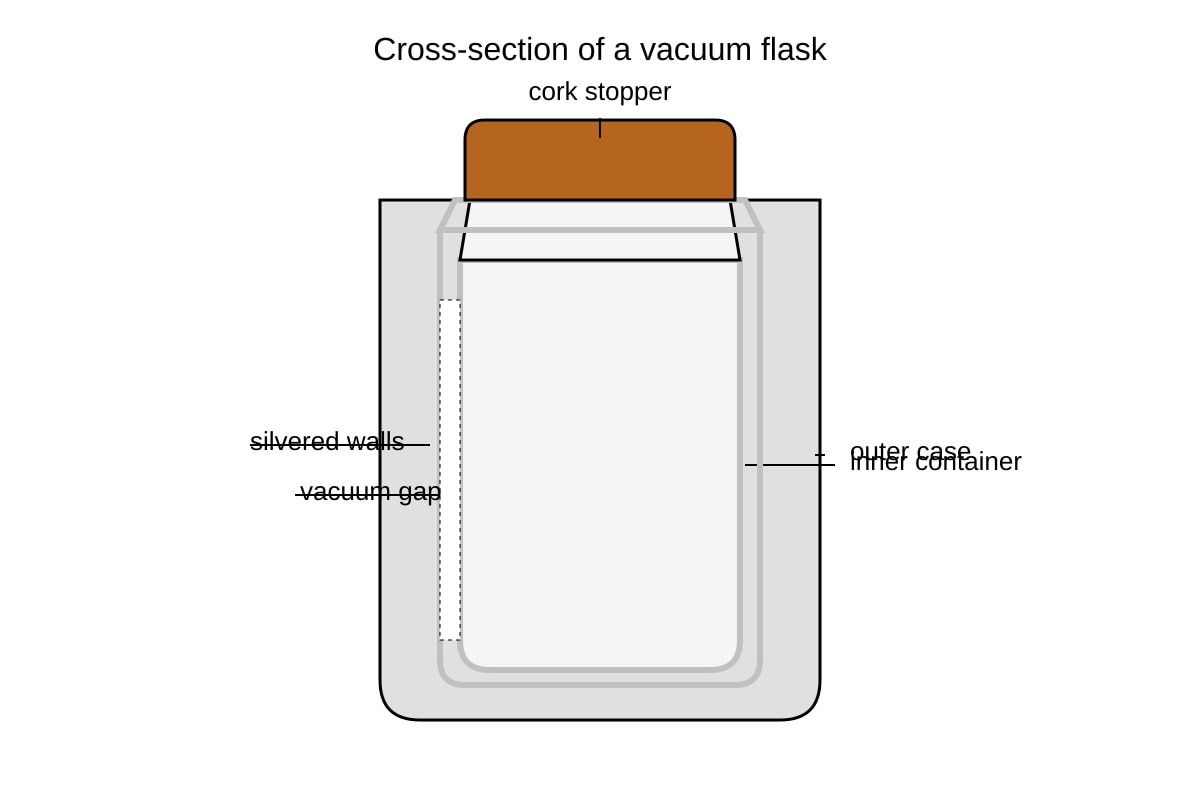
- Vacuum gap: stops conduction & convection. (1)
- Silvered walls: reflect radiation back. (1)
- Cork stopper: poor conductor, reduces conduction/convection at neck. (1)
- Narrow neck: reduces surface area for loss. (1)
Based on diagram Q16-fig1: double wall + silver + stopper visible.
-
(3 marks)
Marks: 1 formula, 1 sub, 1 answer.
Note: K. -
(4 marks)
Heat lost = heat gained
Divide 4200:
Marks: 1 eq, 1 simplify, 1 solve, 1 answer.
Teaching: Insulated → no loss to surroundings. -
(3 marks)
(Any two, 1.5 each)
- Increase temperature: more molecules exceed escape energy.
- Increase surface area: more molecules can escape.
- Blow air / dry wind: removes vapour, speeds net loss.
Marking: Each with explanation.
- (4 marks)
Statement false. (1) Ice at 0°C gaining latent heat changes state, not temp. (1) Energy breaks bonds / raises potential energy. (1) Temp stays 0°C until all melted. (1)
Marking descriptors: Eval with latent heat concept = full.