From Real Exams Quiz

Secondary 3 Physics Modern Physics Quiz

Free Sec 3 Physics Modern Physics quiz, Nemo3 Exam version, with questions, answers, and O Level-style practice for Singapore students.

These static practice materials are generated from the site's syllabus and paper-generation workflow, with source and model context shown so students and parents can evaluate the material before use.

Secondary 3 Physics From Real Exams Generated by NVIDIA Nemotron 3 Ultra 550B A55B Free Updated 2026-06-18

Questions

<!-- TuitionGoWhere generation metadata: stage=3-0; model=nvidia/nemotron-3-ultra-550b-a55b:free; model_label=NVIDIA Nemotron 3 Ultra 550B A55B Free; generated=2026-06-18; Sources: Stage 2-1 real exam-derived templates and Stage 2-2 exam-enriched syllabus. -->

Secondary 3 Physics Quiz - Modern Physics

Name: ___________________________
Class: ___________________________
Date: ___________________________
Score: _____ / 40

Duration: 45 minutes
Total Marks: 40

Instructions:

  • Answer all questions.
  • Write your answers in the spaces provided.
  • For calculation questions, show your working clearly.
  • Use c=3.0×10⁸ m/sc = 3.0 \times 10^8 \text{ m/s} for the speed of light in vacuum.
  • Use h=6.63×1034 J sh = 6.63 \times 10^{-34} \text{ J s} for Planck's constant.
  • Use e=1.60×10¹⁹ Ce = 1.60 \times 10^{-19} \text{ C} for the elementary charge.

Section A: Multiple Choice Questions (10 marks)

Answer all questions. Choose the correct option and write the letter (A, B, C, or D) in the box provided.

1. [1 mark]

Which of the following statements about the photoelectric effect is correct?

A. The kinetic energy of emitted electrons depends on the intensity of incident light.
B. Electrons are emitted only if the frequency of incident light exceeds a threshold frequency.
C. There is a significant time delay between illumination and electron emission.
D. The number of emitted electrons per second is independent of light intensity.

Answer: □

2. [1 mark]

A photon has a wavelength of 500 nm. What is its energy in electronvolts (eV)?

A. 1.24 eV
B. 2.48 eV
C. 3.72 eV
D. 4.96 eV

Answer: □

3. [1 mark]

In a photoelectric experiment, the stopping potential is measured to be 2.5 V. What is the maximum kinetic energy of the emitted photoelectrons?

A. 2.5×10¹⁹ J2.5 \times 10^{-19} \text{ J}
B. 4.0×10¹⁹ J4.0 \times 10^{-19} \text{ J}
C. 2.5 eV2.5 \text{ eV}
D. 4.0 eV4.0 \text{ eV}

Answer: □

4. [1 mark]

The work function of a metal is 2.0 eV. Light of frequency 8.0×10¹⁴ Hz8.0 \times 10^{14} \text{ Hz} is incident on the metal surface. What is the maximum kinetic energy of the emitted photoelectrons? (Use h=6.63×1034 J sh = 6.63 \times 10^{-34} \text{ J s})

A. 0.3 eV
B. 1.3 eV
C. 2.3 eV
D. 3.3 eV

Answer: □

5. [1 mark]

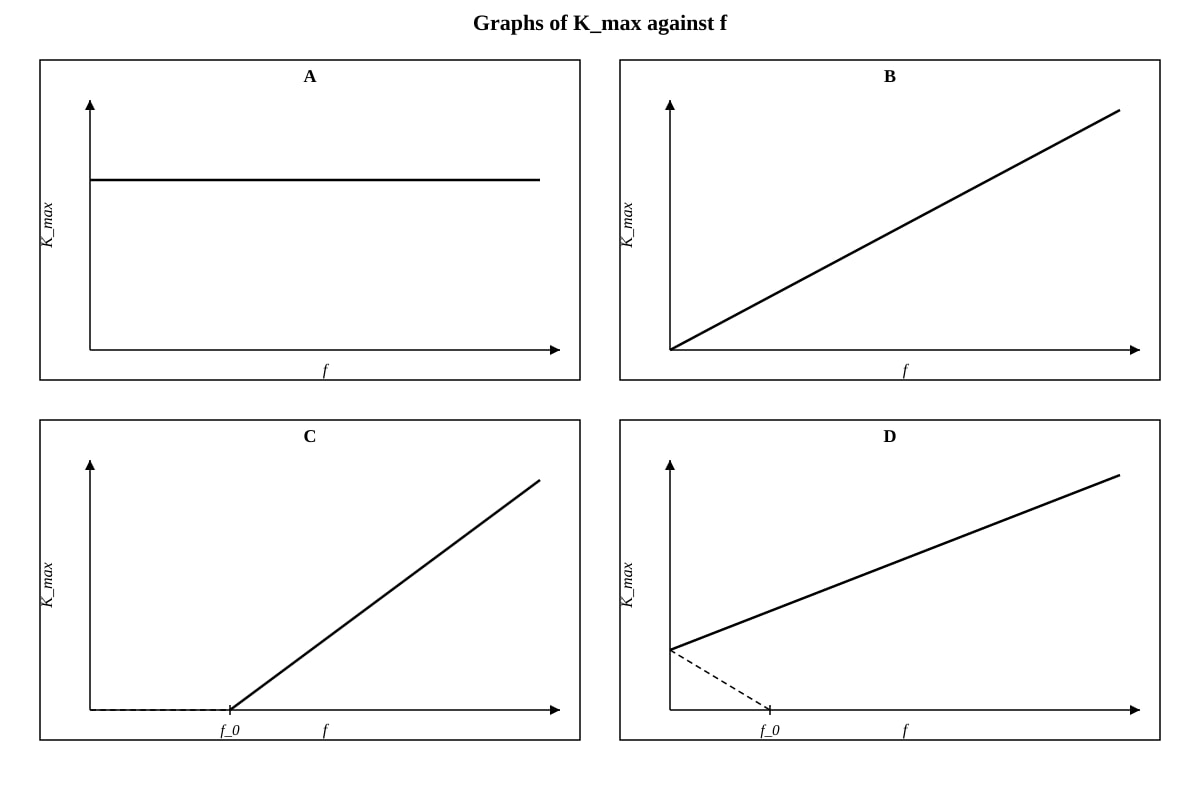
Which graph correctly shows the relationship between the maximum kinetic energy KmaxK_{\text{max}} of photoelectrons and the frequency ff of incident light?

<image_placeholder> id: Q5-fig1 type: graph linked_question: Q5 description: Four graphs showing K_max vs f. Graph A: horizontal line. Graph B: straight line through origin with positive slope. Graph C: straight line with positive slope and negative f-intercept. Graph D: straight line with positive slope and positive f-intercept. labels: K_max (y-axis), f (x-axis), threshold frequency f_0 marked on x-axis for Graph C values: None must_show: Graph C must show linear relationship with x-intercept at threshold frequency f_0 </image_placeholder>

Answer: □

6. [1 mark]

An electron is accelerated through a potential difference of 100 V. What is its de Broglie wavelength? (Use me=9.11×1031 kgm_e = 9.11 \times 10^{-31} \text{ kg})

A. 1.23×10¹⁰ m1.23 \times 10^{-10} \text{ m}
B. 2.46×10¹⁰ m2.46 \times 10^{-10} \text{ m}
C. 3.69×10¹⁰ m3.69 \times 10^{-10} \text{ m}
D. 4.92×10¹⁰ m4.92 \times 10^{-10} \text{ m}

Answer: □

7. [1 mark]

Which of the following provides evidence for the wave nature of electrons?

A. Photoelectric effect
B. Compton scattering
C. Electron diffraction
D. Line emission spectra

Answer: □

8. [1 mark]

In the Bohr model of the hydrogen atom, the energy of an electron in the nn-th energy level is given by En=13.6n2 eVE_n = -\frac{13.6}{n^2} \text{ eV}. What is the energy of the photon emitted when an electron transitions from n=3n=3 to n=2n=2?

A. 1.89 eV
B. 2.55 eV
C. 3.40 eV
D. 10.2 eV

Answer: □

9. [1 mark]

X-rays are produced when high-energy electrons strike a metal target. Which statement about the resulting X-ray spectrum is correct?

A. The characteristic X-ray lines depend on the accelerating voltage.
B. The minimum wavelength of the continuous spectrum depends on the target material.
C. The intensity of the continuous spectrum increases with increasing accelerating voltage.
D. The characteristic X-ray lines appear at wavelengths longer than the minimum wavelength.

Answer: □

10. [1 mark]

A radioactive sample has a half-life of 12 hours. What fraction of the original sample remains after 36 hours?

A. 12\frac{1}{2}
B. 14\frac{1}{4}
C. 18\frac{1}{8}
D. 116\frac{1}{16}

Answer: □


Section B: Structured Questions (30 marks)

Answer all questions in the spaces provided.

11. [3 marks]

The photoelectric effect cannot be explained by classical wave theory.

(a) State two observations from the photoelectric effect that contradict classical wave theory. [2]


(b) Explain how Einstein's photon theory accounts for one of these observations. [1]


12. [4 marks]

In a photoelectric experiment, monochromatic light of wavelength 400 nm is incident on a metal surface with work function 2.1 eV.

(a) Calculate the energy of a single photon of this light in joules. [2]


(b) Calculate the maximum kinetic energy of the emitted photoelectrons in eV. [2]


13. [3 marks]

The diagram below shows the energy levels of a hydrogen atom.

<image_placeholder> id: Q13-fig1 type: diagram linked_question: Q13 description: Energy level diagram for hydrogen atom showing n=1, n=2, n=3, n=4, n=5, and n=infinity (ionization level). Energy values in eV marked on the right: n=1: -13.6 eV, n=2: -3.4 eV, n=3: -1.51 eV, n=4: -0.85 eV, n=5: -0.54 eV, n=infinity: 0 eV. Arrows showing transitions from higher to lower levels. labels: Energy levels labelled n=1 to n=5 and n=infinity, energy values in eV, transition arrows values: E1 = -13.6 eV, E2 = -3.4 eV, E3 = -1.51 eV, E4 = -0.85 eV, E5 = -0.54 eV must_show: All energy levels with correct values, at least three transition arrows (e.g., 3→2, 4→2, 5→2) </image_placeholder>

(a) Calculate the wavelength of the photon emitted when an electron transitions from n=4n=4 to n=2n=2. [2]


(b) State which series (Lyman, Balmer, or Paschen) this transition belongs to. [1]


14. [4 marks]

An X-ray tube operates at an accelerating voltage of 50 kV.

(a) Calculate the minimum wavelength of the continuous X-ray spectrum produced. [2]


(b) Explain why the continuous X-ray spectrum has a sharp cut-off at this minimum wavelength. [2]


15. [3 marks]

The de Broglie wavelength of a particle is given by λ=hp\lambda = \frac{h}{p}.

(a) Calculate the de Broglie wavelength of an electron moving at 2.0×10⁶ m/s2.0 \times 10^6 \text{ m/s}. [2]


(b) Explain why the wave nature of electrons is not observable in everyday macroscopic objects. [1]


16. [4 marks]

A radioactive isotope decays by emitting α\alpha-particles. The activity of a sample is measured at regular intervals and the following data is obtained:

Time (days)Activity (Bq)
08000
104000
202000
301000
40500

(a) Determine the half-life of the isotope. [1]


(b) Calculate the decay constant λ\lambda in day1\text{day}^{-1}. [2]


(c) Calculate the activity after 55 days. [1]


17. [3 marks]

In a Geiger-Müller tube experiment, a radioactive source is placed at a fixed distance from the detector. The count rate is recorded with and without a 2 cm thick lead sheet placed between the source and detector.

AbsorberCount rate (counts/min)
None1200
2 cm Pb150

Background count rate = 30 counts/min.

(a) Calculate the corrected count rate without the absorber. [1]


(b) Calculate the fraction of radiation transmitted through the 2 cm lead sheet. [1]


(c) What type of radiation is most likely being emitted? Explain your reasoning. [1]


18. [3 marks]

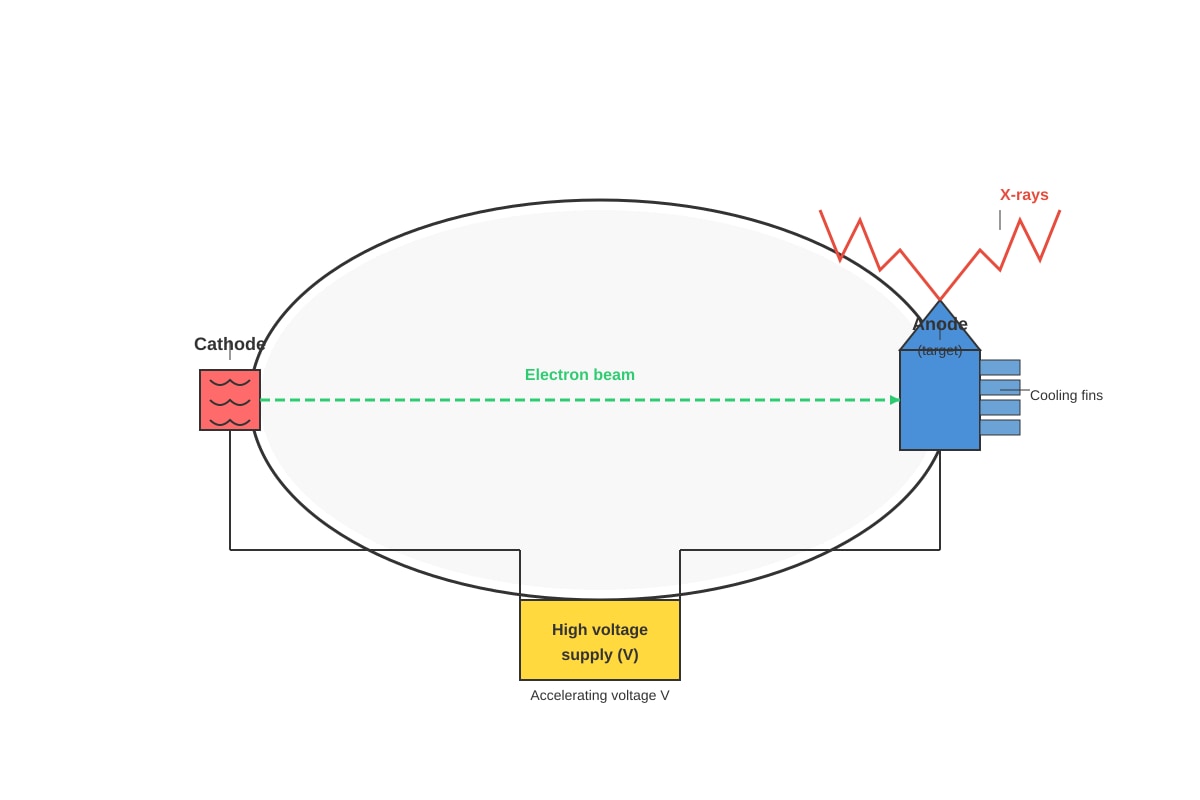
The diagram shows a simple model of an X-ray tube.

<image_placeholder> id: Q18-fig1 type: diagram linked_question: Q18 description: Simple X-ray tube diagram showing cathode (filament), anode (target), high voltage supply between them, electron beam from cathode to anode, X-rays emitted from anode target. Cooling fins on anode. labels: Cathode, Anode (target), High voltage supply (V), Electron beam, X-rays, Cooling fins values: Accelerating voltage V marked must_show: Clear labels for cathode, anode, electron path, X-ray emission direction, high voltage connection </image_placeholder>

(a) Explain how the electrons are produced at the cathode. [1]


(b) State the energy conversion that takes place when electrons strike the anode target. [1]


(c) The anode is made of tungsten and has cooling fins. Explain why. [1]


19. [3 marks]

A student conducts an experiment to investigate the photoelectric effect using different coloured filters and a zinc plate connected to an electroscope. The zinc plate is initially given a negative charge.

(a) The electroscope leaf falls when ultraviolet light is shone on the zinc plate, but not when red light of the same intensity is used. Explain this observation. [2]


(b) When the UV light source is moved further away from the zinc plate, the leaf falls more slowly. Explain why. [1]


20. [3 marks]

Carbon-14 dating is used to determine the age of archaeological artifacts. The half-life of carbon-14 is 5730 years. A sample of ancient wood shows an activity of 25% of that found in living wood.

(a) Calculate the age of the ancient wood sample. [2]


(b) State one assumption made in carbon-14 dating. [1]


End of Quiz

Answers

<!-- TuitionGoWhere generation metadata: stage=3-0; model=nvidia/nemotron-3-ultra-550b-a55b:free; model_label=NVIDIA Nemotron 3 Ultra 550B A55B Free; generated=2026-06-18; Sources: Stage 2-1 real exam-derived templates and Stage 2-2 exam-enriched syllabus. -->

Secondary 3 Physics Quiz - Modern Physics (Answer Key)

Total Marks: 40


Section A: Multiple Choice Questions (10 marks)

1. [1 mark] Answer: B

Explanation: The photoelectric effect shows that electrons are emitted only when the incident light frequency exceeds a threshold frequency f0f_0, regardless of intensity. This contradicts classical wave theory which predicts energy depends on intensity. The kinetic energy of emitted electrons depends on frequency (not intensity), emission is nearly instantaneous (no time delay), and the number of electrons per second (photocurrent) is proportional to intensity.

Marking note: 1 mark for correct choice.


2. [1 mark] Answer: B

Working: E=hcλ=(6.63×1034)(3.0×10⁸)500×109=3.978×10¹⁹ JE = \frac{hc}{\lambda} = \frac{(6.63 \times 10^{-34})(3.0 \times 10^8)}{500 \times 10^{-9}} = 3.978 \times 10^{-19} \text{ J} Convert to eV: 3.978×10191.60×1019=2.486 eV2.48 eV\frac{3.978 \times 10^{-19}}{1.60 \times 10^{-19}} = 2.486 \text{ eV} \approx 2.48 \text{ eV}

Alternative: Use hc=1240 eV⋅nmhc = 1240 \text{ eV·nm}, so E=1240500=2.48 eVE = \frac{1240}{500} = 2.48 \text{ eV}.

Marking note: 1 mark for correct choice.


3. [1 mark] Answer: C

Explanation: The stopping potential VsV_s is related to maximum kinetic energy by Kmax=eVsK_{\text{max}} = eV_s. If Vs=2.5 VV_s = 2.5 \text{ V}, then Kmax=2.5 eVK_{\text{max}} = 2.5 \text{ eV}. In joules: 2.5×1.60×1019=4.0×10¹⁹ J2.5 \times 1.60 \times 10^{-19} = 4.0 \times 10^{-19} \text{ J}. Option C gives the answer directly in eV, which is the conventional unit for photoelectron energies.

Marking note: 1 mark for correct choice. Common mistake: confusing eV and J values.


4. [1 mark] Answer: B

Working: Photon energy: E=hf=(6.63×1034)(8.0×10¹⁴)=5.304×10¹⁹ JE = hf = (6.63 \times 10^{-34})(8.0 \times 10^{14}) = 5.304 \times 10^{-19} \text{ J} In eV: 5.304×10191.60×1019=3.315 eV\frac{5.304 \times 10^{-19}}{1.60 \times 10^{-19}} = 3.315 \text{ eV} Kmax=Eϕ=3.3152.0=1.315 eV1.3 eVK_{\text{max}} = E - \phi = 3.315 - 2.0 = 1.315 \text{ eV} \approx 1.3 \text{ eV}

Marking note: 1 mark for correct choice.


5. [1 mark] Answer: C

Explanation: Einstein's photoelectric equation: Kmax=hfϕ=hfhf0K_{\text{max}} = hf - \phi = hf - hf_0. This is a linear equation y=mx+cy = mx + c with slope hh and x-intercept at threshold frequency f0f_0. Graph C shows a straight line with positive slope crossing the frequency axis at f0f_0 (negative intercept on KmaxK_{\text{max}} axis).

Marking note: 1 mark for correct choice. Graph B is incorrect because it passes through origin (would imply zero work function).


6. [1 mark] Answer: A

Working: Electron kinetic energy: K=eV=(1.60×10¹⁹)(100)=1.60×10¹⁷ JK = eV = (1.60 \times 10^{-19})(100) = 1.60 \times 10^{-17} \text{ J} Momentum: p=2meK=2(9.11×1031)(1.60×10¹⁷)=5.40×1024 kg m/sp = \sqrt{2m_eK} = \sqrt{2(9.11 \times 10^{-31})(1.60 \times 10^{-17})} = 5.40 \times 10^{-24} \text{ kg m/s} de Broglie wavelength: λ=hp=6.63×10345.40×1024=1.23×10¹⁰ m\lambda = \frac{h}{p} = \frac{6.63 \times 10^{-34}}{5.40 \times 10^{-24}} = 1.23 \times 10^{-10} \text{ m}

Shortcut formula: λ=h2meeV1.23V nm=1.23100=0.123 nm=1.23×10¹⁰ m\lambda = \frac{h}{\sqrt{2m_e eV}} \approx \frac{1.23}{\sqrt{V}} \text{ nm} = \frac{1.23}{\sqrt{100}} = 0.123 \text{ nm} = 1.23 \times 10^{-10} \text{ m}

Marking note: 1 mark for correct choice.


7. [1 mark] Answer: C

Explanation: Electron diffraction (e.g., Davisson-Germer experiment) demonstrates the wave nature of electrons by showing interference patterns. The photoelectric effect and Compton scattering demonstrate particle nature of light. Line emission spectra demonstrate quantised atomic energy levels.

Marking note: 1 mark for correct choice.


8. [1 mark] Answer: A

Working: E3=13.632=1.51 eVE_3 = -\frac{13.6}{3^2} = -1.51 \text{ eV} E2=13.622=3.40 eVE_2 = -\frac{13.6}{2^2} = -3.40 \text{ eV} Photon energy: ΔE=E3E2=(1.51)(3.40)=1.89 eV\Delta E = E_3 - E_2 = (-1.51) - (-3.40) = 1.89 \text{ eV}

Marking note: 1 mark for correct choice.


9. [1 mark] Answer: C

Explanation:

  • A is incorrect: Characteristic X-ray lines depend on target material (atomic number), not accelerating voltage.
  • B is incorrect: Minimum wavelength λmin=hceV\lambda_{\text{min}} = \frac{hc}{eV} depends only on accelerating voltage, not target material.
  • C is correct: Higher accelerating voltage → more energetic electrons → more intense bremsstrahlung (continuous spectrum).
  • D is incorrect: Characteristic lines appear at specific wavelengths; they can be shorter or longer than λmin\lambda_{\text{min}} depending on voltage.

Marking note: 1 mark for correct choice.


10. [1 mark] Answer: C

Working: 36 hours = 3 half-lives (36/12 = 3). Fraction remaining = (12)3=18(\frac{1}{2})^3 = \frac{1}{8}.

Marking note: 1 mark for correct choice.


Section B: Structured Questions (30 marks)

11. [3 marks]

(a) [2 marks] Any two of:

  • Electrons are emitted only if the frequency of incident light exceeds a threshold frequency f0f_0, independent of intensity. (Classical theory predicts emission at any frequency given sufficient intensity.)
  • Maximum kinetic energy of emitted electrons depends on frequency, not intensity. (Classical theory predicts energy depends on intensity.)
  • Emission is nearly instantaneous (no time lag) even at very low intensities. (Classical theory predicts a time delay for energy accumulation.)
  • The photocurrent (number of electrons per second) is directly proportional to light intensity. (Classical theory can explain this, but not the other observations.)

Marking: 1 mark per valid observation, max 2 marks.

(b) [1 mark] Einstein proposed light consists of photons with energy E=hfE = hf. An electron absorbs one photon. If hf>ϕhf > \phi (work function), the electron is emitted with Kmax=hfϕK_{\text{max}} = hf - \phi. This explains:

  • Threshold frequency: need hf>ϕhf > \phif>f0=ϕ/hf > f_0 = \phi/h
  • KmaxK_{\text{max}} depends on ff, not intensity
  • Instantaneous emission: one photon → one electron interaction

Marking: 1 mark for correct explanation linking photon model to one observation.


12. [4 marks]

(a) [2 marks] E=hcλ=(6.63×1034)(3.0×10⁸)400×109=4.9725×10¹⁹ JE = \frac{hc}{\lambda} = \frac{(6.63 \times 10^{-34})(3.0 \times 10^8)}{400 \times 10^{-9}} = 4.9725 \times 10^{-19} \text{ J} Answer: 4.97×10¹⁹ J4.97 \times 10^{-19} \text{ J} (or 4.97×10¹⁹ J4.97 \times 10^{-19} \text{ J})

Marking: 1 mark for correct substitution, 1 mark for correct answer with unit.

(b) [2 marks] Photon energy in eV: 4.9725×10191.60×1019=3.108 eV\frac{4.9725 \times 10^{-19}}{1.60 \times 10^{-19}} = 3.108 \text{ eV} (or use hc=1240 eV⋅nmhc = 1240 \text{ eV·nm}: 1240400=3.10 eV\frac{1240}{400} = 3.10 \text{ eV}) Kmax=Eϕ=3.1082.1=1.008 eV1.01 eVK_{\text{max}} = E - \phi = 3.108 - 2.1 = 1.008 \text{ eV} \approx 1.01 \text{ eV}

Answer: 1.01 eV1.01 \text{ eV} (accept 1.0 eV1.0 \text{ eV} or 1.01 eV1.01 \text{ eV})

Marking: 1 mark for converting photon energy to eV or using hc=1240 eV⋅nmhc = 1240 \text{ eV·nm}, 1 mark for correct subtraction and answer with unit.


13. [3 marks]

(a) [2 marks] Energy difference: ΔE=E4E2=(0.85)(3.40)=2.55 eV\Delta E = E_4 - E_2 = (-0.85) - (-3.40) = 2.55 \text{ eV} Convert to joules: 2.55×1.60×1019=4.08×10¹⁹ J2.55 \times 1.60 \times 10^{-19} = 4.08 \times 10^{-19} \text{ J} Wavelength: λ=hcΔE=(6.63×1034)(3.0×10⁸)4.08×1019=4.87×10⁷ m=487 nm\lambda = \frac{hc}{\Delta E} = \frac{(6.63 \times 10^{-34})(3.0 \times 10^8)}{4.08 \times 10^{-19}} = 4.87 \times 10^{-7} \text{ m} = 487 \text{ nm}

Alternative using hc=1240 eV⋅nmhc = 1240 \text{ eV·nm}: λ=12402.55=486 nm\lambda = \frac{1240}{2.55} = 486 \text{ nm}

Answer: 487 nm487 \text{ nm} (accept 486 nm486 \text{ nm} or 4.87×10⁷ m4.87 \times 10^{-7} \text{ m})

Marking: 1 mark for correct energy difference, 1 mark for correct wavelength calculation with unit.

(b) [1 mark] Balmer series (transitions to n=2n=2).

Marking: 1 mark for correct series name.


14. [4 marks]

(a) [2 marks] Minimum wavelength occurs when all electron kinetic energy converts to one photon: eV=hcλmineV = \frac{hc}{\lambda_{\text{min}}} λmin=hceV=(6.63×1034)(3.0×10⁸)(1.60×10¹⁹)(50×103)=2.486×10¹¹ m\lambda_{\text{min}} = \frac{hc}{eV} = \frac{(6.63 \times 10^{-34})(3.0 \times 10^8)}{(1.60 \times 10^{-19})(50 \times 10^3)} = 2.486 \times 10^{-11} \text{ m}

Alternative: λmin(nm)=1240V(V)=124050000=0.0248 nm=2.48×10¹¹ m\lambda_{\text{min}} (\text{nm}) = \frac{1240}{V(\text{V})} = \frac{1240}{50000} = 0.0248 \text{ nm} = 2.48 \times 10^{-11} \text{ m}

Answer: 2.49×10¹¹ m2.49 \times 10^{-11} \text{ m} (or 0.0249 nm0.0249 \text{ nm})

Marking: 1 mark for correct formula/substitution, 1 mark for correct answer with unit.

(b) [2 marks] The minimum wavelength corresponds to the maximum photon energy, which occurs when a single electron loses all its kinetic energy in one collision (bremsstrahlung). The electron's kinetic energy is eVeV, so the maximum photon energy is eVeV, giving a minimum wavelength λmin=hc/eV\lambda_{\text{min}} = hc/eV. No photon can have energy greater than the electron's initial kinetic energy, hence the sharp cut-off.

Marking: 1 mark for stating maximum photon energy equals electron kinetic energy, 1 mark for explaining the cut-off.


15. [3 marks]

(a) [2 marks] Momentum: p=mev=(9.11×1031)(2.0×10⁶)=1.822×1024 kg m/sp = m_e v = (9.11 \times 10^{-31})(2.0 \times 10^6) = 1.822 \times 10^{-24} \text{ kg m/s} λ=hp=6.63×10341.822×1024=3.64×10¹⁰ m\lambda = \frac{h}{p} = \frac{6.63 \times 10^{-34}}{1.822 \times 10^{-24}} = 3.64 \times 10^{-10} \text{ m}

Answer: 3.64×10¹⁰ m3.64 \times 10^{-10} \text{ m} (or 0.364 nm0.364 \text{ nm})

Marking: 1 mark for correct momentum calculation, 1 mark for correct wavelength with unit.

(b) [1 mark] Macroscopic objects have large mass, so their momentum p=mvp = mv is very large even at ordinary speeds. Their de Broglie wavelength λ=h/p\lambda = h/p is extremely small (typically <1030 m< 10^{-30} \text{ m}), far too small to produce observable diffraction or interference effects.

Marking: 1 mark for correct explanation (large mass → large momentum → negligible wavelength).


16. [4 marks]

(a) [1 mark] From the table, activity halves every 10 days (8000 → 4000 → 2000 → 1000 → 500). Half-life = 10 days

Marking: 1 mark for correct value with unit.

(b) [2 marks] λ=ln2t1/2=0.69310=0.0693 day1\lambda = \frac{\ln 2}{t_{1/2}} = \frac{0.693}{10} = 0.0693 \text{ day}^{-1}

Answer: 0.0693 day10.0693 \text{ day}^{-1} (accept 6.93×10² day16.93 \times 10^{-2} \text{ day}^{-1})

Marking: 1 mark for correct formula, 1 mark for correct calculation with unit.

(c) [1 mark] After 55 days = 5.5 half-lives. A=A0(12)t/t1/2=8000×(12)5.5=8000×0.0221=177 BqA = A_0 (\frac{1}{2})^{t/t_{1/2}} = 8000 \times (\frac{1}{2})^{5.5} = 8000 \times 0.0221 = 177 \text{ Bq}

Alternative using decay constant: A=A0eλt=8000e0.0693×55=8000e3.8115=8000×0.0221=177 BqA = A_0 e^{-\lambda t} = 8000 e^{-0.0693 \times 55} = 8000 e^{-3.8115} = 8000 \times 0.0221 = 177 \text{ Bq}

Answer: 177 Bq177 \text{ Bq} (accept 180 Bq180 \text{ Bq} or 176 Bq176 \text{ Bq})

Marking: 1 mark for correct answer with unit.


17. [3 marks]

(a) [1 mark] Corrected count rate = measured count rate - background = 120030=1170 counts/min1200 - 30 = 1170 \text{ counts/min}

Answer: 1170 counts/min1170 \text{ counts/min}

Marking: 1 mark for correct subtraction.

(b) [1 mark] Corrected count rate with absorber = 15030=120 counts/min150 - 30 = 120 \text{ counts/min} Fraction transmitted = 1201170=0.10260.103\frac{120}{1170} = 0.1026 \approx 0.103 (or 10.3%10.3\%)

Answer: 0.1030.103 (or 10.3%10.3\%)

Marking: 1 mark for correct calculation (must subtract background from both readings).

(c) [1 mark] γ\gamma-radiation (gamma rays). Reasoning: α\alpha-particles are stopped by a few cm of air or paper; β\beta-particles are stopped by a few mm of aluminium. A 2 cm thick lead sheet transmits about 10% of the radiation, which is characteristic of penetrating γ\gamma-radiation.

Marking: 1 mark for correct radiation type with valid reasoning.


18. [3 marks]

(a) [1 mark] Electrons are produced by thermionic emission: the cathode filament is heated by a low-voltage current, giving electrons enough thermal energy to overcome the work function of the metal and escape.

Marking: 1 mark for "thermionic emission" or description of heating filament to release electrons.

(b) [1 mark] Kinetic energy of electrons → X-ray photons (electromagnetic radiation) + heat. (Accept: Electrical potential energy → kinetic energy of electrons → X-rays + heat)

Marking: 1 mark for correct energy conversion.

(c) [1 mark] Most of the electron kinetic energy (over 99%) is converted to heat at the anode target. Tungsten is used for its high melting point (3422°C), and cooling fins increase surface area for heat dissipation to prevent the anode from melting.

Marking: 1 mark for explaining heat production and need for high melting point/cooling.


19. [3 marks]

(a) [2 marks] The photoelectric effect requires photons with energy E=hfE = hf greater than the work function ϕ\phi of zinc. UV light has higher frequency (shorter wavelength) than red light, so UV photons have sufficient energy to eject electrons (hfUV>ϕhf_{\text{UV}} > \phi), while red photons do not (hfred<ϕhf_{\text{red}} < \phi). Intensity only affects the number of photons per second, not the energy per photon.

Marking: 1 mark for linking UV frequency to work function, 1 mark for explaining why red light fails (photon energy too low) and intensity is irrelevant.

(b) [1 mark] Moving the UV source further away reduces the intensity (photon flux) at the zinc plate. Fewer photons per second strike the surface, so fewer electrons are emitted per second, reducing the discharge current and causing the leaf to fall more slowly.

Marking: 1 mark for linking distance to intensity to emission rate.


20. [3 marks]

(a) [2 marks] Activity ratio: AA0=0.25=(12)t/t1/2\frac{A}{A_0} = 0.25 = (\frac{1}{2})^{t/t_{1/2}} (12)t/5730=(12)2(\frac{1}{2})^{t/5730} = (\frac{1}{2})^2 t5730=2\frac{t}{5730} = 2 t=2×5730=11460 yearst = 2 \times 5730 = 11460 \text{ years}

Alternative using decay constant: λ=ln25730=1.209×10⁴ yr1\lambda = \frac{\ln 2}{5730} = 1.209 \times 10^{-4} \text{ yr}^{-1} 0.25=eλtln0.25=λtt=ln4λ=1.3861.209×104=11460 years0.25 = e^{-\lambda t} \Rightarrow \ln 0.25 = -\lambda t \Rightarrow t = \frac{\ln 4}{\lambda} = \frac{1.386}{1.209 \times 10^{-4}} = 11460 \text{ years}

Answer: 11460 years11460 \text{ years} (accept 11500 years11500 \text{ years} or 1.15×10⁴ years1.15 \times 10^4 \text{ years})

Marking: 1 mark for correct method (half-life or decay constant), 1 mark for correct answer with unit.

(b) [1 mark] Any one of:

  • The initial carbon-14 activity in living organisms has been constant over time (constant atmospheric 14C/12C^{14}\text{C}/^{12}\text{C} ratio).
  • The sample has not been contaminated by carbon from other sources.
  • The decay constant/half-life of carbon-14 has not changed.
  • The sample was in equilibrium with the atmosphere when the organism died.

Marking: 1 mark for any valid assumption.


End of Answer Key