From Real Exams Quiz
Secondary 3 Physics Modern Physics Quiz
Free Sec 3 Physics Modern Physics quiz, Kimi2.6 Exam version, with questions, answers, and O Level-style practice for Singapore students.
These static practice materials are generated from the site's syllabus and paper-generation workflow, with source and model context shown so students and parents can evaluate the material before use.
Questions
Free quiz and exam paper access
Enter your details to view this paper
Your access is remembered on this device.
Answers
Secondary 3 Physics Quiz – Modern Physics: ANSWER KEY
Total Marks: 40
Duration: 50 minutes
Section A: Multiple Choice (Questions 1–10)
| Question | Answer | Explanation |
|---|---|---|
| 1 | B | A radioactive isotope is an atom with the same number of protons (same element) but a different number of neutrons. This gives it different nuclear properties (unstable nucleus) compared to the stable form. |
| 2 | B | Half-life is defined as the time taken for half of the radioactive nuclei present in a sample to decay. It is a constant for each isotope and does not depend on the amount of substance or external conditions. |
| 3 | A | Alpha radiation consists of helium nuclei ( or ), which contain 2 protons and 2 neutrons. This gives it a +2 charge and relatively large mass. |
| 4 | A | Number of half-lives = 24 ÷ 8 = 3. Activity after half-lives = initial activity ÷ = 1600 ÷ = 1600 ÷ 8 = 200 counts per minute. |
| 5 | C | Beta radiation consists of high-speed electrons emitted from the nucleus when a neutron converts to a proton. It is NOT electromagnetic radiation (that's gamma), is LESS ionizing than alpha, and has non-zero mass. |
| 6 | A | Mass number: 238 = 234 + , so = 4. Atomic number: 92 = 90 + , so = 2. This is an alpha particle (), consistent with alpha decay of uranium. |
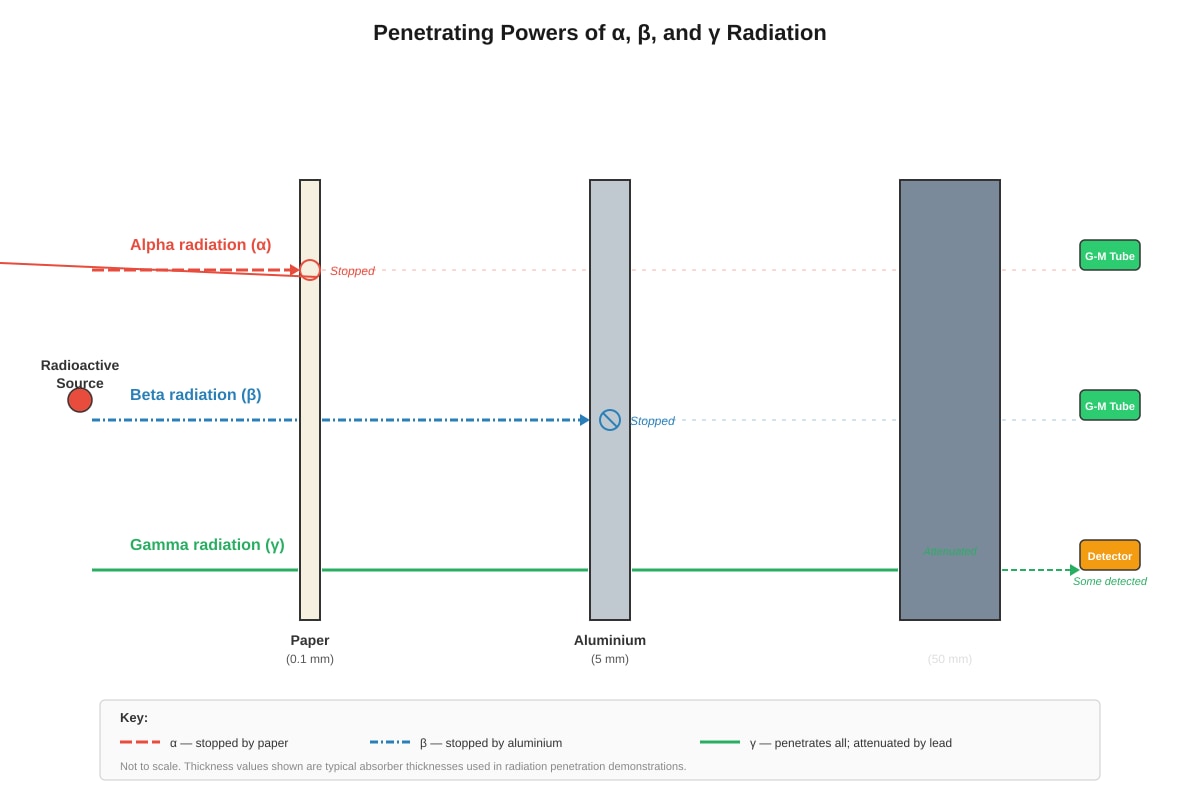
| 7 | C | Gamma radiation is electromagnetic radiation with no charge and no mass. It is the most penetrating, requiring thick lead or concrete to significantly attenuate it. Alpha is least penetrating (stopped by paper), beta by aluminium. |
| 8 | B | A Geiger-Müller (G-M) tube detects ionizing radiation by using the ionization produced in a gas to create electrical pulses, which are then counted. It does NOT produce, accelerate, or store radiation. |
| 9 | C | Safe practices: use tongs (not bare hands), keep at arm's length (inverse square law reduces exposure), point away from people, and store in lead-lined containers in designated areas. Only option C is correct. |
| 10 | B | Control rods absorb neutrons. By adjusting how far the rods are inserted, the number of available neutrons for fission is controlled, thus regulating the reaction rate. Fully inserting them shuts down the reactor. |
Section A Total: 20 marks
Section B: Structured Response
11. [3 marks]
| Difference | Fission | Fusion |
|---|---|---|
| Process | Heavy nucleus splits into lighter nuclei | Light nuclei combine to form heavier nucleus |
| Conditions required | Requires neutron bombardment; occurs at room temperature for some isotopes | Requires extremely high temperature ( K) and pressure |
| Where it occurs | Nuclear reactors, atomic bombs | Core of stars, including the Sun; experimental reactors |
[1 mark per correct row; accept equivalent valid differences such as products, energy release per nucleon, or fuel types]
Common mistakes: Confusing which process happens where; stating that fusion occurs in reactors currently (commercial fusion is still experimental).
12. [4 marks]
(a) [2 marks]
Number of half-lives in 18 hours = 18 ÷ 6 = 3 half-lives [1]
Count rate after 3 half-lives = 4800 ÷ = 4800 ÷ 8 = 600 counts per minute [1]
Working must show: identification of 3 half-lives and correct calculation. Accept 4800 → 2400 → 1200 → 600 as alternative working.
(b) [1 mark]
3 half-lives
(c) [1 mark]
Radioactive decay is a random process [½]. Even after many half-lives, there is always a small probability that some nuclei have not yet decayed [½]. The activity approaches zero asymptotically but theoretically never reaches exactly zero.
13. [4 marks]
(a) [2 marks]
For conservation of mass number: 241 = + 4, so = 237 [1]
For conservation of charge (atomic number): 95 = + 2, so = 93 [1]
Completed equation:
(b) [2 marks]
Any two of the following:
- Alpha particles have very low penetrating power [½] and are stopped by a few centimetres of air or the plastic casing of the detector [½]
- The americium is present in very small quantities sealed inside the smoke detector [½]
- The source is not removed from the detector during normal use [½]
- The distance from the source to anyone nearby is sufficient that alpha particles cannot reach them [½]
Maximum 2 marks.
14. [3 marks]
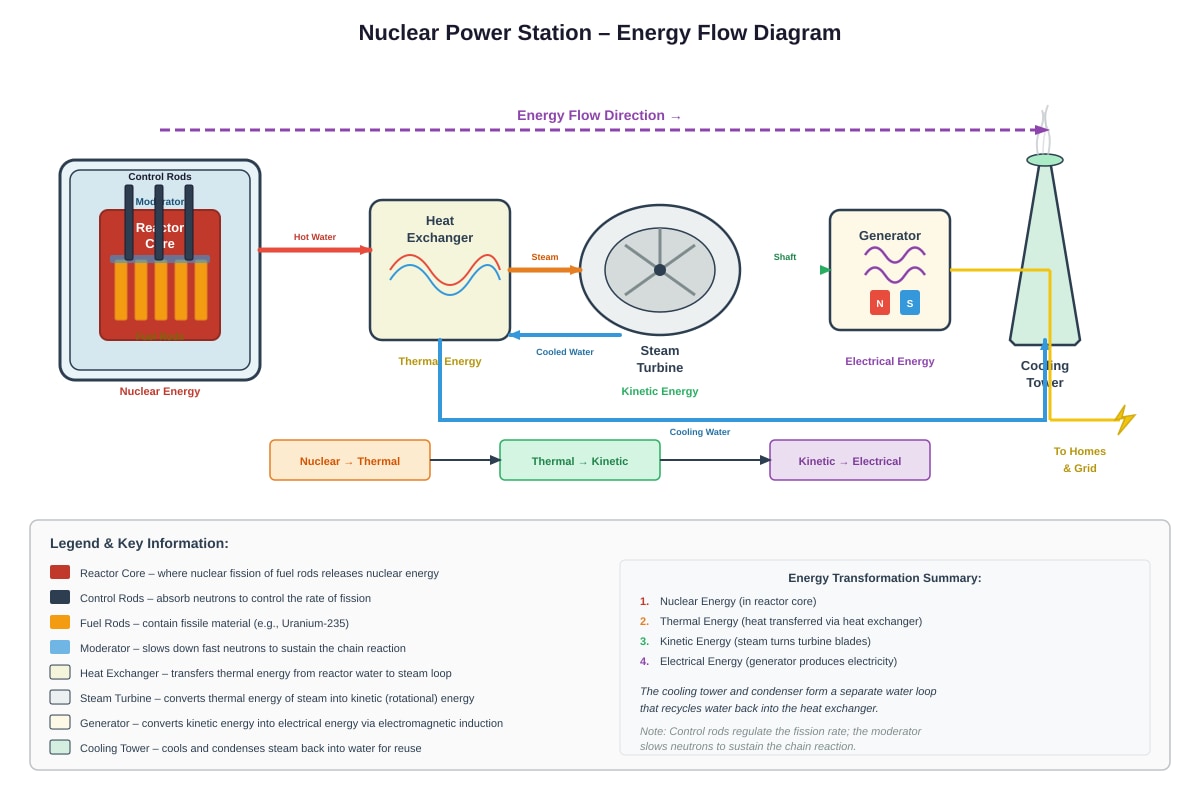
Working from the diagram (nuclear power station flow):
- Nuclear energy → Thermal energy: Nuclear fission in fuel rods releases energy as heat in the reactor core [1]
- Thermal energy → Kinetic energy: Heat boils water to produce steam, which drives the turbine [1]
- Kinetic energy → Electrical energy: The turbine turns the generator, producing electricity [1]
For full marks, must mention all three transformations in correct order with correct energy forms. Accept "heat" for thermal energy and "mechanical energy" for kinetic energy.
15. [5 marks]
(a) [3 marks]
Number of half-lives = 4800 ÷ 1600 = 3 half-lives [1]
Atoms remaining = ÷ [1]
= ÷ 8 = atoms [1]
Alternative working:
(b) [2 marks]
- Even though the half-life is long, radium-226 is highly radioactive and emits alpha particles that are very ionizing [1]
- Long half-life means the source remains dangerous for thousands of years, posing long-term storage and contamination risks [1]
- Alpha emitters are particularly hazardous if ingested or inhaled, as the radiation is concentrated in tissue [1]
Maximum 2 marks.
Section C: Application and Analysis
16. [4 marks]
(a) [2 marks]
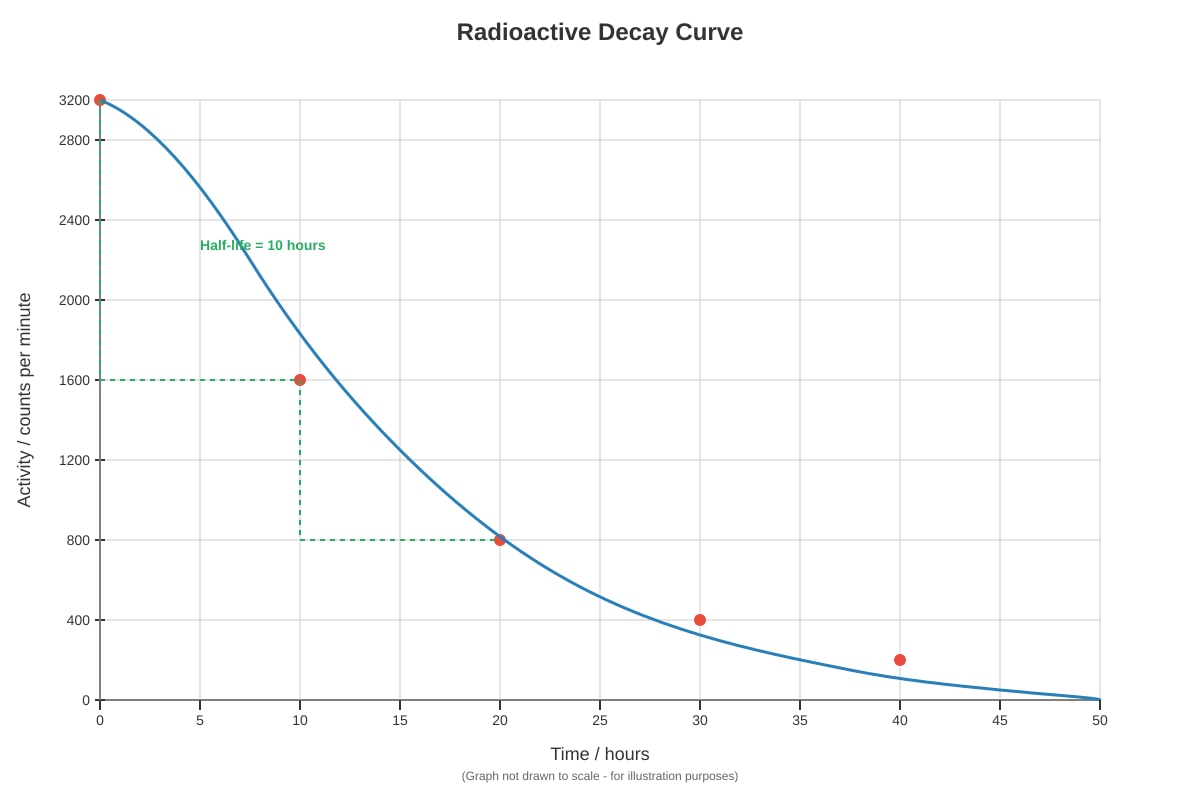
Reading from graph: Initial activity = 3200 counts/min [½]
After one half-life, activity falls to 1600 counts/min [½]
From graph, this occurs at 10 hours [1]
Accept 9–11 hours if clearly reading from drawn graph. Alternative: could use any two corresponding points, e.g., 1600 to 800 gives same half-life.
(b) [2 marks]
From 40 hours to 50 hours is one half-life (since half-life = 10 hours) [1]
Activity at 40 hours = 200 counts/min
Activity after 50 hours = 200 ÷ 2 = 100 counts per minute [1]
Alternative: 50 hours = 5 half-lives, so activity = 3200 ÷ = 3200 ÷ 32 = 100 counts/min
17. [4 marks]
(a) [2 marks]
Ratio remaining = of original [½]
Number of half-lives needed: , so [1]
Age of artifact = 2 × 5700 = 11 400 years [½]
(b) [2 marks]
- After 65 million years, the number of half-lives = 65 000 000 ÷ 5700 ≈ 11 400 half-lives [1]
- This means the carbon-14 would have decayed to essentially undetectable levels [½]
- The remaining carbon-14 would be indistinguishable from background radiation or contamination [½]
- For such old samples, isotopes with longer half-lives (e.g., potassium-40, uranium-238) are used instead [½]
Maximum 2 marks for part (b).
18. [3 marks]
Any three valid precautions:
| Precaution | Explanation |
|---|---|
| Minimize exposure time | Radiation dose is proportional to time spent near sources [1] |
| Maximize distance from sources | Follows inverse square law; doubling distance quarters dose rate [1] |
| Use shielding | Wear lead aprons, work behind lead screens, use lead-lined containers [1] |
| Use radiation badges/monitors | Dosimeters track cumulative exposure to ensure safety limits not exceeded [1] |
| Avoid ingestion/inhalation | Wear protective clothing, masks; prevents internal exposure [1] |
Maximum 3 marks. Must include explanation linked to physics for full mark each.
19. [4 marks]
Detection arrangement: [1 mark for any valid setup]
A Geiger-Müller tube is placed at a fixed distance from the unknown source. Counts are recorded with:
- No absorber present
- Paper inserted between source and detector
- 5 mm aluminium inserted
- 50 mm lead inserted
Identification method: [3 marks]
| Observation | Radiation identified |
|---|---|
| Counts present with no absorber, but stopped by paper | Alpha [1] – alpha particles cannot penetrate paper |
| Counts pass through paper but stopped by aluminium | Beta [1] – beta particles penetrate paper but not 5 mm Al |
| Counts pass through paper and aluminium, reduced by lead | Gamma [1] – gamma penetrates both but is attenuated by thick lead |
If counts remain unchanged through all absorbers: source emits gamma (and very energetic gamma if not reduced by lead). If no counts at all: source may be too weak, too distant, or not radioactive.
20. [4 marks]
(a) [2 marks]
Mass of 4 hydrogen nuclei = 4 × kg = kg [½]
Mass of products = + (2 × ) [½]
= + = kg [½]
Mass defect = - = kg [½]
Accept kg or similar rounding. Deduct ½ mark for arithmetic error with correct method.
(b) [2 marks]
- The mass defect represents mass that has been converted to energy [1]
- According to Einstein's equation [½], where m/s
- A very small mass defect produces a very large amount of energy because is enormous [½]
- This energy is released mainly as kinetic energy of the products and as gamma radiation [½]
Maximum 2 marks.
END OF ANSWER KEY
Total Marks: 40