From Real Exams Quiz
Secondary 3 Physics Modern Physics Quiz
Free Sec 3 Physics Modern Physics quiz, HY3 Exam version, with questions, answers, and O Level-style practice for Singapore students.
These static practice materials are generated from the site's syllabus and paper-generation workflow, with source and model context shown so students and parents can evaluate the material before use.
Questions
Secondary 3 Physics Quiz - Modern Physics
Name: ________________________
Class: ________________________
Date: ________________________
Score: ________________________
Duration: 45 minutes
Total Marks: 40
Instructions:
- Answer all 20 questions.
- Section A: Multiple Choice (1 mark each)
- Section B: Short Answer (1–2 marks each)
- Section C: Structured Response (2–4 marks each)
- Show all working where calculation is required.
- Use g=10 m s−2 if needed.
Section A: Multiple Choice (Questions 1–5)
1. Which of the following best describes an atom of a radioactive nuclide?
A. An atom with equal numbers of protons and neutrons
B. An atom with an unstable nucleus that decays spontaneously
C. An atom that cannot undergo chemical reaction
D. An atom with no electrons
____ (1 mark)
2. A radioactive source emits radiation that is deflected upward by a magnetic field applied into the page. The radiation is most likely:
A. Alpha
B. Beta
C. Gamma
D. X-ray
____ (1 mark)
3. The half-life of a radioactive substance is 4 days. If the initial number of nuclei is 800, how many remain after 12 days?
A. 100
B. 200
C. 400
D. 50
____ (1 mark)
4. Which radiation has the greatest penetrating power?
A. Alpha
B. Beta
C. Gamma
D. All equal
____ (1 mark)
5. In a cloud chamber, alpha particles leave thick short tracks because they:
A. Travel at speed of light
B. Are highly ionising and strongly interacting
C. Have no charge
D. Are unaffected by air
____ (1 mark)
Section B: Short Answer (Questions 6–10)
6. State one property of gamma radiation.
________________________________________ (1 mark)
7. What is meant by "background radiation"?
________________________________________ (1 mark)
8. Name the radiation that consists of helium nuclei.
________________________________________ (1 mark)
9. A nucleus emits a beta particle. What change occurs in its proton number?
________________________________________ (1 mark)
10. State the unit used to measure radiation dose equivalent.
________________________________________ (1 mark)
Section C: Structured Response (Questions 11–20)
11. A sample contains 1000 nuclei of a radioactive isotope. After 15 days, 125 nuclei remain.
(a) How many half-lives have passed?
(b) Calculate the half-life of the isotope.
____ (2 marks)
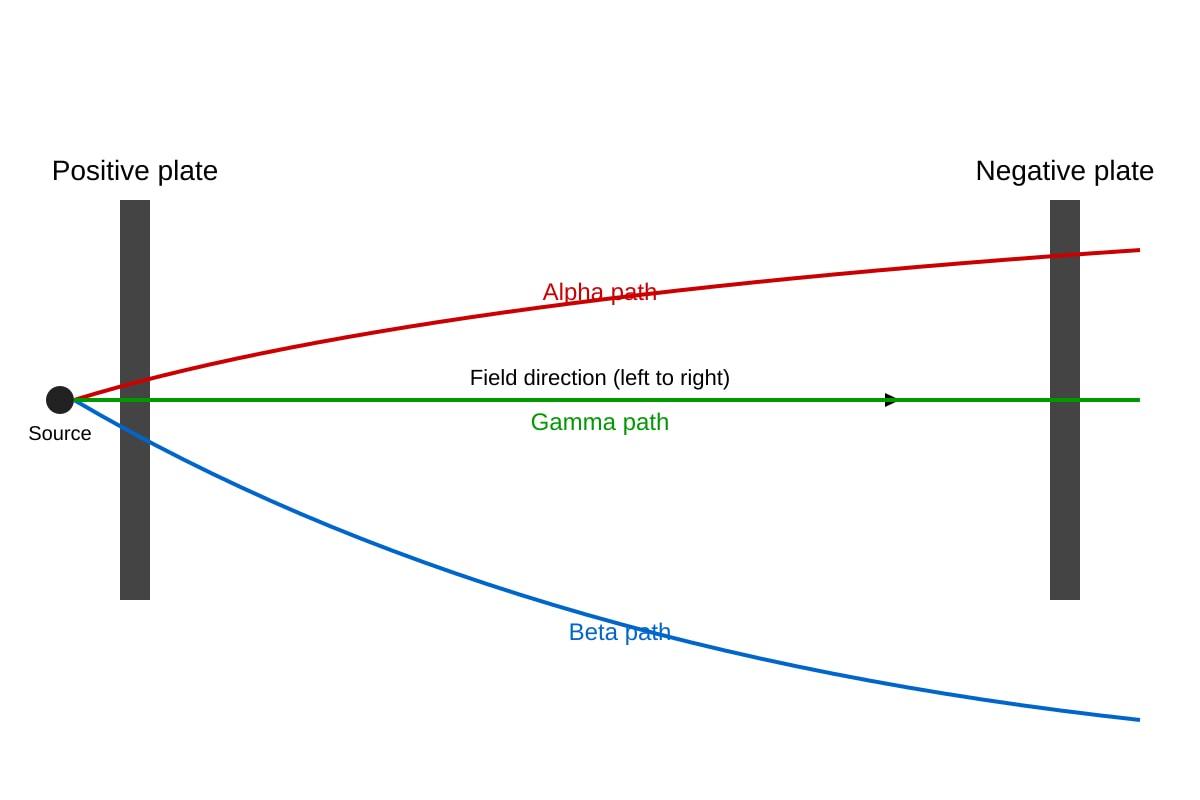
12. Describe how alpha, beta, and gamma radiations are affected by an electric field. Use a diagram description if needed.

Generated diagram for Q12.
____ (3 marks)
13. A radioactive source has activity 200 s−1 and decays with half-life 10 s. Calculate its activity after 30 s.
____ (2 marks)
14. Explain why gamma radiation is used for sterilising medical equipment.
____ (2 marks)
15. The table shows counts from a Geiger counter near a source.
| Time (min) | Counts |
|---|---|
| 0 | 800 |
| 2 | 400 |
| 4 | 200 |
(a) What is the half-life from the table?
(b) Why must background count be subtracted?
____ (2 marks)
16. A nucleus 88226Ra emits an alpha particle.
(a) Write the nuclear equation.
(b) Identify the daughter nucleus.
____ (3 marks)
17. Beta radiation can be stopped by a 5 mm aluminium sheet but not by paper. Explain this in terms of penetration and ionising power.
____ (2 marks)
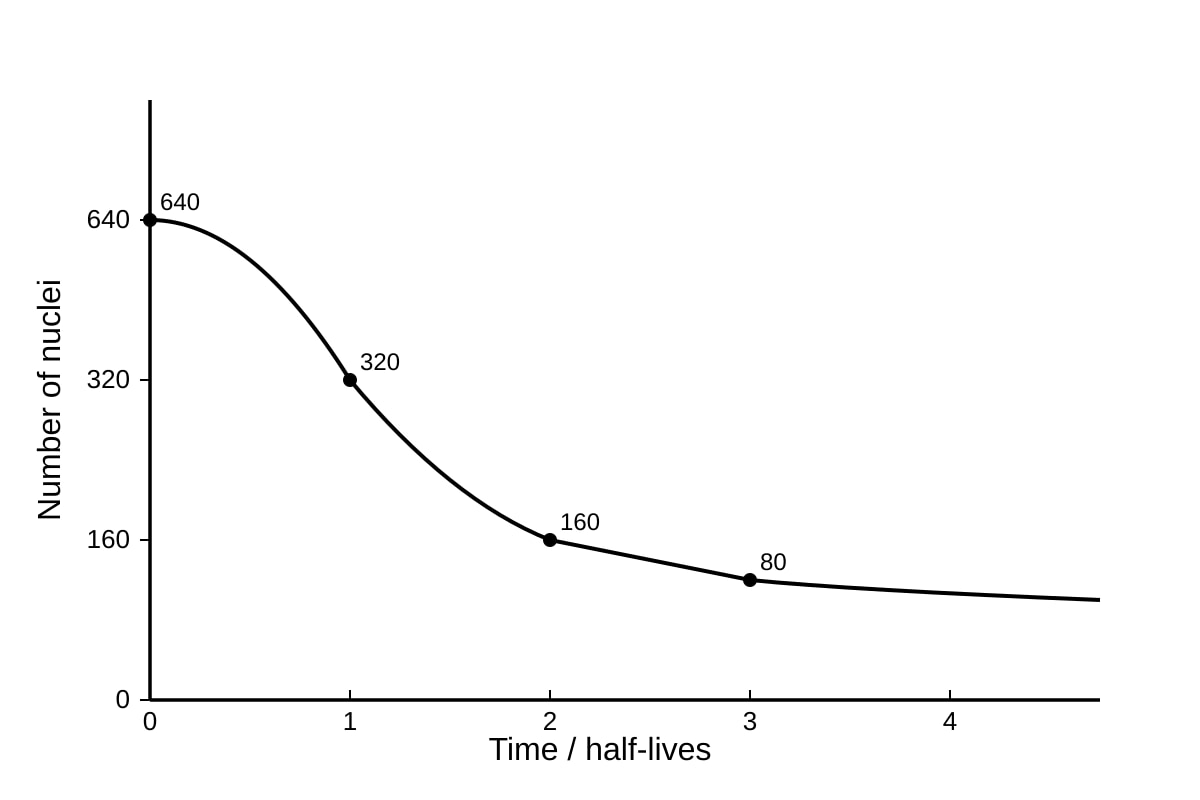
18. A sample initially has 640 radioactive atoms. Sketch a decay graph shape and state the number remaining after 3 half-lives.

Generated graph for Q18.
____ (2 marks)
19. A worker receives a dose of 4 mSv from gamma and 1 mSv from beta.
(a) Calculate total equivalent dose.
(b) State one health effect of high dose.
____ (2 marks)
20. Compare alpha and gamma radiation for use in smoke detectors and cancer treatment. Give one reason each.
____ (4 marks)
Answers
Secondary 3 Physics Quiz - Modern Physics (Answers)
Total Marks: 40
Section A: Multiple Choice
1. B (1 mark)
Teaching note: A radioactive nuclide has an unstable nucleus that decays spontaneously emitting radiation. Not defined by proton-neutron equality.
2. B (1 mark)
Beta particles are electrons (negative charge); magnetic field into page deflects negative charge upward by Fleming's left-hand rule.
3. A (1 mark)
12 days ÷ 4 days = 3 half-lives. 800→400→200→100.
4. C (1 mark)
Gamma is electromagnetic wave, least ionising, most penetrating.
5. B (1 mark)
Alpha heavily ionises air, loses energy fast, short thick track.
Section B: Short Answer
6. (1 mark)
Any one: no charge / no mass / electromagnetic wave / highly penetrating.
7. (1 mark)
Radiation present in environment from natural (rocks, cosmic) and artificial sources.
8. (1 mark)
Alpha radiation.
9. (1 mark)
Proton number increases by 1 (neutron → proton + electron).
10. (1 mark)
Sievert (Sv) or millisievert (mSv).
Section C: Structured Response
11. (2 marks)
(a) 1000→500→250→125 = 3 half-lives. (1 mark)
(b) 15÷3=5 days. (1 mark)
12. (3 marks)
Alpha (positive) deflects toward negative plate (left). (1)
Beta (negative) deflects toward positive plate (right), larger curvature. (1)
Gamma (neutral) undeflected. (1)
13. (2 marks)
30 s=3 half-lives.
A=200×(1/2)3=200÷8=25 s−1. (2 marks)
14. (2 marks)
Gamma penetrates packaging (1), kills microbes without heating/chemical residue (1).
15. (2 marks)
(a) Half-life = 2 min (800→400). (1)
(b) Background count adds false source counts; subtract for true activity. (1)
16. (3 marks)
(a) 88226Ra→ 86222Rn+ 24α (2)
(b) Radon-222. (1)
17. (2 marks)
Beta moderately ionising, stopped by aluminium (1); paper stops only alpha, less penetrating (1).
18. (2 marks)
Graph exponential decrease (1). After 3 hl: 640÷8=80 atoms (1).
19. (2 marks)
(a) 4+1=5 mSv (1)
(b) e.g. cell damage / cancer risk (1)
20. (4 marks)
Smoke detector: alpha (1) – ionises air, safe short range (1).
Cancer treatment: gamma (1) – penetrates deep to kill cells (1).
Free quiz and exam paper access
Enter your details to view this paper
Your access is remembered on this device.