From Real Exams Quiz

Secondary 3 Physics Mechanics Quiz

Free Sec 3 Physics Mechanics quiz, Nemo3 Exam version, with questions, answers, and O Level-style practice for Singapore students.

These static practice materials are generated from the site's syllabus and paper-generation workflow, with source and model context shown so students and parents can evaluate the material before use.

Secondary 3 Physics From Real Exams Generated by NVIDIA Nemotron 3 Ultra 550B A55B Free Updated 2026-06-18

Questions

<!-- TuitionGoWhere generation metadata: stage=3-0; model=nvidia/nemotron-3-ultra-550b-a55b:free; model_label=NVIDIA Nemotron 3 Ultra 550B A55B Free; generated=2026-06-18; Sources: Stage 2-1 real exam-derived templates and Stage 2-2 exam-enriched syllabus. -->

Secondary 3 Physics Quiz - Mechanics

Name: ___________________________
Class: ___________________________
Date: ___________________________
Score: ______ / 40

Duration: 45 minutes
Total Marks: 40

Instructions:

  • Answer all questions.
  • Write your answers in the spaces provided.
  • For calculation questions, show your working clearly.
  • Use g=10 N/kgg = 10 \text{ N/kg} unless otherwise stated.
  • The number of marks is given in brackets [ ] at the end of each question or part question.

Section A: Multiple Choice Questions (10 marks)

Answer all questions. Choose the correct option and write the letter (A, B, C, or D) in the box provided.

1. [1]

A student measures the mass of a metal block using a beam balance and its weight using a spring balance. The experiment is repeated on the Moon where the gravitational field strength is 1.6 N/kg1.6 \text{ N/kg}. Which row correctly describes the readings?

Beam Balance ReadingSpring Balance Reading
ASame as on EarthSame as on Earth
BSame as on EarthDecreases
CDecreasesSame as on Earth
DDecreasesDecreases

Answer:

2. [1]

A car of mass 1200 kg1200 \text{ kg} accelerates uniformly from rest to 20 m/s20 \text{ m/s} in 10 s10 \text{ s}. What is the average resultant force acting on the car?

A. 240 N240 \text{ N}
B. 2400 N2400 \text{ N}
C. 24000 N24000 \text{ N}
D. 240000 N240000 \text{ N}

Answer:

3. [1]

A box of mass 5 kg5 \text{ kg} is pulled along a rough horizontal floor by a horizontal force of 30 N30 \text{ N}. The frictional force acting on the box is 10 N10 \text{ N}. What is the acceleration of the box?

A. 2 m/s22 \text{ m/s}^2
B. 4 m/s24 \text{ m/s}^2
C. 6 m/s26 \text{ m/s}^2
D. 8 m/s28 \text{ m/s}^2

Answer:

4. [1]

Two forces of 6 N6 \text{ N} and 8 N8 \text{ N} act at a point at an angle of 9090^\circ to each other. What is the magnitude of their resultant force?

A. 2 N2 \text{ N}
B. 10 N10 \text{ N}
C. 14 N14 \text{ N}
D. 48 N48 \text{ N}

Answer:

5. [1]

A satellite orbits the Earth in a circular path at constant speed. Which statement about the satellite is correct?

A. The resultant force on the satellite is zero.
B. The satellite has no acceleration.
C. The gravitational force provides the centripetal force.
D. The kinetic energy of the satellite is zero.

Answer:

6. [1]

A ball is thrown vertically upwards. At the highest point of its motion, which of the following is true? (Ignore air resistance.)

A. Velocity is zero, acceleration is zero.
B. Velocity is zero, acceleration is 10 m/s210 \text{ m/s}^2 downwards.
C. Velocity is maximum, acceleration is zero.
D. Velocity is maximum, acceleration is 10 m/s210 \text{ m/s}^2 downwards.

Answer:

7. [1]

The gravitational force between two masses m1m_1 and m2m_2 separated by a distance rr is FF. If both masses are doubled and the distance is halved, what is the new gravitational force?

A. 4F4F
B. 8F8F
C. 16F16F
D. 32F32F

Answer:

8. [1]

A force of 20 N20 \text{ N} acts on an object of mass 4 kg4 \text{ kg} for 3 s3 \text{ s}. The object starts from rest. What is the final velocity of the object?

A. 5 m/s5 \text{ m/s}
B. 10 m/s10 \text{ m/s}
C. 15 m/s15 \text{ m/s}
D. 20 m/s20 \text{ m/s}

Answer:

9. [1]

A block of weight WW rests on a rough inclined plane at angle θ\theta to the horizontal. The frictional force ff prevents the block from sliding down. Which equation correctly relates WW, ff, and θ\theta?

A. f=Wsinθf = W \sin \theta
B. f=Wcosθf = W \cos \theta
C. f=Wtanθf = W \tan \theta
D. f=Wsinθf = \frac{W}{\sin \theta}

Answer:

10. [1]

An object moves in a straight line. Its velocity-time graph is a straight line with a negative gradient passing through the origin. Which statement describes the motion?

A. Constant velocity
B. Constant acceleration
C. Increasing acceleration
D. Decreasing acceleration

Answer:


Section B: Structured Questions (18 marks)

Answer all questions in the spaces provided.

11. [3]

A skydiver of mass 80 kg80 \text{ kg} jumps from a helicopter. During the fall, the air resistance acting on him varies with time.

(a) State the two forces acting on the skydiver during the fall. [1]


(b) At one instant, the air resistance is 500 N500 \text{ N}. Calculate the acceleration of the skydiver at this instant. [2]


12. [4]

A car of mass 1000 kg1000 \text{ kg} travels along a horizontal road. The engine provides a constant driving force of 4000 N4000 \text{ N}. The total resistive force (air resistance + friction) is given by FR=200vF_R = 200v, where vv is the speed in m/s\text{m/s} and FRF_R is in N\text{N}.

(a) Write down the equation relating the resultant force FnetF_{\text{net}}, driving force, and resistive force. [1]


(b) Calculate the terminal velocity of the car. [2]


(c) Explain why the car cannot exceed this terminal velocity. [1]


13. [3]

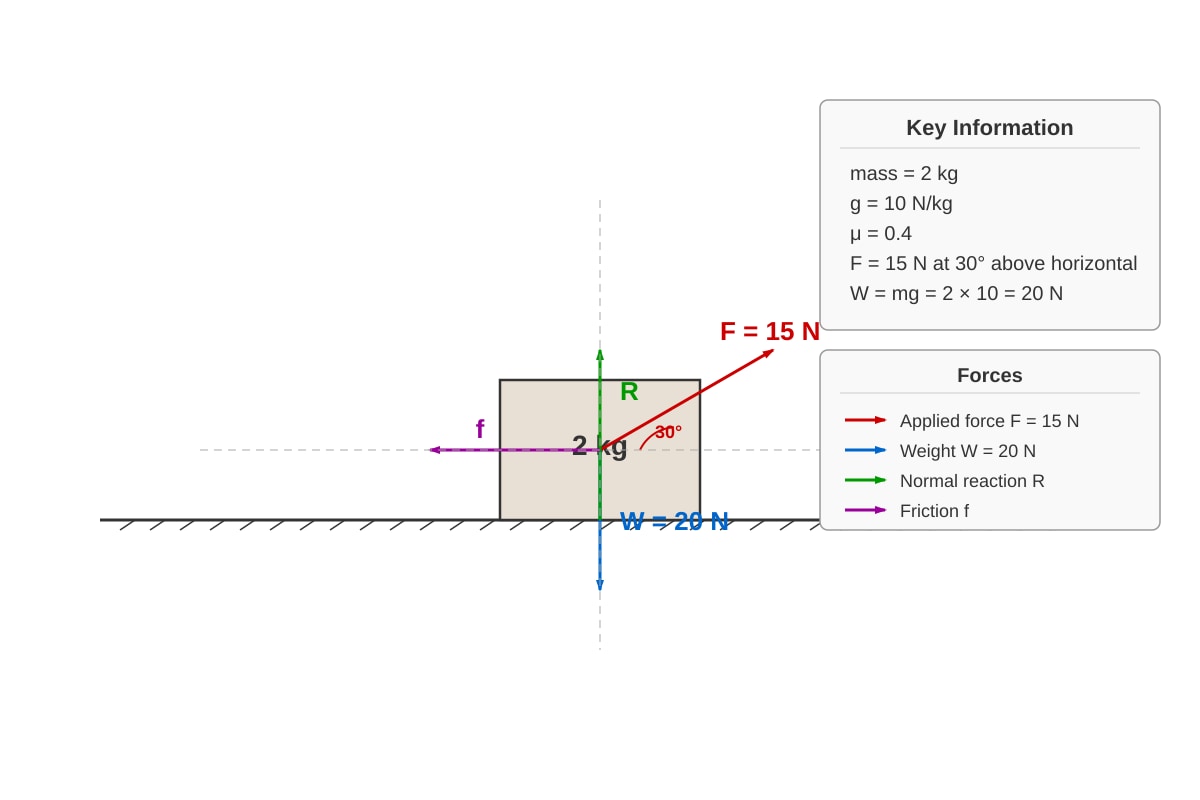
<image_placeholder> id: Q13-fig1 type: diagram linked_question: Q13 description: A block of mass 2 kg on a rough horizontal surface. A force of 15 N is applied at an angle of 30° above the horizontal. Show the block, applied force with angle, weight, normal reaction, and friction force. Label all forces with magnitudes where known. labels: Applied force = 15 N at 30° to horizontal, Weight = 20 N, Normal reaction = R, Friction = f values: mass = 2 kg, applied force = 15 N, angle = 30°, g = 10 N/kg must_show: Force arrows with labels, angle indication, horizontal surface </image_placeholder>

A block of mass 2 kg2 \text{ kg} rests on a rough horizontal surface. A force of 15 N15 \text{ N} is applied at an angle of 3030^\circ above the horizontal as shown. The coefficient of friction between the block and the surface is 0.40.4.

(a) Calculate the normal reaction force RR acting on the block. [2]


(b) Determine whether the block moves. Show your working. [1]


14. [4]

A rocket of initial mass 500 kg500 \text{ kg} (including fuel) is launched vertically upwards. The engine ejects gas at a constant rate of 2 kg/s2 \text{ kg/s} with a constant exhaust velocity of 1000 m/s1000 \text{ m/s} relative to the rocket. Assume g=10 N/kgg = 10 \text{ N/kg} and ignore air resistance.

(a) Calculate the thrust force produced by the engine. [2]


(b) Calculate the initial acceleration of the rocket. [2]


15. [4]

Two planets X and Y have masses MXM_X and MYM_Y and radii RXR_X and RYR_Y respectively. The gravitational field strength at the surface of planet X is gXg_X and at the surface of planet Y is gYg_Y.

Given that MY=2MXM_Y = 2M_X and RY=4RXR_Y = 4R_X, find the ratio gYgX\frac{g_Y}{g_X}. [4]


Section C: Longer Structured Questions (12 marks)

Answer all questions in the spaces provided.

16. [6]

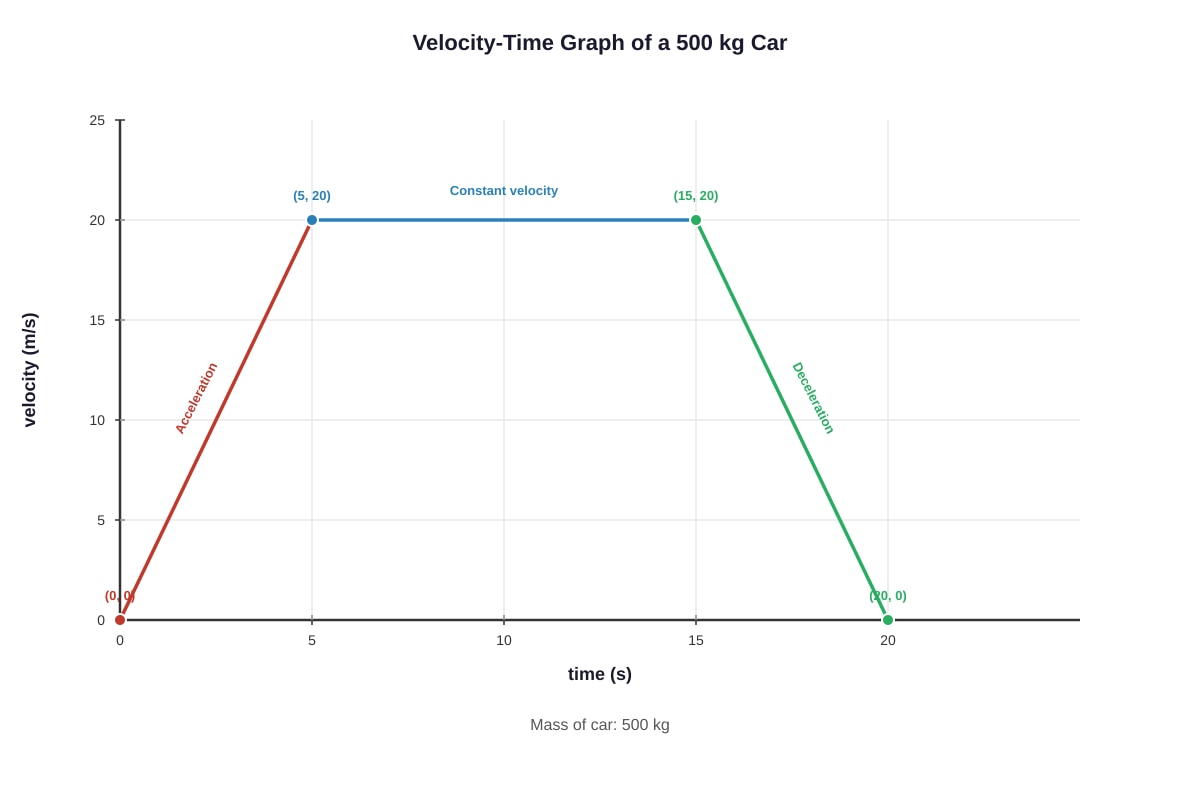
<image_placeholder> id: Q16-fig1 type: graph linked_question: Q16 description: Velocity-time graph for a 500 kg car. Graph shows: 0-5s: straight line from (0,0) to (5,20); 5-15s: horizontal line at v=20 m/s; 15-20s: straight line from (15,20) to (20,0). Axes: time (s) from 0 to 20, velocity (m/s) from 0 to 25. labels: time (s), velocity (m/s) values: (0,0), (5,20), (15,20), (20,0) must_show: Three distinct segments with correct slopes, labelled axes with units, key coordinates marked </image_placeholder>

The velocity-time graph above shows the motion of a car of mass 500 kg500 \text{ kg} over a 20 s20 \text{ s} period.

(a) Describe the motion of the car in each of the three time intervals: 05 s0-5 \text{ s}, 515 s5-15 \text{ s}, and 1520 s15-20 \text{ s}. [3]


(b) Calculate the acceleration of the car during the first 5 s5 \text{ s}. [1]


(c) Calculate the resultant force acting on the car during the first 5 s5 \text{ s}. [1]


(d) Calculate the total distance travelled by the car in 20 s20 \text{ s}. [1]


17. [6]

A student investigates the relationship between force and acceleration for a trolley of constant mass. The student applies different horizontal forces to the trolley and measures the resulting acceleration. The data collected is shown below.

Force / N1.02.03.04.05.0
Acceleration / m/s²0.40.91.31.82.2

(a) Plot the data on the grid below and draw the best-fit line. [2]

<image_placeholder> id: Q17-fig1 type: graph linked_question: Q17 description: Blank grid for plotting Force vs Acceleration. x-axis: Force (N) from 0 to 6. y-axis: Acceleration (m/s²) from 0 to 3.0. Grid lines at 0.5 intervals. labels: Force (N), Acceleration (m/s²) values: Data points: (1.0, 0.4), (2.0, 0.9), (3.0, 1.3), (4.0, 1.8), (5.0, 2.2) must_show: Labelled axes with units and scales, 5 data points plotted, best-fit straight line through origin </image_placeholder>

(b) The graph does not pass through the origin. Suggest a reason for this. [1]


(c) Determine the mass of the trolley from the gradient of the graph. [2]


(d) The student repeats the experiment on a smoother surface. State and explain how the graph would change. [1]


18. [6]

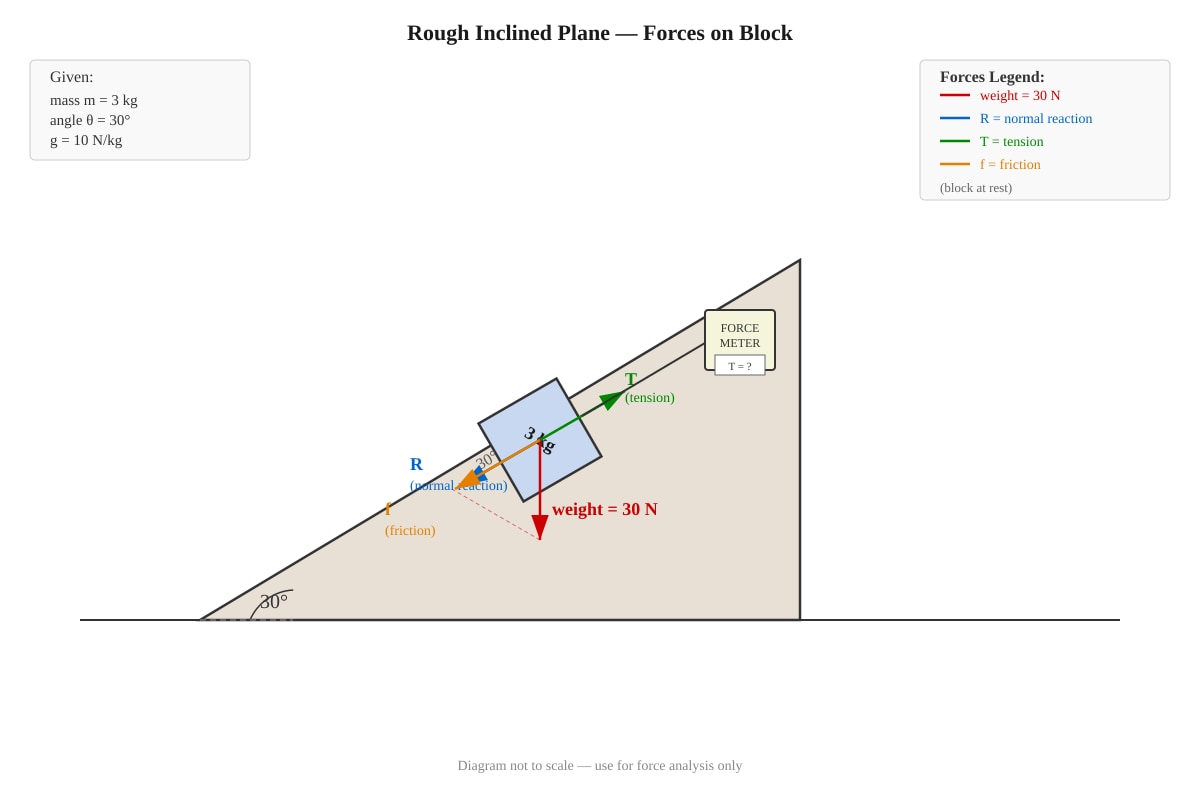
<image_placeholder> id: Q18-fig1 type: diagram linked_question: Q18 description: Inclined plane at 30° to horizontal. A block of mass 3 kg is held at rest by a string parallel to the plane, attached to a force meter. Show the inclined plane, block, string parallel to plane, force meter, and all forces acting on block (weight, normal reaction, tension, friction). labels: mass = 3 kg, angle = 30°, tension = T, weight = 30 N, normal reaction = R, friction = f values: mass = 3 kg, angle = 30°, g = 10 N/kg must_show: Inclined plane with angle, block, string parallel to plane, force arrows with labels </image_placeholder>

A block of mass 3 kg3 \text{ kg} is held at rest on a rough inclined plane at 3030^\circ to the horizontal by a string parallel to the plane, as shown. The string is attached to a force meter which reads TT. The coefficient of static friction between the block and the plane is 0.50.5.

(a) Draw and label all the forces acting on the block on the diagram above. [2]

(b) Calculate the component of the weight parallel to the plane. [1]


(c) Calculate the maximum static friction force. [2]


(d) Determine the tension TT in the string. [1]


19. [6]

A spacecraft of mass 2000 kg2000 \text{ kg} is in a circular orbit around the Earth at a height of 400 km400 \text{ km} above the Earth's surface. The radius of the Earth is 6400 km6400 \text{ km} and the gravitational field strength at the Earth's surface is 10 N/kg10 \text{ N/kg}.

(a) Calculate the gravitational field strength at the orbit height. [2]


(b) Calculate the orbital speed of the spacecraft. [2]


(c) The spacecraft fires its engines to move to a higher orbit. Explain why its orbital speed decreases. [2]


20. [6]

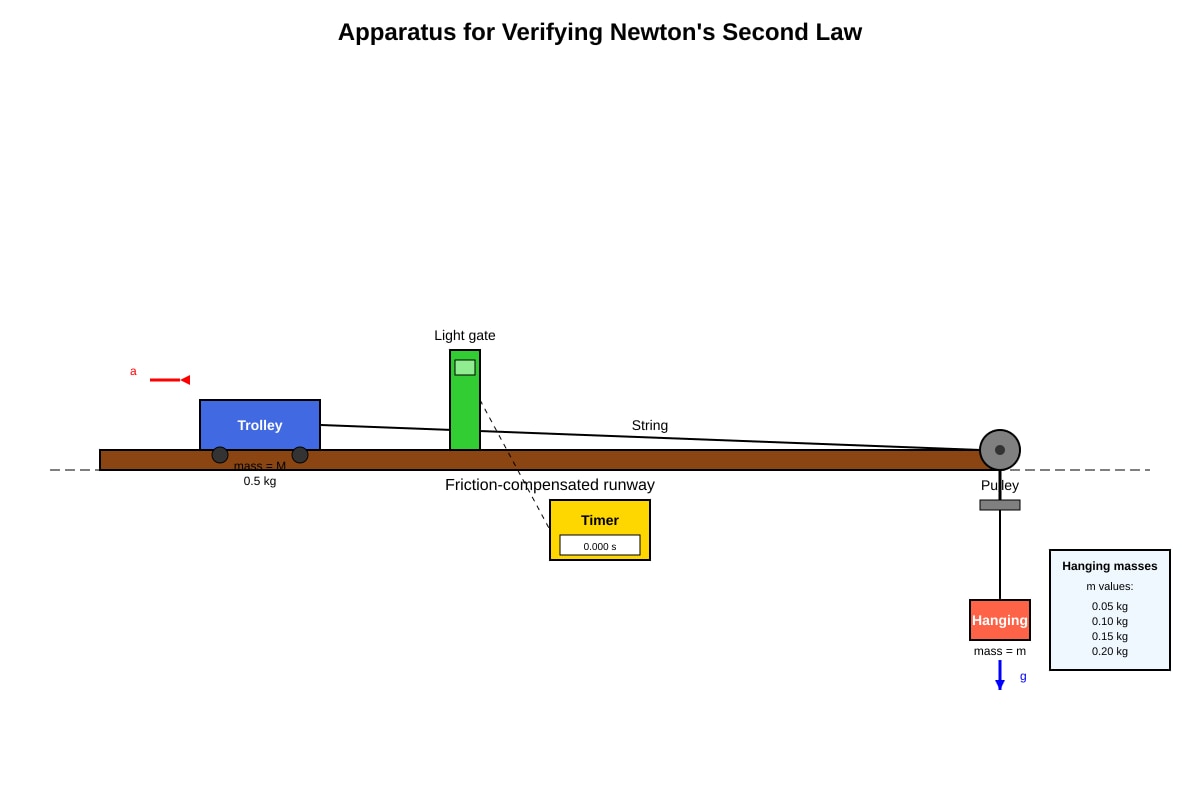
<image_placeholder> id: Q20-fig1 type: experimental_setup linked_question: Q20 description: Apparatus for verifying Newton's second law: A trolley on a horizontal friction-compensated runway, connected by a string over a pulley to a hanging mass. Light gate and timer to measure acceleration. Show trolley, runway, pulley, string, hanging mass, light gate, timer. labels: Trolley mass = M, Hanging mass = m, String, Light gate, Timer, Friction-compensated runway values: Trolley mass = 0.5 kg, Hanging masses = 0.05 kg, 0.10 kg, 0.15 kg, 0.20 kg must_show: Trolley on horizontal runway, string over pulley, hanging masses, light gate position, timer </image_placeholder>

A student sets up an experiment to verify Newton's second law using the apparatus shown. A trolley of mass 0.5 kg0.5 \text{ kg} runs on a friction-compensated horizontal runway. A string attached to the trolley passes over a frictionless pulley and carries a hanging mass mm. The acceleration aa of the trolley is measured using a light gate and timer.

(a) Explain what is meant by a "friction-compensated runway". [1]


(b) The student varies the hanging mass mm and records the acceleration aa. The net force accelerating the system is the weight of the hanging mass. Write down the equation relating the net force, total mass of the system, and acceleration. [1]


(c) The student plots a graph of aa against mm. State the expected shape of the graph and explain your reasoning. [2]


(d) In one trial, m=0.15 kgm = 0.15 \text{ kg} and the measured acceleration is 2.5 m/s22.5 \text{ m/s}^2. The theoretical acceleration is 2.7 m/s22.7 \text{ m/s}^2. Suggest two possible reasons for the discrepancy. [2]


End of Quiz

Answers

<!-- TuitionGoWhere generation metadata: stage=3-0; model=nvidia/nemotron-3-ultra-550b-a55b:free; model_label=NVIDIA Nemotron 3 Ultra 550B A55B Free; generated=2026-06-18; Sources: Stage 2-1 real exam-derived templates and Stage 2-2 exam-enriched syllabus. -->

Secondary 3 Physics Quiz - Mechanics (Answer Key)

Total Marks: 40


Section A: Multiple Choice Questions (10 marks)

1. [1] Answer: B

Explanation: A beam balance compares masses and is independent of gravitational field strength, so the reading stays the same on the Moon. A spring balance measures weight (W=mgW = mg), which decreases on the Moon because gg is smaller (1.6 N/kg1.6 \text{ N/kg} vs 10 N/kg10 \text{ N/kg} on Earth).

Common mistake: Confusing mass (constant) with weight (depends on gg).


2. [1] Answer: B

Working:

  • Acceleration a=vut=20010=2 m/s2a = \frac{v - u}{t} = \frac{20 - 0}{10} = 2 \text{ m/s}^2
  • Resultant force F=ma=1200×2=2400 NF = ma = 1200 \times 2 = 2400 \text{ N}

Key concept: Newton's second law F=maF = ma. Always find acceleration first from kinematics, then apply F=maF = ma.


3. [1] Answer: B

Working:

  • Resultant force Fnet=3010=20 NF_{\text{net}} = 30 - 10 = 20 \text{ N}
  • Acceleration a=Fnetm=205=4 m/s2a = \frac{F_{\text{net}}}{m} = \frac{20}{5} = 4 \text{ m/s}^2

Key concept: Resultant force = applied force − friction. Then a=Fnet/ma = F_{\text{net}}/m.


4. [1] Answer: B

Working:

  • For perpendicular forces: Fresultant=F12+F22=62+82=36+64=100=10 NF_{\text{resultant}} = \sqrt{F_1^2 + F_2^2} = \sqrt{6^2 + 8^2} = \sqrt{36 + 64} = \sqrt{100} = 10 \text{ N}

Key concept: Vector addition at 9090^\circ uses Pythagoras' theorem. This is a 3-4-5 triangle scaled by 2.


5. [1] Answer: C

Explanation: For circular motion, a centripetal force is required. For a satellite, the gravitational force is the centripetal force. The satellite has centripetal acceleration (v2/rv^2/r) directed towards Earth, so resultant force is not zero and acceleration is not zero. Kinetic energy is not zero since it has speed.

Key concept: Gravitational force provides centripetal force for orbital motion.


6. [1] Answer: B

Explanation: At the highest point, velocity is momentarily zero. However, the weight mgmg still acts downwards, so acceleration is g=10 m/s2g = 10 \text{ m/s}^2 downwards (by F=maF=ma, a=mg/m=ga = mg/m = g).

Common mistake: Thinking acceleration is zero when velocity is zero. Acceleration is rate of change of velocity; the velocity is changing from upward to downward.


7. [1] Answer: C

Working:

  • Original: F=Gm1m2r2F = \frac{G m_1 m_2}{r^2}
  • New: F=G(2m1)(2m2)(r/2)2=4Gm1m2r2/4=16Gm1m2r2=16FF' = \frac{G (2m_1)(2m_2)}{(r/2)^2} = \frac{4 G m_1 m_2}{r^2/4} = 16 \frac{G m_1 m_2}{r^2} = 16F

Key concept: Fm1m2F \propto m_1 m_2 and F1/r2F \propto 1/r^2. Doubling both masses gives ×4\times 4. Halving distance gives ×4\times 4 (since 1/(1/2)2=41/(1/2)^2 = 4). Combined: 4×4=164 \times 4 = 16.


8. [1] Answer: C

Working:

  • Acceleration a=Fm=204=5 m/s2a = \frac{F}{m} = \frac{20}{4} = 5 \text{ m/s}^2
  • Final velocity v=u+at=0+5×3=15 m/sv = u + at = 0 + 5 \times 3 = 15 \text{ m/s}

Key concept: Use F=maF=ma to find aa, then v=u+atv = u + at.


9. [1] Answer: A

Explanation: On an inclined plane, the component of weight parallel to the plane is WsinθW \sin \theta. Since the block is at rest (equilibrium), friction ff balances this component: f=Wsinθf = W \sin \theta.

Key concept: Resolution of weight on inclined plane: parallel component = WsinθW \sin \theta, perpendicular component = WcosθW \cos \theta.


10. [1] Answer: B

Explanation: A straight line on a velocity-time graph indicates constant acceleration (gradient = acceleration). Negative gradient means constant deceleration (acceleration in the negative direction). Since it passes through the origin, initial velocity is zero.

Key concept: Gradient of v-t graph = acceleration. Straight line = constant acceleration.


Section B: Structured Questions (18 marks)

11. [3]

(a) [1] Weight (gravitational force) acting downwards, and air resistance (drag) acting upwards.

(b) [2] Working:

  • Weight W=mg=80×10=800 NW = mg = 80 \times 10 = 800 \text{ N} (downwards)
  • Air resistance R=500 NR = 500 \text{ N} (upwards)
  • Resultant force Fnet=WR=800500=300 NF_{\text{net}} = W - R = 800 - 500 = 300 \text{ N} (downwards)
  • Acceleration a=Fnetm=30080=3.75 m/s2a = \frac{F_{\text{net}}}{m} = \frac{300}{80} = 3.75 \text{ m/s}^2 downwards

Answer: 3.75 m/s23.75 \text{ m/s}^2 downwards

Marking: 1 mark for correct resultant force, 1 mark for correct acceleration with direction.


12. [4]

(a) [1] Fnet=FdriveFR=4000200vF_{\text{net}} = F_{\text{drive}} - F_R = 4000 - 200v

(b) [2] Working:

  • At terminal velocity, Fnet=0F_{\text{net}} = 0, so Fdrive=FRF_{\text{drive}} = F_R
  • 4000=200vterminal4000 = 200v_{\text{terminal}}
  • vterminal=4000200=20 m/sv_{\text{terminal}} = \frac{4000}{200} = 20 \text{ m/s}

Answer: 20 m/s20 \text{ m/s}

(c) [1] At terminal velocity, the driving force equals the resistive force, so the resultant force is zero. By Newton's first law, the car continues at constant velocity (no acceleration). To exceed this speed would require a resultant force in the direction of motion, but the resistive force increases with speed and would exceed the driving force, causing deceleration.

Key concept: Terminal velocity occurs when driving force = resistive force → zero resultant force → zero acceleration → constant velocity.


13. [3]

(a) [2] Working:

  • Vertical forces in equilibrium (no vertical acceleration): R+Fvertical=WR + F_{\text{vertical}} = W
  • Vertical component of applied force: Fy=15sin30=15×0.5=7.5 NF_y = 15 \sin 30^\circ = 15 \times 0.5 = 7.5 \text{ N} (upwards)
  • Weight W=mg=2×10=20 NW = mg = 2 \times 10 = 20 \text{ N} (downwards)
  • R+7.5=20R + 7.5 = 20
  • R=207.5=12.5 NR = 20 - 7.5 = 12.5 \text{ N}

Answer: 12.5 N12.5 \text{ N}

Marking: 1 mark for resolving vertical component correctly, 1 mark for correct normal reaction.

(b) [1] Working:

  • Horizontal component of applied force: Fx=15cos30=15×0.866=12.99 N13.0 NF_x = 15 \cos 30^\circ = 15 \times 0.866 = 12.99 \text{ N} \approx 13.0 \text{ N}
  • Maximum friction fmax=μR=0.4×12.5=5.0 Nf_{\text{max}} = \mu R = 0.4 \times 12.5 = 5.0 \text{ N}
  • Since Fx(13.0 N)>fmax(5.0 N)F_x (13.0 \text{ N}) > f_{\text{max}} (5.0 \text{ N}), the block moves.

Answer: Yes, the block moves because the horizontal component of the applied force (13.0 N13.0 \text{ N}) exceeds the maximum static friction (5.0 N5.0 \text{ N}).

Marking: 1 mark for correct comparison with conclusion.


14. [4]

(a) [2] Working:

  • Thrust Fthrust=rate of mass ejection×exhaust velocity=dmdt×vexhaustF_{\text{thrust}} = \text{rate of mass ejection} \times \text{exhaust velocity} = \frac{dm}{dt} \times v_{\text{exhaust}}
  • Fthrust=2×1000=2000 NF_{\text{thrust}} = 2 \times 1000 = 2000 \text{ N}

Answer: 2000 N2000 \text{ N}

Key concept: Rocket thrust = dmdt×vexhaust\frac{dm}{dt} \times v_{\text{exhaust}} (rate of change of momentum of ejected gas).

(b) [2] Working:

  • Initial weight W=mg=500×10=5000 NW = mg = 500 \times 10 = 5000 \text{ N}
  • Resultant force Fnet=ThrustWeight=20005000=3000 NF_{\text{net}} = \text{Thrust} - \text{Weight} = 2000 - 5000 = -3000 \text{ N}
  • Acceleration a=Fnetm=3000500=6 m/s2a = \frac{F_{\text{net}}}{m} = \frac{-3000}{500} = -6 \text{ m/s}^2

Answer: 6 m/s2-6 \text{ m/s}^2 (or 6 m/s26 \text{ m/s}^2 downwards)

Note: The rocket does not lift off initially because thrust (2000 N2000 \text{ N}) < weight (5000 N5000 \text{ N}). This is a realistic scenario — rockets need thrust > weight to launch.

Marking: 1 mark for correct resultant force, 1 mark for correct acceleration with sign/direction.


15. [4]

Working:

  • Gravitational field strength at surface: g=GMR2g = \frac{GM}{R^2}
  • For planet X: gX=GMXRX2g_X = \frac{GM_X}{R_X^2}
  • For planet Y: gY=GMYRY2=G(2MX)(4RX)2=2GMX16RX2=18GMXRX2=18gXg_Y = \frac{GM_Y}{R_Y^2} = \frac{G(2M_X)}{(4R_X)^2} = \frac{2GM_X}{16R_X^2} = \frac{1}{8} \frac{GM_X}{R_X^2} = \frac{1}{8} g_X
  • Ratio gYgX=18\frac{g_Y}{g_X} = \frac{1}{8}

Answer: 18\frac{1}{8} or 0.1250.125

Marking: 1 mark for formula g=GM/R2g = GM/R^2, 1 mark for substituting MY=2MXM_Y = 2M_X, 1 mark for substituting RY=4RXR_Y = 4R_X (squared gives 16), 1 mark for correct final ratio.

Key concept: gM/R2g \propto M/R^2. Doubling mass doubles gg; quadrupling radius reduces gg by factor of 16. Net factor = 2/16=1/82/16 = 1/8.


Section C: Longer Structured Questions (12 marks)

16. [6]

(a) [3]

  • 0–5 s: The car accelerates uniformly from rest. Velocity increases linearly from 0 to 20 m/s. Acceleration is constant and positive.
  • 5–15 s: The car moves at constant velocity of 20 m/s. Acceleration is zero. Resultant force is zero.
  • 15–20 s: The car decelerates uniformly to rest. Velocity decreases linearly from 20 m/s to 0. Acceleration is constant and negative (deceleration).

Marking: 1 mark per interval for correct description including acceleration behaviour.

(b) [1] Working:

  • Acceleration = gradient of v-t graph = 20050=4 m/s2\frac{20 - 0}{5 - 0} = 4 \text{ m/s}^2

Answer: 4 m/s24 \text{ m/s}^2

(c) [1] Working:

  • F=ma=500×4=2000 NF = ma = 500 \times 4 = 2000 \text{ N}

Answer: 2000 N2000 \text{ N}

(d) [1] Working:

  • Distance = area under v-t graph
  • Area 1 (0–5 s): 12×5×20=50 m\frac{1}{2} \times 5 \times 20 = 50 \text{ m}
  • Area 2 (5–15 s): 10×20=200 m10 \times 20 = 200 \text{ m}
  • Area 3 (15–20 s): 12×5×20=50 m\frac{1}{2} \times 5 \times 20 = 50 \text{ m}
  • Total distance = 50+200+50=300 m50 + 200 + 50 = 300 \text{ m}

Answer: 300 m300 \text{ m}

Marking: 1 mark for correct total distance (method must be shown or implied).


17. [6]

(a) [2] Expected graph:

  • Axes labelled with units: Force (N) on x-axis, Acceleration (m/s²) on y-axis
  • Suitable scales covering the data range
  • 5 points plotted correctly at (1.0, 0.4), (2.0, 0.9), (3.0, 1.3), (4.0, 1.8), (5.0, 2.2)
  • Best-fit straight line passing near the points and through/near the origin

Marking: 1 mark for correct plotting of all 5 points, 1 mark for best-fit line.

(b) [1] Reason: There is friction (or resistive force) in the system. Even when the applied force is zero, friction opposes motion, so a non-zero force is needed to overcome friction before acceleration occurs. The intercept on the force axis represents the frictional force.

Alternative: Systematic error in force measurement (e.g., uncalibrated force meter).

Key concept: Non-zero intercept on force axis indicates a constant resistive force (friction).

(c) [2] Working:

  • Gradient = ΔaΔF=1m\frac{\Delta a}{\Delta F} = \frac{1}{m} (from F=maF = ma)
  • Using two points on the best-fit line, e.g., (1.0, 0.4) and (5.0, 2.2):
  • Gradient = 2.20.45.01.0=1.84.0=0.45 m/s2 per N\frac{2.2 - 0.4}{5.0 - 1.0} = \frac{1.8}{4.0} = 0.45 \text{ m/s}^2 \text{ per N}
  • Mass m=1gradient=10.45=2.22 kg2.2 kgm = \frac{1}{\text{gradient}} = \frac{1}{0.45} = 2.22 \text{ kg} \approx 2.2 \text{ kg}

Answer: 2.2 kg2.2 \text{ kg} (accept 2.02.5 kg2.0–2.5 \text{ kg} depending on best-fit line)

Marking: 1 mark for correct method (gradient = 1/m), 1 mark for correct calculation from graph.

(d) [1] Answer: On a smoother surface, friction decreases. The graph would have a smaller intercept on the force axis (lower friction to overcome) and a steeper gradient (same mass, but less resistive force means greater acceleration for the same applied force). The line would shift left/up.

Key concept: Less friction → smaller force intercept, steeper gradient (since a=(Ff)/ma = (F - f)/m).


18. [6]

(a) [2] Forces to show on diagram:

  1. Weight W=30 NW = 30 \text{ N} vertically downwards
  2. Normal reaction RR perpendicular to plane, away from surface
  3. Tension TT up the plane (parallel to plane)
  4. Friction ff up the plane (parallel to plane, opposing potential motion down)

Marking: 1 mark for all 4 forces correctly drawn and labelled with correct directions, 1 mark for correct relative magnitudes/angles (weight vertical, R perpendicular, T and f parallel to plane).

(b) [1] Working:

  • Component parallel to plane = Wsinθ=30×sin30=30×0.5=15 NW \sin \theta = 30 \times \sin 30^\circ = 30 \times 0.5 = 15 \text{ N}

Answer: 15 N15 \text{ N} down the plane

(c) [2] Working:

  • Normal reaction R=Wcosθ=30×cos30=30×0.866=25.98 N26.0 NR = W \cos \theta = 30 \times \cos 30^\circ = 30 \times 0.866 = 25.98 \text{ N} \approx 26.0 \text{ N}
  • Maximum static friction fmax=μsR=0.5×25.98=12.99 N13.0 Nf_{\text{max}} = \mu_s R = 0.5 \times 25.98 = 12.99 \text{ N} \approx 13.0 \text{ N}

Answer: 13.0 N13.0 \text{ N}

Marking: 1 mark for correct normal reaction, 1 mark for correct maximum friction.

(d) [1] Working:

  • Block is in equilibrium (at rest): forces up the plane = forces down the plane
  • T+f=WsinθT + f = W \sin \theta
  • Since the block is held at rest and not moving, friction is static. The tension required depends on whether friction is at its maximum.
  • The problem states the block is "held at rest" by the string. The minimum tension occurs when friction is at its maximum (limiting friction) acting up the plane.
  • T=Wsinθfmax=1513=2 NT = W \sin \theta - f_{\text{max}} = 15 - 13 = 2 \text{ N}

Answer: 2 N2 \text{ N}

Note: If the string were not there, the block would slide down because Wsinθ(15 N)>fmax(13 N)W \sin \theta (15 \text{ N}) > f_{\text{max}} (13 \text{ N}). The string provides the additional 2 N2 \text{ N} to maintain equilibrium.


19. [6]

(a) [2] Working:

  • Gravitational field strength g1r2g \propto \frac{1}{r^2} where rr is distance from Earth's centre.
  • At surface: rE=6400 kmr_E = 6400 \text{ km}, gE=10 N/kgg_E = 10 \text{ N/kg}
  • At orbit: rorbit=6400+400=6800 kmr_{\text{orbit}} = 6400 + 400 = 6800 \text{ km}
  • gorbit=gE×(rErorbit)2=10×(64006800)2=10×(1617)2=10×2562898.86 N/kgg_{\text{orbit}} = g_E \times \left(\frac{r_E}{r_{\text{orbit}}}\right)^2 = 10 \times \left(\frac{6400}{6800}\right)^2 = 10 \times \left(\frac{16}{17}\right)^2 = 10 \times \frac{256}{289} \approx 8.86 \text{ N/kg}

Answer: 8.86 N/kg8.86 \text{ N/kg} (accept 8.9 N/kg8.9 \text{ N/kg})

Marking: 1 mark for correct orbital radius, 1 mark for correct calculation using inverse square law.

(b) [2] Working:

  • For circular orbit: gravitational force = centripetal force
  • mgorbit=mv2rorbitmg_{\text{orbit}} = \frac{mv^2}{r_{\text{orbit}}}
  • $v^2 = g_{\text{orbit}}

<stage3_quiz_answers_md>

Secondary 3 Physics Quiz - Mechanics (Answer Key)

Total Marks: 40


Section A: Multiple Choice Questions (10 marks)

QuestionAnswerExplanation
1BBeam balance measures mass (same everywhere). Spring balance measures weight = mg, which decreases on the Moon (g = 1.6 N/kg).
2Ba = (v-u)/t = (20-0)/10 = 2 m/s². F = ma = 1200 × 2 = 2400 N.
3BF_net = 30 - 10 = 20 N. a = F_net/m = 20/5 = 4 m/s².
4BResultant = √(6² + 8²) = √(36+64) = √100 = 10 N (3-4-5 triangle).
5CSatellite has centripetal acceleration; gravitational force provides centripetal force.
6BAt highest point, v = 0 but acceleration = g = 10 m/s² downwards.
7CF ∝ m₁m₂/r². New F = (2×2)/(½)² × F = 4/(¼) × F = 16F.
8Ca = F/m = 20/4 = 5 m/s². v = u + at = 0 + 5×3 = 15 m/s.
9AFor equilibrium parallel to plane: f = W sin θ.
10BStraight line with negative gradient on v-t graph = constant (negative) acceleration.

Section B: Structured Questions (18 marks)

11. [3]

(a) Weight (gravitational force) downwards, air resistance upwards. [1]

(b)

  • Weight = mg = 80 × 10 = 800 N downwards [1]
  • Net force = 800 - 500 = 300 N downwards
  • a = F_net/m = 300/80 = 3.75 m/s² downwards [1]

12. [4]

(a) F_net = Driving force - Resistive force = 4000 - 200v [1]

(b) At terminal velocity, F_net = 0

  • 4000 - 200v = 0
  • 200v = 4000
  • v = 20 m/s [2]

(c) At terminal velocity, resultant force is zero, so acceleration is zero. The car cannot exceed this speed because the resistive force increases with speed, balancing the driving force. [1]

13. [3]

(a)

  • Vertical forces: R + 15 sin 30° = mg
  • R + 15 × 0.5 = 2 × 10
  • R + 7.5 = 20
  • R = 12.5 N [2]

(b)

  • Max friction = μR = 0.4 × 12.5 = 5 N
  • Horizontal component of applied force = 15 cos 30° = 15 × 0.866 = 12.99 N
  • Since 12.99 N > 5 N, the block moves. [1]

14. [4]

(a) Thrust = rate of mass ejection × exhaust velocity = 2 × 1000 = 2000 N [2]

(b)

  • Initial weight = 500 × 10 = 5000 N
  • Net force = Thrust - Weight = 2000 - 5000 = -3000 N
  • a = F_net/m = -3000/500 = -6 m/s² (downwards) [2]
  • Note: Rocket cannot lift off initially; thrust < weight.

15. [4]

  • g = GM/R²
  • g_X = GM_X/R_X²
  • g_Y = GM_Y/R_Y² = G(2M_X)/(4R_X)² = 2GM_X/16R_X² = (2/16) GM_X/R_X² = ⅛ g_X
  • g_Y/g_X = 1/8 or 0.125 [4]

Section C: Longer Structured Questions (12 marks)

16. [6]

(a)

  • 0-5 s: Uniform acceleration from rest to 20 m/s. [1]
  • 5-15 s: Constant velocity of 20 m/s (zero acceleration). [1]
  • 15-20 s: Uniform deceleration from 20 m/s to rest. [1]

(b) a = gradient = (20-0)/(5-0) = 4 m/s² [1]

(c) F = ma = 500 × 4 = 2000 N [1]

(d) Distance = area under graph

  • 0-5 s: ½ × 5 × 20 = 50 m
  • 5-15 s: 10 × 20 = 200 m
  • 15-20 s: ½ × 5 × 20 = 50 m
  • Total = 300 m [1]

17. [6]

(a) [2 marks for correct plotting and best-fit line]

  • Axes labelled with units and suitable scales
  • 5 points plotted accurately
  • Best-fit straight line drawn (should pass near origin but may have small intercept)

(b) The graph not passing through origin indicates systematic error - likely friction in the trolley wheels/axle or air resistance, causing a non-zero intercept on force axis (force needed to overcome friction before acceleration occurs). [1]

(b) Gradient = Δa/ΔF ≈ (2.2 - 0.4)/(5.0 - 1.0) = 1.8/4.0 = 0.45 m/s²/N

  • F = ma → m = 1/gradient = 1/0.45 ≈ 2.22 kg [2]

(c) On smoother surface: gradient increases (steeper line) because less friction means greater acceleration for same force. Intercept on force axis decreases (closer to origin). [1]

18. [6]

(a) Forces on diagram [2]:

  • Weight (30 N) vertically down
  • Normal reaction (R) perpendicular to plane
  • Tension (T) up the plane parallel to surface
  • Friction (f) up the plane (opposing potential motion down)

(b) Component parallel to plane = W sin θ = 30 × sin 30° = 30 × 0.5 = 15 N [1]

(c)

  • R = W cos θ = 30 × cos 30° = 30 × 0.866 = 25.98 N
  • f_max = μR = 0.5 × 25.98 = 12.99 N [2]

(d) For equilibrium parallel to plane: T + f = W sin θ

  • T = W sin θ - f = 15 - 12.99 = 2.01 N [1]
  • Note: Friction acts up the plane, helping tension hold the block.

19. [6]

(a)

  • g ∝ 1/r²
  • r_orbit = 6400 + 400 = 6800 km
  • g_orbit = g_surface × (R_Earth/r_orbit)² = 10 × (6400/6800)² = 10 × (16/17)² = 10 × 256/289 ≈ 8.86 N/kg [2]

(b)

  • Centripetal force = gravitational force
  • mv²/r = mg_orbit
  • v² = g_orbit × r = 8.86 × 6.8×10⁶ = 6.025×10⁷
  • v = √(6.025×10⁷) ≈ 7760 m/s [2]

(c)

  • In higher orbit, r increases → gravitational field strength g decreases [1]
  • For circular orbit: v = √(GM/r) or v² = gr. As r increases, g decreases more rapidly (∝ 1/r²), so v decreases (∝ 1/√r). [1]
  • Alternatively: Total energy becomes less negative; potential energy increases more than kinetic energy decreases.

20. [6]

(a)

  • Trolley on friction-compensated runway (tilted slightly so component of weight balances friction)
  • String connects trolley to hanging mass over pulley
  • Light gate measures trolley acceleration
  • Hanging mass provides accelerating force (mg) [2]

(b)

  • System mass = M + m
  • Accelerating force = mg (weight of hanging mass)
  • a = F/(M+m) = mg/(M+m) [2]

(c)

  • Plot a vs m (or a vs mg)
  • Gradient = g/(M+m) — but M+m changes as m changes
  • Better: Plot a vs mg/(M+m) or use a = (g/(M+m))m
  • Actually: For fixed M, a = [g/(M+m)]m — not linear
  • Correct method: Keep total mass (M+m) constant by transferring masses from trolley to hanger. Then a ∝ m, gradient = g/(M+m). [2]

Marking Summary

SectionQuestionsMarks
A1-1010
B11-1518
C16-2012
Total40

End of Answer Key