Secondary 3 Physics Quiz - Mechanics
Name: ______________________
Class: ______________________
Date: ______________________
Score: _______ / 40
Duration: 60 minutes
Total Marks: 40
Instructions:
- Answer all 20 questions.
- Section A: Multiple-choice (1 mark each). Section B: Short structured (2 marks each). Section C: Extended structured (3–4 marks each).
- Show your working where calculation is required.
- Use g=10 m s−2 unless stated otherwise.
- Write units in your final answers.
Section A: Multiple Choice (Questions 1–5, 1 mark each)
1. A boy pushes a box with a force of 20 N to the right. A frictional force of 5 N acts to the left. What is the resultant force on the box?
A. 15 N to the right
B. 25 N to the right
C. 15 N to the left
D. 25 N to the left
2. Which of the following quantities is a vector?
A. Mass
B. Temperature
C. Velocity
D. Time
3. A car accelerates from rest to 20 m s−1 in 4 s. What is its acceleration?
A. 4 m s−2
B. 5 m s−2
C. 80 m s−2
D. 0.2 m s−2
4. The moment of a force about a pivot is maximum when the force is applied:
A. parallel to the lever
B. at the pivot
C. perpendicular to the lever at the furthest point
D. at the centre of mass
5. Pressure in a liquid increases with:
A. decreasing depth
B. decreasing density
C. increasing depth
D. decreasing gravitational field strength
Section B: Short Structured (Questions 6–10, 2 marks each)
6. A girl of mass 50 kg stands on a weighing scale in a lift. The lift accelerates upward at 2 m s−2. Calculate the reading on the scale in newtons.
7. A block of mass 4 kg is pulled along a horizontal surface with a constant force of 10 N. It accelerates at 1.5 m s−2. Calculate the frictional force acting on the block.
8. A hydraulic press has a small piston of area 0.01 m2 and a large piston of area 0.5 m2. A force of 100 N is applied to the small piston. Calculate the force exerted by the large piston.
9. A ball is thrown vertically upward with an initial velocity of 30 m s−1. Calculate the maximum height reached. (Use g=10 m s−2.)
10. State two ways to increase the stability of a standing object.
-
-
Section C: Extended Structured (Questions 11–20)
11. (3 marks) A child of mass 40 kg slides down a vertical rope at an acceleration of 2 m s−2. Calculate the frictional force between the child and the rope.
12. (3 marks) A wooden block of mass 5 kg is pulled up a rough inclined plane at constant speed by a force of 45 N parallel to the plane. The block moves 3 m along the plane and rises 1.2 m vertically. Calculate:
(a) the work done by the applied force,
(b) the increase in gravitational potential energy,
(c) the work done against friction.
13. (4 marks) A ring of mass 2 kg is suspended by two strings from a horizontal rod. String A makes 50∘ with the horizontal; string B makes 60∘ with the horizontal on the opposite side. Calculate the tension in each string. (Take g=10 m s−2.)
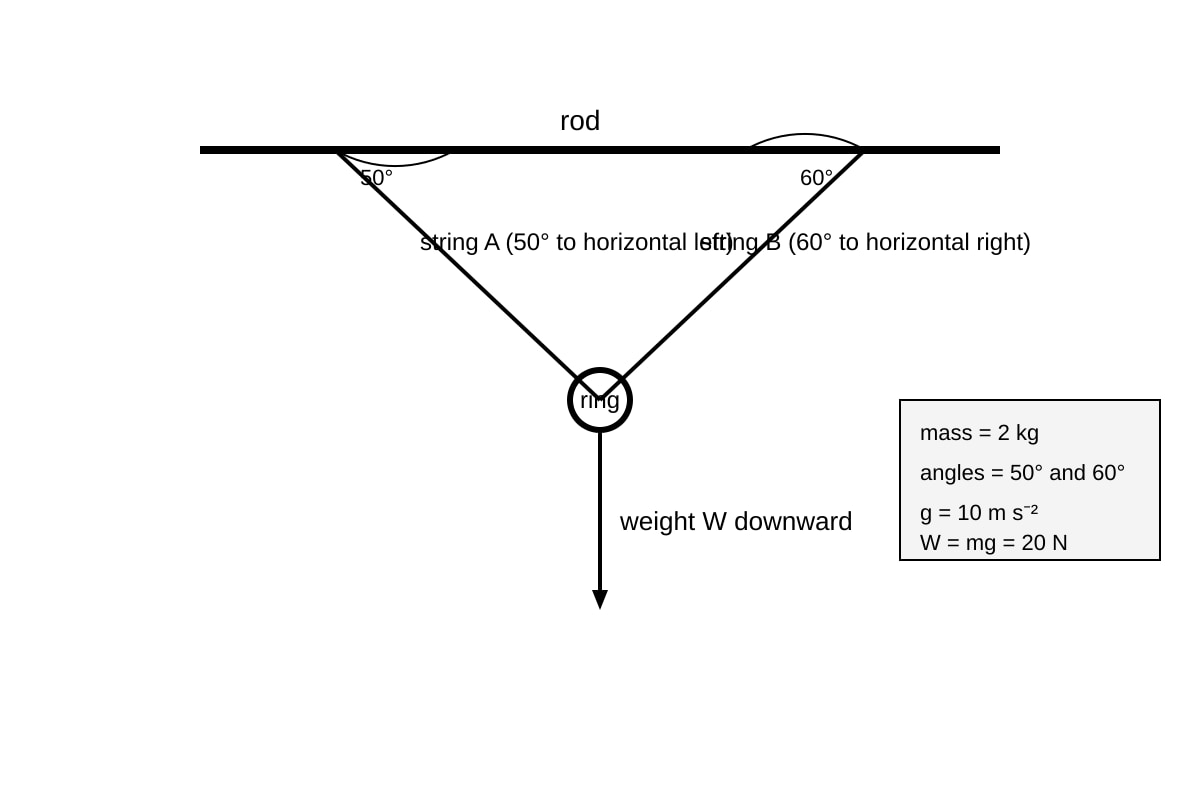
Generated diagram for Q13.
14. (3 marks) A car of mass 1000 kg travelling at 20 m s−1 is brought to rest in 5 s by a constant braking force. Calculate the braking force.
15. (3 marks) A metal block has mass 0.8 kg and volume 2×10⁻⁴ m3. Calculate its density and the pressure it exerts on a table when resting on a base area of 0.02 m2.
16. (4 marks) A boy uses a uniform metre rule of weight 2 N balanced at its centre. A 5 N load is hung at the 20 cm mark. Where must a 4 N force be applied to balance the rule? Show your working using the principle of moments.
17. (3 marks) Two masses, 2 kg and 6 kg, are separated by 0.5 m. Using G=6.67×10⁻¹¹ N m2 kg−2, calculate the gravitational force between them.
18. (3 marks) A person drops a stone from a cliff. It takes 3 s to reach the ground. Calculate the height of the cliff and the velocity on impact. (Use g=10 m s−2.)
19. (4 marks) The velocity-time graph below shows a cyclist's motion.
(a) Describe the motion between 0–4 s.
(b) Calculate the total distance travelled in 10 s.
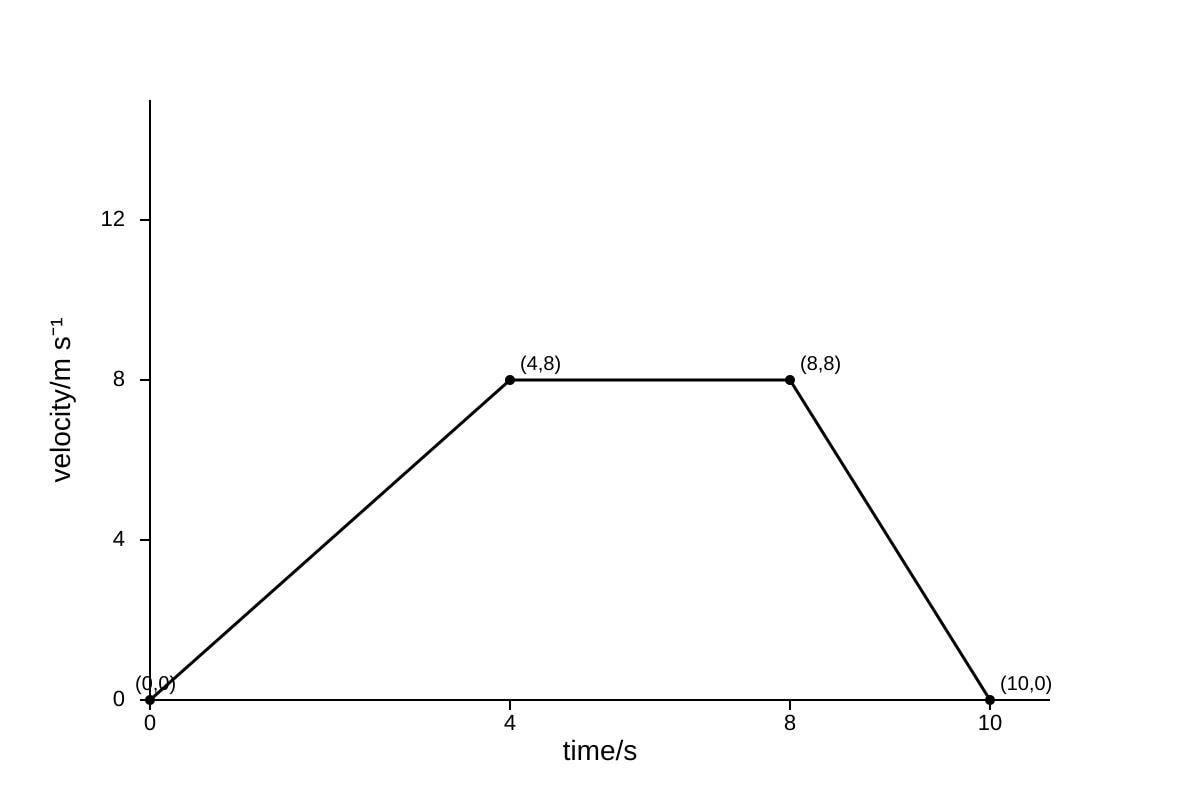
Generated graph for Q19.
20. (4 marks) A crate of mass 10 kg is pushed up a slope of length 5 m and height 2 m by a 60 N force. The crate moves at constant speed. Calculate the work done, gain in GPE, and the frictional force along the slope.