From Real Exams Quiz

Secondary 3 Physics Mechanics Quiz

Free Exam-Derived Secondary 3 Physics Mechanics quiz with questions and answers for Singapore students. This page is rendered as a direct URL so the questions and answers can be discovered without pressing in-page buttons.

These static practice materials are generated from the site's syllabus and paper-generation workflow, with source and model context shown so students and parents can evaluate the material before use.

Secondary 3 Physics From Real Exams Generated by Claude Sonnet 4 Updated 2026-06-03

Questions

Secondary 3 Physics Quiz - Mechanics

Name: _________________ Class: _________ Date: _________

Score: _____ / 30 Duration: 45 minutes

Instructions:

  • Answer all questions in the spaces provided
  • Show all working clearly for calculation questions
  • Take g = 10 m/s²

Section A: Multiple Choice Questions [10 marks]

Choose the best answer for each question. Write the letter in the box provided.

1. Newton's Law of Gravitation is given by F = Gm₁m₂/r². In this equation, what does r represent?

A. The radius of the larger mass B. The distance between the surfaces of the two masses
C. The distance between the centres of the two masses D. The combined radii of both masses

Answer: [ ]

2. A wooden block slides down a rough inclined plane at constant speed. Which statement is correct?

A. The net force on the block is zero B. The friction force equals the weight of the block C. The block has no acceleration D. Both A and C are correct

Answer: [ ]

3. An object moving to the right experiences a force F₁ to the right. Later, an opposing force F₂ of equal magnitude acts to the left. What happens to the object's motion?

A. It stops immediately B. It continues at constant velocity C. It accelerates to the left D. It reverses direction immediately

Answer: [ ]

4. Brownian motion is observed when smoke particles are viewed under a microscope. This motion is caused by:

A. Air currents in the container B. Vibrations from the microscope C. Collisions with gas molecules D. Gravitational forces

Answer: [ ]

5. The principle of conservation of energy states that:

A. Energy cannot change form B. Kinetic energy is always conserved C. Energy cannot be created or destroyed, only transformed D. Potential energy always increases

Answer: [ ]


Section B: Structured Questions [20 marks]

6. A child of mass 40 kg slides down a rope which hangs vertically from a tree. If her acceleration is 8.0 m/s², calculate the frictional force between the child and the rope. [3 marks]

Working:

Answer: _________________ N

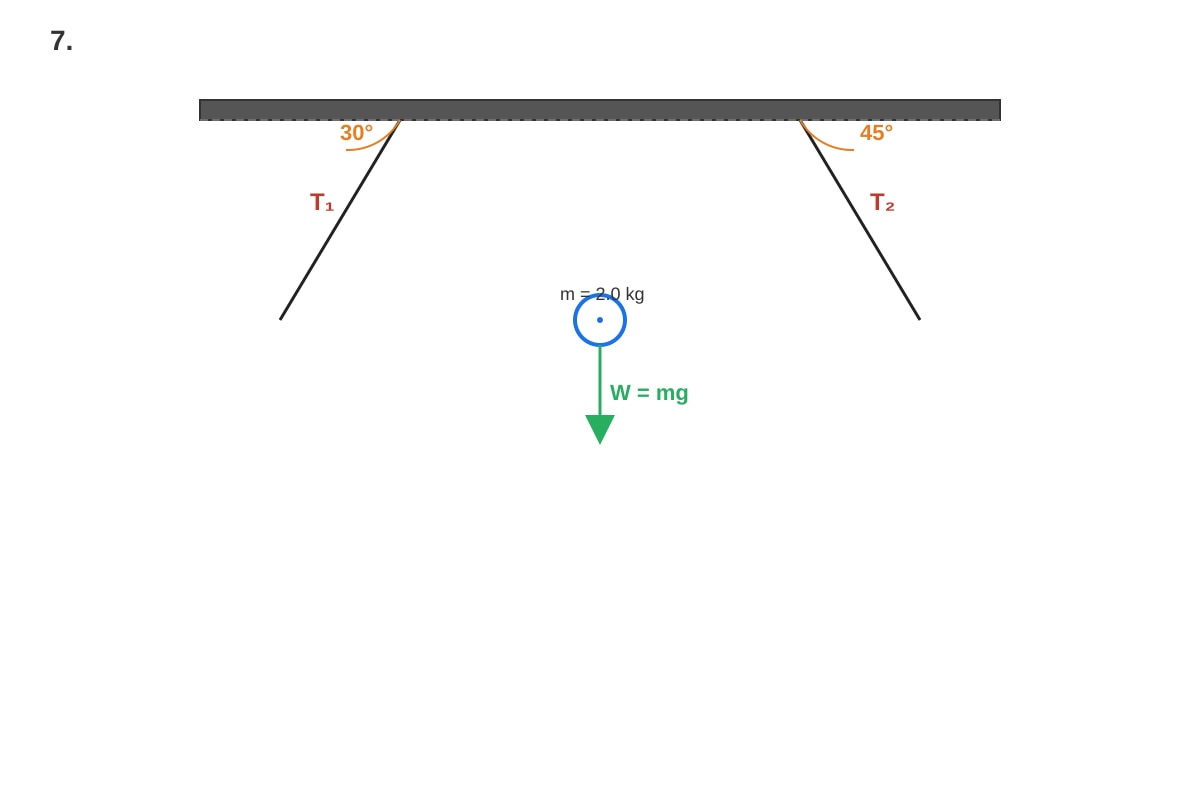
7. A ring is supported by two strings as shown in the diagram below. The strings make angles of 30° and 45° with the horizontal. The ring has a mass of 2.0 kg.

[Diagram shows ring suspended by two strings at given angles]

(a) Draw a free body diagram showing all forces acting on the ring. [2 marks]

(b) Calculate the tension in each string. [4 marks]

Working:

T₁ = _________________ N

T₂ = _________________ N

8. A wooden block of mass 5.0 kg is pulled up a rough inclined plane at constant speed by a force of 35 N. When the distance moved along the plane is 4.0 m, the increase in height is 2.0 m.

(a) Calculate the work done by the applied force. [2 marks]

Working:

Answer: _________________ J

(b) Calculate the gain in gravitational potential energy. [2 marks]

Working:

Answer: _________________ J

(c) Calculate the work done against friction. [2 marks]

Working:

Answer: _________________ J

9. Water of mass 0.50 kg at 25°C is heated by an immersion heater of power 2000 W. The specific heat capacity of water is 4200 J/(kg·°C).

(a) Calculate the thermal energy needed to raise the temperature of the water to 100°C. [2 marks]

Working:

Answer: _________________ J

(b) Calculate the minimum time required to heat the water to boiling point. [3 marks]

Working:

Answer: _________________ s

Answers

Secondary 3 Physics Quiz - Mechanics (Answer Key)


Section A: Multiple Choice Questions [10 marks]

1. C - The distance between the centres of the two masses [1 mark for correct answer]

2. D - Both A and C are correct [1 mark for correct answer. At constant speed, net force = 0 and acceleration = 0]

3. B - It continues at constant velocity
[1 mark for correct answer. When F₁ = F₂, net force = 0, so velocity remains constant]

4. C - Collisions with gas molecules [1 mark for correct answer]

5. C - Energy cannot be created or destroyed, only transformed [1 mark for correct answer]


Section B: Structured Questions [20 marks]

6. Frictional force calculation [3 marks]

Working:

  • Weight of child: W = mg = 40 × 10 = 400 N [1 mark]
  • Apply Newton's second law: mg - f = ma [1 mark]
  • f = mg - ma = m(g - a) = 40(10 - 8.0) = 40 × 2.0 = 80 N [1 mark]

Answer: 80 N

7. Ring equilibrium [6 marks total]

(a) Free body diagram [2 marks]

  • Weight W = mg downward from center of ring [1 mark]
  • Tension T₁ along first string, Tension T₂ along second string [1 mark]

(b) Tension calculations [4 marks]

Working:

  • Weight: W = mg = 2.0 × 10 = 20 N
  • Vertical equilibrium: T₁sin30° + T₂sin45° = 20 [1 mark]
  • Horizontal equilibrium: T₁cos30° = T₂cos45° [1 mark]
  • From horizontal: T₁(0.866) = T₂(0.707), so T₁ = 0.816T₂ [1 mark]
  • Substitute into vertical: 0.816T₂(0.5) + T₂(0.707) = 20
  • 0.408T₂ + 0.707T₂ = 20, so 1.115T₂ = 20
  • T₂ = 17.9 N, T₁ = 14.6 N [1 mark]

T₁ = 14.6 N T₂ = 17.9 N

8. Inclined plane work and energy [6 marks total]

(a) Work done by applied force [2 marks]

  • W = F × d = 35 × 4.0 = 140 J [2 marks]

Answer: 140 J

(b) Gain in gravitational potential energy [2 marks]

  • ΔPE = mgh = 5.0 × 10 × 2.0 = 100 J [2 marks]

Answer: 100 J

(c) Work done against friction [2 marks]

  • Work against friction = Work by applied force - Gain in PE [1 mark]
  • = 140 - 100 = 40 J [1 mark]

Answer: 40 J

9. Heating water [5 marks total]

(a) Thermal energy needed [2 marks]

  • Q = mcΔθ = 0.50 × 4200 × (100 - 25) [1 mark]
  • Q = 0.50 × 4200 × 75 = 157,500 J [1 mark]

Answer: 157,500 J

(b) Time required [3 marks]

  • P = E/t, so t = E/P [1 mark]
  • t = 157,500/2000 [1 mark]
  • t = 78.75 s ≈ 79 s [1 mark]

Answer: 79 s


Total: 30 marks