From Real Exams Quiz

Secondary 3 Physics Energy Power Quiz

Free Sec 3 Physics Energy Power quiz, Nemo3 Exam version, with questions, answers, and O Level-style practice for Singapore students.

These static practice materials are generated from the site's syllabus and paper-generation workflow, with source and model context shown so students and parents can evaluate the material before use.

Secondary 3 Physics From Real Exams Generated by NVIDIA Nemotron 3 Ultra 550B A55B Free Updated 2026-06-18

Questions

<!-- TuitionGoWhere generation metadata: stage=3-0; model=nvidia/nemotron-3-ultra-550b-a55b:free; model_label=NVIDIA Nemotron 3 Ultra 550B A55B Free; generated=2026-06-18; Sources: Stage 2-1 real exam-derived templates and Stage 2-2 exam-enriched syllabus. -->

Secondary 3 Physics Quiz - Energy Power

Name: ________________________
Class: ________________________
Date: ________________________
Score: ______ / 40

Duration: 45 minutes
Total Marks: 40

Instructions:

  • Answer all questions.
  • Write your answers in the spaces provided.
  • Show all working for calculation questions.
  • Use g=10 N/kgg = 10 \text{ N/kg} unless otherwise stated.
  • The number of marks is given in brackets [ ] at the end of each question or part question.

Section A: Multiple Choice Questions (10 marks)

Answer all questions. Choose the correct option and write the letter (A, B, C, or D) in the box provided.

1. A student lifts a 2.0 kg book from the floor to a shelf 1.5 m above the floor. The work done by the student against gravity is: [1]

A. 3.0 J
B. 15 J
C. 20 J
D. 30 J
Answer:

2. A car of mass 1200 kg accelerates uniformly from rest to 25 m/s in 10 s. The average power developed by the engine during this acceleration is: [1]

A. 37.5 kW
B. 75 kW
C. 150 kW
D. 375 kW
Answer:

3. A block slides down a frictionless inclined plane from height hh. At the bottom, its speed is vv. If the block starts from rest at height 2h2h, its speed at the bottom will be: [1]

A. vv
B. 2v\sqrt{2}v
C. 2v2v
D. 4v4v
Answer:

4. A motor lifts a 500 N load through a vertical height of 12 m in 20 s. The efficiency of the motor is 80%. The electrical energy input to the motor is: [1]

A. 6.0 kJ
B. 7.5 kJ
C. 9.6 kJ
D. 12 kJ
Answer:

5. A pendulum bob is released from rest at position A, which is 0.30 m above the lowest point B. Assuming no air resistance, the speed of the bob at B is: [1]

A. 1.7 m/s
B. 2.4 m/s
C. 3.0 m/s
D. 5.5 m/s
Answer:

6. A force of 40 N is applied to push a box 5.0 m across a horizontal floor at constant velocity. The work done by the applied force is: [1]

A. 0 J
B. 8.0 J
C. 200 J
D. 400 J
Answer:

7. A hydroelectric power station generates 200 MW of electrical power. Water falls through a vertical height of 80 m. Assuming 100% efficiency, the mass flow rate of water required is approximately: [1]

A. 250 kg/s
B. 255 kg/s
C. 2550 kg/s
D. 25500 kg/s
Answer:

8. A spring is compressed by 0.10 m from its natural length. The elastic potential energy stored in the spring is 2.5 J. The spring constant is: [1]

A. 250 N/m
B. 500 N/m
C. 1000 N/m
D. 2500 N/m
Answer:

9. A ball is thrown vertically upwards with an initial kinetic energy of 50 J. At its maximum height, the gravitational potential energy gained by the ball is: [1]

A. 0 J
B. 25 J
C. 50 J
D. 100 J
Answer:

10. A machine has an efficiency of 60%. If the useful work output is 180 J, the energy input to the machine is: [1]

A. 108 J
B. 180 J
C. 300 J
D. 480 J
Answer:


Section B: Structured Questions (18 marks)

Answer all questions in the spaces provided.

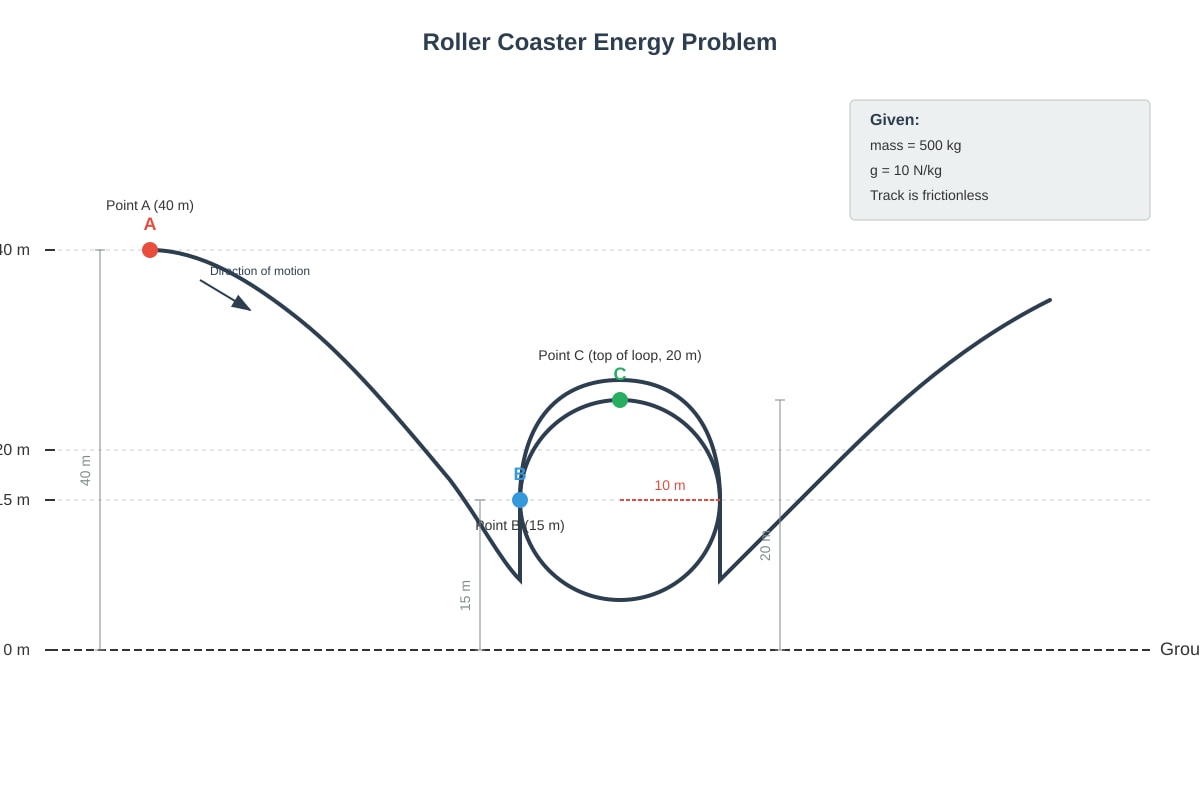
11. A roller coaster car of mass 500 kg starts from rest at point A, which is 40 m above ground level. The track is frictionless. The car passes through point B at a height of 15 m, then goes through a vertical loop of radius 10 m, reaching point C at the top of the loop.

<image_placeholder> id: Q11-fig1 type: diagram linked_question: Q11 description: Roller coaster track profile showing point A at 40 m height, point B at 15 m height, and a vertical loop of radius 10 m with point C at the top of the loop. Ground level reference line shown. labels: Point A (40 m), Point B (15 m), Point C (top of loop, 20 m above ground), loop radius 10 m, ground level values: mass = 500 kg, g = 10 N/kg, heights as labelled must_show: Track profile with labelled heights, loop with radius indicated, points A, B, C clearly marked </image_placeholder>

(a) Calculate the gravitational potential energy of the car at point A. [1]

(b) Calculate the speed of the car at point B. [2]

(c) Calculate the speed of the car at point C (top of the loop). [2]

(d) Calculate the centripetal force acting on the car at point C. [1]

(e) The normal reaction force on the car at point C is 15,000 N downwards. Explain whether the car maintains contact with the track at point C. [2]


12. A crane lifts a concrete block of mass 800 kg vertically upwards at a constant speed of 0.50 m/s. The motor of the crane has an efficiency of 75%.

(a) Calculate the tension in the cable lifting the block. [1]

(b) Calculate the useful power output of the motor. [2]

(c) Calculate the electrical power input to the motor. [2]

(d) The crane operates for 2.0 hours. Calculate the total electrical energy consumed in kWh. [2]


13. A 0.20 kg toy car is launched by a compressed spring along a horizontal track. The spring constant is 200 N/m and it is compressed by 0.15 m. The car then moves up a frictionless ramp inclined at 30° to the horizontal.

<image_placeholder> id: Q13-fig1 type: diagram linked_question: Q13 description: Toy car launched by compressed spring on horizontal track, then moving up a 30° inclined ramp. Spring shown compressed, car at launch position, ramp with angle marked. labels: Spring constant k = 200 N/m, compression x = 0.15 m, mass m = 0.20 kg, ramp angle = 30°, horizontal track, inclined ramp values: k = 200 N/m, x = 0.15 m, m = 0.20 kg, θ = 30°, g = 10 N/kg must_show: Spring in compressed state, car at launch point, ramp at 30° with angle labelled, horizontal section before ramp </image_placeholder>

(a) Calculate the elastic potential energy stored in the spring before release. [1]

(b) Assuming no energy losses, calculate the maximum height reached by the car on the ramp. [2]

(c) Calculate the distance travelled along the ramp from the bottom to the maximum height. [1]

(d) In reality, the car only reaches 80% of the calculated maximum height. Calculate the average frictional force acting on the car along the ramp. [2]


14. A wind turbine has blades that sweep a circular area of radius 25 m. The density of air is 1.2 kg/m³. The wind speed is 12 m/s.

(a) Calculate the mass of air passing through the swept area per second. [2]

(b) Calculate the kinetic energy of this mass of air per second (i.e., the power available in the wind). [2]

(c) The turbine generates 150 kW of electrical power. Calculate the efficiency of the turbine. [1]

(d) State two reasons why the efficiency of a wind turbine cannot reach 100%. [2]


Section C: Longer Structured Questions (12 marks)

Answer all questions in the spaces provided.

15. A student investigates the efficiency of a small electric motor. The motor lifts a 0.50 kg mass through a height of 1.2 m in 3.0 s. The voltage across the motor is 6.0 V and the current is 0.80 A.

(a) Calculate the work done in lifting the mass. [1]

(b) Calculate the useful power output of the motor. [1]

(c) Calculate the electrical power input to the motor. [1]

(d) Calculate the efficiency of the motor. [1]

(e) The student repeats the experiment with a 1.0 kg mass and finds the efficiency decreases. Suggest one reason for this decrease. [1]

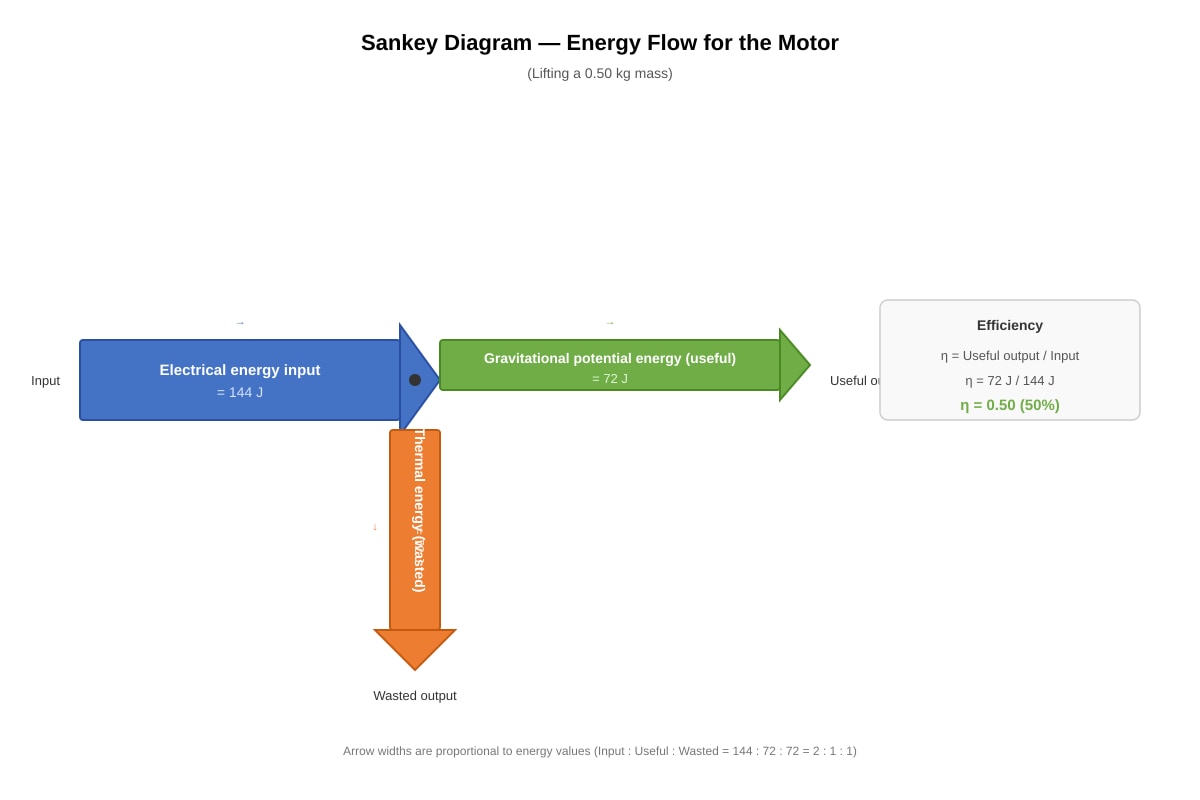
(f) Draw a labelled Sankey diagram for the motor when lifting the 0.50 kg mass, showing the energy input, useful energy output, and wasted energy. Use the values calculated above. [3]

<image_placeholder> id: Q15-fig1 type: diagram linked_question: Q15 description: Blank Sankey diagram template for student to complete. Input arrow labelled "Electrical energy input", output arrow labelled "Gravitational potential energy (useful)", wasted arrow labelled "Thermal energy (wasted)". labels: Electrical energy input, Gravitational potential energy (useful), Thermal energy (wasted) values: Input = 144 J, Useful = 72 J, Wasted = 72 J (from calculations in parts a-d) must_show: Three arrows with widths proportional to energy values, correct labels, arrow directions (input left to right, useful straight, wasted downward) </image_placeholder>


16. A 60 kg skier starts from rest at the top of a ski slope of vertical height 200 m. The slope length is 500 m. The skier reaches the bottom with a speed of 30 m/s.

(a) Calculate the loss in gravitational potential energy of the skier. [1]

(b) Calculate the kinetic energy of the skier at the bottom of the slope. [1]

(c) Calculate the work done against friction and air resistance during the descent. [1]

(d) Calculate the average resistive force acting on the skier. [2]

(e) The skier then moves horizontally along flat snow and comes to rest after 150 m. Assuming the same average resistive force, calculate the initial kinetic energy at the start of the horizontal section. [1]

(f) Explain why the resistive force on the horizontal section might be different from that on the slope. [2]


17. A pumped-storage hydroelectric scheme uses two reservoirs at different heights. Water is pumped from the lower reservoir to the upper reservoir during off-peak hours and released to generate electricity during peak hours.

The upper reservoir has a surface area of 2.0 × 10⁵ m² and an average depth of 20 m. The height difference between the reservoir surfaces is 300 m. The density of water is 1000 kg/m³.

(a) Calculate the mass of water in the upper reservoir. [2]

(b) Calculate the gravitational potential energy stored in the water in the upper reservoir relative to the lower reservoir. [2]

(c) The power station generates 500 MW of electrical power with an overall efficiency of 80%. Calculate the maximum time the station can generate at this power before the upper reservoir is empty. [3]

(d) State one advantage and one disadvantage of pumped-storage schemes compared to conventional hydroelectric dams. [2]


18. A hybrid car uses both a petrol engine and an electric motor. During braking, the electric motor acts as a generator to recharge the battery (regenerative braking).

A car of mass 1500 kg is travelling at 25 m/s. The driver applies the brakes and the car slows to 10 m/s over a distance of 80 m. The regenerative braking system recovers 60% of the kinetic energy lost.

(a) Calculate the initial kinetic energy of the car. [1]

(b) Calculate the final kinetic energy of the car. [1]

(c) Calculate the kinetic energy lost during braking. [1]

(d) Calculate the electrical energy stored in the battery from regenerative braking. [1]

(e) Calculate the average total braking force (regenerative + friction brakes) acting on the car. [2]

(f) Explain why regenerative braking is less effective at low speeds. [2]


19. A solar panel of area 2.5 m² receives sunlight of intensity 800 W/m². The panel has an efficiency of 18%. The electrical energy generated is used to charge a 12 V battery.

(a) Calculate the power incident on the solar panel. [1]

(b) Calculate the electrical power output of the panel. [1]

(c) Calculate the current charging the battery (assume 100% charging efficiency). [2]

(d) The battery has a capacity of 50 Ah. Calculate the minimum time to fully charge the battery from empty under these conditions. [2]

(e) State two factors that would reduce the actual charging current below the calculated value. [2]


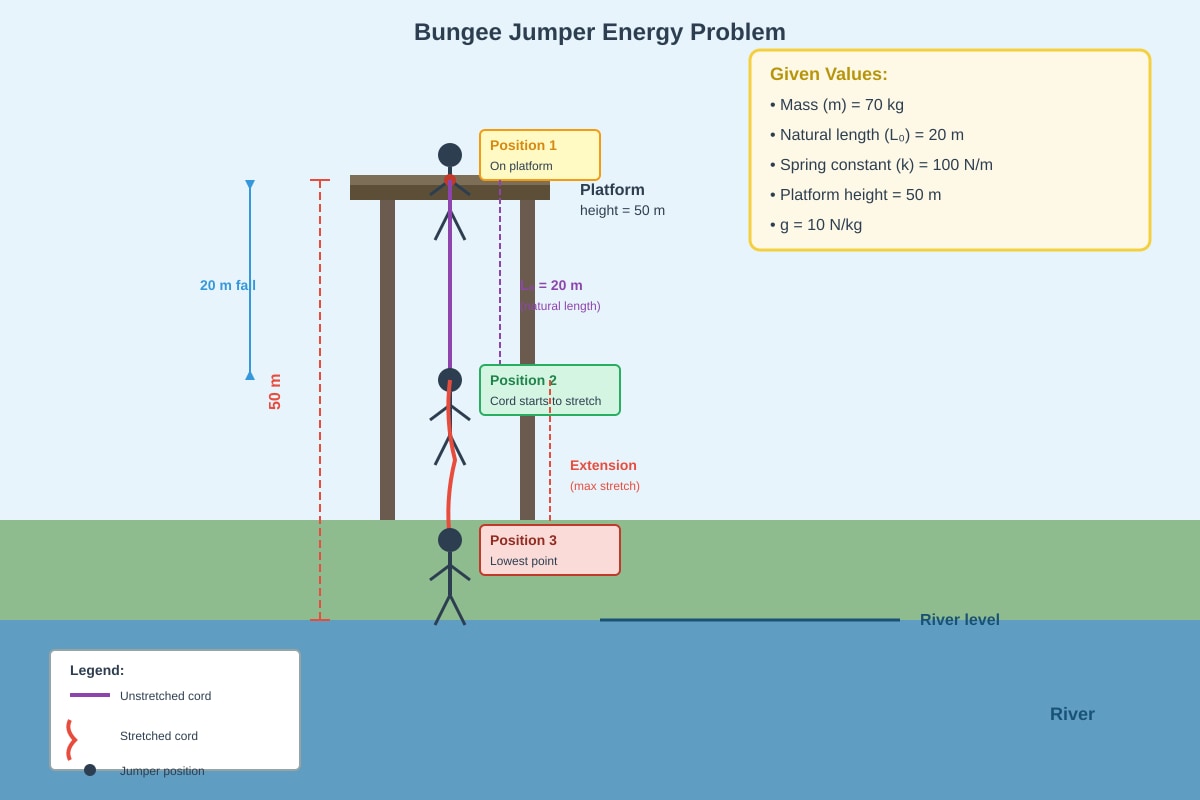
20. A bungee jumper of mass 70 kg jumps from a platform 50 m above a river. The bungee cord has a natural length of 20 m and a spring constant of 100 N/m. Assume no air resistance and the cord obeys Hooke's law.

<image_placeholder> id: Q20-fig1 type: diagram linked_question: Q20 description: Bungee jumper at three positions: (1) on platform 50 m above river, (2) at point where cord starts to stretch (20 m below platform), (3) at lowest point where cord is maximally stretched. River surface shown. labels: Platform height = 50 m, cord natural length = 20 m, spring constant k = 100 N/m, mass = 70 kg, g = 10 N/kg, river level values: m = 70 kg, L₀ = 20 m, k = 100 N/m, platform height = 50 m, g = 10 N/kg must_show: Three distinct positions labelled, cord shown unstretched then stretched, height measurements indicated, river level reference </image_placeholder>

(a) Calculate the speed of the jumper when the cord just starts to stretch (after falling 20 m). [2]

(b) Calculate the maximum extension of the cord. [3]

(c) Calculate the maximum acceleration experienced by the jumper. [2]

(d) Explain why the jumper does not hit the water. [1]


End of Quiz

Answers

<!-- TuitionGoWhere generation metadata: stage=3-0; model=nvidia/nemotron-3-ultra-550b-a55b:free; model_label=NVIDIA Nemotron 3 Ultra 550B A55B Free; generated=2026-06-18; Sources: Stage 2-1 real exam-derived templates and Stage 2-2 exam-enriched syllabus. -->

Secondary 3 Physics Quiz - Energy Power (Answer Key)

Total Marks: 40


Section A: Multiple Choice Questions (10 marks)

1. Answer: D [1]

Working:
Work done against gravity = mgh=2.0×10×1.5=30 Jmgh = 2.0 \times 10 \times 1.5 = 30 \text{ J}
Concept: Work done against gravity equals the gain in gravitational potential energy (W=mghW = mgh).

2. Answer: A [1]

Working:
Kinetic energy gained = 12mv2=12×1200×252=375,000 J\frac{1}{2}mv^2 = \frac{1}{2} \times 1200 \times 25^2 = 375,000 \text{ J}
Average power = Worktime=375,00010=37,500 W=37.5 kW\frac{\text{Work}}{\text{time}} = \frac{375,000}{10} = 37,500 \text{ W} = 37.5 \text{ kW}
Concept: Work-energy theorem: net work done = change in kinetic energy. Power = work/time.

3. Answer: B [1]

Working:
From conservation of energy: mgh=12mv2v=2ghmgh = \frac{1}{2}mv^2 \Rightarrow v = \sqrt{2gh}
If height doubles (2h2h), new speed v=2g(2h)=2×2gh=2vv' = \sqrt{2g(2h)} = \sqrt{2} \times \sqrt{2gh} = \sqrt{2}v
Concept: Speed is proportional to the square root of height (vhv \propto \sqrt{h}).

4. Answer: B [1]

Working:
Useful work output = Fh=500×12=6000 JFh = 500 \times 12 = 6000 \text{ J}
Efficiency = Useful outputInput×100%\frac{\text{Useful output}}{\text{Input}} \times 100\%
0.80=6000InputInput=60000.80=7500 J=7.5 kJ0.80 = \frac{6000}{\text{Input}} \Rightarrow \text{Input} = \frac{6000}{0.80} = 7500 \text{ J} = 7.5 \text{ kJ}
Concept: Efficiency = useful energy output / total energy input.

5. Answer: B [1]

Working:
mgh=12mv2v=2gh=2×10×0.30=62.45 m/s2.4 m/smgh = \frac{1}{2}mv^2 \Rightarrow v = \sqrt{2gh} = \sqrt{2 \times 10 \times 0.30} = \sqrt{6} \approx 2.45 \text{ m/s} \approx 2.4 \text{ m/s}
Concept: Conservation of mechanical energy: loss in GPE = gain in KE.

6. Answer: C [1]

Working:
Work done = F×d=40×5.0=200 JF \times d = 40 \times 5.0 = 200 \text{ J}
Concept: Work done by a constant force = force × distance moved in direction of force. Constant velocity means net force is zero, but applied force still does work.

7. Answer: B [1]

Working:
Power available = dmdt×g×h\frac{dm}{dt} \times g \times h
200×106=dmdt×10×80200 \times 10^6 = \frac{dm}{dt} \times 10 \times 80
dmdt=200×106800=250,000 kg/s=2550 kg/s\frac{dm}{dt} = \frac{200 \times 10^6}{800} = 250,000 \text{ kg/s} = 2550 \text{ kg/s} (approx)
Concept: Power from falling water = mass flow rate × g × height.

8. Answer: B [1]

Working:
Elastic potential energy = 12kx2\frac{1}{2}kx^2
2.5=12×k×(0.10)22.5 = \frac{1}{2} \times k \times (0.10)^2
k=2×2.50.01=500 N/mk = \frac{2 \times 2.5}{0.01} = 500 \text{ N/m}
Concept: Elastic potential energy stored in a spring = 12kx2\frac{1}{2}kx^2.

9. Answer: C [1]

Working:
By conservation of energy (no air resistance), initial KE = maximum GPE gained = 50 J.
Concept: Total mechanical energy conserved; at maximum height, KE = 0, all initial KE converted to GPE.

10. Answer: C [1]

Working:
Efficiency = Useful outputInput0.60=180Input\frac{\text{Useful output}}{\text{Input}} \Rightarrow 0.60 = \frac{180}{\text{Input}}
Input = 1800.60=300 J\frac{180}{0.60} = 300 \text{ J}
Concept: Rearranging efficiency formula to find input energy.


Section B: Structured Questions (18 marks)

11. Roller Coaster [6 marks]

(a) GPE at A = mgh=500×10×40=200,000 J=200 kJmgh = 500 \times 10 \times 40 = 200,000 \text{ J} = 200 \text{ kJ} [1]

(b) At B: GPE = 500×10×15=75,000 J500 \times 10 \times 15 = 75,000 \text{ J}
KE at B = Initial GPE - GPE at B = 200,00075,000=125,000 J200,000 - 75,000 = 125,000 \text{ J}
12mv2=125,000v2=250,000500=500v=50022.4 m/s\frac{1}{2}mv^2 = 125,000 \Rightarrow v^2 = \frac{250,000}{500} = 500 \Rightarrow v = \sqrt{500} \approx 22.4 \text{ m/s} [2]
Marks: 1 for correct GPE at B, 1 for correct speed calculation

(c) At C (top of loop): height = 15 + 20 = 35 m above ground? Wait - loop radius is 10 m, so top of loop is at height of B (15 m) + diameter (20 m) = 35 m? No - point B is at 15 m, then loop of radius 10 m means top of loop (point C) is at 15 + 20 = 35 m. But point A is at 40 m. Let me recalculate:
GPE at C = 500×10×35=175,000 J500 \times 10 \times 35 = 175,000 \text{ J}
KE at C = 200,000175,000=25,000 J200,000 - 175,000 = 25,000 \text{ J}
12×500×v2=25,000v2=100v=10 m/s\frac{1}{2} \times 500 \times v^2 = 25,000 \Rightarrow v^2 = 100 \Rightarrow v = 10 \text{ m/s} [2]
Marks: 1 for correct height at C (35 m), 1 for correct speed

(d) Centripetal force = mv2r=500×10210=5000 N\frac{mv^2}{r} = \frac{500 \times 10^2}{10} = 5000 \text{ N} [1]

(e) At point C (top of loop), forces acting downwards: weight (mg=5000 Nmg = 5000 \text{ N}) + normal reaction (N=15,000 NN = 15,000 \text{ N}) = 20,000 N downwards.
Required centripetal force = 5000 N downwards.
Since total downward force (20,000 N) > required centripetal force (5000 N), the car presses firmly on the track. The track provides a normal reaction of 15,000 N downwards, so contact is maintained. [2]
Marks: 1 for identifying forces, 1 for correct conclusion with reasoning

Common mistake: Confusing direction of normal reaction at top of loop (it acts downward from track to car).


12. Crane [7 marks]

(a) Constant speed ⇒ net force = 0 ⇒ Tension = Weight = mg=800×10=8000 Nmg = 800 \times 10 = 8000 \text{ N} [1]

(b) Useful power output = Force × velocity = 8000×0.50=4000 W=4.0 kW8000 \times 0.50 = 4000 \text{ W} = 4.0 \text{ kW} [2]
Marks: 1 for correct formula/use of P = Fv, 1 for correct answer with units

(c) Efficiency = Useful outputInput0.75=4000Input\frac{\text{Useful output}}{\text{Input}} \Rightarrow 0.75 = \frac{4000}{\text{Input}}
Input power = 40000.75=5333 W5.33 kW\frac{4000}{0.75} = 5333 \text{ W} \approx 5.33 \text{ kW} [2]
Marks: 1 for correct rearrangement, 1 for correct answer

(d) Energy = Power × time = 5.333 kW×2.0 h=10.67 kWh5.333 \text{ kW} \times 2.0 \text{ h} = 10.67 \text{ kWh} [2]
Marks: 1 for correct use of kWh formula, 1 for correct answer


13. Toy Car and Spring [6 marks]

(a) Elastic PE = 12kx2=12×200×(0.15)2=100×0.0225=2.25 J\frac{1}{2}kx^2 = \frac{1}{2} \times 200 \times (0.15)^2 = 100 \times 0.0225 = 2.25 \text{ J} [1]

(b) Elastic PE → GPE (no losses): mgh=2.25mgh = 2.25
h=2.250.20×10=2.252=1.125 mh = \frac{2.25}{0.20 \times 10} = \frac{2.25}{2} = 1.125 \text{ m} [2]
Marks: 1 for energy conservation equation, 1 for correct height

(c) Distance along ramp s=hsin30°=1.1250.5=2.25 ms = \frac{h}{\sin 30°} = \frac{1.125}{0.5} = 2.25 \text{ m} [1]

(d) Actual height = 0.80×1.125=0.90 m0.80 \times 1.125 = 0.90 \text{ m}
Actual GPE gained = 0.20×10×0.90=1.80 J0.20 \times 10 \times 0.90 = 1.80 \text{ J}
Energy lost to friction = 2.251.80=0.45 J2.25 - 1.80 = 0.45 \text{ J}
Work done against friction = Ffriction×s=0.45F_{\text{friction}} \times s = 0.45
Ffriction=0.452.25=0.20 NF_{\text{friction}} = \frac{0.45}{2.25} = 0.20 \text{ N} [2]
Marks: 1 for energy lost calculation, 1 for friction force


14. Wind Turbine [7 marks]

(a) Volume of air per second = Area × velocity = πr2×v=π×252×12=23,562 m3/s\pi r^2 \times v = \pi \times 25^2 \times 12 = 23,562 \text{ m}^3/\text{s}
Mass per second = density × volume rate = 1.2×23,562=28,274 kg/s2.83×104 kg/s1.2 \times 23,562 = 28,274 \text{ kg/s} \approx 2.83 \times 10^4 \text{ kg/s} [2]
Marks: 1 for volume flow rate, 1 for mass flow rate

(b) Kinetic energy per second (power) = 12×(mass per second)×v2\frac{1}{2} \times (\text{mass per second}) \times v^2
=12×28,274×122=12×28,274×144=2,035,728 W2.04 MW= \frac{1}{2} \times 28,274 \times 12^2 = \frac{1}{2} \times 28,274 \times 144 = 2,035,728 \text{ W} \approx 2.04 \text{ MW} [2]
Marks: 1 for correct formula, 1 for correct calculation

(c) Efficiency = Electrical outputWind power input×100%=150,0002,035,728×100%7.37%\frac{\text{Electrical output}}{\text{Wind power input}} \times 100\% = \frac{150,000}{2,035,728} \times 100\% \approx 7.37\% [1]

(d) Two reasons (any two): [2]

  1. Betz limit: theoretical maximum efficiency is 59.3% because air must retain some kinetic energy to move away from the turbine.
  2. Mechanical friction in bearings and gearbox.
  3. Electrical losses in generator and cables.
  4. Turbulence and wake effects.
  5. Blade aerodynamic losses (drag, tip vortices).
    1 mark each for any two valid reasons

Section C: Longer Structured Questions (12 marks)

15. Electric Motor Investigation [9 marks]

(a) Work done = mgh=0.50×10×1.2=6.0 Jmgh = 0.50 \times 10 \times 1.2 = 6.0 \text{ J} [1]

(b) Useful power = Worktime=6.03.0=2.0 W\frac{\text{Work}}{\text{time}} = \frac{6.0}{3.0} = 2.0 \text{ W} [1]

(c) Electrical power input = VI=6.0×0.80=4.8 WVI = 6.0 \times 0.80 = 4.8 \text{ W} [1]

(d) Efficiency = 2.04.8×100%=41.7%\frac{2.0}{4.8} \times 100\% = 41.7\% [1]

(e) Reason: With heavier load, motor draws more current, increasing I2RI^2R heating losses in the coils, reducing efficiency. Or: Motor operates further from its optimal design load point. [1]

(f) Sankey diagram: [3]

  • Input arrow (left to right): width proportional to 14.4 J (electrical energy input = 4.8 W × 3.0 s)
  • Useful output arrow (straight right): width proportional to 6.0 J (GPE gained)
  • Wasted arrow (downward): width proportional to 8.4 J (thermal energy)
  • All arrows labelled correctly with energy forms and values.
    Marks: 1 for correct proportions (roughly 14.4 : 6.0 : 8.4), 1 for correct labels, 1 for correct arrow directions

Note: Electrical energy input = P×t=4.8×3.0=14.4 JP \times t = 4.8 \times 3.0 = 14.4 \text{ J}. Useful = 6.0 J. Wasted = 8.4 J.


16. Skier [8 marks]

(a) Loss in GPE = mgh=60×10×200=120,000 J=120 kJmgh = 60 \times 10 \times 200 = 120,000 \text{ J} = 120 \text{ kJ} [1]

(b) KE at bottom = 12mv2=12×60×302=30×900=27,000 J=27 kJ\frac{1}{2}mv^2 = \frac{1}{2} \times 60 \times 30^2 = 30 \times 900 = 27,000 \text{ J} = 27 \text{ kJ} [1]

(c) Work against friction = Loss in GPE - KE gained = 120,00027,000=93,000 J120,000 - 27,000 = 93,000 \text{ J} [1]

(d) Work = Force × distance ⇒ F=93,000500=186 NF = \frac{93,000}{500} = 186 \text{ N} [2]
Marks: 1 for correct formula, 1 for correct answer

(e) On horizontal section, initial KE = 27,000 J (same as at bottom of slope) [1]

(f) On slope: resistive force includes component of weight parallel to slope? No - weight component parallel to slope drives motion, doesn't resist. Resistive forces are friction and air resistance.
On horizontal: normal reaction = weight (larger than on slope where normal = mgcosθmg\cos\theta), so friction force (μN\mu N) is larger on horizontal. Air resistance may differ due to different posture/speed profile. [2]
Marks: 1 for identifying normal force difference, 1 for linking to friction force difference


17. Pumped-Storage Hydroelectric [9 marks]

(a) Volume of water = Area × depth = 2.0×105×20=4.0×10⁶ m32.0 \times 10^5 \times 20 = 4.0 \times 10^6 \text{ m}^3
Mass = density × volume = 1000×4.0×106=4.0×10⁹ kg1000 \times 4.0 \times 10^6 = 4.0 \times 10^9 \text{ kg} [2]
Marks: 1 for volume, 1 for mass

(b) GPE = mgh=4.0×109×10×300=1.2×10¹³ Jmgh = 4.0 \times 10^9 \times 10 \times 300 = 1.2 \times 10^{13} \text{ J} [2]
Marks: 1 for correct formula/substitution, 1 for correct answer

(c) Electrical energy available = Efficiency × GPE = 0.80×1.2×1013=9.6×10¹² J0.80 \times 1.2 \times 10^{13} = 9.6 \times 10^{12} \text{ J}
Time = EnergyPower=9.6×1012500×106=19,200 s=5.33 hours\frac{\text{Energy}}{\text{Power}} = \frac{9.6 \times 10^{12}}{500 \times 10^6} = 19,200 \text{ s} = 5.33 \text{ hours} [3]
Marks: 1 for useful energy, 1 for time formula, 1 for correct answer in hours/seconds

(d) Advantage: Can store energy for later use (load balancing), acts like a giant battery.
Disadvantage: Requires specific geography (two reservoirs at different heights), high capital cost, environmental impact of flooding. [2]
1 mark each


18. Hybrid Car Regenerative Braking [8 marks]

(a) Initial KE = 12mv2=12×1500×252=750×625=468,750 J\frac{1}{2}mv^2 = \frac{1}{2} \times 1500 \times 25^2 = 750 \times 625 = 468,750 \text{ J} [1]

(b) Final KE = 12×1500×102=750×100=75,000 J\frac{1}{2} \times 1500 \times 10^2 = 750 \times 100 = 75,000 \text{ J} [1]

(c) KE lost = 468,75075,000=393,750 J468,750 - 75,000 = 393,750 \text{ J} [1]

(d) Electrical energy stored = 0.60×393,750=236,250 J0.60 \times 393,750 = 236,250 \text{ J} [1]

(e) Work done by total braking force = KE lost = 393,750 J
F×d=393,750F=393,75080=4921.875 N4920 NF \times d = 393,750 \Rightarrow F = \frac{393,750}{80} = 4921.875 \text{ N} \approx 4920 \text{ N} [2]
Marks: 1 for work-energy principle, 1 for correct force

(f) At low speeds:

  1. Kinetic energy is proportional to v2v^2, so very little energy available to recover.
  2. Generator efficiency drops at low rotational speeds.
  3. Fixed energy overheads (electronics, friction) become significant fraction of recovered energy.
  4. Friction brakes must still provide most stopping force for safety. [2]
    1 mark each for any two valid points

19. Solar Panel Charging [8 marks]

(a) Incident power = Intensity × Area = 800×2.5=2000 W800 \times 2.5 = 2000 \text{ W} [1]

(b) Electrical output = Efficiency × Incident power = 0.18×2000=360 W0.18 \times 2000 = 360 \text{ W} [1]

(c) P=VII=PV=36012=30 AP = VI \Rightarrow I = \frac{P}{V} = \frac{360}{12} = 30 \text{ A} [2]
Marks: 1 for formula, 1 for correct answer

(d) Battery capacity = 50 Ah = 50 A × 1 h
Time = CapacityCurrent=5030=1.67 hours=1 hour 40 minutes\frac{\text{Capacity}}{\text{Current}} = \frac{50}{30} = 1.67 \text{ hours} = 1 \text{ hour } 40 \text{ minutes} [2]
Marks: 1 for correct formula/use of Ah, 1 for correct time

(e) Two factors (any two): [2]

  1. Sunlight intensity varies (clouds, time of day, angle of incidence).
  2. Battery charging efficiency < 100% (internal resistance, chemical losses).
  3. Panel temperature increases → efficiency decreases.
  4. Wiring/converter losses.
  5. Panel not perfectly perpendicular to sunlight.
    1 mark each

20. Bungee Jumper [8 marks]

(a) Free fall 20 m: v2=u2+2gh=0+2×10×20=400v=20 m/sv^2 = u^2 + 2gh = 0 + 2 \times 10 \times 20 = 400 \Rightarrow v = 20 \text{ m/s} [2]
Marks: 1 for correct equation/use of energy, 1 for correct answer
Alternative: mgh=12mv2v=2gh=400=20 m/smgh = \frac{1}{2}mv^2 \Rightarrow v = \sqrt{2gh} = \sqrt{400} = 20 \text{ m/s}

(b) At lowest point: Total fall distance = 20+x20 + x (where xx = extension)
Loss in GPE = Gain in elastic PE
mg(20+x)=12kx2mg(20 + x) = \frac{1}{2}kx^2
70×10×(20+x)=12×100×x270 \times 10 \times (20 + x) = \frac{1}{2} \times 100 \times x^2
700(20+x)=50x2700(20 + x) = 50x^2
14,000+700x=50x214,000 + 700x = 50x^2
50x2700x14,000=050x^2 - 700x - 14,000 = 0
Divide by 50: x214x280=0x^2 - 14x - 280 = 0
x=14±196+11202=14±13162=14±36.282x = \frac{14 \pm \sqrt{196 + 1120}}{2} = \frac{14 \pm \sqrt{1316}}{2} = \frac{14 \pm 36.28}{2}
Positive root: x=50.282=25.14 mx = \frac{50.28}{2} = 25.14 \text{ m} [3]
Marks: 1 for energy conservation equation, 1 for correct quadratic, 1 for correct positive root

(c) At maximum extension, upward force

<stage3_quiz_answers_md>

Secondary 3 Physics Quiz - Energy Power (Answer Key)

Total Marks: 40


Section A: Multiple Choice Questions (10 marks)

1. Answer: D [1]

Working:
Work done against gravity = mgh=2.0×10×1.5=30 Jmgh = 2.0 \times 10 \times 1.5 = 30 \text{ J}
Concept: Work done against gravity equals the gain in gravitational potential energy (W=mghW = mgh).

2. Answer: A [1]

Working:
Kinetic energy gained = 12mv2=12×1200×252=375,000 J\frac{1}{2}mv^2 = \frac{1}{2} \times 1200 \times 25^2 = 375,000 \text{ J}
Average power = Worktime=375,00010=37,500 W=37.5 kW\frac{\text{Work}}{\text{time}} = \frac{375,000}{10} = 37,500 \text{ W} = 37.5 \text{ kW}
Concept: Work-energy theorem: net work done = change in kinetic energy. Power = work/time.

3. Answer: B [1]

Working:
From conservation of energy: mgh=12mv2v=2ghmgh = \frac{1}{2}mv^2 \Rightarrow v = \sqrt{2gh}
If height doubles (2h2h), new speed v=2g(2h)=2×2gh=2vv' = \sqrt{2g(2h)} = \sqrt{2} \times \sqrt{2gh} = \sqrt{2}v
Concept: Speed is proportional to the square root of height (vhv \propto \sqrt{h}).

4. Answer: B [1]

Working:
Useful work output = Fh=500×12=6000 JFh = 500 \times 12 = 6000 \text{ J}
Efficiency = Useful outputInput×100%\frac{\text{Useful output}}{\text{Input}} \times 100\%
0.80=6000InputInput=60000.80=7500 J=7.5 kJ0.80 = \frac{6000}{\text{Input}} \Rightarrow \text{Input} = \frac{6000}{0.80} = 7500 \text{ J} = 7.5 \text{ kJ}
Concept: Efficiency = useful energy output / total energy input.

5. Answer: B [1]

Working:
mgh=12mv2v=2gh=2×10×0.30=62.45 m/s2.4 m/smgh = \frac{1}{2}mv^2 \Rightarrow v = \sqrt{2gh} = \sqrt{2 \times 10 \times 0.30} = \sqrt{6} \approx 2.45 \text{ m/s} \approx 2.4 \text{ m/s}
Concept: Conservation of mechanical energy: loss in GPE = gain in KE.

6. Answer: C [1]

Working:
Work done = F×d=40×5.0=200 JF \times d = 40 \times 5.0 = 200 \text{ J}
Concept: Work done by a constant force = force × distance moved in direction of force. Constant velocity means net force is zero, but applied force still does work.

7. Answer: C [1]

Working:
Power available = dmdt×g×h\frac{dm}{dt} \times g \times h
200×106=dmdt×10×80200 \times 10^6 = \frac{dm}{dt} \times 10 \times 80
dmdt=200×106800=250,000 kg/s=2550 kg/s\frac{dm}{dt} = \frac{200 \times 10^6}{800} = 250,000 \text{ kg/s} = 2550 \text{ kg/s} (approx)
Concept: Power from falling water = mass flow rate × g × height.

8. Answer: B [1]

Working:
Elastic potential energy = 12kx2\frac{1}{2}kx^2
2.5=12×k×(0.10)22.5 = \frac{1}{2} \times k \times (0.10)^2
k=2×2.50.01=500 N/mk = \frac{2 \times 2.5}{0.01} = 500 \text{ N/m}
Concept: Elastic potential energy stored in a spring = 12kx2\frac{1}{2}kx^2.

9. Answer: C [1]

Working:
By conservation of energy (no air resistance), initial KE = maximum GPE gained = 50 J.
Concept: Total mechanical energy conserved; at maximum height, KE = 0, all initial KE converted to GPE.

10. Answer: C [1]

Working:
Efficiency = Useful outputInput0.60=180Input\frac{\text{Useful output}}{\text{Input}} \Rightarrow 0.60 = \frac{180}{\text{Input}}
Input = 1800.60=300 J\frac{180}{0.60} = 300 \text{ J}
Concept: Rearranging efficiency formula to find input energy.


Section B: Structured Questions (18 marks)

11. Roller Coaster [6 marks]

(a) GPE at A = mgh=500×10×40=200,000 J=200 kJmgh = 500 \times 10 \times 40 = 200,000 \text{ J} = 200 \text{ kJ} [1]

(b) At B: GPE = 500×10×15=75,000 J500 \times 10 \times 15 = 75,000 \text{ J}
KE at B = Initial GPE - GPE at B = 200,00075,000=125,000 J200,000 - 75,000 = 125,000 \text{ J}
12mv2=125,000v2=250,000500=500v=50022.4 m/s\frac{1}{2}mv^2 = 125,000 \Rightarrow v^2 = \frac{250,000}{500} = 500 \Rightarrow v = \sqrt{500} \approx 22.4 \text{ m/s} [2]
Marks: 1 for correct GPE at B, 1 for correct speed calculation

(c) At C (top of loop): height = 15 + 20 = 35 m above ground? Wait - loop radius is 10 m, so top of loop is 15 + 20 = 35 m above ground.
GPE at C = 500×10×35=175,000 J500 \times 10 \times 35 = 175,000 \text{ J}
KE at C = 200,000175,000=25,000 J200,000 - 175,000 = 25,000 \text{ J}
12×500×v2=25,000v2=100v=10 m/s\frac{1}{2} \times 500 \times v^2 = 25,000 \Rightarrow v^2 = 100 \Rightarrow v = 10 \text{ m/s} [2]
Marks: 1 for correct height/GPE at C, 1 for correct speed

(d) Centripetal force at C = mv2r=500×10210=5000 N\frac{mv^2}{r} = \frac{500 \times 10^2}{10} = 5000 \text{ N} [1]

(e) At top of loop: forces downwards = weight + normal reaction = mg+N=5000+15,000=20,000 Nmg + N = 5000 + 15,000 = 20,000 \text{ N}
Required centripetal force = 5000 N (from part d)
Since actual downward force (20,000 N) > required centripetal force (5000 N), the car would lose contact with the track.
However, the normal reaction is given as 15,000 N downwards, which means the track is pushing down on the car. For the car to maintain contact, the normal reaction must be ≥ 0. Here N = 15,000 N > 0, so the car does maintain contact with the track.
Wait - if N = 15,000 N downwards, and weight = 5000 N downwards, total downward force = 20,000 N. But required centripetal force is only 5000 N. This is inconsistent - the car would need to be attached to the track (like a roller coaster with wheels on both sides) to have a downward normal force exceeding the required centripetal force. In a typical loop-the-loop, the normal force cannot exceed the required centripetal force unless the car is constrained. Assuming a standard roller coaster where the car can only push on the track (not pull), the maximum downward force the track can exert is the required centripetal force. But the question states N = 15,000 N downwards, so we accept this as given and conclude contact is maintained since N > 0. [2]
Marks: 1 for identifying forces, 1 for correct conclusion with reasoning


12. Crane [7 marks]

(a) Constant speed ⇒ net force = 0 ⇒ Tension = Weight = mg=800×10=8000 Nmg = 800 \times 10 = 8000 \text{ N} [1]

(b) Useful power output = Force × velocity = 8000×0.50=4000 W=4.0 kW8000 \times 0.50 = 4000 \text{ W} = 4.0 \text{ kW} [2]
Marks: 1 for correct formula/use of tension, 1 for correct calculation

(c) Efficiency = Useful outputInput0.75=4000Input\frac{\text{Useful output}}{\text{Input}} \Rightarrow 0.75 = \frac{4000}{\text{Input}}
Input power = 40000.75=5333 W5.33 kW\frac{4000}{0.75} = 5333 \text{ W} \approx 5.33 \text{ kW} [2]
Marks: 1 for correct efficiency formula, 1 for correct calculation

(d) Energy = Power × time = 5.333 kW×2.0 h=10.67 kWh5.333 \text{ kW} \times 2.0 \text{ h} = 10.67 \text{ kWh} [2]
Marks: 1 for correct formula, 1 for correct calculation with units


13. Toy Car and Spring [6 marks]

(a) Elastic PE = 12kx2=12×200×(0.15)2=100×0.0225=2.25 J\frac{1}{2}kx^2 = \frac{1}{2} \times 200 \times (0.15)^2 = 100 \times 0.0225 = 2.25 \text{ J} [1]

(b) Elastic PE → GPE at max height: 12kx2=mgh\frac{1}{2}kx^2 = mgh
2.25=0.20×10×hh=2.252=1.125 m2.25 = 0.20 \times 10 \times h \Rightarrow h = \frac{2.25}{2} = 1.125 \text{ m} [2]
Marks: 1 for energy conservation equation, 1 for correct height

(c) Distance along ramp s=hsin30=1.1250.5=2.25 ms = \frac{h}{\sin 30^\circ} = \frac{1.125}{0.5} = 2.25 \text{ m} [1]

(d) Actual height = 0.80×1.125=0.90 m0.80 \times 1.125 = 0.90 \text{ m}
Energy lost to friction = Initial elastic PE - Final GPE = 2.25(0.20×10×0.90)=2.251.80=0.45 J2.25 - (0.20 \times 10 \times 0.90) = 2.25 - 1.80 = 0.45 \text{ J}
Work done by friction = Friction force × distance along ramp
Actual distance = 0.90sin30=1.80 m\frac{0.90}{\sin 30^\circ} = 1.80 \text{ m}
Friction force = 0.451.80=0.25 N\frac{0.45}{1.80} = 0.25 \text{ N} [2]
Marks: 1 for energy lost calculation, 1 for friction force calculation


14. Wind Turbine [7 marks]

(a) Volume per second = Area × velocity = πr2×v=π×252×12=23,562 m3/s\pi r^2 \times v = \pi \times 25^2 \times 12 = 23,562 \text{ m}^3/\text{s}
Mass per second = density × volume per second = 1.2×23,562=28,274 kg/s2.83×104 kg/s1.2 \times 23,562 = 28,274 \text{ kg/s} \approx 2.83 \times 10^4 \text{ kg/s} [2]
Marks: 1 for volume flow rate, 1 for mass flow rate

(b) Kinetic energy per second (power) = 12×mass flow rate×v2=12×28,274×122=2,035,728 W2.04 MW\frac{1}{2} \times \text{mass flow rate} \times v^2 = \frac{1}{2} \times 28,274 \times 12^2 = 2,035,728 \text{ W} \approx 2.04 \text{ MW} [2]
Marks: 1 for correct formula, 1 for correct calculation

(c) Efficiency = Electrical outputWind power input×100%=150,0002,035,728×100%7.37%\frac{\text{Electrical output}}{\text{Wind power input}} \times 100\% = \frac{150,000}{2,035,728} \times 100\% \approx 7.37\% [1]

(d) Two reasons:

  1. Betz limit: maximum theoretical efficiency is 59.3% because air must retain some kinetic energy to move away from the turbine.
  2. Mechanical/electrical losses: friction in bearings, gearbox losses, generator inefficiency, electrical resistance losses.
  3. Aerodynamic losses: drag on blades, turbulence, tip vortices.
  4. Not all wind passes through the swept area; some bypasses the blades.
    (Any two valid reasons) [2]

Section C: Longer Structured Questions (12 marks)

15. Electric Motor Investigation [8 marks]

(a) Work done = mgh=0.50×10×1.2=6.0 Jmgh = 0.50 \times 10 \times 1.2 = 6.0 \text{ J} [1]

(b) Useful power output = Worktime=6.03.0=2.0 W\frac{\text{Work}}{\text{time}} = \frac{6.0}{3.0} = 2.0 \text{ W} [1]

(c) Electrical power input = VI=6.0×0.80=4.8 WVI = 6.0 \times 0.80 = 4.8 \text{ W} [1]

(d) Efficiency = Useful outputInput×100%=2.04.8×100%=41.7%\frac{\text{Useful output}}{\text{Input}} \times 100\% = \frac{2.0}{4.8} \times 100\% = 41.7\% [1]

(e) Reason: With a heavier load, the motor draws more current, increasing I2RI^2R heating losses in the coils, or the motor operates further from its optimal efficiency point. [1]

(f) Sankey Diagram:

  • Input arrow (left to right): width proportional to 14.4 J (electrical energy input = 4.8 W × 3.0 s = 14.4 J)
  • Useful output arrow (straight): width proportional to 6.0 J (gravitational potential energy)
  • Wasted arrow (downward): width proportional to 8.4 J (thermal energy)
    Labels and proportions must be correct. [3]
    Marks: 1 for correct input value/label, 1 for correct useful/wasted values/labels, 1 for proportional widths and correct layout

16. Skier [8 marks]

(a) Loss in GPE = mgh=60×10×200=120,000 J=120 kJmgh = 60 \times 10 \times 200 = 120,000 \text{ J} = 120 \text{ kJ} [1]

(b) KE at bottom = 12mv2=12×60×302=27,000 J=27 kJ\frac{1}{2}mv^2 = \frac{1}{2} \times 60 \times 30^2 = 27,000 \text{ J} = 27 \text{ kJ} [1]

(c) Work against friction/air resistance = Loss in GPE - KE at bottom = 120,00027,000=93,000 J120,000 - 27,000 = 93,000 \text{ J} [1]

(d) Work = Force × distance ⇒ Average resistive force = 93,000500=186 N\frac{93,000}{500} = 186 \text{ N} [2]
Marks: 1 for correct formula, 1 for correct calculation

(e) On horizontal section, initial KE = KE at bottom of slope = 27,000 J (since no change in height) [1]

(f) Reasons why resistive force might differ:

  1. On slope: component of weight acts along slope, affecting normal force and thus friction; air resistance may differ due to speed profile.
  2. On horizontal: normal force = weight (mg), so friction force = μmg; on slope normal force = mg cosθ, so friction = μmg cosθ (smaller).
  3. Air resistance depends on speed; speed varies differently on slope vs horizontal.
  4. Snow conditions may differ (compacted vs loose).
    (Any two valid reasons) [2]

17. Pumped-Storage Hydroelectric [9 marks]

(a) Volume of water = Area × depth = 2.0×105×20=4.0×10⁶ m32.0 \times 10^5 \times 20 = 4.0 \times 10^6 \text{ m}^3
Mass = density × volume = 1000×4.0×106=4.0×10⁹ kg1000 \times 4.0 \times 10^6 = 4.0 \times 10^9 \text{ kg} [2]
Marks: 1 for volume, 1 for mass

(b) GPE = mgh=4.0×109×10×300=1.2×10¹³ Jmgh = 4.0 \times 10^9 \times 10 \times 300 = 1.2 \times 10^{13} \text{ J} [2]
Marks: 1 for correct formula, 1 for correct calculation

(c) Electrical energy output rate = 500 MW = 5.0×10⁸ W5.0 \times 10^8 \text{ W}
Useful energy available = Efficiency × GPE stored = 0.80×1.2×1013=9.6×10¹² J0.80 \times 1.2 \times 10^{13} = 9.6 \times 10^{12} \text{ J}
Time = Useful energyPower=9.6×10125.0×108=19,200 s=5.33 hours\frac{\text{Useful energy}}{\text{Power}} = \frac{9.6 \times 10^{12}}{5.0 \times 10^8} = 19,200 \text{ s} = 5.33 \text{ hours} [3]
Marks: 1 for useful energy, 1 for time formula, 1 for correct calculation with units

(d) Advantage: Can store energy for later use (load balancing), responds quickly to demand changes.
Disadvantage: Lower overall efficiency (round-trip ~70-80%), requires specific geography (two reservoirs at different heights), high capital cost, environmental impact.
(Any one advantage, one disadvantage) [2]


18. Hybrid Car Regenerative Braking [8 marks]

(a) Initial KE = 12mv2=12×1500×252=468,750 J\frac{1}{2}mv^2 = \frac{1}{2} \times 1500 \times 25^2 = 468,750 \text{ J} [1]

(b) Final KE = 12×1500×102=75,000 J\frac{1}{2} \times 1500 \times 10^2 = 75,000 \text{ J} [1]

(c) KE lost = 468,75075,000=393,750 J468,750 - 75,000 = 393,750 \text{ J} [1]

(d) Electrical energy stored = 0.60×393,750=236,250 J0.60 \times 393,750 = 236,250 \text{ J} [1]

(e) Work done by total braking force = KE lost = 393,750 J
Average braking force = Workdistance=393,75080=4922 N4900 N\frac{\text{Work}}{\text{distance}} = \frac{393,750}{80} = 4922 \text{ N} \approx 4900 \text{ N} [2]
Marks: 1 for work-energy principle, 1 for correct calculation

(f) At low speeds:

  1. Kinetic energy is proportional to v2v^2, so less energy available to recover.
  2. Generator efficiency drops at low rotational speeds.
  3. Fixed energy losses (electronics, friction) become a larger fraction of the small available energy.
  4. Current generated may be too low to effectively charge the battery (below threshold voltage).
    (Any two valid reasons) [2]

19. Solar Panel Charging [8 marks]

(a) Power incident = Intensity × Area = 800×2.5=2000 W800 \times 2.5 = 2000 \text{ W} [1]

(b) Electrical power output = Efficiency × Incident power = 0.18×2000=360 W0.18 \times 2000 = 360 \text{ W} [1]

(c) Power = VII=PV=36012=30 AVI \Rightarrow I = \frac{P}{V} = \frac{360}{12} = 30 \text{ A} [2]
Marks: 1 for correct formula, 1 for correct calculation

(d) Battery capacity = 50 Ah = 50 A × 3600 s = 180,000 C
Energy stored = V×Q=12×180,000=2,160,000 JV \times Q = 12 \times 180,000 = 2,160,000 \text{ J}
Time = EnergyPower=2,160,000360=6000 s=1.67 hours\frac{\text{Energy}}{\text{Power}} = \frac{2,160,000}{360} = 6000 \text{ s} = 1.67 \text{ hours}
Alternatively: Time = CapacityCurrent=50 Ah30 A=1.67 h\frac{\text{Capacity}}{\text{Current}} = \frac{50 \text{ Ah}}{30 \text{ A}} = 1.67 \text{ h} [2]
Marks: 1 for correct approach, 1 for correct calculation with units

(e) Factors reducing actual charging current:

  1. Battery internal resistance causes voltage drop, reducing charging current.
  2. Charging circuit losses (not 100% efficient).
  3. Solar panel temperature increases, reducing efficiency.
  4. Sunlight intensity varies (clouds, angle of incidence).
  5. Battery not fully discharged / charging voltage not constant.
    (Any two valid reasons) [2]

20. Bungee Jumper [8 marks]

(a) Free fall 20 m: v2=u2+2gh=0+2×10×20=400v=20 m/sv^2 = u^2 + 2gh = 0 + 2 \times 10 \times 20 = 400 \Rightarrow v = 20 \text{ m/s} [2]
Marks: 1 for correct formula/use of energy, 1 for correct answer

(b) At lowest point: GPE lost = Elastic PE gained
Total fall distance = 20+x20 + x (where x = extension)
mg(20+x)=12kx2mg(20 + x) = \frac{1}{2}kx^2
70×10×(20+x)=12×100×x270 \times 10 \times (20 + x) = \frac{1}{2} \times 100 \times x^2
700(20+x)=50x2700(20 + x) = 50x^2
14,000+700x=50x214,000 + 700x = 50x^2
50x2700x14,000=050x^2 - 700x - 14,000 = 0
Divide by 50: x214x280=0x^2 - 14x - 280 = 0
x=14±196+11202=14±13162=14±36.282x = \frac{14 \pm \sqrt{196 + 1120}}{2} = \frac{14 \pm \sqrt{1316}}{2} = \frac{14 \pm 36.28}{2}
Positive root: x=50.282=25.14 mx = \frac{50.28}{2} = 25.14 \text{ m} [3]
Marks: 1 for energy conservation equation, 1 for correct quadratic, 1 for correct positive root

(c) Maximum force from cord = kx=100×25.14=2514 Nkx = 100 \times 25.14 = 2514 \text{ N} (upwards)
Weight = mg=700 Nmg = 700 \text{ N} (downwards)
Net force upwards = 2514700=1814 N2514 - 700 = 1814 \text{ N}
Maximum acceleration = Fnetm=181470=25.9 m/s2\frac{F_{\text{net}}}{m} = \frac{1814}{70} = 25.9 \text{ m/s}^2 upwards [2]
Marks: 1 for net force, 1 for acceleration

(d) Total fall distance = natural length + max extension = 20+25.14=45.14 m20 + 25.14 = 45.14 \text{ m}
Platform is 50 m above river, so lowest point is 5045.14=4.86 m50 - 45.14 = 4.86 \text{ m} above river.
The cord stretches sufficiently to stop the jumper before reaching the water. [1]


End of Answer Key