From Real Exams Quiz
Secondary 3 Physics Energy Power Quiz
Free Sec 3 Physics Energy Power quiz with questions, answers, and O Level-style practice for Singapore students preparing for school assessments.
These static practice materials are generated from the site's syllabus and paper-generation workflow, with source and model context shown so students and parents can evaluate the material before use.
Questions
Secondary 3 Physics Quiz - Energy Power
Name: _________________________________ Class: _________ Date: ___________
Duration: 35 minutes
Total Marks: 40 marks
Instructions: Answer ALL questions. Show all working for calculation questions. Write your answers in the spaces provided.
Section A: Multiple Choice (Questions 1–8) [8 marks]
Choose the correct answer for each question. Each question carries 1 mark.
1. Which of the following is a correct unit for power?
A) Joule (J)
B) Watt (W)
C) Newton (N)
D) Kilogram (kg)
Answer: _________
2. A student of mass 50 kg climbs a staircase of vertical height 3.0 m in 6.0 seconds. What is his average power output? (Take g = 10 N/kg)
A) 25 W
B) 90 W
C) 150 W
D) 250 W
Answer: _________
3. Which energy transformation occurs in a hydroelectric power station?
A) Chemical energy → Electrical energy
B) Kinetic energy → Electrical energy
C) Gravitational potential energy → Electrical energy
D) Nuclear energy → Electrical energy
Answer: _________
4. The efficiency of a machine is defined as:
A)
B)
C)
D)
Answer: _________
5. A ball is thrown vertically upwards. At the highest point of its flight:
A) its kinetic energy is maximum and potential energy is zero
B) its kinetic energy is zero and potential energy is maximum
C) both kinetic and potential energies are zero
D) both kinetic and potential energies are maximum
Answer: _________
6. A car engine has an output power of 60 kW. It can keep the car moving at a constant speed of 30 m/s against resistive forces. What is the magnitude of the resistive force?
A) 1800 N
B) 2000 N
C) 5000 N
D) 4500 N
Answer: _________
7. Which statement about energy is correct according to the principle of conservation of energy?
A) Energy can be created but not destroyed
B) Energy can be destroyed but not created
C) The total energy in a closed system remains constant
D) Kinetic energy is always conserved in all collisions
Answer: _________
8. A heater rated at 2.0 kW is used for 30 minutes. How much electrical energy is converted?
A) 60 kJ
B) 900 kJ
C) 3600 kJ
D) 7200 kJ
Answer: _________
Section B: Short Answer and Structured Questions (Questions 9–16) [20 marks]
9. (a) State the formula for kinetic energy. [1]
(b) A trolley of mass 2.0 kg is moving at a speed of 4.0 m/s. Calculate its kinetic energy. [2]
10. (a) Define gravitational potential energy. [1]
(b) A 0.5 kg book is lifted from a shelf 1.5 m above the ground to a shelf 2.5 m above the ground. Calculate the increase in gravitational potential energy of the book. (Take g = 10 N/kg) [2]
11. A motor lifts a load of 800 N through a vertical height of 5.0 m in 25 seconds.
(a) Calculate the work done by the motor. [2]
(b) Calculate the power output of the motor. [2]
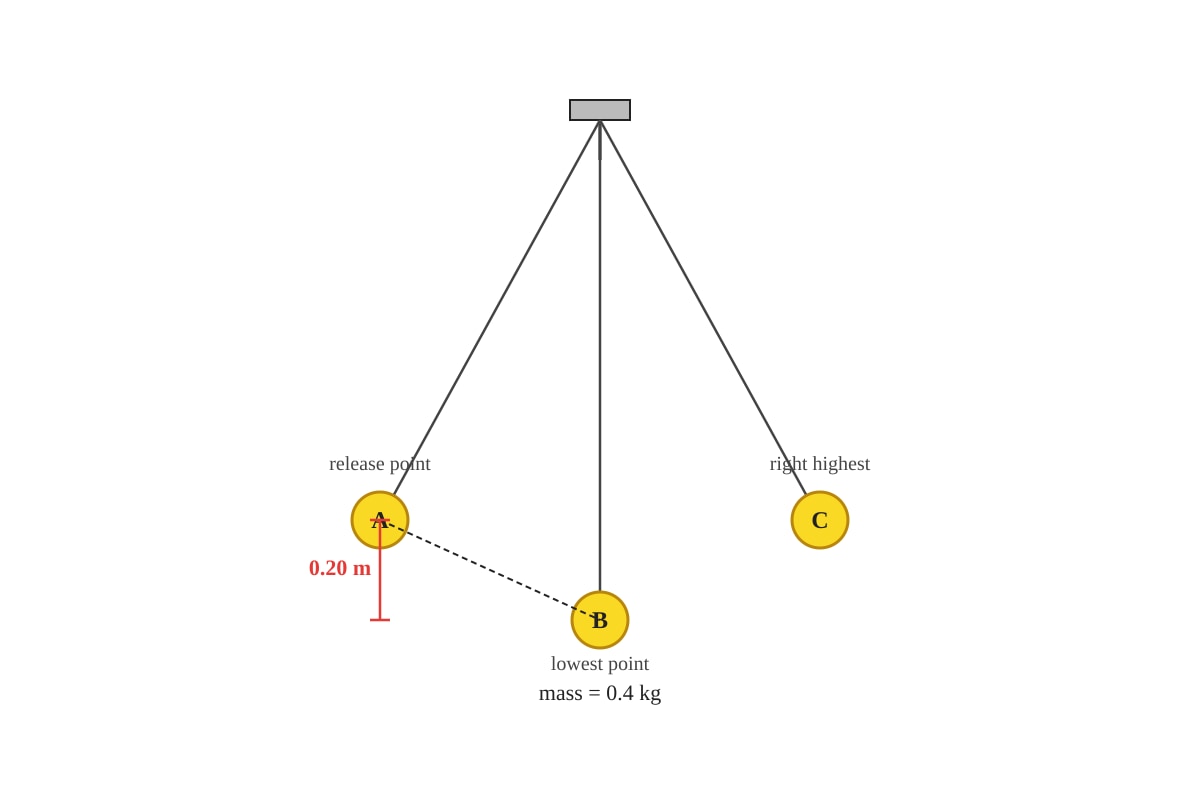
12. The diagram below shows a simple pendulum. The bob has a mass of 0.4 kg and is released from rest at position A, which is 0.20 m vertically above position B (the lowest point).
<image_placeholder> id: Q12-fig1 type: diagram linked_question: Q12 description: Simple pendulum with bob at positions A, B, and C. Point B is the lowest point. Point A is to the left at highest position. Point C is to the right at highest position. Vertical height difference between A and B is labeled 0.20 m. labels: A (release point, left), B (lowest point), C (right highest point), mass = 0.4 kg, height A-B = 0.20 m values: mass = 0.4 kg, height difference = 0.20 m must_show: pendulum string, pivot point at top, bob positions at A, B, C with clear labels, vertical height dimension from B to A </image_placeholder>
(a) Calculate the gravitational potential energy of the bob at position A relative to position B. (Take g = 10 N/kg) [2]
(b) State the kinetic energy of the bob at position B, assuming no energy is lost to air resistance. [1]
(c) Explain why the bob does not rise higher than position A on the other side. [2]
13. An electric motor is used to lift a load. The input electrical power to the motor is 500 W. The useful power output is 350 W.
(a) Calculate the efficiency of the motor. [2]
(b) Explain why the efficiency is less than 100%. [2]
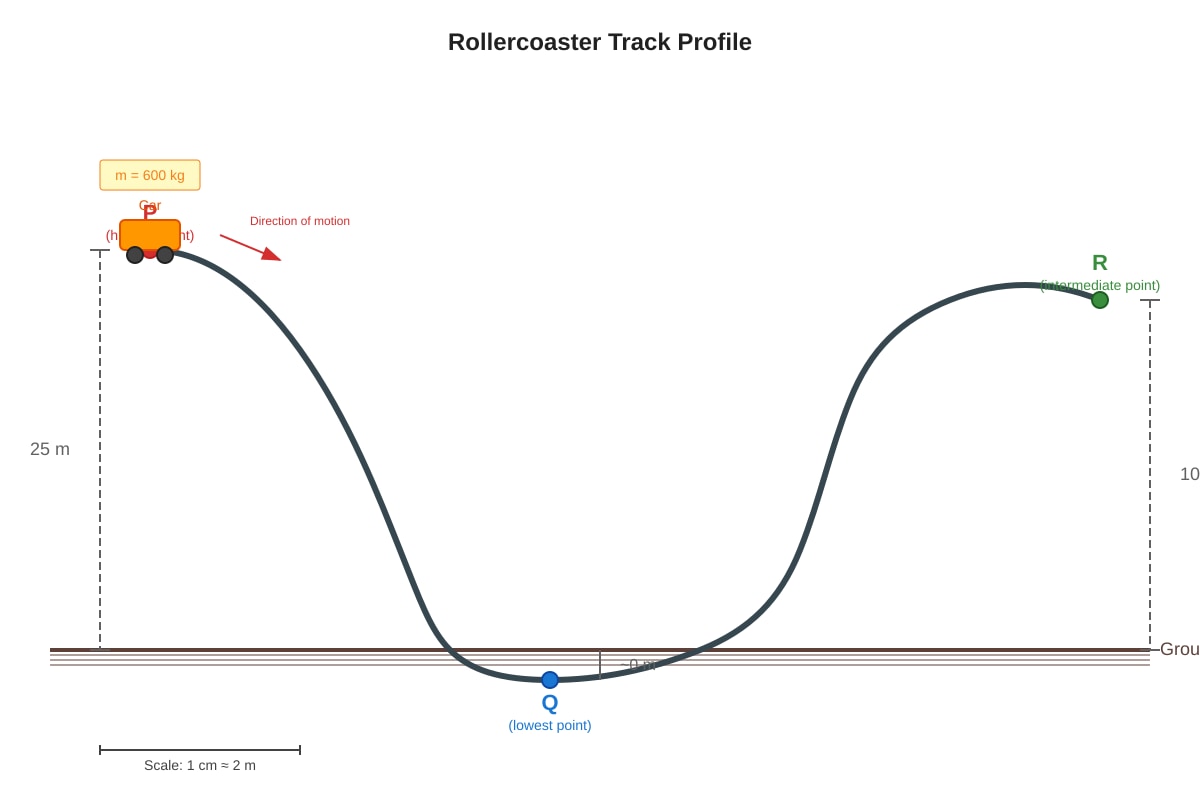
14. The diagram shows a rollercoaster car moving along a track.
<image_placeholder> id: Q14-fig1 type: diagram linked_question: Q14 description: Rollertoaster track profile showing points P, Q, and R. P is highest point on left. Q is lowest point in middle. R is intermediate height on right, lower than P. Rollertoaster car shown at point P. labels: P (highest point, left), Q (lowest point, middle), R (intermediate point, right), heights relative to ground values: height at P = 25 m, height at R = 10 m, mass of car and passengers = 600 kg must_show: track shape with P, Q, R labeled, vertical heights from ground level marked, car at position P, approximate scale indication </image_placeholder>
The mass of the car and passengers is 600 kg. The car starts from rest at point P, which is 25 m above the ground. Point R is 10 m above the ground. Assume negligible friction.
(a) Calculate the gravitational potential energy of the car at point P relative to the ground. (Take g = 10 N/kg) [2]
(b) Calculate the speed of the car at point Q. [3]
(c) Explain whether the speed of the car at point R will be greater than, equal to, or less than its speed at point Q. [2]
15. A student investigates how the efficiency of a ramp changes with its angle. The table shows some results.
| Angle of ramp (°) | Height of ramp (m) | Length of ramp (m) | Force to pull load up ramp (N) | Weight of load (N) |
|---|---|---|---|---|
| 20 | 0.34 | 1.00 | 4.5 | 10 |
| 30 | 0.50 | 1.00 | 6.0 | 10 |
| 40 | 0.64 | 1.00 | 7.8 | 10 |
| 50 | 0.77 | 1.00 | 9.2 | 10 |
(a) For the 30° ramp, calculate:
(i) the work done against gravity (useful work output) [2]
(ii) the work done by the pulling force (total work input) [2]
(iii) the efficiency of the ramp at this angle [2]
(b) Describe and explain the trend in efficiency as the angle of the ramp increases. [3]
16. A car of mass 1200 kg accelerates from rest to a speed of 20 m/s. At this speed, the resistive forces acting on the car total 800 N.
(a) Calculate the kinetic energy of the car at 20 m/s. [2]
(b) The car then maintains a constant speed of 20 m/s. Calculate the power required to overcome the resistive forces. [2]
(c) Explain why the engine must continue to supply power when the car is moving at constant speed. [2]
Section C: Data Analysis and Application (Questions 17–20) [12 marks]
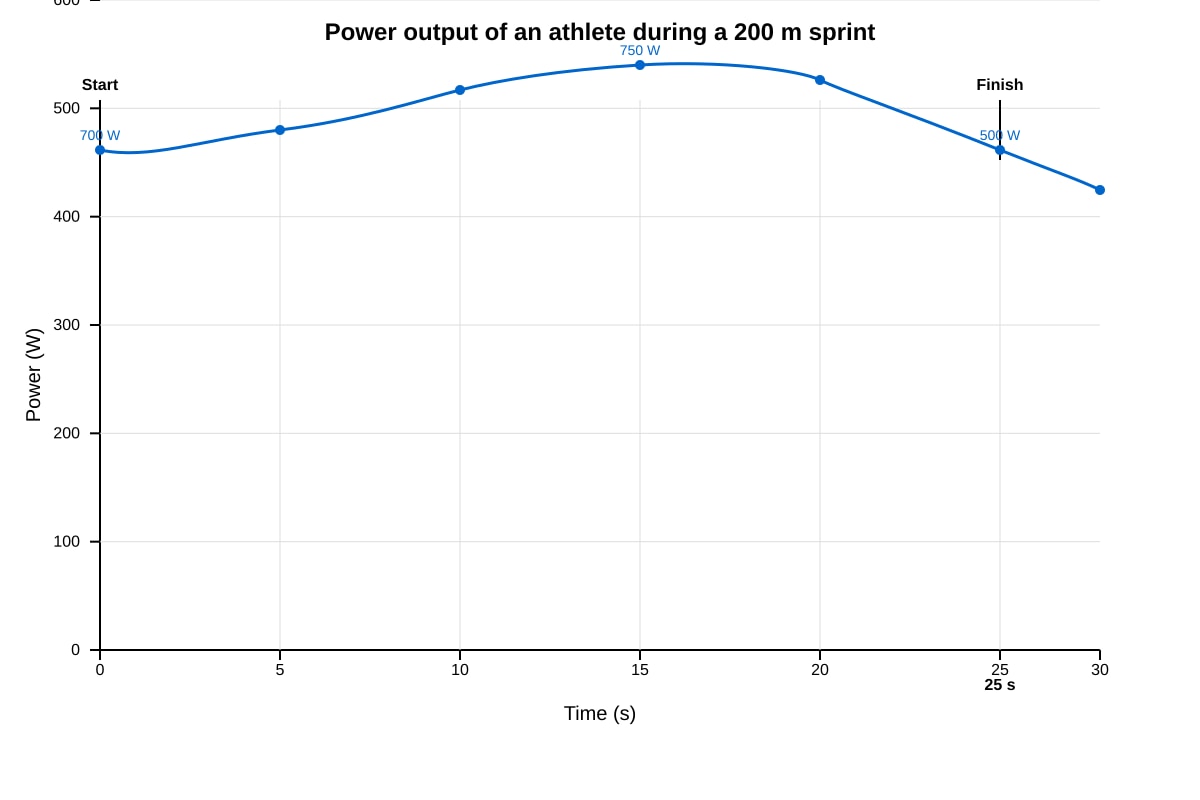
17. The graph shows how the power output of an athlete varies with time during a 200 m sprint.
<image_placeholder> id: Q17-fig1 type: graph linked_question: Q17 description: Power-time graph for an athlete during a 200 m sprint. X-axis: time (s) from 0 to 30. Y-axis: power (W) from 0 to 800. Curve starts at high power (~700 W), dips slightly, then rises to peak around 10-15 s, then gradually decreases. labels: time (s), power (W), start, finish line marked at 25 s values: initial power ~700 W, peak power ~750 W at ~12 s, power at finish ~500 W, finish time = 25 s must_show: labeled axes with units, curve showing power variation, start and finish markers, approximate values readable from graph </image_placeholder>
(a) Determine the maximum power output of the athlete from the graph. [1]
(b) State the time at which the athlete crosses the finish line. [1]
(c) Explain why the power output decreases towards the end of the race even though the athlete is still running. [2]
(d) The area under a power-time graph represents the total work done. Describe how you would estimate the total work done by the athlete during this race. [2]
18. A wind turbine has an input power from the wind of 2.0 MW. The electrical power output is 500 kW.
(a) Calculate the efficiency of the wind turbine. [2]
(b) State two reasons why the efficiency of a wind turbine is typically much lower than that of a fossil fuel power station. [2]
(c) Suggest one advantage and one disadvantage of using wind turbines instead of fossil fuel power stations for generating electricity. [2]
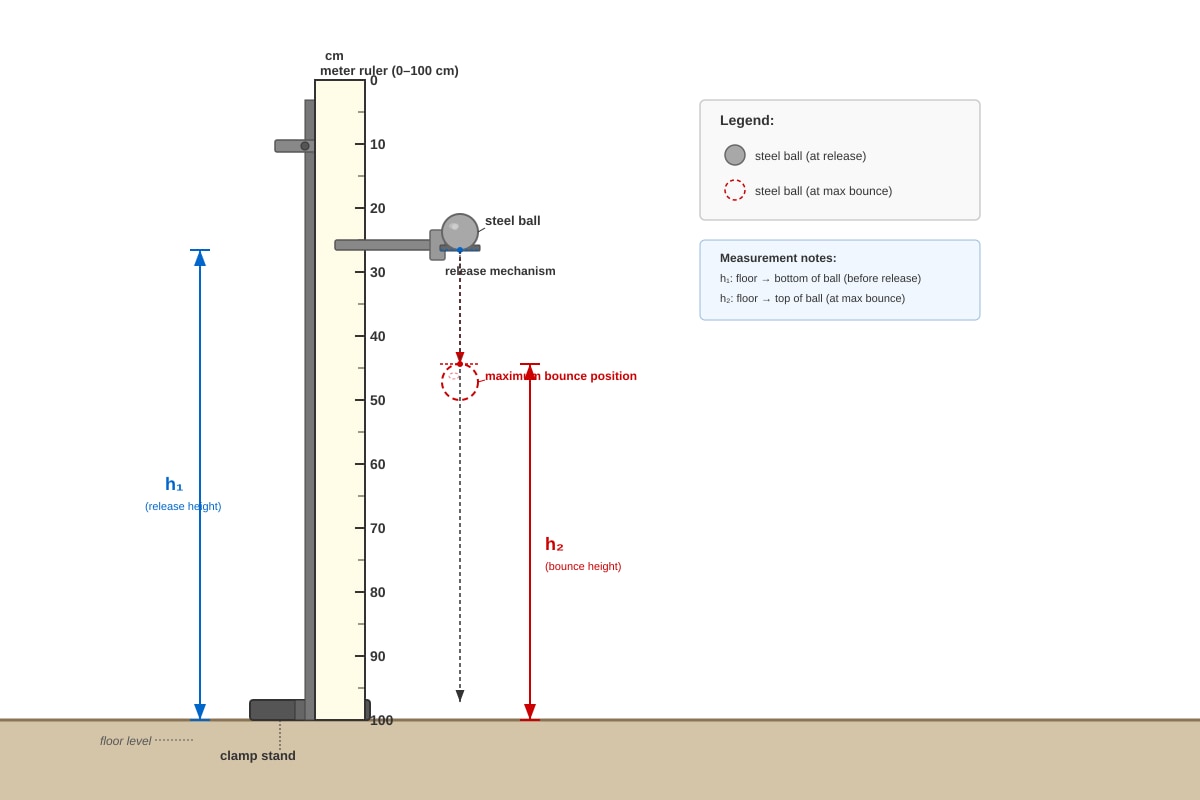
19. A student designs an experiment to investigate the relationship between the drop height of a ball and the height it bounces back to.
<image_placeholder> id: Q19-fig1 type: experimental_setup linked_question: Q19 description: Apparatus for measuring bounce height of a ball. Meter ruler clamped vertically. Ball release mechanism at adjustable height. Ball shown at release position and at maximum bounce position. labels: meter ruler (0-100 cm), clamp stand, release height h1, bounce height h2, steel ball values: h1 measured from floor to bottom of ball before release, h2 measured from floor to top of ball at maximum bounce must_show: vertical meter ruler with clear scale, ball at two positions (release and maximum bounce), height labels h1 and h2 with indication of measurement points </image_placeholder>
(a) State the independent variable and the dependent variable in this investigation. [2]
(b) Suggest why the student uses a release mechanism rather than dropping the ball by hand. [1]
(c) The student calculates the energy efficiency of the bounce using . Explain why this formula gives the energy efficiency. [3]
20. A pump is used to transfer water from a lower reservoir to a higher reservoir. Water of mass 5000 kg is lifted through a vertical height of 15 m in 10 minutes. The electrical power supplied to the pump is 2.5 kW.
(a) Calculate the increase in gravitational potential energy of the water. (Take g = 10 N/kg) [2]
(b) Calculate the minimum power required to lift the water assuming 100% efficiency. [3]
(c) Hence calculate the efficiency of the pump. [2]
(d) Suggest one practical reason why the efficiency of the pump is less than 100%. [1]
END OF QUIZ
Answers
Secondary 3 Physics Quiz - Energy Power: ANSWER KEY
Section A: Multiple Choice
| Question | Answer | Explanation |
|---|---|---|
| 1 | B | Power is the rate of doing work, measured in watts (W). Joule (J) is energy/work, Newton (N) is force, kilogram (kg) is mass. |
| 2 | D | Power = W |
| 3 | C | In hydroelectric power, water stored at height has gravitational potential energy. As it falls, this converts to kinetic energy of moving water, which spins turbines to generate electrical energy. The overall chain starts from gravitational potential energy. |
| 4 | B | Efficiency = . This measures what fraction of input energy is usefully used. |
| 5 | B | At the highest point, all kinetic energy has converted to gravitational potential energy. The ball momentarily stops (v = 0, so KE = 0) and is at maximum height (so GPE is maximum). |
| 6 | B | Power = Force × velocity, so N. At constant speed, driving force equals resistive force. |
| 7 | C | The principle of conservation of energy states that energy cannot be created or destroyed, only converted from one form to another. In a closed system, the total energy remains constant. |
| 8 | C | Energy = Power × time = 2.0 kW × 0.5 h = 1.0 kWh = 2000 W × 1800 s = 3,600,000 J = 3600 kJ. |
Section B: Short Answer and Structured Questions
9. (a) Kinetic energy = [1 mark]
(b) KE = J [2 marks]
- Formula: 1 mark
- Correct substitution and answer: 1 mark
10. (a) Gravitational potential energy is the energy possessed by an object due to its position in a gravitational field / due to its height above a reference level. [1 mark]
(b) Increase in GPE = mgΔh = 0.5 × 10 × (2.5 − 1.5) = 0.5 × 10 × 1.0 = 5.0 J [2 marks]
- Or: GPE at 2.5 m = 12.5 J, GPE at 1.5 m = 7.5 J, increase = 5.0 J
- Formula/method: 1 mark; correct answer: 1 mark
11. (a) Work done = Force × distance = 800 × 5.0 = 4000 J [2 marks]
- Or: Work done = mgh where weight = mg = 800 N
- Formula: 1 mark; correct answer: 1 mark
(b) Power = W [2 marks]
- Formula: 1 mark; correct answer: 1 mark
12. (a) GPE = mgh = 0.4 × 10 × 0.20 = 0.80 J [2 marks]
- Formula: 1 mark; correct substitution and answer: 1 mark
(b) Kinetic energy at B = 0.80 J [1 mark]
- By conservation of energy, all GPE at A converts to KE at B (assuming no energy loss)
(c) By the principle of conservation of energy, the total mechanical energy (KE + GPE) remains constant. [2 marks]
- If air resistance is negligible, the bob rises to the same height on the other side where all KE converts back to GPE.
- Since the initial total energy was fixed by the height at A, the bob cannot exceed this height without gaining extra energy, which is impossible.
13. (a) Efficiency = [2 marks]
- Formula or method: 1 mark; correct answer: 1 mark
(b) Explanation (any two points, 1 mark each):
- Some energy is lost as heat due to friction in the moving parts of the motor
- Some energy is lost as sound
- Some energy is used to overcome air resistance
- Some electrical energy is dissipated as heat in the coils due to resistance heating (I²R losses) [2 marks]
14. (a) GPE at P = mgh = 600 × 10 × 25 = 150 000 J = 150 kJ [2 marks]
- Formula: 1 mark; correct answer with unit: 1 mark
(b) By conservation of energy: GPE at P = KE at Q
- v = 22.4 m/s (or ≈ 22.4 m/s, or 22 m/s to 2 s.f.) [3 marks]
- Method/conservation principle: 1 mark
- Correct substitution: 1 mark
- Final answer: 1 mark
(c) The speed at R will be less than the speed at Q. [2 marks]
- Point R is higher than point Q, so some kinetic energy has converted back to gravitational potential energy.
- Since total mechanical energy is conserved (assuming no friction), less KE means lower speed.
- OR: At Q, all GPE has become KE (minimum GPE). At R, some energy is stored as GPE again, so KE and hence speed is reduced.
15. (a) (i) Useful work = Weight × vertical height = 10 × 0.50 = 5.0 J [2 marks]
- Method: 1 mark; answer: 1 mark
(ii) Total work = Force × distance along ramp = 6.0 × 1.00 = 6.0 J [2 marks]
- Method: 1 mark; answer: 1 mark
(iii) Efficiency = or 83% [2 marks]
- Formula/method: 1 mark; answer: 1 mark
(b) As the angle increases, the efficiency decreases. [3 marks]
- Trend identification: 1 mark
- Explanation: A steeper ramp means a greater proportion of the applied force is used to overcome friction between the load and the ramp surface (normal reaction increases, hence friction increases).
- Also, the applied force needs to overcome a greater component of weight along the plane, but more work is done against friction for the same vertical rise.
- More work input is wasted, so efficiency drops. (Any valid explanation referencing increased friction/work against friction: 2 marks)
16. (a) **KE = J = 2.4 × 10⁵ J [2 marks]
- Formula: 1 mark; correct answer: 1 mark
(b) Power = Force × velocity = 800 × 20 = 16 000 W = 16 kW [2 marks]
- Formula: 1 mark; correct answer: 1 mark
(c) At constant speed, the driving force equals the resistive force (zero resultant force). [2 marks]
- The engine must supply a forward force to balance the resistive forces.
- Power = Force × velocity, so if there is a resistive force to overcome and the car is moving, power must be supplied continuously to maintain this force against resistance.
Section C: Data Analysis and Application
17. (a) Maximum power = 750 W (± 25 W acceptable from graph) [1 mark]
(b) Time = 25 s (where finish line is marked) [1 mark]
(c) Explanation: [2 marks]
- The athlete's muscles become fatigued; less force can be applied with each stride.
- Metabolic waste products (lactate) build up, reducing muscle efficiency.
- Energy stores (ATP, glycogen) deplete, so the rate of energy conversion decreases.
- Breathing and heart rate cannot supply oxygen fast enough for sustained maximum power output.
(d) Method: [2 marks]
- Count the number of complete squares under the curve between t = 0 and t = 25 s.
- Calculate the work represented by one square (power scale × time scale).
- Multiply number of squares by work per square.
- OR: Use the trapezium rule or estimate average power and multiply by time (25 s).
- Any valid method with correct reasoning about area estimation: 2 marks
18. (a) Efficiency = [2 marks]
- Conversion/formula: 1 mark; correct answer: 1 mark
(b) Any two reasons: [2 marks]
- Wind speed is variable and unpredictable; turbine may not always operate at optimal speed
- Not all kinetic energy of wind can be extracted (would require wind to stop completely behind turbine)
- Mechanical energy losses in gearbox and generator
- Friction in moving parts dissipates energy as heat
(c) Advantage: Renewable energy source; no greenhouse gas emissions during operation; low running costs once installed; no fuel costs [1 mark] Disadvantage: Intermittent/variable output depends on weather; visual pollution; noise; land use; expensive initial construction [1 mark]
19. (a) Independent variable: Drop height (h₁) [1 mark] Dependent variable: Bounce height (h₂) [1 mark]
(b) Using a release mechanism ensures the ball is dropped from rest (no initial velocity) and allows precise, consistent release height every time. [1 mark]
- Dropping by hand may give inconsistent release heights and unintentional throwing motion.
(c) Explanation: [3 marks]
- As the ball falls from height h₁, gravitational potential energy is converted to kinetic energy: mgh₁
- After bouncing, kinetic energy converts back to gravitational potential energy: mgh₂ at maximum height
- If mass is constant,
- This ratio gives the fraction of energy retained, which is the energy efficiency.
- Hence the formula works because GPE is directly proportional to height when mass and g are constant.
20. (a) ΔGPE = mgh = 5000 × 10 × 15 = 750 000 J = 7.5 × 10⁵ J [2 marks]
- Formula: 1 mark; correct answer: 1 mark
(b) Time = 10 minutes = 600 s
- Minimum power = W = 1.25 kW [3 marks]
- Correct time conversion: 1 mark
- Formula: 1 mark
- Correct answer: 1 mark
(c) Efficiency =
- Or: [2 marks]
- Method: 1 mark; correct answer: 1 mark
(d) Any one reason: [1 mark]
- Friction in the pump mechanism
- Heat produced in the motor
- Turbulence and fluid friction as water moves through pipes
- Sound energy losses
TOTAL: 40 marks