From Real Exams Quiz
Secondary 3 Physics Energy Power Quiz
Free Sec 3 Physics Energy Power quiz, HY3 Exam version, with questions, answers, and O Level-style practice for Singapore students.
These static practice materials are generated from the site's syllabus and paper-generation workflow, with source and model context shown so students and parents can evaluate the material before use.
Questions
Secondary 3 Physics Quiz - Energy Power
Name: ___________________________
Class: ________
Date: ____________
Score: _______ / 40
Duration: 45 minutes
Total Marks: 40
Instructions:
- Answer all 20 questions.
- Section A: Multiple Choice (1 mark each)
- Section B: Short Answer (2 marks each)
- Section C: Structured Response (3–4 marks each)
- Show your working where calculation is required.
- Use g=10 m s−2 unless stated otherwise.
Section A: Multiple Choice (Questions 1–5)
1. Which of the following is a correct unit for energy?
A. W
B. J
C. N
D. kg
Answer: ______
2. A lamp uses 200 J of electrical energy in 10 s. What is its power?
A. 20 W
B. 2000 W
C. 0.05 W
D. 210 W
Answer: ______
3. The energy stored in a moving object is called:
A. gravitational potential energy
B. chemical energy
C. kinetic energy
D. elastic energy
Answer: ______
4. Efficiency of a device is given by:
A. useful energy output ÷ total energy input
B. total energy input ÷ useful energy output
C. power input ÷ power output
D. work done ÷ time
Answer: ______
5. A 2 kg ball is lifted to a height of 5 m. What is its gain in gravitational potential energy? (g=10 m s−2)
A. 10 J
B. 100 J
C. 20 J
D. 50 J
Answer: ______
Section B: Short Answer (Questions 6–10)
6. Define power in physics.
[2 marks]
7. A machine does 500 J of useful work and wastes 100 J as heat. Calculate its efficiency as a percentage.
[2 marks]
8. State the principle of conservation of energy.
[2 marks]
9. A car of mass 800 kg moves at 15 m s−1. Calculate its kinetic energy.
[2 marks]
10. A student runs up a flight of stairs of height 3 m in 4 s. If the student's weight is 400 N, calculate the power developed.
[2 marks]
Section C: Structured Response (Questions 11–20)
11. A crane lifts a 50 kg load vertically at a constant speed through a height of 8 m in 4 s.
(a) Calculate the gain in gravitational potential energy of the load. [2]
(b) Calculate the useful power of the crane. [2]
12. A electric heater rated 1.5 kW is used for 10 minutes.
(a) Calculate the electrical energy converted in joules. [2]
(b) If half the energy is lost to the surroundings, what is the useful energy delivered? [1]
13. A ball of mass 0.5 kg is dropped from a height of 20 m. Air resistance is negligible.
(a) Calculate its gravitational potential energy at the top. [1]
(b) State its kinetic energy just before hitting the ground. [1]
(c) Calculate its speed just before impact. [2]
14. A motor raises a 20 kg mass 10 m in 5 s. It uses 3000 J of electrical energy.
(a) Calculate useful work done. [2]
(b) Calculate efficiency of the motor. [2]
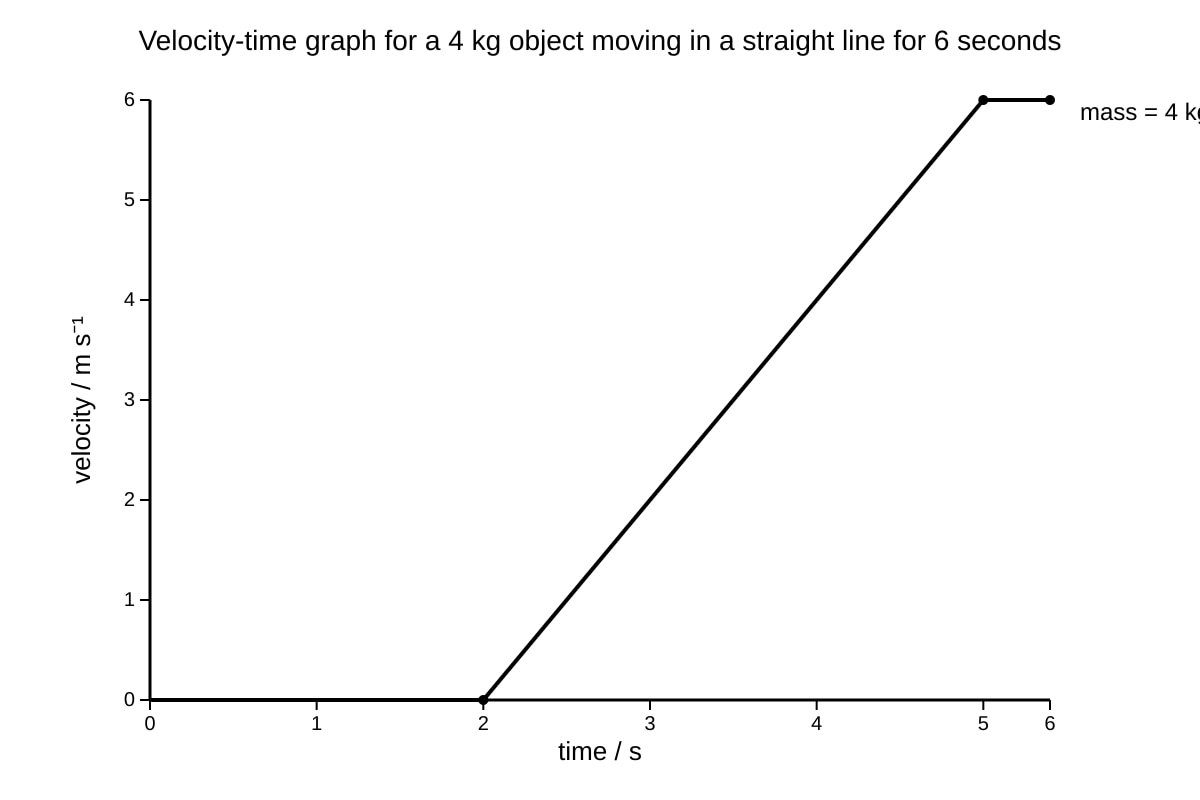
15.

Generated graph for Q15.
Using the graph, calculate the kinetic energy of the object at t = 6 s. [3]
16. A 100 W fan operates for 2 hours.
(a) Calculate energy used in kWh. [2]
(b) Convert your answer to joules. [1]
17. A block of mass 4 kg slides down a frictionless slope of vertical height 5 m.
(a) Calculate loss in gravitational potential energy. [2]
(b) Hence find its speed at the bottom. [2]
18. A power drill uses 600 J in 2 s.
(a) Calculate its power output. [1]
(b) If 25% of input energy is wasted, calculate the input energy. [3]
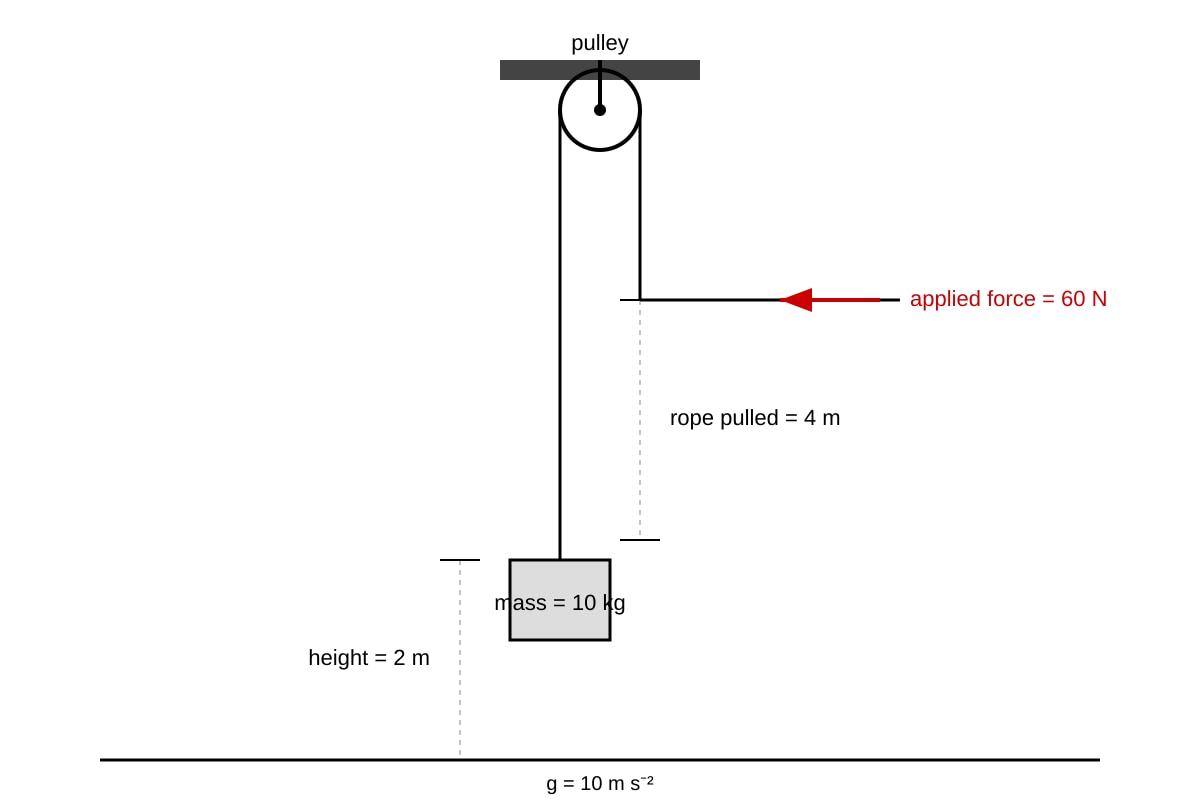
19.

Generated experimental_setup for Q19.
(a) Calculate work done by the applied force. [2]
(b) Calculate useful work done on the load. [1]
(c) Calculate efficiency. [1]
20. A solar panel produces 2 kW of power for 5 hours a day.
(a) Calculate daily energy output in kWh. [2]
(b) If the panel receives 10 kWh of solar energy per day, calculate its efficiency. [2]
Answers
Secondary 3 Physics Quiz - Energy Power (Answers)
Total Marks: 40
Duration: 45 minutes
Section A: Multiple Choice
1. B [1]
Teaching note: Energy is measured in joules (J). W is watt (power), N is newton (force), kg is mass.
2. A [1]
P=E/t=200/10=20 W.
3. C [1]
Kinetic energy is energy due to motion.
4. A [1]
Efficiency = useful energy output ÷ total energy input.
5. B [1]
ΔEp=mgh=2×10×5=100 J.
Section B: Short Answer
6. [2]
Power is the rate of doing work (or rate of energy transfer).
Marking: 1 mark for "rate", 1 mark for "work/energy transfer".
7. [2]
Total input = 500 + 100 = 600 J.
Efficiency = (500/600) × 100% = 83.3% (or 83%).
Marks: 1 for total energy, 1 for correct percentage.
8. [2]
Energy cannot be created or destroyed; it can only change from one form to another (or total energy is conserved).
Marks: 1 for conservation idea, 1 for transformation.
9. [2]
KE=21mv2=0.5×800×152=400×225=90000 J.
Marks: 1 for formula/substitution, 1 for answer.
10. [2]
Work = weight × height = 400 × 3 = 1200 J.
Power = 1200 / 4 = 300 W.
Marks: 1 for work, 1 for power.
Section C: Structured Response
11. [4]
(a) ΔEp=mgh=50×10×8=4000 J [2]
(b) P=E/t=4000/4=1000 W [2]
12. [3]
(a) E=Pt=1500×(10×60)=1500×600=900000 J [2]
(b) Useful = 900 000 / 2 = 450 000 J [1]
13. [4]
(a) Ep=mgh=0.5×10×20=100 J [1]
(b) KE = 100 J (by conservation) [1]
(c) 21mv2=100⇒0.25v2=100⇒v2=400⇒v=20 m s−1 [2]
14. [4]
(a) W=mgh=20×10×10=2000 J [2]
(b) Efficiency = (2000/3000) × 100% = 66.7% [2]
15. [3]
At t=6 s, v = 6 m/s (from graph).
KE=21mv2=0.5×4×62=2×36=72 J.
Marks: 1 read v, 1 formula, 1 answer.
16. [3]
(a) E=Pt=0.1 kW×2 h=0.2 kWh [2]
(b) 0.2×3.6×106=720000 J [1]
17. [4]
(a) ΔEp=mgh=4×10×5=200 J [2]
(b) 21mv2=200⇒2v2=200⇒v=10 m s−1 [2]
18. [4]
(a) P=E/t=600/2=300 W [1]
(b) Useful = 75% of input; input = 600 / 0.75 = 800 J [3]
19. [4]
(a) Win=Fd=60×4=240 J [2]
(b) Wout=mgh=10×10×2=200 J [1]
(c) Efficiency = 200/240 × 100% = 83.3% [1]
20. [4]
(a) E=2×5=10 kWh [2]
(b) Efficiency = 10/10 × 100% = 100% [2]
Free quiz and exam paper access
Enter your details to view this paper
Your access is remembered on this device.