AI Generated Exam Paper

Secondary 3 Physics Practice Paper 5

Free Kimi AI-generated Sec 3 Physics Practice Paper 5 with questions, answers, and O Level-style practice for Singapore students preparing for exams.

These static practice materials are generated from the site's syllabus and paper-generation workflow, with source and model context shown so students and parents can evaluate the material before use.

Secondary 3 Physics AI Generated Generated by Kimi K2.6 Free Updated 2026-06-10

Questions

<!-- TuitionGoWhere generation metadata: stage=5-2; model=moonshotai/kimi-k2.6:free; model_label=Kimi K2.6 Free; generated=2026-06-10; Sources: Stage 4-0 LLM templates, syllabus context, and Stage 2 evidence where available. -->

TuitionGoWhere Practice Paper - Physics Secondary 3

TuitionGoWhere Practice Paper (AI)
Version: 5 of 5

| Subject: | Physics | | Level: | Secondary 3 | | Paper: | Practice Paper — Mechanics | | Duration: | 1 hour 15 minutes | | Total Marks: | 75 |

| Name: | | | Class: | | | Date: | |


Instructions to Candidates

  • Write your name, class, and date in the spaces provided above.
  • Answer all questions.
  • Write your answers in the spaces provided.
  • For numerical answers, show all working clearly. Marks will be awarded for correct method even if the final answer is incorrect.
  • Where diagrams or sketches are required, use a sharp pencil and ruler.
  • Non-programmable calculators are allowed.
  • Use g=10 N/kgg = 10 \text{ N/kg} or g=10 m/s2g = 10 \text{ m/s}^2 where required.

Section A: Multiple Choice (Questions 1–10)

Answer all questions. Each question is worth 2 marks.
Section Total: 20 marks

For each question, circle the correct answer.


1. A student measures the thickness of a coin using a micrometer screw gauge. Which reading is most reasonable?

A0.20 cm0.20 \text{ cm}
B2.0 mm2.0 \text{ mm}
C20 mm20 \text{ mm}
D2.0 cm2.0 \text{ cm}

Answer: _______________


2. Which of the following is a vector quantity?

AMass
BTime
CSpeed
DWeight

Answer: _______________


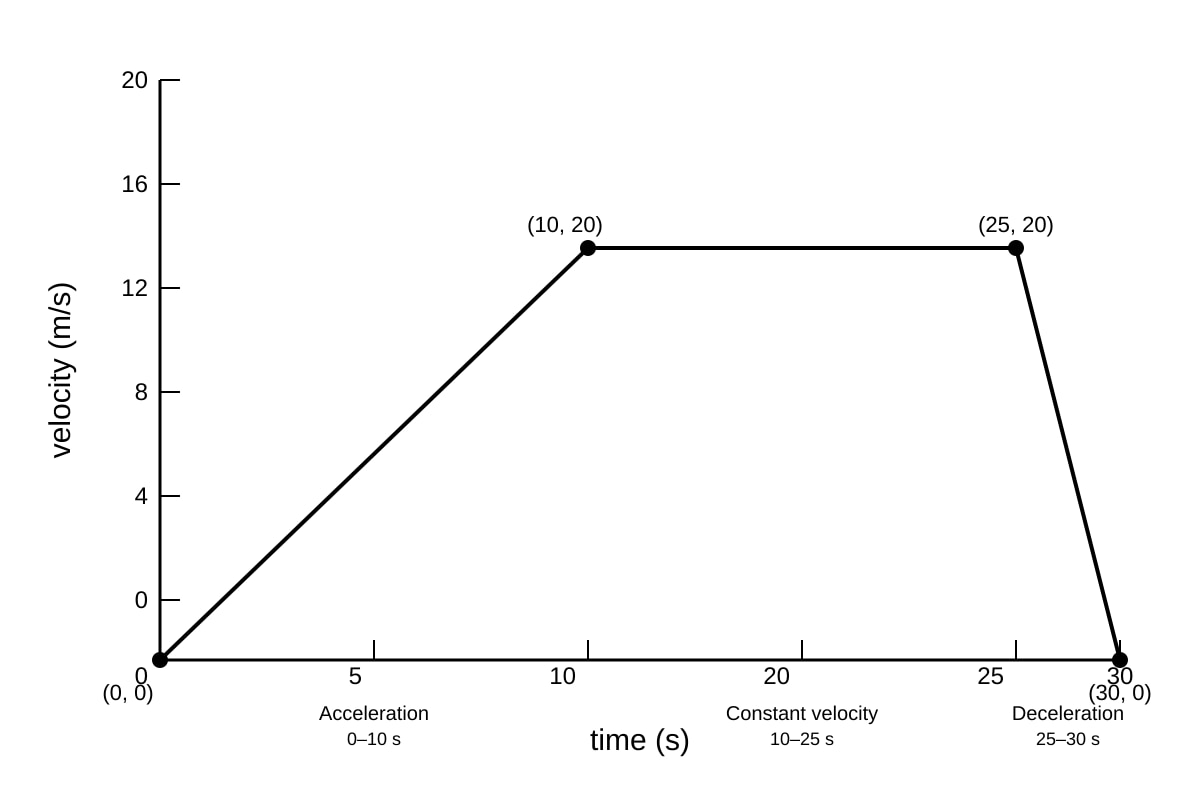
3. The velocity-time graph below shows the motion of a train.

<image_placeholder> id: Q3-fig1 type: graph linked_question: Q3 description: Velocity-time graph for train motion showing constant acceleration from rest to 20 m/s over 10 s, then constant velocity for 15 s, then constant deceleration to rest over 5 s labels: velocity (m/s) on y-axis, time (s) on x-axis; points at (0,0), (10,20), (25,20), (30,0) values: max velocity 20 m/s, total time 30 s, acceleration phase 0-10 s, constant velocity 10-25 s, deceleration 25-30 s must_show: clearly labelled axes with units, three distinct phases, numerical values on axes, straight line segments connecting key points </image_placeholder>

What is the acceleration of the train during the first 10 seconds?

A0.5 m/s20.5 \text{ m/s}^2
B2.0 m/s22.0 \text{ m/s}^2
C5.0 m/s25.0 \text{ m/s}^2
D20 m/s220 \text{ m/s}^2

Answer: _______________


4. A stone is thrown vertically upward. At the highest point of its motion, which statement is correct?

AThe acceleration is zero.
BThe velocity and acceleration are both zero.
CThe velocity is zero but the acceleration is 10 m/s210 \text{ m/s}^2 downward.
DThe stone experiences no forces.

Answer: _______________


5. A block of mass 5 kg is pulled along a rough horizontal surface by a force of 20 N. The block moves at constant velocity. What is the magnitude of the frictional force?

A0 N0 \text{ N}
B20 N20 \text{ N}
C50 N50 \text{ N}
D70 N70 \text{ N}

Answer: _______________


6. Two forces act on an object: 12 N12 \text{ N} to the east and 5 N5 \text{ N} to the north. What is the magnitude of the resultant force?

A7 N7 \text{ N}
B13 N13 \text{ N}
C17 N17 \text{ N}
D169 N169 \text{ N}

Answer: _______________


7. A car of mass 800 kg accelerates from rest to a speed of 20 m/s20 \text{ m/s} in 10 seconds. What is the average power developed?

A1.6 kW1.6 \text{ kW}
B8.0 kW8.0 \text{ kW}
C16 kW16 \text{ kW}
D160 kW160 \text{ kW}

Answer: _______________


8. A ball is dropped from a height of 20 m. Assuming air resistance is negligible, what is its speed just before it hits the ground?

A10 m/s10 \text{ m/s}
B20 m/s20 \text{ m/s}
C40 m/s40 \text{ m/s}
D400 m/s400 \text{ m/s}

Answer: _______________


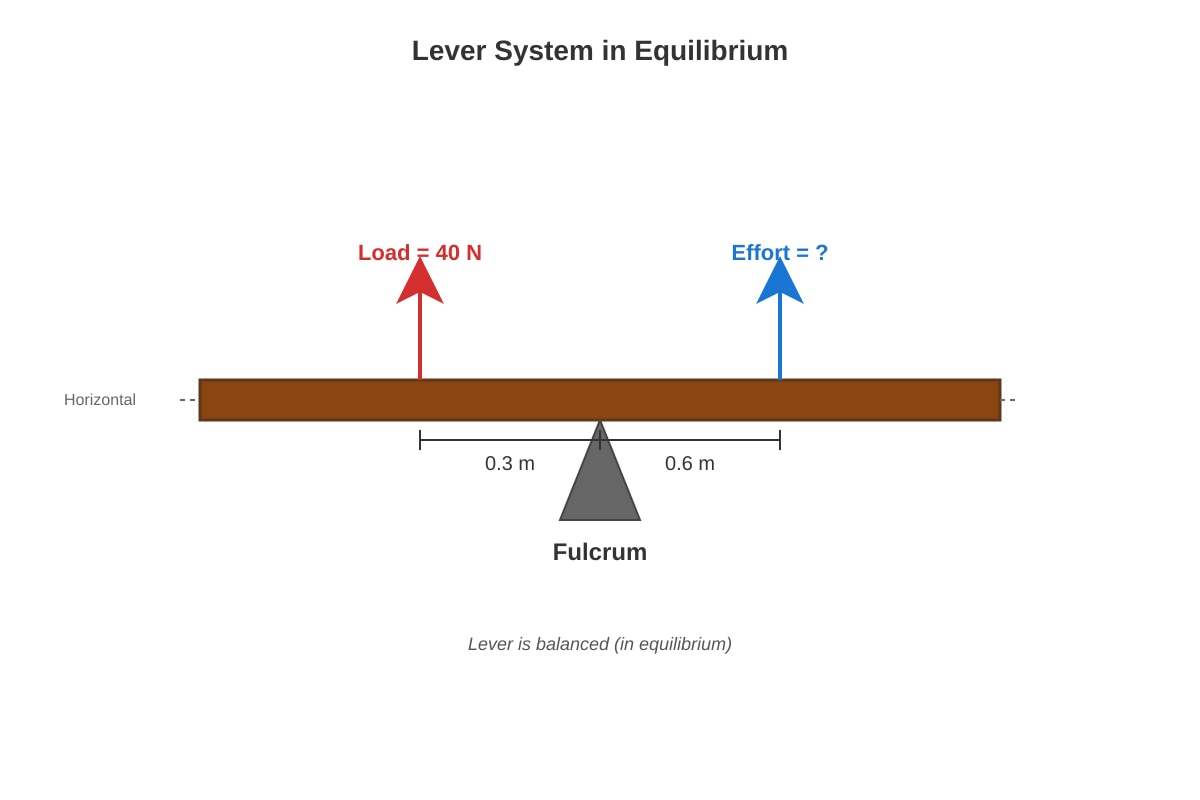
9. The diagram shows a lever in equilibrium.

<image_placeholder> id: Q9-fig1 type: diagram linked_question: Q9 description: Simple lever system with fulcrum, load and effort marked labels: fulcrum at centre, load = 40 N at 0.3 m from fulcrum on left, effort on right at 0.6 m from fulcrum, lever horizontal and balanced values: load = 40 N, load distance = 0.3 m, effort distance = 0.6 m must_show: fulcrum position, load and effort arrows with labels, perpendicular distances clearly marked with values, lever drawn horizontal </image_placeholder>

What is the magnitude of the effort force?

A10 N10 \text{ N}
B20 N20 \text{ N}
C40 N40 \text{ N}
D80 N80 \text{ N}

Answer: _______________


10. Which graph shows the relationship between kinetic energy and speed for an object of constant mass?

AStraight line through origin
BParabola opening upward
CHyperbola
DStraight line with negative gradient

Answer: _______________


Section B: Structured Questions (Questions 11–17)

Answer all questions. Marks are shown in brackets.
Section Total: 40 marks


11. A cyclist travels from point P to point Q along a straight road. The journey consists of three stages described below.

StageDescriptionTime / s
1Accelerates uniformly from rest to 6 m/s6 \text{ m/s}4
2Travels at constant velocity of 6 m/s6 \text{ m/s}10
3Decelerates uniformly to rest6

(a) Calculate the acceleration during Stage 1. [2 marks]


(b) Calculate the distance travelled during Stage 2. [2 marks]


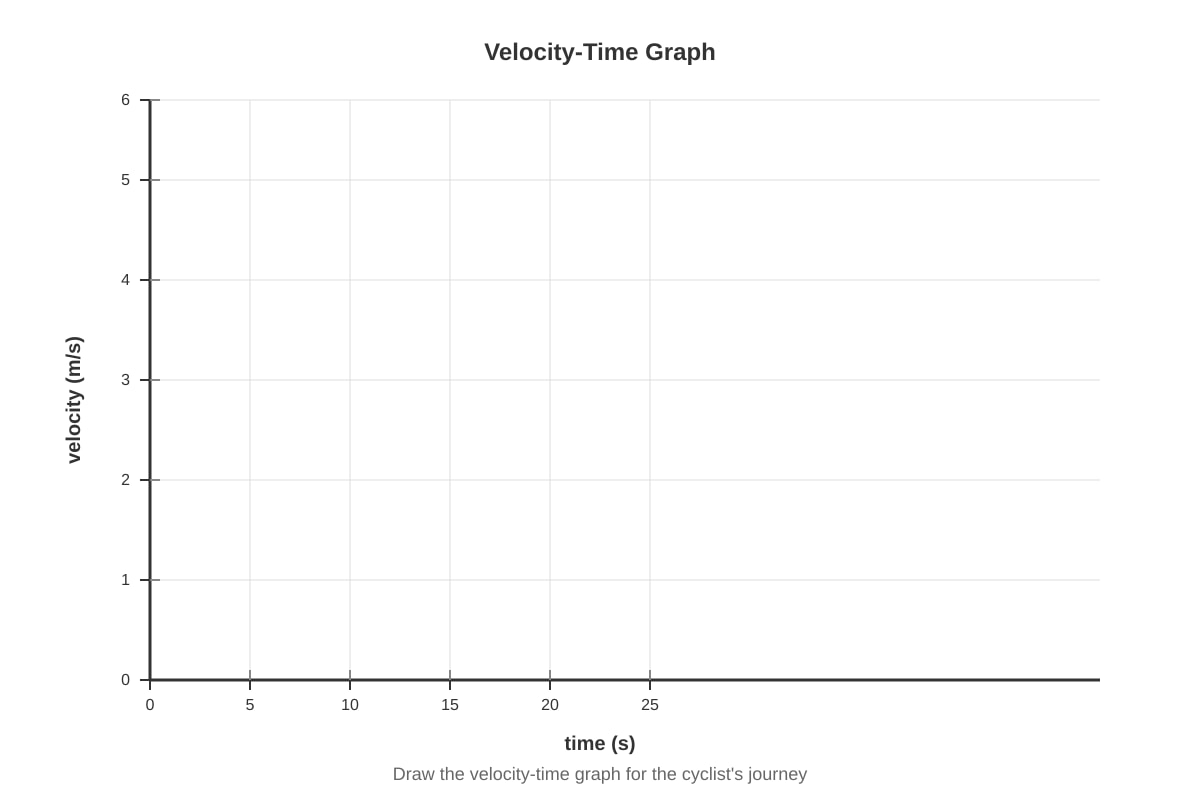
(c) On the axes below, draw the velocity-time graph for the entire journey. Label all key values. [3 marks]

<image_placeholder> id: Q11-fig1 type: graph linked_question: Q11c description: Blank velocity-time axes for student to draw motion graph of cyclist labels: velocity (m/s) on y-axis up to 8, time (s) on x-axis up to 25 values: grid lines at intervals; student should plot points at (0,0), (4,6), (14,6), (20,0) must_show: labelled axes with units, uniform grid suitable for plotting, sufficient space for all three stages </image_placeholder>

(d) Determine the total distance travelled from P to Q. [2 marks]


12. A parcel of mass 2.5 kg is suspended from a spring balance inside a lift.

(a) Calculate the weight of the parcel. [1 mark]


(b) When the lift is accelerating upward at 2 m/s22 \text{ m/s}^2, the reading on the spring balance changes. Calculate this new reading. [3 marks]


(c) Explain why the reading on the spring balance is greater when the lift accelerates upward compared to when it is at rest. [2 marks]


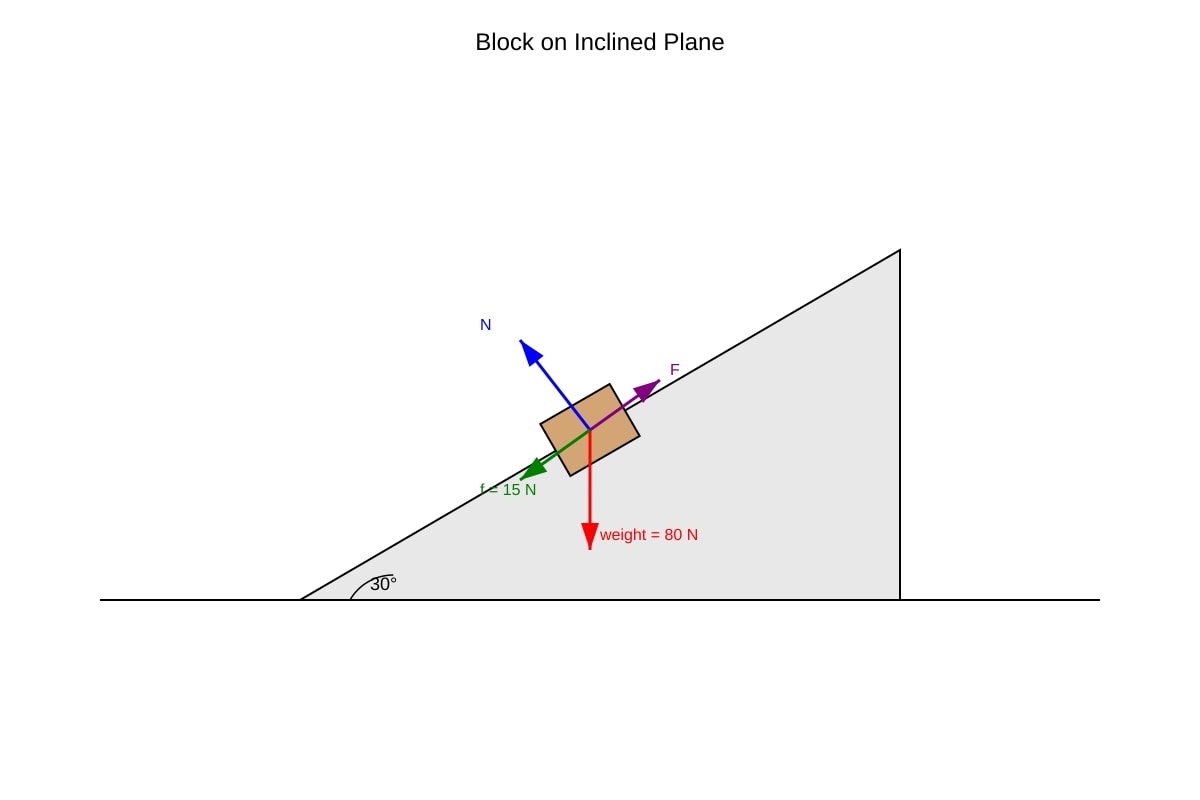
13. The diagram shows a block of weight 80 N on a rough inclined plane. The plane makes an angle of 30°30° with the horizontal. A force FF parallel to the plane pulls the block up the slope at constant speed. The frictional force opposing motion is 15 N.

<image_placeholder> id: Q13-fig1 type: diagram linked_question: Q13 description: Block on inclined plane with forces shown labels: block on slope inclined at 30° to horizontal; weight = 80 N shown vertically downward; normal reaction N perpendicular to slope; frictional force f = 15 N down slope; applied force F up slope; angle 30° marked values: weight = 80 N, angle = 30°, friction = 15 N must_show: inclined plane at 30° angle clearly marked, block on slope, all four forces with arrow labels, angle indication between slope and horizontal </image_placeholder>

(a) Calculate the component of the weight parallel to the plane. [2 marks]


(b) Calculate the magnitude of force FF required to maintain constant speed. [2 marks]


(c) State one way to reduce the friction between the block and the plane, and explain why this would help. [2 marks]


14. A car of mass 1200 kg is travelling along a straight horizontal road at 15 m/s15 \text{ m/s} when the driver applies the brakes. The car comes to rest after travelling 45 m.

(a) Calculate the kinetic energy of the car before braking. [2 marks]


(b) Calculate the average braking force exerted on the car. [3 marks]


(c) If the same car were travelling at 30 m/s30 \text{ m/s} and the same braking force were applied, explain whether the stopping distance would be double, more than double, or less than double the original stopping distance. You should support your answer with relevant calculations or reasoning. [3 marks]


15. A crane lifts a load of mass 500 kg vertically through a height of 8 m at constant speed.

(a) Calculate the work done by the crane. [2 marks]


(b) The crane took 20 seconds to lift the load. Calculate the power output of the crane. [2 marks]


(c) Explain why the power output of the crane's motor must be greater than the value calculated in part (b). [2 marks]


16. The diagram shows a simple pulley system used to lift a load.

<image_placeholder> id: Q16-fig1 type: diagram linked_question: Q16 description: Block and tackle pulley system with mechanical advantage labels: upper fixed pulley block with 2 pulleys, lower movable pulley block with 2 pulleys, load suspended from lower block, effort rope pulled upward, load = 600 N indicated values: load = 600 N, 4 supporting strands visible must_show: clear distinction between fixed and movable pulley blocks, all rope segments numbered or clearly visible, load arrow downward, effort direction indicated, supporting strands clearly countable </image_placeholder>

(a) State the velocity ratio of this pulley system. Explain how you determined your answer. [2 marks]


(b) If the system is 75% efficient, calculate the effort required to lift the load. [3 marks]


(c) Explain why the actual effort required is greater than the theoretical effort for an ideal (frictionless, massless) system. [2 marks]


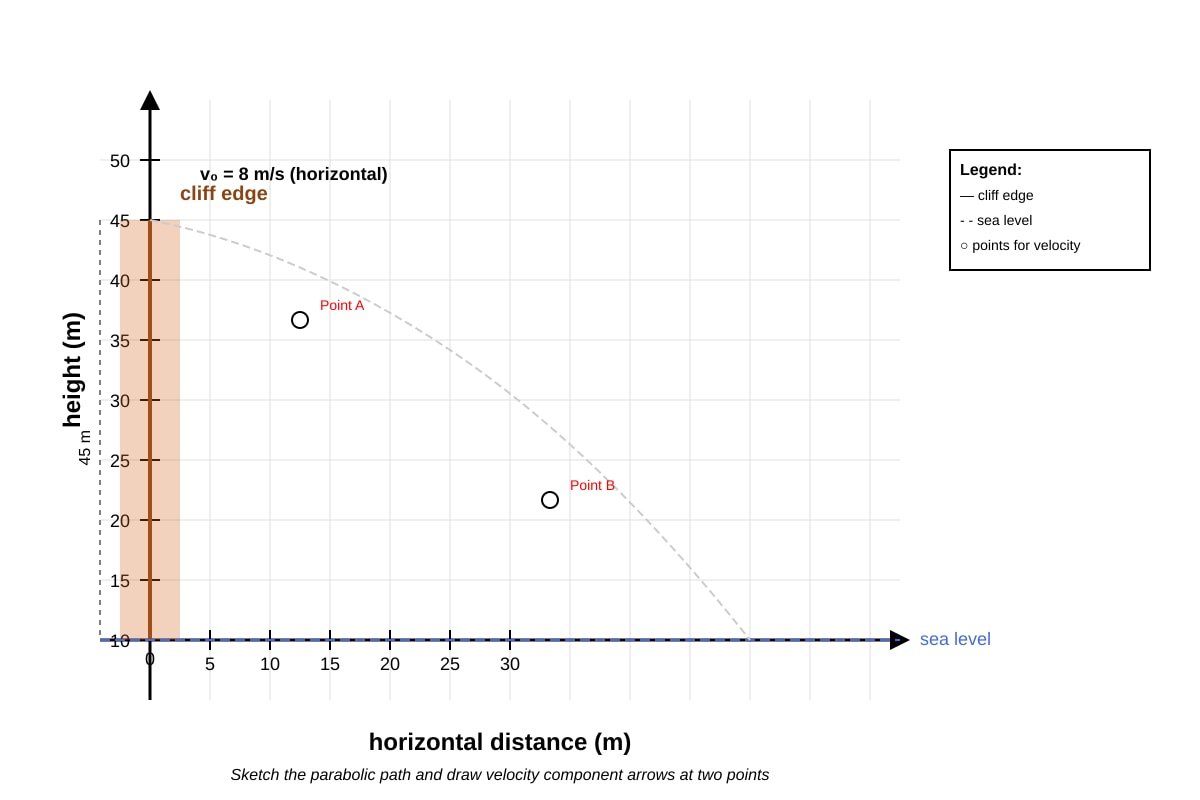
17. A ball is thrown horizontally from the top of a cliff with speed 8 m/s8 \text{ m/s}. The cliff is 45 m above the sea level.

(a) Calculate the time taken for the ball to reach the sea. Assume air resistance is negligible. [2 marks]


(b) Calculate the horizontal distance travelled by the ball before hitting the sea. [2 marks]


(c) On the axes below, sketch the path of the ball from the cliff top to the sea, and indicate the horizontal and vertical velocity components at two points on the path. [3 marks]

<image_placeholder> id: Q17-fig1 type: graph linked_question: Q17c description: Blank axes for sketching projectile motion path with velocity components labels: height (m) on y-axis to 50, horizontal distance (m) on x-axis to 30; cliff edge marked at origin level values: cliff height 45 m, initial horizontal velocity 8 m/s must_show: labelled axes, cliff edge clearly indicated at start, parabolic curve downward, spaces for student to draw velocity component arrows at two different points </image_placeholder>

(d) Explain how the kinetic energy of the ball changes during its flight. Calculate the speed of the ball just before impact. [4 marks]


Section C: Data Analysis and Application (Questions 18–20)

Answer all questions. Marks are shown in brackets.
Section Total: 15 marks


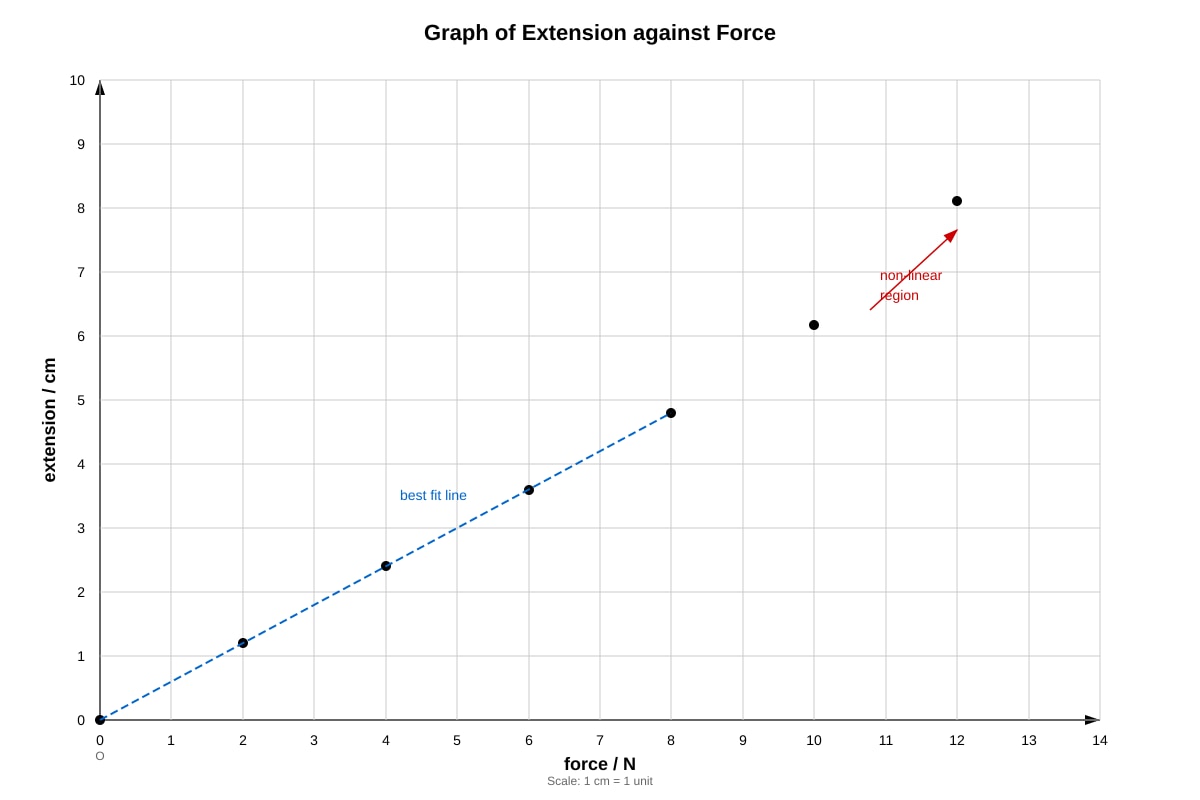
18. An experiment is conducted to investigate how the extension of a spring varies with the force applied. The results are shown in the table below.

Force / N024681012
Extension / cm01.22.43.64.86.28.5

(a) On the grid below, plot a graph of extension against force for these results. [3 marks]

<image_placeholder> id: Q18-fig1 type: graph linked_question: Q18a description: Blank graph axes for plotting spring extension data labels: extension (cm) on y-axis to 10, force (N) on x-axis to 14; grid lines at suitable intervals values: data points at (0,0), (2,1.2), (4,2.4), (6,3.6), (8,4.8), (10,6.2), (12,8.5) must_show: labelled axes with units, uniform grid with at least 1 cm squares, sufficient range for all data points, origin at (0,0) </image_placeholder>

(b) Use your graph to determine the range of forces for which the spring obeys Hooke's Law. Explain your reasoning. [2 marks]


(c) Calculate the spring constant kk for the region where Hooke's Law is obeyed. Give your answer in N/m\text{N/m}. [3 marks]


(d) Suggest why the spring ceases to obey Hooke's Law at higher forces. [2 marks]


19. The table gives information about four different vehicles accelerating from rest.

VehicleMass / kgTime to reach 30 m/s30 \text{ m/s} / sMaximum Power / kW
A150010150
B12008180
C200012200
D10006160

(a) Calculate the acceleration of vehicle B. [1 mark]


(b) Calculate the kinetic energy of vehicle C when travelling at 30 m/s30 \text{ m/s}. [2 marks]


(c) By calculating the work done by the engine for each vehicle, or otherwise, determine which vehicle has the greatest average power during the acceleration phase. Show your working clearly. [4 marks]


20. Read the following passage and answer the questions that follow.

Modern cars are designed with many safety features to protect passengers during collisions. Crumple zones at the front and rear of the car are designed to deform progressively during impact, increasing the time over which the car decelerates. Seat belts restrain passengers and prevent them from hitting the windscreen or dashboard. Airbags deploy rapidly to provide a cushion between the passenger and hard surfaces of the car interior.

(a) Use Newton's Second Law (F=maF = ma) to explain how crumple zones reduce the force experienced by passengers during a collision. [3 marks]


(b) Explain why a passenger not wearing a seat belt continues to move forward when a car brakes suddenly, and how this relates to Newton's First Law. [3 marks]


(c) Suggest one additional safety feature in modern vehicles and explain the physics principle behind how it protects occupants. [2 marks]


END OF PAPER


Section Marks:
Section A: 20 marks | Section B: 40 marks | Section C: 15 marks
Total: 75 marks

Answers

<!-- TuitionGoWhere generation metadata: stage=5-2; model=moonshotai/kimi-k2.6:free; model_label=Kimi K2.6 Free; generated=2026-06-10; Sources: Stage 4-0 LLM templates, syllabus context, and Stage 2 evidence where available. -->

TuitionGoWhere Practice Paper Answers - Physics Secondary 3

Version: 5 of 5 | Mechanics


Section A: Multiple Choice (Questions 1–10)

Each question: 2 marks. Section Total: 20 marks


1. B — 2.0 mm2.0 \text{ mm}

Teaching note: A typical coin thickness is about 2 mm (or 0.2 cm). The micrometer screw gauge measures small dimensions precisely. Option A (0.20 cm=2.0 mm0.20 \text{ cm} = 2.0 \text{ mm}) has the correct value but micrometer readings are typically given in mm. However, 2.0 mm2.0 \text{ mm} is the standard form. Option D is 20 mm (2 cm) — too thick for one coin. Option C is 20 mm — far too large. The most reasonable measurement is 2.0 mm.

Common mistake: Confusing mm and cm units; forgetting that 1 cm=10 mm1 \text{ cm} = 10 \text{ mm}.


2. D — Weight

Teaching note: A vector quantity has both magnitude and direction.

  • Mass (A): scalar — amount of matter, no direction
  • Time (B): scalar — no direction
  • Speed (C): scalar — magnitude of velocity only
  • Weight (D): vector — force due to gravity, acts downward toward Earth's centre

Weight = mgmg, where gg is acceleration due to gravity (vector). Weight is a force, and all forces are vectors.

Common mistake: Confusing mass and weight — mass is scalar, weight is vector.


3. B — 2.0 m/s22.0 \text{ m/s}^2

Teaching note: Acceleration = gradient of velocity-time graph.

From the graph description: velocity increases from 00 to 20 m/s20 \text{ m/s} in 10 s10 \text{ s}.

a=ΔvΔt=200100=2010=2.0 m/s2a = \frac{\Delta v}{\Delta t} = \frac{20 - 0}{10 - 0} = \frac{20}{10} = 2.0 \text{ m/s}^2

Step-by-step:

  • Identify initial velocity: u=0 m/su = 0 \text{ m/s}
  • Identify final velocity: v=20 m/sv = 20 \text{ m/s}
  • Identify time interval: Δt=10 s\Delta t = 10 \text{ s}
  • Apply formula: a=vut=2010=2.0 m/s2a = \frac{v-u}{t} = \frac{20}{10} = 2.0 \text{ m/s}^2

4. C — The velocity is zero but the acceleration is 10 m/s210 \text{ m/s}^2 downward.

Teaching note: At the highest point of vertical motion:

  • Velocity is momentarily zero — the ball stops before changing direction
  • Acceleration is NOT zero — gravity still acts, so a=g=10 m/s2a = g = 10 \text{ m/s}^2 downward
  • The ball is still under the influence of Earth's gravitational field

This is a common exam trap. Never confuse "momentarily at rest" with "no forces acting." Newton's Second Law (F=maF = ma) tells us that if Fgrav=mgF_{grav} = mg acts, then a=ga = g.


5. B — 20 N20 \text{ N}

Teaching note: Constant velocity means zero acceleration, so net force = zero (Newton's First Law).

For horizontal motion: F=ma=0\sum F = ma = 0

Therefore: Applied force − Friction = 0

Fapplied=Ffriction=20 NF_{applied} = F_{friction} = 20 \text{ N}

Marking point: Recognition that constant velocity \Rightarrow balanced forces [1 mark]; correct answer [1 mark].


6. B — 13 N13 \text{ N}

Teaching note: Forces at right angles → use Pythagoras' theorem.

Fresultant=F12+F22=122+52=144+25=169=13 NF_{resultant} = \sqrt{F_1^2 + F_2^2} = \sqrt{12^2 + 5^2} = \sqrt{144 + 25} = \sqrt{169} = 13 \text{ N}

Step-by-step:

  • Draw vector diagram: 12 N east, 5 N north, resultant as hypotenuse
  • Apply Pythagoras: c2=a2+b2c^2 = a^2 + b^2
  • Calculate: 169=13 N\sqrt{169} = 13 \text{ N}
  • Direction: tan1(5/12)=22.6°\tan^{-1}(5/12) = 22.6° north of east (not asked, but useful)

Common mistake: Simply adding (17 N) or subtracting (7 N) — only valid for collinear forces.


7. C — 16 kW16 \text{ kW}

Teaching note: Average power = work done / time = change in kinetic energy / time (or P=FvP = Fv average).

Method 1 — Using energy:

  • KE=12mv2=12×800×202=12×800×400=160000 JKE = \frac{1}{2}mv^2 = \frac{1}{2} \times 800 \times 20^2 = \frac{1}{2} \times 800 \times 400 = 160\,000 \text{ J}
  • P=KEt=16000010=16000 W=16 kWP = \frac{KE}{t} = \frac{160\,000}{10} = 16\,000 \text{ W} = 16 \text{ kW}

Method 2 — Using force and velocity:

  • a=vut=20010=2 m/s2a = \frac{v-u}{t} = \frac{20-0}{10} = 2 \text{ m/s}^2
  • F=ma=800×2=1600 NF = ma = 800 \times 2 = 1600 \text{ N}
  • Average v=10 m/sv = 10 \text{ m/s}; P=F×vavg=1600×10=16000 W=16 kWP = F \times v_{avg} = 1600 \times 10 = 16\,000 \text{ W} = 16 \text{ kW}

Or using P=FvP = Fv at final instant: 1600×20=32 kW1600 \times 20 = 32 \text{ kW}, then average = 16 kW16 \text{ kW}.


8. B — 20 m/s20 \text{ m/s}

Teaching note: Use conservation of energy or suvat equations.

Method — Energy:

  • PElost=KEgainedPE_{lost} = KE_{gained}
  • mgh=12mv2mgh = \frac{1}{2}mv^2
  • gh=12v2gh = \frac{1}{2}v^2
  • v=2gh=2×10×20=400=20 m/sv = \sqrt{2gh} = \sqrt{2 \times 10 \times 20} = \sqrt{400} = 20 \text{ m/s}

Method — suvat:

  • s=20 ms = 20 \text{ m}, u=0u = 0, a=10 m/s2a = 10 \text{ m/s}^2, find vv
  • v2=u2+2as=0+2×10×20=400v^2 = u^2 + 2as = 0 + 2 \times 10 \times 20 = 400
  • v=20 m/sv = 20 \text{ m/s}

9. B — 20 N20 \text{ N}

Teaching note: Principle of moments: clockwise moment = anticlockwise moment.

Taking moments about the fulcrum:

  • Anticlockwise moment (load side) = 40×0.3=12 Nm40 \times 0.3 = 12 \text{ Nm}
  • Clockwise moment (effort side) = E×0.6E \times 0.6

For equilibrium: E×0.6=40×0.3E \times 0.6 = 40 \times 0.3

E=40×0.30.6=120.6=20 NE = \frac{40 \times 0.3}{0.6} = \frac{12}{0.6} = 20 \text{ N}

Marking: Correct moment equation [1 mark]; correct substitution and answer [1 mark].


10. B — Parabola opening upward

Teaching note: KE=12mv2KE = \frac{1}{2}mv^2

For constant mass: KEv2KE \propto v^2

This is a quadratic relationship — graph of yx2y \propto x^2 is a parabola opening upward from the origin.

vvKEKE
00
22m2m
48m8m
618m18m

The values increase faster than linearly — characteristic of v2v^2 dependence.


Section B: Structured Questions (Questions 11–17)

Section Total: 40 marks


11. (a) Acceleration during Stage 1 [2 marks]

a=vut=604=1.5 m/s2a = \frac{v-u}{t} = \frac{6-0}{4} = 1.5 \text{ m/s}^2

Marking: Formula [1 mark]; correct substitution and answer with unit [1 mark].


(b) Distance during Stage 2 [2 marks]

At constant velocity: s=vt=6×10=60 ms = vt = 6 \times 10 = 60 \text{ m}

Marking: Formula or recognition of constant velocity [1 mark]; correct answer with unit [1 mark].


(c) Velocity-time graph [3 marks]

<image_placeholder> id: Q11-ans-fig1 type: graph linked_question: Q11c description: Completed velocity-time graph for cyclist labels: velocity (m/s) on y-axis, time (s) on x-axis values: straight line from (0,0) to (4,6), horizontal line to (14,6), straight line to (20,0) must_show: axes labelled with units, correct scale, three distinct phases with correct end points, all key values (0, 4, 14, 20 on time axis; 0, 6 on velocity axis) labelled </image_placeholder>

Marking: Correct shape — acceleration, constant velocity, deceleration [1 mark]; correct values on axes [1 mark]; correct time and velocity values at transition points [1 mark].


(d) Total distance [2 marks]

Distance = area under v-t graph:

  • Stage 1: triangle = 12×4×6=12 m\frac{1}{2} \times 4 \times 6 = 12 \text{ m}
  • Stage 2: rectangle = 6×10=60 m6 \times 10 = 60 \text{ m}
  • Stage 3: triangle = 12×6×6=18 m\frac{1}{2} \times 6 \times 6 = 18 \text{ m}

Total = 12+60+18=90 m12 + 60 + 18 = 90 \text{ m}

Or using average velocity: Stage 1 avg = 3 m/s, distance = 12 m; Stage 2 = 60 m; Stage 3 avg = 3 m/s, distance = 18 m.

Marking: Correct method (areas or kinematic equations) [1 mark]; correct final answer with unit [1 mark].


12. (a) Weight of parcel [1 mark]

W=mg=2.5×10=25 NW = mg = 2.5 \times 10 = 25 \text{ N}


(b) Reading when accelerating upward [3 marks]

When accelerating upward: Tmg=maT - mg = ma (Newton's Second Law, upward positive)

T=m(g+a)=2.5×(10+2)=2.5×12=30 NT = m(g + a) = 2.5 \times (10 + 2) = 2.5 \times 12 = 30 \text{ N}

Step-by-step:

  • Draw free body diagram: tension T upward, weight mgmg downward [implicit]
  • Net force upward: Tmg=maT - mg = ma [1 mark]
  • Substitution: T25=2.5×2=5T - 25 = 2.5 \times 2 = 5 [1 mark]
  • Solve: T=30 NT = 30 \text{ N} [1 mark]

(c) Explanation of increased reading [2 marks]

The spring balance measures tension in the spring. When the lift accelerates upward:

  • The parcel must also accelerate upward
  • By Newton's Second Law, net force must be upward
  • Therefore tension > weight (T=m(g+a)>mgT = m(g+a) > mg)
  • The balance reads the tension, so it shows more than the actual weight

Marking: Identifies that spring balance reads tension [1 mark]; explains need for net upward force/acceleration [1 mark].


13. (a) Component of weight parallel to plane [2 marks]

W=Wsinθ=80×sin30°=80×0.5=40 NW_{\parallel} = W \sin \theta = 80 \times \sin 30° = 80 \times 0.5 = 40 \text{ N}

Marking: Correct formula WsinθW \sin \theta or mgsinθmg \sin \theta [1 mark]; correct substitution and answer [1 mark].

Common mistake: Using cos30°\cos 30° instead of sin30°\sin 30° — always check which component you need. The parallel component uses sinθ\sin \theta; perpendicular uses cosθ\cos \theta.


(b) Force F for constant speed [2 marks]

At constant speed: net force = 0 (equilibrium)

Forces up slope = Forces down slope: F=W+f=40+15=55 NF = W_{\parallel} + f = 40 + 15 = 55 \text{ N}

Marking: Recognition of equilibrium/constant speed [1 mark]; correct addition of components [1 mark].


(c) Reducing friction [2 marks]

Method: Lubricate the surface / use rollers / use smoother materials / reduce normal force

Explanation: Friction f=μRf = \mu R (where μ\mu is coefficient, RR is normal reaction). By reducing μ\mu (lubrication, smoother surface) or using rolling friction instead of sliding friction, the frictional force decreases, so less applied force F is needed.

Marking: Valid method [1 mark]; clear explanation of mechanism [1 mark].


14. (a) Kinetic energy before braking [2 marks]

KE=12mv2=12×1200×152=600×225=135000 J=135 kJKE = \frac{1}{2}mv^2 = \frac{1}{2} \times 1200 \times 15^2 = 600 \times 225 = 135\,000 \text{ J} = 135 \text{ kJ}

Marking: Formula [1 mark]; correct substitution and answer with unit [1 mark].


(b) Average braking force [3 marks]

Work done by brakes = KE lost = 135000 J135\,000 \text{ J}

W=F×dF=Wd=13500045=3000 NW = F \times d \Rightarrow F = \frac{W}{d} = \frac{135\,000}{45} = 3000 \text{ N}

Alternative — kinematics first:

  • v2=u2+2as0=225+2a(45)a=2.5 m/s2v^2 = u^2 + 2as \Rightarrow 0 = 225 + 2a(45) \Rightarrow a = -2.5 \text{ m/s}^2
  • F=ma=1200×2.5=3000 NF = ma = 1200 \times 2.5 = 3000 \text{ N}

Marking: Correct energy/work method or kinematic method [1 mark]; correct substitution [1 mark]; final answer with unit [1 mark].


(c) Stopping distance at double speed [3 marks]

Answer: More than double.

Reasoning:

  • KEv2KE \propto v^2, so at 30 m/s30 \text{ m/s}, KE=12×1200×900=540000 JKE = \frac{1}{2} \times 1200 \times 900 = 540\,000 \text{ J} — this is 4 times the original KE
  • Work to stop: W=F×d=KElostW = F \times d = KE_{lost}
  • With same FF: d=KEFKEv2d = \frac{KE}{F} \propto KE \propto v^2
  • New distance = 4×45=180 m4 \times 45 = 180 \text{ m}

This is 4 times, not 2 times, the original.

Or calculate directly: a=2.5 m/s2a = -2.5 \text{ m/s}^2 (same braking force), then v2=u2+2as0=900+2(2.5)ss=180 mv^2 = u^2 + 2as \Rightarrow 0 = 900 + 2(-2.5)s \Rightarrow s = 180 \text{ m}

Marking: Correct identification (more than double) [1 mark]; explains KEv2KE \propto v^2 [1 mark]; shows calculation leading to factor of 4 [1 mark].


15. (a) Work done [2 marks]

W=F×d=mg×h=500×10×8=40000 JW = F \times d = mg \times h = 500 \times 10 \times 8 = 40\,000 \text{ J}

Or: W=mgh=500×10×8=40000 JW = mgh = 500 \times 10 \times 8 = 40\,000 \text{ J}

Marking: Formula [1 mark]; correct substitution and answer with unit [1 mark].


(b) Power output [2 marks]

P=Wt=4000020=2000 W=2 kWP = \frac{W}{t} = \frac{40\,000}{20} = 2000 \text{ W} = 2 \text{ kW}

Marking: Formula [1 mark]; correct answer with unit [1 mark].


(c) Why actual power > calculated [2 marks]

The calculated value is the useful power output for lifting the load. The motor's actual power must be greater because:

  • Energy is lost to heat due to friction in moving parts
  • Energy is used to lift the cable/rope itself (if massive)
  • Energy is lost to air resistance
  • The motor is not 100% efficient

Marking: Identifies energy losses [1 mark]; names specific loss mechanisms [1 mark].


16. (a) Velocity ratio [2 marks]

Velocity ratio = 4

Explanation: Count the number of supporting strands — rope segments that directly support the load. In the diagram, 4 strands support the movable pulley block, so the load is shared among 4 strands.

Marking: Correct value [1 mark]; correct explanation (supporting strands) [1 mark].


(b) Effort required [3 marks]

For ideal machine: MA=VR=4MA = VR = 4, so ideal effort = 6004=150 N\frac{600}{4} = 150 \text{ N}

With efficiency η=75%=0.75\eta = 75\% = 0.75:

η=MAVR=LEVR\eta = \frac{MA}{VR} = \frac{\frac{L}{E}}{VR}

0.75=600/E4=6004E0.75 = \frac{600/E}{4} = \frac{600}{4E}

E=6004×0.75=6003=200 NE = \frac{600}{4 \times 0.75} = \frac{600}{3} = 200 \text{ N}

Or: Useful work out = 600×h600 \times h; work in = E×4hE \times 4h (effort moves 4× distance)

η=600hE×4h=6004E=0.75\eta = \frac{600h}{E \times 4h} = \frac{600}{4E} = 0.75

Same result: E=200 NE = 200 \text{ N}

Marking: Correct efficiency relationship [1 mark]; correct substitution [1 mark]; final answer [1 mark].


(c) Why actual effort > ideal effort [2 marks]

In an ideal system: no friction, no mass of moving parts.

Actual system requires more effort because:

  • Friction in pulley bearings opposes motion
  • The pulleys themselves (especially movable ones) have mass that must also be lifted
  • Energy is lost to these factors, so more work input is needed for the same work output

Marking: Identifies friction [1 mark]; identifies mass of pulley system [1 mark].


17. (a) Time to reach sea [2 marks]

Vertical motion only (horizontal does not affect vertical fall time):

uy=0u_y = 0 (thrown horizontally), s=45 ms = 45 \text{ m}, a=g=10 m/s2a = g = 10 \text{ m/s}^2

s=ut+12at245=0+12×10×t2s = ut + \frac{1}{2}at^2 \Rightarrow 45 = 0 + \frac{1}{2} \times 10 \times t^2

t2=9t=3 st^2 = 9 \Rightarrow t = 3 \text{ s}

Marking: Correct vertical equation/values [1 mark]; correct answer [1 mark].


(b) Horizontal distance [2 marks]

Horizontal: constant velocity ux=8 m/su_x = 8 \text{ m/s}, time = 3 s

sx=ux×t=8×3=24 ms_x = u_x \times t = 8 \times 3 = 24 \text{ m}

Marking: Correct formula/recognition of constant horizontal velocity [1 mark]; correct answer with unit [1 mark].


(c) Path sketch [3 marks]

<image_placeholder> id: Q17-ans-fig1 type: sketch linked_question: Q17c description: Completed projectile path with velocity components labels: height (m) on y-axis, horizontal distance (m) on x-axis; parabolic curve from cliff edge down to sea values: cliff height 45 m, horizontal distance 24 m, initial horizontal velocity 8 m/s must_show: parabolic trajectory (not straight line), horizontal velocity component arrows of equal length at two points (constant), vertical velocity component arrows increasing in length as ball descends, clear labels v_x and v_y </image_placeholder>

Marking: Correct parabolic shape [1 mark]; horizontal component constant (same length arrows) [1 mark]; vertical component increasing (longer arrow lower down) [1 mark].


(d) Kinetic energy change and impact speed [4 marks]

KE change:

  • Horizontal vxv_x stays constant at 8 m/s8 \text{ m/s} (no horizontal acceleration)
  • Vertical vyv_y increases: vy=gt=10×3=30 m/sv_y = gt = 10 \times 3 = 30 \text{ m/s} at impact (or vy2=2gs=900v_y^2 = 2gs = 900, so vy=30 m/sv_y = 30 \text{ m/s})
  • Speed at impact: v=vx2+vy2=64+900=96431.0 m/sv = \sqrt{v_x^2 + v_y^2} = \sqrt{64 + 900} = \sqrt{964} \approx 31.0 \text{ m/s}

KE increases because:

  • Gravitational PE converts to KE as height decreases
  • Total mechanical energy conserved (no air resistance)
  • Speed increases, so KE=12mv2KE = \frac{1}{2}mv^2 increases

Calculation: v=82+302=64+900=964=31.0 m/sv = \sqrt{8^2 + 30^2} = \sqrt{64 + 900} = \sqrt{964} = 31.0 \text{ m/s}

Or by energy: mgh=12mv212mux2mgh = \frac{1}{2}mv^2 - \frac{1}{2}mu_x^2

10×45=12(v264)10 \times 45 = \frac{1}{2}(v^2 - 64) 900=v264900 = v^2 - 64 v2=964v^2 = 964 v=31.0 m/sv = 31.0 \text{ m/s}

Marking: Explains KE increases due to PE conversion [1 mark]; states horizontal velocity constant [1 mark]; calculates vertical component or uses energy method [1 mark]; final speed with method [1 mark].


Section C: Data Analysis and Application (Questions 18–20)

Section Total: 15 marks


18. (a) Graph plotting [3 marks]

<image_placeholder> id: Q18-ans-fig1 type: graph linked_question: Q18a description: Completed extension vs force graph with best fit lines labels: extension (cm) on y-axis, force (N) on x-axis values: points at (0,0), (2,1.2), (4,2.4), (6,3.6), (8,4.8), (10,6.2), (12,8.5); straight line of best fit from origin through points up to (8,4.8), then curved section must_show: all 7 points correctly plotted within half a small square, axes labelled with units, suitable scale, straight line for first 5 points, clear deviation at (10,6.2) and (12,8.5) </image_placeholder>

Marking: Correct axes and scale [1 mark]; all points correct (allow ±0.2 cm) [1 mark]; line of best fit showing Hooke's Law region and deviation [1 mark].


(b) Range of Hooke's Law [2 marks]

Answer: 00 to 8 N8 \text{ N} (approximately, up to between 8 and 10 N)

Reasoning: Hooke's Law states that extension is directly proportional to force (F=kxF = kx or xFx \propto F). This produces a straight line through the origin. The graph is linear up to F=8 NF = 8 \text{ N} (check: x/F=1.2/2=0.6x/F = 1.2/2 = 0.6, 2.4/4=0.62.4/4 = 0.6, 3.6/6=0.63.6/6 = 0.6, 4.8/8=0.64.8/8 = 0.6 — constant ratio). At 10 N and 12 N, the ratio increases (6.2/10=0.626.2/10 = 0.62, 8.5/12=0.718.5/12 = 0.71), showing deviation from proportionality.

Marking: Correct range approximately 0–8 N [1 mark]; evidence of constant ratio/straight line check [1 mark].


(c) Spring constant [3 marks]

From linear region: k=Fxk = \frac{F}{x} (using F=kxF = kx in form k=F/xk = F/x)

Using F=8 NF = 8 \text{ N}, x=4.8 cm=0.048 mx = 4.8 \text{ cm} = 0.048 \text{ m}:

k=80.048=166.7 N/mk = \frac{8}{0.048} = 166.7 \text{ N/m}

Or using gradient: 800.0480=80.048=166.7 N/m\frac{8 - 0}{0.048 - 0} = \frac{8}{0.048} = 166.7 \text{ N/m}

Accept 167 N/m or 170 N/m.

Step-by-step:

  • Identify Hooke's Law region [implicit in choice of point]
  • Convert cm to m: 4.8 cm=0.048 m4.8 \text{ cm} = 0.048 \text{ m} [crucial mark]
  • Calculate k=F/xk = F/x [1 mark]
  • Final answer with unit N/m [1 mark]

Marking: Correct formula [1 mark]; unit conversion from cm to m [1 mark]; correct final value [1 mark].


(d) Why Hooke's Law ceases [2 marks]

At higher forces:

  • The elastic limit of the material is exceeded
  • Permanent deformation occurs — the spring does not return to original length
  • The atomic/molecular bonds in the spring material are being stretched beyond their elastic capability
  • The spring may be approaching its limit of proportionality

Marking: States elastic limit/limit of proportionality exceeded [1 mark]; explains permanent deformation or atomic level change [1 mark].


19. (a) Acceleration of vehicle B [1 mark]

a=vut=3008=3.75 m/s2a = \frac{v-u}{t} = \frac{30-0}{8} = 3.75 \text{ m/s}^2


(b) Kinetic energy of vehicle C [2 marks]

KE=12mv2=12×2000×302=1000×900=900000 J=900 kJKE = \frac{1}{2}mv^2 = \frac{1}{2} \times 2000 \times 30^2 = 1000 \times 900 = 900\,000 \text{ J} = 900 \text{ kJ}

Marking: Formula [1 mark]; correct answer [1 mark].


(c) Greatest average power [4 marks]

Average power = work done / time = gain in kinetic energy / time

VehicleKE gained (J)Time (s)Average Power (W)
A12×1500×900=675000\frac{1}{2} \times 1500 \times 900 = 675\,0001067,500
B12×1200×900=540000\frac{1}{2} \times 1200 \times 900 = 540\,000867,500
C12×2000×900=900000\frac{1}{2} \times 2000 \times 900 = 900\,0001275,000
D12×1000×900=450000\frac{1}{2} \times 1000 \times 900 = 450\,000675,000

Vehicles C and D tie at 75 kW.

Wait — rechecking:

  • D: 450000/6=75000450\,000 / 6 = 75\,000 W
  • C: 900000/12=75000900\,000 / 12 = 75\,000 W

Both have the same average power. If we need one answer, we can note they are equal, or D has greater power-to-mass ratio. But the question asks for greatest average power: C and D are equal at 75 kW, which is greater than A and B (67.5 kW).

Marking: Correct KE formula/application for at least 2 vehicles [1 mark]; calculates all four or identifies method [1 mark]; correct calculation for C or D [1 mark]; identifies C and D equal and highest [1 mark].


20. (a) Crumple zones and Newton's Second Law [3 marks]

Newton's Second Law: F=ma=mΔvΔt=Δ(mv)Δt=ΔpΔtF = ma = m\frac{\Delta v}{\Delta t} = \frac{\Delta(mv)}{\Delta t} = \frac{\Delta p}{\Delta t}

So F=ΔpΔtF = \frac{\Delta p}{\Delta t} for constant mass.

During a collision:

  • Momentum change Δp=mvfinalmvinitial\Delta p = mv_{final} - mv_{initial} is fixed (depends on initial speed, final speed = 0)
  • Crumple zones increase Δt\Delta t by allowing gradual deformation
  • Since F=ΔpΔtF = \frac{\Delta p}{\Delta t}, increasing Δt\Delta t decreases FF

Less force on passengers → less injury risk.

Marking: States F=maF = ma or F=Δp/ΔtF = \Delta p/\Delta t [1 mark]; explains that Δp\Delta p is constant [1 mark]; links increased time to reduced force [1 mark].


(b) Seat belts and Newton's First Law [3 marks]

Newton's First Law: An object continues in its state of rest or uniform motion unless acted upon by a resultant force. Also called inertia.

When car brakes suddenly:

  • The car decelerates rapidly due to braking force
  • The passenger, not wearing a seat belt, has no horizontal force acting on them (ignoring friction with seat, which is small)
  • By Newton's First Law, the passenger continues moving forward at the original speed
  • Relative to the car, the passenger appears to be "thrown forward"
  • The seat belt provides the necessary force to decelerate the passenger with the car, preventing collision with windscreen/dashboard

Marking: States Newton's First Law / inertia [1 mark]; explains passenger continues at original velocity [1 mark]; explains seat belt provides stopping force / consequence of no seat belt [1 mark].


(c) Additional safety feature [2 marks]

Feature: Head restraints / anti-lock braking system (ABS) / passenger cell / side impact bars / collapsible steering column

Example — Head restraints:

  • During rear collision, torso pushed forward by seat
  • Head tends to stay in place due to inertia (Newton's First Law), then whips backward
  • Head restraint provides support, reducing neck extension and whiplash injury

Example — ABS:

  • Prevents wheels locking during braking
  • Allows driver to steer while braking
  • Reduces stopping distance on slippery surfaces by preventing skidding

Example — Passenger safety cell with crumple zones:

  • Rigid cell protects occupant space
  • Crumple zones absorb energy

Marking: Valid safety feature [1 mark]; correct physics principle applied [1 mark].


END OF ANSWER KEY

Total Marks Check:
Section A: 20 | Section B: 40 | Section C: 15
Total: 75 marks ✓