AI Generated Exam Paper
Secondary 3 Physics Practice Paper 5
Free Sec 3 Physics Practice Paper 5, HY3 AI version, with questions, answers, and O Level-style practice for Singapore students.
These static practice materials are generated from the site's syllabus and paper-generation workflow, with source and model context shown so students and parents can evaluate the material before use.
Questions
TuitionGoWhere Practice Paper - Physics Secondary 3
TuitionGoWhere Practice Paper (AI) — Version 5
Subject: Physics
Level: Secondary 3
Paper: Practice Paper (Mechanics Topic Set)
Duration: 60 minutes
Total Marks: 50
Name: __________________________
Class: ____________
Date: ____________
Instructions:
- This practice paper contains 20 questions on the topic of Mechanics.
- Section A: 10 short questions (1 mark each). Section B: 6 structured questions (2–4 marks each). Section C: 4 extended questions (3–5 marks each).
- Show all working clearly. Use g=10 m s−2 unless stated.
- Write answers in the spaces provided.
Section A (10 marks)
Answer all questions. 1 mark each.
1. Which of the following is a vector quantity?
A. Speed
B. Distance
C. Force
D. Mass
2. A car travels 100 m in 5 s at constant speed. What is its average speed?
__________ m s⁻¹
3. State the formula for pressure in terms of force and area.
4. What is the moment of a force about a pivot?
A. Force × parallel distance
B. Force × perpendicular distance from pivot
C. Force ÷ distance
D. Mass × acceleration
5. An object falls freely near Earth. Ignoring air resistance, its acceleration is approximately __________ m s⁻².
6. Calculate the weight of a 4 kg mass. (g=10 m s−2)
__________ N
7. Density is defined as mass divided by __________.
8. The area under a velocity-time graph represents __________.
9. A block is in equilibrium on a beam. The clockwise moments equal the __________ moments.
10. A hydraulic system works because pressure is transmitted equally in all directions in an __________ fluid.
Section B (16 marks)
Answer all questions. Show working where required.
11. A boy of mass 50 kg slides down a vertical rope with acceleration 2 m s⁻². Find the frictional force between him and the rope. [2]
12. A wooden block of mass 2 kg is pulled up a rough inclined plane at constant speed by a force of 20 N. The vertical height gained is 1.5 m over a distance of 4 m along the plane.
(a) Calculate the work done by the applied force. [1]
(b) Calculate the gain in gravitational potential energy. [1]
(c) State the energy lost to friction. [1]
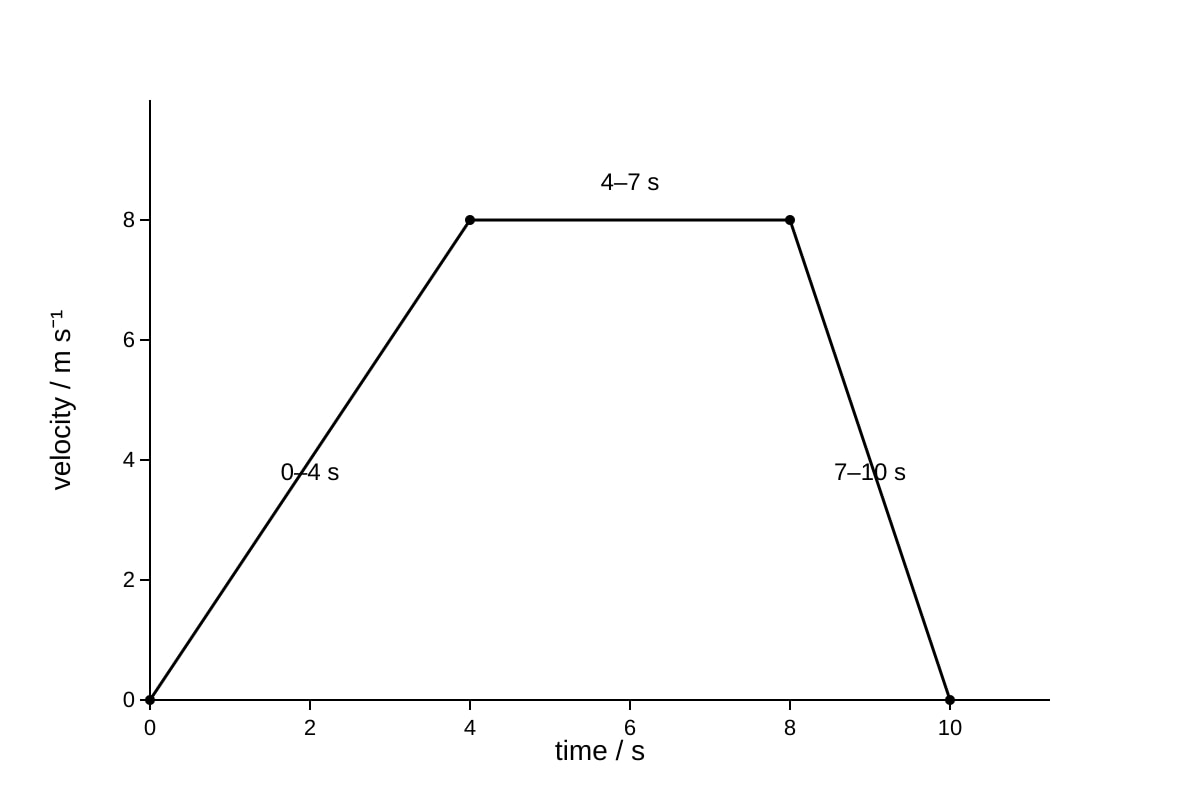
13. The velocity-time graph below shows a cyclist's motion for 10 s.
Image pending generation: graph for 13.
(a) Calculate the acceleration in the first 4 s. [1]
(b) Calculate the total distance travelled. [2]
14. A ring of mass 2 kg is suspended by two strings from a rod. String 1 is at 60° to the horizontal left, string 2 at 30° to the horizontal right. Find the tension in each string. [4]
15. A 5 kg block rests on a rough inclined plane at 30° to horizontal. Coefficient of friction is 0.4.
(a) Calculate the component of weight parallel to the plane. [1]
(b) Determine if it slides. Show working. [2]
16. A force of 10 N acts at a perpendicular distance of 0.5 m from a pivot. Calculate the moment. [1]
A second force of 15 N is applied on the other side at 0.4 m. State whether the rod is in equilibrium. [1]
Section C (24 marks)
Answer all questions with clear explanation.
17. A car of mass 800 kg accelerates from rest to 20 m s⁻¹ in 10 s.
(a) Calculate the acceleration. [1]
(b) Calculate the resultant force. [2]
(c) If resistive force is 200 N, find the driving force. [2]
18. A metal cylinder has mass 0.8 kg and volume 0.0002 m³. It is lowered into water. (g=10 m s−2, density of water = 1000 kg m⁻³)
(a) Calculate its density. [1]
(b) Calculate the upthrust when fully submerged. [2]
(c) State whether it sinks or floats when released. [1]
(d) Explain your answer using forces. [1]
19. A student uses a manometer to measure gas pressure. The liquid column difference is 0.2 m, liquid density 1000 kg m⁻³.
(a) Calculate the pressure difference. [2]
(b) Explain how a manometer works. [2]
(c) State one precaution in reading the manometer. [1]
20. A block of mass 3 kg is pulled 5 m up a smooth incline of height 2 m by a constant force parallel to the plane.
(a) Calculate gain in GPE. [1]
(b) Calculate work done by the force. [2]
(c) Find the magnitude of the force. [1]
(d) Explain why no energy is lost to friction. [1]
End of Paper
Answers
TuitionGoWhere Practice Paper - Physics Secondary 3 (Version 5) Answer Key
Total Marks: 50
Section A (10 marks)
1. C [1]
Force is a vector (has magnitude and direction). Speed, distance, mass are scalars.
Teaching note: Vectors need direction; forces act in a direction.
2. 20 [1]
v=td=5100=20 m s−1.
3. Pressure = Force / Area [1]
P=AF.
4. B [1]
Moment = Force × perpendicular distance from pivot.
5. 10 [1]
Free-fall acceleration near Earth ≈ 10 m s−2.
6. 40 [1]
W=mg=4×10=40 N.
7. volume [1]
ρ=Vm.
8. displacement (or distance) [1]
Area under v-t graph = displacement.
9. anticlockwise [1]
Principle of moments: clockwise = anticlockwise for equilibrium.
10. enclosed [1]
Pascal's principle: pressure transmitted equally in enclosed fluid.
Section B (16 marks)
11. [2]
Weight W=mg=50×10=500 N down.
Net force down: ma=50×2=100 N.
W−f=ma⇒500−f=100⇒f=400 N up.
Mark: 1 for equation, 1 for answer.
12. [3]
(a) W=Fd=20×4=80 J [1]
(b) ΔEp=mgh=2×10×1.5=30 J [1]
(c) 80−30=50 J lost to friction [1]
13. [3]
(a) a=4−08−0=2 m s−2 [1]
(b) Area = triangle1 + rect + triangle2 = 21(4)(8)+(3)(8)+21(3)(8)=16+24+12=52 m [2]
Mark: 1 for method, 1 for answer.
14. [4]
W=mg=2×10=20 N.
T1cos60∘=T2cos30∘ (horizontal)
T1sin60∘+T2sin30∘=20 (vertical)
Solve: T1(0.5)=T2(0.866)⇒T1=1.732T2
1.732T2(0.866)+0.5T2=20⇒2T2=20⇒T2=10 N,T1=17.3 N.
Mark: 1 horizontal eq, 1 vertical eq, 2 solve/answer.
15. [3]
(a) mgsin30∘=5×10×0.5=25 N [1]
(b) N=mgcos30∘=43.3 N, max f=μN=0.4×43.3=17.3 N. Since 25 > 17.3, slides. [2]
16. [2]
M1=10×0.5=5 N m [1]
M2=15×0.4=6 N m, not equal → not equilibrium [1]
Section C (24 marks)
17. [5]
(a) a=1020−0=2 m s−2 [1]
(b) F=ma=800×2=1600 N [2]
(c) Driving – resistive = net → Fd−200=1600⇒Fd=1800 N [2]
18. [5]
(a) ρ=0.00020.8=4000 kg m−3 [1]
(b) U=ρwVg=1000×0.0002×10=2 N [2]
(c) Sinks [1]
(d) Weight = 8 N > upthrust 2 N, so net downward force. [1]
19. [5]
(a) ΔP=hρg=0.2×1000×10=2000 Pa [2]
(b) Manometer compares gas pressure to atmospheric via liquid column height difference. [2]
(c) Read at meniscus eye-level / use same liquid. [1]
20. [5]
(a) ΔEp=mgh=3×10×2=60 J [1]
(b) Work = 60 J (smooth, no loss) [2]
(c) F=W/d=60/5=12 N [1]
(d) Smooth plane → no friction force, all work becomes GPE. [1]
End of Answer Key
Free quiz and exam paper access
Enter your details to view this paper
Your access is remembered on this device.