AI Generated Exam Paper

Secondary 3 Physics Practice Paper 4

Free Kimi AI-generated Sec 3 Physics Practice Paper 4 with questions, answers, and O Level-style practice for Singapore students preparing for exams.

These static practice materials are generated from the site's syllabus and paper-generation workflow, with source and model context shown so students and parents can evaluate the material before use.

Secondary 3 Physics AI Generated Generated by Kimi K2.6 Free Updated 2026-06-10

Questions

<!-- TuitionGoWhere generation metadata: stage=5-2; model=moonshotai/kimi-k2.6:free; model_label=Kimi K2.6 Free; generated=2026-06-10; Sources: Stage 4-0 LLM templates, syllabus context, and Stage 2 evidence where available. -->

TuitionGoWhere Practice Paper - Physics Secondary 3

TuitionGoWhere Practice Paper (AI) Version 4 of 5


Subject: Physics
Level: Secondary 3
Paper: Practice Paper
Duration: 1 hour 15 minutes
Total Marks: 60


Name: _____________________________
Class: _____________________________
Date: _____________________________


Instructions

  • Answer ALL questions.
  • Write your answers in the spaces provided.
  • For numerical answers, show all working clearly. Marks will be awarded for correct method even if the final answer is wrong.
  • Use g = 10 N/kg where required.
  • Pay attention to the number of marks allocated for each question. The marks indicate the depth of answer expected.

Section A: Multiple Choice (10 marks)

Answer ALL questions. Each question carries 1 mark.

For each question, circle the correct answer.


1. Which of the following is a vector quantity?

A. Speed
B. Mass
C. Distance
D. Velocity

Answer: ______


2. A car travels 60 km north, then 80 km east. What is the magnitude of the displacement of the car from its starting point?

A. 20 km
B. 100 km
C. 140 km
D. 4800 km

Answer: ______


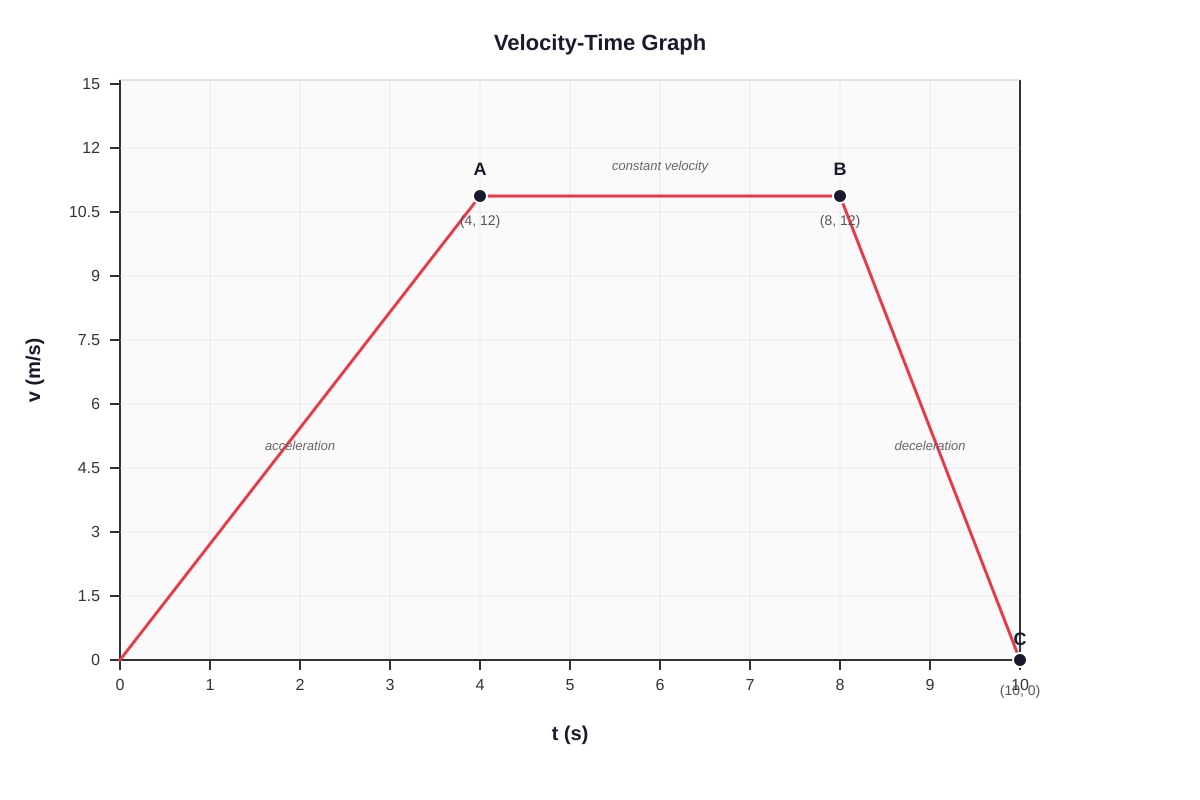
3. The velocity-time graph for an object is shown below.

<image_placeholder> id: Q3-fig1 type: graph linked_question: Q3 description: Velocity-time graph showing a straight line starting from origin with positive gradient, reaching maximum velocity at t=4s, then horizontal line until t=8s, then straight line with negative gradient back to zero at t=10s labels: v (m/s) on y-axis, t (s) on x-axis, point A at (4, 12), point B at (8, 12), point C at (10, 0) values: velocity scale 0-15 m/s, time scale 0-10 s, coordinates: (0,0), (4,12), (8,12), (10,0) must_show: axes with units, straight line segments, labelled points A, B, C, grid lines for accurate reading </image_placeholder>

Between which time intervals is the object decelerating?

A. 0 to 4 s
B. 4 s to 8 s
C. 8 s to 10 s
D. 0 to 10 s

Answer: ______


4. A force of 15 N acts on a mass of 3.0 kg. What is the acceleration produced?

A. 0.2 m/s²
B. 5.0 m/s²
C. 12 m/s²
D. 45 m/s²

Answer: ______


5. A book rests on a table. The reaction force to the weight of the book is:

A. The force of the book on the table
B. The force of the table on the book
C. The force of the Earth on the book
D. The force of the book on the Earth

Answer: ______


6. Which statement about friction is correct?

A. Friction always opposes motion and is therefore always harmful
B. Static friction is greater than dynamic friction for the same surfaces
C. Friction depends only on the speed of the object
D. Rolling friction is always greater than sliding friction

Answer: ______


7. A stone is thrown vertically upwards. At the highest point of its motion:

A. Its velocity and acceleration are both zero
B. Its velocity is zero but its acceleration is 10 m/s² downwards
C. Its velocity is 10 m/s and its acceleration is zero
D. Its velocity and acceleration are both 10 m/s²

Answer: ______


8. Two forces of 6 N and 8 N act at a point. Which of the following cannot be the magnitude of the resultant force?

A. 2 N
B. 10 N
C. 14 N
D. 16 N

Answer: ______


9. A ball of mass 0.5 kg is dropped from rest from a height of 20 m. Ignoring air resistance, what is its kinetic energy just before it hits the ground? (g = 10 N/kg)

A. 10 J
B. 100 J
C. 200 J
D. 400 J

Answer: ______


10. A crane lifts a load of 500 kg vertically through a height of 8 m at constant speed in 4 seconds. What is the power output of the crane? (g = 10 N/kg)

A. 1000 W
B. 4000 W
C. 10000 W
D. 40000 W

Answer: ______


Section B: Structured Response (30 marks)

Answer ALL questions. Show all working clearly.


11. Define the following terms. [3 marks]

(a) Speed: _________________________________________________________________


(b) Velocity: ________________________________________________________________


(c) Acceleration: _____________________________________________________________


12. A cyclist travels along a straight road. The journey has three parts.

Part 1: She accelerates uniformly from rest to 8.0 m/s in 4.0 seconds. Part 2: She travels at constant velocity of 8.0 m/s for 10 seconds. Part 3: She decelerates uniformly to rest in 5.0 seconds.

(a) Calculate the acceleration during Part 1. [2 marks]


(b) Calculate the total distance travelled during the entire journey. [4 marks]


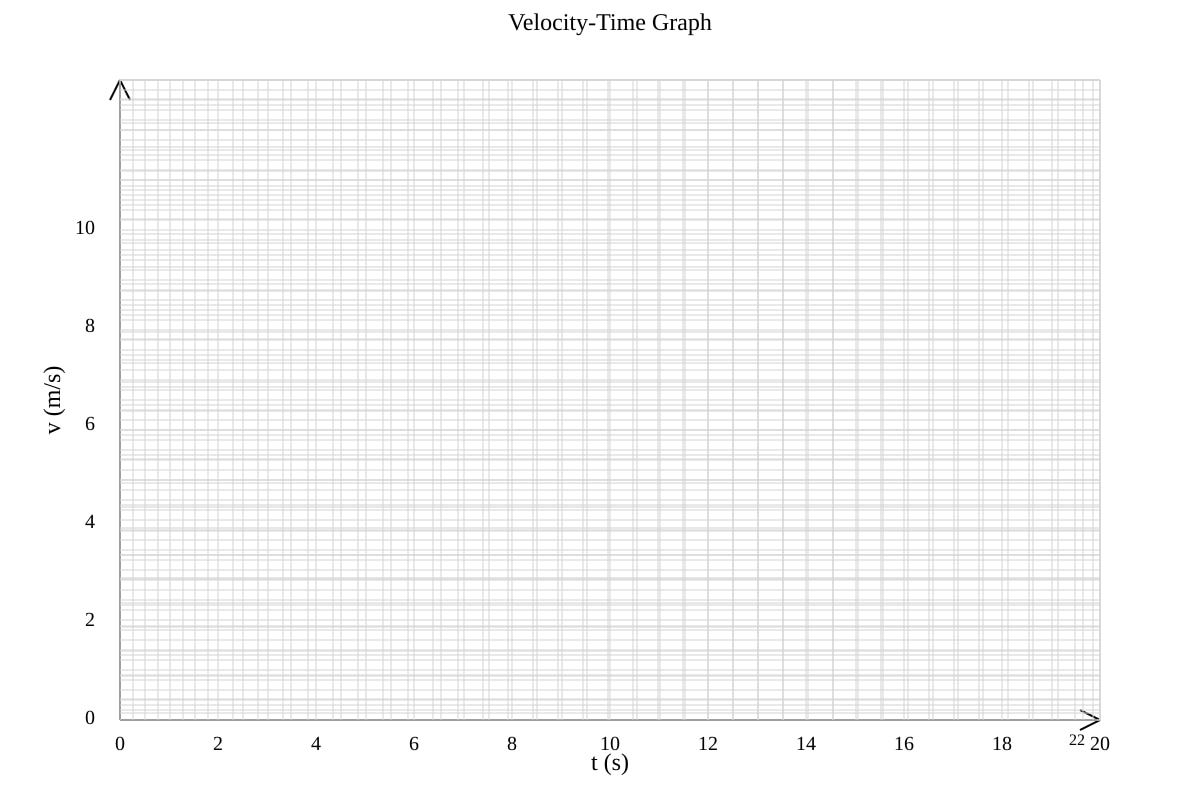
(c) On the axes below, sketch the velocity-time graph for the entire journey. Label all significant values. [3 marks]

<image_placeholder> id: Q12-fig1 type: graph linked_question: Q12(c) description: Empty axes for velocity-time graph with proper scales labels: v (m/s) on y-axis, t (s) on x-axis values: y-axis scale 0-10 m/s in 2 m/s divisions, x-axis scale 0-22 s in 2 s divisions must_show: both axes with units, grid lines, sufficient space for student to draw three distinct phases of motion with correct coordinates </image_placeholder>


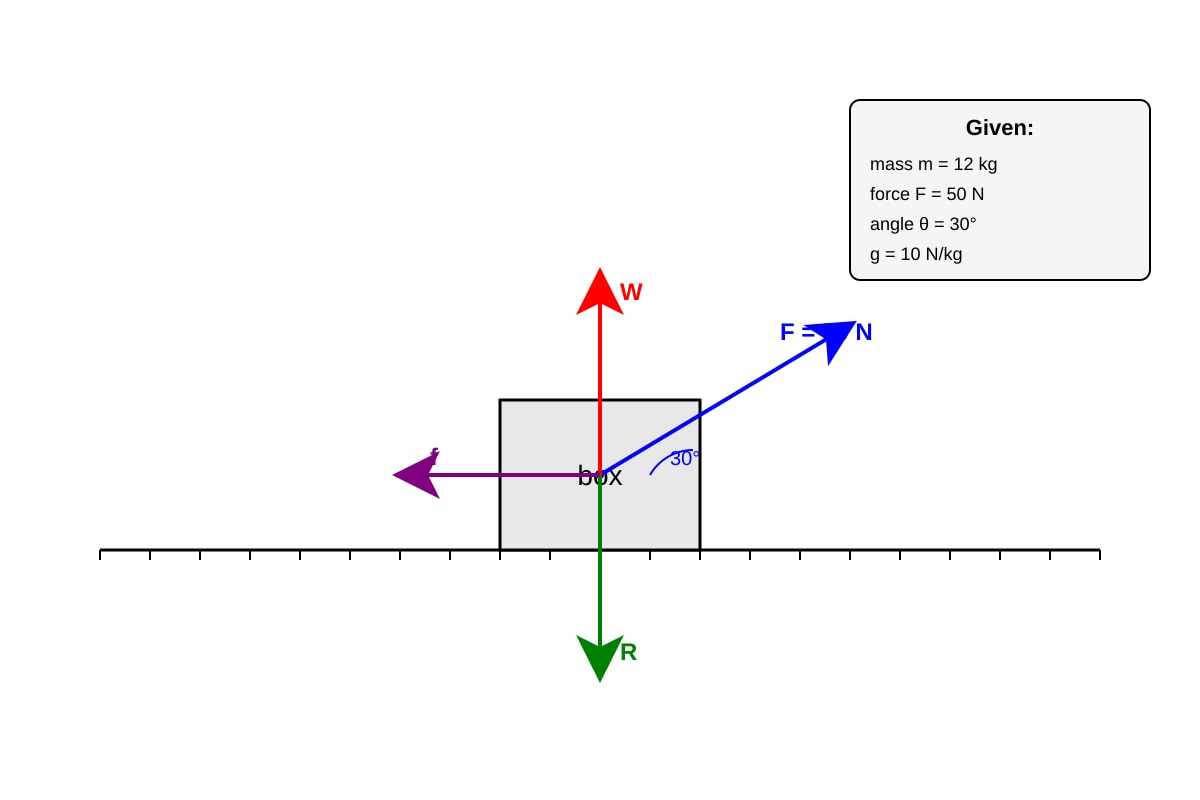
13. A box of mass 12 kg is pulled along a rough horizontal floor by a force of 50 N acting at 30° above the horizontal. The box moves at constant velocity.

<image_placeholder> id: Q13-fig1 type: diagram linked_question: Q13 description: Free body diagram setup showing a rectangular box on horizontal surface with applied force at angle labels: box, applied force F = 50 N at 30° above horizontal, weight W, normal reaction R, friction f values: mass m = 12 kg, force F = 50 N, angle θ = 30°, g = 10 N/kg must_show: all four forces labelled with arrows, angle marked between force and horizontal, surface shown as horizontal line </image_placeholder>

(a) Calculate the weight of the box. [1 mark]


(b) By resolving the applied force, calculate the horizontal component of the 50 N force. [2 marks]


(c) Explain why the box moves at constant velocity despite the applied force. [2 marks]


(d) Calculate the magnitude of the frictional force acting on the box. [1 mark]


(e) Given that the box travels 6.0 m, calculate the work done by the applied force. [2 marks]


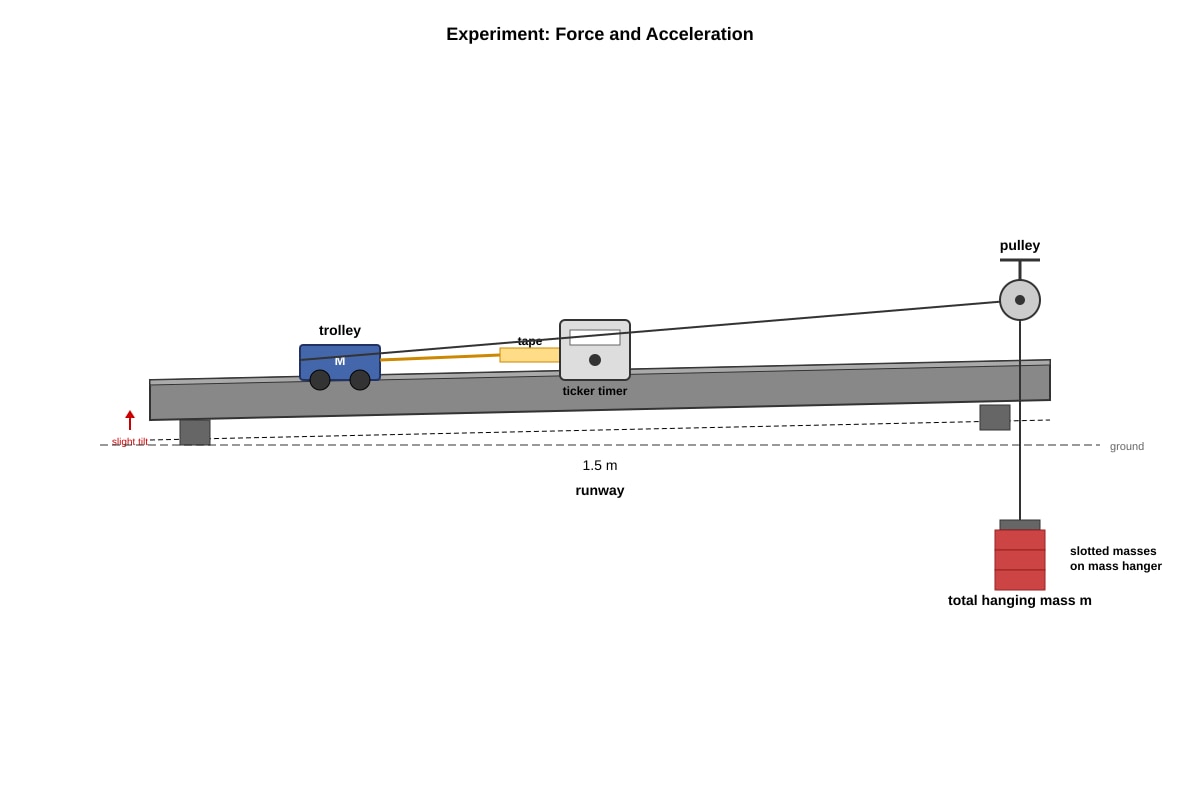
14. The diagram below shows an experiment to investigate the relationship between force and acceleration for a constant mass.

<image_placeholder> id: Q14-fig1 type: experimental_setup linked_question: Q14 description: Trolley on horizontal runway connected by string over pulley to hanging masses labels: trolley, runway, pulley, slotted masses on mass hanger, ticker timer, tape attached to trolley values: mass of trolley M, total hanging mass m, runway length 1.5 m must_show: all components labelled, horizontal runway with slight slope compensation, pulley at end, hanging masses vertical, ticker timer positioned to mark tape </image_placeholder>

(a) State Newton's Second Law of Motion. [1 mark]


(b) Explain why the runway is slightly tilted before the experiment begins. [2 marks]


(c) Suggest why the total mass of the hanging masses should be much less than the mass of the trolley for this experiment to verify F = ma directly. [2 marks]


15. A ball of mass 0.40 kg is thrown vertically upwards with an initial velocity of 15 m/s. It reaches a maximum height and then falls back down. Air resistance is negligible. (g = 10 N/kg)

(a) Calculate the maximum height reached by the ball. [3 marks]


(b) Calculate the time taken to reach maximum height. [2 marks]


(c) With reference to energy changes, explain why the speed of the ball just before it hits the ground is approximately 15 m/s (ignoring air resistance). [3 marks]


16. A car of mass 1200 kg is travelling at 25 m/s when the driver applies the brakes. The car comes to rest after travelling 80 m.

(a) Calculate the initial kinetic energy of the car. [2 marks]


(b) Calculate the average braking force required to stop the car in this distance. [2 marks]


(c) The actual braking force is not constant during the stopping distance. Explain how the braking force varies and why. [2 marks]


Section C: Data Analysis and Extended Response (20 marks)

Answer ALL questions.


17. The table below shows data from an experiment measuring how the stopping distance of a toy car varies with its initial velocity.

Initial velocity v (m/s)Stopping distance s (m)
2.00.40
4.01.60
6.03.60
8.06.40
10.010.00

(a) Using the data in the table, complete the missing values in the third column of the table below. [2 marks]

v (m/s)s (m)v² (m²/s²)
2.00.40____
4.01.60____
6.03.60____
8.06.40____
10.010.00____

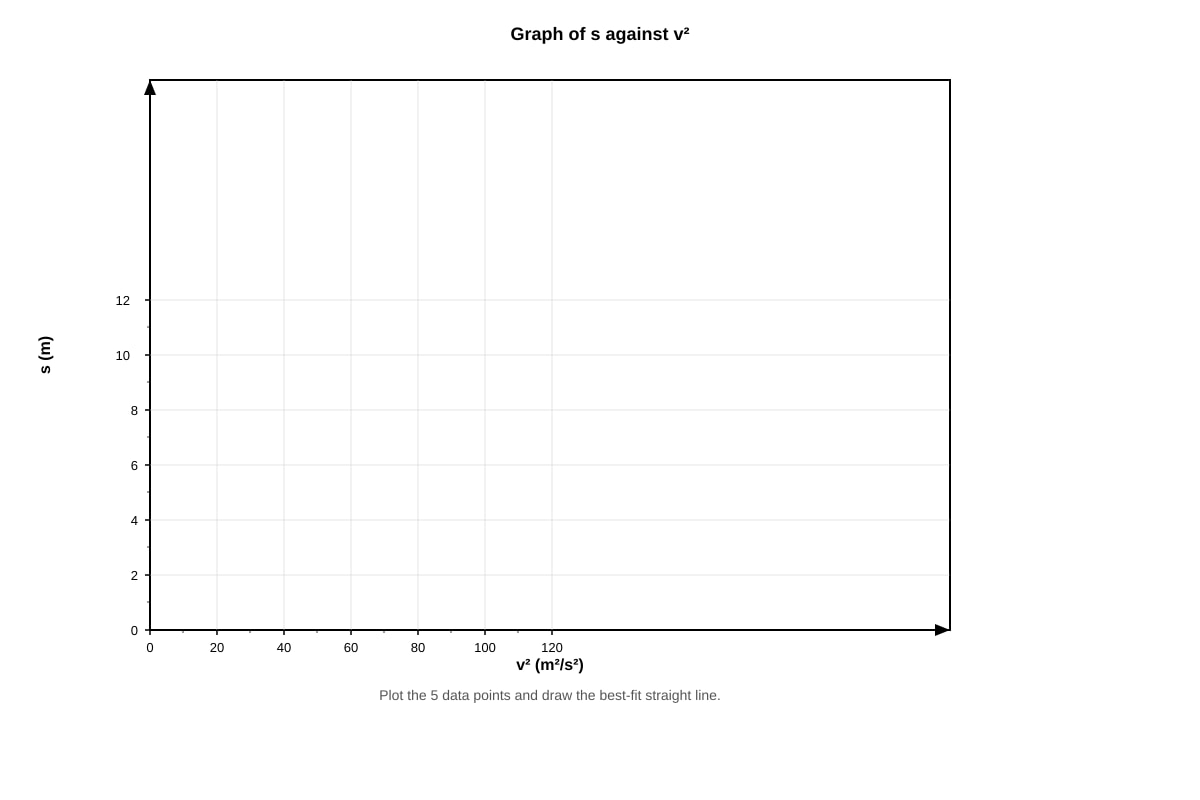
(b) Plot a graph of s (y-axis) against v² (x-axis) on the grid below. [3 marks]

<image_placeholder> id: Q17-fig1 type: graph linked_question: Q17(b) description: Empty axes for plotting s against v squared labels: s (m) on y-axis, v² (m²/s²) on x-axis values: y-axis scale 0-12 m in 2 m divisions, x-axis scale 0-120 m²/s² in 20 divisions, based on data range v²: 4, 16, 36, 64, 100 must_show: both axes with units and scales, grid lines, space for 5 data points to be plotted and best-fit line drawn </image_placeholder>


(c) Determine the gradient of your graph and state its units. [2 marks]


(d) The theoretical relationship between stopping distance and initial velocity for constant deceleration is s=v22as = \frac{v^2}{2a}. Use your gradient to calculate the deceleration of the toy car. [2 marks]


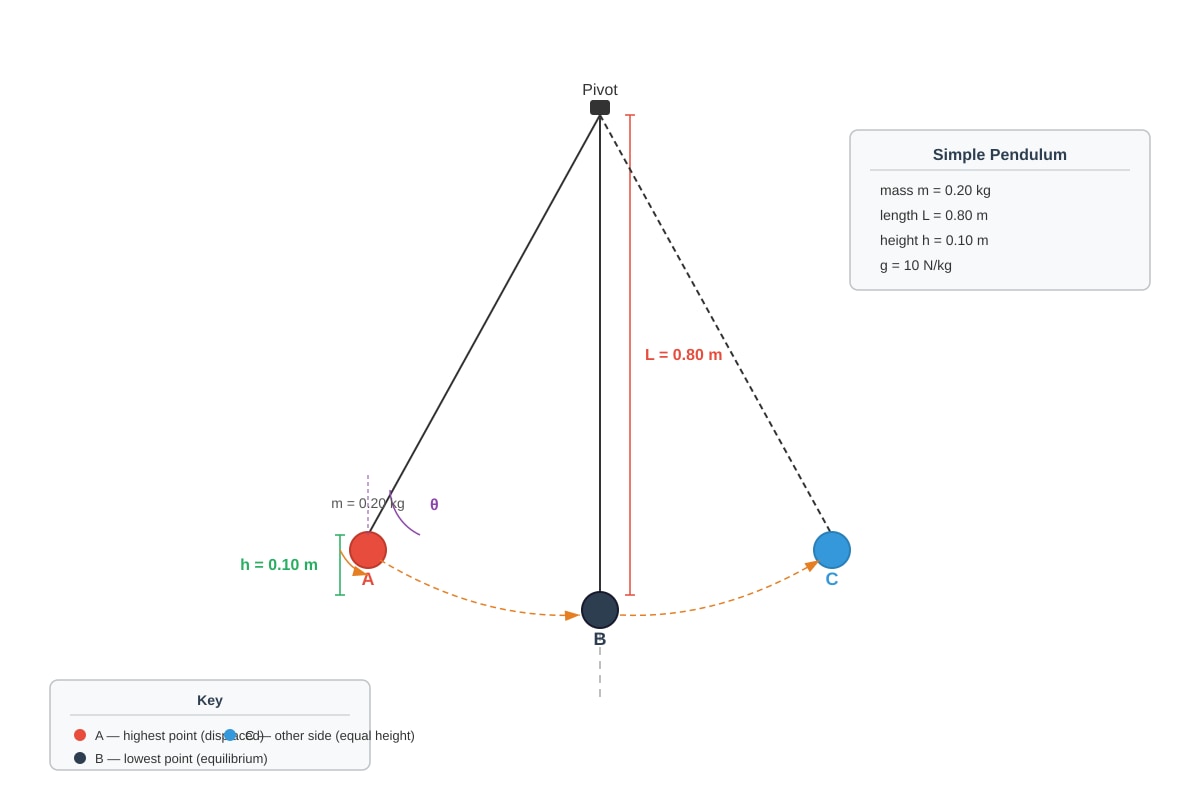
18. The diagram shows a simple pendulum consisting of a bob of mass 0.20 kg suspended by a string of length 0.80 m. The bob is displaced to point A, 0.10 m vertically above its lowest position B, and released.

<image_placeholder> id: Q18-fig1 type: diagram linked_question: Q18 description: Simple pendulum diagram showing bob at three positions labels: point A (highest point, displaced), point B (lowest point), point C (other side equal height), string length L, vertical displacement h = 0.10 m, angle θ at maximum displacement values: mass m = 0.20 kg, length L = 0.80 m, vertical height h = 0.10 m, g = 10 N/kg must_show: pendulum bob at three positions (A, B, C), string fixed at pivot point, vertical reference line through B, height h labelled between A and B horizontal levels, angle θ shown at A </image_placeholder>

(a) Calculate the gravitational potential energy of the bob at point A relative to point B. [2 marks]


(b) Assuming no energy losses, calculate the maximum speed of the bob at point B. [3 marks]


(c) In practice, the bob does not quite reach point C at the same height as point A. Explain why, with reference to energy changes. [2 marks]


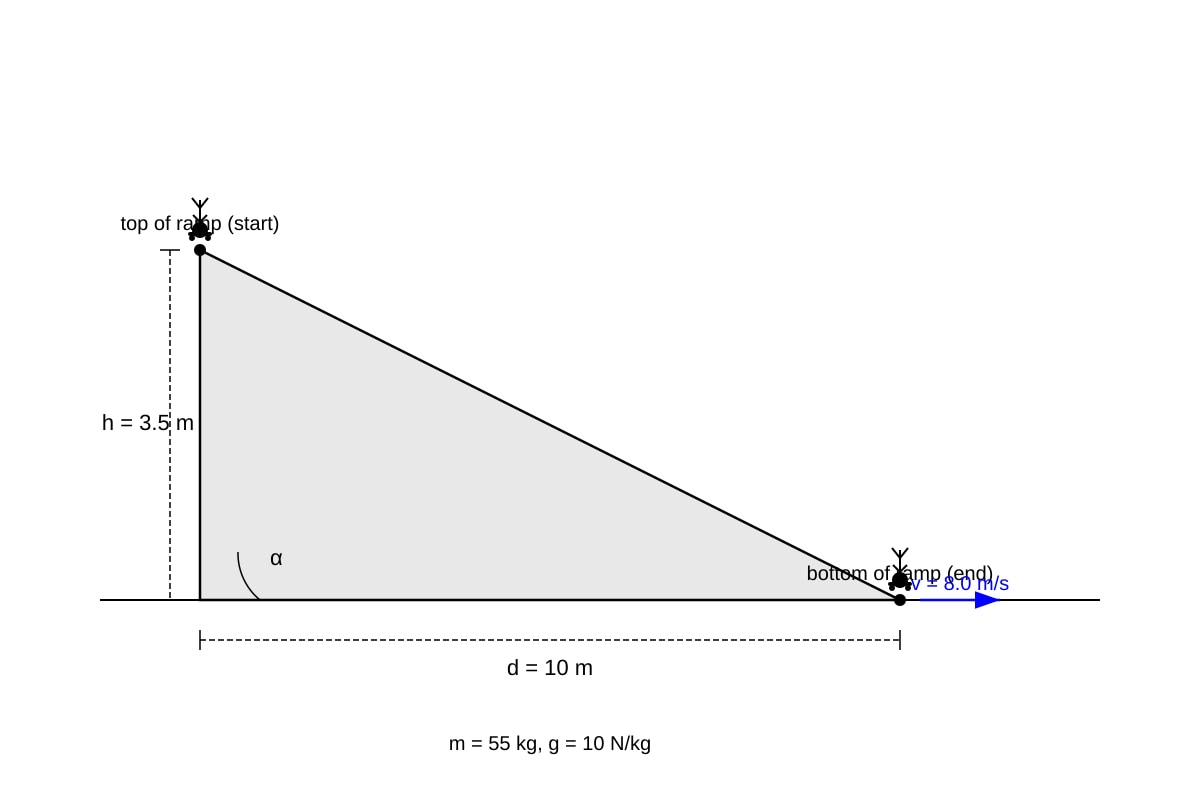
19. A skateboarder of total mass 55 kg starts from rest at the top of a ramp. The ramp is 3.5 m high and 10 m long. She reaches the bottom of the ramp with a speed of 8.0 m/s.

<image_placeholder> id: Q19-fig1 type: diagram linked_question: Q19 description: Side view of skateboard ramp showing sloping surface labels: top of ramp (start), bottom of ramp (end), vertical height h, length along slope d, angle of slope α values: height h = 3.5 m, length d = 10 m, final speed v = 8.0 m/s, mass m = 55 kg, g = 10 N/kg must_show: ramp as straight inclined plane, height labelled vertically, length along slope labelled, start and end points marked, horizontal ground at base </image_placeholder>

(a) Calculate the gravitational potential energy lost by the skateboarder in descending the ramp. [2 marks]


(b) Calculate the kinetic energy gained by the skateboarder. [2 marks]


(c) Explain why the kinetic energy gained is less than the potential energy lost, and calculate the work done against friction. [3 marks]


20. This question is about power and efficiency in transporting people.

(a) Define power. [1 mark]


(b) A student of mass 60 kg walks up a flight of stairs of vertical height 12 m in 20 seconds. Calculate the power output of the student. [3 marks]


(c) The same student then takes a lift to the same height. The lift has a mass of 400 kg and takes 8.0 seconds. The electrical power input to the lift motor is 9000 W.

(i) Calculate the total useful work done by the lift motor. [2 marks]


(ii) Calculate the efficiency of the lift system. [2 marks]


(iii) Suggest two reasons why the efficiency is not 100%. [2 marks]


END OF PAPER


Section Mark Summary

SectionMarksQuestions
A101–10
B3011–16
C2017–20
TOTAL60

[Turn over for rough working if required]

Answers

<!-- TuitionGoWhere generation metadata: stage=5-2; model=moonshotai/kimi-k2.6:free; model_label=Kimi K2.6 Free; generated=2026-06-10; Sources: Stage 4-0 LLM templates, syllabus context, and Stage 2 evidence where available. -->

TuitionGoWhere Practice Paper Answers - Physics Secondary 3

Version 4 of 5


Section A: Multiple Choice Answers and Explanations


1. Answer: D. Velocity

Explanation: Velocity is a vector quantity because it has both magnitude (speed) and direction. Speed (A), mass (B), and distance (C) are scalar quantities — they have magnitude only, with no direction associated.

Marking note: 1 mark for correct answer.


2. Answer: B. 100 km

Explanation: The two displacements are perpendicular (north and east). Use Pythagoras' theorem to find the resultant displacement:

R=(60)2+(80)2=3600+6400=10000=100 kmR = \sqrt{(60)^2 + (80)^2} = \sqrt{3600 + 6400} = \sqrt{10000} = 100 \text{ km}

Common mistake: Adding 60 + 80 = 140 km (C) gives the total distance travelled, not the displacement.

Marking note: 1 mark for correct answer.


3. Answer: C. 8 s to 10 s

Explanation: Deceleration occurs when velocity decreases with time. Looking at the graph:

  • 0 to 4 s: velocity increases (acceleration)
  • 4 s to 8 s: velocity constant (zero acceleration)
  • 8 s to 10 s: velocity decreases from 12 m/s to 0 (deceleration)

The gradient is negative in this final interval, indicating deceleration.

Marking note: 1 mark for correct answer.


4. Answer: B. 5.0 m/s²

Explanation: Using Newton's Second Law: F=maF = ma

a=Fm=15 N3.0 kg=5.0 m/s2a = \frac{F}{m} = \frac{15 \text{ N}}{3.0 \text{ kg}} = 5.0 \text{ m/s}^2

Marking note: 1 mark for correct answer.


5. Answer: D. The force of the book on the Earth

Explanation: Newton's Third Law states that forces occur in equal and opposite pairs acting on different bodies. The weight of the book is the gravitational force of the Earth on the book. The reaction force acts on the Earth, so it is the force of the book on the Earth.

Note: The force of the table on the book (B) is the normal contact force, which pairs with the force of the book on the table — this is a different interaction from the weight.

Marking note: 1 mark for correct answer.


6. Answer: B. Static friction is greater than dynamic friction for the same surfaces

Explanation: Static friction (friction preventing motion from starting) is typically greater than dynamic/kinetic friction (friction when surfaces are sliding). This is why it often takes more force to start an object moving than to keep it moving.

  • A is incorrect: friction can be useful (e.g., walking, braking)
  • C is incorrect: friction depends on the nature of surfaces and normal force, not primarily on speed
  • D is incorrect: rolling friction is typically less than sliding friction

Marking note: 1 mark for correct answer.


7. Answer: B. Its velocity is zero but its acceleration is 10 m/s² downwards

Explanation: At the highest point, the stone momentarily comes to rest (velocity = 0) before falling back. However, acceleration due to gravity acts throughout the motion and remains constant at 10 m/s² downward. The acceleration does not become zero at the highest point — if it did, the stone would remain suspended in the air!

Common mistake: Students often think acceleration is zero when velocity is zero. Velocity and acceleration are independent quantities.

Marking note: 1 mark for correct answer.


8. Answer: D. 16 N

Explanation: The resultant of two forces ranges from |F₁ - F₂| (forces opposite) to F₁ + F₂ (forces in same direction).

For 6 N and 8 N: resultant R satisfies 86R8+68 - 6 \leq R \leq 8 + 6, i.e., 2 NR14 N2 \text{ N} \leq R \leq 14 \text{ N}

  • 2 N achievable (forces opposite)
  • 10 N achievable (forces perpendicular: 62+82=10\sqrt{6^2+8^2} = 10)
  • 14 N achievable (forces in same direction)
  • 16 N is impossible (exceeds maximum possible resultant)

Marking note: 1 mark for correct answer.


9. Answer: B. 100 J

Explanation: By conservation of energy, the kinetic energy just before impact equals the initial gravitational potential energy (taking ground as reference):

GPE=mgh=0.5 kg×10 N/kg×20 m=100 J\text{GPE} = mgh = 0.5 \text{ kg} \times 10 \text{ N/kg} \times 20 \text{ m} = 100 \text{ J}

Or using kinematics: v2=2gh=2×10×20=400v^2 = 2gh = 2 \times 10 \times 20 = 400, so v=20v = 20 m/s

KE=12mv2=12×0.5×400=100 J\text{KE} = \frac{1}{2}mv^2 = \frac{1}{2} \times 0.5 \times 400 = 100 \text{ J}

Marking note: 1 mark for correct answer.


10. Answer: C. 10000 W

Explanation: At constant speed, tension in cable equals weight:

W=mg=500×10=5000 NW = mg = 500 \times 10 = 5000 \text{ N}

Work done: Wwork=F×d=5000×8=40000W_{work} = F \times d = 5000 \times 8 = 40000 J

Power: P=Wworkt=400004=10000P = \frac{W_{work}}{t} = \frac{40000}{4} = 10000 W

Marking note: 1 mark for correct answer.


Section B: Structured Response Answers


11. Definitions [3 marks]

(a) Speed: [1 mark]

Speed is the rate of change of distance with time, or distance travelled per unit time. It is a scalar quantity measured in m/s.

speed=distancetime\text{speed} = \frac{\text{distance}}{\text{time}}

(b) Velocity: [1 mark]

Velocity is the rate of change of displacement with time, or displacement per unit time in a stated direction. It is a vector quantity measured in m/s.

velocity=displacementtime\text{velocity} = \frac{\text{displacement}}{\text{time}}

(c) Acceleration: [1 mark]

Acceleration is the rate of change of velocity with time. It is a vector quantity measured in m/s².

acceleration=change in velocitytime taken=vut\text{acceleration} = \frac{\text{change in velocity}}{\text{time taken}} = \frac{v - u}{t}


12. Motion of cyclist [9 marks]

(a) Acceleration during Part 1 [2 marks]

Using: a=vuta = \frac{v - u}{t}

  • u=0u = 0 m/s (from rest)
  • v=8.0v = 8.0 m/s
  • t=4.0t = 4.0 s

a=8.004.0=2.0 m/s2a = \frac{8.0 - 0}{4.0} = 2.0 \text{ m/s}^2

[1 mark] Correct formula stated or implied
[1 mark] Correct answer with unit: 2.0 m/s²


(b) Total distance travelled [4 marks]

Distance in Part 1 (acceleration): Using s=ut+12at2s = ut + \frac{1}{2}at^2 or s=(u+v)2ts = \frac{(u+v)}{2}t s1=(0+8.0)2×4.0=4.0×4.0=16 ms_1 = \frac{(0 + 8.0)}{2} \times 4.0 = 4.0 \times 4.0 = 16 \text{ m}

Or: s1=12×2.0×(4.0)2=16s_1 = \frac{1}{2} \times 2.0 \times (4.0)^2 = 16 m

Distance in Part 2 (constant velocity): s2=v×t=8.0×10=80 ms_2 = v \times t = 8.0 \times 10 = 80 \text{ m}

Distance in Part 3 (deceleration): s3=(8.0+0)2×5.0=4.0×5.0=20 ms_3 = \frac{(8.0 + 0)}{2} \times 5.0 = 4.0 \times 5.0 = 20 \text{ m}

Or: find deceleration a=08.05.0=1.6a = \frac{0-8.0}{5.0} = -1.6 m/s², then s=8.0×5.0+12×(1.6)×25=4020=20s = 8.0 \times 5.0 + \frac{1}{2} \times (-1.6) \times 25 = 40 - 20 = 20 m

Total distance: stotal=16+80+20=116s_{total} = 16 + 80 + 20 = 116 m

Marking breakdown:
[1 mark] Correct distance for Part 1 (16 m)
[1 mark] Correct distance for Part 2 (80 m)
[1 mark] Correct distance for Part 3 (20 m)
[1 mark] Correct total: 116 m


(c) Velocity-time graph [3 marks]

Expected shape:

  • Straight line from (0, 0) to (4, 8) — positive gradient
  • Horizontal line from (4, 8) to (14, 8) — zero gradient
  • Straight line from (14, 8) to (19, 0) — negative gradient

Marking breakdown:
[1 mark] Correct shape (three distinct sections: increasing, constant, decreasing)
[1 mark] All key coordinates correctly labelled: (0,0), (4,8), (14,8), (19,0) or equivalent
[1 mark] Velocity reaches zero at t = 19 s (or consistent with 4 + 10 + 5 = 19 s total time)

Note: The image placeholder provides axes with scales; student should plot on this.


13. Forces on inclined pull [8 marks]

(a) Weight of box [1 mark]

W=mg=12×10=120 NW = mg = 12 \times 10 = 120 \text{ N}

[1 mark] Correct answer: 120 N


(b) Horizontal component of force [2 marks]

Resolving horizontally: Fx=Fcosθ=50cos30°F_x = F \cos \theta = 50 \cos 30°

cos30°=320.866\cos 30° = \frac{\sqrt{3}}{2} \approx 0.866

Fx=50×0.866=43.3 NF_x = 50 \times 0.866 = 43.3 \text{ N}

Or more precisely: Fx=50×32=25343.3F_x = 50 \times \frac{\sqrt{3}}{2} = 25\sqrt{3} \approx 43.3 N

[1 mark] Correct formula: FcosθF \cos \theta or equivalent
[1 mark] Correct answer: 43.3 N (accept 25√3 N)


(c) Why constant velocity [2 marks]

According to Newton's First Law, an object moves with constant velocity (including zero velocity) when the net force acting on it is zero.

[1 mark] The horizontal component of the applied force (43.3 N to the right) is balanced by the frictional force acting to the left.

[1 mark] The vertical forces also balance: the upward normal reaction plus the upward vertical component of the applied force equals the downward weight.

Since there is no resultant force in any direction, the box continues at constant velocity (Newton's First Law — equilibrium).


(d) Frictional force [1 mark]

Since velocity is constant (equilibrium): f=Fx=43.3 Nf = F_x = 43.3 \text{ N}

[1 mark] Correct answer: 43.3 N (accept 50 cos 30° if working shown)


(e) Work done by applied force [2 marks]

Work done = force × distance moved in direction of force

W=F×d×cosθ=50×6.0×cos30°W = F \times d \times \cos \theta = 50 \times 6.0 \times \cos 30°

Or: W=Fx×d=43.3×6.0=260W = F_x \times d = 43.3 \times 6.0 = 260 J

Or directly: W=50×6.0×0.866=259.8260W = 50 \times 6.0 \times 0.866 = 259.8 \approx 260 J

[1 mark] Correct formula: W=FdcosθW = Fd\cos\theta or W=Fx×dW = F_x \times d
[1 mark] Correct answer: 260 J (accept 259.8 J or 150√3 J ≈ 259.8 J)


14. Force and acceleration experiment [5 marks]

(a) Newton's Second Law [1 mark]

Newton's Second Law states that the resultant force acting on an object is directly proportional to the acceleration produced, and the acceleration is in the same direction as the resultant force.

Or mathematically: F=maF = ma where F is resultant force, m is mass, and a is acceleration.

[1 mark] Correct statement of law


(b) Tilting the runway [2 marks]

The runway is tilted (raised slightly at one end) to compensate for friction.

[1 mark] Without this compensation, friction would oppose motion and the resultant force would be less than the tension in the string. The accelerating force would then be (Tf)(T - f) not just TT, violating the assumption that the hanging weight provides the only force.

[1 mark] By tilting until the trolley moves at constant velocity with no applied force, friction is balanced by a component of gravity. When the hanging mass is added, this becomes the only unbalanced force, allowing verification of F=maF = ma.


(c) Hanging mass much less than trolley mass [2 marks]

The tension T in the string is less than mg (the weight of the hanging masses) because the entire system accelerates.

[1 mark] For the hanging masses: mgT=mamg - T = ma, so T=mgma=m(ga)T = mg - ma = m(g-a). Only if aga \ll g (which requires mMm \ll M) does TmgT \approx mg.

[1 mark] If the hanging mass is comparable to the trolley mass, the acceleration is significant and T is noticeably less than mg. This means the "force" in F=maF = ma is not accurately given by the hanging weight. With mMm \ll M, the system's acceleration is small, so TmgT \approx mg and we can approximate the force as the hanging weight.


15. Vertical motion under gravity [8 marks]

(a) Maximum height [3 marks]

Using: v2=u2+2asv^2 = u^2 + 2as

At maximum height: v=0v = 0

  • u=15u = 15 m/s
  • a=g=10a = -g = -10 m/s² (negative because gravity opposes upward motion)
  • s=hmaxs = h_{max} (what we want)

0=(15)2+2(10)hmax0 = (15)^2 + 2(-10)h_{max}

0=22520hmax0 = 225 - 20h_{max}

hmax=22520=11.25 mh_{max} = \frac{225}{20} = 11.25 \text{ m}

Or using energy: 12mu2=mghmax\frac{1}{2}mu^2 = mgh_{max}, so hmax=u22g=22520=11.25h_{max} = \frac{u^2}{2g} = \frac{225}{20} = 11.25 m

[1 mark] Correct formula stated
[1 mark] Correct substitution (including sign convention or energy equivalence)
[1 mark] Correct answer: 11.25 m (or 11.3 m)


(b) Time to reach maximum height [2 marks]

Using: v=u+atv = u + at

0=15+(10)t0 = 15 + (-10)t

t=1510=1.5 st = \frac{15}{10} = 1.5 \text{ s}

Or: s=ut+12at2s = ut + \frac{1}{2}at^2 with s=11.25s = 11.25 m: 11.25=15t5t211.25 = 15t - 5t^2, solving gives t=1.5t = 1.5 s

[1 mark] Correct formula and substitution
[1 mark] Correct answer: 1.5 s


(c) Energy explanation for return speed [3 marks]

[1 mark] At the point of release, the ball has kinetic energy 12mu2\frac{1}{2}mu^2 and zero gravitational potential energy (if we take the launch point as reference).

[1 mark] At maximum height, this kinetic energy has been converted to gravitational potential energy mghmaxmgh_{max}. On falling back, this potential energy converts back to kinetic energy.

[1 mark] Since mechanical energy is conserved (no air resistance, no energy losses to heat/sound), the kinetic energy just before hitting the ground equals the initial kinetic energy. With the same mass and same kinetic energy, the speed must equal the initial speed: v = 15 m/s (same magnitude, opposite direction).

The direction is downward now, but the question asks for speed (scalar), so 15 m/s is correct.


16. Braking car [6 marks]

(a) Initial kinetic energy [2 marks]

KE=12mv2=12×1200×(25)2\text{KE} = \frac{1}{2}mv^2 = \frac{1}{2} \times 1200 \times (25)^2

=600×625=375000 J= 600 \times 625 = 375000 \text{ J}

=3.75×10⁵ J=375 kJ= 3.75 \times 10^5 \text{ J} = 375 \text{ kJ}

[1 mark] Correct formula and substitution
[1 mark] Correct answer: 375 000 J or 3.75 × 10⁵ J


(b) Average braking force [2 marks]

Using work-energy principle: Work done by braking force = change in kinetic energy

F×d=ΔKEF \times d = \Delta \text{KE}

F×80=375000F \times 80 = 375000

F=37500080=4687.5 NF = \frac{375000}{80} = 4687.5 \text{ N}

Or using kinematics: v2=u2+2asv^2 = u^2 + 2as, so 0=625+2a(80)0 = 625 + 2a(80), giving a=3.90625a = -3.90625 m/s²

Then F=ma=1200×3.90625=4687.5F = ma = 1200 \times 3.90625 = 4687.5 N

[1 mark] Correct method (work-energy or kinematics)
[1 mark] Correct answer: 4688 N or 4690 N or 4687.5 N


(c) Variation of braking force [2 marks]

[1 mark] The braking force is not constant because:

  • Brakes may be applied gradually at first, then harder
  • Brake pads heat up, changing friction coefficient
  • Different wheels may have different braking effectiveness
  • ABS (anti-lock braking system) may pulse the brakes

[1 mark] Specifically, the braking force typically increases initially as the driver pushes harder, then may decrease slightly as brakes heat up (fade) or vary due to road surface conditions. The "average" force is a simplification.


Section C: Data Analysis and Extended Response Answers


17. Stopping distance experiment [9 marks]

(a) Complete v² column [2 marks]

v (m/s)s (m)v² (m²/s²)
2.00.404.0
4.01.6016.0
6.03.6036.0
8.06.4064.0
10.010.00100.0

Calculations: 2.02=4.02.0^2 = 4.0, 4.02=16.04.0^2 = 16.0, 6.02=36.06.0^2 = 36.0, 8.02=64.08.0^2 = 64.0, 10.02=100.010.0^2 = 100.0

[2 marks] All five values correct (deduct 1 mark for each error, minimum 0)


(b) Graph plot [3 marks]

Points to plot: (4.0, 0.40), (16.0, 1.60), (36.0, 3.60), (64.0, 6.40), (100.0, 10.00)

Expected: straight line through origin with gradient ≈ 0.10

[1 mark] Correct axes labelled with quantities and units
[1 mark] All points plotted accurately (within ±1 small square)
[1 mark] Best-fit straight line drawn through origin with reasonable fit to points


(c) Gradient of graph [2 marks]

Taking two points on the line, e.g. (0, 0) and (100, 10.0):

gradient=ΔsΔv2=10.001000=10.0100=0.10\text{gradient} = \frac{\Delta s}{\Delta v^2} = \frac{10.0 - 0}{100 - 0} = \frac{10.0}{100} = 0.10

Or using (64, 6.40): gradient = 6.4064=0.10\frac{6.40}{64} = 0.10

Units: mm2/s2=ms2m2=s2m\frac{\text{m}}{\text{m}^2/\text{s}^2} = \frac{\text{m} \cdot \text{s}^2}{\text{m}^2} = \frac{\text{s}^2}{\text{m}}

Or more simply: mm2/s2=m×s2m2=s2/m\frac{\text{m}}{\text{m}^2/\text{s}^2} = \text{m} \times \frac{\text{s}^2}{\text{m}^2} = \text{s}^2/\text{m}

[1 mark] Correct gradient: 0.10 (accept 0.095–0.105 from graph reading)
[1 mark] Correct units: s²/m (or m⁻¹·s²)


(d) Deceleration from gradient [2 marks]

Given: s=v22as = \frac{v^2}{2a}, so comparing with s=(gradient)×v2s = (\text{gradient}) \times v^2:

gradient=12a\text{gradient} = \frac{1}{2a}

0.10=12a0.10 = \frac{1}{2a}

a=12×0.10=10.20=5.0 m/s2a = \frac{1}{2 \times 0.10} = \frac{1}{0.20} = 5.0 \text{ m/s}^2

[1 mark] Correct relationship: gradient = 12a\frac{1}{2a} or equivalent rearrangement
[1 mark] Correct answer: 5.0 m/s²


18. Simple pendulum [7 marks]

(a) Gravitational potential energy at A [2 marks]

GPE=mgh=0.20×10×0.10=0.20 J\text{GPE} = mgh = 0.20 \times 10 \times 0.10 = 0.20 \text{ J}

[1 mark] Correct formula GPE=mgh\text{GPE} = mgh
[1 mark] Correct answer: 0.20 J


(b) Maximum speed at B [3 marks]

By conservation of energy: GPE at A = KE at B (lowest point, zero height by our reference)

mgh=12mv2mgh = \frac{1}{2}mv^2

gh=12v2gh = \frac{1}{2}v^2

v=2gh=2×10×0.10=2.0=1.41 m/sv = \sqrt{2gh} = \sqrt{2 \times 10 \times 0.10} = \sqrt{2.0} = 1.41 \text{ m/s}

Or: 0.20=12×0.20×v20.20 = \frac{1}{2} \times 0.20 \times v^2, so v2=2.0v^2 = 2.0, v=1.41v = 1.41 m/s

[1 mark] Conservation of energy stated or implied
[1 mark] Correct equating: mgh=12mv2mgh = \frac{1}{2}mv^2
[1 mark] Correct answer: 1.41 m/s (accept √2 m/s or 1.4 m/s)


(c) Why bob doesn't reach same height [2 marks]

[1 mark] In practice, air resistance acts on the bob as it moves, doing work against the motion. Some mechanical energy is converted to thermal energy (heat) of the surrounding air and the string/pivot.

[1 mark] Because total mechanical energy decreases due to these energy losses, the kinetic energy at B is less than the theoretical value, so the bob cannot regain all the original potential energy. It rises to a lower maximum height on the other side (point C is slightly lower than point A).


19. Skateboarder on ramp [7 marks]

(a) Potential energy lost [2 marks]

ΔGPE=mgh=55×10×3.5=1925 J\Delta \text{GPE} = mgh = 55 \times 10 \times 3.5 = 1925 \text{ J}

[1 mark] Correct formula
[1 mark] Correct answer: 1925 J


(b) Kinetic energy gained [2 marks]

ΔKE=12mv20=12×55×(8.0)2\Delta \text{KE} = \frac{1}{2}mv^2 - 0 = \frac{1}{2} \times 55 \times (8.0)^2

=12×55×64=27.5×64=1760 J= \frac{1}{2} \times 55 \times 64 = 27.5 \times 64 = 1760 \text{ J}

[1 mark] Correct formula with final minus initial
[1 mark] Correct answer: 1760 J


(c) Energy difference and work against friction [3 marks]

[1 mark] The kinetic energy gained (1760 J) is less than the potential energy lost (1925 J) because work is done against friction between the skateboard wheels and the ramp, and between the skateboarder and air resistance.

[1 mark] This "missing" energy is converted to thermal energy (heat) in the wheels, bearings, ramp surface, and surrounding air.

[1 mark] Work done against friction: Wfriction=GPE lostKE gained=19251760=165 JW_{friction} = \text{GPE lost} - \text{KE gained} = 1925 - 1760 = 165 \text{ J}

[1 mark] Correct answer: 165 J


20. Power and efficiency [11 marks]

(a) Define power [1 mark]

Power is the rate of doing work or the rate of energy transfer.

P=Wt=EtP = \frac{W}{t} = \frac{E}{t}

Unit: watt (W) = joule per second (J/s)

[1 mark] Correct definition


(b) Power output of student [3 marks]

Work done against gravity: W=mgh=60×10×12=7200W = mgh = 60 \times 10 \times 12 = 7200 J

Power: P=Wt=720020=360P = \frac{W}{t} = \frac{7200}{20} = 360 W

[1 mark] Correct work calculation: 7200 J
[1 mark] Correct formula P=W/tP = W/t
[1 mark] Correct answer: 360 W


(c)(i) Useful work done by lift motor [2 marks]

Total mass lifted: mtotal=60+400=460m_{total} = 60 + 400 = 460 kg (student + lift)

Useful work: W=mtotalgh=460×10×12=55200W = m_{total}gh = 460 \times 10 \times 12 = 55200 J

Or W=460×10×12=55200W = 460 \times 10 \times 12 = 55200 J = 5.52 × 10⁴ J

[1 mark] Correct total mass or correct method
[1 mark] Correct answer: 55 200 J


(c)(ii) Efficiency of lift system [2 marks]

Total energy input: Ein=Pin×t=9000×8.0=72000E_{in} = P_{in} \times t = 9000 \times 8.0 = 72000 J

efficiency=useful energy outputenergy input×100%=5520072000×100%\text{efficiency} = \frac{\text{useful energy output}}{\text{energy input}} \times 100\% = \frac{55200}{72000} \times 100\%

=0.7667×100%=76.7%= 0.7667 \times 100\% = 76.7\%

Or using power: η=PusefulPin=55200/89000=69009000=76.7%\eta = \frac{P_{useful}}{P_{in}} = \frac{55200/8}{9000} = \frac{6900}{9000} = 76.7\%

[1 mark] Correct formula for efficiency
[1 mark] Correct answer: 76.7% (accept 77% or 76.6%)


(c)(iii) Two reasons why efficiency not 100% [2 marks]

Any two from:

  • [1 mark] Electrical energy is converted to thermal energy in the motor windings due to resistance (heating effect of current)
  • [1 mark] Friction in the pulleys, cables, and guide rails dissipates energy as heat
  • [1 mark] Energy required to accelerate the lift mechanism itself (structural mass, not just useful load)
  • [1 mark] Sound energy produced by motor and mechanical vibrations
  • [1 mark] Energy lost in the electrical control systems and power transmission

END OF ANSWER KEY


Image Placeholder Verification Summary

IDTypeLinked QVerification
Q3-fig1graphQ3v-t graph with three phases; answer requires reading deceleration from negative gradient 8-10s
Q12-fig1graphQ12(c)Empty axes for student graph; marks awarded for correct shape and labels
Q13-fig1diagramQ13Force diagram with angles; answer requires resolving 50 N at 30°
Q14-fig1experimental_setupQ14Ticker-timer arrangement; answer requires understanding friction compensation
Q17-fig1graphQ17(b)Empty axes for data plot; gradient calculation depends on accurate plotting
Q18-fig1diagramQ18Pendulum setup; answer requires height h = 0.10 m for energy calculations
Q19-fig1diagramQ19Inclined ramp; answer requires height 3.5 m for GPE calculation

All image placeholders contain sufficient labels, values, and must_show criteria for later image generation and for answers to be fully verifiable without the rendered image.