TuitionGoWhere Practice Paper - Physics Secondary 3
TuitionGoWhere Practice Paper (AI) — Version 4 of 5
Subject: Physics
Level: Secondary 3
Paper: Practice Paper (Mechanics Topic Focus)
Duration: 60 minutes
Total Marks: 40
Name:
Class:
Date:
Instructions
- Answer all questions in the spaces provided.
- Show your working clearly where calculation is required.
- Use g=10 m s−2 unless stated otherwise.
- Section A: 10 multiple-choice questions (1 mark each). Section B: 5 structured questions (2 marks each). Section C: 5 extended questions (2–4 marks each). Total = 40 marks.
Section A (10 marks)
Answer all questions. Each question carries 1 mark.
1. A scalar quantity has only magnitude. Which of the following is a scalar?
A. Velocity
B. Force
C. Mass
D. Acceleration
2. A car travels 100 m in 20 s at constant speed. What is its average speed?
A. 2 m s−1
B. 5 m s−1
C. 10 m s−1
D. 20 m s−1
3. Which statement about weight is correct?
A. Weight is the amount of matter in an object.
B. Weight is a scalar quantity.
C. Weight = mass × gravitational field strength.
D. Weight is independent of location.
4. A book of mass 0.5 kg rests on a table. What is the normal force acting on it? (g=10 m s−2)
A. 0.5 N
B. 5 N
C. 10 N
D. 50 N
5. The moment of a force about a pivot is maximum when the force is applied:
A. parallel to the lever
B. at the pivot
C. perpendicular to the lever at the furthest point
D. at half the length
6. Pressure in a liquid increases with:
A. decreasing depth
B. decreasing density
C. increasing depth
D. decreasing gravitational field strength
7. A box is pushed with 10 N and friction is 4 N. What is the net force?
A. 6 N forward
B. 14 N forward
C. 6 N backward
D. 14 N backward
8. Kinetic energy depends on:
A. mass and height
B. mass and speed
C. weight and time
D. volume and pressure
9. A object falls freely near Earth. Its acceleration is approximately:
A. 0 m s−2
B. 5 m s−2
C. 10 m s−2
D. 20 m s−2
10. Efficiency is defined as:
A. useful energy output / total energy input ×100%
B. total energy input / useful output
C. work done / time
D. power / energy
Section B (10 marks)
Answer all questions. Each carries 2 marks.
11. A cyclist moves 60 m in 12 s uniformly. Calculate the speed. [2]
12. A force of 20 N is applied perpendicular to a spanner at 0.3 m from the nut. Calculate the moment. [2]
13. A block of mass 4 kg is on a surface. Calculate its weight. (g=10 m s−2) [2]
14. A hydraulic press has input area 0.01 m2 and output 0.1 m2. If input force is 50 N, what is output force? [2]
15. A 2 kg object moves at 3 m s−1. Calculate its kinetic energy. [2]
Section C (20 marks)
Answer all questions. Marks stated.
16. A velocity-time graph shows a car accelerating from 0 to 12 m s−1 in 4 s, then constant for 3 s, then decelerating to 0 in 3 s.
(a) Calculate acceleration in first phase. [1]
(b) Calculate total distance travelled. [3]
17. A 6 kg child slides down a vertical rope with acceleration 2 m s−2. Find frictional force. (g=10 m s−2) [3]
18. A 5 kg block is pulled up a rough incline at constant speed by 40 N. Vertical rise is 1.5 m over 4 m distance.
(a) Work done by applied force. [1]
(b) Gain in gravitational potential energy. [1]
(c) Work lost to friction. [2]
19. A ring of mass 2 kg is suspended by two strings at 60° and 30° to the horizontal.
(a) State equilibrium conditions. [1]
(b) Calculate tensions T1 and T2. [3]
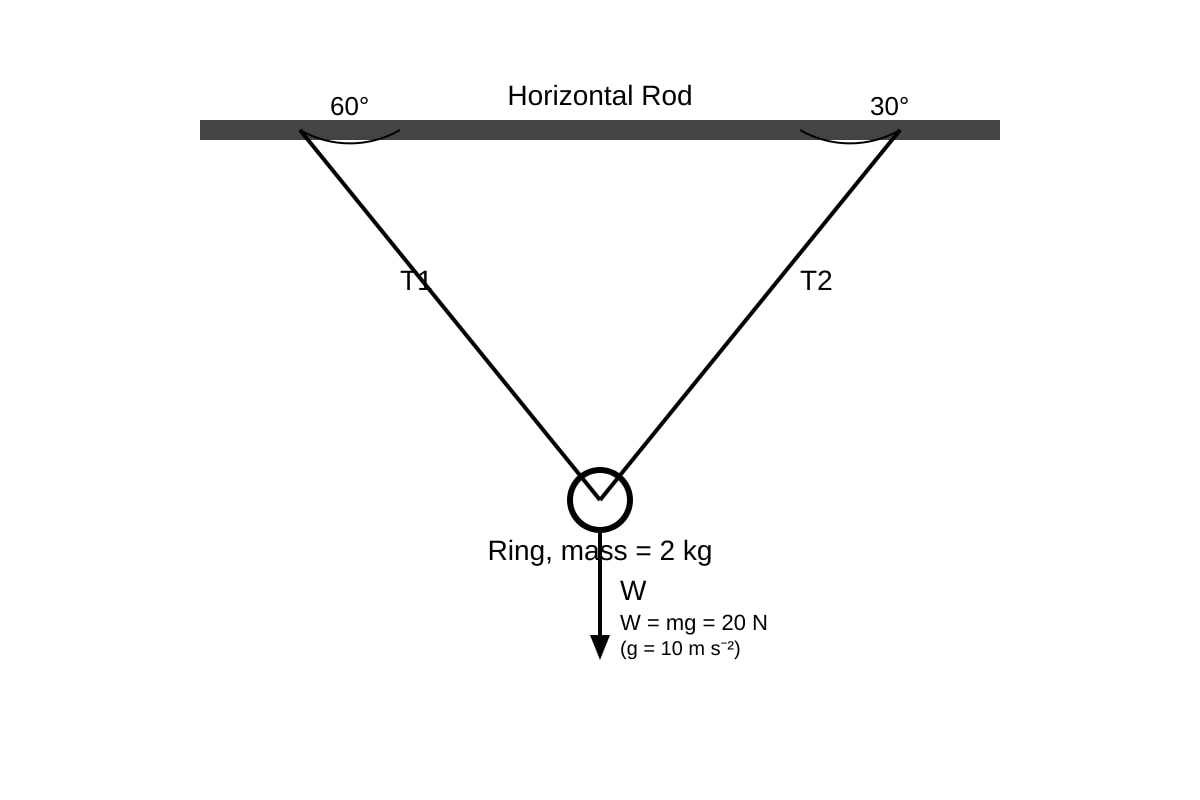
Generated diagram for Q19.
20. A 3 kg block on a 25° incline, coefficient friction 0.3.
(a) Component of weight parallel to plane. [1]
(b) Max friction. [1]
(c) State if it slides. [1]
End of Paper