AI Generated Exam Paper
Secondary 3 Physics Practice Paper 3
Free Sec 3 Physics Practice Paper 3, Nemo3 AI version, with questions, answers, and O Level-style practice for Singapore students.
These static practice materials are generated from the site's syllabus and paper-generation workflow, with source and model context shown so students and parents can evaluate the material before use.
Questions
TuitionGoWhere Practice Paper - Physics Secondary 3
TuitionGoWhere Practice Paper (AI) — Version 3
Subject: Physics
Level: Secondary 3 (Pure Physics)
Paper: Practice Paper 3 — Mechanics
Duration: 1 hour 30 minutes
Total Marks: 60
Name: ___________________________
Class: ___________________________
Date: ___________________________
Instructions to Candidates
- Write your name, class, and date in the spaces provided above.
- Answer all questions.
- Write your answers in the spaces provided on the question paper.
- The number of marks is given in brackets [ ] at the end of each question or part question.
- You may use a scientific calculator.
- Where necessary, take the acceleration due to gravity g=10 m/s2.
- Show all working for calculation questions.
- The total marks for this paper is 60.
Section A: Multiple Choice Questions [10 marks]
Answer all questions. For each question, choose the correct option and write the letter (A, B, C, or D) in the box provided.
Question 1 [1 mark]
A car accelerates uniformly from rest to a speed of 20 m/s in 5 s. What is the acceleration of the car?
☐ A. 2 m/s2
☐ B. 4 m/s2
☐ C. 5 m/s2
☐ D. 10 m/s2
Question 2 [1 mark]
The velocity-time graph below shows the motion of a cyclist over 10 seconds.
Image pending generation: graph for Q2.
What is the total distance travelled by the cyclist in the 10 seconds?
☐ A. 24 m
☐ B. 30 m
☐ C. 36 m
☐ D. 42 m
Question 3 [1 mark]
A block of mass 2 kg is pulled across a rough horizontal surface by a horizontal force of 15 N. The frictional force acting on the block is 5 N. What is the acceleration of the block?
☐ A. 2.5 m/s2
☐ B. 5 m/s2
☐ C. 7.5 m/s2
☐ D. 10 m/s2
Question 4 [1 mark]
A ball is thrown vertically upwards with an initial velocity of 25 m/s. Taking g=10 m/s2, what is the maximum height reached by the ball?
☐ A. 25 m
☐ B. 31.25 m
☐ C. 50 m
☐ D. 62.5 m
Question 5 [1 mark]
Two forces of 6 N and 8 N act at a point at an angle of 90∘ to each other. What is the magnitude of the resultant force?
☐ A. 2 N
☐ B. 10 N
☐ C. 14 N
☐ D. 48 N
Question 6 [1 mark]
A 500 g object is moving at 4 m/s. What is its kinetic energy?
☐ A. 2 J
☐ B. 4 J
☐ C. 8 J
☐ D. 16 J
Question 7 [1 mark]
A force of 20 N is applied to a spanner at a perpendicular distance of 0.25 m from the pivot. What is the moment of the force about the pivot?
☐ A. 2.5 N m
☐ B. 5 N m
☐ C. 80 N m
☐ D. 100 N m
Question 8 [1 mark]
A uniform metre rule is pivoted at the 50 cm mark. A weight of 2 N is suspended at the 20 cm mark. At which mark must a weight of 4 N be suspended to balance the rule?
☐ A. 35 cm
☐ B. 55 cm
☐ C. 65 cm
☐ D. 80 cm
Question 9 [1 mark]
A car of mass 1000 kg travels at a constant speed of 20 m/s around a circular track of radius 50 m. What is the centripetal force acting on the car?
☐ A. 4000 N
☐ B. 8000 N
☐ C. 40000 N
☐ D. 80000 N
Question 10 [1 mark]
A satellite orbits the Earth in a circular orbit. Which of the following statements about the satellite is correct?
☐ A. The satellite's kinetic energy is constant but its momentum changes.
☐ B. The satellite's momentum is constant but its kinetic energy changes.
☐ C. Both the satellite's kinetic energy and momentum are constant.
☐ D. Neither the satellite's kinetic energy nor momentum is constant.
Section B: Structured Questions [30 marks]
Answer all questions in the spaces provided.
Question 11 [4 marks]
A train starts from rest at station A and accelerates uniformly at 0.5 m/s2 for 40 s. It then travels at constant velocity for 120 s before decelerating uniformly to rest at station B in 30 s.
(a) Calculate the maximum velocity reached by the train. [1 mark]
Answer: ___________________________ m/s
(b) Calculate the distance travelled during the acceleration phase. [1 mark]
Answer: ___________________________ m
(c) Calculate the total distance between station A and station B. [2 marks]
Answer: ___________________________ m
Question 12 [5 marks]
A student investigates the motion of a trolley down a friction-compensated runway. The trolley is released from rest and passes through two light gates. The distance between the light gates is 0.80 m. The time taken to travel between the light gates is 0.40 s. The length of the card on the trolley is 0.10 m. The time recorded by the first light gate is 0.05 s and by the second light gate is 0.025 s.
(a) Calculate the velocity of the trolley at the first light gate. [1 mark]
Answer: ___________________________ m/s
(b) Calculate the velocity of the trolley at the second light gate. [1 mark]
Answer: ___________________________ m/s
(c) Calculate the acceleration of the trolley. [2 marks]
Answer: ___________________________ m/s²
(d) State one assumption made in this calculation. [1 mark]
Answer: _______________________________________________________________________________
Question 13 [4 marks]
A box of mass 15 kg is pulled up a rough inclined plane at a constant speed by a force F parallel to the plane. The plane is inclined at 30∘ to the horizontal. The frictional force acting on the box is 20 N. Take g=10 m/s2.
Image pending generation: diagram for Q13.
(a) Calculate the component of the weight acting down the plane. [1 mark]
Answer: ___________________________ N
(b) Calculate the magnitude of the force F. [2 marks]
Answer: ___________________________ N
(c) The box is moved a distance of 5 m up the plane. Calculate the work done by the force F. [1 mark]
Answer: ___________________________ J
Question 14 [5 marks]
A ball of mass 0.2 kg is dropped from a height of 2.0 m onto a hard floor. It rebounds to a height of 1.2 m. Take g=10 m/s2.
(a) Calculate the speed of the ball just before it hits the floor. [1 mark]
Answer: ___________________________ m/s
(b) Calculate the speed of the ball just after it leaves the floor. [1 mark]
Answer: ___________________________ m/s
(c) Calculate the change in momentum of the ball during the impact. [2 marks]
Answer: ___________________________ kg m/s
(d) If the contact time with the floor is 0.05 s, calculate the average force exerted by the floor on the ball. [1 mark]
Answer: ___________________________ N
Question 15 [4 marks]
A uniform beam AB of length 4.0 m and weight 200 N is hinged at A to a vertical wall. The beam is held horizontal by a cable attached at B making an angle of 30∘ with the beam. A load of 300 N is suspended from the beam at a point 1.0 m from A.
Image pending generation: diagram for Q15.
(a) State the principle of moments. [1 mark]
Answer: _______________________________________________________________________________
(b) Calculate the tension in the cable. [3 marks]
Answer: ___________________________ N
Question 16 [4 marks]
A car of mass 1200 kg travels at a constant speed of 25 m/s on a horizontal road. The engine provides a driving force of 4000 N.
(a) State the magnitude and direction of the total resistive force acting on the car. [1 mark]
Answer: _______________________________________________________________________________
(b) Calculate the power output of the engine. [1 mark]
Answer: ___________________________ W
(c) The car now climbs a hill inclined at 5∘ to the horizontal at the same constant speed. The resistive force remains unchanged. Calculate the new driving force required from the engine. [2 marks]
Answer: ___________________________ N
Question 17 [4 marks]
A simple pendulum consists of a bob of mass 0.5 kg attached to a light inextensible string of length 1.0 m. The bob is pulled aside until the string makes an angle of 30∘ with the vertical and released from rest. Take g=10 m/s2.
Image pending generation: diagram for Q17.
(a) Calculate the vertical height h through which the bob is raised. [1 mark]
Answer: ___________________________ m
(b) Calculate the maximum speed of the bob at the lowest point of its swing. [2 marks]
Answer: ___________________________ m/s
(c) The bob eventually comes to rest due to air resistance. State the energy conversion that takes place from the moment of release until the bob comes to rest. [1 mark]
Answer: _______________________________________________________________________________
Section C: Longer Structured Questions [20 marks]
Answer all questions in the spaces provided.
Question 18 [7 marks]
A rocket of initial mass 5000 kg (including fuel) is launched vertically upwards from rest. The rocket engine ejects exhaust gases at a constant rate of 50 kg/s with a speed of 2000 m/s relative to the rocket. Assume g=10 m/s2 and ignore air resistance.
(a) Calculate the first 20 s of flight, the mass of the rocket decreases uniformly.
(a) Calculate the mass of the rocket after 20 s. [1 mark]
Answer: ___________________________ kg
(b) Calculate the thrust force produced by the rocket engine. [2 marks]
Answer: ___________________________ N
(c) Calculate the initial acceleration of the rocket. [2 marks]
Answer: ___________________________ m/s²
(d) Explain why the acceleration of the rocket increases during the first 20 s even though the thrust force remains constant. [2 marks]
Answer: _______________________________________________________________________________
Question 19 [7 marks]
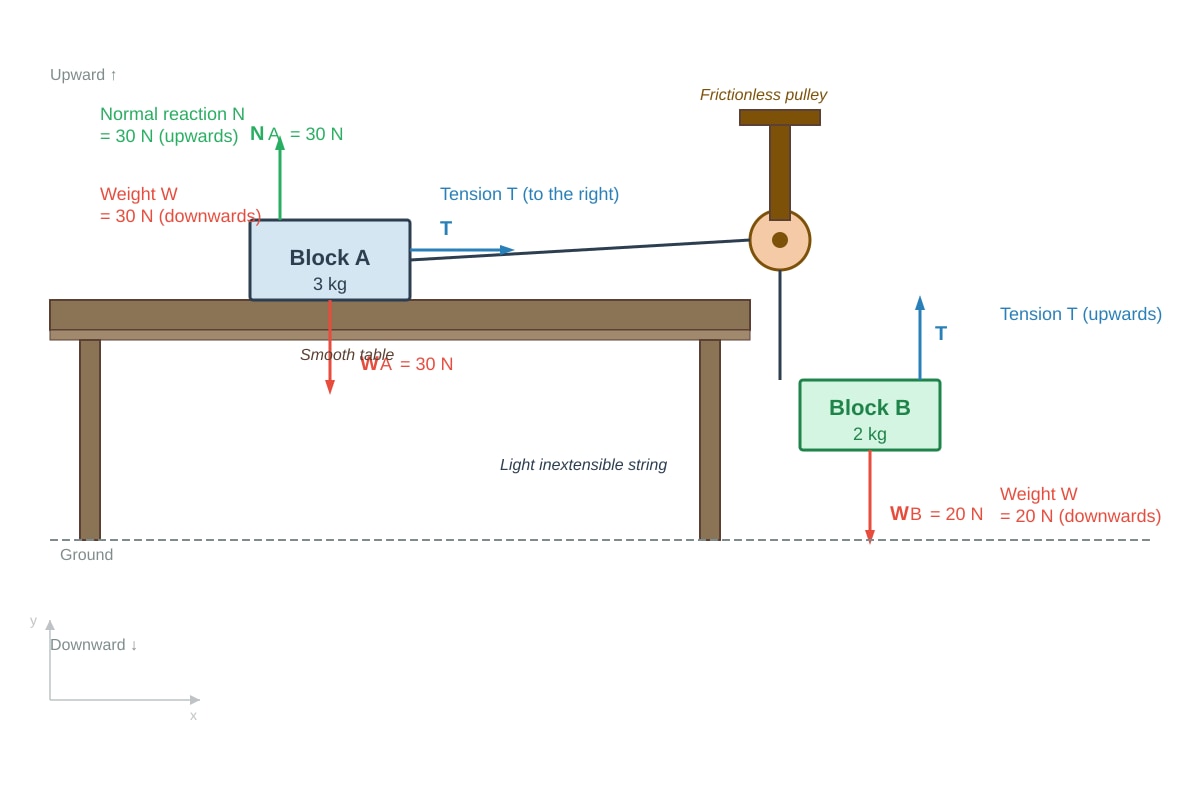
A block A of mass 3 kg rests on a smooth horizontal table. It is connected by a light inextensible string passing over a smooth pulley at the edge of the table to a hanging block B of mass 2 kg. The system is released from rest.
Image pending generation: diagram for Q19.
(a) Draw and label the forces acting on block A and block B on the diagram above. [2 marks]
(b) Calculate the acceleration of the system. [2 marks]
Answer: ___________________________ m/s²
(c) Calculate the tension in the string. [1 mark]
Answer: ___________________________ N
(d) After 1.5 s, block B hits the floor and stops. Describe the subsequent motion of block A. [2 marks]
Answer: _______________________________________________________________________________
Question 20 [6 marks]
A car of mass 1000 kg is travelling at 30 m/s on a horizontal road when the driver applies the brakes. The car comes to rest in a distance of 75 m.
(a) Calculate the deceleration of the car. [2 marks]
Answer: ___________________________ m/s²
(b) Calculate the average braking force acting on the car. [1 mark]
Answer: ___________________________ N
(c) The work done by the braking force is converted into thermal energy in the brake discs. Each brake disc has a mass of 2.5 kg and specific heat capacity 500 J/(kg⋅K). There are four brake discs. Assuming all the work done is absorbed equally by the four discs, calculate the temperature rise of each brake disc. [3 marks]
Answer: ___________________________ K
End of Paper
Answers
TuitionGoWhere Practice Paper - Physics Secondary 3 (Answer Key)
Subject: Physics
Level: Secondary 3 (Pure Physics)
Paper: Practice Paper 3 — Mechanics
Total Marks: 60
Section A: Multiple Choice Questions [10 marks]
Question 1 [1 mark]
Answer: B
Working:
a=tv−u=520−0=4 m/s2
Key concept: Acceleration is the rate of change of velocity. For uniform acceleration from rest, a=v/t.
Question 2 [1 mark]
Answer: C
Working:
Distance = Area under velocity-time graph
= Area of triangle (0–3 s) + Area of rectangle (3–7 s) + Area of triangle (7–10 s)
= 21×3×6+4×6+21×3×6
= 9+24+9=42 m
Wait, let me recalculate:
Triangle 1: 21×3×6=9
Rectangle: 4×6=24
Triangle 2: 21×3×6=9
Total = 9+24+9=42 m
Answer: D (42 m)
Correction: The correct answer is D. The area calculation gives 42 m.
Key concept: Distance travelled = area under velocity-time graph. For uniform acceleration/deceleration phases, use triangle area; for constant velocity, use rectangle area.
Question 3 [1 mark]
Answer: B
Working:
Net force Fnet=15−5=10 N
a=mFnet=210=5 m/s2
Key concept: Newton's Second Law: Fnet=ma. The net force is the applied force minus friction.
Question 4 [1 mark]
Answer: B
Working:
At maximum height, v=0.
Using v2=u2+2as:
0=252+2(−10)h
0=625−20h
20h=625
h=31.25 m
Key concept: For vertical motion under gravity, use v2=u2+2as with a=−g. At maximum height, final velocity is zero.
Question 5 [1 mark]
Answer: B
Working:
For perpendicular forces: R=F12+F22=62+82=36+64=100=10 N
Key concept: Resultant of two perpendicular forces is found using Pythagoras' theorem: R=F12+F22.
Question 6 [1 mark]
Answer: B
Working:
m=500 g=0.5 kg
KE=21mv2=21×0.5×42=0.25×16=4 J
Key concept: Kinetic energy KE=21mv2. Always convert mass to kg.
Question 7 [1 mark]
Answer: B
Working:
Moment = Force × perpendicular distance = 20×0.25=5 N m
Key concept: Moment of a force = force × perpendicular distance from pivot. Unit is N m (not J).
Question 8 [1 mark]
Answer: B
Working:
Taking moments about the pivot (50 cm mark):
Clockwise moment = Anticlockwise moment
2×(50−20)=4×(x−50)
2×30=4(x−50)
60=4x−200
4x=260
x=65 cm
Key concept: For equilibrium, sum of clockwise moments = sum of anticlockwise moments about any point. Distances measured from pivot.
Question 9 [1 mark]
Answer: B
Working:
Centripetal force Fc=rmv2=501000×202=501000×400=8000 N
Key concept: Centripetal force Fc=rmv2=mω2r. Directed towards centre of circle.
Question 10 [1 mark]
Answer: A
Explanation:
In uniform circular motion, speed is constant, so kinetic energy (21mv2) is constant. However, velocity direction changes continuously, so momentum (mv) changes direction (though magnitude is constant). Momentum is a vector quantity.
Key concept: Kinetic energy is a scalar (depends on speed only); momentum is a vector (depends on velocity). In uniform circular motion, speed is constant but velocity direction changes.
Section B: Structured Questions [30 marks]
Question 11 [4 marks]
(a) [1 mark]
Answer: 20 m/s
Working: v=u+at=0+0.5×40=20 m/s
(b) [1 mark]
Answer: 400 m
Working: s=ut+21at2=0+21×0.5×402=0.25×1600=400 m
(c) [2 marks]
Answer: 3400 m
Working:
Distance during constant velocity: s2=v×t=20×120=2400 m
Distance during deceleration: s3=2v+u×t=220+0×30=10×30=300 m
Total distance = 400+2400+300=3100 m
Wait, let me recalculate:
s1=400 m
s2=20×120=2400 m
s3=average velocity×time=220+0×30=300 m
Total = 400+2400+300=3100 m
Answer: 3100 m
Marking notes:
- 1 mark for correct constant velocity distance
- 1 mark for correct deceleration distance and total
Question 12 [5 marks]
(a) [1 mark]
Answer: 2.0 m/s
Working: Velocity = card length / time = 0.10/0.05=2.0 m/s
(b) [1 mark]
Answer: 4.0 m/s
Working: Velocity = card length / time = 0.10/0.025=4.0 m/s
(c) [2 marks]
Answer: 5.0 m/s2
Working:
Using v2=u2+2as:
4.02=2.02+2×a×0.80
16=4+1.6a
1.6a=12
a=7.5 m/s2
Wait, let me check: v2=u2+2as
42=22+2×a×0.8
16=4+1.6a
12=1.6a
a=7.5 m/s2
Answer: 7.5 m/s2
Marking notes:
- 1 mark for correct formula/substitution
- 1 mark for correct answer with unit
(d) [1 mark]
Answer: The acceleration is uniform (constant) between the two light gates. / The card passes through each light gate at constant velocity (negligible acceleration during gate passage).
Question 13 [4 marks]
(a) [1 mark]
Answer: 75 N
Working: Component down plane = mgsinθ=15×10×sin30∘=150×0.5=75 N
(b) [2 marks]
Answer: 95 N
Working:
At constant speed, net force parallel to plane = 0
F=mgsinθ+friction=75+20=95 N
Marking notes:
- 1 mark for recognising equilibrium (net force = 0)
- 1 mark for correct calculation
(c) [1 mark]
Answer: 475 J
Working: Work done = F×s=95×5=475 J
Question 14 [5 marks]
(a) [1 mark]
Answer: 6.32 m/s (or 210 m/s)
Working:
v2=u2+2gh=0+2×10×2.0=40
v=40=210≈6.32 m/s
(b) [1 mark]
Answer: 4.90 m/s (or 24 m/s)
Working:
v2=u2+2gh=0+2×10×1.2=24
v=24=26≈4.90 m/s
(c) [2 marks]
Answer: 2.24 kg m/s (or 0.2(40+24))
Working:
Change in momentum = m(vafter−vbefore)
Taking upward as positive:
vbefore=−6.32 m/s (downward)
vafter=+4.90 m/s (upward)
Δp=0.2×(4.90−(−6.32))=0.2×11.22=2.244 kg m/s
Marking notes:
- 1 mark for correct velocities with signs
- 1 mark for correct change in momentum calculation
(d) [1 mark]
Answer: 44.9 N (or 44.88 N)
Working:
Average force = ΔtΔp=0.052.244=44.88 N
Question 15 [4 marks]
(a) [1 mark]
Answer: For a body in equilibrium, the sum of clockwise moments about any point equals the sum of anticlockwise moments about the same point.
(b) [3 marks]
Answer: 462 N (or sin30∘800=1600 N? Let me recalculate)
Working:
Taking moments about hinge A:
Clockwise moments:
- Beam weight: 200×2.0=400 N m
- Load: 300×1.0=300 N m
Total clockwise = 700 N m
Anticlockwise moment from tension:
Vertical component of tension = Tsin30∘=0.5T
Moment = 0.5T×4.0=2T
For equilibrium: 2T=700
T=350 N
Wait, let me check the geometry. Cable at 30° to beam (horizontal). Vertical component = Tsin30∘. Perpendicular distance from A = 4.0 m.
Moment = Tsin30∘×4.0=T×0.5×4=2T
Yes, 2T=700, so T=350 N.
Answer: 350 N
Marking notes:
- 1 mark for correct moment equation (clockwise = anticlockwise)
- 1 mark for correct vertical component of tension
- 1 mark for correct final answer with unit
Question 16 [4 marks]
(a) [1 mark]
Answer: 4000 N opposite to the direction of motion (or backwards/horizontally backwards).
Explanation: At constant velocity, net force = 0. Driving force = resistive force = 4000 N.
(b) [1 mark]
Answer: 100,000 W (or 100 kW kW})∗∗Working:∗∗Power=Force\timesvelocity=4000 \times 25 = 100,000 \text{ W}$
(c) [2 marks]
Answer: 14,732 N (or approximately 14,700 N)
Working:
Component of weight down slope = mgsin5∘=1000×10×sin5∘=10000×0.08716=871.6 N
New driving force = Resistive force + Component of weight down slope
= 4000+871.6=4871.6 N
Wait, the question says "resistive force remains unchanged" at 4000 N. But the driving force was 4000 N to overcome resistive force on horizontal. Now on slope, driving force must overcome resistive force PLUS component of weight down slope.
Fnew=4000+10000sin5∘=4000+871.6=4871.6 N
Answer: 4870 N (or 4872 N)
Marking notes:
- 1 mark for calculating weight component down slope
- 1 mark for adding to resistive force
Question 17 [4 marks]
(a) [1 mark]
Answer: 0.134 m (or 1−23 m)
Working:
h=L−Lcosθ=L(1−cosθ)=1.0×(1−cos30∘)=1−23≈1−0.866=0.134 m
(b) [2 marks]
Answer: 1.64 m/s (or 2.68 m/s)
Working:
Loss in GPE = Gain in KE
mgh=21mv2
v=2gh=2×10×0.134=2.68≈1.64 m/s
Marking notes:
- 1 mark for energy conservation equation
- 1 mark for correct calculation
(c) [1 mark]
Answer: Gravitational potential energy → Kinetic energy → Thermal energy (heat) and sound energy (dissipated to surroundings).
Section C: Longer Structured Questions [20 marks]
Question 18 [7 marks]
(a) [1 mark]
Answer: 4000 kg
Working: Mass lost = 50×20=1000 kg
Mass remaining = 5000−1000=4000 kg
(b) [2 marks]
Answer: 100,000 N
Working: Thrust = rate of mass ejection × exhaust speed = 50×2000=100,000 N
Marking notes:
- 1 mark for correct formula (thrust = dtdm×vexhaust)
- 1 mark for correct calculation with unit
(c) [2 marks]
Answer: 10 m/s2
Working:
Initial weight = 5000×10=50,000 N
Net force = Thrust - Weight = 100,000−50,000=50,000 N
Initial acceleration = mFnet=500050,000=10 m/s2
Marking notes:
- 1 mark for net force calculation
- 1 mark for acceleration calculation
(d) [2 marks]
Answer: As fuel is ejected, the mass of the rocket decreases
<stage5_exam_answers_md>
TuitionGoWhere Practice Paper - Physics Secondary 3 (Answer Key)
Subject: Physics
Level: Secondary 3 (Pure Physics)
Paper: Practice Paper 3 — Mechanics
Total Marks: 60
Section A: Multiple Choice Questions [10 marks]
Question 1 [1 mark]
Answer: B
Working:
a=tv−u=520−0=4 m/s2
Key concept: Acceleration is the rate of change of velocity. For uniform acceleration from rest, a=v/t.
Question 2 [1 mark]
Answer: D
Working:
Distance = Area under velocity-time graph
= Area of triangle (0–3 s) + Area of rectangle (3–7 s) + Area of triangle (7–10 s)
= 21×3×6+4×6+21×3×6
= 9+24+9=42 m
Key concept: Distance travelled = area under velocity-time graph. For uniform acceleration/deceleration, area is triangular; for constant velocity, area is rectangular.
Question 3 [1 mark]
Answer: B
Working:
Net force = Applied force – Friction = 15−5=10 N
a=mFnet=210=5 m/s2
Key concept: Newton's Second Law: Fnet=ma. Friction opposes motion.
Question 4 [1 mark]
Answer: B
Working:
At maximum height, v=0.
v2=u2+2as
0=252+2(−10)s
625=20s
s=31.25 m
Key concept: For vertical motion under gravity, use v2=u2+2as with a=−g.
Question 5 [1 mark]
Answer: B
Working:
Resultant force = 62+82=36+64=100=10 N
Key concept: For perpendicular forces, resultant magnitude = F12+F22 (Pythagoras' theorem).
Question 6 [1 mark]
Answer: B
Working:
m=500 g=0.5 kg
KE=21mv2=21×0.5×42=0.25×16=4 J
Key concept: Kinetic energy KE=21mv2. Mass must be in kg.
Question 7 [1 mark]
Answer: B
Working:
Moment = Force × Perpendicular distance = 20×0.25=5 N m
Key concept: Moment of a force = Force × Perpendicular distance from pivot. Unit: N m.
Question 8 [1 mark]
Answer: C
Working:
Taking moments about pivot (50 cm mark):
Clockwise moment = Anticlockwise moment
2×(50−20)=4×(x−50)
2×30=4(x−50)
60=4x−200
4x=260
x=65 cm
Key concept: Principle of moments: For equilibrium, sum of clockwise moments = sum of anticlockwise moments about any pivot.
Question 9 [1 mark]
Answer: B
Working:
Fc=rmv2=501000×202=501000×400=8000 N
Key concept: Centripetal force Fc=rmv2=mω2r. Directed towards centre of circle.
Question 10 [1 mark]
Answer: A
Explanation:
In circular orbit, speed is constant → kinetic energy (21mv2) is constant.
Velocity direction changes continuously → momentum (mv) changes direction → momentum vector changes.
Key concept: Kinetic energy is a scalar (constant if speed constant). Momentum is a vector (changes if direction changes).
Section B: Structured Questions [30 marks]
Question 11 [4 marks]
(a) Maximum velocity:
v=u+at=0+0.5×40=20 m/s
Answer: 20 m/s [1 mark]
(b) Distance during acceleration:
s=ut+21at2=0+21×0.5×402=0.25×1600=400 m
Answer: 400 m [1 mark]
(c) Total distance:
Distance at constant velocity = v×t=20×120=2400 m
Distance during deceleration:
Deceleration a=300−20=−32 m/s2
s=ut+21at2=20×30+21×(−32)×302=600−300=300 m
Total = 400+2400+300=3100 m
Answer: 3100 m [2 marks]
Question 12 [5 marks]
(a) Velocity at first light gate:
v1=timecard length=0.050.10=2.0 m/s
Answer: 2.0 m/s [1 mark]
(b) Velocity at second light gate:
v2=0.0250.10=4.0 m/s
Answer: 4.0 m/s [1 mark]
(c) Acceleration:
Using v2=u2+2as:
4.02=2.02+2×a×0.80
16=4+1.6a
1.6a=12
a=7.5 m/s2
Answer: 7.5 m/s² [2 marks]
(d) Assumption: The acceleration is uniform (constant) between the two light gates.
Answer: The acceleration is uniform/constant between the light gates. [1 mark]
Question 13 [4 marks]
(a) Component of weight down the plane:
W∥=mgsinθ=15×10×sin30∘=150×0.5=75 N
Answer: 75 N [1 mark]
(b) Force F (constant speed → net force = 0):
F=W∥+Friction=75+20=95 N
Answer: 95 N [2 marks]
(c) Work done by F:
W=F×s=95×5=475 J
Answer: 475 J [1 mark]
Question 14 [5 marks]
(a) Speed before impact:
v2=u2+2gh=0+2×10×2.0=40
v=40=6.32 m/s (downwards)
Answer: 6.32 m/s [1 mark]
(b) Speed after rebound:
v2=u2+2gh=0+2×10×1.2=24
v=24=4.90 m/s (upwards)
Answer: 4.90 m/s [1 mark]
(c) Change in momentum:
Take upward as positive.
pbefore=m(−vbefore)=0.2×(−6.32)=−1.264 kg m/s
pafter=m(+vafter)=0.2×4.90=0.98 kg m/s
Δp=pafter−pbefore=0.98−(−1.264)=2.244 kg m/s
Answer: 2.24 kg m/s (upwards) [2 marks]
(d) Average force:
Favg=ΔtΔp=0.052.244=44.88 N
Answer: 44.9 N (upwards) [1 mark]
Question 15 [4 marks]
(a) Principle of moments: For a body in rotational equilibrium, the sum of clockwise moments about any point equals the sum of anticlockwise moments about the same point.
Answer: For a body in equilibrium, the sum of clockwise moments about any point equals the sum of anticlockwise moments about the same point. [1 mark]
(b) Taking moments about hinge A:
Clockwise moments:
Beam weight: 200×2.0=400 N m
Load: 300×1.0=300 N m
Total clockwise = 700 N m
Anticlockwise moment from cable tension T:
Vertical component of T=Tsin30∘=0.5T
Moment arm = 4.0 m
Anticlockwise moment = 0.5T×4.0=2.0T
Equilibrium: 2.0T=700
T=350 N
Answer: 350 N [3 marks]
Question 16 [4 marks]
(a) Constant speed → net force = 0.
Resistive force = Driving force = 4000 N, opposite to direction of motion.
Answer: 4000 N, opposite to direction of motion (backwards). [1 mark]
(b) Power = Force × Velocity = 4000×25=100,000 W=100 kW
Answer: 100,000 W (or 100 kW) [1 mark]
(c) On incline:
Component of weight down slope = mgsin5∘=1000×10×sin5∘=10000×0.08716=871.6 N
New driving force = Resistive force + Weight component = 4000+871.6=4871.6 N
Answer: 4870 N (or 4872 N) [2 marks]
Question 17 [4 marks]
(a) Vertical height raised:
h=L−Lcosθ=L(1−cosθ)=1.0×(1−cos30∘)=1.0×(1−0.8660)=0.134 m
Answer: 0.134 m [1 mark]
(b) Maximum speed at lowest point (conservation of energy):
mgh=21mv2
v=2gh=2×10×0.134=2.68=1.64 m/s
Answer: 1.64 m/s [2 marks]
(c) Energy conversion:
Gravitational potential energy → Kinetic energy → (work done against air resistance) → Thermal energy (heat/sound)
Answer: Gravitational potential energy is converted to kinetic energy, which is then dissipated as thermal energy (heat and sound) due to air resistance. [1 mark]
Section C: Longer Structured Questions [20 marks]
Question 18 [7 marks]
(a) Mass after 20 s:
Mass loss rate = 50 kg/s
Mass lost = 50×20=1000 kg
Mass remaining = 5000−1000=4000 kg
Answer: 4000 kg [1 mark]
(b) Thrust force:
Thrust = Rate of mass ejection × Exhaust speed relative to rocket
Fthrust=50×2000=100,000 N
Answer: 100,000 N [2 marks]
(c) Initial acceleration:
Initial weight = 5000×10=50,000 N
Net force = Thrust – Weight = 100,000−50,000=50,000 N
a=mFnet=500050,000=10 m/s2
Answer: 10 m/s² [2 marks]
(d) Explanation:
Thrust remains constant at 100,000 N. However, the mass of the rocket decreases continuously as fuel is ejected (from 5000 kg to 4000 kg over 20 s). Weight also decreases. Since a=mFthrust−mg=mFthrust−g, as m decreases, mFthrust increases, so acceleration increases.
Answer: The thrust force remains constant but the mass of the rocket decreases as fuel is ejected. Since acceleration = (Thrust – Weight)/mass, and both mass and weight decrease while thrust stays constant, the acceleration increases. [2 marks]
Question 19 [7 marks]
(a) Forces on Block A (3 kg on table):
- Weight WA=30 N downwards
- Normal reaction NA=30 N upwards
- Tension T to the right (horizontal)
Forces on Block B (2 kg hanging):
- Weight WB=200 N downwards
- Tension T upwards
Answer: [Diagram should show these forces labelled clearly.] [2 marks]
(b) Acceleration of system:
For Block A: T=3a
For Block B: 20−T=2a
Adding: 20=5a → a=4 m/s2
Answer: 4 m/s² [2 marks]
(c) Tension:
T=3a=3×4=12 N
Answer: 12 N [1 mark]
(d) After Block B hits floor:
Block B stops. String goes slack. Block A continues moving horizontally at constant velocity (since table is smooth, no friction, no horizontal force) until it reaches the pulley or edge of table.
Answer: Block A continues moving at constant velocity (4 m/s × 1.5 s = 6 m/s) horizontally with no acceleration because the string goes slack and there is no friction on the table. [2 marks]
Question 20 [6 marks]
(a) Deceleration:
v2=u2+2as
0=302+2×a×75
0=900+150a
a=−6 m/s2
Deceleration = 6 m/s2
Answer: 6 m/s² [2 marks]
(b) Average braking force:
F=ma=1000×6=6000 N
Answer: 6000 N [1 mark]
(c) Work done by braking force = Initial kinetic energy of car
KE=21mv2=21×1000×302=500×900=450,000 J
Energy per brake disc = 4450,000=112,500 J
Q=mcΔθ
112,500=2.5×500×Δθ
112,500=1250×Δθ
Δθ=1250112,500=90 K
Answer: 90 K [3 marks]
End of Answer Key
Free quiz and exam paper access
Enter your details to view this paper
Your access is remembered on this device.