TuitionGoWhere Practice Paper - Physics Secondary 3
TuitionGoWhere Practice Paper (AI) — Version 3 of 5
Subject: Physics
Level: Secondary 3
Paper: Practice Paper (Mechanics Focus)
Duration: 60 minutes
Total Marks: 60
Name:
Class:
Date:
Instructions:
- This practice paper contains 20 questions across three sections.
- Answer all questions in the spaces provided.
- Show all working clearly where calculation is required.
- Use g=10 m s−2 unless stated otherwise.
- Section marks and question marks sum exactly to 60.
Section A: Multiple Choice and Short Structured (Questions 1–8, total 16 marks)
1. [2 marks] A car travels 240 m in 20 s at constant speed. What is its average speed?
- A. 8 m s−1
- B. 10 m s−1
- C. 12 m s−1
- D. 24 m s−1
2. [2 marks] Which of the following is a vector quantity?
- A. Mass
- B. Temperature
- C. Force
- D. Energy
3. [2 marks] A book of mass 1.5 kg rests on a table. What is the gravitational force (weight) acting on it? (g=10 m s−2)
- A. 0.15 N
- B. 1.5 N
- C. 15 N
- D. 150 N
4. [2 marks] The diagram below shows a uniform rod of length 1.2 m pivoted at its centre. A 4 N force acts downward at the left end. What upward force at the right end keeps it in equilibrium?

Generated diagram for Q4.
5. [2 marks] Pressure in a liquid increases with:
- A. decreasing depth
- B. decreasing density
- C. increasing depth
- D. decreasing gravitational field strength
6. [2 marks] A box is pushed with a constant force and moves at constant velocity. What can be said about the net force?
- A. Net force is zero
- B. Net force acts forward
- C. Net force acts backward
- D. Net force equals weight
7. [2 marks] Calculate the moment of a 5 N force applied perpendicular at 0.3 m from a pivot.
- A. 1.5 N m
- B. 8.3 N m
- C. 15 N m
- D. 0.15 N m
8. [2 marks] A stone is dropped from rest near Earth. Ignoring air resistance, its acceleration is approximately:
- A. 0 m s−2
- B. 5 m s−2
- C. 10 m s−2
- D. 20 m s−2
Section B: Structured Response (Questions 9–14, total 24 marks)
9. [4 marks] A cyclist accelerates uniformly from 2 m s−1 to 10 m s−1 in 4 s.
(a) Calculate the acceleration. [2]
(b) Calculate the distance travelled in this time. [2]
10. [4 marks] A block of mass 2 kg is pulled along a horizontal surface by a 10 N force. Friction is 4 N.
(a) Calculate the net force. [1]
(b) Calculate the acceleration. [2]
(c) State Newton’s first law in relation to the motion. [1]
11. [4 marks] A 3 kg mass is lifted vertically by a crane at constant speed through 5 m.
(a) Calculate the weight of the mass. [1]
(b) Calculate the work done by the crane. [2]
(c) Where does the energy go? [1]
12. [4 marks] The velocity-time graph below shows a train’s motion.
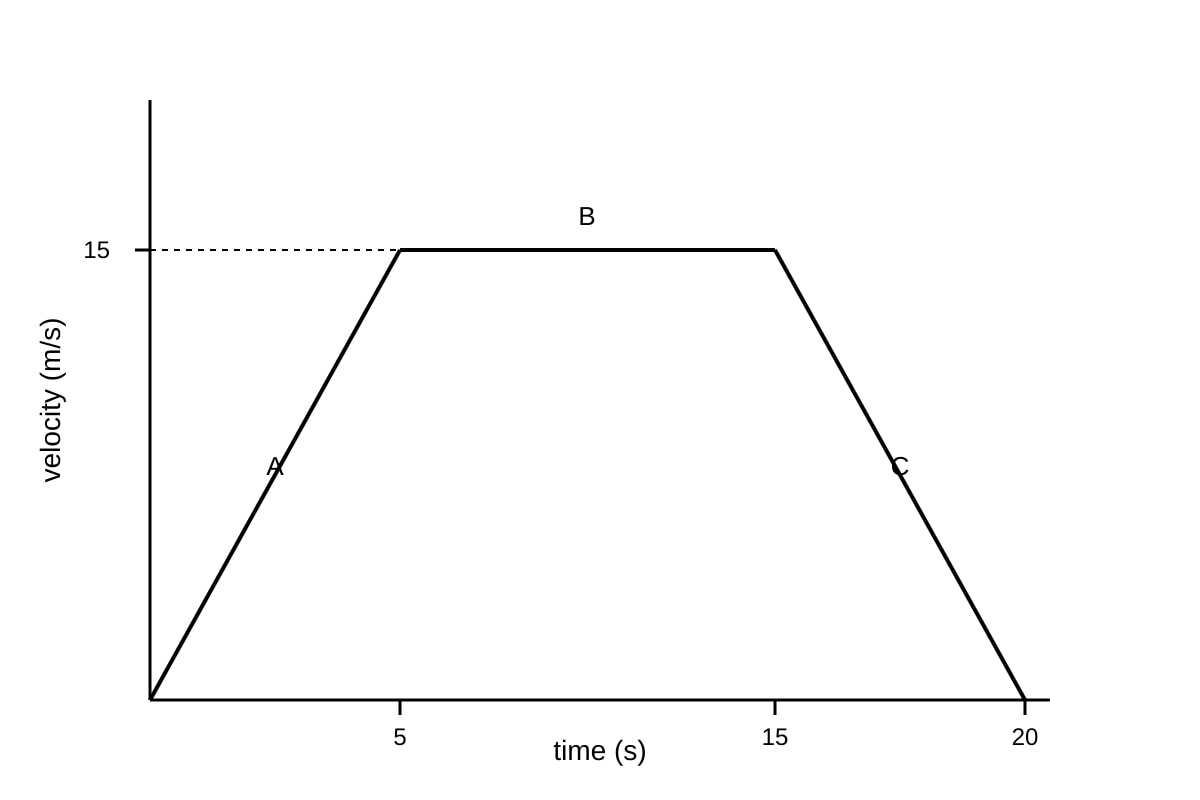
Generated graph for Q12.
(a) Calculate acceleration in section A. [1]
(b) Calculate total distance travelled. [3]
13. [4 marks] A uniform metre rule is pivoted at the 50 cm mark. A 2 N weight hangs at 20 cm mark. A 3 N weight hangs at the 80 cm mark.
(a) Calculate the moment due to 2 N weight. [1]
(b) Calculate the moment due to 3 N weight. [1]
(c) Is the rule in equilibrium? Explain. [2]
14. [4 marks] A hydraulic press has a small piston area 0.01 m2 and large piston area 0.1 m2. A 20 N force is applied to the small piston.
(a) State Pascal’s principle. [1]
(b) Calculate pressure at small piston. [1]
(c) Calculate force at large piston. [2]
Section C: Extended Application (Questions 15–20, total 20 marks)
15. [3 marks] A child of mass 40 kg slides down a vertical rope with acceleration 2 m s−2 downward. Calculate the friction force between her and the rope.
16. [4 marks] A block of mass 5 kg is on a rough inclined plane at 30∘ to horizontal. Coefficient of friction 0.4.
(a) Calculate component of weight parallel to plane. [2]
(b) Determine if it slides. Show working. [2]
17. [3 marks] A ring of mass 2 kg is suspended by two strings at 60∘ and 45∘ to the horizontal as shown.
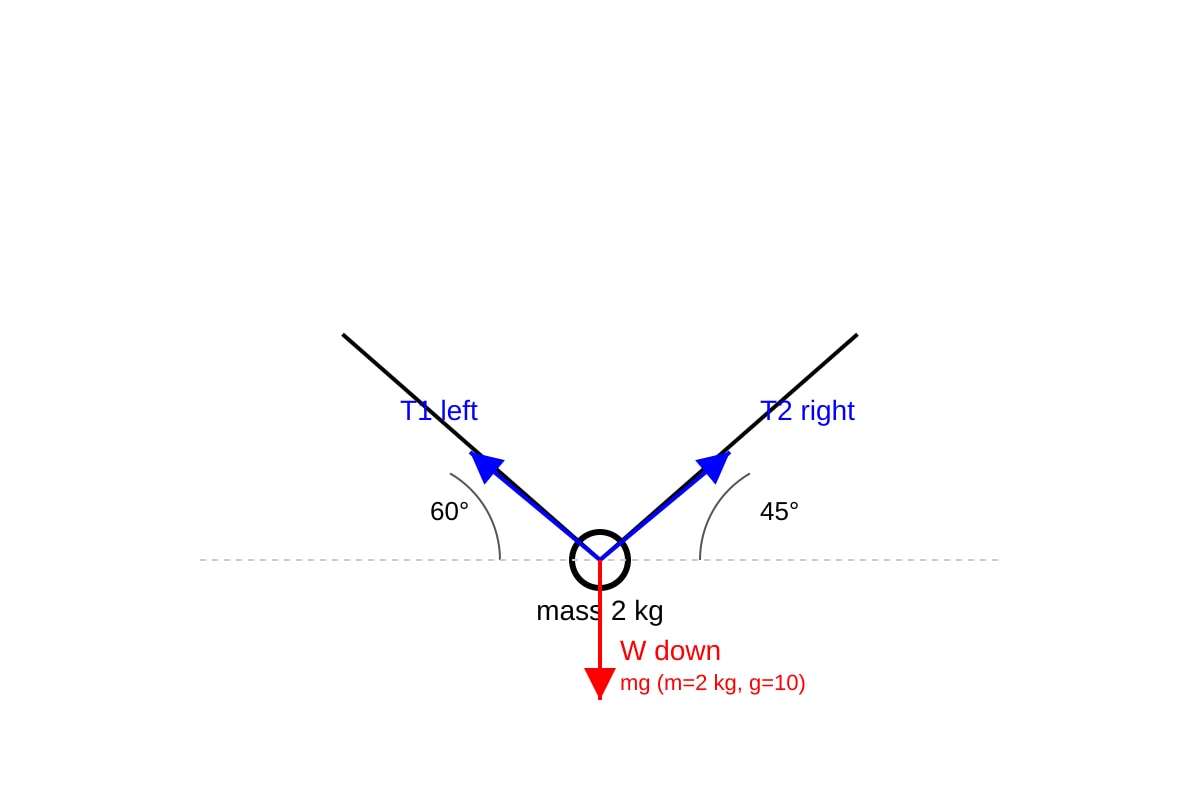
Generated diagram for Q17.
Calculate the tension T1 in the left string.
18. [3 marks] Water column of height 8 m has density 1000 kg m−3. Calculate pressure at the bottom due to water. (g=10)
19. [4 marks] A 0.5 kg ball is dropped from 5 m.
(a) Calculate loss in gravitational potential energy. [2]
(b) Assuming all becomes kinetic energy, find speed just before impact. [2]
20. [3 marks] A wooden block of mass 4 kg is pulled up a rough slope 6 m long, rising 2 m, at constant speed by 50 N. Calculate energy lost to friction.