AI Generated Exam Paper

Secondary 3 Physics Practice Paper 2

Free Kimi AI-generated Sec 3 Physics Practice Paper 2 with questions, answers, and O Level-style practice for Singapore students preparing for exams.

These static practice materials are generated from the site's syllabus and paper-generation workflow, with source and model context shown so students and parents can evaluate the material before use.

Secondary 3 Physics AI Generated Generated by Kimi K2.6 Free Updated 2026-06-10

Questions

<!-- TuitionGoWhere generation metadata: stage=5-2; model=moonshotai/kimi-k2.6:free; model_label=Kimi K2.6 Free; generated=2026-06-10; Sources: Stage 4-0 LLM templates, syllabus context, and Stage 2 evidence where available. -->

TuitionGoWhere Practice Paper - Physics Secondary 3

TuitionGoWhere Practice Paper (AI) Version: 2 of 5

Subject:Physics
Level:Secondary 3 (Pure Physics)
Paper:Practice Paper
Duration:1 hour 30 minutes
Total Marks:80
Name:_________________________
Class:_________________________
Date:_________________________

Instructions to Candidates

  • Write your name, class, and date in the spaces provided above.
  • This paper consists of Section A and Section B.
  • Section A (Questions 1–10): Short-answer and structured questions. Answer all questions. [40 marks]
  • Section B (Questions 11–16): Structured-response and calculation questions. Answer all questions. [40 marks]
  • Show all your working clearly. Marks will be awarded for correct methods even if answers are incorrect.
  • Write your answers in the spaces provided. Additional paper may be used if necessary.
  • The use of an approved scientific calculator is expected.
  • Take acceleration due to gravity, g=10 m/s2g = 10 \text{ m/s}^2 unless otherwise stated.

Section A (40 marks)

Answer all questions. All questions carry the marks shown in brackets.


1. State the difference between a scalar quantity and a vector quantity. Give one example of each. [2]


2. A student measures the length of a metal rod using a metre rule. She records the length as 45.2 cm.

(a) State the precision of the metre rule used. [1]


(b) Explain why the student should take measurements at different positions along the rod and calculate a mean. [2]


3. A car travels 120 km due east, then turns and travels 80 km due west. The total journey takes 4.0 hours.

(a) Calculate the total distance travelled. [1]


(b) Calculate the displacement of the car from its starting point. [1]


(c) Calculate the average speed of the car. [2]


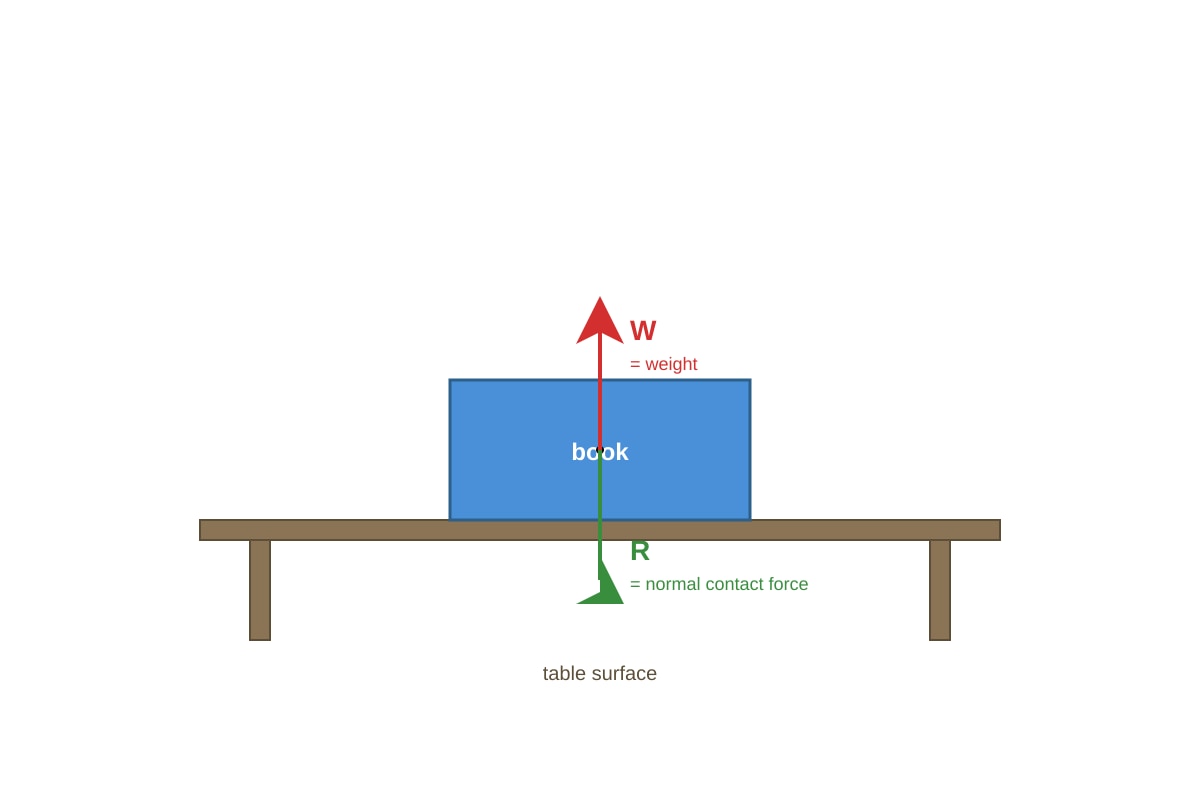
4. The diagram below shows the forces acting on a book resting on a horizontal table.

<image_placeholder> id: Q4-fig1 type: diagram linked_question: Q4 description: Free-body diagram of a book resting on a horizontal table. The book is shown as a rectangular block in the center. Two vertical arrows act on the book: one pointing downward from the center labeled "W" (weight), and one pointing upward from the center labeled "R" (normal contact force). The arrows should be equal in length. labels: W = weight, R = normal contact force, book, table surface values: none must_show: Equal length arrows for W and R; W pointing downward; R pointing upward; both arrows originating from center of book; book resting on horizontal table surface </image_placeholder>

(a) State the name of force RR. [1]


(b) State Newton's Third Law pair to force WW. [1]


(c) Explain why the book remains at rest, using the concept of equilibrium. [2]


5. A cyclist accelerates from rest at 2.5 m/s22.5 \text{ m/s}^2 for 6.0 seconds.

(a) Calculate the final velocity of the cyclist. [2]


(b) Calculate the distance travelled during this acceleration. [2]


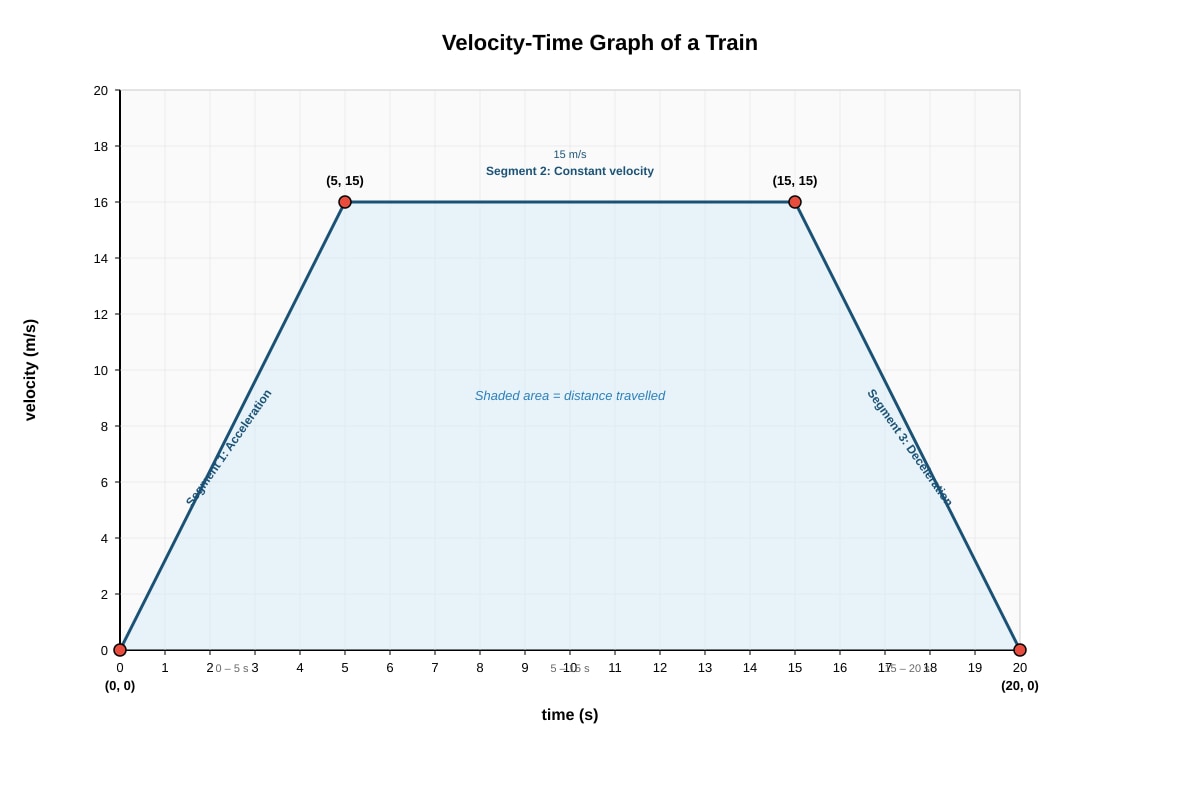
6. The velocity-time graph below shows the motion of a train over a 20-second period.

<image_placeholder> id: Q6-fig1 type: graph linked_question: Q6 description: Velocity-time graph with velocity (m/s) on y-axis from 0 to 20, and time (s) on x-axis from 0 to 20. The graph consists of three straight-line segments: (1) from (0,0) to (5,15) - upward slope; (2) from (5,15) to (15,15) - horizontal; (3) from (15,15) to (20,0) - downward slope to zero. labels: velocity (m/s), time (s), points at (0,0), (5,15), (15,15), (20,0) values: Segment 1: 0-5s, acceleration; Segment 2: 5-15s, constant velocity 15 m/s; Segment 3: 15-20s, deceleration to rest must_show: Axes labeled with units; three distinct phases; numerical values at key points; straight line segments; area under graph shaded lightly to indicate distance </image_placeholder>

(a) Calculate the acceleration during the first 5 seconds. [2]


(b) Calculate the distance travelled during the period of constant velocity. [2]


(c) Calculate the total distance travelled in 20 seconds. [3]


7. A ball of mass 0.50 kg is thrown vertically upward with an initial velocity of 12 m/s12 \text{ m/s}. Assume air resistance is negligible.

(a) Calculate the maximum height reached by the ball. [2]


(b) Calculate the time taken to reach maximum height. [2]


(c) State the velocity of the ball when it returns to the thrower's hand. [1]


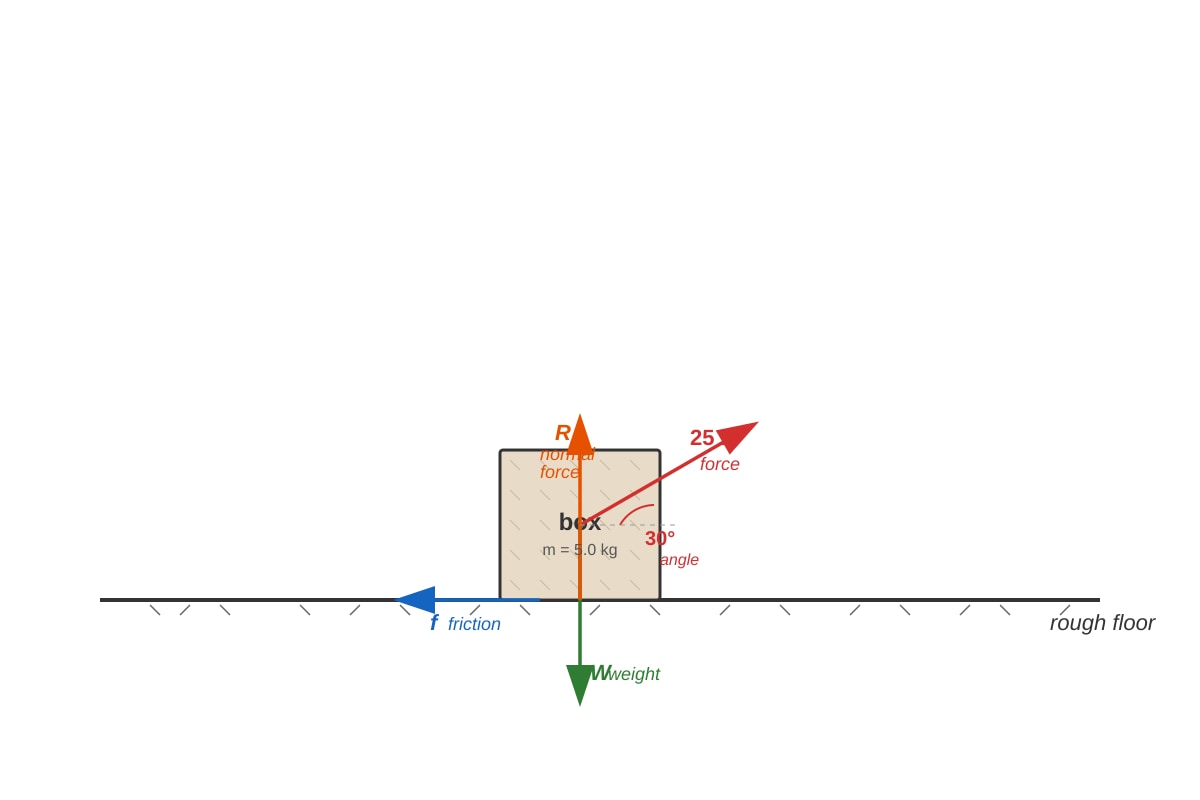
8. A 5.0 kg box is pulled along a rough horizontal floor by a force of 25 N acting at 3030^\circ above the horizontal. The box moves at constant velocity.

<image_placeholder> id: Q8-fig1 type: diagram linked_question: Q8 description: Diagram showing a rectangular box on a horizontal rough surface. A force arrow pulls from the center of the box at 30 degrees above the horizontal pointing to the right. The arrow is labeled 25 N. A friction arrow points left along the surface from the bottom of the box. Weight arrow points down, normal force arrow points up. labels: 25 N force, 30° angle, friction f, weight W, normal force R, box, rough floor values: mass = 5.0 kg, applied force = 25 N, angle = 30°, constant velocity must_show: Box on horizontal surface; 25 N arrow at 30° above horizontal; friction arrow opposing motion; W and R arrows vertical; angle clearly marked; all labels </image_placeholder>

(a) Calculate the horizontal component of the 25 N force. [2]


(b) State the magnitude of the frictional force. Explain your answer. [2]


9. A satellite of mass 200 kg orbits Earth at a height of 400 km above the surface. The radius of Earth is 6.4×10⁶ m6.4 \times 10^6 \text{ m} and its mass is 6.0×1024 kg6.0 \times 10^{24} \text{ kg}.

(a) Calculate the distance of the satellite from the centre of Earth. [1]


(b) Calculate the gravitational force acting on the satellite. [3]


[Gravitational constant G=6.67×10¹¹ N m2/kg2G = 6.67 \times 10^{-11} \text{ N m}^2/\text{kg}^2]


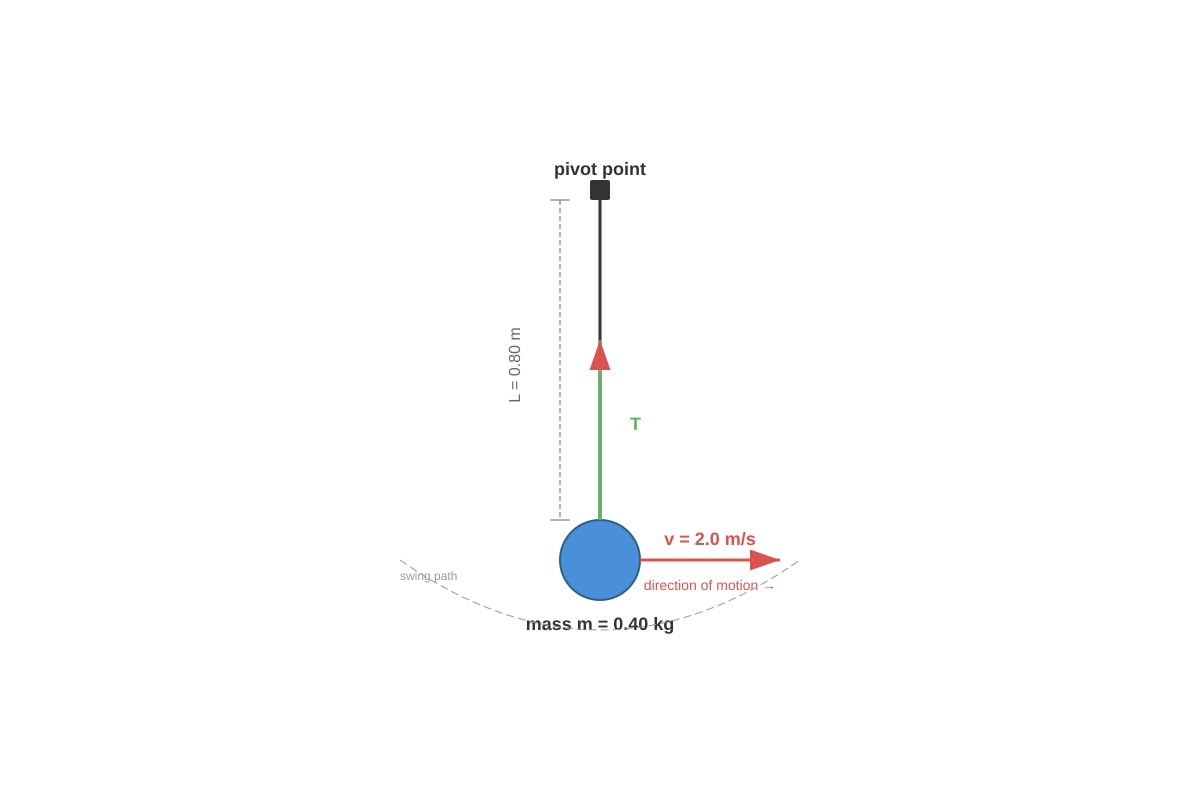
10. The diagram shows a simple pendulum swinging through its lowest point.

<image_placeholder> id: Q10-fig1 type: diagram linked_question: Q10 description: Diagram of a simple pendulum at its lowest point of swing. A bob of mass 0.40 kg is shown at the bottom of its arc, moving left to right with velocity 2.0 m/s indicated by horizontal arrow. The string length is 0.80 m from pivot to bob center. Tension force T is shown along the string pointing toward the pivot. labels: mass m = 0.40 kg, velocity v = 2.0 m/s, string length L = 0.80 m, tension T, pivot point values: m = 0.40 kg, v = 2.0 m/s, L = 0.80 m, g = 10 m/s² must_show: Pendulum bob at lowest point; string straight; velocity arrow horizontal; tension arrow along string toward pivot; all numerical labels; direction of motion indicated </image_placeholder>

(a) Calculate the weight of the bob. [1]


(b) At the lowest point, the net force on the bob toward the centre of the circular path is given by Tmg=mv2rT - mg = \frac{mv^2}{r}. Calculate the tension TT in the string. [3]


Section B (40 marks)

Answer all questions. All questions carry the marks shown in brackets.


11. A stone is dropped from rest from the top of a tall bridge. It falls 45 m to the water below. Assume air resistance is negligible.

(a) Calculate the velocity of the stone just before it hits the water. [3]


(b) Calculate the time taken for the stone to fall. [2]


(c) Sketch a velocity-time graph for the stone from the moment it is dropped until it hits the water. Label your axes clearly. [3]


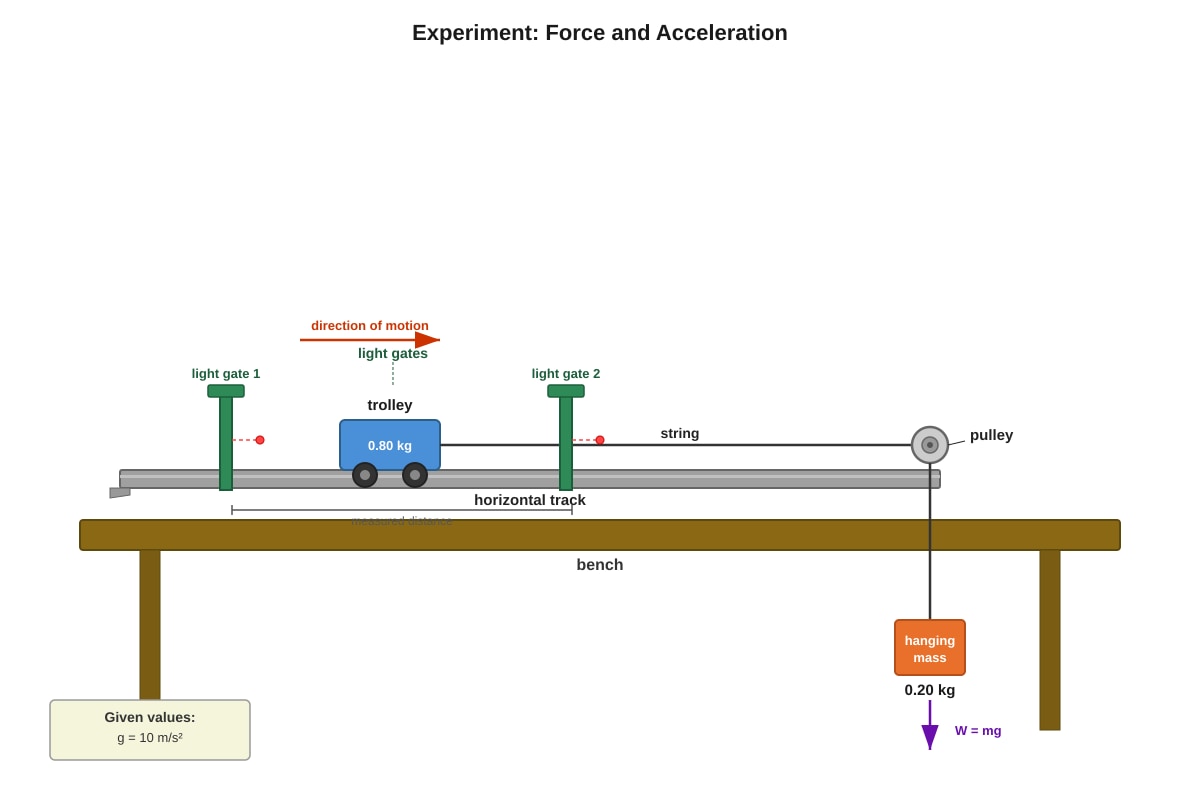
12. The diagram shows an experiment to investigate the relationship between force and acceleration for a trolley on a horizontal track.

<image_placeholder> id: Q12-fig1 type: experimental_setup linked_question: Q12 description: Diagram of horizontal runway/trolley experiment. A trolley on a level horizontal track is connected by a string over a pulley to a hanging mass of 0.20 kg. Light gates are positioned at two points along the track to measure acceleration. The hanging mass provides the accelerating force. labels: trolley, horizontal track, pulley, hanging mass = 0.20 kg, light gates, string, bench values: hanging mass = 0.20 kg, trolley mass = 0.80 kg, g = 10 m/s² must_show: Level horizontal track; trolley on track; string over pulley at end; hanging mass suspended; light gates positioned along track; all components labeled </image_placeholder>

(a) Explain why the track is slightly tilted to compensate for friction before the experiment begins. [2]


(b) The total mass of the trolley and its load is 0.80 kg. Calculate the acceleration of the system when released. [3]


(c) Explain why the acceleration would be less than your calculated value if friction were not compensated for. [2]


13. A car of mass 1200 kg is travelling at 25 m/s25 \text{ m/s} along a straight horizontal road. The driver applies the brakes and the car comes to rest in 50 m.

(a) Calculate the average braking force. [4]


(b) Calculate the time taken to come to rest. [2]


(c) Sketch a velocity-time graph for the braking car, assuming constant deceleration. Label your axes and indicate the time and velocity values. [3]


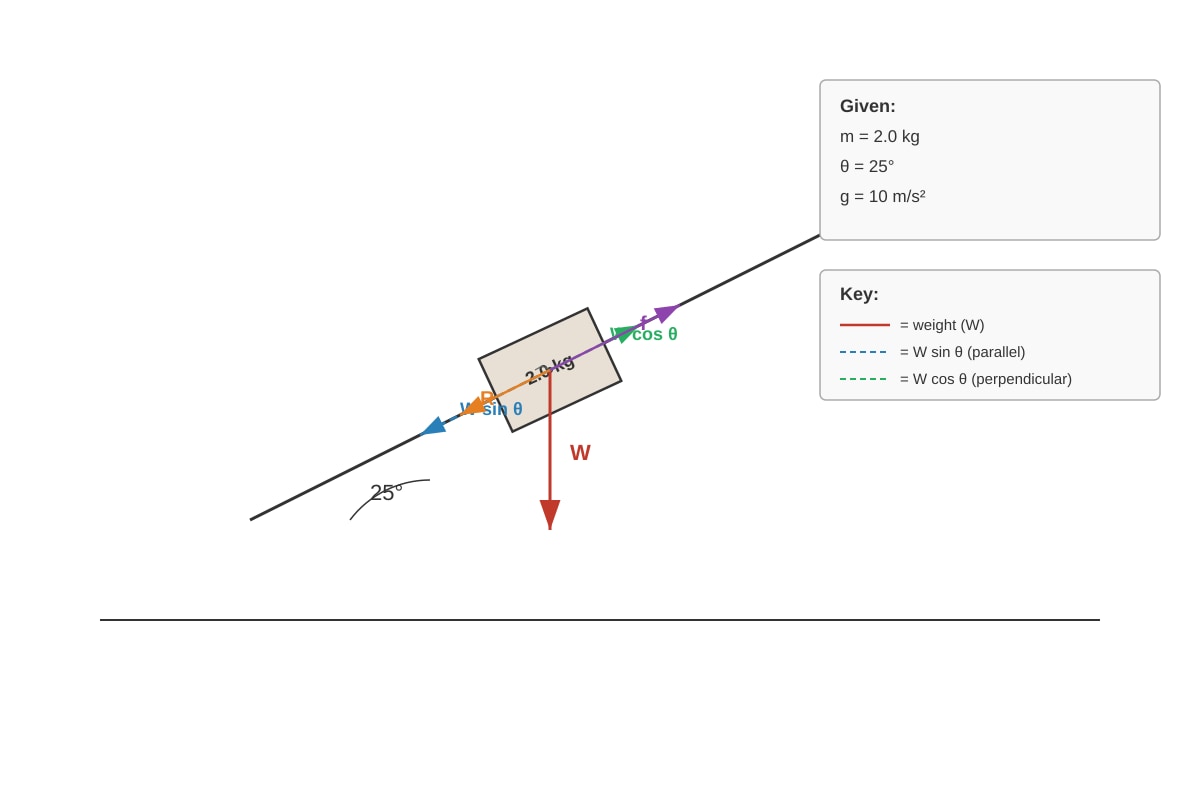
14. A 2.0 kg block is placed on a rough slope inclined at 2525^\circ to the horizontal. The block is just about to slide down.

<image_placeholder> id: Q14-fig1 type: diagram linked_question: Q14 description: Diagram of a block on an inclined plane at 25 degrees to horizontal. A rectangular block sits on the slope with its weight shown as downward arrow from center. Components of weight parallel and perpendicular to slope are shown as dashed arrows. Friction arrow points up the slope. Normal contact force is perpendicular to slope surface. labels: mass = 2.0 kg, angle = 25°, weight W, component parallel to slope W sin θ, component perpendicular to slope W cos θ, friction f, normal force R values: m = 2.0 kg, θ = 25°, g = 10 m/s² must_show: Slope at 25° angle; block on slope; weight arrow vertical downward; parallel and perpendicular components clearly indicated with right-angle triangle construction; friction arrow up slope; normal force perpendicular to slope; all labels </image_placeholder>

(a) Calculate the weight of the block. [1]


(b) Calculate the component of the weight parallel to the slope. [2]


(c) State the magnitude of the frictional force, giving a reason. [2]


(d) Calculate the normal contact force between the block and the slope. [3]


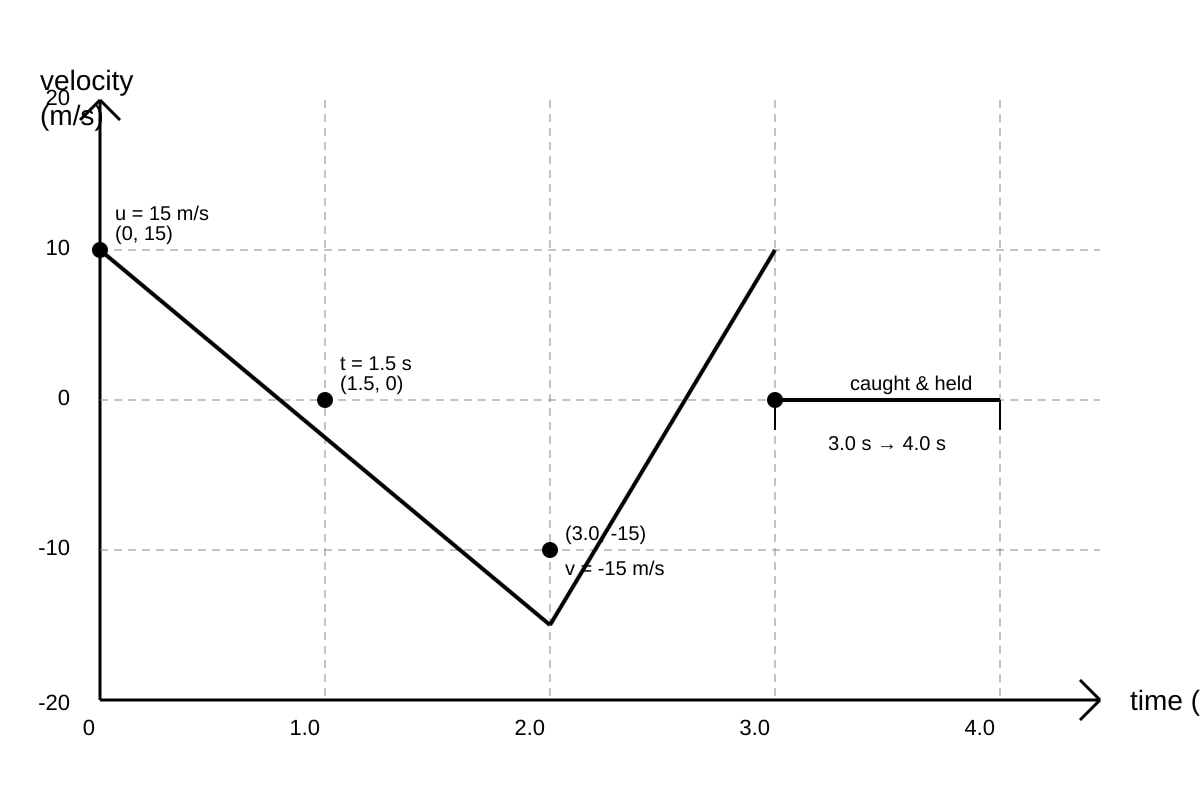
15. The velocity-time graph below shows the motion of a ball thrown vertically upward from ground level.

<image_placeholder> id: Q15-fig1 type: graph linked_question: Q15 description: Velocity-time graph for vertical throw. Velocity (m/s) on y-axis from -20 to +20, time (s) on x-axis from 0 to 4.0. Straight line with negative gradient starting at (0, 15), crossing t-axis at (1.5, 0), continuing to (3.0, -15), then flat line at zero from (3.0, 4.0) indicating ball caught and held. labels: velocity (m/s), time (s), initial velocity u = 15 m/s, time to max height t = 1.5 s, velocity when caught = -15 m/s values: initial velocity = 15 m/s upward; time to max height = 1.5 s; total time in air before caught = 3.0 s; final velocity when caught = -15 m/s must_show: Straight line with constant negative gradient; positive initial velocity; crossing time axis at maximum height; symmetric negative velocity when caught; flat line at zero after catch; axes labeled with units; key points marked with coordinates </image_placeholder>

(a) Calculate the acceleration of the ball during its flight. [2]


(b) Calculate the maximum height reached above ground level. [3]


(c) State why the gradient of the velocity-time graph is constant throughout the flight. [1]


(d) Explain why the area under the velocity-time graph between t=0t = 0 and t=1.5 st = 1.5 \text{ s} gives the maximum height, whereas the total area between t=0t = 0 and t=3.0 st = 3.0 \text{ s} gives zero displacement. [3]


16. A student of mass 55 kg stands on a bathroom scale inside an elevator. The scale reads different values during the elevator's motion.

(a) State the reading on the scale when the elevator is at rest. [1]


(b) The elevator accelerates upward at 2.0 m/s22.0 \text{ m/s}^2. Calculate the reading on the scale. [3]


(c) The elevator now moves upward at constant velocity. State and explain the scale reading. [2]


(d) The scale reads 440 N. Determine the acceleration of the elevator and state its direction. [3]


END OF PAPER


Total Section A: 40 marks Total Section B: 40 marks Grand Total: 80 marks

<div style="page-break-after: always;"></div>

Answers

<!-- TuitionGoWhere generation metadata: stage=5-2; model=moonshotai/kimi-k2.6:free; model_label=Kimi K2.6 Free; generated=2026-06-10; Sources: Stage 4-0 LLM templates, syllabus context, and Stage 2 evidence where available. -->

TuitionGoWhere Practice Paper - Physics Secondary 3 (Version 2)

Answer Key and Marking Scheme


Section A (40 marks)


Question 1 [2 marks]

Answer:

  • A scalar quantity has magnitude (size) only. [½]
  • A vector quantity has both magnitude and direction. [½]
  • Example of scalar: speed, mass, distance, time, energy, temperature (any one) [½]
  • Example of vector: velocity, displacement, force, acceleration, weight (any one) [½]

Teaching note: The key distinction is direction. Scalars are described by a number and unit alone; vectors need a direction as well. Common error: students confuse speed (scalar) with velocity (vector), or distance (scalar) with displacement (vector).


Question 2 [3 marks]

(a) [1 mark]

Answer: Precision is 0.1 cm (or 1 mm). [1]

Teaching note: A metre rule has the smallest division of 1 mm = 0.1 cm. All readings should be recorded to this precision.

(b) [2 marks]

Answer:

  • The rod may not be perfectly uniform or straight [1]
  • Taking measurements at different positions and finding a mean reduces the effect of random errors / gives a more reliable result [1]

Teaching note: This is an application of repeated measurements. Random errors arise from estimation between scale divisions or slight irregularities in the object. A mean value is more representative of the true length.


Question 3 [4 marks]

(a) [1 mark]

Answer: Total distance = 120+80=200 km120 + 80 = 200 \text{ km} [1]

(b) [1 mark]

Answer: Displacement = 12080=40 km120 - 80 = 40 \text{ km} due east [1]

Common error: Forgetting direction for displacement. "40 km" alone loses the direction mark.

(c) [2 marks]

Answer: Average speed=total distancetotal time=200 km4.0 h=50 km/h\text{Average speed} = \frac{\text{total distance}}{\text{total time}} = \frac{200 \text{ km}}{4.0 \text{ h}} = 50 \text{ km/h} [2]

Teaching note: Average speed uses total distance (scalar), not displacement. Average velocity would use displacement: 40/4.0=1040/4.0 = 10 km/h east.


Question 4 [4 marks]

(a) [1 mark]

Answer: Force RR is the normal contact force (or normal reaction force). [1]

(b) [1 mark]

Answer: The Newton's Third Law pair to WW is: the gravitational pull of the book on the Earth (or the book attracts Earth with equal and opposite force). [1]

Common error: Saying "reaction force from the table" — this is actually the pair to RR, not WW. The Third Law pair to weight must involve Earth as the other body.

(c) [2 marks]

Answer:

  • The book is at rest, so the resultant force on it must be zero [1]
  • This means RR and WW are equal in magnitude and opposite in direction, so they balance / the book is in equilibrium [1]

Teaching note: Equilibrium means zero resultant force. Students often confuse "balanced forces" with Newton's Third Law pairs. RR and WW act on the SAME body (the book), so they can balance. Third Law pairs always act on DIFFERENT bodies.


Question 5 [4 marks]

(a) [2 marks]

Answer: Using v=u+atv = u + at: v=0+(2.5×6.0)=15 m/sv = 0 + (2.5 \times 6.0) = 15 \text{ m/s} [2]

(b) [2 marks]

Answer: Using s=ut+12at2s = ut + \frac{1}{2}at^2: s=0+12(2.5)(6.0)2=12(2.5)(36)=45 ms = 0 + \frac{1}{2}(2.5)(6.0)^2 = \frac{1}{2}(2.5)(36) = 45 \text{ m} [2]

Or using s=(u+v)2t=(0+15)2×6.0=45 ms = \frac{(u+v)}{2}t = \frac{(0+15)}{2} \times 6.0 = 45 \text{ m}

Teaching note: Both kinematic equations give the same answer. Encourage students to write down the known values before selecting the appropriate equation.


Question 6 [7 marks]

(a) [2 marks]

Answer: acceleration=change in velocitytime=15050=155=3.0 m/s2\text{acceleration} = \frac{\text{change in velocity}}{\text{time}} = \frac{15 - 0}{5 - 0} = \frac{15}{5} = 3.0 \text{ m/s}^2 [2]

Teaching note: Gradient of velocity-time graph = acceleration. First segment: straight line from origin to (5, 15), so gradient = 15/5 = 3 m/s².

(b) [2 marks]

Answer: distance=velocity×time=15×(155)=15×10=150 m\text{distance} = \text{velocity} \times \text{time} = 15 \times (15-5) = 15 \times 10 = 150 \text{ m} [2]

Teaching note: During constant velocity, distance = area of rectangle = base × height = 10 s × 15 m/s = 150 m.

(c) [3 marks]

Answer:

SegmentCalculationDistance
0–5 sArea of triangle: 12×5×15\frac{1}{2} \times 5 \times 1537.5 m
5–15 sArea of rectangle: 10×1510 \times 15150 m
15–20 sArea of triangle: 12×5×15\frac{1}{2} \times 5 \times 1537.5 m
Total225 m

Total distance = 37.5+150+37.5=225 m37.5 + 150 + 37.5 = 225 \text{ m} [3]

Teaching note: Total area under velocity-time graph = total distance. Since velocity is always positive, area gives distance (not displacement). Mark allocation: method (splitting into areas) [1], correct individual areas [1], final answer with unit [1].


Question 7 [5 marks]

(a) [2 marks]

Answer: Using v2=u2+2asv^2 = u^2 + 2as with v=0v = 0 at maximum height: 0=(12)2+2(10)s0 = (12)^2 + 2(-10)s 0=14420s0 = 144 - 20s s=14420=7.2 ms = \frac{144}{20} = 7.2 \text{ m} [2]

Teaching note: At max height, velocity is momentarily zero. Acceleration is 10-10 m/s² (or take g=10g = -10 m/s²). Common error: forgetting acceleration is negative, or using wrong sign convention.

(b) [2 marks]

Answer: Using v=u+atv = u + at: 0=12+(10)t0 = 12 + (-10)t t=1210=1.2 st = \frac{12}{10} = 1.2 \text{ s} [2]

Or using s=(u+v)2ts = \frac{(u+v)}{2}t: 7.2=(12+0)2t7.2 = \frac{(12+0)}{2}t, so t=1.2t = 1.2 s

(c) [1 mark]

Answer: Velocity = 12 m/s12 \text{ m/s} downward (or 12 m/s-12 \text{ m/s} if up is positive). [1]

Teaching note: With no air resistance, motion is symmetric. Returns with same speed as launch, opposite direction. Common error: saying "zero" (confusing with max height).


Question 8 [4 marks]

(a) [2 marks]

Answer: Fhorizontal=25cos30°=25×0.866=21.6521.7 NF_{\text{horizontal}} = 25 \cos 30° = 25 \times 0.866 = 21.65 \approx 21.7 \text{ N} [2]

Teaching note: Resolving forces: adjacent side to angle uses cosine. The horizontal component pulls the box forward; vertical component 25sin30°=12.525 \sin 30° = 12.5 N reduces the normal force.

(b) [2 marks]

Answer: Frictional force = 21.7 N [1]

Reason: The box moves at constant velocity, so resultant force is zero (equilibrium). Therefore friction equals the horizontal component of the applied force. [1]

Teaching note: "Constant velocity" is the key phrase — implies equilibrium, not acceleration. Friction opposes motion and exactly balances the forward horizontal component.


Question 9 [4 marks]

(a) [1 mark]

Answer: r=6.4×10⁶+400×103=6.4×10⁶+0.4×106=6.8×10⁶ mr = 6.4 \times 10^6 + 400 \times 10^3 = 6.4 \times 10^6 + 0.4 \times 10^6 = 6.8 \times 10^6 \text{ m} [1]

Common error: Using 400 km directly without converting to metres, or forgetting to add Earth's radius.

(b) [3 marks]

Answer: Using F=Gm1m2r2F = \frac{Gm_1m_2}{r^2}:

F=(6.67×10¹¹)(6.0×1024)(200)(6.8×10⁶)2F = \frac{(6.67 \times 10^{-11})(6.0 \times 10^{24})(200)}{(6.8 \times 10^6)^2} [1]

F=8.004×10164.624×1013F = \frac{8.004 \times 10^{16}}{4.624 \times 10^{13}} [1]

F=1.73×10³ N1730 NF = 1.73 \times 10^3 \text{ N} \approx 1730 \text{ N} [1]

Teaching note: rr is centre-to-centre distance, crucial for correct substitution. Always work in base units (kg, m, s). Final answer approximately 1700 N or 1730 N acceptable.


Question 10 [4 marks]

(a) [1 mark]

Answer: W=mg=0.40×10=4.0 NW = mg = 0.40 \times 10 = 4.0 \text{ N} [1]

(b) [3 marks]

Answer: Given: Tmg=mv2rT - mg = \frac{mv^2}{r}

mv2r=0.40×(2.0)20.80=0.40×4.00.80=1.60.80=2.0 N\frac{mv^2}{r} = \frac{0.40 \times (2.0)^2}{0.80} = \frac{0.40 \times 4.0}{0.80} = \frac{1.6}{0.80} = 2.0 \text{ N} [1]

T4.0=2.0T - 4.0 = 2.0 [1]

T=6.0 NT = 6.0 \text{ N} [1]

Teaching note: At the lowest point, tension must exceed weight to provide the centripetal force. The net force toward the centre (upward at this point) equals mv2/rmv^2/r. So T=mg+mv2/r=4.0+2.0=6.0T = mg + mv^2/r = 4.0 + 2.0 = 6.0 N. This is larger than the weight because the string must both support the bob and pull it in a circle.


Section B (40 marks)


Question 11 [8 marks]

(a) [3 marks]

Answer: Using v2=u2+2asv^2 = u^2 + 2as with u=0u = 0, a=g=10 m/s2a = g = 10 \text{ m/s}^2, s=45 ms = 45 \text{ m}:

v2=0+2(10)(45)=900v^2 = 0 + 2(10)(45) = 900 [1]

v=900=30 m/sv = \sqrt{900} = 30 \text{ m/s} [2]

[Final answer with unit, working shown: 3 marks. If no working but correct answer: 2 marks maximum.]

(b) [2 marks]

Answer: Using v=u+atv = u + at:

30=0+10t30 = 0 + 10t [1]

t=3.0 st = 3.0 \text{ s} [1]

Or using s=(u+v)2ts = \frac{(u+v)}{2}t: 45=302t45 = \frac{30}{2}t, so t=3.0t = 3.0 s

(c) [3 marks]

Answer:

Expected sketch:

  • Straight line passing through origin with positive gradient [1]
  • Correct labels: velocity (m/s) on y-axis, time (s) on x-axis [1]
  • Line ends at (3.0,30)(3.0, 30) or indicates final values correctly [1]

Teaching note: Velocity-time graph for free fall from rest is a straight line through origin with gradient g=10g = 10 m/s². The graph should NOT start below zero or have a curve.


Question 12 [7 marks]

(a) [2 marks]

Answer:

  • Tilting compensates for friction between the trolley and the track [1]
  • When tilted correctly, the component of the trolley's weight down the slope equals friction, so the trolley moves at constant velocity with no applied force, or acceleration is due only to the hanging mass [1]

Teaching note: This is called "friction compensation" or "tilting the track." Once compensated, any measured acceleration is caused by the applied force from the hanging mass only.

(b) [3 marks]

Answer: Total mass being accelerated, Mtotal=0.80+0.20=1.0 kgM_{\text{total}} = 0.80 + 0.20 = 1.0 \text{ kg}

Driving force = weight of hanging mass = 0.20×10=2.0 N0.20 \times 10 = 2.0 \text{ N} [1]

Using F=maF = ma: a=Fm=2.01.0=2.0 m/s2a = \frac{F}{m} = \frac{2.0}{1.0} = 2.0 \text{ m/s}^2 [2]

Teaching note: The hanging mass accelerates too, so total mass is trolley PLUS hanging mass. The driving force is the weight of the hanging mass. If students use 0.80 kg alone: 1 mark only for correct force calculation.

(c) [2 marks]

Answer:

  • Friction would oppose the motion of the trolley [1]
  • Therefore the resultant force on the system would be less than the weight of the hanging mass, producing a smaller acceleration for the same total mass [1]

Question 13 [9 marks]

(a) [4 marks]

Answer:

Method 1 — Using kinematics: v2=u2+2asv^2 = u^2 + 2as 0=(25)2+2a(50)0 = (25)^2 + 2a(50) 0=625+100a0 = 625 + 100a a=6.25 m/s2a = -6.25 \text{ m/s}^2 [2]

Then F=ma=1200×6.25=7500 NF = ma = 1200 \times 6.25 = 7500 \text{ N} [2]

Method 2 — Using work-energy: Work done by brakes=loss in KE\text{Work done by brakes} = \text{loss in KE} F×50=12(1200)(25)2F \times 50 = \frac{1}{2}(1200)(25)^2 [2] F×50=375000F \times 50 = 375000 F=7500 NF = 7500 \text{ N} [2]

Teaching note: Negative acceleration means deceleration. Magnitude of braking force is 7500 N. Both methods are valid. Award marks for correct physics principles applied.

(b) [2 marks]

Answer: v=u+atv = u + at 0=25+(6.25)t0 = 25 + (-6.25)t t=256.25=4.0 st = \frac{25}{6.25} = 4.0 \text{ s} [2]

Or using average velocity: s=(u+v)2ts = \frac{(u+v)}{2}t, so 50=252t50 = \frac{25}{2}t, giving t=4.0t = 4.0 s

(c) [3 marks]

Answer:

Expected sketch:

  • Straight line with negative gradient from (0,25)(0, 25) to (4.0,0)(4.0, 0) [1]
  • Correctly labeled axes: velocity (m/s) and time (s) [1]
  • Correct values indicated: v=25v = 25 m/s at t=0t = 0, and t=4.0t = 4.0 s when v=0v = 0 [1]

Question 14 [8 marks]

(a) [1 mark]

Answer: W=mg=2.0×10=20 NW = mg = 2.0 \times 10 = 20 \text{ N} [1]

(b) [2 marks]

Answer: Wparallel=mgsinθ=20×sin25°=20×0.423=8.468.5 NW_{\text{parallel}} = mg \sin \theta = 20 \times \sin 25° = 20 \times 0.423 = 8.46 \approx 8.5 \text{ N} [2]

Teaching note: The component down the slope uses sine. This is the component that tries to make the block slide. sin25°0.423\sin 25° \approx 0.423.

(c) [2 marks]

Answer: Frictional force = 8.5 N [1]

Reason: The block is just about to slide / in limiting equilibrium, so friction (acting up the slope) exactly balances the component of weight down the slope. [1]

Teaching note: "Just about to slide" means friction is at its maximum (limiting friction) and equals the parallel component. If the angle were smaller, friction would be less than this maximum.

(d) [3 marks]

Answer: Wperpendicular=mgcosθ=20×cos25°=20×0.906=18.118 NW_{\text{perpendicular}} = mg \cos \theta = 20 \times \cos 25° = 20 \times 0.906 = 18.1 \approx 18 \text{ N} [2]

For equilibrium perpendicular to slope: R=Wperpendicular=18 NR = W_{\text{perpendicular}} = 18 \text{ N} [1]

Teaching note: There is no acceleration perpendicular to the slope, so forces balance in that direction. The normal force equals the perpendicular component of weight, not the full weight.


Question 15 [9 marks]

(a) [2 marks]

Answer: acceleration=gradient=15153.00=303.0=10 m/s2\text{acceleration} = \text{gradient} = \frac{-15 - 15}{3.0 - 0} = \frac{-30}{3.0} = -10 \text{ m/s}^2 [2]

Or from t=0t = 0 to t=1.5t = 1.5 s: 0151.5=10\frac{0 - 15}{1.5} = -10 m/s²

The acceleration is 10 m/s210 \text{ m/s}^2 downward (or 10 m/s2-10 \text{ m/s}^2 if up is positive). [2]

(b) [3 marks]

Answer:

Method — area under graph from t=0t = 0 to t=1.5t = 1.5 s:

Maximum height=area of triangle=12×1.5×15=11.2511.3 m\text{Maximum height} = \text{area of triangle} = \frac{1}{2} \times 1.5 \times 15 = 11.25 \approx 11.3 \text{ m} [3]

Or using kinematics: s=ut+12at2=15(1.5)+12(10)(1.5)2=22.511.25=11.25 ms = ut + \frac{1}{2}at^2 = 15(1.5) + \frac{1}{2}(-10)(1.5)^2 = 22.5 - 11.25 = 11.25 \text{ m}

Or using v2=u2+2asv^2 = u^2 + 2as: 0=225+2(10)s0 = 225 + 2(-10)s, so s=11.25s = 11.25 m

(c) [1 mark]

Answer: The gradient is constant because the acceleration is constant (due to gravity, gg) throughout the flight. [1]

Teaching note: Air resistance is neglected, so only gravity acts. Constant acceleration means constant (negative) gradient on v-t graph.

(d) [3 marks]

Answer:

  • From t=0t = 0 to t=1.5t = 1.5 s: velocity is positive (upward motion), so area is positive and gives upward displacement from starting point — this is the maximum height [1]
  • From t=1.5t = 1.5 s to t=3.0t = 3.0 s: velocity is negative (downward motion), so area is negative [1]
  • The positive and negative areas are equal in magnitude, so total displacement (net area) is zero, meaning the ball returns to its starting point [1]

Teaching note: Area under v-t graph gives displacement (vector), not distance. Above-axis area = positive displacement; below-axis = negative displacement. Total area = algebraic sum = displacement.


Question 16 [9 marks]

(a) [1 mark]

Answer: Reading = mg=55×10=550mg = 55 \times 10 = 550 N (or 55 kg if scale reads in kg, but normally scales read force in N). 550 N [1]

Teaching note: At rest, the scale reads the normal force equals weight. Some scales display mass; if so, 55 kg. Accept either with appropriate unit.

(b) [3 marks]

Answer: When accelerating upward: Rmg=maR - mg = ma (Newton's Second Law, upward positive)

R=m(g+a)=55(10+2.0)=55×12=660 NR = m(g + a) = 55(10 + 2.0) = 55 \times 12 = 660 \text{ N} [3]

Mark breakdown:

  • Correct equation/recognition of increased normal force [1]
  • Correct substitution [1]
  • Final answer with unit [1]

Teaching note: The scale reads more than weight when accelerating upward ("feeling heavier"). This is apparent weight. The net force is upward, so normal force exceeds weight.

(c) [2 marks]

Answer: Reading = 550 N [1]

Reason: Constant velocity means zero acceleration, so resultant force is zero. The normal force equals the weight. [1]

Teaching note: Just like the book on the table (Q4), constant velocity implies equilibrium. No acceleration means no extra force needed.

(d) [3 marks]

Answer:

Given R=440R = 440 N:

Rmg=maR - mg = ma 440550=55a440 - 550 = 55a 110=55a-110 = 55a a=2.0 m/s2a = -2.0 \text{ m/s}^2 [2]

The negative sign indicates acceleration is downward. [1]

Or: magnitude is 2.0 m/s22.0 \text{ m/s}^2 directed downward.

Teaching note: Scale reads less than weight — the student feels lighter. This happens when accelerating downward (or decelerating while moving upward). The direction must be stated clearly.


END OF ANSWER KEY