AI Generated Exam Paper
Secondary 3 Physics Practice Paper 2
Free Sec 3 Physics Practice Paper 2, HY3 AI version, with questions, answers, and O Level-style practice for Singapore students.
These static practice materials are generated from the site's syllabus and paper-generation workflow, with source and model context shown so students and parents can evaluate the material before use.
Questions
TuitionGoWhere Practice Paper - Physics Secondary 3
TuitionGoWhere Practice Paper (AI) — Version 2 of 5
Subject: Physics
Level: Secondary 3
Paper: Practice Paper (Mechanics Focus)
Duration: 60 minutes
Total Marks: 40
Name: ________________________
Class: ________
Date: ____________
Instructions:
- This practice paper contains 20 questions on Mechanics.
- Answer all questions in the spaces provided.
- Show your working clearly where calculation is required.
- Use g=10 m s−2 unless stated otherwise.
- Section A: 10 short questions (1 mark each). Section B: 6 structured questions (2 marks each). Section C: 4 extended questions (total 3 marks each). Total = 40 marks.
Section A (10 marks)
Answer all questions. Each question carries 1 mark.
1. Which of the following is a vector quantity?
A. Mass
B. Temperature
C. Velocity
D. Time
2. A car travels 100 m in 20 s at constant speed. What is its average speed?
A. 2 m/s
B. 5 m/s
C. 10 m/s
D. 20 m/s
3. The unit of force is the:
A. Joule
B. Newton
C. Watt
D. Pascal
4. What is the weight of a 4 kg object? (g=10 m s−2)
A. 0.4 N
B. 4 N
C. 40 N
D. 400 N
5. Moment of a force about a pivot is calculated as:
A. Force ÷ distance
B. Force × distance
C. Force + distance
D. Force − distance
6. Pressure is defined as:
A. Force × area
B. Force ÷ area
C. Area ÷ force
D. Force + area
7. A block is at rest on a table. The normal force acts:
A. Downwards
B. Upwards
C. Sideways
D. Towards the centre
8. In a velocity-time graph, the gradient represents:
A. Distance
B. Displacement
C. Acceleration
D. Speed
9. The formula for kinetic energy is:
A. mgh
B. 21mv2
C. Fs
D. mg
10. Two forces of 3 N and 4 N act at right angles. The resultant force is approximately:
A. 1 N
B. 5 N
C. 7 N
D. 12 N
Section B (12 marks)
Answer all questions. Each question carries 2 marks.
11. A boy accelerates from rest to 8 m s−1 in 4 s. Calculate his acceleration.
12. A 2 kg mass is lifted vertically by 3 m. Calculate the increase in gravitational potential energy. (g=10 m s−2)
13. A force of 20 N is applied at a perpendicular distance of 0.5 m from a pivot. Calculate the moment of the force.
14. A block of mass 5 kg is pulled with a net force of 10 N. Find its acceleration using F=ma.
15. A hydraulic press has a small piston area 0.01 m2 and large piston area 0.1 m2. If input force is 50 N, what is output force?
16. A person exerts 200 N over an area of 0.05 m2. Calculate the pressure produced.
Section C (18 marks)
Answer all questions. Each question carries 3 marks.
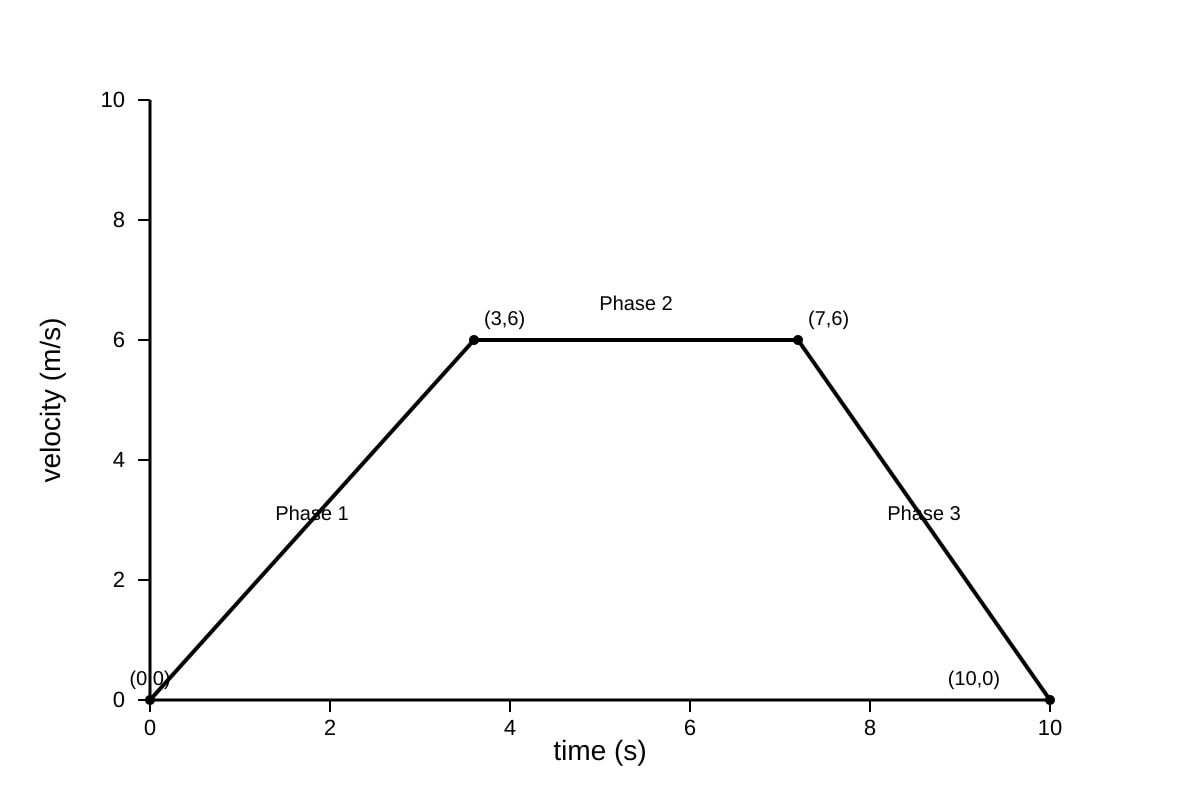
17. A car moves as shown in the velocity-time graph below.
Image pending generation: graph for Q17.
(a) Find acceleration in first 3 s. [1]
(b) Calculate total distance travelled. [2]
18. A 10 kg child slides down a vertical rope with acceleration 2 m s−2. Find frictional force. (g=10 m s−2)
19. A block of mass 4 kg is on a rough incline at 30∘. Coefficient of friction 0.3. Does it slide? Show working.
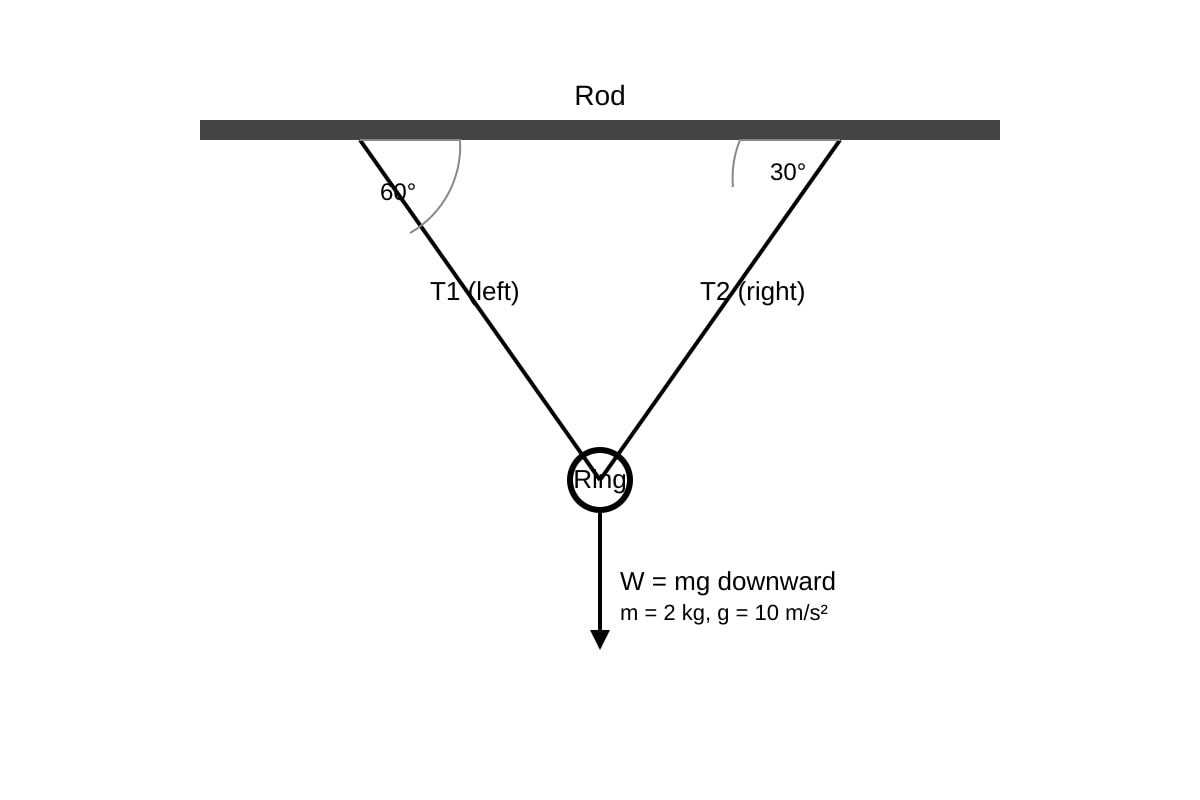
20. A ring of mass 2 kg is suspended by two strings at 60∘ and 30∘ to the horizontal as shown. Find tensions T1 and T2.
Image pending generation: diagram for Q20.
Answers
TuitionGoWhere Practice Paper - Physics Secondary 3 (Answers)
Version 2 of 5 — Answer Key & Teaching Notes
Section A (10 marks)
1. C [1]
Teaching note: Velocity has magnitude and direction → vector. Mass, temperature, time are scalars.
2. B [1]
v=20100=5 m/s.
3. B [1]
Newton (N) is unit of force.
4. C [1]
W=mg=4×10=40 N.
5. B [1]
Moment = Force × perpendicular distance.
6. B [1]
P=AF.
7. B [1]
Normal force from table acts upwards on block.
8. C [1]
Gradient of v-t graph = acceleration.
9. B [1]
KE=21mv2.
10. B [1]
Resultant = 32+42=5 N.
Section B (12 marks)
11. [2]
a=tv−u=48−0=2 m s−2.
Mark: 2 for correct substitution and answer.
12. [2]
ΔPE=mgh=2×10×3=60 J.
Mark: 1 for formula, 1 for answer.
13. [2]
M=F×d=20×0.5=10 N m.
Mark: 1 formula, 1 answer.
14. [2]
a=mF=510=2 m s−2.
Mark: 1 formula, 1 answer.
15. [2]
By Pascal: A2F2=A1F1⇒F2=50×0.010.1=500 N.
Mark: 1 method, 1 answer.
16. [2]
P=AF=0.05200=4000 Pa.
Mark: 1 formula, 1 answer.
Section C (18 marks)
17. [3]
(a) [1] a=3−06−0=2 m s−2.
(b) [2] Distance = area: triangle1 21×3×6=9, rect 4×6=24, triangle2 21×3×6=9; total = 42 m.
Marks: 1 for acc, 2 for total area.
18. [3]
Downward positive: mg−f=ma
10×10−f=10×2⇒100−f=20⇒f=80 N.
Marks: 1 eq, 1 sub, 1 ans.
19. [3]
Parallel weight = mgsin30=4×10×0.5=20 N.
Normal = mgcos30=40×0.866=34.6 N.
Max friction = μN=0.3×34.6=10.4 N.
Since 20 > 10.4, block slides.
Marks: 1 comp, 1 friction, 1 conclusion.
20. [3]
Vertical: T1sin60+T2sin30=20.
Horizontal: T1cos60=T2cos30.
Solve: T1=10 N,T2=17.3 N.
Marks: 1 eqs, 2 values.
Free quiz and exam paper access
Enter your details to view this paper
Your access is remembered on this device.