AI Generated Exam Paper
Secondary 3 Physics Practice Paper 1
Free Kimi AI-generated Sec 3 Physics Practice Paper 1 with questions, answers, and O Level-style practice for Singapore students preparing for exams.
These static practice materials are generated from the site's syllabus and paper-generation workflow, with source and model context shown so students and parents can evaluate the material before use.
Questions
TuitionGoWhere Practice Paper - Physics Secondary 3
TuitionGoWhere Practice Paper (AI) — Version 1
| Subject: | Physics |
| Level: | Secondary 3 |
| Paper: | Practice Paper (Mechanics Focus) |
| Duration: | 1 hour 15 minutes |
| Total Marks: | 60 |
Name: _________________________ Class: __________ Date: __________
Instructions
- Answer all questions.
- Write your answers in the spaces provided.
- Show all working clearly. Marks will be awarded for correct methods even if the final answer is incorrect.
- For calculations, give answers to 2 or 3 significant figures where appropriate.
- The use of calculators is permitted.
- Take or where required.
Section A: Multiple Choice [10 marks]
Answer all questions. Each question carries 1 mark.
Questions 1–10
1. Which of the following is a vector quantity?
| A | mass |
| B | time |
| C | speed |
| D | velocity |
Answer: __________
2. A car accelerates uniformly from rest to in 5 s. What is its acceleration?
| A | |
| B | |
| C | |
| D |
Answer: __________
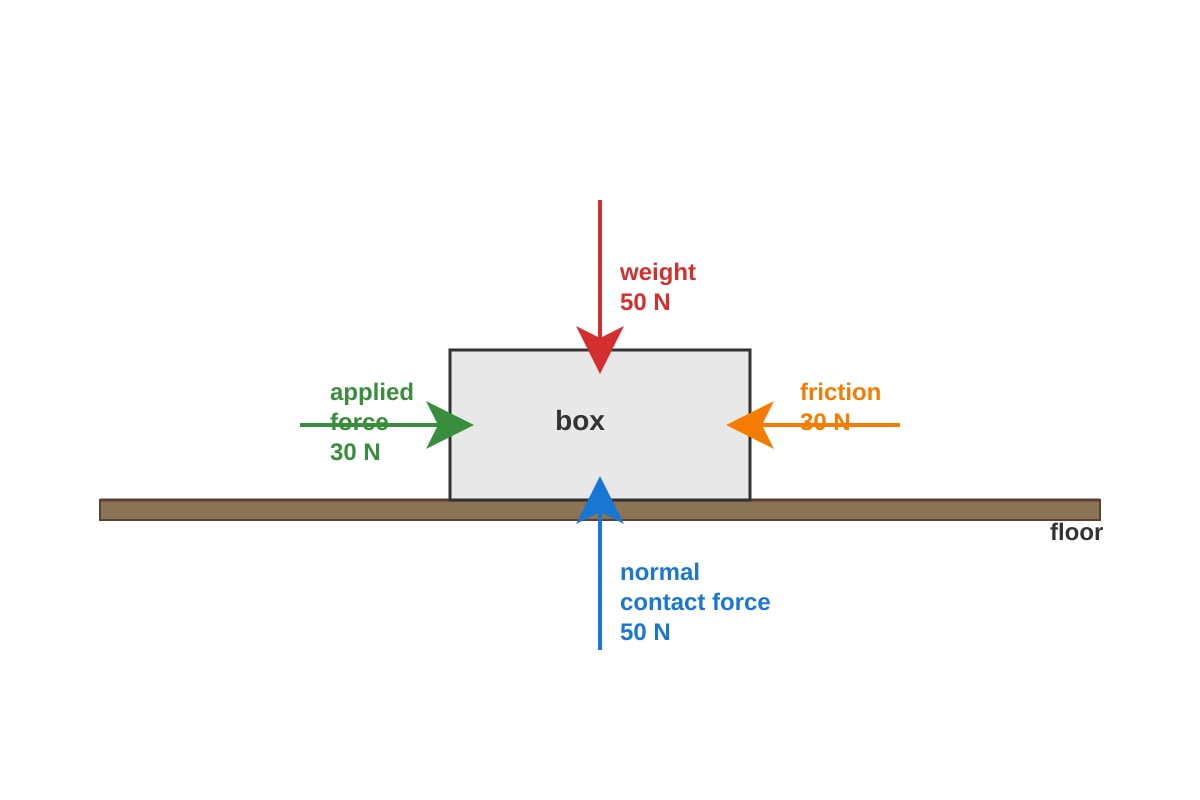
3. The diagram shows the forces acting on a box resting on a horizontal surface.
<image_placeholder> id: Q3-fig1 type: diagram linked_question: Q3 description: A rectangular box on a horizontal floor with four labelled arrows: 50 N arrow pointing down labelled "weight", 50 N arrow pointing up from surface labelled "normal contact force", 30 N arrow pointing right labelled "applied force", and 30 N arrow pointing left labelled "friction" labels: box, floor, weight (50 N, down), normal contact force (50 N, up), applied force (30 N, right), friction (30 N, left) values: weight = 50 N, normal force = 50 N, applied force = 30 N, friction = 30 N must_show: All four force vectors with correct directions and labelled magnitudes; box clearly centred; horizontal surface shown </image_placeholder>
What is the resultant force on the box?
| A | |
| B | |
| C | |
| D |
Answer: __________
4. A ball is thrown vertically upward. At the highest point of its motion, which statement is correct?
| A | The acceleration is zero. |
| B | The velocity is maximum. |
| C | The velocity is zero and the acceleration is downward. |
| D | The velocity and acceleration are both zero. |
Answer: __________
5. Which property of a body can be measured in newtons?
| A | density |
| B | mass |
| C | volume |
| D | weight |
Answer: __________
6. A stone is dropped from the top of a tall building. It reaches the ground after 3 s. Ignoring air resistance, what is the height of the building?
| A | |
| B | |
| C | |
| D |
Answer: __________
7. The momentum of an object is calculated using which formula?
| A | momentum = mass × acceleration |
| B | momentum = mass × velocity |
| C | momentum = force × time |
| D | momentum = force × distance |
Answer: __________
8. A lever is used to lift a heavy load with a small effort. Which principle explains why this is possible?
| A | Conservation of energy |
| B | Principle of moments |
| C | Newton's first law |
| D | Principle of inertia |
Answer: __________
9. A cyclist travels due north, then turns and travels due east. What is the magnitude of the cyclist's displacement from the starting point?
| A | |
| B | |
| C | |
| D |
Answer: __________
10. A ball of mass moving at collides with a wall and rebounds with the same speed. What is the magnitude of the change in momentum of the ball?
| A | |
| B | |
| C | |
| D |
Answer: __________
Section B: Structured Questions [32 marks]
Answer all questions. Write your answers in the spaces provided.
11. A train accelerates uniformly from rest along a straight horizontal track.
(a) Define uniform acceleration. [1]
(b) The train reaches a speed of after accelerating for 50 s. Calculate the acceleration of the train. [2]
(c) The train continues to accelerate at this same rate for a further 30 s. Calculate the final speed of the train. [2]
[5 marks]
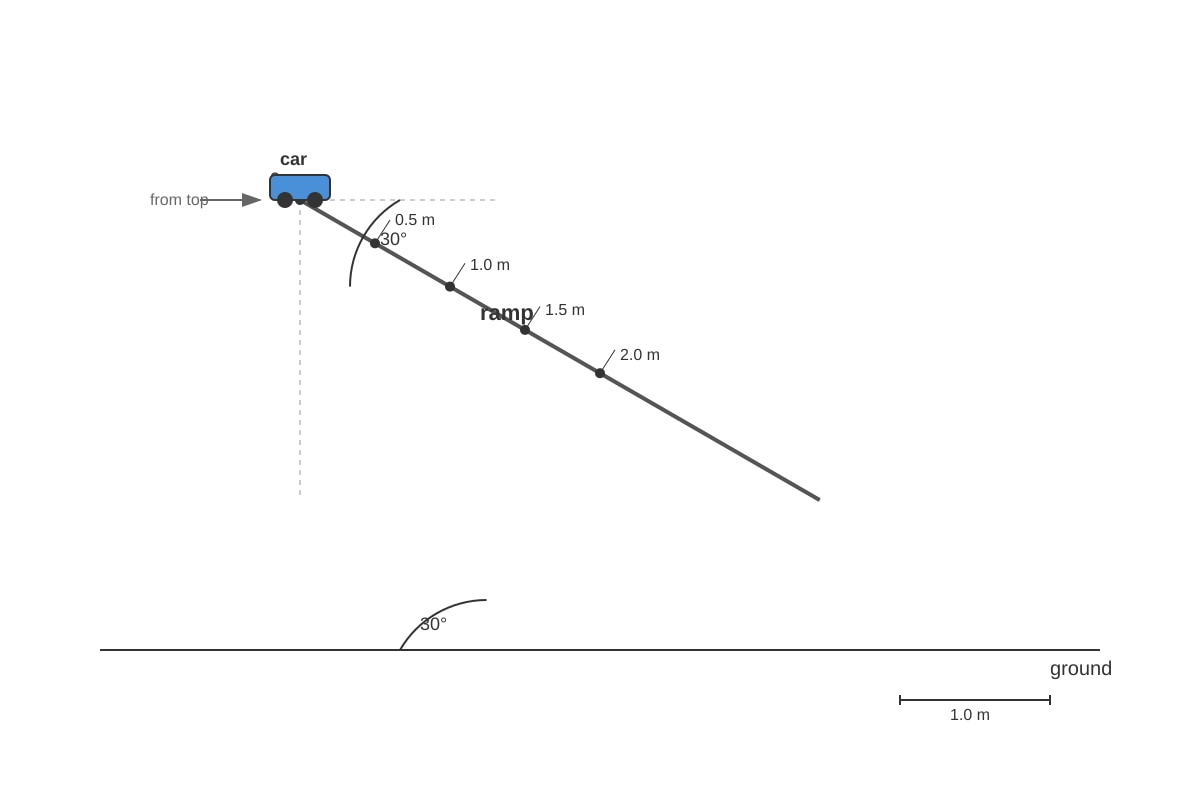
12. A student investigates the motion of a toy car rolling down a ramp.
<image_placeholder> id: Q12-fig1 type: diagram linked_question: Q12 description: Side view of a toy car on an inclined ramp; ramp angle 30 degrees to horizontal; car at top position; distances marked along ramp from top: 0 m, 0.5 m, 1.0 m, 1.5 m, 2.0 m labels: ramp, car, angle 30°, distances: 0 m, 0.5 m, 1.0 m, 1.5 m, 2.0 m from top values: ramp angle = 30°, distance markers every 0.5 m must_show: Ramp clearly inclined at 30°; car at top; evenly spaced distance markers along ramp surface; horizontal ground shown at bottom </image_placeholder>
(a) Add to the diagram an arrow to show the direction of the gravitational force acting on the car. Label this arrow W. [1]
(b) The mass of the car is . Calculate the weight of the car. [1]
(c) Explain why the car accelerates as it rolls down the ramp. [2]
(d) The car takes 1.5 s to travel the first from rest. Calculate its average speed for this part of the motion. [2]
(e) Suggest one reason why the acceleration of the car is less than . [1]
[7 marks]
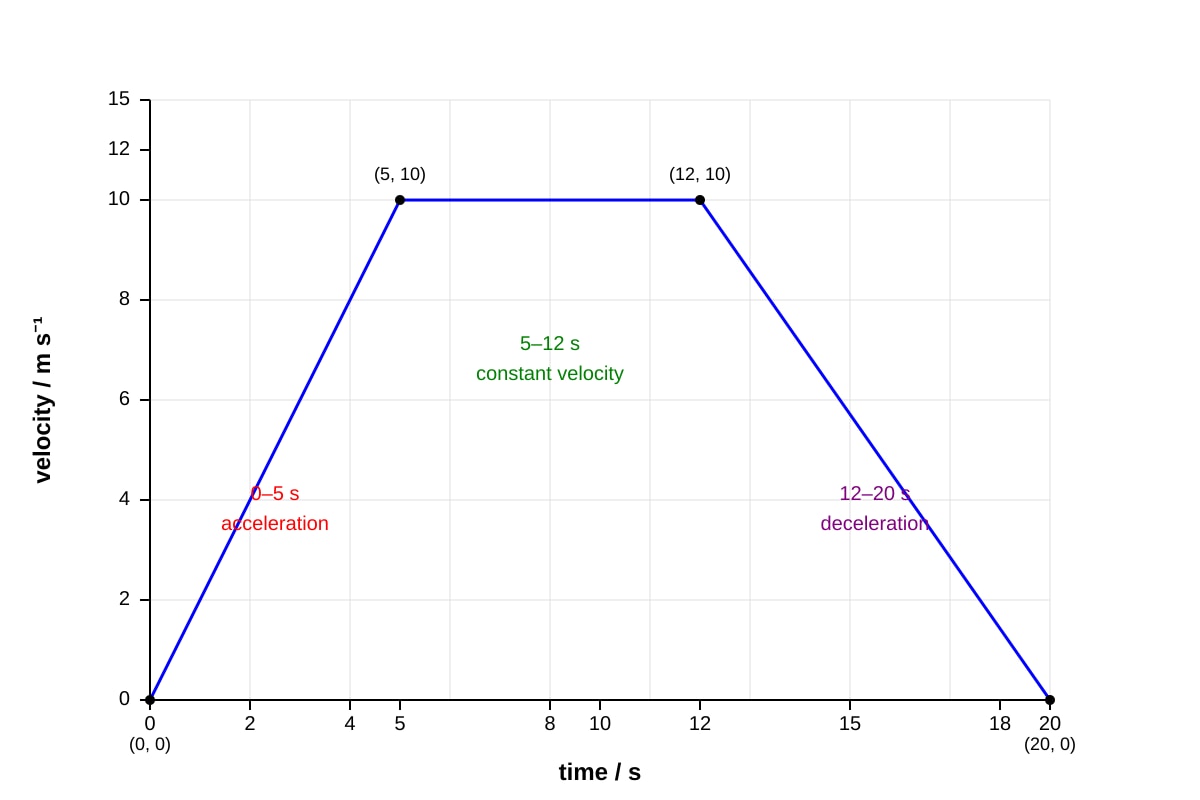
13. The velocity-time graph below shows the motion of a bus along a straight road.
<image_placeholder> id: Q13-fig1 type: graph linked_question: Q13 description: Velocity-time graph for a bus; horizontal axis time (s) from 0 to 20 s; vertical axis velocity (m s^-1) from 0 to 15; graph consists of straight line from (0, 0) to (5, 10), then horizontal line from (5, 10) to (12, 10), then straight line from (12, 10) to (20, 0) labels: axes: time/s, velocity/m s^-1; key points: (0,0), (5,10), (12,10), (20,0); regions labelled: 0-5 s acceleration, 5-12 s constant velocity, 12-20 s deceleration values: 0-5 s: acceleration to 10 m s^-1; 5-12 s: constant 10 m s^-1; 12-20 s: deceleration to rest must_show: Clearly labelled axes with units; three distinct straight-line segments; numerical values at key points; grid background implied for area calculation </image_placeholder>
(a) State the velocity of the bus during the period of constant velocity. [1]
(b) Calculate the acceleration of the bus during the first 5 s. [2]
(c) Calculate the total distance travelled by the bus in 20 s. [3]
(d) Describe the motion of the bus between 12 s and 20 s. [1]
[7 marks]
14. A block is pulled along a rough horizontal surface by a horizontal force of . The block moves at constant velocity.
(a) State Newton's First Law of Motion. [2]
(b) Explain, using Newton's laws, why the block moves at constant velocity although a force is applied. [2]
(c) Calculate the magnitude of the frictional force acting on the block. [1]
(d) The pulling force is suddenly increased to . Calculate the resultant force on the block and state the direction of the acceleration. [2]
[7 marks]
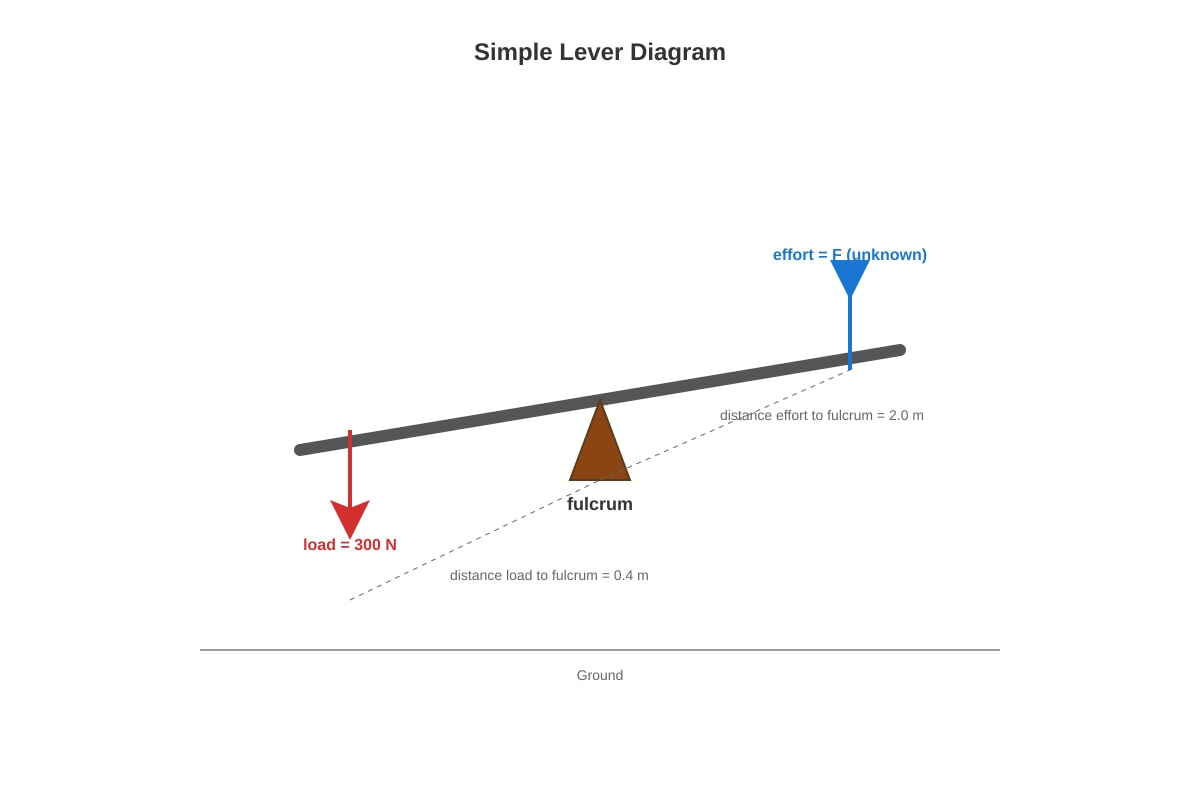
15. A simple lever is used to lift a heavy rock as shown.
<image_placeholder> id: Q15-fig1 type: diagram linked_question: Q15 description: A simple lever with fulcrum; load of 300 N at 0.4 m from fulcrum on left side; effort force F applied on right side at 2.0 m from fulcrum; lever shown tilted slightly with load end down and effort end up labels: fulcrum, load = 300 N, distance load to fulcrum = 0.4 m, effort = F (unknown), distance effort to fulcrum = 2.0 m values: load = 300 N, load arm = 0.4 m, effort arm = 2.0 m must_show: Fulcrum clearly marked; load and effort on opposite sides; perpendicular distances labelled with values; lever beam shown </image_placeholder>
(a) Define the moment of a force about a pivot. [2]
(b) Calculate the moment of the load about the fulcrum. [2]
(c) Calculate the effort force needed to balance the lever, assuming the lever itself has negligible weight. [2]
(d) Explain one practical way to reduce the effort needed to lift the rock without changing the positions of the load and fulcrum. [1]
[6 marks]
Section C: Longer Structured Question [18 marks]
Answer all parts of this question.
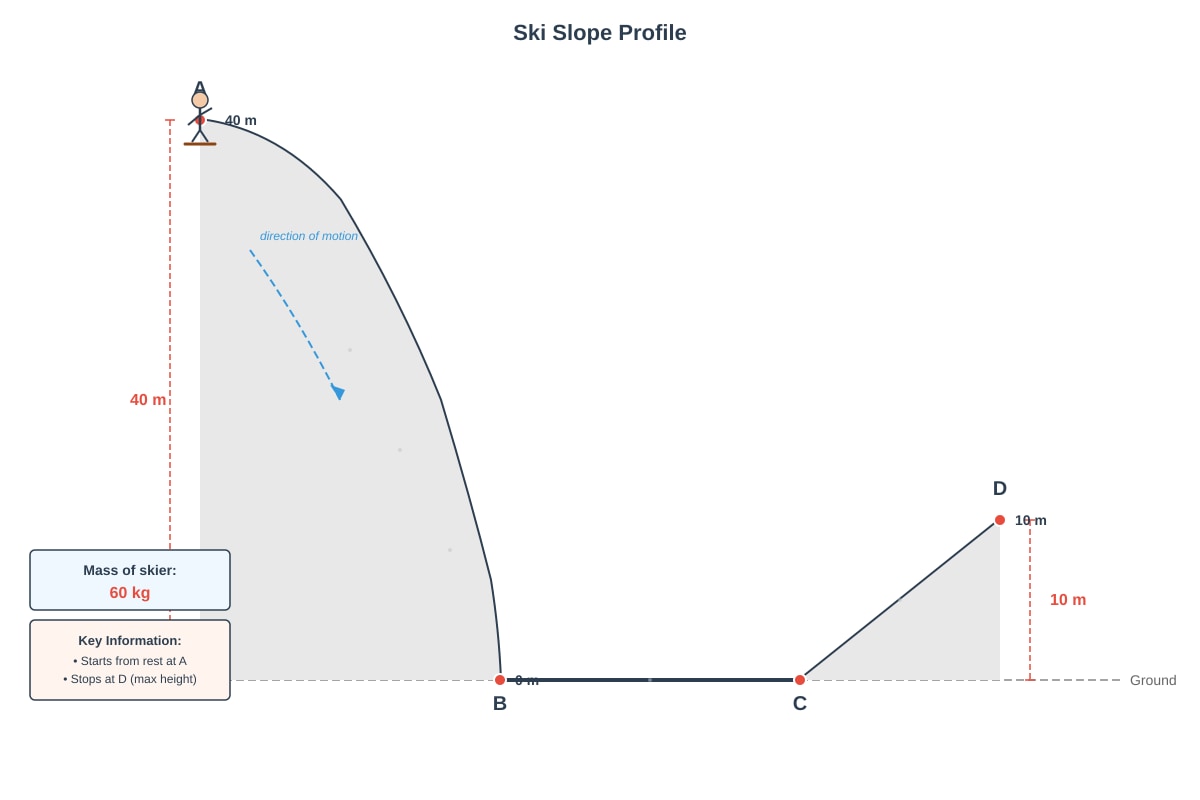
16. This question is about force, motion, and energy. A skier of mass slides from rest down a curved ski slope.
<image_placeholder> id: Q16-fig1 type: diagram linked_question: Q16 description: Side view of curved ski slope; skier starts at rest at point A (top, height 40 m); slides down to point B (bottom, height 0 m); continues on horizontal section to point C; another point D shown on upward slope where skier reaches maximum height of 10 m before stopping labels: points A, B, C, D; heights: A = 40 m, B = 0 m, D = 10 m; horizontal distance B to C not specified; skier shown initially at A values: mass of skier = 60 kg; height at A = 40 m; height at D = 10 m; starts from rest at A must_show: Curved slope from A to B; horizontal section B to C; shallow upward slope after C to D; heights labelled vertically from ground level; points clearly labelled; skier figure at A </image_placeholder>
(a) The skier starts from rest at point A, which is above the ground.
(i) Calculate the gravitational potential energy of the skier at point A. [2]
(ii) State the principle of conservation of energy. [2]
(b) Assuming no friction and no air resistance, calculate the speed of the skier at point B. [3]
(c) In practice, friction and air resistance are present. The skier reaches point D at a maximum height of on the upward slope after passing B and C.
(i) Calculate the total energy lost due to friction and air resistance between A and D. [3]
(ii) Explain why the skier eventually comes to rest at or before point D, even though energy is conserved in the universe as a whole. [2]
(d) At point C on the horizontal section, the skier is moving at . A constant braking force of is then applied to stop the skier.
(i) Calculate the deceleration of the skier due to the braking force. [2]
(ii) Calculate the stopping distance from point C. [3]
(e) Suggest one way in which the design of the skier's clothing reduces air resistance. [1]
[18 marks]
END OF PAPER
[Stage 5 Quiz: Mechanics — 20 Questions]
Secondary 3 Physics Quiz - Mechanics
Name: _________________________ Class: __________ Date: __________
Duration: 30 minutes Total Marks: 40 Instructions: Answer all questions. Show working for calculation questions.
Section A: Multiple Choice [10 marks]
Questions 1–10
1. Which of the following quantities is a scalar?
| A | displacement |
| B | force |
| C | velocity |
| D | speed |
Answer: __________
2. A car travels in 30 minutes. What is its average speed in ?
| A | |
| B | |
| C | |
| D |
Answer: __________
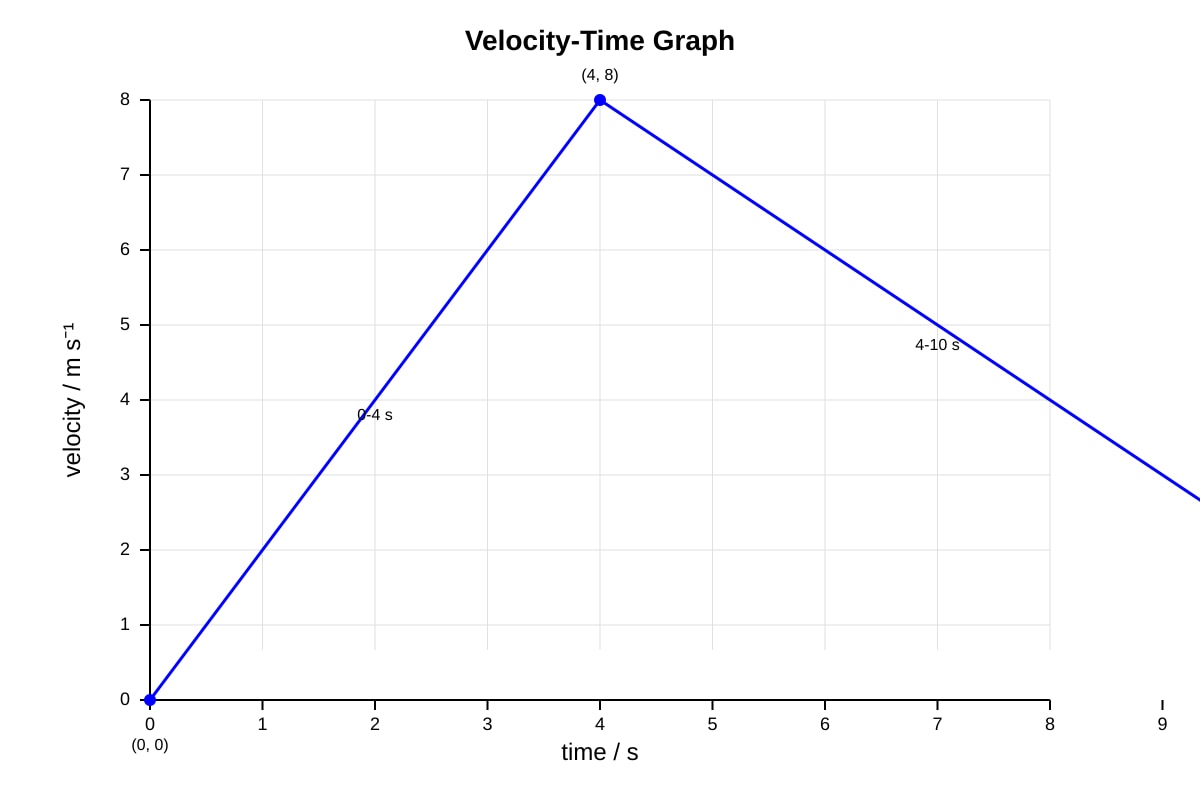
3. The diagram shows a velocity-time graph for a moving object.
<image_placeholder> id: Q3-quiz-fig1 type: graph linked_question: Q3-quiz description: Velocity-time graph with velocity on y-axis (0 to 8 m s^-1) and time on x-axis (0 to 10 s); straight line from (0, 0) to (4, 8), then straight line from (4, 8) to (10, 2) labels: axes: time/s, velocity/m s^-1; points: (0,0), (4,8), (10,2); segments: 0-4 s, 4-10 s values: 0-4 s: acceleration to 8 m s^-1; 4-10 s: deceleration to 2 m s^-1 must_show: Clearly labelled axes with units; two straight-line segments; numerical values at end points; grid background </image_placeholder>
What is the acceleration during the first 4 seconds?
| A | |
| B | |
| C | |
| D |
Answer: __________
4. A book of weight rests on a table. What is the resultant force acting on the book?
| A | |
| B | downward |
| C | upward |
| D | downward |
Answer: __________
5. Which of the following describes Newton's Second Law of Motion?
| A | A body remains at rest or moves with constant velocity unless acted upon by a resultant force. |
| B | For every action there is an equal and opposite reaction. |
| C | The rate of change of momentum is directly proportional to the resultant force. |
| D | Force is equal to mass divided by acceleration. |
Answer: __________
6. A force of acts on an object of mass . What is the acceleration produced?
| A | |
| B | |
| C | |
| D |
Answer: __________
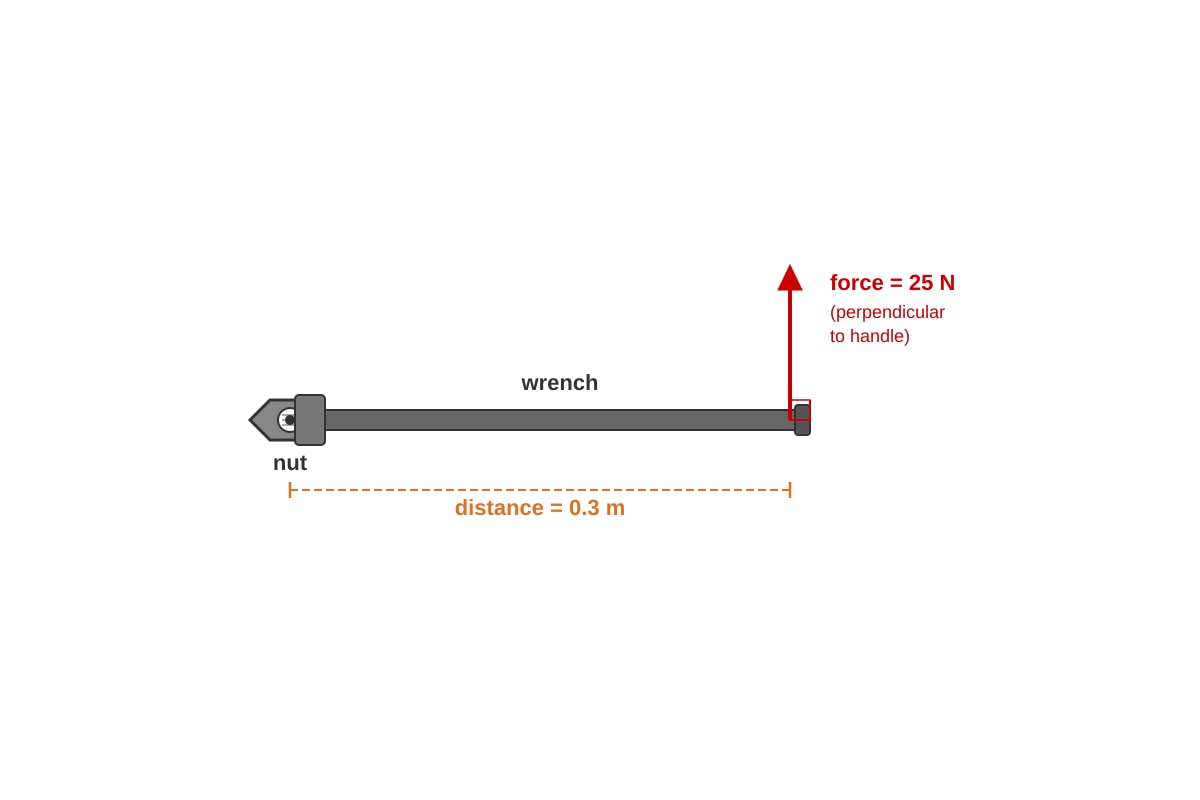
7. The diagram shows a force being applied to a wrench to turn a nut.
<image_placeholder> id: Q7-quiz-fig1 type: diagram linked_question: Q7-quiz description: A wrench with one end on a nut; force of 25 N applied at other end perpendicular to wrench handle; distance from center of nut to point of force application is 0.3 m labels: nut, wrench, force = 25 N (perpendicular to handle), distance = 0.3 m values: force = 25 N, perpendicular distance = 0.3 m must_show: Wrench clearly shown; nut at pivot point; force arrow perpendicular to handle; distance labelled along handle </image_placeholder>
What is the moment of the force about the centre of the nut?
| A | |
| B | |
| C | |
| D |
Answer: __________
8. A ball is thrown vertically upwards with an initial velocity of . Neglecting air resistance, how long does it take to reach its maximum height?
| A | 1.0 s |
| B | 2.0 s |
| C | 10 s |
| D | 20 s |
Answer: __________
9. Two objects collide and stick together. Which quantity is always conserved in this collision?
| A | kinetic energy |
| B | total momentum |
| C | potential energy |
| D | velocity |
Answer: __________
10. A load of is lifted using a system of two pulleys as shown.
<image_placeholder> id: Q10-quiz-fig1 type: diagram linked_question: Q10-quiz description: A single fixed pulley and single movable pulley system (block and tackle); load of 400 N attached to movable pulley; effort force F pulls downward on free end of rope; rope passes around fixed pulley then around movable pulley labels: fixed pulley, movable pulley, load = 400 N, effort = F values: load = 400 N, assuming ideal mechanical advantage of 2 must_show: Two pulleys with rope threading; load clearly attached to movable pulley; effort direction shown; pulley supports shown </image_placeholder>
Assuming the pulley system is ideal (no friction, massless pulleys and rope), what is the effort force required to lift the load at constant speed?
| A | |
| B | |
| C | |
| D |
Answer: __________
Section B: Short Answer and Structured [18 marks]
Questions 11–16
11. Define the following terms:
(a) Distance [1]
(b) Displacement [1]
(c) Explain one situation where the distance travelled by an object is greater than its displacement. [1]
[3 marks]
12. A cyclist starts from rest and accelerates uniformly at along a straight road.
(a) Calculate the velocity of the cyclist after 6 s. [2]
(b) Calculate the distance travelled by the cyclist in the first 6 s. [2]
(c) After 6 s, the cyclist stops pedalling and the bicycle slows down due to air resistance. Explain why the bicycle slows down using Newton's laws of motion. [2]
[6 marks]
13. The diagram shows a vehicle with a uniform weight of supported by two bridges.
<image_placeholder> id: Q13-quiz-fig1 type: diagram linked_question: Q13-quiz description: A uniform horizontal beam representing a vehicle supported at two points X and Y; support X at left end, support Y at 2/3 along from left; total length 6 m shown; center of gravity at midpoint (3 m from left) with weight 8000 N acting downward labels: X (left support), Y (right support), weight 8000 N at center, distances: X to weight = 3 m, X to Y = 4 m, Y to right end = 2 m values: weight = 8000 N, total length = 6 m, X to CG = 3 m, X to Y = 4 m, Y to right end = 2 m must_show: Uniform beam; two support points clearly labelled; center of gravity marked at midpoint; weight arrow; all relevant distances labelled </image_placeholder>
(a) Explain why a uniform object has its centre of gravity at its geometric centre. [1]
(b) By taking moments about support X, calculate the upward force at support Y. [3]
(c) Hence calculate the upward force at support X. [1]
[5 marks]
14. A ball of mass is moving at when it strikes a wall. It rebounds with a velocity of . The contact time with the wall is .
(a) Calculate the change in momentum of the ball. [2]
(b) Calculate the average force exerted by the wall on the ball. [2]
(c) State Newton's Third Law and explain how it applies to this collision. [2]
[6 marks]
Section C: Data Analysis and Extended Response [12 marks]
Questions 17–20
15. (Note: Numbered as 17 in sequence)
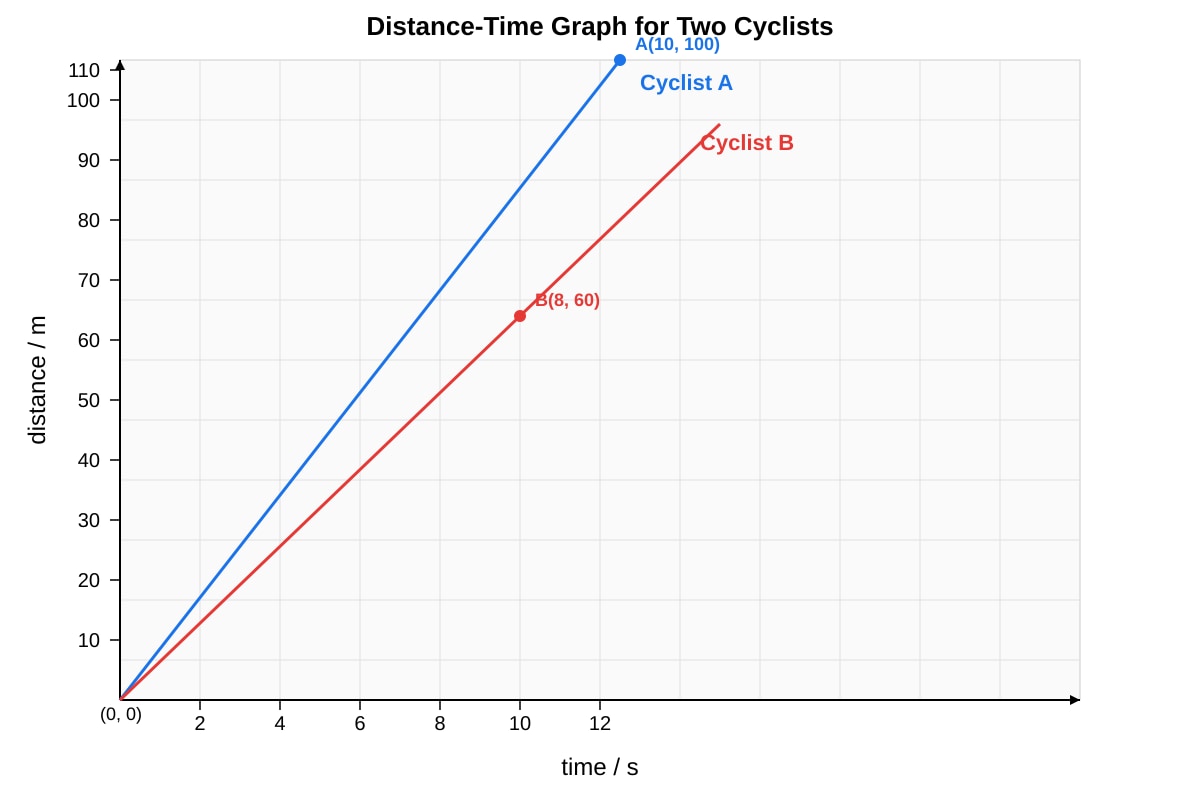
<image_placeholder> id: Q17-quiz-fig1 type: graph linked_question: Q17-quiz description: Distance-time graph for two cyclists A and B; both start from same point at time zero; cyclist A: straight line from (0,0) to (10, 100); cyclist B: straight line from (0,0) passing through point (8, 60) and continuing; x-axis time (s) 0-12, y-axis distance (m) 0-120 labels: axes: time/s, distance/m; line A labelled, line B labelled; key points: A(10, 100), B(8, 60) values: cyclist A: 100 m in 10 s; cyclist B: 60 m in 8 s (and continuing) must_show: Two diverging straight lines from origin; clear labels for A and B; axes with units; numerical values marked </image_placeholder>
The graph shows the motion of two cyclists A and B.
(a) Calculate the speed of cyclist A. [1]
(b) Calculate the speed of cyclist B. [1]
(c) Explain how you can tell from the graph that cyclist A is moving faster than cyclist B. [1]
[3 marks]
18. A student performs an experiment to investigate the relationship between the force applied to a trolley and its acceleration.
(a) State the independent variable and the dependent variable in this experiment. [2]
(b) Describe how the student could measure the acceleration of the trolley using a ticker-tape timer or motion sensor. [3]
(c) Sketch the expected graph of force against acceleration, assuming the total mass of the trolley and its load remains constant. Label your axes. [2]
[7 marks]
19. Explain, using the concept of pressure and force, why a sharp knife cuts through vegetables more easily than a blunt knife. [2]
[2 marks]
20. Read the following passage and answer the questions.
"In September 2023, Singapore's Land Transport Authority conducted trials of autonomous buses on designated routes. These self-driving vehicles use multiple sensors to detect obstacles and adjust their speed accordingly. When an obstacle is detected ahead, the bus decelerates uniformly. Engineers must calculate safe stopping distances at various speeds to ensure passenger safety. At a test speed of , a trial bus took 5 s to come to rest under emergency braking."
(a) Calculate the deceleration of the bus during the emergency braking. [2]
(b) Calculate the stopping distance of the bus. [2]
(c) Explain why the actual stopping distance in practice might be greater than the value calculated. [1]
[5 marks]
END OF QUIZ
Answers
TuitionGoWhere Practice Paper - Physics Secondary 3 (Version 1)
Answer Key and Marking Scheme
Section A: Multiple Choice [10 marks]
| Question | Answer | Explanation |
|---|---|---|
| 1 | D | Velocity is a vector quantity (has magnitude and direction). Mass, time, and speed are scalar quantities (magnitude only). |
| 2 | B | Using . |
| 3 | A | Vertical forces: . Horizontal forces: . Resultant force = . The object is in equilibrium. |
| 4 | C | At maximum height, the ball momentarily stops (velocity = 0) but acceleration due to gravity ( downward) still acts on it. |
| 5 | D | Weight is the gravitational force on a body, measured in newtons. Mass is measured in kg, density in kg m, volume in m. |
| 6 | C | Using . |
| 7 | B | Momentum = mass × velocity. This is a fundamental definition in mechanics. |
| 8 | B | The principle of moments states that for equilibrium, the sum of clockwise moments equals the sum of anticlockwise moments. A small effort at a large distance can balance a large load at a small distance. |
| 9 | C | Using Pythagoras: displacement = . |
| 10 | C | Initial momentum = (toward wall). Final momentum = (away from wall). Change = . Magnitude = . |
Section B: Structured Questions [32 marks]
Question 11 [5 marks]
(a) Uniform acceleration is constant rate of change of velocity / velocity changes by equal amounts in equal time intervals [1]
(b) Calculation:
- [1]
- [1]
(c) Calculation:
- [1]
- [1]
[Total: 5 marks]
Question 12 [7 marks]
(a) Arrow drawn vertically downward from centre of car, labelled W [1]
(b) Weight = [1]
(c) Explanation:
- There is a component of the weight acting down the slope [1]
- This component is unbalanced (or: net force down the slope), so by Newton's Second Law, the car accelerates down the slope [1]
(d) Average speed = [2] (Allow or )
(e) Reason: friction between car and ramp / air resistance acting against motion [1]
[Total: 7 marks]
Question 13 [7 marks]
(a) [1] (read directly from horizontal section of graph)
(b) Calculation:
- [1]
- [1]
(c) Calculation:
- Distance = total area under graph [1]
- Area 1 (0-5 s): [0.5]
- Area 2 (5-12 s): [0.5]
- Area 3 (12-20 s): [0.5]
- Total distance = [0.5]
(d) The bus is decelerating uniformly / slowing down at a constant rate (from to rest) [1]
[Total: 7 marks]
Question 14 [7 marks]
(a) Newton's First Law: A body remains at rest, or continues to move with uniform velocity (constant speed in a straight line), unless acted upon by a resultant external force [2] (Mark breakdown: state change in motion [1]; state condition of resultant force/not acted upon by resultant force [1])
(b) Explanation:
- By Newton's First Law, constant velocity means zero resultant force [1]
- The applied force of 12 N is balanced by an equal and opposite frictional force of 12 N, so resultant force is zero [1]
(c) Frictional force = [1] (by Newton's First Law, must equal applied force for constant velocity)
(d) Calculation:
- Resultant force = [1]
- Direction of acceleration: in the direction of the pulling force / to the right / forward [1]
[Total: 7 marks]
Question 15 [6 marks]
(a) The moment of a force about a pivot is the product of the force and the perpendicular distance from the pivot to the line of action of the force [2] (Mark breakdown: product/force × distance [1]; perpendicular distance/from pivot to line of action [1])
(b) Calculation:
- Moment = force × perpendicular distance [1]
- Moment = (clockwise) [1]
(c) Calculation:
- For equilibrium, sum of clockwise moments = sum of anticlockwise moments [0.5]
- [0.5]
- [1]
(d) Increase the effort arm / move the effort force further from the fulcrum / use a longer lever on the effort side [1]
[Total: 6 marks]
Section C: Longer Structured Question [18 marks]
Question 16 [18 marks]
(a)(i) Calculation:
- GPE = [1]
- GPE = [1]
(a)(ii) Principle of conservation of energy: Energy cannot be created or destroyed, but can only be converted from one form to another / the total energy in a closed system remains constant [2] (Mark breakdown: energy not created or destroyed [1]; converted from one form to another/total energy constant [1])
(b) Calculation:
- By conservation of energy: loss in GPE = gain in KE [1]
- [1]
- (mass cancels)
- [1] (accept to 2 s.f.)
(c)(i) Calculation:
- GPE at A = [0.5]
- GPE at D = [1]
- Energy lost = [1.5] (Alternative: KE at B would be 24000 J; max possible height with no energy loss = 40 m; actual at 10 m, so energy lost = J)
(c)(ii) Explanation:
- Energy is transferred from the skier to the surroundings [1]
- Work is done against friction and air resistance, converting mechanical energy to thermal energy (and sound) [1]
(d)(i) Calculation:
- [1]
- [1] (magnitude; deceleration is opposite to motion)
(d)(ii) Calculation:
- Using with [1]
- [1]
- [1]
(e) Tight-fitting / streamlined clothing / aerodynamic helmet / smooth fabrics reduce turbulent airflow and drag [1]
[Total: 18 marks]
GRAND TOTAL: 60 marks
Secondary 3 Physics Quiz - Mechanics: Answer Key
Total Marks: 40
Section A: Multiple Choice [10 marks]
| Question | Answer | Mark | Explanation |
|---|---|---|---|
| 1 | D | 1 | Speed is a scalar (magnitude only). Displacement, force, and velocity are vectors (magnitude and direction). |
| 2 | B | 1 | Time = 30 min = 1800 s; Distance = 40000 m; Average speed = |
| 3 | B | 1 | Gradient = |
| 4 | A | 1 | The book is in equilibrium. Weight (15 N down) is balanced by normal contact force from table (15 N up). Resultant force = 0 N. |
| 5 | C | 1 | Newton's Second Law: resultant force = rate of change of momentum (). Option A is Newton's First Law; B is Newton's Third Law. |
| 6 | B | 1 | |
| 7 | A | 1 | Moment = |
| 8 | B | 1 | |
| 9 | B | 1 | In any collision (elastic or inelastic), total momentum is always conserved. Kinetic energy is only conserved in perfectly elastic collisions. |
| 10 | B | 1 | For ideal single fixed + single movable pulley: MA = 2, so |
Section B: Short Answer and Structured [18 marks]
Question 11 [3 marks]
(a) Distance is the total length of the path travelled by an object / the scalar quantity measuring how far an object has moved [1]
(b) Displacement is the straight-line distance from the initial to the final position, together with the direction / the vector quantity measuring change in position [1]
(c) Any situation where the object returns toward its starting point or follows a curved path, e.g.: A person walks 5 m east then 3 m west — distance = 8 m but displacement = 2 m east; or running around a track — distance is circumference but displacement is zero after one lap [1]
Question 12 [6 marks]
(a) Calculation:
- [1]
- [1]
(b) Calculation:
- or [1]
- [1] (Or using )
(c) Explanation:
- Air resistance provides a resultant force opposing the motion [1]
- By Newton's Second Law, this resultant force produces a deceleration (negative acceleration), causing the bicycle to slow down [1]
Question 13 [5 marks]
(a) A uniform object has its mass evenly distributed throughout its volume, so the centre of gravity (the point where the whole weight appears to act) is at the geometric centre [1]
(b) Calculation by moments about X:
- Anticlockwise moment from weight = [1]
- Clockwise moment from force at Y = [1]
- For equilibrium: [0.5]
- [0.5]
(c) Calculation:
- Total upward force = total downward force [0.5]
- [0.5]
Question 14 [6 marks]
(a) Calculation:
- Change in momentum = final momentum – initial momentum [0.5]
- Taking direction toward wall as positive: [0.5]
- [0.5]
- Magnitude of change = (or state with direction reversed) [0.5]
(b) Calculation:
- or [1]
- [1]
(c) Statement and application:
- Newton's Third Law: When body A exerts a force on body B, body B exerts a force of equal magnitude, opposite direction, on body A [1]
- The wall exerts a force on the ball to reverse its motion; simultaneously the ball exerts an equal and opposite force on the wall [1]
Section C: Data Analysis and Extended Response [12 marks]
Question 17 [3 marks]
(a) Speed of A = gradient = [1]
(b) Speed of B = gradient = [1]
(c) The gradient of line A is steeper than the gradient of line B / line A is steeper than line B / for the same time, cyclist A covers more distance [1]
Question 18 [7 marks]
(a) Independent variable: Force applied to trolley [1] Dependent variable: Acceleration of trolley [1]
(b) Method description:
- Attach ticker tape to trolley; thread through ticker-tape timer [1]
- Timer marks dots at 50 Hz (every 0.02 s); analyze spacing between dots to find velocity changes [1]
- Or: use motion sensor connected to data logger to record position-time data, then software calculates velocity and acceleration [1]
- Acceleration found from gradient of velocity-time graph or from [1] (Any coherent method with valid physics scores; maximum 3 marks)
(c) Sketch description: [2]
- Straight line passing through origin [1]
- Axes labelled: vertical acceleration/, horizontal force/N [1]
- (Note: when mass constant, so linear relationship through origin)
Question 19 [2 marks]
- Pressure = force/area [1]
- A sharp knife has a smaller contact area than a blunt knife, so for the same applied force, it produces greater pressure, cutting more easily [1]
Question 20 [5 marks]
(a) Calculation:
- [1]
- , so deceleration = [1]
(b) Calculation:
- [1]
- [1] (Or: m)
(c) Explanation: reaction time of autonomous system / sensors may have detection delay / braking system response time / friction less than ideal / wet road conditions / not uniform deceleration [1]
QUIZ TOTAL: 40 marks