AI Generated Exam Paper
Secondary 3 Physics Practice Paper 1
Free Sec 3 Physics Practice Paper 1, HY3 AI version, with questions, answers, and O Level-style practice for Singapore students.
These static practice materials are generated from the site's syllabus and paper-generation workflow, with source and model context shown so students and parents can evaluate the material before use.
Questions
TuitionGoWhere Practice Paper - Physics Secondary 3
TuitionGoWhere Practice Paper (AI) — Version 1 of 5
Subject: Physics
Level: Secondary 3
Paper: Practice Paper (Mechanics Topic Set)
Duration: 60 minutes
Total Marks: 40
Name: ________________________
Class: ____________
Date: ____________
Instructions:
- This practice paper contains 20 questions on Mechanics only.
- Section A: 10 short questions (1 mark each). Section B: 6 structured questions (2 marks each). Section C: 4 extended questions (3 marks each).
- Use g=10 m s−2 where needed.
- Show all working clearly. Write units in your final answers.
- Section marks and question marks add up exactly to 40.
Section A (10 marks, Questions 1–10, 1 mark each)
1. Which of the following is a vector quantity?
A) Speed
B) Distance
C) Force
D) Mass
2. A car travels 100 m in 20 s at constant speed. What is its average speed?
A) 2 m/s
B) 5 m/s
C) 10 m/s
D) 20 m/s
3. The unit of force is the ______.
4. Weight is calculated using the formula W= ______.
5. Moment of a force about a pivot is given by force × ______ distance from pivot.
6. Pressure is defined as force per unit ______.
7. In a velocity-time graph, the gradient represents ______.
8. A book of mass 0.5 kg has weight = ______ N. (Use g=10 m s−2)
9. The turning effect that makes an object rotate is called ______.
10. Liquid pressure increases with ______.
Section B (12 marks, Questions 11–16, 2 marks each)
11. A boy accelerates from rest to 6 m s−1 in 3 s. Calculate his acceleration.
12. A block of mass 4 kg is pulled with a force of 20 N on a frictionless surface. Find its acceleration.
13. A see-saw is balanced. On the left, a 10 N force acts 2 m from pivot. What is the clockwise moment needed on the right 1 m from pivot?
14. A box of area 0.5 m2 has 100 N pressing on it. Calculate pressure.
15. A 2 kg object is lifted 3 m. Calculate gain in gravitational potential energy. (g=10 m s−2)
16. A car moves at constant velocity. State Newton’s First Law and explain with this example.
Section C (18 marks, Questions 17–20, 3 marks each)
17. A child of mass 30 kg slides down a vertical rope at acceleration 2 m s−2. Find frictional force. (g=10 m s−2)
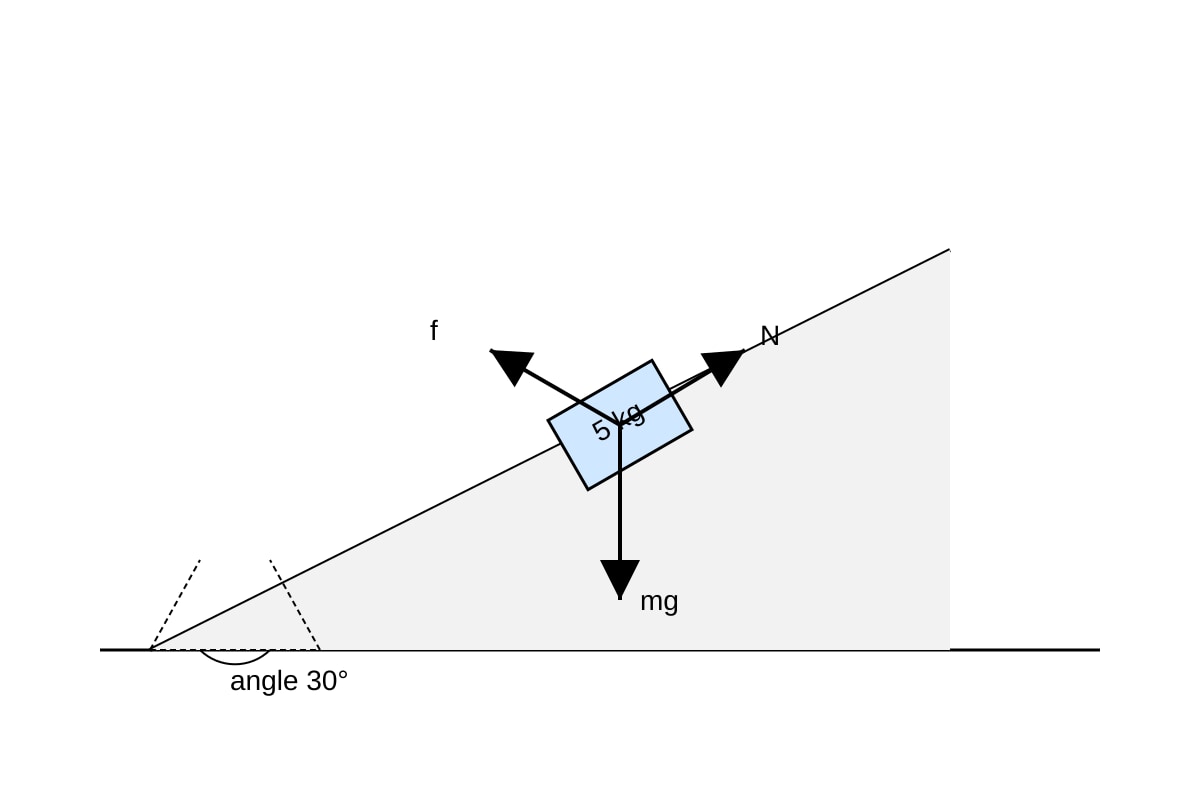
18. A block of mass 5 kg is on a rough inclined plane at 30° to horizontal. Coefficient of friction 0.4.
(a) Calculate component of weight parallel to plane. [1]
(b) Determine if it slides. [2]
Image pending generation: diagram for Q18.
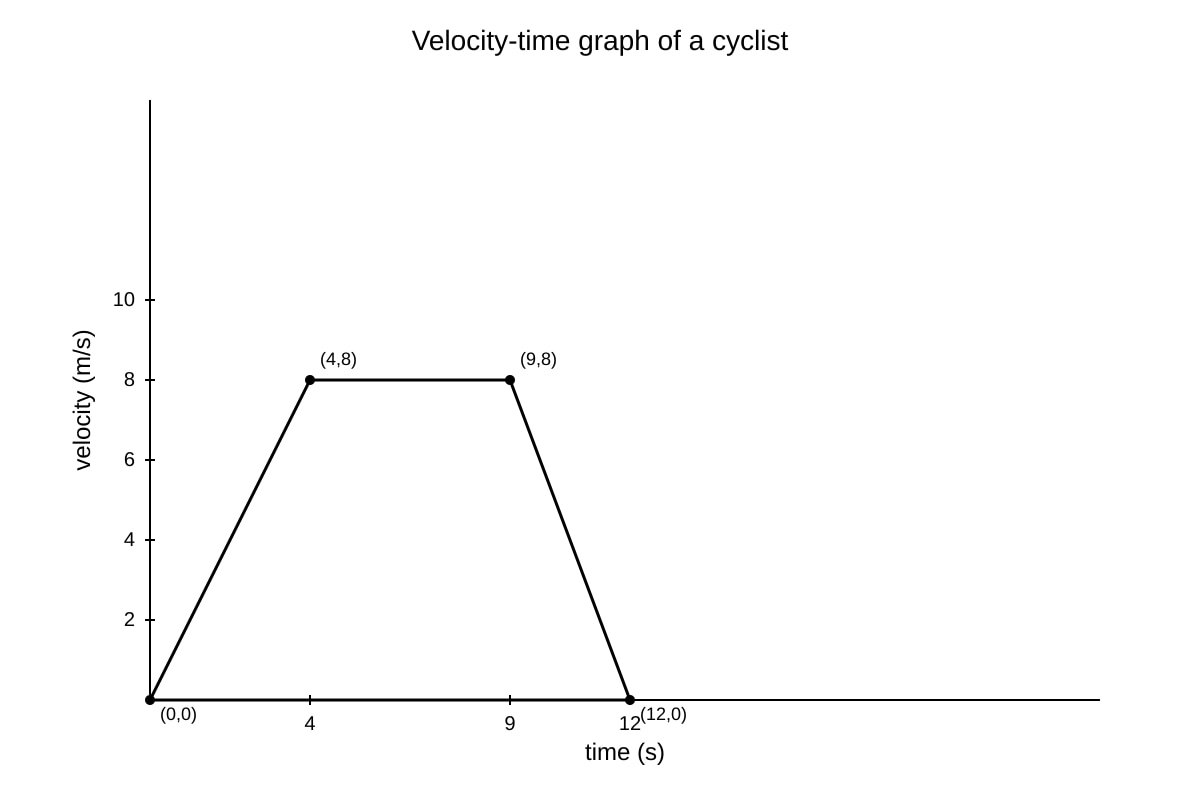
19. Velocity-time graph of a cyclist: 0–4 s accelerates 0 to 8 m/s; 4–9 s constant; 9–12 s decelerates to 0.
(a) Acceleration first 4 s. [1]
(b) Distance in constant part. [1]
(c) Total distance. [1]
Image pending generation: graph for Q19.
20. A 2 kg mass is raised 5 m by 80 N force along a rough vertical rope at constant speed. Calculate work done and energy lost to friction.
Answers
Answer Key — TuitionGoWhere Practice Paper Physics Secondary 3 (Version 1)
Total Marks: 40
Topic: Mechanics
Section A (1 mark each)
1. C Force.
Teaching note: Vector has magnitude + direction. Speed, distance, mass are scalars.
2. B 5 m/s.
v=20100=5 m s−1.
3. newton (N).
SI unit of force.
4. mg (or mass × gravitational field strength).
Weight = mass × g.
5. perpendicular.
Moment = F × perpendicular distance.
6. area.
P=F/A.
7. acceleration.
Gradient of v-t graph = acceleration.
8. 5 N.
W=0.5×10=5 N.
9. moment (or torque).
10. depth.
Liquid pressure ∝ depth.
Section B (2 marks each)
11. a=36−0=2 m s−2. [2]
Method: use a=Δv/t.
12. a=F/m=20/4=5 m s−2. [2]
Newton’s 2nd Law.
13. Anticlockwise moment = 10×2 = 20 Nm. For balance, clockwise = 20 Nm. Force = 20/1 = 20 N. [2]
Principle of moments.
14. P=100/0.5=200 Pa. [2]
15. ΔPE=mgh=2×10×3=60 J. [2]
16. Newton’s First Law: object stays at rest or uniform velocity unless acted by resultant force. [1] Car at constant velocity means forces balanced (e.g. driving force = friction). [1]
Section C (3 marks each)
17. Weight = 30×10 = 300 N down. Net: mg−f=ma → 300−f=30×2=60 → f=240 N. [3]
Common mistake: using a=g.
18. (a) mgsin30°=5×10×0.5=25 N. [1]
(b) Max friction = μmgcos30°=0.4×5×10×0.866=17.3 N. Since 25 > 17.3, slides. [2]
19. (a) a=8/4=2 m s−2. [1]
(b) 8×5=40 m. [1]
(c) Area total = triangle1 (½×4×8=16) + rect (40) + triangle2 (½×3×8=12) = 68 m. [1]
20. Work done = 80×5 = 400 J. [1] GPE gain = 2×10×5 = 100 J. [1] Energy lost = 400-100 = 300 J. [1]
Free quiz and exam paper access
Enter your details to view this paper
Your access is remembered on this device.