AI Generated Exam Paper
Secondary 3 Physics Practice Paper 1
Free AI-Generated Secondary 3 Physics Practice Paper 1 practice paper with questions and answers for Singapore students. This page is rendered as a direct URL so the questions and answers can be discovered without pressing in-page buttons.
These static practice materials are generated from the site's syllabus and paper-generation workflow, with source and model context shown so students and parents can evaluate the material before use.
Questions
TuitionGoWhere Practice Paper - Physics Secondary 3
TuitionGoWhere Practice Paper (AI)
Subject: Physics
Level: Secondary 3
Paper: 1
Duration: 1 hour 30 minutes
Total Marks: 60
Name: _________________ Class: _______ Date: _____________
Instructions to Candidates
- This paper consists of Section A and Section B.
- Answer all questions.
- Write your answers in the spaces provided.
- Show all working clearly for calculation questions.
- Take g = 10 m/s² and the speed of light c = 3.0 × 10⁸ m/s where needed.
- The use of calculators is permitted.
Section A: Multiple Choice Questions [15 marks]
For each question, choose the best answer and write the letter in the box provided.
1. Which of the following is a vector quantity?
A. Speed
B. Distance
C. Mass
D. Velocity
Answer: [ ]
2. Newton's Law of Gravitation states that F = Gm₁m₂/r². If the distance between two masses is doubled, the gravitational force becomes: A. Four times larger B. Two times larger C. Two times smaller D. Four times smaller
Answer: [ ]
3. A car travels 100 m in 20 s, then 150 m in the next 30 s. What is the average speed for the entire journey? A. 4.0 m/s B. 5.0 m/s C. 6.0 m/s D. 7.5 m/s
Answer: [ ]
4. In which situation is an object in equilibrium? A. A ball falling at terminal velocity B. A car accelerating on a straight road C. A pendulum swinging back and forth D. A rocket launching upward
Answer: [ ]
5. The specific heat capacity of water is 4200 J kg⁻¹ °C⁻¹. How much energy is needed to raise the temperature of 2 kg of water by 15°C? A. 126 kJ B. 280 kJ C. 560 kJ D. 1260 kJ
Answer: [ ]
6. Which statement about Brownian motion is correct? A. It only occurs in gases B. It is caused by air currents C. It provides evidence for the kinetic particle model D. It only happens at high temperatures
Answer: [ ]
7. A wave has a frequency of 50 Hz and travels at 340 m/s. Its wavelength is: A. 0.15 m B. 6.8 m C. 17 m D. 17000 m
Answer: [ ]
8. Which electromagnetic wave has the highest frequency? A. Radio waves B. Visible light C. X-rays D. Gamma rays
Answer: [ ]
9. In a series circuit with three identical resistors connected to a 12 V battery, the voltage across each resistor is: A. 12 V B. 6 V C. 4 V D. 3 V
Answer: [ ]
10. The half-life of a radioactive substance is 4 hours. If the initial activity is 800 Bq, what will be the activity after 12 hours? A. 100 Bq B. 200 Bq C. 400 Bq D. 600 Bq
Answer: [ ]
11. Which of the following energy transformations occurs in a hydroelectric power station? A. Chemical → Electrical B. Nuclear → Electrical C. Gravitational potential → Electrical D. Solar → Electrical
Answer: [ ]
12. A sound wave travels from air into water. Which property remains constant? A. Speed B. Wavelength C. Frequency D. Amplitude
Answer: [ ]
13. The moment of a force is calculated using: A. Force × time B. Force × distance moved C. Force × perpendicular distance from pivot D. Force × velocity
Answer: [ ]
14. Which factor does NOT affect the resistance of a wire? A. Length B. Cross-sectional area C. Material D. Current flowing through it
Answer: [ ]
15. An object moving in a circle at constant speed has: A. Constant velocity B. Zero acceleration C. Centripetal acceleration toward the center D. Tangential acceleration
Answer: [ ]
Section B: Structured Questions [45 marks]
Answer all questions in this section.
16. A student investigates the motion of a trolley on a track. The velocity-time graph below shows the results.
Velocity (m/s)
|
12 | _______________
| / \
8 | / \
| / \
4 | / \
|/ \
0 |_________________________\___
0 2 4 6 8 10 12 14 Time (s)
(a) Calculate the acceleration of the trolley during the first 2 seconds. [2 marks]
(b) Calculate the distance traveled by the trolley between t = 4s and t = 8s. [2 marks]
(c) Describe the motion of the trolley during the time interval from t = 10s to t = 14s. [2 marks]
(d) Calculate the total distance traveled by the trolley during the 14 seconds. [3 marks]
17. A copper block of mass 0.8 kg at a temperature of 85°C is placed in 1.2 kg of water at 20°C. The final temperature of the mixture is 35°C.
(a) Calculate the heat gained by the water. [2 marks] (Specific heat capacity of water = 4200 J kg⁻¹ °C⁻¹)
(b) Assuming no heat is lost to the surroundings, calculate the specific heat capacity of copper. [3 marks]
(c) Explain, in terms of particle motion, why the temperature of the mixture eventually becomes constant. [2 marks]
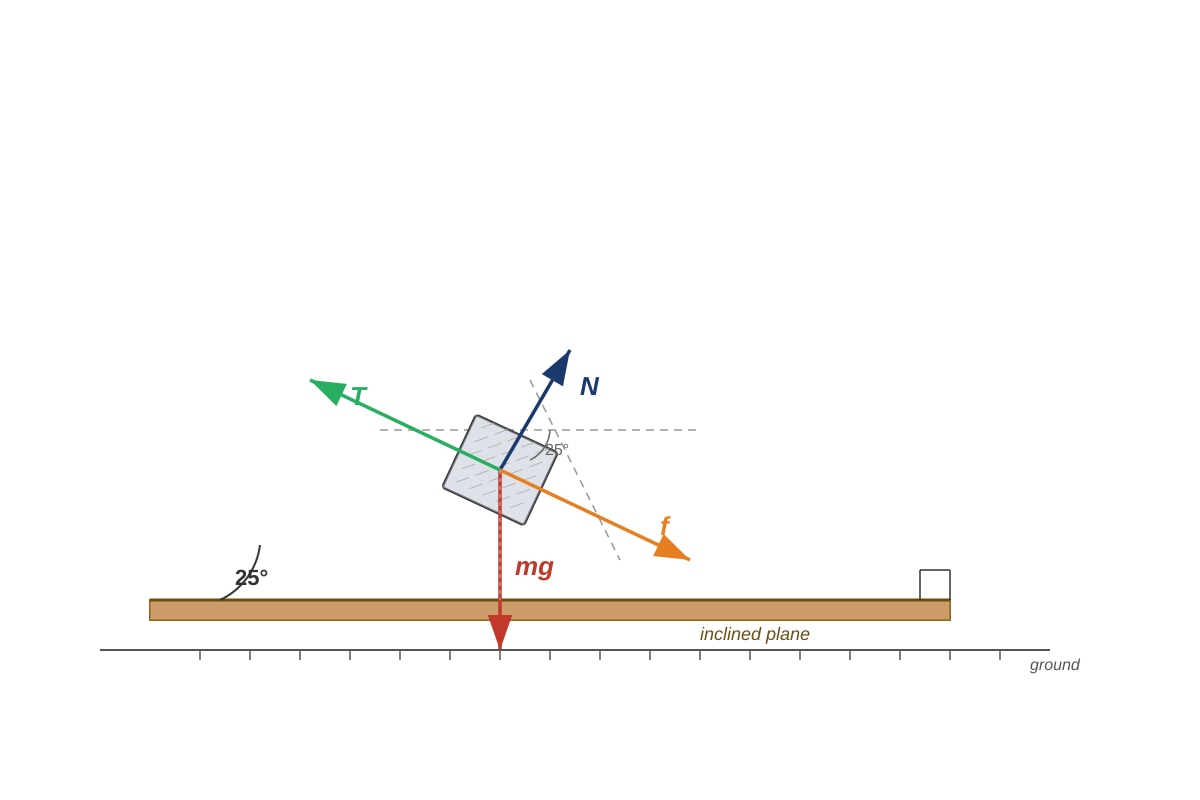
18. A wooden crate of mass 25 kg is pulled up a rough inclined plane by a rope. The plane makes an angle of 25° with the horizontal. The tension in the rope is 180 N and the crate moves at constant velocity.
(a) Draw a free body diagram showing all the forces acting on the crate. [3 marks]
(b) Calculate the component of the crate's weight parallel to the inclined plane. [2 marks]
(c) Calculate the friction force acting on the crate. [2 marks]
(d) Calculate the coefficient of friction between the crate and the plane. [3 marks]
19. A ball of mass 0.3 kg is thrown horizontally from the top of a building 45 m high with an initial speed of 12 m/s.
(a) Calculate the time taken for the ball to reach the ground. [2 marks]
(b) Calculate the horizontal distance traveled by the ball. [2 marks]
(c) Calculate the speed of the ball just before it hits the ground. [3 marks]
20. A circuit contains a 6 V battery connected to three resistors: 4 Ω and 8 Ω in parallel, and this combination in series with a 3 Ω resistor.
(a) Calculate the combined resistance of the 4 Ω and 8 Ω resistors in parallel. [2 marks]
(b) Calculate the total resistance of the circuit. [1 mark]
(c) Calculate the current supplied by the battery. [2 marks]
(d) Calculate the power dissipated in the 3 Ω resistor. [2 marks]
21. A radioactive sample has an initial activity of 2400 Bq and a half-life of 6 hours.
(a) Define the term "half-life". [1 mark]
(b) Calculate the activity of the sample after 18 hours. [2 marks]
(c) Calculate the time taken for the activity to decrease to 150 Bq. [3 marks]
End of Paper
Answers
TuitionGoWhere Practice Paper - Physics Secondary 3 (Answer Key)
Section A: Multiple Choice Questions [15 marks]
1. D - Velocity (has both magnitude and direction)
2. D - Four times smaller (F ∝ 1/r², so doubling r makes F become 1/4 of original)
3. B - 5.0 m/s (Total distance = 250 m, Total time = 50 s, Average speed = 250/50 = 5.0 m/s)
4. A - A ball falling at terminal velocity (net force = 0)
5. A - 126 kJ (Q = mcΔT = 2 × 4200 × 15 = 126,000 J = 126 kJ)
6. C - It provides evidence for the kinetic particle model
7. B - 6.8 m (λ = v/f = 340/50 = 6.8 m)
8. D - Gamma rays
9. C - 4 V (12 V ÷ 3 resistors = 4 V each)
10. A - 100 Bq (12 hours = 3 half-lives, so 800 × (1/2)³ = 100 Bq)
11. C - Gravitational potential → Electrical
12. C - Frequency
13. C - Force × perpendicular distance from pivot
14. D - Current flowing through it
15. C - Centripetal acceleration toward the center
Section B: Structured Questions [45 marks]
16. Velocity-time graph analysis [9 marks]
(a) Acceleration in first 2 seconds [2 marks] a = (12 - 0)/(2 - 0) = 6 m/s² [1 mark for method, 1 mark for answer with unit]
(b) Distance between t = 4s and t = 8s [2 marks] Distance = area under curve = 12 × 4 = 48 m [1 mark for identifying area method, 1 mark for correct calculation]
(c) Motion from t = 10s to t = 14s [2 marks] The trolley decelerates uniformly from 12 m/s to 0 m/s [2 marks for complete description of uniform deceleration]
(d) Total distance in 14 seconds [3 marks] Area = ½ × 2 × 12 + 4 × 12 + ½ × 4 × 12 + ½ × 4 × 12 = 12 + 48 + 24 + 24 = 108 m [1 mark for identifying areas, 1 mark for calculation method, 1 mark for correct total]
17. Heat transfer problem [7 marks]
(a) Heat gained by water [2 marks] Q = mcΔT = 1.2 × 4200 × (35 - 20) = 75,600 J [1 mark for formula, 1 mark for correct calculation]
(b) Specific heat capacity of copper [3 marks] Heat lost by copper = Heat gained by water = 75,600 J c = Q/(mΔT) = 75,600/(0.8 × (85 - 35)) = 75,600/(0.8 × 50) = 1890 J kg⁻¹ °C⁻¹ [1 mark for heat conservation principle, 1 mark for rearrangement, 1 mark for calculation]
(c) Constant temperature explanation [2 marks] At thermal equilibrium, the average kinetic energy of particles in both substances becomes equal, so heat transfer stops and temperature remains constant. [2 marks for complete explanation involving particle kinetic energy and equilibrium]
18. Inclined plane problem [10 marks]
(a) Free body diagram [3 marks] [Diagram should show: Weight mg vertically downward, Normal force N perpendicular to plane, Tension T up the plane, Friction f down the plane - 3 marks for complete diagram]
(b) Component parallel to plane [2 marks] F∥ = mg sin 25° = 25 × 10 × sin 25° = 250 × 0.423 = 106 N [1 mark for formula, 1 mark for calculation]
(c) Friction force [2 marks] At constant velocity: T = F∥ + f f = T - F∥ = 180 - 106 = 74 N [1 mark for equilibrium principle, 1 mark for calculation]
(d) Coefficient of friction [3 marks] Normal force N = mg cos 25° = 250 × cos 25° = 250 × 0.906 = 227 N μ = f/N = 74/227 = 0.33 [1 mark for normal force, 1 mark for friction formula, 1 mark for coefficient]
19. Projectile motion [7 marks]
(a) Time to reach ground [2 marks] Using s = ut + ½gt²: 45 = 0 + ½ × 10 × t² t² = 9, t = 3 s [1 mark for correct equation, 1 mark for answer]
(b) Horizontal distance [2 marks] Horizontal distance = horizontal velocity × time = 12 × 3 = 36 m [1 mark for method, 1 mark for calculation]
(c) Speed just before impact [3 marks] Horizontal velocity = 12 m/s (constant) Vertical velocity = gt = 10 × 3 = 30 m/s Resultant speed = √(12² + 30²) = √(144 + 900) = √1044 = 32.3 m/s [1 mark for horizontal component, 1 mark for vertical component, 1 mark for resultant]
20. Circuit analysis [7 marks]
(a) Parallel resistance [2 marks] 1/R = 1/4 + 1/8 = 3/8 R = 8/3 = 2.67 Ω [1 mark for parallel formula, 1 mark for calculation]
(b) Total resistance [1 mark] R_total = 2.67 + 3 = 5.67 Ω [1 mark for adding series resistance]
(c) Battery current [2 marks] I = V/R = 6/5.67 = 1.06 A [1 mark for Ohm's law, 1 mark for calculation]
(d) Power in 3 Ω resistor [2 marks] P = I²R = (1.06)² × 3 = 3.37 W [1 mark for power formula, 1 mark for calculation]
21. Radioactive decay [6 marks]
(a) Definition of half-life [1 mark] Half-life is the time taken for half the radioactive nuclei to decay (or for the activity to halve). [1 mark for correct definition]
(b) Activity after 18 hours [2 marks] 18 hours = 3 half-lives Activity = 2400 × (1/2)³ = 2400 × 1/8 = 300 Bq [1 mark for identifying number of half-lives, 1 mark for calculation]
(c) Time for activity to reach 150 Bq [3 marks] 150 = 2400 × (1/2)ⁿ (1/2)ⁿ = 150/2400 = 1/16 = (1/2)⁴ n = 4 half-lives Time = 4 × 6 = 24 hours [1 mark for setting up equation, 1 mark for finding n = 4, 1 mark for final time]
Total: 60 marks
Grade Boundaries (Suggested):
- A: 54-60 marks (90-100%)
- B: 48-53 marks (80-89%)
- C: 42-47 marks (70-79%)
- D: 36-41 marks (60-69%)
- E: 30-35 marks (50-59%)
- F: Below 30 marks (Below 50%)