From Real Exams Exam Paper

Secondary 3 Physics Semestral Assessment 2 (End of Year) Paper 5

Free Sec 3 Physics SA2 Paper 5, Nemo3 Exam version, with questions, answers, and O Level-style practice for Singapore students.

These static practice materials are generated from the site's syllabus and paper-generation workflow, with source and model context shown so students and parents can evaluate the material before use.

Secondary 3 Physics From Real Exams Generated by NVIDIA Nemotron 3 Ultra 550B A55B Free Updated 2026-06-18

Questions

<!-- TuitionGoWhere generation metadata: stage=3-1; model=nvidia/nemotron-3-ultra-550b-a55b:free; model_label=NVIDIA Nemotron 3 Ultra 550B A55B Free; generated=2026-06-18; Sources: Stage 2-1 real exam-derived templates and Stage 2-2 exam-enriched syllabus. -->

TuitionGoWhere Practice Paper - Physics Secondary 3

TuitionGoWhere Secondary School (AI)

Subject: Physics
Level: Secondary 3 (Pure Physics)
Paper: SA2 Version 5
Duration: 1 hour 30 minutes
Total Marks: 60

Name: ________________________
Class: ________________________
Date: ________________________


Instructions to Candidates

  1. Write your name, class, and date in the spaces provided above.
  2. Answer all questions.
  3. Write your answers in the spaces provided on the question paper.
  4. The number of marks is given in brackets [ ] at the end of each question or part question.
  5. You may use a scientific calculator.
  6. Where necessary, take the acceleration due to gravity g=10 m/s2g = 10 \text{ m/s}^2.
  7. Show all working for calculation questions.

Section A: Multiple Choice Questions [10 marks]

Answer all questions. For each question, choose the correct option and write the letter (A, B, C, or D) in the box provided.

1

A student measures the diameter of a steel ball bearing using a micrometer screw gauge. The main scale reading is 4.5 mm and the thimble scale reading is 28 divisions. The zero error of the micrometer is +0.02 mm. What is the actual diameter of the ball bearing?

A. 4.76 mm
B. 4.78 mm
C. 4.80 mm
D. 4.82 mm

[1]

Answer:

2

A car accelerates uniformly from rest to a speed of 20 m/s in 8.0 s. What is the distance travelled by the car during this time?

A. 40 m
B. 80 m
C. 160 m
D. 320 m

[1]

Answer:

3

A block of mass 2.0 kg is pulled along a horizontal surface by a horizontal force of 15 N. The frictional force acting on the block is 5.0 N. What is the acceleration of the block?

A. 2.5 m/s²
B. 5.0 m/s²
C. 7.5 m/s²
D. 10 m/s²

[1]

Answer:

4

A satellite orbits the Earth at a height where the gravitational field strength is 4.0 N/kg. The mass of the satellite is 500 kg. What is the weight of the satellite at this height?

A. 125 N
B. 500 N
C. 2000 N
D. 5000 N

[1]

Answer:

5

A force of 10 N acts on an object of mass 2.0 kg for 3.0 s. The object starts from rest. What is the final momentum of the object?

A. 6.0 kg·m/s
B. 15 kg·m/s
C. 30 kg·m/s
D. 60 kg·m/s

[1]

Answer:

6

A ball is thrown vertically upwards with an initial speed of 15 m/s. Ignoring air resistance, what is the maximum height reached by the ball? (Take g=10 m/s2g = 10 \text{ m/s}^2)

A. 7.5 m
B. 11.25 m
C. 15 m
D. 22.5 m

[1]

Answer:

7

A box of mass 5.0 kg is pushed up a rough inclined plane at a constant speed. The plane is inclined at 30° to the horizontal. The frictional force acting on the box is 10 N. What is the magnitude of the pushing force applied parallel to the plane?

A. 15 N
B. 25 N
C. 35 N
D. 45 N

[1]

Answer:

8

Two objects of masses 3.0 kg and 5.0 kg are moving towards each other with speeds of 4.0 m/s and 2.0 m/s respectively. They collide and stick together. What is their common velocity after the collision?

A. 0.25 m/s in the direction of the 3.0 kg mass
B. 0.25 m/s in the direction of the 5.0 kg mass
C. 0.50 m/s in the direction of the 3.0 kg mass
D. 0.50 m/s in the direction of the 5.0 kg mass

[1]

Answer:

9

A force of 20 N is applied to a lever at a perpendicular distance of 0.40 m from the pivot. What is the moment of the force about the pivot?

A. 5.0 N·m
B. 8.0 N·m
C. 20 N·m
D. 50 N·m

[1]

Answer:

10

A uniform metre rule is pivoted at the 40 cm mark. A weight of 2.0 N is suspended at the 10 cm mark. At which mark must a weight of 3.0 N be suspended to balance the rule horizontally? (Ignore the weight of the rule.)

A. 50 cm
B. 60 cm
C. 70 cm
D. 80 cm

[1]

Answer:


Section B: Short Answer and Structured Questions [30 marks]

Answer all questions in the spaces provided.

11

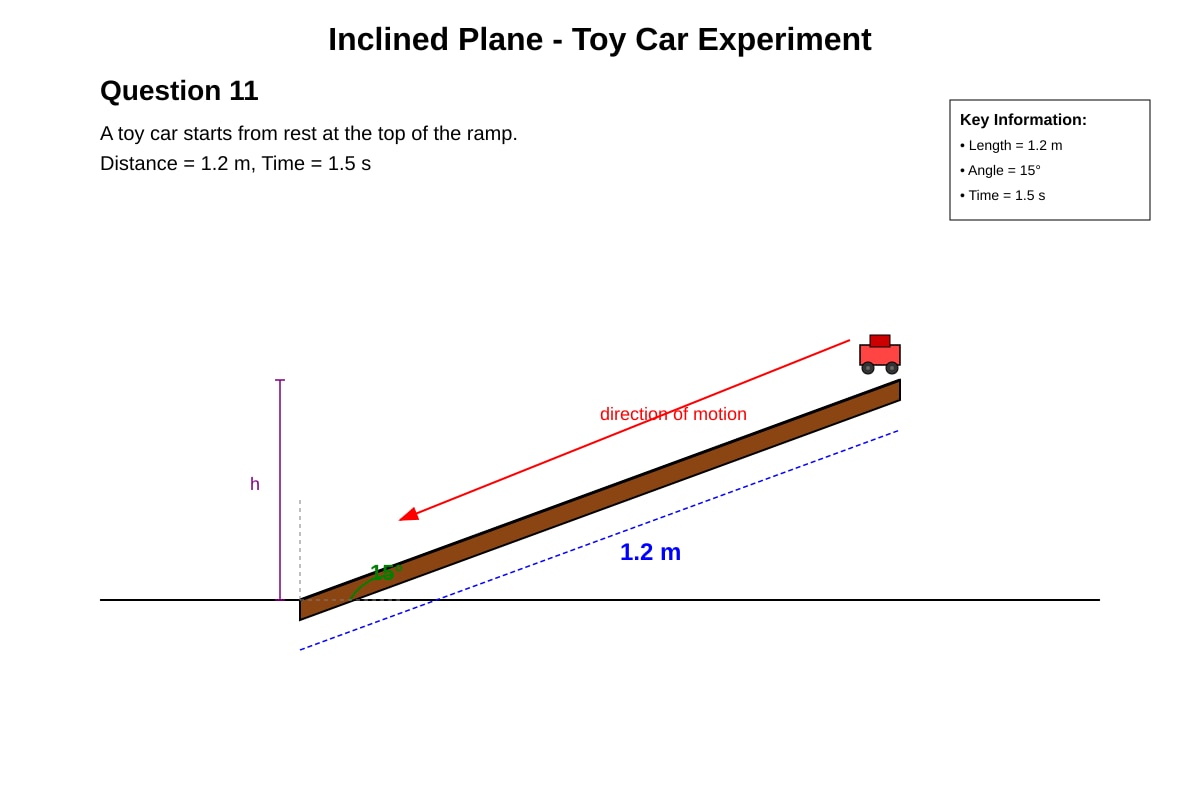
A student investigates the motion of a toy car moving down a ramp. The car starts from rest at the top of the ramp and travels a distance of 1.2 m in 1.5 s.

<image_placeholder> id: Q11-fig1 type: diagram linked_question: Q11 description: A ramp inclined at an angle to the horizontal. A toy car is shown at the top of the ramp. The length of the ramp is labelled 1.2 m. The angle of inclination is labelled 15°. labels: ramp length = 1.2 m, angle = 15°, car at top values: length = 1.2 m, angle = 15°, time = 1.5 s must_show: inclined plane with car at top, length and angle labelled </image_placeholder>

(a) Calculate the average speed of the car down the ramp. [1]

(b) Assuming uniform acceleration, calculate the acceleration of the car. [2]

(c) Calculate the final speed of the car at the bottom of the ramp. [1]

(d) The mass of the car is 0.15 kg. Calculate the kinetic energy of the car at the bottom of the ramp. [1]

(e) The vertical height of the ramp is 0.31 m. Calculate the loss in gravitational potential energy of the car. [1]

(f) Suggest a reason why the kinetic energy at the bottom is less than the loss in gravitational potential energy. [1]


12

A rocket of mass 2000 kg lifts off vertically from the ground. The rocket engines produce a constant upward thrust of 30,000 N. Take g=10 m/s2g = 10 \text{ m/s}^2.

(a) Calculate the weight of the rocket. [1]

(b) Calculate the resultant force acting on the rocket at lift-off. [1]

(c) Calculate the initial acceleration of the rocket. [1]

(d) Explain why the acceleration of the rocket increases as it rises, even though the thrust remains constant. [2]


13

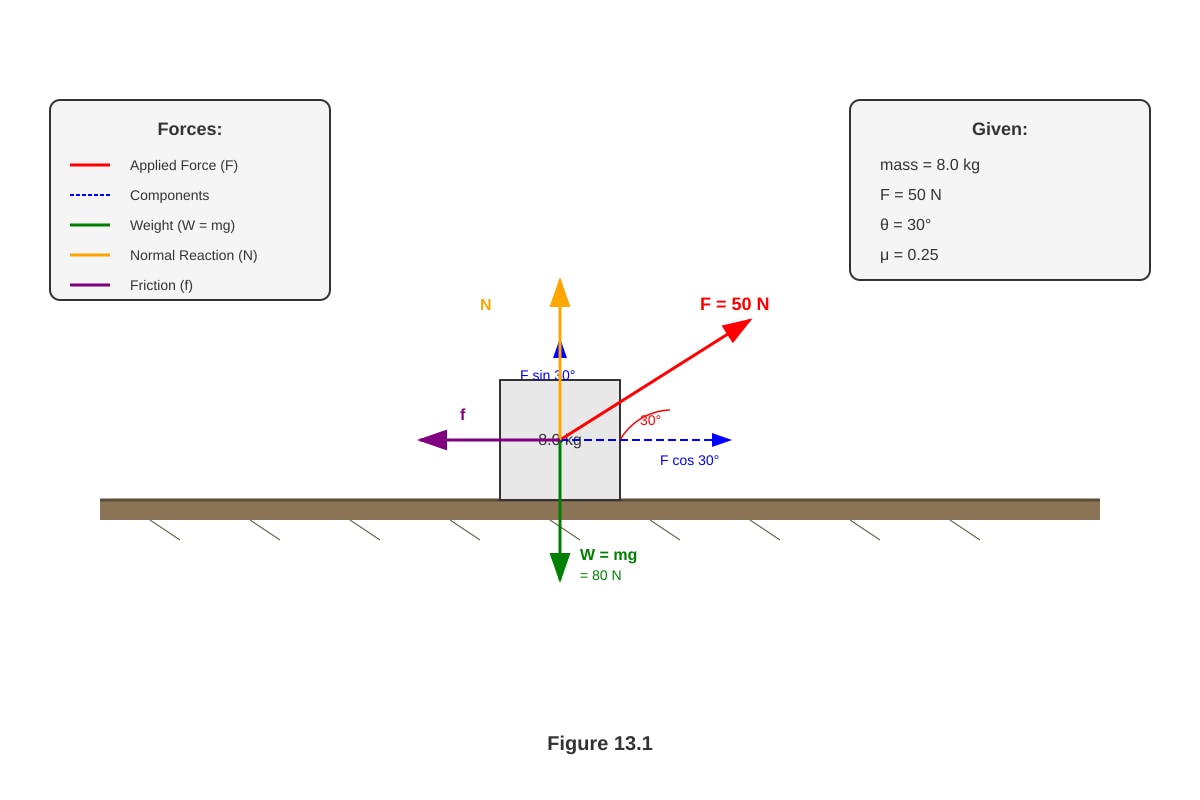
A box of mass 8.0 kg is pulled across a horizontal floor by a force of 50 N applied at an angle of 30° to the horizontal. The coefficient of friction between the box and the floor is 0.25. Take g=10 m/s2g = 10 \text{ m/s}^2.

<image_placeholder> id: Q13-fig1 type: diagram linked_question: Q13 description: A box on a horizontal floor. A force of 50 N is applied at 30° to the horizontal. The weight, normal reaction, friction, and applied force components are shown. labels: mass = 8.0 kg, applied force = 50 N at 30°, μ = 0.25 values: mass = 8.0 kg, F = 50 N, θ = 30°, μ = 0.25, g = 10 m/s² must_show: free-body diagram with force components, weight, normal reaction, friction </image_placeholder>

(a) Calculate the normal reaction force acting on the box. [2]

(b) Calculate the frictional force acting on the box. [1]

(c) Calculate the horizontal component of the applied force. [1]

(d) Calculate the acceleration of the box. [2]


14

Two ice skaters, A and B, stand facing each other on a frictionless ice rink. Skater A has a mass of 60 kg and skater B has a mass of 40 kg. Skater A pushes skater B, causing skater B to move away with a velocity of 3.0 m/s.

(a) State the principle of conservation of momentum. [1]

(b) Calculate the velocity of skater A after the push. [2]

(c) Explain why the total kinetic energy of the two skaters after the push is greater than zero, even though the total momentum is zero. [2]


15

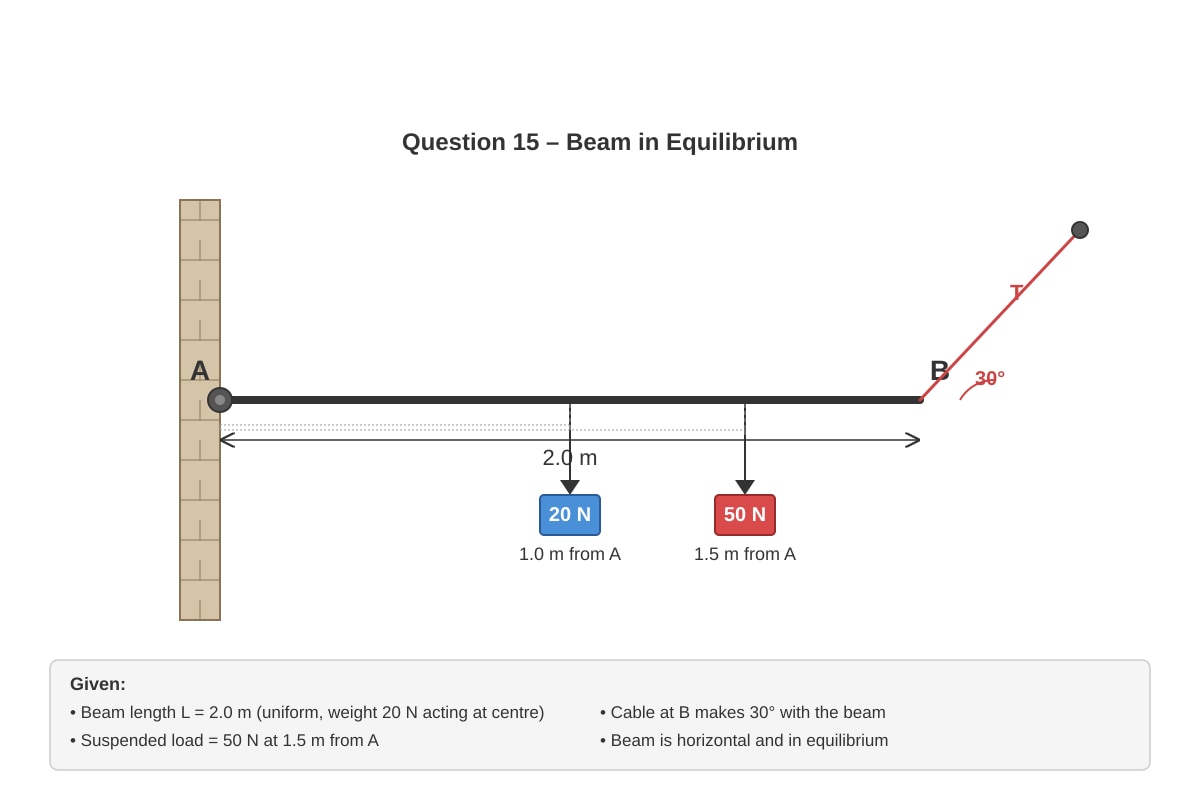
A uniform beam AB of length 2.0 m and weight 20 N is hinged at A to a vertical wall. The beam is held horizontal by a cable attached at B, making an angle of 30° with the beam. A weight of 50 N is suspended from the beam at a distance of 1.5 m from A.

<image_placeholder> id: Q15-fig1 type: diagram linked_question: Q15 description: A horizontal beam AB of length 2.0 m hinged at A to a wall. A cable at B makes 30° with the beam. A 50 N weight hangs at 1.5 m from A. The beam weight 20 N acts at the centre (1.0 m from A). labels: beam length = 2.0 m, beam weight = 20 N at centre, suspended weight = 50 N at 1.5 m from A, cable at B at 30° to beam values: L = 2.0 m, W_beam = 20 N at 1.0 m, W_load = 50 N at 1.5 m, cable angle = 30° must_show: horizontal beam, hinge at A, cable at B at 30°, weights at correct positions </image_placeholder>

(a) Calculate the moment of the beam's weight about the hinge A. [1]

(b) Calculate the moment of the suspended weight about the hinge A. [1]

(c) By taking moments about A, calculate the tension in the cable. [3]


16

A ball of mass 0.20 kg is dropped from a height of 2.5 m onto a hard floor. It rebounds to a height of 1.6 m. The ball is in contact with the floor for 0.020 s. Take g=10 m/s2g = 10 \text{ m/s}^2.

(a) Calculate the speed of the ball just before it hits the floor. [2]

(b) Calculate the speed of the ball just after it leaves the floor. [2]

(c) Calculate the change in momentum of the ball during the impact. [2]

(d) Calculate the average force exerted by the floor on the ball during the impact. [2]


17

A car of mass 1200 kg travels at a constant speed of 25 m/s around a circular bend of radius 80 m.

(a) Calculate the centripetal force acting on the car. [2]

(b) The maximum frictional force between the tyres and the road is 9000 N. Determine whether the car will skid. [1]

(c) The road is banked at an angle of 10° to the horizontal. Explain how banking reduces the reliance on friction to provide the centripetal force. [2]


18

A spring obeys Hooke's law. When a load of 2.0 N is hung from the spring, its length is 12.0 cm. When a load of 5.0 N is hung from the spring, its length is 16.5 cm.

(a) Calculate the spring constant of the spring. [2]

(b) Calculate the unstretched length of the spring. [1]

(c) Calculate the elastic potential energy stored in the spring when the load is 5.0 N. [2]


19

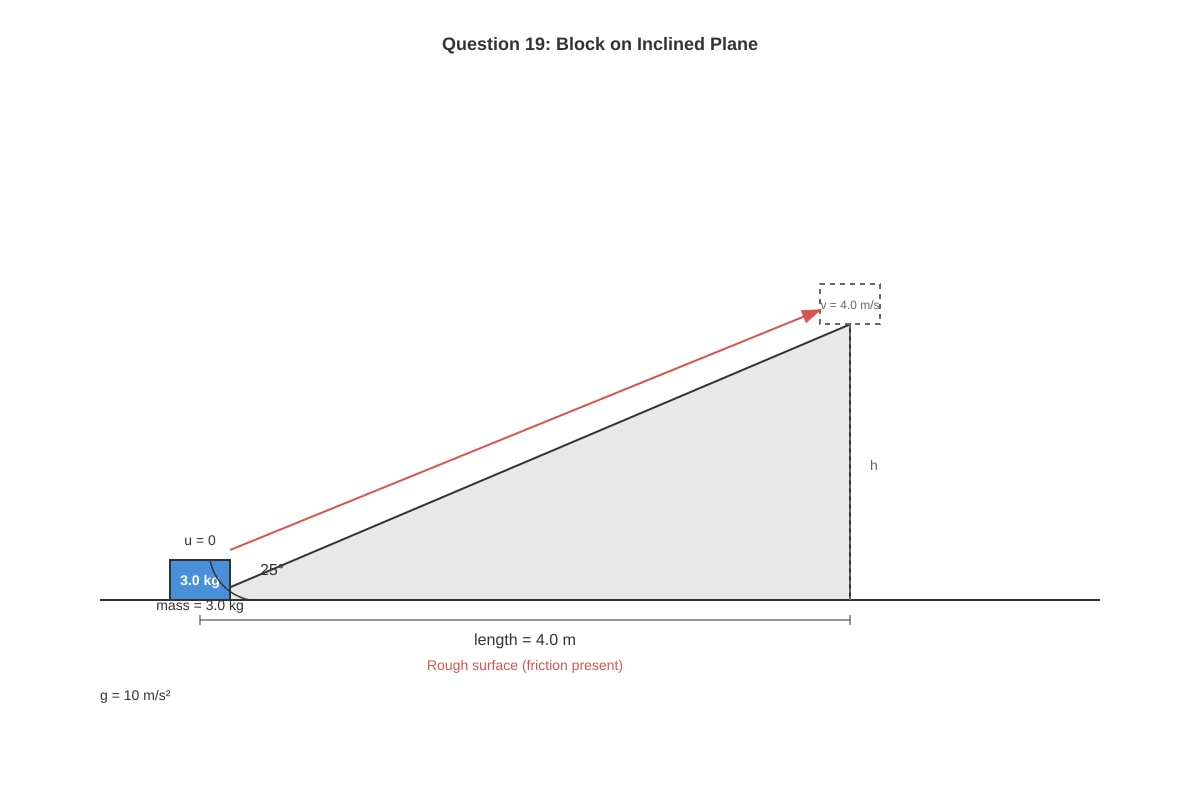
A block of mass 3.0 kg slides down a rough inclined plane of length 4.0 m inclined at 25° to the horizontal. The block starts from rest and reaches the bottom with a speed of 4.0 m/s. Take g=10 m/s2g = 10 \text{ m/s}^2.

<image_placeholder> id: Q19-fig1 type: diagram linked_question: Q19 description: An inclined plane of length 4.0 m at 25° to horizontal. A block of mass 3.0 kg slides from rest at the top to the bottom. labels: mass = 3.0 kg, length = 4.0 m, angle = 25°, initial speed = 0, final speed = 4.0 m/s values: m = 3.0 kg, L = 4.0 m, θ = 25°, u = 0, v = 4.0 m/s, g = 10 m/s² must_show: inclined plane with block, length and angle labelled </image_placeholder>

(a) Calculate the loss in gravitational potential energy of the block. [2]

(b) Calculate the gain in kinetic energy of the block. [1]

(c) Calculate the work done against friction. [1]

(d) Calculate the average frictional force acting on the block. [2]


20

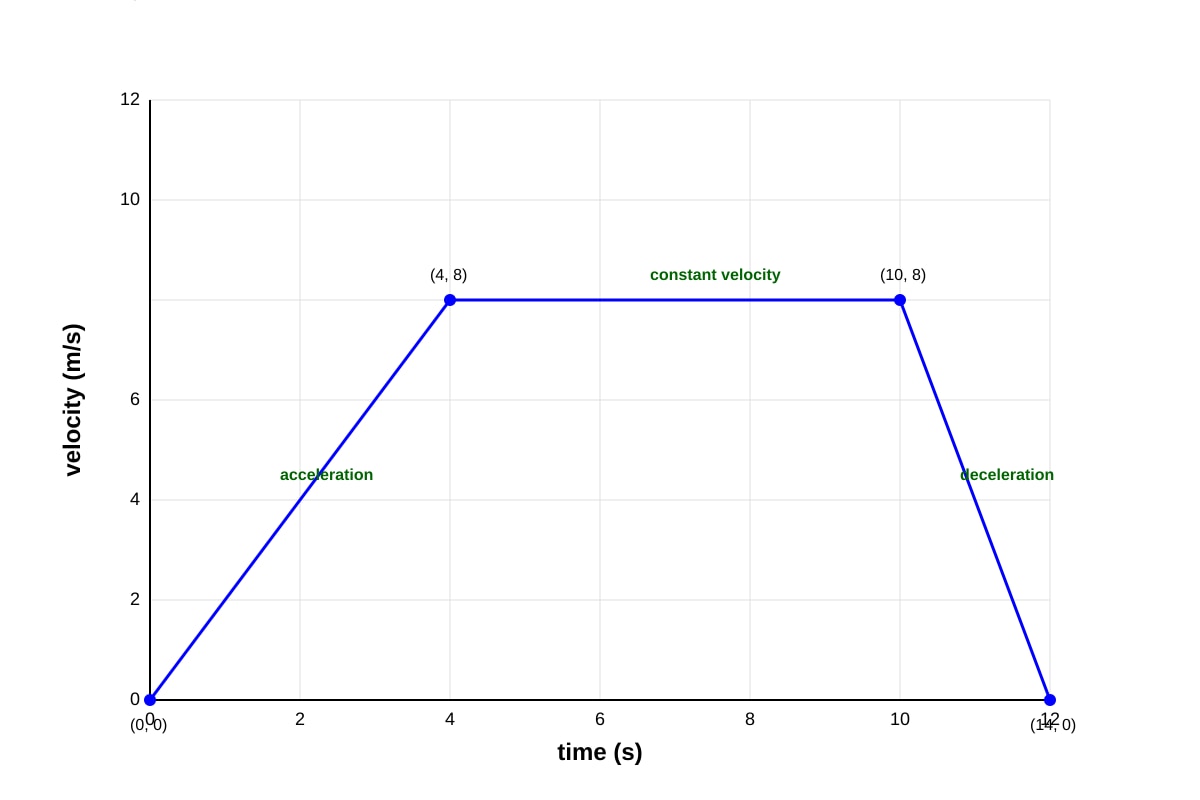
The diagram shows a velocity-time graph for a particle moving in a straight line.

<image_placeholder> id: Q20-fig1 type: graph linked_question: Q20 description: Velocity-time graph. The graph starts at (0,0), rises linearly to (4, 8), stays constant at 8 m/s from t=4 to t=10, then falls linearly to (14, 0). labels: velocity (m/s) on y-axis, time (s) on x-axis values: points: (0,0), (4,8), (10,8), (14,0) must_show: v-t graph with three segments: acceleration, constant velocity, deceleration </image_placeholder>

(a) Describe the motion of the particle during the first 4 seconds. [1]

(b) Calculate the acceleration of the particle during the first 4 seconds. [1]

(c) Calculate the total distance travelled by the particle in 14 seconds. [3]

(d) Calculate the average speed of the particle over the 14 seconds. [1]


End of Paper

Answers

<!-- TuitionGoWhere generation metadata: stage=3-1; model=nvidia/nemotron-3-ultra-550b-a55b:free; model_label=NVIDIA Nemotron 3 Ultra 550B A55B Free; generated=2026-06-18; Sources: Stage 2-1 real exam-derived templates and Stage 2-2 exam-enriched syllabus. -->

TuitionGoWhere Practice Paper - Physics Secondary 3 (SA2 Version 5) - Answer Key

Total Marks: 60


Section A: Multiple Choice Questions [10 marks]

1

Answer: B
Working:
Micrometer reading = main scale + thimble scale = 4.5 mm + (28 × 0.01 mm) = 4.5 + 0.28 = 4.78 mm
Actual diameter = measured reading − zero error = 4.78 mm − (+0.02 mm) = 4.76 mm

Wait, let me recalculate:
Zero error is +0.02 mm, meaning the reading is 0.02 mm too large.
Actual = measured − zero error = 4.78 − 0.02 = 4.76 mm → A

Correction: Answer: A
Marking note: Common error is adding the zero error instead of subtracting. Positive zero error means the instrument reads higher than actual.


2

Answer: B
Working:
For uniform acceleration from rest: s=12at2s = \frac{1}{2}at^2 and v=atv = at
a=vt=208=2.5 m/s2a = \frac{v}{t} = \frac{20}{8} = 2.5 \text{ m/s}^2
s=12×2.5×82=12×2.5×64=80 ms = \frac{1}{2} \times 2.5 \times 8^2 = \frac{1}{2} \times 2.5 \times 64 = 80 \text{ m}

Alternative: Average speed = 0+202=10 m/s\frac{0 + 20}{2} = 10 \text{ m/s}, distance = 10×8=80 m10 \times 8 = 80 \text{ m}


3

Answer: A
Working:
Resultant force = applied force − friction = 15 N − 5.0 N = 10 N
a=Fm=102.0=5.0 m/s2a = \frac{F}{m} = \frac{10}{2.0} = 5.0 \text{ m/s}^2

Wait: F=maF = ma, so a=F/m=10/2=5.0 m/s2a = F/m = 10/2 = 5.0 \text{ m/s}^2B

Correction: Answer: B
Marking note: Some students forget to subtract friction or use the applied force directly.


4

Answer: C
Working:
Weight = mass × gravitational field strength = 500 kg × 4.0 N/kg = 2000 N


5

Answer: C
Working:
Impulse = change in momentum = force × time = 10 N × 3.0 s = 30 N·s = 30 kg·m/s
Since initial momentum = 0, final momentum = 30 kg·m/s


6

Answer: B
Working:
v2=u2+2asv^2 = u^2 + 2as, at max height v=0v = 0
0=152+2(10)h0 = 15^2 + 2(-10)h
0=22520h0 = 225 - 20h
h=22520=11.25 mh = \frac{225}{20} = 11.25 \text{ m}


7

Answer: C
Working:
Constant speed → resultant force parallel to plane = 0
Component of weight down plane = mgsin30°=5.0×10×0.5=25 Nmg \sin 30° = 5.0 \times 10 \times 0.5 = 25 \text{ N}
Pushing force = weight component + friction = 25 + 10 = 35 N


8

Answer: A
Working:
Take direction of 3.0 kg mass as positive.
Initial momentum = (3.0×4.0)+(5.0×2.0)=1210=2.0 kg⋅m/s(3.0 \times 4.0) + (5.0 \times -2.0) = 12 - 10 = 2.0 \text{ kg·m/s}
Combined mass = 8.0 kg
Final velocity = 2.08.0=0.25 m/s\frac{2.0}{8.0} = 0.25 \text{ m/s} in direction of 3.0 kg mass


9

Answer: B
Working:
Moment = force × perpendicular distance = 20 N × 0.40 m = 8.0 N·m


10

Answer: C
Working:
Take moments about pivot (40 cm mark).
Clockwise moment = 2.0 N×(4010) cm=2.0×30=60 N⋅cm2.0 \text{ N} \times (40 - 10) \text{ cm} = 2.0 \times 30 = 60 \text{ N·cm}
Anticlockwise moment = 3.0 N×(x40) cm3.0 \text{ N} \times (x - 40) \text{ cm}
For balance: 3.0(x40)=603.0(x - 40) = 60
x40=20x - 40 = 20
x=60 cmx = 60 \text{ cm}

Wait, that gives 60 cm which is option B. Let me recheck.
Weight at 10 cm is 30 cm from pivot (40-10). Moment = 2 × 30 = 60 N·cm clockwise.
3.0 N weight must provide 60 N·cm anticlockwise. Distance from pivot = 60/3 = 20 cm.
Position = 40 + 20 = 60 cm. → B

Correction: Answer: B


Section B: Short Answer and Structured Questions [30 marks]

11

(a) Average speed = total distancetotal time=1.21.5=0.80 m/s\frac{\text{total distance}}{\text{total time}} = \frac{1.2}{1.5} = 0.80 \text{ m/s} [1]

(b) For uniform acceleration from rest: s=12at2s = \frac{1}{2}at^2
1.2=12×a×(1.5)21.2 = \frac{1}{2} \times a \times (1.5)^2
1.2=0.5×a×2.25=1.125a1.2 = 0.5 \times a \times 2.25 = 1.125a
a=1.21.125=1.07 m/s2a = \frac{1.2}{1.125} = 1.07 \text{ m/s}^2 (or 1.1 m/s21.1 \text{ m/s}^2 to 2 s.f.) [2]
Marks: 1 for correct formula/substitution, 1 for correct answer

(c) v=u+at=0+1.07×1.5=1.60 m/sv = u + at = 0 + 1.07 \times 1.5 = 1.60 \text{ m/s} (or v2=2as=2×1.07×1.2=2.57v^2 = 2as = 2 \times 1.07 \times 1.2 = 2.57, v=1.60 m/sv = 1.60 \text{ m/s}) [1]

(d) KE=12mv2=12×0.15×(1.60)2=0.075×2.56=0.192 JKE = \frac{1}{2}mv^2 = \frac{1}{2} \times 0.15 \times (1.60)^2 = 0.075 \times 2.56 = 0.192 \text{ J} [1]

(e) Loss in GPE = mgh=0.15×10×0.31=0.465 Jmgh = 0.15 \times 10 \times 0.31 = 0.465 \text{ J} [1]

(f) Some gravitational potential energy is converted to heat and sound due to friction between the car and ramp, and air resistance. [1]
Accept: work done against friction / energy lost to surroundings


12

(a) Weight = mg=2000×10=20,000 Nmg = 2000 \times 10 = 20,000 \text{ N} [1]

(b) Resultant force = thrust − weight = 30,000 − 20,000 = 10,000 N (upwards) [1]

(c) a=Fm=10,0002000=5.0 m/s2a = \frac{F}{m} = \frac{10,000}{2000} = 5.0 \text{ m/s}^2 [1]

(d) As the rocket rises, its mass decreases because fuel is burnt and ejected. Since thrust is constant and a=F/ma = F/m, the acceleration increases as mass decreases. [2]
Marks: 1 for mass decreases, 1 for a=F/ma = F/m so acceleration increases
Also accept: gravitational field strength decreases slightly, but mass decrease is the main effect at this level


13

(a) Vertical forces balance (no vertical acceleration):
N+Fsin30°=mgN + F \sin 30° = mg
N+50×0.5=8.0×10N + 50 \times 0.5 = 8.0 \times 10
N+25=80N + 25 = 80
N=55 NN = 55 \text{ N} [2]
Marks: 1 for resolving vertical component, 1 for correct answer

(b) Friction = μN=0.25×55=13.75 N\mu N = 0.25 \times 55 = 13.75 \text{ N} (or 14 N to 2 s.f.) [1]

(c) Horizontal component = Fcos30°=50×32=43.3 NF \cos 30° = 50 \times \frac{\sqrt{3}}{2} = 43.3 \text{ N} [1]

(d) Resultant horizontal force = Fcos30°friction=43.313.75=29.55 NF \cos 30° - \text{friction} = 43.3 - 13.75 = 29.55 \text{ N}
a=Fnetm=29.558.0=3.69 m/s2a = \frac{F_{\text{net}}}{m} = \frac{29.55}{8.0} = 3.69 \text{ m/s}^2 (or 3.7 m/s²) [2]
Marks: 1 for net force, 1 for acceleration


14

(a) The total momentum of a closed system remains constant if no external resultant force acts on it. [1]

(b) Initial total momentum = 0 (both at rest)
Final momentum: mAvA+mBvB=0m_A v_A + m_B v_B = 0
60vA+40×3.0=060 v_A + 40 \times 3.0 = 0
60vA=12060 v_A = -120
vA=2.0 m/sv_A = -2.0 \text{ m/s} (i.e., 2.0 m/s in the opposite direction to skater B) [2]
Marks: 1 for conservation equation, 1 for correct magnitude and direction

(c) Momentum is a vector quantity; the skaters have equal and opposite momenta, so total momentum is zero. Kinetic energy is a scalar quantity; both skaters have positive kinetic energy, so total KE is the sum of their individual KEs and cannot be zero (unless both are at rest). [2]
Marks: 1 for vector vs scalar distinction, 1 for explaining KE adds as scalars


15

(a) Moment of beam's weight about A = 20 N×1.0 m=20 N⋅m20 \text{ N} \times 1.0 \text{ m} = 20 \text{ N·m} (clockwise) [1]

(b) Moment of suspended weight about A = 50 N×1.5 m=75 N⋅m50 \text{ N} \times 1.5 \text{ m} = 75 \text{ N·m} (clockwise) [1]

(c) Taking moments about A (anticlockwise positive):
Tension vertical component = Tsin30°=0.5TT \sin 30° = 0.5T
Anticlockwise moment from tension = 0.5T×2.0=T N⋅m0.5T \times 2.0 = T \text{ N·m}
Clockwise moments = 20+75=95 N⋅m20 + 75 = 95 \text{ N·m}
For equilibrium: T=95 NT = 95 \text{ N} [3]
Marks: 1 for vertical component of tension, 1 for moment arm (2.0 m), 1 for correct equation and answer


16

(a) v2=u2+2gh=0+2×10×2.5=50v^2 = u^2 + 2gh = 0 + 2 \times 10 \times 2.5 = 50
v=50=7.07 m/sv = \sqrt{50} = 7.07 \text{ m/s} (downwards) [2]
Marks: 1 for correct formula/substitution, 1 for answer

(b) Rebound height 1.6 m: v2=2gh=2×10×1.6=32v^2 = 2gh = 2 \times 10 \times 1.6 = 32
v=32=5.66 m/sv = \sqrt{32} = 5.66 \text{ m/s} (upwards) [2]
Marks: 1 for correct formula/substitution, 1 for answer

(c) Change in momentum = m(vu)m(v - u) (taking upward as positive)
u=7.07 m/su = -7.07 \text{ m/s}, v=+5.66 m/sv = +5.66 \text{ m/s}
Δp=0.20×(5.66(7.07))=0.20×12.73=2.55 kg⋅m/s\Delta p = 0.20 \times (5.66 - (-7.07)) = 0.20 \times 12.73 = 2.55 \text{ kg·m/s} [2]
Marks: 1 for correct signs/direction, 1 for correct calculation

(d) Average force = ΔpΔt=2.550.020=127.5 N\frac{\Delta p}{\Delta t} = \frac{2.55}{0.020} = 127.5 \text{ N} (upwards) [2]
Marks: 1 for formula, 1 for correct answer with unit


17

(a) Centripetal force = mv2r=1200×25280=1200×62580=750,00080=9375 N\frac{mv^2}{r} = \frac{1200 \times 25^2}{80} = \frac{1200 \times 625}{80} = \frac{750,000}{80} = 9375 \text{ N} [2]
Marks: 1 for formula/substitution, 1 for answer

(b) Required centripetal force (9375 N) > maximum friction (9000 N), so the car will skid. [1]

(c) On a banked road, the normal reaction force has a horizontal component directed towards the centre of the circle. This component provides part (or all) of the required centripetal force, reducing the reliance on friction. [2]
Marks: 1 for normal reaction has horizontal component, 1 for this component provides centripetal force


18

(a) Extension for 2.0 N load: x1=12.0l0x_1 = 12.0 - l_0
Extension for 5.0 N load: x2=16.5l0x_2 = 16.5 - l_0
Hooke's law: F=kxF = kx
5.02.0=k(x2x1)5.0 - 2.0 = k(x_2 - x_1)
3.0=k(16.512.0)=k×4.53.0 = k(16.5 - 12.0) = k \times 4.5
k=3.04.5=0.667 N/cm=66.7 N/mk = \frac{3.0}{4.5} = 0.667 \text{ N/cm} = 66.7 \text{ N/m} [2]
Marks: 1 for using difference in force/extension, 1 for correct answer with unit

(b) F=kxF = kx2.0=0.667×(12.0l0)2.0 = 0.667 \times (12.0 - l_0)
12.0l0=2.00.667=3.012.0 - l_0 = \frac{2.0}{0.667} = 3.0
l0=12.03.0=9.0 cml_0 = 12.0 - 3.0 = 9.0 \text{ cm} [1]

(c) At 5.0 N, extension x=16.59.0=7.5 cm=0.075 mx = 16.5 - 9.0 = 7.5 \text{ cm} = 0.075 \text{ m}
EPE=12kx2=12×66.7×(0.075)2=0.188 JEPE = \frac{1}{2} k x^2 = \frac{1}{2} \times 66.7 \times (0.075)^2 = 0.188 \text{ J}
Or using EPE=12Fx=12×5.0×0.075=0.1875 JEPE = \frac{1}{2} F x = \frac{1}{2} \times 5.0 \times 0.075 = 0.1875 \text{ J} [2]
Marks: 1 for correct extension, 1 for correct formula and answer


19

(a) Vertical height dropped = 4.0×sin25°=4.0×0.4226=1.69 m4.0 \times \sin 25° = 4.0 \times 0.4226 = 1.69 \text{ m}
Loss in GPE = mgh=3.0×10×1.69=50.7 Jmgh = 3.0 \times 10 \times 1.69 = 50.7 \text{ J} [2]
Marks: 1 for height calculation, 1 for GPE

(b) Gain in KE = 12mv2=12×3.0×4.02=1.5×16=24 J\frac{1}{2}mv^2 = \frac{1}{2} \times 3.0 \times 4.0^2 = 1.5 \times 16 = 24 \text{ J} [1]

(c) Work done against friction = loss in GPE − gain in KE = 50.7 − 24 = 26.7 J [1]

(d) Work done against friction = friction × distance
26.7=Ff×4.026.7 = F_f \times 4.0
Ff=26.74.0=6.68 NF_f = \frac{26.7}{4.0} = 6.68 \text{ N} [2]
Marks: 1 for formula, 1 for answer


20

(a) The particle accelerates uniformly from rest to 8 m/s in 4 seconds. [1]

(b) Acceleration = gradient = 8040=2.0 m/s2\frac{8 - 0}{4 - 0} = 2.0 \text{ m/s}^2 [1]

(c) Distance = area under v-t graph
Area 1 (0-4 s): 12×4×8=16 m\frac{1}{2} \times 4 \times 8 = 16 \text{ m}
Area 2 (4-10 s): 6×8=48 m6 \times 8 = 48 \text{ m}
Area 3 (10-14 s): 12×4×8=16 m\frac{1}{2} \times 4 \times 8 = 16 \text{ m}
Total distance = 16+48+16=80 m16 + 48 + 16 = 80 \text{ m} [3]
Marks: 1 for each area, 1 for total

(d) Average speed = total distancetotal time=8014=5.71 m/s\frac{\text{total distance}}{\text{total time}} = \frac{80}{14} = 5.71 \text{ m/s} [1]


End of Answer Key