From Real Exams Exam Paper

Secondary 3 Physics Semestral Assessment 2 (End of Year) Paper 5

Free Kimi AI-generated Sec 3 Physics SA2 Paper 5 with questions, answers, and O Level-style practice for Singapore students preparing for exams.

These static practice materials are generated from the site's syllabus and paper-generation workflow, with source and model context shown so students and parents can evaluate the material before use.

Secondary 3 Physics From Real Exams Generated by Kimi K2.6 Free Updated 2026-06-10

Questions

<!-- TuitionGoWhere generation metadata: stage=3-1; model=moonshotai/kimi-k2.6:free; model_label=Kimi K2.6 Free; generated=2026-06-10; Sources: Stage 2-1 real exam-derived templates and Stage 2-2 exam-enriched syllabus. -->

TuitionGoWhere Practice Paper - Physics Secondary 3

TuitionGoWhere Secondary School (AI)

Subject: Physics
Level: Secondary 3
Paper: SA2 Practice
Duration: 1 hour 15 minutes
Total Marks: 60
Version: 5 of 5

Name: _________________________ Class: _________ Date: _____________


INSTRUCTIONS TO CANDIDATES

  • Write your name, class, and date in the spaces provided above.
  • Answer all questions.
  • Write your answers in the spaces provided.
  • All working must be clearly shown.
  • Take gravitational field strength, g=10 N/kgg = 10 \text{ N/kg}.
  • Calculators may be used.
  • Pay attention to the mark allocation for each question.

SECTION A (20 marks)

Answer all questions. Each question carries 1 mark.

Questions 1–10


1. Which of the following is a vector quantity?

A. Mass
B. Time
C. Velocity
D. Energy

Answer: _________________


2. A car accelerates uniformly from rest to 20 m/s20 \text{ m/s} in 5 s5 \text{ s}. What is its acceleration?

Answer: _________________ m/s²


3. State Newton's First Law of Motion in your own words.

Answer: _____________________________________________________________


4. A box of mass 8 kg8 \text{ kg} rests on a horizontal surface. Calculate its weight.

Answer: _________________ N


5. A force of 12 N12 \text{ N} acts on a mass of 4 kg4 \text{ kg}. Calculate the acceleration produced.

Answer: _________________ m/s²


6. What is the principle of conservation of energy?

Answer: _____________________________________________________________


7. A ball is thrown vertically upwards. At the highest point of its motion, which statement is correct?

A. The velocity and acceleration are both zero.
B. The velocity is zero and the acceleration is 10 m/s210 \text{ m/s}^2 downwards.
C. The velocity is 10 m/s10 \text{ m/s} and the acceleration is zero.
D. The velocity and acceleration are both 10 m/s210 \text{ m/s}^2.

Answer: _________________


8. A cyclist travels 300 m300 \text{ m} north and then 400 m400 \text{ m} east. What is the magnitude of the cyclist's displacement from the starting point?

Answer: _________________ m


9. Name two factors that affect the braking distance of a vehicle.

Answer: (i) _____________________________________________________________

(ii) _____________________________________________________________


10. A stone is dropped from a height of 20 m20 \text{ m}. How long does it take to reach the ground? (Ignore air resistance.)

Answer: _________________ s


SECTION B (24 marks)

Answer all questions. Marks are shown in brackets.


11. A car of mass 1200 kg1200 \text{ kg} travelling at 25 m/s25 \text{ m/s} brakes to a stop in 10 s10 \text{ s}.

(a) Calculate the deceleration of the car. [2]


(b) Calculate the braking force required. [2]


(c) Sketch a velocity-time graph for this motion, labelling the axes clearly. [2]


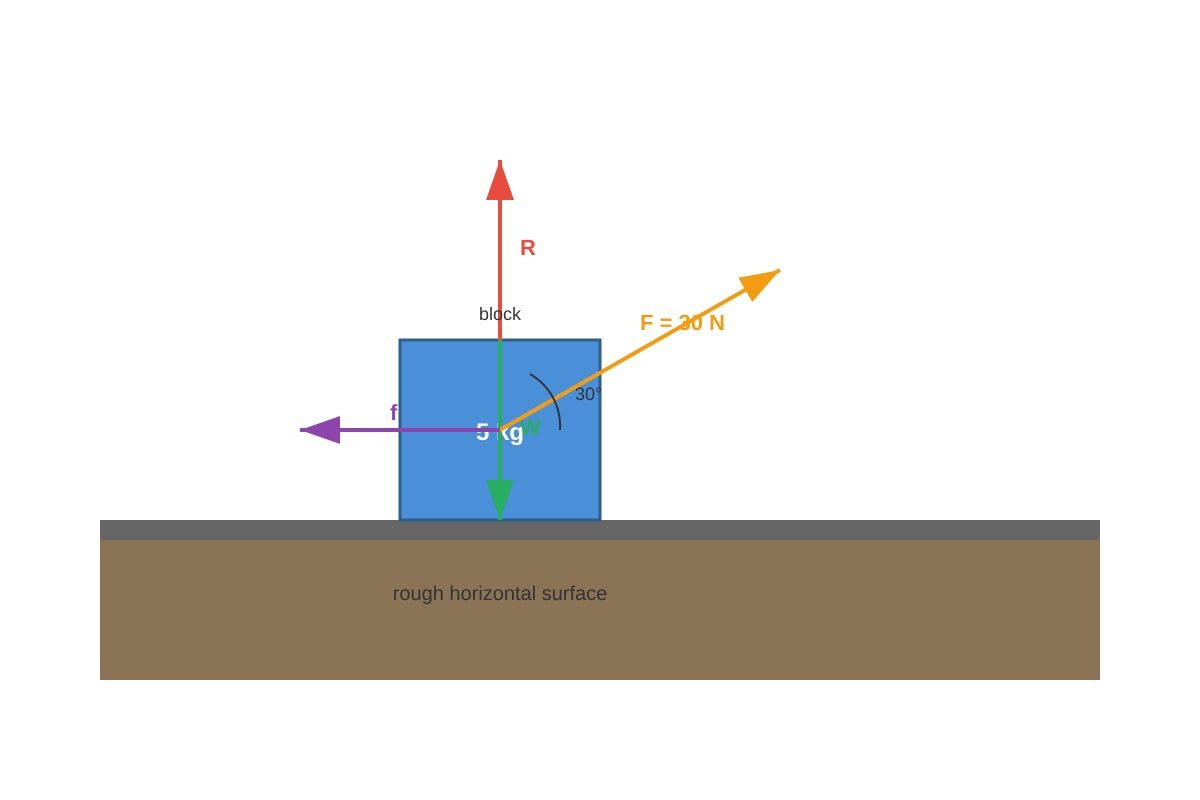
12. The diagram below shows a block of mass 5 kg5 \text{ kg} being pulled along a rough horizontal surface by a force of 30 N30 \text{ N} at an angle of 30°30° to the horizontal. The block moves at constant velocity.

<image_placeholder> id: Q12-fig1 type: diagram linked_question: Q12 description: A 5 kg block on a rough horizontal surface being pulled by a 30 N force at 30 degrees above the horizontal. Show the normal reaction force R, weight W, applied force F, and friction f clearly labelled. labels: block, horizontal surface, 30 N force, angle 30°, R (normal reaction), W (weight), f (friction) values: mass = 5 kg, applied force = 30 N, angle = 30° must_show: all four forces labelled with correct directions, angle marked between force and horizontal, block dimensions clear </image_placeholder>

(a) Explain what is meant by "constant velocity" and state the net force on the block. [2]


(b) Calculate the horizontal component of the applied force. [2]


(c) Determine the magnitude of the frictional force acting on the block. Explain your reasoning. [2]


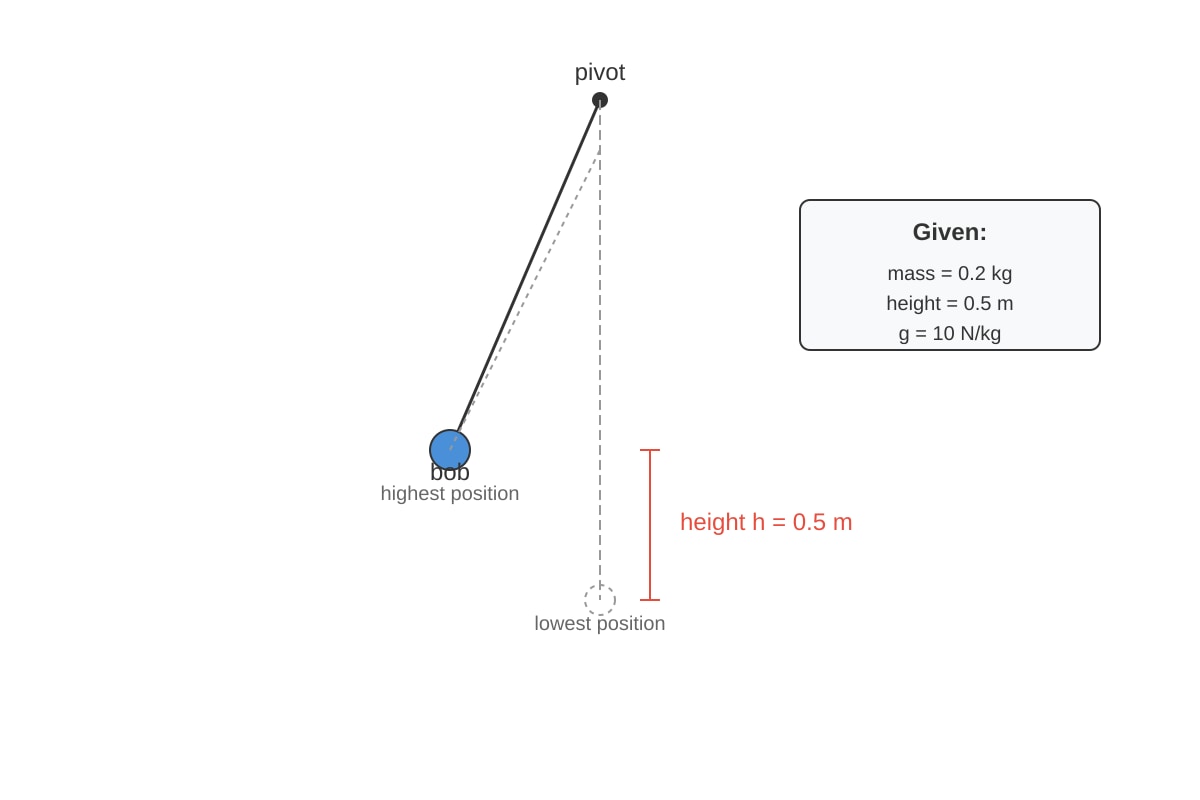
13. A pendulum bob of mass 0.2 kg0.2 \text{ kg} is raised to a height of 0.5 m0.5 \text{ m} above its lowest point and released.

<image_placeholder> id: Q13-fig1 type: diagram linked_question: Q13 description: A simple pendulum showing the bob at its highest position (0.5 m above lowest point) with the vertical reference line and height labelled. labels: pivot, string, bob, highest position, lowest position, height h = 0.5 m values: mass = 0.2 kg, height = 0.5 m, g = 10 N/kg must_show: clear arc of swing, vertical dimension labelled 0.5 m, bob at extreme position, pivot point </image_placeholder>

(a) Calculate the gravitational potential energy of the bob at its highest point. [2]


(b) Assuming no energy losses, calculate the maximum speed of the bob at its lowest point. [3]


(c) In practice, the bob does not quite reach the same height on the other side. Explain why. [1]


14. A satellite of mass 200 kg200 \text{ kg} orbits Earth at a distance of 8000 km8000 \text{ km} from Earth's centre. The mass of Earth is 6.0×1024 kg6.0 \times 10^{24} \text{ kg}.

(a) State Newton's Law of Gravitation in words or by formula. [2]


(b) Calculate the gravitational force between Earth and the satellite. [3]

Given: G=6.67×10¹¹ N m2kg2G = 6.67 \times 10^{-11} \text{ N m}^2 \text{kg}^{-2}


SECTION C (16 marks)

Answer all questions. Marks are shown in brackets.


15. A train of total mass 4.0×10⁵ kg4.0 \times 10^5 \text{ kg} accelerates from rest along a straight horizontal track. The driving force is 8.0×10⁵ N8.0 \times 10^5 \text{ N} and a constant resistive force of 2.0×10⁵ N2.0 \times 10^5 \text{ N} opposes the motion.

(a) Calculate the resultant force on the train. [1]


(b) Calculate the acceleration of the train. [2]


(c) Calculate the distance travelled by the train in the first 30 s30 \text{ s}, assuming the acceleration remains constant. [3]


(d) After 30 s30 \text{ s}, the driving force is removed but the resistive force continues. Describe and explain the subsequent motion of the train. [2]


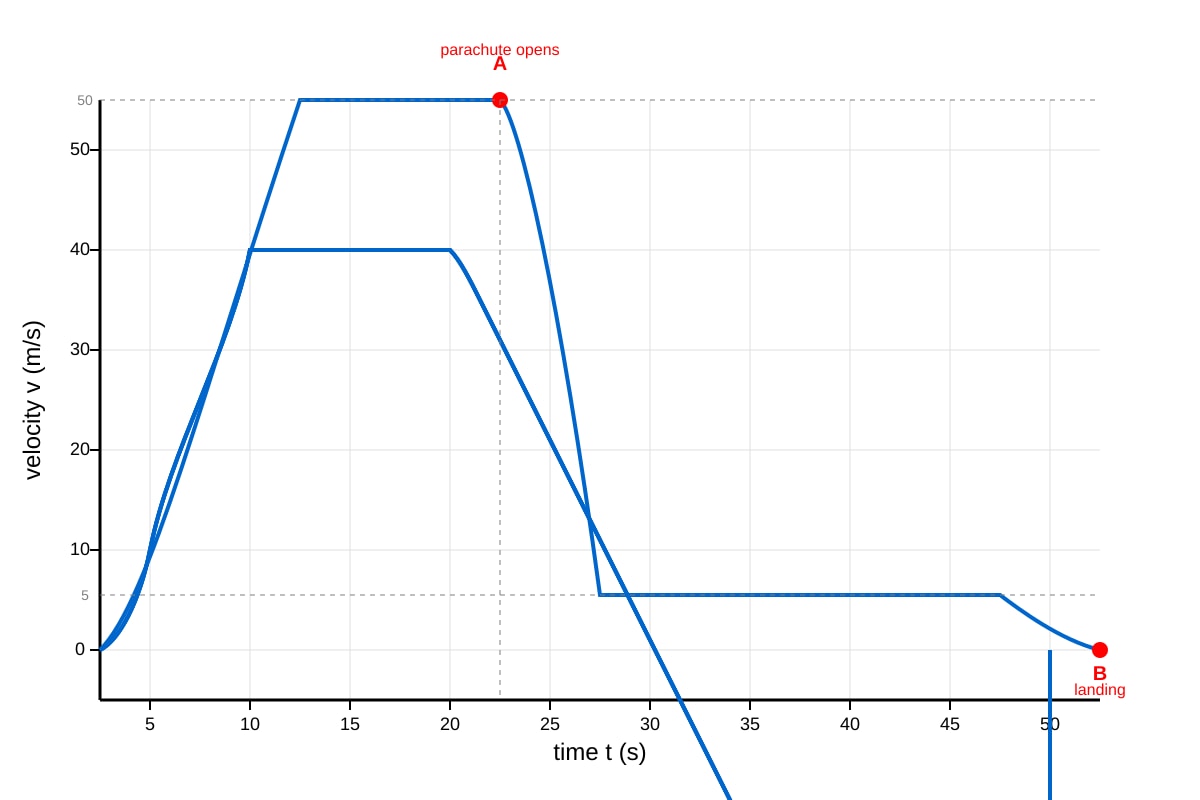
16. The velocity-time graph below shows the motion of a skydiver from the moment she jumps from an aircraft until she reaches the ground.

<image_placeholder> id: Q16-fig1 type: graph linked_question: Q16 description: Velocity-time graph for skydiver motion from jump to landing. Initial acceleration, then terminal velocity, then deceleration when parachute opens, then lower terminal velocity, then landing at zero velocity. labels: velocity v (m/s) on y-axis, time t (s) on x-axis, point A (parachute opens), point B (landing) values: initial jump at v=0, reaches approximately 50 m/s terminal velocity at t=10s, parachute opens at t=20s (point A), decelerates to approximately 5 m/s by t=25s, maintains 5 m/s until t=45s, lands at t=50s (point B), v=0 must_show: labelled axes with units, point A marked at t=20s with annotation "parachute opens", point B at t=50s with "landing", two distinct horizontal plateaus at different velocities, curved transitions between phases </image_placeholder>

(a) State the terminal velocity of the skydiver before the parachute opens. [1]


(b) Explain why the skydiver reaches a terminal velocity. [2]


(c) Explain the shape of the graph between points A and B (from t=20 st = 20 \text{ s} to t=50 st = 50 \text{ s}). [3]


(d) Calculate the total distance fallen by the skydiver in the first 20 s20 \text{ s}. You may assume the area under the graph can be approximated. [2]


17. A road safety campaign investigates the factors affecting stopping distance. The following data were collected for a car travelling at different speeds on a dry road.

Speed / (m/s)Thinking distance / mBraking distance / m
1065
201220
301845
402480

(a) Explain the difference between thinking distance and braking distance. [2]


(b) Determine the driver's reaction time from the data. Show your working. [2]


(c) Explain why the braking distance increases more rapidly than the thinking distance as speed increases. [2]


END OF PAPER


TOTAL: 60 MARKS

Answers

<!-- TuitionGoWhere generation metadata: stage=3-1; model=moonshotai/kimi-k2.6:free; model_label=Kimi K2.6 Free; generated=2026-06-10; Sources: Stage 2-1 real exam-derived templates and Stage 2-2 exam-enriched syllabus. -->

TuitionGoWhere Practice Paper - Physics Secondary 3: Answer Key (Version 5)


SECTION A (20 marks)


1. Answer: C (Velocity)

Explanation: A vector quantity has both magnitude and direction. Velocity includes both speed (magnitude) and direction of motion. Mass, time, and energy are scalar quantities—they have magnitude only.

Common mistake: Confusing speed and velocity. Speed is scalar; velocity is vector.

Mark: [1]


2. Answer: 4

Working: a=vut=2005=4 m/s2a = \frac{v - u}{t} = \frac{20 - 0}{5} = 4 \text{ m/s}^2

Explanation: Acceleration is the rate of change of velocity. Using a=Δvta = \frac{\Delta v}{t} with initial velocity u=0u = 0 (from rest), final velocity v=20 m/sv = 20 \text{ m/s}, and time t=5 st = 5 \text{ s}.

Mark: [1]


3. Answer: An object will remain at rest or continue moving with constant velocity (constant speed in a straight line) unless acted upon by a resultant (unbalanced) force.

Explanation: Newton's First Law describes inertia—the tendency of objects to resist changes to their motion. "Constant velocity" means both constant speed AND constant direction (straight line). The key phrase is "resultant force" or "unbalanced force" (not just "force"—balanced forces allow constant velocity too).

Mark: [1]


4. Answer: 80

Working: W=mg=8×10=80 NW = mg = 8 \times 10 = 80 \text{ N}

Explanation: Weight is the gravitational force on a mass, calculated by W=mgW = mg. Mass m=8 kgm = 8 \text{ kg}, g=10 N/kgg = 10 \text{ N/kg}.

Note: Weight is measured in newtons (N), mass in kilograms (kg).

Mark: [1]


5. Answer: 3

Working: F=maa=Fm=124=3 m/s2F = ma \Rightarrow a = \frac{F}{m} = \frac{12}{4} = 3 \text{ m/s}^2

Explanation: Newton's Second Law states F=maF = ma. Rearranging for acceleration: a=F/ma = F/m.

Mark: [1]


6. Answer: Energy cannot be created or destroyed, only converted from one form to another. The total energy in a closed system remains constant.

Explanation: This principle means that in any energy transfer or transformation, the total amount of energy before equals the total after. Energy may change form (e.g., kinetic to potential, or to thermal energy due to friction), but the total is conserved.

Mark: [1]


7. Answer: B

Explanation: At the highest point, the ball momentarily stops (velocity = 0) before falling back down. However, acceleration remains constant at g=10 m/s2g = 10 \text{ m/s}^2 downwards throughout the flight (ignoring air resistance). Gravity still acts on the ball even when it is instantaneously at rest.

Common mistake: Thinking acceleration is zero when velocity is zero. Acceleration is due to gravity and is constant.

Mark: [1]


8. Answer: 500

Working: Displacement forms the hypotenuse of a right-angled triangle: s=3002+4002=90000+160000=250000=500 ms = \sqrt{300^2 + 400^2} = \sqrt{90000 + 160000} = \sqrt{250000} = 500 \text{ m}

Explanation: Displacement is the shortest distance from start to finish (straight line), not the total path travelled. Using Pythagoras' theorem for the perpendicular displacements north and east.

Mark: [1]


9. Answer: Any two from:

  • (i) Speed of the vehicle (greater speed → longer braking distance)
  • (ii) Road surface condition (wet/icy roads increase braking distance)
  • (iii) Condition of brakes/worn brake pads
  • (iv) Tire condition/tread depth
  • (v) Mass of vehicle

Explanation: Braking distance is the distance travelled while decelerating to a stop. It depends on factors affecting the deceleration achievable. Thinking distance (distance before brakes are applied) depends mainly on reaction time and speed.

Mark: [1] each, max [2]


10. Answer: 2

Working: Using s=ut+12at2s = ut + \frac{1}{2}at^2 with u=0u = 0, a=g=10 m/s2a = g = 10 \text{ m/s}^2, s=20 ms = 20 \text{ m}: 20=0+12(10)t220 = 0 + \frac{1}{2}(10)t^2 20=5t220 = 5t^2 t2=4t^2 = 4 t=2 st = 2 \text{ s}

Explanation: For free-fall from rest, use the equation of motion s=12gt2s = \frac{1}{2}gt^2. Take care with signs—if downward is negative, both ss and gg are negative, giving the same result.

Mark: [1]


SECTION B (24 marks)


11.

(a) Deceleration = 2.5 m/s² [2]

Working: a=vut=02510=2.5 m/s2a = \frac{v - u}{t} = \frac{0 - 25}{10} = -2.5 \text{ m/s}^2

Deceleration is 2.5 m/s22.5 \text{ m/s}^2 (or 2.5 m/s2-2.5 \text{ m/s}^2 if deceleration direction is specified).

Mark breakdown:

  • [1] Correct substitution or method
  • [1] Correct answer with unit

(b) Braking force = 3000 N [2]

Working: F=ma=1200×2.5=3000 NF = ma = 1200 \times 2.5 = 3000 \text{ N} (Using magnitude of deceleration: F=1200×2.5F = 1200 \times 2.5)

Or using resultant force: The braking force causes deceleration, so F=3000 NF = 3000 \text{ N} opposite to motion.

Mark breakdown:

  • [1] Correct substitution or method
  • [1] Correct answer with unit

(c) Velocity-time graph [2]

Expected features:

  • Straight line starting at (0,25)(0, 25)
  • Sloping downward with negative gradient
  • Reaching (10,0)(10, 0) on time axis
  • Axes labelled: velocity (m/s) vertical, time (s) horizontal
  • Straight line, not curved (uniform deceleration)

Mark breakdown:

  • [1] Correct shape (straight line, proper start/end points)
  • [1] Correctly labelled axes with units

12.

(a) [2]

Answer: "Constant velocity" means the block moves with unchanging speed in a straight line (constant speed AND direction). The net (resultant) force on the block is zero.

Explanation: By Newton's First Law, if velocity is constant, acceleration is zero, so resultant force must be zero. The block is in equilibrium—forces balance in both horizontal and vertical directions.

Mark breakdown:

  • [1] Correct statement about constant velocity (must mention constant speed in straight line, or no acceleration)
  • [1] Net force = 0 (or forces are balanced)

(b) Horizontal component = 25.98 N ≈ 26 N [2]

Working: Fhorizontal=Fcosθ=30×cos30°=30×0.866=25.98 NF_{\text{horizontal}} = F \cos \theta = 30 \times \cos 30° = 30 \times 0.866 = 25.98 \text{ N}

Or exactly: 153 N15\sqrt{3} \text{ N} or approximately 26 N26 \text{ N}

Mark breakdown:

  • [1] Correct formula or method (cosine of angle, not sine)
  • [1] Correct answer with unit

(c) Frictional force = 25.98 N ≈ 26 N [2]

Working/Reasoning: Since velocity is constant, horizontal forces balance: f=Fhorizontal=30cos30°=25.98 Nf = F_{\text{horizontal}} = 30 \cos 30° = 25.98 \text{ N}

Explanation: For constant velocity, resultant horizontal force must be zero (Newton's First Law). Therefore friction exactly opposes and equals the horizontal component of the applied force.

Mark breakdown:

  • [1] Correct reasoning (constant velocity means forces balanced, or resultant force = 0)
  • [1] Correct value with unit

13.

(a) Gravitational potential energy = 1.0 J [2]

Working: GPE=mgh=0.2×10×0.5=1.0 JGPE = mgh = 0.2 \times 10 \times 0.5 = 1.0 \text{ J}

Mark breakdown:

  • [1] Correct formula or substitution
  • [1] Correct answer with unit

(b) Maximum speed = 3.16 m/s ≈ 3.2 m/s [3]

Working: By conservation of energy: GPE at top = KE at bottom mgh=12mv2mgh = \frac{1}{2}mv^2

gh=12v2gh = \frac{1}{2}v^2

v2=2gh=2×10×0.5=10v^2 = 2gh = 2 \times 10 \times 0.5 = 10

v=10=3.16 m/sv = \sqrt{10} = 3.16 \text{ m/s}

Or using values: 1.0=12×0.2×v21.0 = \frac{1}{2} \times 0.2 \times v^2, so v2=10v^2 = 10, v=3.16v = 3.16 m/s

Mark breakdown:

  • [1] States conservation of energy or correct energy equation
  • [1] Correct substitution and manipulation
  • [1] Correct final answer with unit

Alternative using kinematics: v2=u2+2as=0+2(10)(0.5)=10v^2 = u^2 + 2as = 0 + 2(10)(0.5) = 10, v=3.16v = 3.16 m/s — accept if correct.

(c) Energy is lost to air resistance/drag [1]

Explanation: Some mechanical energy is converted to thermal energy (and sound) due to air resistance acting on the bob. This means not all GPE becomes KE on the downward swing, and on the upward swing, some KE is lost to air resistance before becoming GPE.

Mark: [1]


14.

(a) [2]

Answer: The gravitational force between two point masses is directly proportional to the product of their masses and inversely proportional to the square of the distance between their centres.

Formula: F=Gm1m2r2F = \frac{Gm_1m_2}{r^2}

where GG is the gravitational constant, m1m_1 and m2m_2 are the masses, and rr is the distance between centres.

Mark breakdown:

  • [1] Correct statement of proportionality relationships (or correct formula with all variables defined)
  • [1] Complete definition with "distance between centres" or correctly defined variables

(b) Gravitational force = 1250 N (accept 1251 N) [3]

Working: F=Gm1m2r2F = \frac{Gm_1m_2}{r^2}

Given: G=6.67×10¹¹ N m2kg2G = 6.67 \times 10^{-11} \text{ N m}^2 \text{kg}^{-2}, m1=6.0×1024 kgm_1 = 6.0 \times 10^{24} \text{ kg}, m2=200 kgm_2 = 200 \text{ kg}, r=8000 km=8.0×10⁶ mr = 8000 \text{ km} = 8.0 \times 10^6 \text{ m}

F=(6.67×1011)×(6.0×1024)×200(8.0×10⁶)2F = \frac{(6.67 \times 10^{-11}) \times (6.0 \times 10^{24}) \times 200}{(8.0 \times 10^6)^2}

F=8.004×10166.4×1013F = \frac{8.004 \times 10^{16}}{6.4 \times 10^{13}}

F=1250.6 N1250 N or 1251 NF = 1250.6 \text{ N} \approx 1250 \text{ N} \text{ or } 1251 \text{ N}

Mark breakdown:

  • [1] Correct formula with correct substitution (including conversion of km to m)
  • [1] Correct calculation of numerator or denominator
  • [1] Correct final answer with unit

Note: rr must be in metres: 8000 km=8.0×10⁶ m8000 \text{ km} = 8.0 \times 10^6 \text{ m}. Common error: forgetting to convert km to m.


SECTION C (16 marks)


15.

(a) Resultant force = 6.0 × 10⁵ N [1]

Working: Fresultant=FdriveFresist=8.0×1052.0×105=6.0×10⁵ NF_{\text{resultant}} = F_{\text{drive}} - F_{\text{resist}} = 8.0 \times 10^5 - 2.0 \times 10^5 = 6.0 \times 10^5 \text{ N}

Mark: [1] — correct answer with unit

(b) Acceleration = 1.5 m/s² [2]

Working: F=maa=Fm=6.0×1054.0×105=1.5 m/s2F = ma \Rightarrow a = \frac{F}{m} = \frac{6.0 \times 10^5}{4.0 \times 10^5} = 1.5 \text{ m/s}^2

Mark breakdown:

  • [1] Correct substitution (using resultant force, not driving force)
  • [1] Correct answer with unit

Common error: Using 8.0×1058.0 \times 10^5 N instead of 6.0×1056.0 \times 10^5 N gives a=2.0a = 2.0 m/s² — incorrect.

(c) Distance = 675 m [3]

Working: Using s=ut+12at2s = ut + \frac{1}{2}at^2 with u=0u = 0, a=1.5a = 1.5 m/s², t=30t = 30 s:

s=0+12×1.5×(30)2s = 0 + \frac{1}{2} \times 1.5 \times (30)^2

s=0.5×1.5×900s = 0.5 \times 1.5 \times 900

s=0.75×900=675 ms = 0.75 \times 900 = 675 \text{ m}

Mark breakdown:

  • [1] Correct formula selected
  • [1] Correct substitution
  • [1] Correct answer with unit

Alternative using kinematic equations or average velocity: Average velocity = (0+45)/2=22.5(0 + 45)/2 = 22.5 m/s, distance = 22.5×30=67522.5 \times 30 = 675 m — accept if correct.

(d) [2]

Answer: The train will decelerate (slow down) because the resistive force now exceeds the forward force (which is zero). The train will continue to slow down until it comes to rest.

Explanation: With no driving force, the resultant force is just the resistive force (2.0×1052.0 \times 10^5 N) acting opposite to motion. By Newton's Second Law, this causes deceleration. The deceleration a=Fresist/m=2.0×105/4.0×105=0.5a = -F_{\text{resist}}/m = -2.0 \times 10^5 / 4.0 \times 10^5 = -0.5 m/s².

Mark breakdown:

  • [1] Train decelerates/slows down/stops (stated or described)
  • [1] Explanation: resistive force acts as resultant force opposing motion (or equivalent reasoning mentioning unbalanced force opposing motion)

16.

(a) Terminal velocity = 50 m/s [1] (accept value read from graph: 50–52 m/s)

Mark: [1] — correct value with unit from graph

(b) [2]

Answer: As the skydiver falls, air resistance (drag) increases with speed. When air resistance equals the skydiver's weight, the resultant force becomes zero. By Newton's First Law, the skydiver then falls at constant (terminal) velocity.

Mark breakdown:

  • [1] Air resistance increases with speed and eventually equals weight
  • [1] Resultant force becomes zero, so no further acceleration / constant velocity reached

(c) [3]

Answer for A to ~25 s: The parachute opens, causing a large increase in air resistance (drag). This creates a large resultant force upwards, causing rapid deceleration. The gradient is steep and negative.

Answer for ~25 s to B: The skydiver slows until air resistance (now with parachute) again equals her weight. She reaches a new, lower terminal velocity (about 5 m/s). The graph becomes horizontal again. Finally, she lands at zero velocity.

Mark breakdown:

  • [1] Parachute increases air resistance dramatically, causing rapid deceleration (steep negative gradient)
  • [1] New lower terminal velocity reached where air resistance (with parachute) = weight
  • [1] Landing at B with zero velocity / coming to rest

(d) Distance ≈ 500 m [2]

Working: The area under the velocity-time graph gives distance. For 0–20 s:

  • Approximate as triangle or trapezium/triangle + rectangle
  • Area ≈ 12×20×50=500\frac{1}{2} \times 20 \times 50 = 500 m

Or more accurately: area ≈ area of triangle from 0 to ~10 s + rectangle from ~10 s to 20 s at 50 m/s

  • 12×10×50+10×50=250+500=750\approx \frac{1}{2} \times 10 \times 50 + 10 \times 50 = 250 + 500 = 750 m — but this overestimates

Better estimate using triangle to terminal velocity:

  • 12×20×50=500\frac{1}{2} \times 20 \times 50 = 500 m is acceptable as approximation

Or using area of trapezium with visible curve: accept 400–600 m with clear working shown.

Mark breakdown:

  • [1] Method: states area under graph = distance, or appropriate counting of squares
  • [1] Reasonable estimate with working shown (accept 400–650 m depending on method; must show some calculation)

17.

(a) [2]

Thinking distance: The distance travelled by the vehicle during the driver's reaction time (the time between seeing a hazard and applying the brakes). It depends on speed and reaction time.

Braking distance: The distance travelled by the vehicle while actually braking (decelerating) to a stop. It depends on speed, road conditions, brakes, and vehicle condition.

Mark breakdown:

  • [1] Correct description of thinking distance (distance during reaction time/delay)
  • [1] Correct description of braking distance (distance while brakes are applied/decelerating)

(b) Reaction time = 0.60 s [2]

Working: reaction time=thinking distancespeed=610=0.60 s\text{reaction time} = \frac{\text{thinking distance}}{\text{speed}} = \frac{6}{10} = 0.60 \text{ s}

Check with other values: 1220=0.60\frac{12}{20} = 0.60 s, 1830=0.60\frac{18}{30} = 0.60 s, 2440=0.60\frac{24}{40} = 0.60 s

Mark breakdown:

  • [1] Correct method (thinking distance ÷ speed, or equivalent)
  • [1] Correct answer with unit or consistent seconds

(c) [2]

Answer: Thinking distance is directly proportional to speed (linear relationship: double speed → double thinking distance). However, braking distance depends on v2v^2 (kinetic energy = 12mv2\frac{1}{2}mv^2 which must be dissipated by braking work = force × braking distance). Since kinetic energy increases with speed squared, braking distance increases with speed squared (quadruples when speed doubles).

Mark breakdown:

  • [1] Thinking distance ∝ speed (linear) — correct relationship stated
  • [1] Braking distance ∝ v2v^2 (or related to kinetic energy 12mv2\frac{1}{2}mv^2) — correct reasoning that KE or stopping work relates to squared relationship

Alternative acceptable reasoning: Work done = F×dF \times d = loss in KE = 12mv2\frac{1}{2}mv^2. If FF is constant (max braking force), then dv2d \propto v^2.


TOTAL: 60 MARKS