From Real Exams Exam Paper
Secondary 3 Physics Semestral Assessment 2 (End of Year) Paper 5
Free Sec 3 Physics SA2 Paper 5, HY3 Exam version, with questions, answers, and O Level-style practice for Singapore students.
These static practice materials are generated from the site's syllabus and paper-generation workflow, with source and model context shown so students and parents can evaluate the material before use.
Questions
TuitionGoWhere Practice Paper - Physics Secondary 3 (SA2)
School: TuitionGoWhere Secondary School (AI)
Subject: Physics
Level: Secondary 3
Paper: SA2 Practice Paper (Version 5 of 5)
Duration: 60 minutes
Total Marks: 60
Name: ___________________________
Class: ____________
Date: ____________
Instructions:
- Answer all questions in the spaces provided.
- Show your working clearly where calculation is required.
- Use g=10 m s−2 unless stated otherwise.
- Section A: Multiple Choice (1 mark each). Section B: Structured Short Answers (2–3 marks each). Section C: Extended Structured (4 marks each).
Section A (Questions 1–5, 5 marks)
-
A boy of mass 50 kg stands on a weighing scale in a stationary lift. What is the reading on the scale in newtons?
A. 0 N
B. 50 N
C. 500 N
D. 5000 N
[ ] -
Which of the following quantities is a vector?
A. Speed
B. Distance
C. Mass
D. Acceleration
[ ] -
A car travels 100 m in 5 s at constant speed. What is its speed?
A. 5 m/s
B. 20 m/s
C. 50 m/s
D. 500 m/s
[ ] -
The moment of a force about a pivot is maximum when the force is applied:
A. parallel to the lever
B. at the pivot
C. perpendicular to the lever at the furthest point
D. at the centre of gravity
[ ] -
Pressure in a liquid increases with:
A. decreasing depth
B. decreasing density
C. increasing depth
D. decreasing gravitational field strength
[ ]
Section B (Questions 6–15, 24 marks)
-
(a) Define scalar and vector quantities. [2]
(b) Give one example of each. [1] -
A runner covers 200 m in 25 s. Calculate his average speed. [2]
-
A block of mass 4 kg is pushed with a force of 20 N on a frictionless surface. Find the acceleration. [2]
-
A child of mass 30 kg slides down a vertical rope with acceleration 2 m/s². Calculate the frictional force between her and the rope. [3]
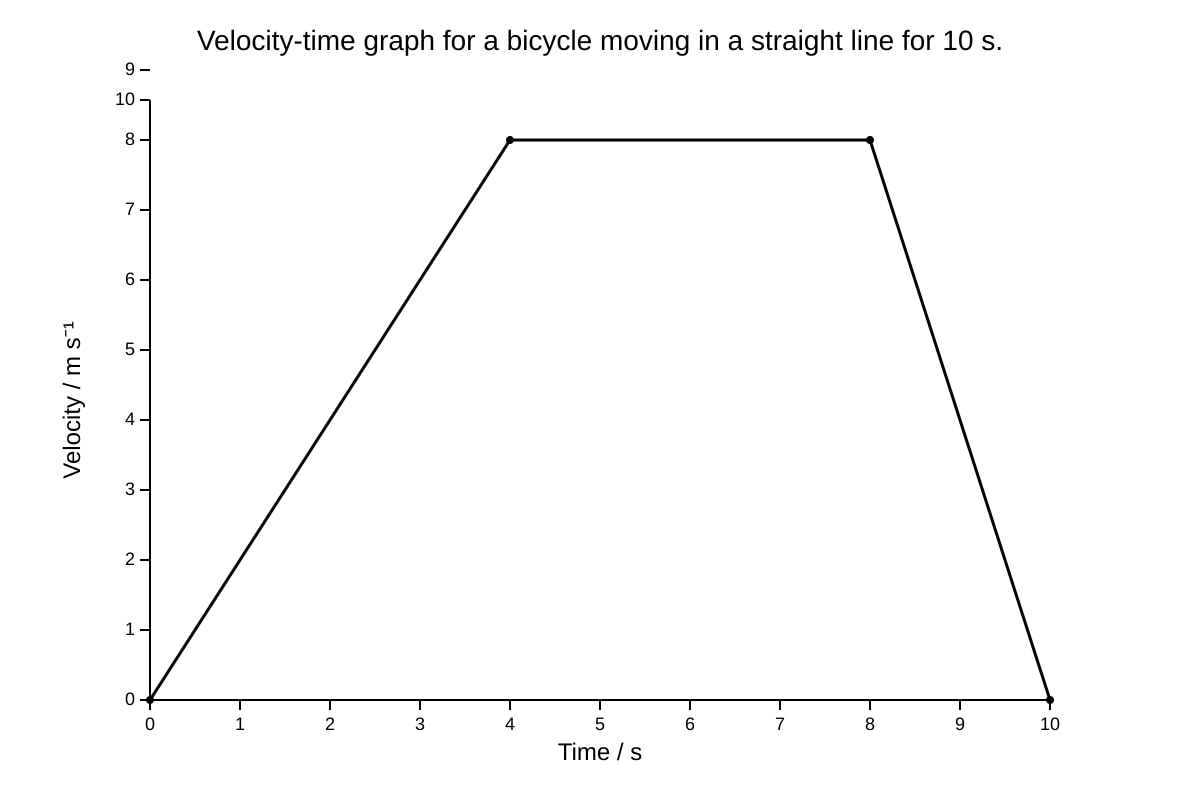
Image pending generation: graph for Q10.
Using the graph, calculate the total distance travelled by the bicycle. [3]
11. A wooden block of mass 5 kg is pulled up a rough inclined plane at constant speed by a force of 40 N. The distance moved along the plane is 3 m and vertical rise is 1.5 m. Calculate the work done against friction. [3]
-
State the principle of moments and give one condition for equilibrium of a body under coplanar forces. [2]
-
A hydraulic press has a small piston area 0.01 m² and large piston area 0.5 m². A force of 100 N is applied to the small piston. Find the force on the large piston. [3]
-
A ball is dropped from rest. After 3 s, what is its velocity? (Take g=10 m/s², ignore air resistance.) [2]
-
A metal cube has mass 270 g and volume 100 cm³. Calculate its density in kg/m³. [3]
Section C (Questions 16–20, 31 marks)
-
A ring of mass 2 kg is suspended by two strings from a horizontal rod. String 1 makes 50° with the horizontal, string 2 makes 60° with the horizontal on the opposite side. Calculate the tension in each string. [4]
-
A car of mass 800 kg accelerates from rest to 20 m/s in 10 s.
(a) Calculate the acceleration. [2]
(b) Calculate the net force. [2]
(c) If resistive force is 300 N, find the driving force. [2] -
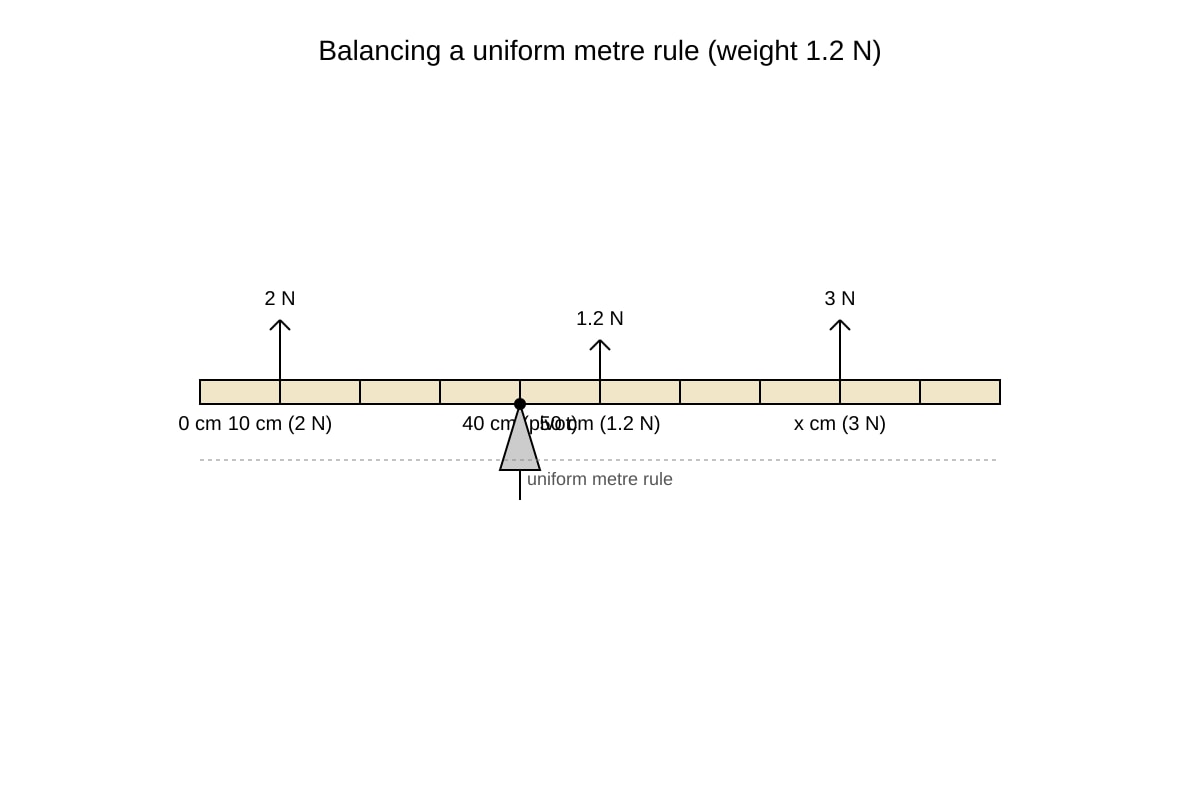
A uniform metre rule of weight 1.2 N is pivoted at the 40 cm mark. A 2 N load is hung at the 10 cm mark. Where must a 3 N load be placed to balance the rule? [4]
Image pending generation: diagram for Q18.
-
Explain why a wide base and low centre of gravity increase stability. Use physics principles. [4]
-
A crane lifts a 500 kg container vertically by 12 m in 20 s.
(a) Calculate gain in gravitational potential energy. [2]
(b) Calculate useful power output. [2]
(c) If the crane's motor uses 40 kW, calculate efficiency. [2]
(d) State one energy loss not accounted for. [1]
Answers
TuitionGoWhere Practice Paper - Physics Secondary 3 (SA2) Answer Key (Version 5)
Total Marks: 60
Section A
-
C [1]
Weight = mg=50×10=500 N. Stationary lift → no acceleration, scale reads weight. -
D [1]
Acceleration has magnitude and direction → vector. Others are scalars. -
B [1]
Speed = distance/time = 100/5=20 m/s. -
C [1]
Moment = F× perpendicular distance; max when perpendicular and furthest. -
C [1]
Liquid pressure = hρg → increases with depth h.
Section B
-
(a) Scalar: quantity with magnitude only [1]. Vector: magnitude + direction [1].
(b) e.g. mass (scalar), force (vector) [1]. -
Avg speed = 200/25=8 m/s [2].
-
a=F/m=20/4=5 m/s² [2].
-
Weight = 30×10=300 N down. Net: mg−f=ma → 300−f=30×2=60 → f=240 N [3].
-
Distance = area under graph = triangle (0–4): 21×4×8=16 m; rect (4–8): 4×8=32 m; triangle (8–10): 21×2×8=8 m. Total = 56 m [3].
-
Work applied = 40×3=120 J. PE gain = 5×10×1.5=75 J. Friction work = 120−75=45 J [3].
-
Principle: sum of clockwise moments = sum of anticlockwise moments for equilibrium [1]. Condition: resultant force = 0 and resultant moment = 0 [1].
-
Pascal: F2/A2=F1/A1 → F2=100×0.5/0.01=5000 N [3].
-
v=u+gt=0+10×3=30 m/s [2].
-
ρ=m/V=0.270 kg/(100×10−6 m3)=2700 kg/m³ [3].
Section C
-
Weight = 2×10=20 N.
Vertical: T1sin50+T2sin60=20
Horizontal: T1cos50=T2cos60
Solve: T1=T2cos60/cos50=0.6527T2
Sub: 0.6527T2(0.766)+0.866T2=20 → 0.5T2+0.866T2=20 → 1.366T2=20 → T2=14.6 N, T1=9.5 N [4]. -
(a) a=(20−0)/10=2 m/s² [2].
(b) F=ma=800×2=1600 N [2].
(c) Driving = 1600 + 300 = 1900 N [2]. -
Pivot 40 cm. Anticlockwise: 2×(40−10)=60 Ncm. Clockwise from rule: 1.2×(50−40)=12 Ncm. Let 3 N at x cm from 0, distance from pivot = x−40. Balance: 60=12+3(x−40) → 48=3x−120 → 3x=168 → x=56 cm [4].
-
Wide base → larger overturning distance before COM passes pivot [2]. Low CG → smaller turning moment for same tilt [2].
-
(a) GPE = 500×10×12=60000 J [2].
(b) P=60000/20=3000 W [2].
(c) η=3000/40000=7.5% [2].
(d) e.g. heat from motor, sound, friction [1].
Free quiz and exam paper access
Enter your details to view this paper
Your access is remembered on this device.