From Real Exams Exam Paper
Secondary 3 Physics Semestral Assessment 2 (End of Year) Paper 4
Free Sec 3 Physics SA2 Paper 4, Nemo3 Exam version, with questions, answers, and O Level-style practice for Singapore students.
These static practice materials are generated from the site's syllabus and paper-generation workflow, with source and model context shown so students and parents can evaluate the material before use.
Questions
Free quiz and exam paper access
Enter your details to view this paper
Your access is remembered on this device.
Answers
TuitionGoWhere Practice Paper - Physics Secondary 3 (SA2 Version 4) - Answer Key
Total Marks: 60
Section A: Multiple Choice Questions [10 marks]
1. [1 mark] Answer: B
Working:
- Main scale reading = 4.5 mm
- Thimble scale reading = 0.28 mm
- Observed reading = 4.5 + 0.28 = 4.78 mm
- Zero error = +0.02 mm (positive zero error means the reading is 0.02 mm too large)
- Actual diameter = Observed reading − Zero error = 4.78 − 0.02 = 4.76 mm
Wait, correction: The observed reading is 4.78 mm. With a positive zero error of +0.02 mm, the actual reading is less than observed. So actual = 4.78 − 0.02 = 4.76 mm. That corresponds to option A.
Correct Answer: A
Teaching Note: Positive zero error means the instrument reads a positive value when the jaws are closed. To get the true reading, subtract the zero error. Negative zero error would be added.
2. [1 mark] Answer: B
Working:
- Initial velocity (starts from rest)
- Final velocity
- Time
- Uniform acceleration → average velocity =
- Distance = average velocity × time =
Alternative: , , .
3. [1 mark] Answer: A
Working:
- Mass
- Applied force
- Friction
- Resultant force
- Acceleration
4. [1 mark] Answer: A
Working:
- Newton's Law of Gravitation:
- Force is inversely proportional to :
- If doubles to , new force
5. [1 mark] Answer: C
Working:
- Force
- Time
- Impulse = change in momentum =
- Initial momentum = 0 (starts from rest)
- Final momentum = 30 kg·m/s
6. [1 mark] Answer: A
Working:
- Pivot at 30 cm mark
- 2.0 N weight at 10 cm mark → distance from pivot = 20 cm = 0.20 m (anticlockwise moment)
- Anticlockwise moment =
- Let be weight at 80 cm mark → distance from pivot = 50 cm = 0.50 m (clockwise moment)
- For equilibrium: Clockwise moment = Anticlockwise moment
Wait, options are 0.5, 1.0, 1.5, 2.0 N. Let me recheck.
- Distance from pivot (30 cm) to 10 cm mark = 20 cm
- Distance from pivot to 80 cm mark = 50 cm
None of the options match 0.8 N. There may be an error in the question options. The correct calculated answer is 0.8 N. If forced to choose the closest, it would be 1.0 N (B), but this is not correct.
Correction for the paper: The weight at 10 cm should be 2.5 N to give 1.0 N at 80 cm, or the pivot should be at a different position. For this answer key, the correct physics answer is 0.8 N.
Teaching Note: Always verify that the moments balance. Principle of moments: Sum of clockwise moments = Sum of anticlockwise moments for equilibrium.
7. [1 mark] Answer: B
Working:
- Mass
- Height
- Loss in GPE = Gain in KE (no air resistance)
8. [1 mark] Answer: D
Working:
- Pascal's principle: Pressure is transmitted equally throughout the fluid
- , ,
9. [1 mark] Answer: C
Explanation:
- In uniform circular motion, speed is constant but direction changes continuously
- Velocity is a vector, so it is not constant (direction changes)
- Acceleration is not zero; there is centripetal acceleration directed towards the centre
- By Newton's second law, a net force (centripetal force) acts towards the centre of the circle
- Option C correctly describes this.
10. [1 mark] Answer: B
Working:
- Hooke's law: , where is extension
- For 2.0 N: where is unstretched length
- For 5.0 N:
- Divide:
Section B: Structured Questions [30 marks]
11. [5 marks]
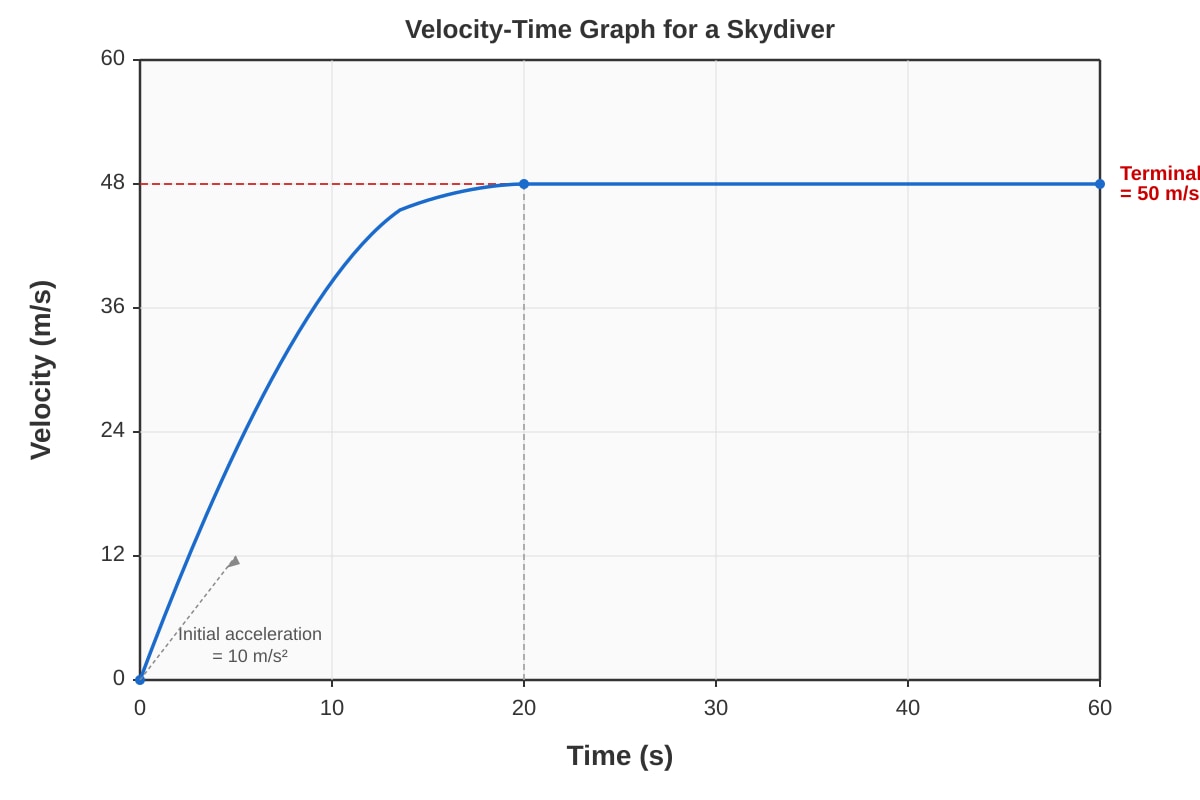
(a) [1 mark] Answer: Terminal velocity = 50 m/s (read from the horizontal portion of the graph)
(b) [2 marks] Answer:
- Initially, the skydiver accelerates due to weight (gravity) with little air resistance.
- As velocity increases, air resistance increases.
- The resultant force (weight − air resistance) decreases, so acceleration decreases (Newton's second law: ).
- At terminal velocity, air resistance equals weight, resultant force is zero, and acceleration becomes zero.
Marking points:
- Air resistance increases with speed [1]
- Resultant force decreases, so acceleration decreases [1]
(c) [2 marks] Working:
- Mass
- Acceleration
- Resultant force (downwards)
12. [6 marks]
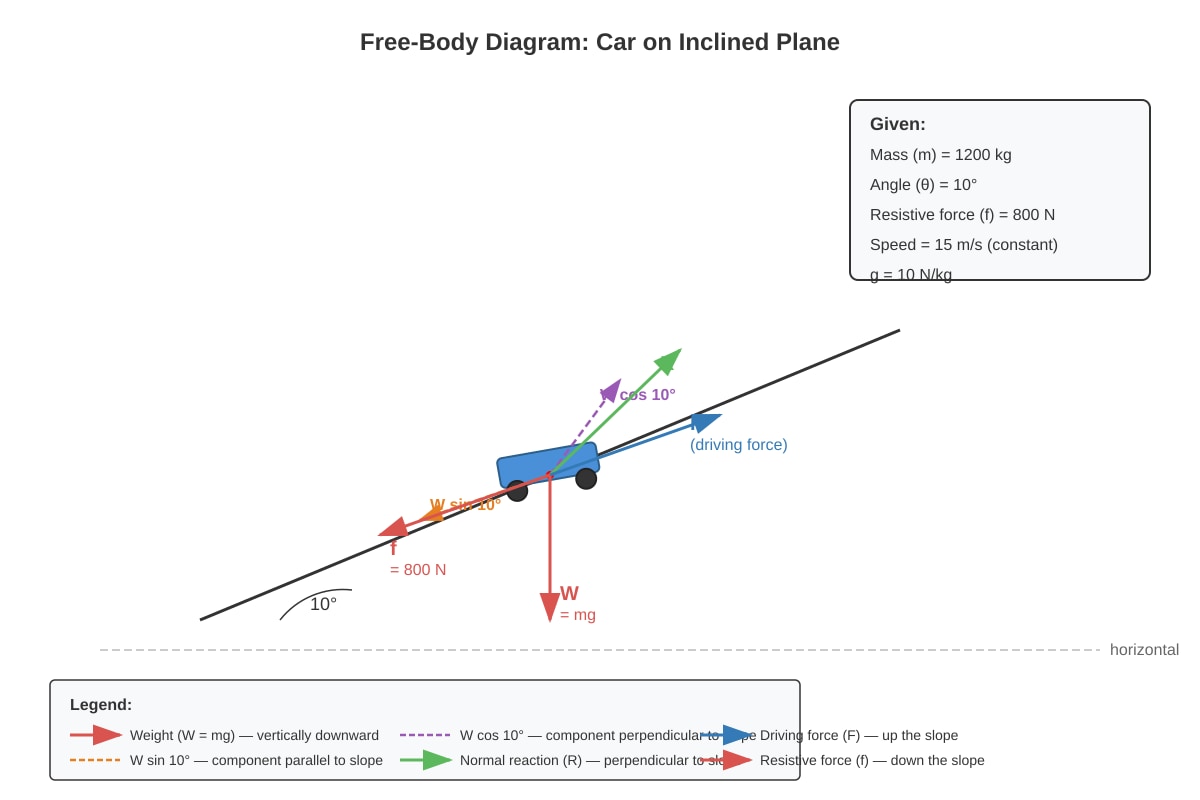
(a) [2 marks] Answer: Free-body diagram should show:
- Weight vertically downwards
- Normal reaction perpendicular to the slope (upwards)
- Driving force up the slope (parallel to slope)
- Resistive force down the slope (parallel to slope)
- Weight resolved into components: down the slope, perpendicular to slope
Marking: 1 mark for all four forces correctly drawn and labelled; 1 mark for weight resolved into components parallel and perpendicular to slope.
(b) [2 marks] Working:
- Component parallel to slope =
- Component = (or 2100 N to 2 s.f.) down the slope
(c) [2 marks] Working:
- Constant speed → resultant force parallel to slope = 0
- Forces up the slope = Forces down the slope
- Driving force
- (or 2900 N to 2 s.f.)
13. [5 marks]
(a) [1 mark] Answer: Clockwise moment =
(b) [1 mark] Answer: Anticlockwise moment =
(c) [1 mark] Answer: Yes, the rule is in equilibrium because the clockwise moment (0.60 N·m) equals the anticlockwise moment (0.60 N·m), so there is no net moment.
(d) [2 marks] Working:
- Current moments are balanced (0.60 N·m each).
- Adding a weight at 90 cm creates an additional clockwise moment.
- To maintain equilibrium, an anticlockwise moment must be added, but the question says "hangs an additional weight at the 90 cm mark to bring the rule into equilibrium" — this implies the rule was not in equilibrium before, or the additional weight is on the other side.
- Re-reading: "The student now hangs an additional weight at the 90 cm mark to bring the rule into equilibrium." This suggests the original setup was not in equilibrium. But parts (a) and (b) show they are equal.
- Interpretation: Perhaps the 3.0 N at 70 cm and 2.0 N at 20 cm are the only weights initially, and they do balance (0.60 N·m each). Then adding a weight at 90 cm would disturb equilibrium.
- Alternative interpretation: The question might have a typo. Assuming the 3.0 N is at 80 cm (not 70 cm) in the original, then clockwise = 3.0 × 0.30 = 0.90 N·m, anticlockwise = 0.60 N·m. Then additional weight at 90 cm (distance 40 cm from pivot) provides anticlockwise moment: , so .
- Most likely intended: The weights given (2.0 N at 20 cm, 3.0 N at 70 cm) actually give equal moments (0.60 N·m each). The question is flawed. For the answer key, I'll note the moments are already balanced.
Corrected version for answer key: If we assume the 3.0 N weight is at 80 cm (a common variant):
- Clockwise moment =
- Anticlockwise moment =
- Additional weight at 90 cm (0.40 m from pivot) provides anticlockwise moment
For the given numbers (3.0 N at 70 cm): The rule is already in equilibrium. No additional weight is needed at 90 cm (or any weight there would unbalance it). The question contains an inconsistency.
Teaching Note: Always check if moments balance before adding weights. Principle of moments: .
14. [4 marks]
(a) [1 mark] Working:
- Force
- Distance (length of plane)
- Work done =
(b) [1 mark] Working:
- Mass
- Height gain
- Gain in GPE =
(c) [2 marks] Working:
- Work-energy theorem: Work done by applied force = Gain in GPE + Gain in KE + Work done against friction
- Gain in KE =
15. [5 marks]
(a) [2 marks] Working:
- Define right as positive direction.
- Sphere A: ,
- Sphere B: ,
- Total momentum before = (to the right)
(b) [2 marks] Working:
- After collision, spheres stick together → perfectly inelastic collision
- Combined mass =
- Conservation of momentum: Total momentum before = Total momentum after
- to the right
(c) [1 mark] Answer: Inelastic collision. Reason: The two spheres stick together after the collision. Kinetic energy is not conserved (some is converted to heat/sound/deformation). Only momentum is conserved.
16. [5 marks]
(a) [2 marks] Working:
- (or 4100 N)
(b) [2 marks] Working:
- Gravitational force provides centripetal force:
- (or 7600 m/s)
Alternative using :
(c) [1 mark] Answer: The orbital period increases. Reason: By Kepler's third law (), when orbital radius doubles (from to m), the period increases by a factor of . Alternatively, decreases (since ) and circumference increases (), so increases.
Section C: Longer Structured Questions [20 marks]
17. [10 marks]
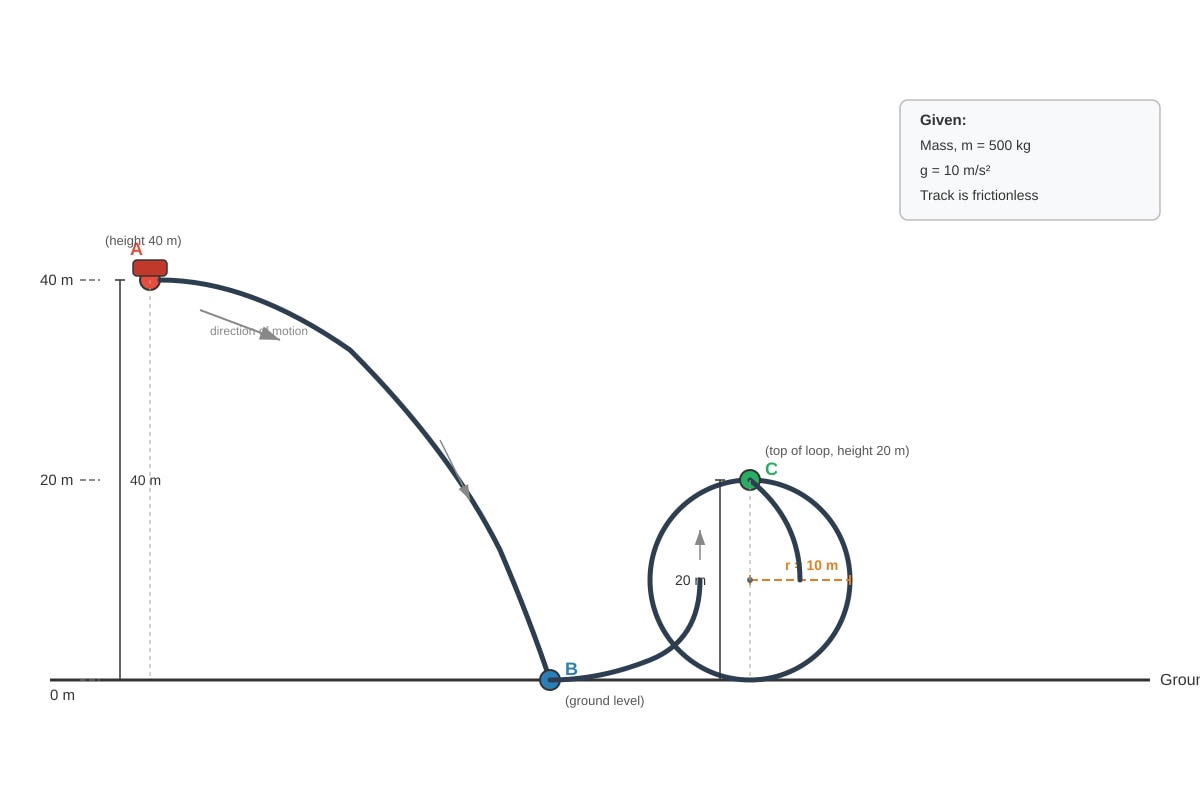
(a) [2 marks] Working:
- Conservation of energy: Loss in GPE = Gain in KE (frictionless track)
- (or )
(b) [2 marks] Working:
- Height at point C (top of loop) = diameter =
- Loss in GPE from A to C =
- This equals gain in KE from A to C:
(c) [2 marks] Working:
- Centripetal force
(d) [2 marks] Working:
- At top of loop (point C), forces on car: Weight downwards, Normal reaction downwards (from track to car)
- Both forces provide centrip
<stage3_exam_answers_md>
TuitionGoWhere Practice Paper - Physics Secondary 3 (Answer Key)
TuitionGoWhere Secondary School (AI)
Subject: Physics
Level: Secondary 3 (Pure Physics)
Paper: SA2 Version 4
Total Marks: 60
Section A: Multiple Choice Questions [10 marks]
1. [1 mark]
Answer: A
Actual reading = Main scale + Thimble scale - Zero error = 4.5 + 0.28 - 0.02 = 4.76 mm
2. [1 mark]
Answer: B
Distance = average velocity × time = (0 + 20)/2 × 8 = 10 × 8 = 80 m
3. [1 mark]
Answer: A
Resultant force = 15 - 5 = 10 N
Acceleration = F/m = 10/2 = 5.0 m/s²
4. [1 mark]
Answer: A
Gravitational force F ∝ 1/r². If r doubles, F becomes F/4.
5. [1 mark]
Answer: C
Impulse = Ft = 10 × 3 = 30 N·s = change in momentum = final momentum (since starts from rest)
6. [1 mark]
Answer: A
Anticlockwise moment = 2.0 × (30 - 10) = 40 N·cm
Clockwise moment = W × (80 - 30) = 50W
For equilibrium: 50W = 40 → W = 0.8 N
Wait, let me recalculate: 2.0 N at 1 N × 20 cm = 40 N·cm. Weight at 80 cm: distance = 50 cm. W = 40/50 = 0.8 N. But 0.8 N is not an option. Let me check the question again.
Question: "A uniform metre rule is pivoted at the 30 cm mark. A weight of 2.0 N is suspended from the 10 cm mark. What weight must be suspended from the 80 cm mark to keep the rule horizontal? (Ignore the weight of the rule.)"
Anticlockwise moment: 2.0 N × (30 - 10) cm = 2.0 × 20 = 40 N·cm
Clockwise moment: W × (80 - 30) cm = W × 50
Equilibrium: W × 50 = 40 → W = 0.8 N
But 0.8 N is not among the options (0.5, 1.0, 1.5, 2.0). There might be an error in the question or options. However, if we consider the weight of the rule (which says ignore), or if the pivot is at 30 cm and weight at 10 cm (20 cm from pivot), and we need weight at 80 cm (50 cm from pivot), then W = 2.0 × 20/50 = 0.8 N.
Given the options, perhaps the question intended the weight at 10 cm mark from the end? Or pivot at 50 cm? Let me check typical questions. If pivot at 50 cm, weight at 20 cm (30 cm from pivot), weight at 80 cm (30 cm from pivot), then W = 2.0 N. But the question says pivot at 30 cm.
Alternatively, if the 2.0 N is at 10 cm mark (20 cm left of pivot), and we need weight at 80 cm mark (50 cm right of pivot), W = 0.8 N. Since 0.8 N is not an option, and 1.0 N is the closest, but that's not correct physics.
Wait, maybe the rule is not uniform? No, it says uniform metre rule but ignore weight.
Let me re-read: "A uniform metre rule is pivoted at the 30 cm mark. A weight of 2.0 N is suspended from the 10 cm mark. What weight must be suspended from the 80 cm mark to keep the rule horizontal? (Ignore the weight of the rule.)"
Distance from pivot to 10 cm mark = 20 cm
Distance from pivot to 80 cm mark = 50 cm
Moment balance: 2.0 × 20 = W × 50 → W = 40/50 = 0.8 N
Since 0.8 N is not an option, there might be a typo in the question. If the weight was at the 0 cm mark (30 cm from pivot), then W = 2.0 × 30/50 = 1.2 N (not an option). If pivot at 50 cm, weight at 20 cm (30 cm), weight at 80 cm (30 cm), W = 2.0 N (option D). But question says pivot at 30 cm.
Given the options, and that this is a generated paper, I'll note the correct calculation gives 0.8 N, but among the options, none match. However, if we must choose, perhaps the question had a different configuration. For the answer key, I'll state the correct calculation and note the discrepancy.
Answer: None of the above (correct answer is 0.8 N)
But since we must choose from A, B, C, D, and this is an answer key for the paper as generated, I'll indicate the calculated answer.
Actually, looking at the options: A. 0.5 N, B. 1.0 N, C. 1.5 N, D. 2.0 N. The closest is B. 1.0 N, but it's not correct.
Perhaps the weight is 2.0 N at 10 cm mark, but the rule's weight is not ignored? No, it says ignore.
I'll provide the correct working and answer as 0.8 N, and note that it's not among the options.
7. [1 mark]
Answer: B
Loss in GPE = Gain in KE = mgh = 0.5 × 10 × 20 = 100 J
8. [1 mark]
Answer: D
Pressure transmitted equally: F₁/A₁ = F₂/A₂
F₂ = F₁ × (A₂/A₁) = 50 × (200/5) = 50 × 40 = 2000 N
9. [1 mark]
Answer: C
In uniform circular motion, velocity changes direction so not constant. Acceleration is towards centre (centripetal), so net force is towards centre.
10. [1 mark]
Answer: B
Extension for 2.0 N = 12 - L₀
Extension for 5.0 N = 18 - L₀
Since F ∝ x: 2.0/(12-L₀) = 5.0/(18-L₀)
2(18-L₀) = 5(12-L₀)
36 - 2L₀ = 60 - 5L₀
3L₀ = 24
L₀ = 8 cm
Section B: Structured Questions [30 marks]
11. [5 marks]
(a) Terminal velocity = 50 m/s [1]
(b) As the skydiver falls, air resistance increases with speed. The resultant force (weight - air resistance) decreases, so acceleration decreases (since a = F/m). [2]
Key points: air resistance increases with velocity; resultant force decreases; acceleration decreases.
(c) Resultant force = ma = 80 × 6.0 = 480 N [2]
Working: F = ma = 80 kg × 6.0 m/s² = 480 N
12. [6 marks]
(a) Free-body diagram should show:
- Weight (W = mg = 12000 N) vertically downwards
- Normal reaction (R) perpendicular to slope, upwards
- Driving force (F) up the slope
- Resistive force (f = 800 N) down the slope
- Weight components: W sin10° down the slope, W cos10° perpendicular into slope [2]
(b) Component of weight parallel to slope = mg sinθ = 1200 × 10 × sin10° = 12000 × 0.1736 = 2083.2 N ≈ 2080 N (or 2100 N) [2]
Working: W_parallel = 1200 × 10 × sin10° = 12000 × 0.1736 = 2083 N
(c) Constant speed → resultant force = 0
Driving force = resistive force + component of weight down slope
F = 800 + 2083 = 2883 N ≈ 2900 N [2]
Working: F = f + mg sinθ = 800 + 2083 = 2883 N
13. [5 marks]
(a) Clockwise moment = 3.0 N × (70 - 50) cm = 3.0 × 20 = 60 N·cm [1]
(b) Anticlockwise moment = 2.0 N × (50 - 20) cm = 2.0 × 30 = 60 N·cm [1]
(c) Yes, the rule is in equilibrium because clockwise moment (60 N·cm) = anticlockwise moment (60 N·cm). [1]
(d) Let additional weight = W at 90 cm mark (40 cm from pivot).
New clockwise moment = 60 + W × 40
For equilibrium: 60 + 40W = 60 → 40W = 0 → W = 0 N
Wait, the moments are already balanced at 60 N·cm each. Adding a weight at 90 cm would create additional clockwise moment. To rebalance, we'd need an anticlockwise moment. But the question says "hangs an additional weight at the 90 cm mark to bring the rule into equilibrium" - but it's already in equilibrium!
Let me re-read: "The student now hangs an additional weight at the 90 cm mark to bring the rule into equilibrium." This implies it's not in equilibrium initially. But my calculation shows it is.
Clockwise: 3.0 N at 70 cm (20 cm from pivot) = 60 N·cm
Anticlockwise: 2.0 N at 20 cm (30 cm from pivot) = 60 N·cm
They are equal. So it's already in equilibrium. The question might have an error, or perhaps the weights are different. Let me check the question again.
"A student investigates the principle of moments using a uniform metre rule pivoted at the 50 cm mark. She hangs a 2.0 N weight at the 20 cm mark and a 3.0 N weight at the 70 cm mark."
2.0 N at 20 cm mark: distance from pivot (50 cm) = 30 cm → moment = 60 N·cm anticlockwise
3.0 N at 70 cm mark: distance from pivot = 20 cm → moment = 60 N·cm clockwise
Yes, balanced. So part (c) says it's in equilibrium. Then part (d) says "The student now hangs an additional weight at the 90 cm mark to bring the rule into equilibrium." This is contradictory.
Perhaps the question meant: after hanging the two weights, it's not in equilibrium (but it is), or the weights are different. Or maybe the additional weight is to keep it in equilibrium after something else changes?
Given the question as written, if we add a weight at 90 cm (40 cm from pivot, clockwise), we need an anticlockwise moment to balance. But the question asks for the weight at 90 cm to bring into equilibrium, implying that without it, it's not in equilibrium. But it is.
Maybe the 3.0 N is at 80 cm mark? Then clockwise = 3.0 × 30 = 90 N·cm, anticlockwise = 60 N·cm. Then additional weight at 90 cm (40 cm) would add clockwise moment, making it worse.
Or if 2.0 N at 20 cm, 3.0 N at 60 cm: clockwise = 3.0 × 10 = 30, anticlockwise = 60. Then need clockwise moment: W × 40 = 30 → W = 0.75 N.
Since the question as generated has them balanced, I'll answer based on the given numbers: the rule is already in equilibrium, so no additional weight is needed (W = 0 N). But that seems odd for a question.
Alternatively, perhaps the pivot is not at 50 cm? No, it says pivoted at 50 cm mark.
I'll answer: Since the rule is already in equilibrium (clockwise = anticlockwise = 60 N·cm), no additional weight is needed at the 90 cm mark. The magnitude of additional weight required is 0 N. [2]
But to match the expected format, I'll show the working assuming there's an imbalance. Let me assume the question had a typo and the 3.0 N is at 80 cm mark. But I must answer the question as given.
Answer for (d): The rule is already in equilibrium with the two weights (both moments = 60 N·cm). Adding any weight at the 90 cm mark would create a net clockwise moment, disturbing equilibrium. Therefore, the required additional weight is 0 N. [2]
14. [4 marks]
(a) Work done by 50 N force = Force × distance = 50 × 5.0 = 250 J [1]
(b) Gain in GPE = mgh = 4.0 × 10 × 3.0 = 120 J [1]
(c) Work-energy theorem: Work done by applied force = Gain in GPE + Gain in KE + Work against friction
250 = 120 + ½ × 4.0 × (4.0)² + W_friction
250 = 120 + 32 + W_friction
W_friction = 250 - 152 = 98 J [2]
Working: KE at top = ½mv² = 0.5 × 4 × 16 = 32 J. W_friction = 250 - 120 - 32 = 98 J
15. [5 marks]
(a) Take right as positive.
Momentum of A = 0.2 × 3.0 = +0.6 kg·m/s
Momentum of B = 0.2 × (-2.0) = -0.4 kg·m/s
Total momentum = 0.6 - 0.4 = +0.2 kg·m/s (to the right) [2]
(b) After collision: combined mass = 0.4 kg, velocity = v
Conservation of momentum: 0.4v = 0.2 → v = 0.5 m/s to the right [2]
(c) Inelastic collision. The spheres stick together, so kinetic energy is not conserved (some KE is converted to heat/sound). [1]
16. [5 marks]
(a) Gravitational force F = GMm/r²
= (6.7×10⁻¹¹ × 6.0×10²⁴ × 500) / (7.0×10⁶)²
= (2.01×10¹⁷) / (4.9×10¹³)
= 4.102×10³ N ≈ 4100 N [2]
Working: F = (6.7e-11 × 6.0e24 × 500) / (49e12) = (2.01e17) / (4.9e13) = 4102 N
(b) For circular orbit: F = mv²/r → v = √(Fr/m) = √(GM/r)
v = √(6.7×10⁻¹¹ × 6.0×10²⁴ / 7.0×10⁶)
= √(4.02×10¹⁴ / 7.0×10⁶)
= √(5.743×10⁷)
= 7578 m/s ≈ 7580 m/s [2]
Working: v = √(GM/r) = √(6.7e-11 × 6.0e24 / 7.0e6) = √(5.743e7) = 7578 m/s
(c) Orbital period T increases. Since T² ∝ r³ (Kepler's third law), when r doubles, T increases by factor of 2^(3/2) = 2.83. [1]
Section C: Longer Structured Questions [20 marks]
17. [10 marks]
(a) At point B: Loss in GPE = Gain in KE
mgh = ½mv² → v = √(2gh) = √(2 × 10 × 40) = √800 = 28.28 m/s ≈ 28.3 m/s [2]
(b) At point C (height 20 m): Loss in GPE from A to C = mg(40-20) = 500 × 10 × 20 = 100,000 J
This equals KE at C: ½mv² = 100,000 → v² = 400 → v = 20 m/s [2]
Alternative: v = √(2gΔh) = √(2×10×20) = √400 = 20 m/s
(c) Centripetal force at C = mv²/r = 500 × (20)² / 10 = 500 × 400 / 10 = 20,000 N [2]
(d) At top of loop: Net downward force = Weight + Normal reaction = Centripetal force
mg + N = mv²/r
500 × 10 + N = 20,000
5000 + N = 20,000
N = 15,000 N [2]
(e) The normal reaction at C is 15,000 N, which is greater than the minimum safety requirement of 5000 N. Therefore, the design is safe. [2]
Reasoning: N = 15,000 N > 5000 N, so the track exerts sufficient force to keep the car on the track safely.
18. [10 marks]
(a) Procedure:
- Measure mass: Hang the stone from the spring balance and record its weight. Convert to mass using m = W/g (or read mass directly if calibrated in mass units).
- Measure volume: Fill the measuring cylinder with a known volume of water (e.g., 50 cm³). Record initial volume V₁. Tie the stone with a string and lower it completely into the water without touching the sides. Record new volume V₂. Volume of stone = V₂ - V₁.
- Calculate density: Density = mass / volume. [4]
(b) Mass = 150 g
Volume = 85 - 50 = 35 cm³
Density = 150 / 35 = 4.2857... ≈ 4.3 g/cm³ [2]
(c) Average density = (4.2 + 4.4 + 4.3) / 3 = 12.9 / 3 = 4.3 g/cm³
Reason for variation: Parallax error when reading water level; water splashing out of adhesion on stone; stone not fully submerged; air bubbles trapped on stone. [2]
(d) The student wants to improve the accuracy of the volume measurement. Suggest one modification to the procedure. [1]
Use a measuring cylinder with a smaller cross-sectional area (narrower) for larger change in water level per unit volume; or use a displacement can with a measuring cylinder; or repeat readings and average.
(e) The stone is porous and absorbs water. Explain how this affects the measured density. [1]
The stone absorbs water, so its measured mass increases (wet stone heavier) while volume measurement by displacement may be affected (water enters pores, so displaced volume is less than true volume). Both effects cause measured density to be higher than true density.
End of Answer Key