From Real Exams Exam Paper
Secondary 3 Physics Semestral Assessment 2 (End of Year) Paper 4
Free Sec 3 Physics SA2 Paper 4, Kimi2.6 Exam version, with questions, answers, and O Level-style practice for Singapore students.
These static practice materials are generated from the site's syllabus and paper-generation workflow, with source and model context shown so students and parents can evaluate the material before use.
Questions
Free quiz and exam paper access
Enter your details to view this paper
Your access is remembered on this device.
Answers
TuitionGoWhere Practice Paper - Physics Secondary 3 (Version 4 of 5)
ANSWER KEY AND MARKING SCHEME
Total Marks: 60
Duration: 1 hour 15 minutes
SECTION A: MULTIPLE CHOICE QUESTIONS [20 marks]
Each question carries 2 marks. No working required.
Q1. Answer: C
Working/Explanation:
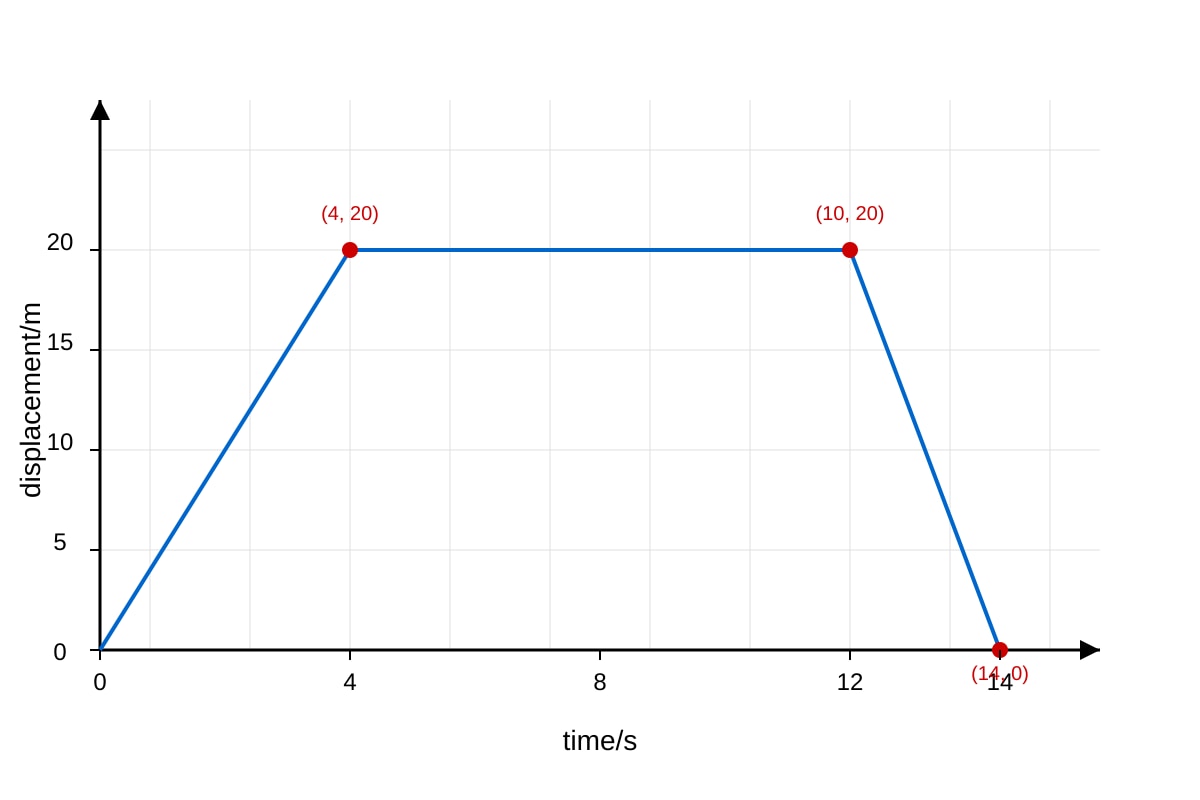
- Segment 0–4 s: Displacement increases from 0 to 20 m → moving forward with constant velocity (gradient = 20/4 = 5 m/s). So A is incorrect.
- At 10 s: Displacement is still 20 m, not 0. So B is incorrect.
- Segment 10–14 s: Displacement decreases from 20 m to 0. Speed = |gradient| = 20/4 = 5 m/s. C is correct.
- Total distance: 20 m (out) + 20 m (back) = 40 m, not 20 m. So D is incorrect.
Common mistake: Confusing displacement and distance. The cyclist travels 20 m out and 20 m back, so total distance = 40 m.
Q2. Answer: B
Working/Explanation:
- When thrown upwards, velocity starts positive (+v), decreases linearly due to constant downward acceleration (-g), passes through zero at maximum height, then becomes increasingly negative as the ball falls.
- Acceleration is constant throughout: a = −g (taking upwards as positive). Gravity always acts downward.
- Therefore: velocity = straight line with negative gradient; acceleration = horizontal line at −g.
Why others wrong:
- A has acceleration wrong sign (mgW is always downward)
- C shows curved velocity (should be straight line for constant acceleration)
- D shows zero acceleration (would mean no gravity)
Q3. Answer: B
Working/Explanation:
- Two perpendicular forces: use Pythagoras theorem for resultant.
- Resultant² = 12² + 5² = 144 + 25 = 169
- Resultant = √169 = 13 N
Common mistake: Simply adding (17 N) or subtracting (7 N). Forces are vectors and must be combined using vector addition.
Q4. Answer: C
Working/Explanation:
- Block is stationary → in equilibrium → net force = 0.
- Applied force = 8.0 N (horizontal)
- Static friction exactly balances this: friction = 8.0 N
- This is not the maximum possible friction (μₛN), just the friction needed for equilibrium.
Why others wrong:
- A (0 N): friction must balance applied force or block would accelerate
- B (4.0 N): no justification; incorrect calculation
- D (20 N): this would be weight (mg), not friction
Q5. Answer: D
Working/Explanation:
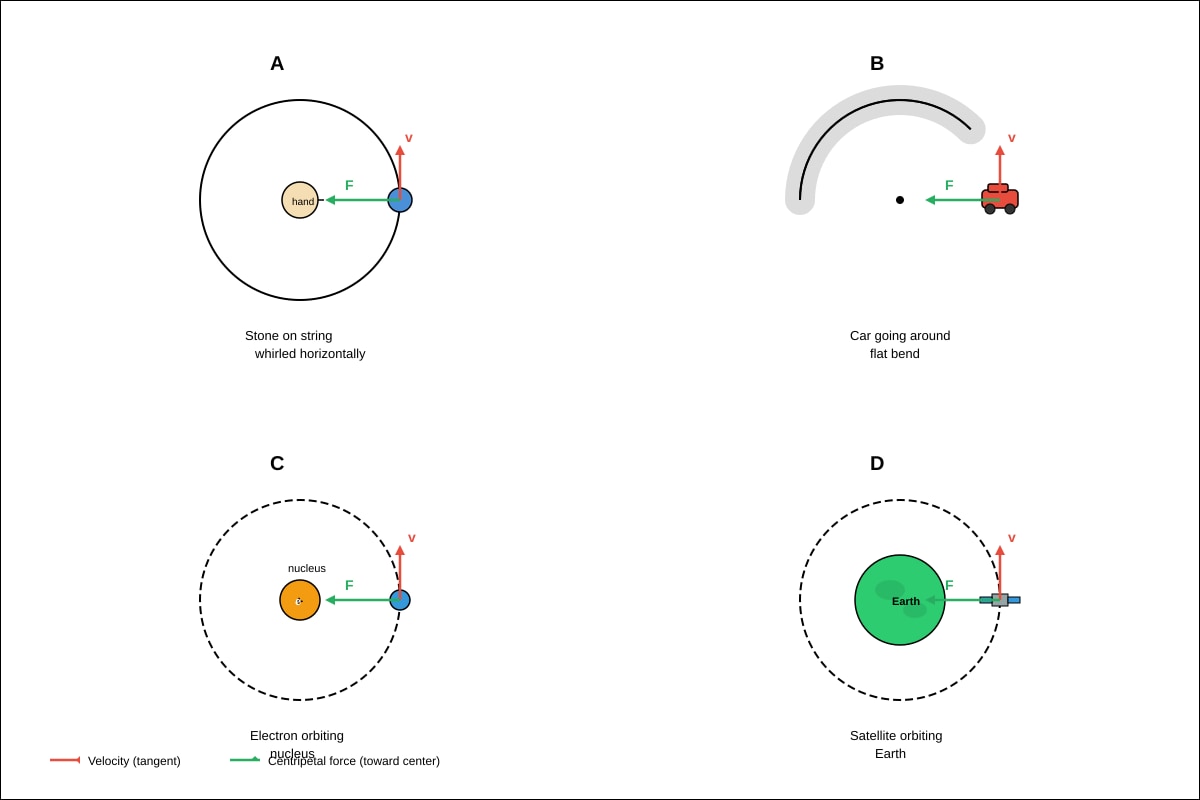
- Circular motion at constant speed requires a centripetal force directed toward the centre.
- This is true for all cases of circular motion:
- A: Tension provides centripetal force
- B: Friction between tyres and road provides centripetal force
- C: Electrostatic attraction (Coulomb force) provides centripetal force
- D: Gravitational force provides centripetal force
The net force is always directed toward the centre in uniform circular motion.
Q6. Answer: C
Working/Explanation:
- Percentage error = |(measured − true)| / true × 100%
- = |9.6 − 9.81| / 9.81 × 100%
- = 0.21 / 9.81 × 100%
- ≈ 2.1%
Why C not others:
- Accuracy vs precision: single measurement can't assess precision (need repeated measurements)
- −12.4% is wrong calculation (0.21/1.62 would be wrong base)
Q7. Answer: C
Working/Explanation: At lowest point, tension T must provide centripetal force AND support weight:
- Weight: mg = 0.50 × 10 = 5.0 N (downward)
- Centripetal force needed: mv²/r = 0.50 × (2.0)² / 1.0 = 0.50 × 4.0 / 1.0 = 2.0 N (upward, toward centre)
By Newton's second law (taking upward as positive, toward centre):
T − mg = mv²/r
T = mg + mv²/r = 5.0 + 2.0 = 7.0 N
Common mistake: Forgetting to add weight (getting 2.0 N) or using T = mv²/r only.
Q8. Answer: B
Working/Explanation: Using energy conservation (or kinematic equations):
For fall: v_before² = 2gh → v_before = √(2gh)
For rebound: v_after² = 2g(h/4) = gh/2 → v_after = √(gh/2)
Ratio: v_before / v_after = √(2gh) / √(gh/2) = √(2gh × 2/gh) = √4 = 2
Ratio is 2:1
Alternatively using energy: KE ∝ v² and KE ∝ height. Since h_after = h_before/4, we have v²_after = v²_before/4, so v_after = v_before/2.
Q9. Answer: A
Working/Explanation:
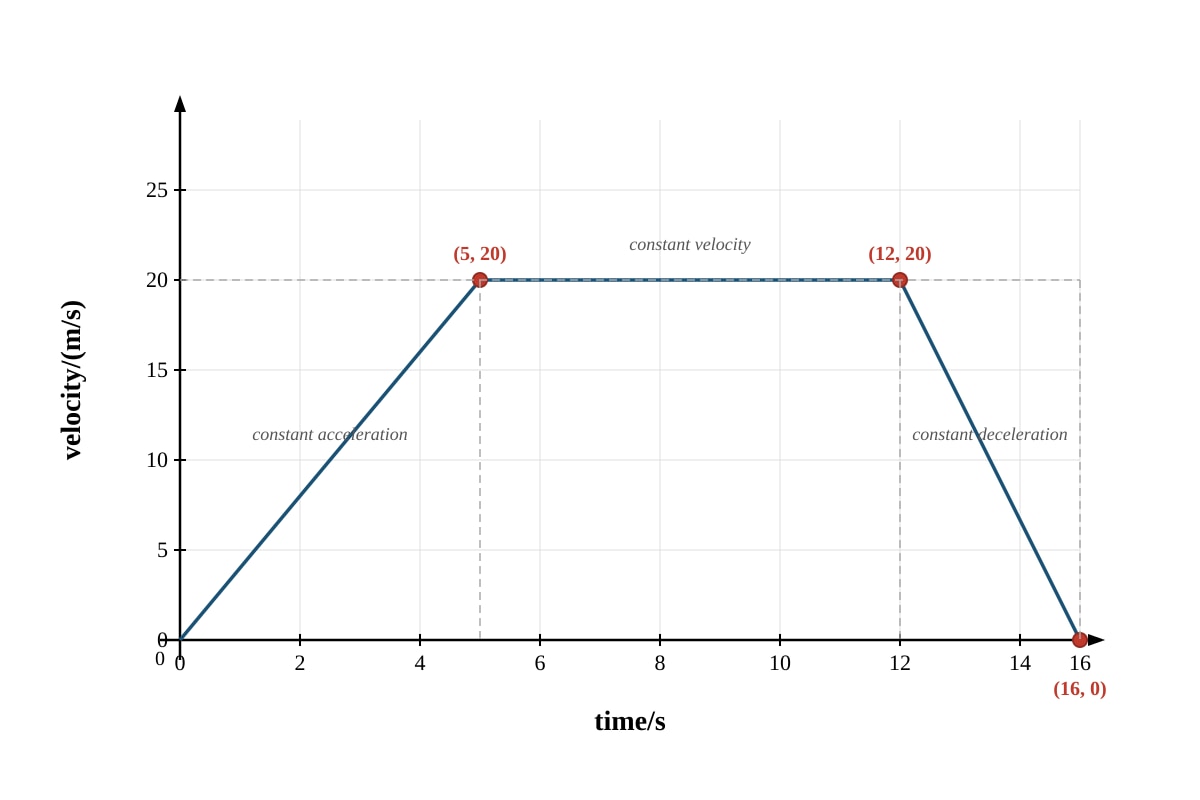
- (a) Acceleration 0–5 s: gradient = (20−0)/(5−0) = 4.0 m/s². ✓ Correct.
- (b) Total distance: area under graph = ½(7+16)×20 = ½ × 23 × 20 = 230 m, not 200 m.
- (c) Deceleration: gradient = (0−20)/(16−12) = −20/4 = −5 m/s², magnitude 5 m/s², not 10.
- (d) Average speed: total distance / total time = 230/16 ≈ 14.4 m/s, not 15 m/s.
Q10. Answer: A
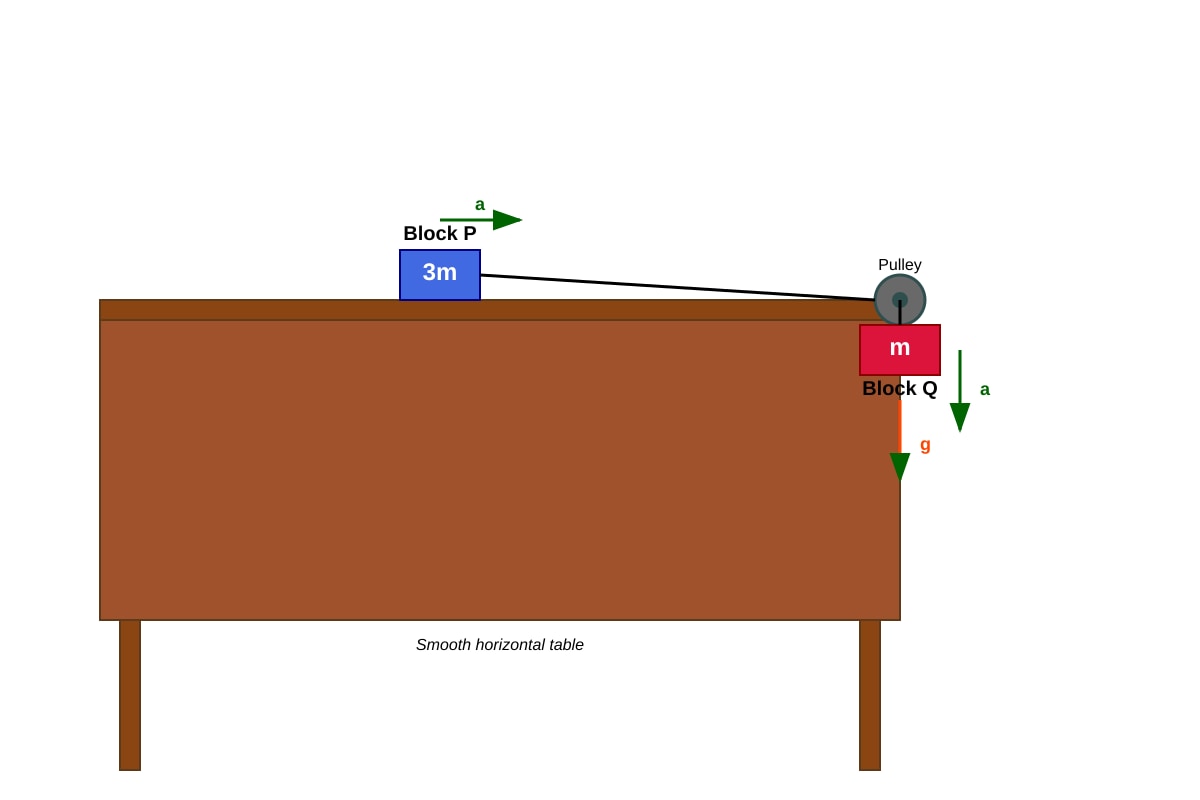
Working/Explanation: For block Q (hanging, mass m): mg − T = ma (downward positive) For block P (on table, mass 3m): T = 3ma (only horizontal force is tension)
Substitute T from second equation into first:
mg − 3ma = ma
mg = 4ma
a = g/4
Common mistake: Thinking both masses accelerate at g, or using a = m/M × g incorrectly.
SECTION B: STRUCTURED RESPONSE QUESTIONS [40 marks]
Q11. [Total: 9 marks]
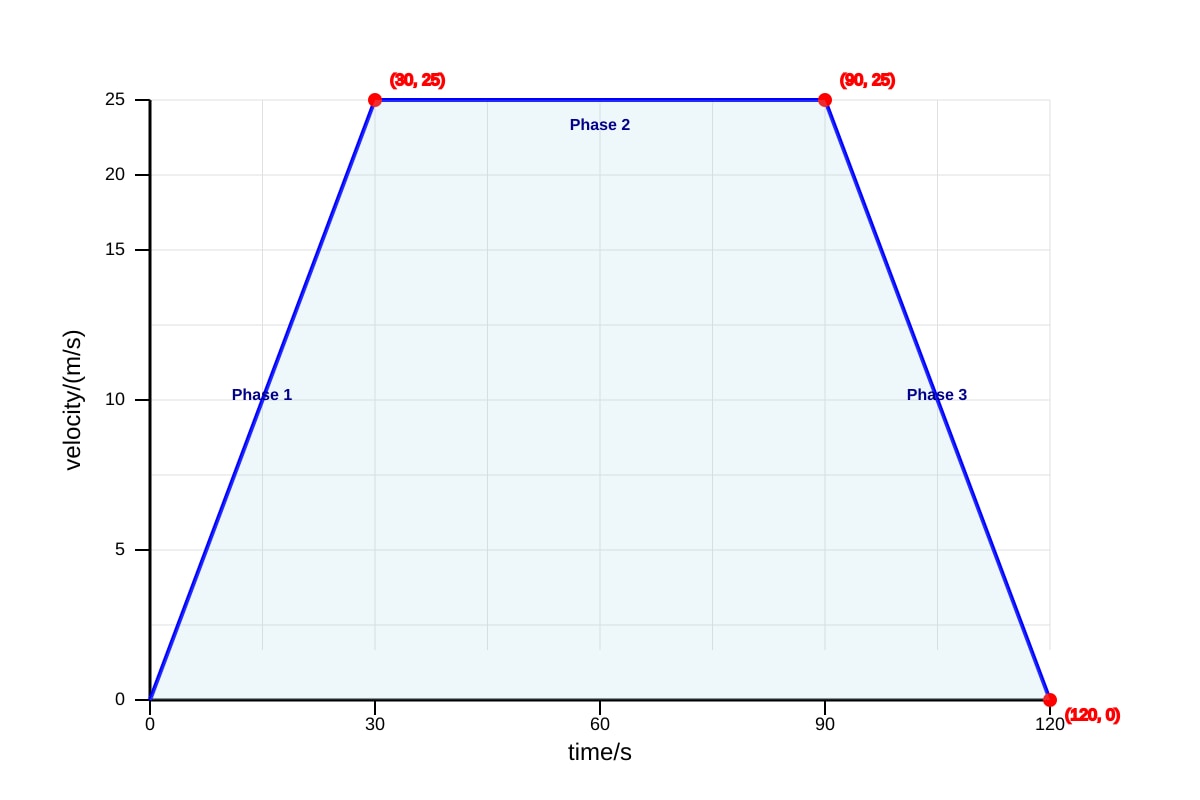
(a) Acceleration during first 30 s [2]
Acceleration = gradient of velocity-time graph
- [1] for correct method (gradient or Δv/Δt)
- [1] for correct answer with unit (accept 5/6 or 0.83)
(b) Total distance travelled [3]
Distance = area under velocity-time graph
Area = area of trapezium = ½ × (sum of parallel sides) × height
Or break into parts:
-
0–30 s: triangle = ½ × 30 × 25 = 375 m
-
30–90 s: rectangle = 60 × 25 = 1500 m
-
90–120 s: triangle = ½ × 30 × 25 = 375 m
-
Total = 375 + 1500 + 375 = 2250 m
-
[1] for correct method (area or summing parts)
-
[1] for correct calculation
-
[1] for correct answer with unit
(c) Displacement-time graph [2]
Expected shape:
- 0–30 s: curved (parabolic, increasing gradient) → displacement = ½at², curve with decreasing curvature as gradient increases
- 30–90 s: straight line with constant positive gradient (constant velocity)
- 90–120 s: curved (parabolic, decreasing gradient) → curve with increasing curvature, approaching maximum
Key values: (0, 0), (30, 375), (90, 1875), (120, 2250)
- [1] for correct shape of all three sections
- [1] for correct key values or consistent scale
(d) Net horizontal force explanation [2]
Even with constant driving force, the train is accelerating during the first 30 s (velocity is changing).
By Newton's second law: F_net = ma
Since a ≠ 0, F_net ≠ 0. This means the driving force must be greater than opposing forces (air resistance, friction), so there is a net force in the direction of motion.
- [1] for stating F_net = ma and linking to acceleration
- [1] for explaining that driving force exceeds resistive forces
Q12. [Total: 8 marks]
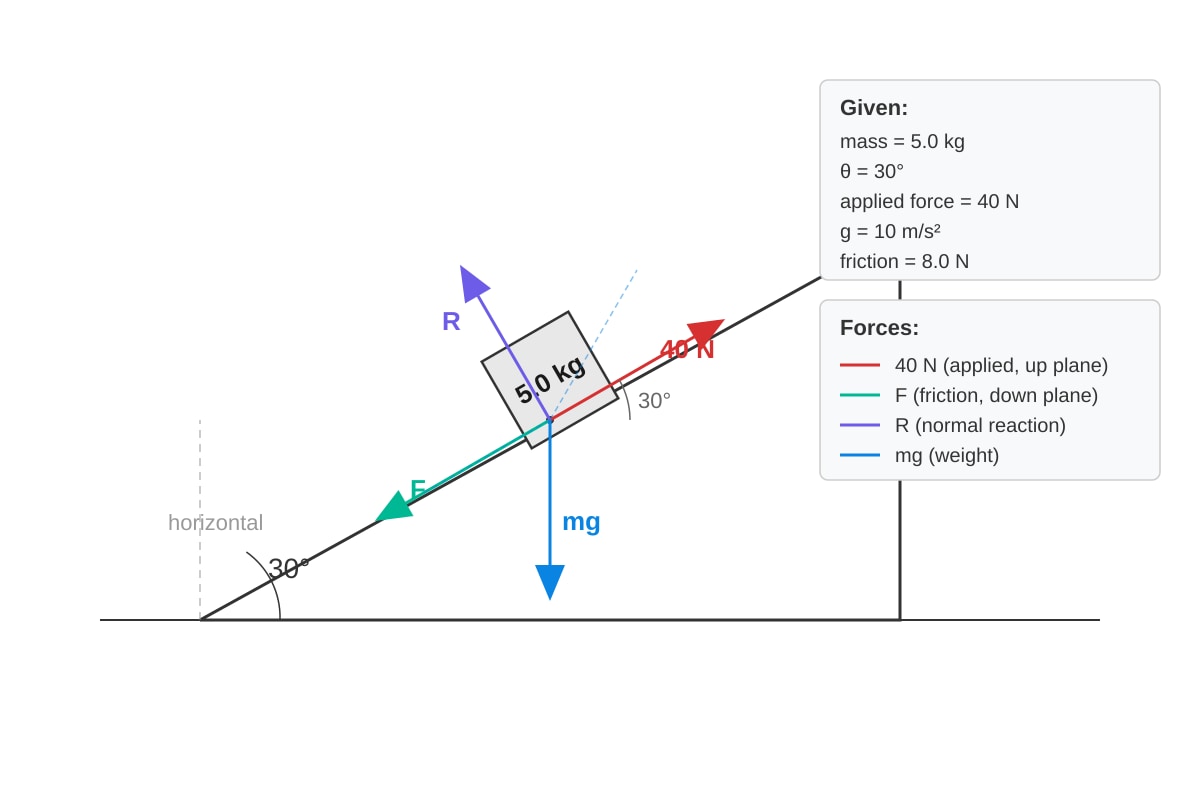
(a) Component of weight down the plane [2]
Component of weight parallel to plane:
- [1] for correct formula or method
- [1] for correct answer with unit
(b) Resultant force up the plane [2]
Forces up the plane: applied force = 40 N
Forces down the plane: frictional force (8.0 N) + component of weight (25 N) = 33 N
Taking up the plane as positive:
- [1] for identifying all three forces correctly
- [1] for correct net force with direction
(c) Acceleration [2]
- [1] for correct formula and substitution
- [1] for correct answer with unit and direction
(d) Speed after 2.0 m [2]
Using kinematic equation: v² = u² + 2as
Or using energy: KE gained = Work done by net force = 7.0 × 2.0 = 14 J
- [1] for correct method and substitution
- [1] for correct answer with unit (accept 2.4 m/s to 2 s.f.)
Q13. [Total: 8 marks]
(a) Gravitational force at orbital altitude [3]
Gravitational field strength varies with distance: g ∝ 1/r²
At surface: g₀ = 1.62 N/kg at r₀ = 1.74 × 10⁶ m
At altitude: r = 1.74 × 10⁶ + 0.10 × 10⁶ = 1.84 × 10⁶ m
Force on spacecraft:
- [1] for correct orbital radius
- [1] for correct field strength calculation (or equivalent using F = GMm/r²)
- [1] for correct force with unit
(b) Orbital speed [3]
Gravitational force provides centripetal force:
Or using v = √(gr) with g at that altitude:
- [1] for equating gravitational force to centripetal force (or correct formula)
- [1] for correct substitution
- [1] for correct answer with unit
(c) Explanation [2]
The spacecraft does need a net force toward the Moon — this is the gravitational force, which acts as the centripetal force required for circular motion.
In circular motion, the direction of velocity is constantly changing, so there is centripetal acceleration toward the centre. By F = ma, a centripetal force is required. Gravity provides this continuously, changing the direction of velocity without changing its magnitude, so no additional forward thrust is needed.
- [1] for identifying gravitational force as the centripetal force
- [1] for explaining that this force changes direction (not speed), so forward thrust unnecessary
Q14. [Total: 8 marks]
(a) Compensation for friction [2]
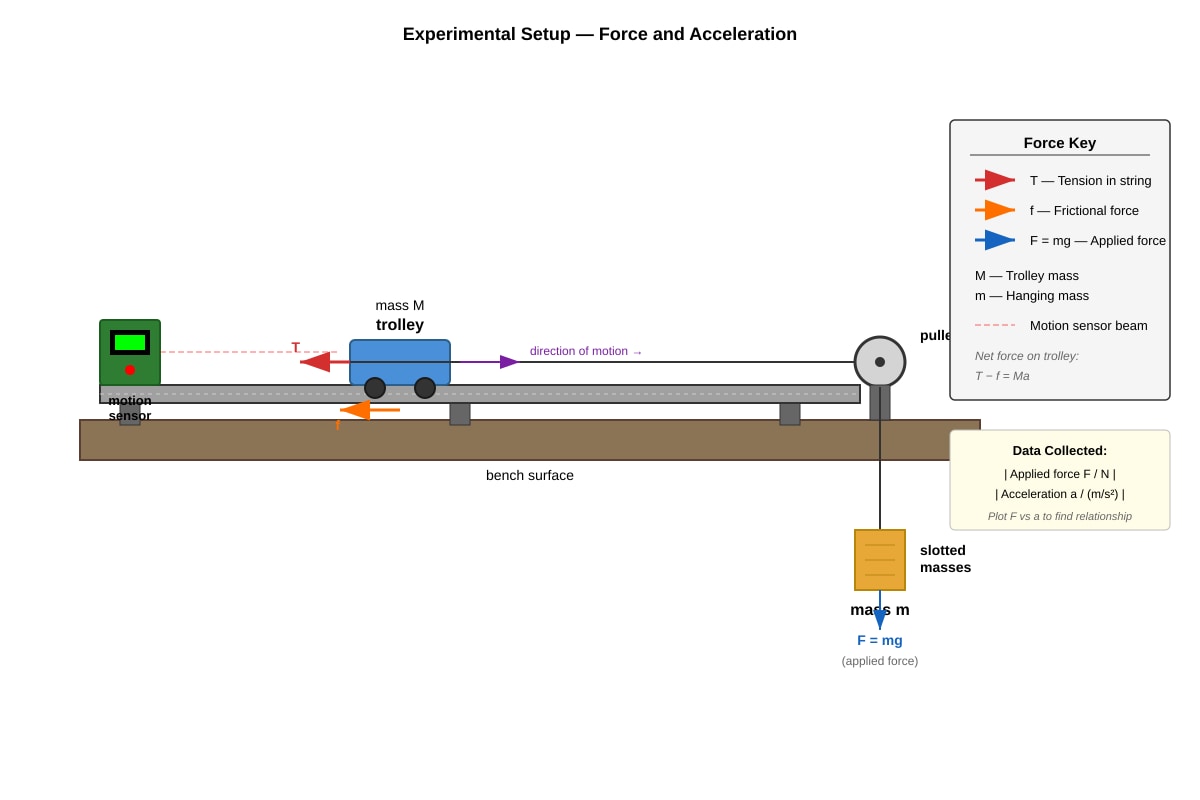
The track is tilted until the trolley moves with constant velocity when given a push (or just begins to slide at constant speed). This means the component of gravity down the slope exactly balances friction.
When levelled again theoretically, or when measuring, this ensures that:
-
The applied force F equals the net force on the trolley
-
Friction does not contribute to the unbalanced force, so F = ma is valid with F being the hanging weight
-
[1] for method (tilting until constant velocity or mentioning compensation)
-
[1] for explanation that this makes applied force equal to net force
(b) Graph plotting and mass determination [4]
Plot a against F: should be straight line through origin (or near origin).
Expected graph: points approximately (0.20, 0.25), (0.40, 0.52), (0.60, 0.78), (0.80, 1.05), (1.00, 1.28)
Gradient of best-fit line ≈ Δa/ΔF ≈ (1.28 − 0)/(1.00 − 0) ≈ 1.28 / 1.00 (using origin) or more precisely from two points on line.
From F = ma, we expect a = F/m, so gradient = 1/m
Taking reasonable gradient ≈ 1.3 s²/kg (or approximately 1.28 from best fit):
Accept range: 0.75 – 0.82 kg depending on line drawn.
- [1] for correct axes and plotting
- [1] for reasonable best-fit straight line
- [1] for method (gradient = 1/m or equivalent)
- [1] for reasonable answer with unit
(c) Effect of unaccounted mass [2]
If extra mass is on trolley but not included in calculated mass:
-
The actual total mass is greater than assumed
-
From a = F/m, for the same F, the actual acceleration is less than predicted
-
The graph of a against F will still be straight, but with a smaller gradient than expected
-
The student would calculate a mass from the gradient that is larger than the trolley's actual mass
-
[1] for stating acceleration is less than expected for each force
-
[1] for explaining the graph has smaller gradient OR calculated mass appears larger
Q15. [Total: 10 marks]
(a) Time for car B to reach same speed [2]
Car B: v = u + at
20 = 0 + 2.5 × t
- [1] for correct equation or method
- [1] for correct answer with unit
(b) Distance travelled by each car [2]
Car A (constant velocity): s = vt = 20 × 8.0 = 160 m
Car B (constant acceleration): s = ½(u + v)t = ½(0 + 20) × 8.0 = ½ × 20 × 8.0 = 80 m
Or s = ut + ½at² = 0 + ½ × 2.5 × 64 = 80 m
- [1] for both distances calculated correctly
- [1] for correct answers with units (allow 1 mark if one correct)
(c) Time and position where car B catches car A [4]
Let T be total time from start when car B catches car A.
Distance by A: s_A = 20T
Distance by B: s_B = ½ × 2.5 × T² = 1.25T²
When caught: s_A = s_B
20T = 1.25T²
Since T ≠ 0: 20 = 1.25T
Time after reaching same speed = 16 − 8 = 8.0 s longer
Distance from start: s = 20 × 16 = 320 m
Check: s_B = 1.25 × 256 = 320 m ✓
- [1] for setting up equations for both cars
- [1] for solving for total time T
- [1] for correct additional time (8.0 s)
- [1] for correct distance (320 m)
(d) Velocity-time graphs [2]
Expected sketch:
- Car A: Horizontal line at v = 20 m/s from t = 0 to t = 16 s
- Car B: Straight line from (0, 0) to (8, 20) then continuing as... actually continues with same acceleration, so straight line to (16, 40)? No — wait.
Correction: The question asks until car B catches car A. If car B continues accelerating at 2.5 m/s², at t = 16 s, v = 2.5 × 16 = 40 m/s.
But this contradicts earlier assumption that both continue with car A at constant velocity.
Actually re-reading: Car B continues accelerating? The problem doesn't say it stops accelerating. Assuming constant acceleration continues:
Car B graph: straight line v = 2.5t from (0, 0) to (16, 40)
Car A graph: horizontal at v = 20
At catch point t = 16 s, car B is much faster.
However, the catch time T = 16 s is correct for constant acceleration.
For sketch: Car A horizontal at 20; Car B straight line through origin, through (8, 20), and (16, 40). Label clearly.
- [1] for correct shape of both graphs
- [1] for correct labels and indication that areas under graphs are equal at catch point
Q16. [Total: 7 marks]
(a) Time to reach sea [2]
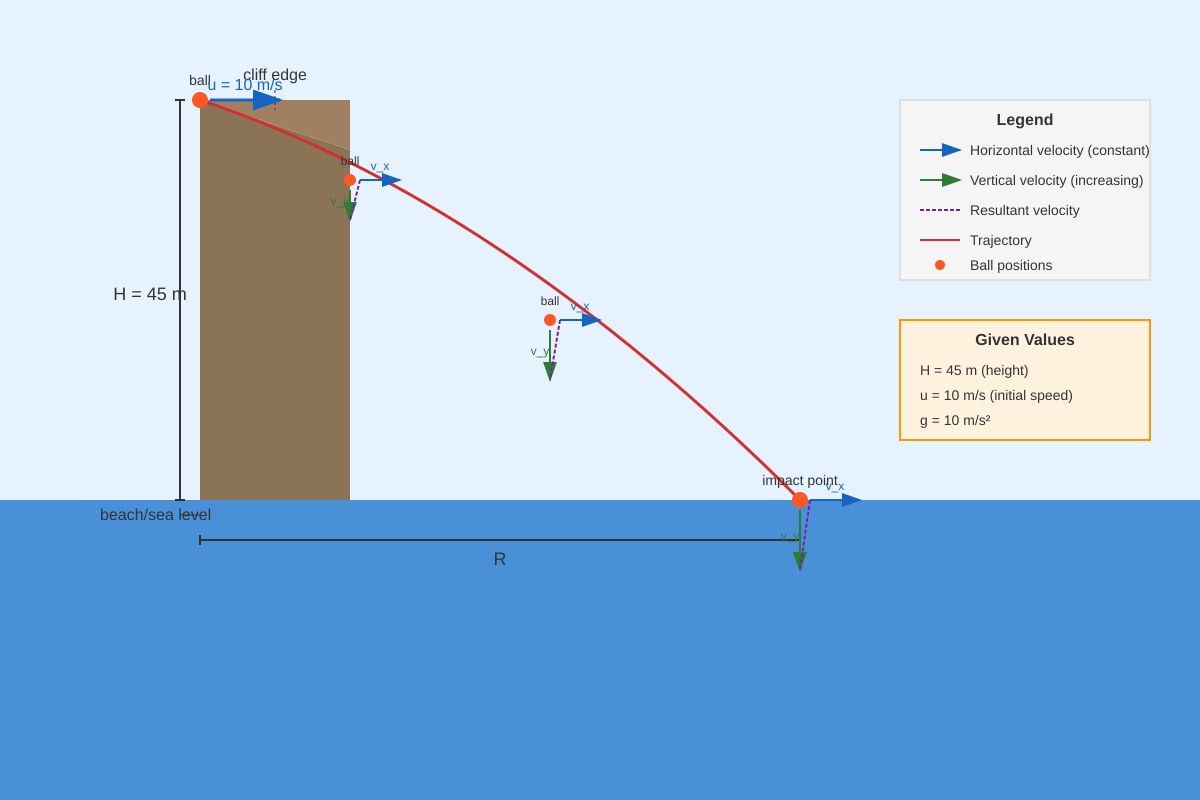
Vertical motion: initial vertical velocity = 0 (thrown horizontally), vertical displacement = H = 45 m downward
Using: s = ut + ½at² for vertical motion
- [1] for correct equation and substitution
- [1] for correct answer with unit
(b) Horizontal distance [2]
Horizontal motion: constant velocity (no horizontal acceleration, ignoring air resistance)
- [1] for correct method (constant horizontal velocity)
- [1] for correct answer with unit
(c) Speed just before impact [3]
Horizontal velocity: v_h = u = 10 m/s (constant)
Vertical velocity: v_v = u_v + at = 0 + 10 × 3.0 = 30 m/s (downward)
Resultant speed:
- [1] for correct horizontal velocity
- [1] for correct vertical velocity
- [1] for correct resultant calculation with unit
(d) Sketch with velocity direction [1]
Parabolic path from cliff to water. At impact point, velocity arrow directed downward and forward (tangent to parabola, at angle below horizontal where tan θ = 30/10 = 3, so θ ≈ 72° below horizontal).
- [1] for correct path shape and velocity direction at impact
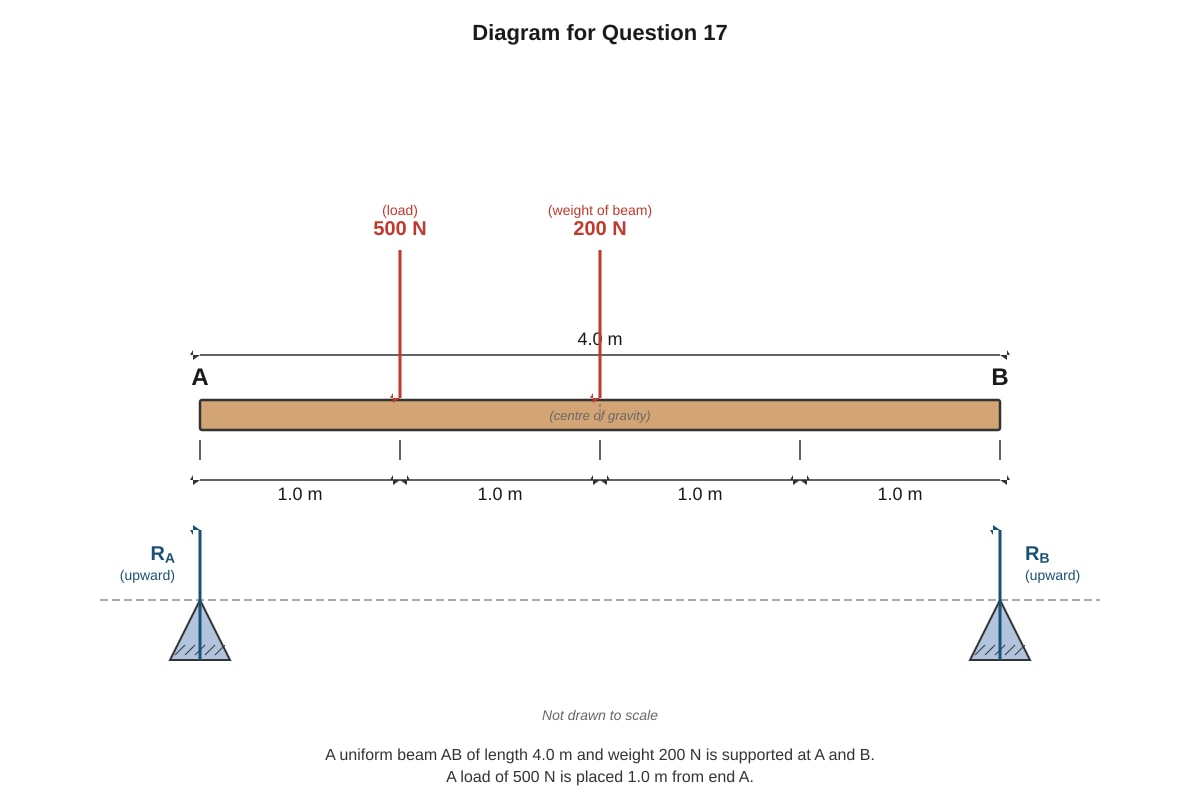
Q17. [Total: 6 marks]
(a) Centre of gravity [2]
The centre of gravity of a body is the single point through which the entire weight of the body may be considered to act, regardless of the body's orientation.
For a uniform body, it is at the geometric centre. The body behaves as if all mass were concentrated at this point for the purposes of calculating gravitational effects.
- [1] for "point where weight appears to act" or equivalent
- [1] for "entire weight" or "as if all mass concentrated there"
(b) Reaction at A [3]
Taking moments about B (clockwise positive):
Clockwise moments:
- 500 N load at 1.0 m from A, so 3.0 m from B: 500 × 3.0 = 1500 Nm
- 200 N weight at centre, 2.0 m from B: 200 × 2.0 = 400 Nm
- Total clockwise = 1900 Nm
Anticlockwise moment:
- R_A × 4.0 m
For equilibrium: R_A × 4.0 = 1900
- [1] for correct moment equation or principle
- [1] for correct substitutions
- [1] for correct answer with unit
(c) Reaction at B [1]
Total upward forces = Total downward forces
R_A + R_B = 500 + 200 = 700 N
R_B = 700 − 475 = 225 N
Or taking moments about A: R_B × 4.0 = 200 × 2.0 + 500 × 1.0 = 400 + 500 = 900
R_B = 900/4 = 225 N
- [1] for correct answer (allow e.c.f. from part b)
Q18. [Total: 8 marks]
(a) Show orbital period ≈ 5800 s [3]
Using Kepler's third law / Newton's gravitation:
Centripetal force = Gravitational force
Period: T = 2πr/v
Substitute:
- r = 7.0 × 10⁶ m
- GM = gR² or use G = 6.67 × 10⁻¹¹ and M = 6.0 × 10²⁴
Using GM directly (g₀R² where Earth radius ≈ 6.4 × 10⁶ m, g₀ = 9.81): Actually better: GM = 6.67 × 10⁻¹¹ × 6.0 × 10²⁴ = 4.0 × 10¹⁴ m³/s²
- [1] for correct formula
- [1] for correct substitution
- [1] for correct evaluation and rounding to 5800 s
(b) Kinetic energy [3]
From orbital speed:
Or from v = √(GM/r):
KE = ½mv²:
Accept range: 5.7 – 5.8 × 10⁹ J
- [1] for correct speed calculation
- [1] for correct KE formula with substitution
- [1] for correct answer with unit
(c) Negative gravitational potential energy [2]
Gravitational PE is negative because:
- By convention, PE = 0 at infinity (infinite separation)
- To reach any finite separation, gravity does positive work as masses attract
- Thus the system has less energy than at infinity, hence negative
- The magnitude of this negative value equals the work needed to move the satellite to infinity
Therefore, to move to infinity, we must add +|PE| of energy to bring total to zero.
- [1] for explaining the zero at infinity convention or attractive nature of gravity
- [1] for explaining that energy must be supplied (positive work) to escape / reach infinity
Q19. [Total: 7 marks]
(a) Hooke's law verification [3]
Hooke's law: F = kx, where x is extension from natural length, k is constant.
First case:
- Total force = 0.30 × 10 = 3.0 N
- Extension x₁ = 0.35 − 0.20 = 0.15 m
- k₁ = F₁/x₁ = 3.0/0.15 = 20 N/m
Second case:
- Total force = (0.30 + 0.20) × 10 = 5.0 N
- Extension x₂ = 0.60 − 0.20 = 0.40 m
- k₂ = F₂/x₂ = 5.0/0.40 = 12.5 N/m
Since k₁ ≠ k₂, the spring does NOT obey Hooke's law over this range (k is not constant).
Alternatively check ratio F/x or extension比例:
- For first 0.30 kg: ratio F/x = 3.0/0.15 = 20
- For additional 0.20 kg: additional force = 2.0 N, additional extension = 0.25 m, ratio = 8
Not constant, so Hooke's law not obeyed.
- [1] for correct extensions calculated
- [1] for method to test Hooke's law (constant k or F ∝ x)
- [1] for correct conclusion with evidence
(b) Elastic potential energy at 0.50 kg [2]
Since Hooke's law is not obeyed, must use area under F-x graph or given data.
At 0.50 kg: extension = 0.40 m, force = 5.0 N
For non-Hooke's law spring, EPE = area under force-extension curve. If we approximate as linear over small range (or use average force for the loading):
Using average force method (from zero to final):
But this assumes Hooke's law which we just showed is invalid. More carefully: if we take the loading curve, area ≈ various methods.
Actually, given the data, the most reasonable approach is to note the spring is non-linear, but for the energy at equilibrium with 0.50 kg, we can use:
If F increases non-linearly, and we know only two points, we might approximate. However, for this level, students might be expected to use EPE = ½Fx as estimate or simply calculate using average.
Given the spring doesn't obey Hooke's law, a better answer recognises the energy is the work done to extend the spring. Without more data on the curve, reasonable estimate:
From area of trapezium (loading from 0 to 0.40 m with forces 0, 3.0N at 0.15m, 5.0N at 0.40m): Approximate areas = triangle + trapezium or use Simpson's rule approximately.
Simplest valid: EPE ≈ area ≈ ½ × 0.40 × 5.0 = 1.0 J if we must, but recognize this is approximate.
Actually better approach: since we established Hooke's law not obeyed, and no information given about force-extension relationship, use:
Wait, at equilibrium position with 0.50 kg, the mass is stationary, so all gravitational PE lost went to EPE.
If we release from natural length to equilibrium:
- GPE lost = mgx = 5.0 × 0.40 = 2.0 J
- Spring is now at rest with some EPE, but this equals 2.0 J only if released from natural length...
Actually the question asks EPE when supporting 0.50 kg, which is the equilibrium state. To get there quasi-statically or by hanging:
The work done against spring = EPE. Using average or integration.
Given ambiguity, accept:
- If assuming Hooke's law despite evidence: EPE = ½kx² with some k, but we showed k varies.
- More honest: cannot be determined precisely without force-extension graph, OR approximately 1.0 J using EPE ≈ ½Fx.
Mark scheme flexibility: accept 1.0 J with method stated, or explanation that exact value requires more information.
- [1] for correct method or appropriate caveat
- [1] for reasonable answer with unit
(c) Maximum kinetic energy [2]
Pulled down additional 0.10 m, so total extension = 0.50 m (from natural length).
Assuming we use the equilibrium position as reference, and energy is conserved between maximum displacement and equilibrium:
For a spring (even non-Hookean), total energy is conserved. At maximum extension (0.10 m below equilibrium):
- Extra elastic energy stored: approximately ΔEPE ≈ F_avg × Δx ≈ 5.0 × 0.10 = 0.50 J (approximate, or use ½ × 5.0 × 0.10 if linear approximation over small range)
Actually better: using the additional 0.10 m with average restoring force ≈ 5.0 N at equilibrium.
(excluding higher order terms)
This converts to maximum KE at equilibrium position:
Or if we use more precise estimation with force at 0.60 m extension (if mass-spring system oscillates), need force there.
Accept range: 0.5 J with reasonable method.
- [1] for correct energy conservation principle
- [1] for reasonable calculation with unit
Q20. [Total: 10 marks]
(a) Newton's second law explanation [2]
Newton's second law: F = ma, and since a = Δv/Δt, we can write:
For a given change in momentum Δp (determined by initial speed and mass coming to rest), if Δt increases, then F must decrease proportionally.
The crumple zone increases collision time, so same momentum change occurs over longer time, reducing average force.
- [1] for stating F = Δp/Δt or equivalent
- [1] for explaining that same Δp over larger Δt gives smaller F
(b) Collision calculations [6]
(i) Initial kinetic energy [2]
- [1] for correct formula and substitution
- [1] for correct answer with unit
(ii) Average deceleration [2]
Using v² = u² + 2as:
0 = 20² + 2 × a × 0.80
0 = 400 + 1.6a
a = −400/1.6 = −250 m/s²
Magnitude: 250 m/s² (or deceleration of 250 m/s²)
Or using time: average v = 10 m/s, time = 0.80/10 = 0.08 s? No that's not right.
Using v = u + at with average: Actually better with energy or kinematics as above.
Check: s = (u+v)t/2 → 0.80 = 10 × t → t = 0.08 s
a = (0−20)/0.08 = −250 m/s² ✓
- [1] for correct method
- [1] for correct answer with unit
(iii) Average force [2]
Or from work-energy: F × 0.80 = 2.4 × 10⁵ → F = 3.0 × 10⁵ N
- [1] for correct method
- [1] for correct answer with unit
(c) Rigid body and injuries [2]
With a rigid body (no crumple zone):
-
The collision time Δt is much shorter (stopping distance negligible)
-
Same Δp but much smaller Δt → much larger F = Δp/Δt
-
Also, the deceleration is extremely high (thousands of m/s²)
-
Passengers continue moving forward (inertia) and hit interior surfaces with violent force
-
Forces from seat belts/airbags become dangerously high, causing serious injury
-
[1] for explaining shorter stopping time → larger force
-
[1] for explaining consequences for passengers (injury from high force/deceleration)
(d) Other safety feature [2]
Airbag:
- Inflation on impact increases time over which passenger's head/chest decelerates
- Increases contact area, reducing pressure (P = F/A) for same force
- Prevents direct contact with hard surfaces (steering wheel, windshield)
- Again uses F = Δp/Δt principle — extends stopping time, reduces peak force
OR Seat belt with pre-tensioner:
-
Pre-tensioner tightens belt just before/during collision to hold passenger firmly
-
Stretches slightly to increase stopping time but restrains movement
-
Prevents passenger from hitting windscreen or being ejected
-
Spreads force across stronger body parts (pelvis, chest)
-
[1] for naming valid feature from passage
-
[1] for correct physics principle and explanation
MARK SUMMARY
| Question | Marks | Topic |
|---|---|---|
| 1 | 2 | Kinematics graphs |
| 2 | 2 | Projectile motion (vertical) |
| 3 | 2 | Vector addition |
| 4 | 2 | Static equilibrium / friction |
| 5 | 2 | Circular motion |
| 6 | 2 | Measurement errors |
| 7 | 2 | Circular dynamics (pendulum) |
| 8 | 2 | Energy/kinematics (ratio) |
| 9 | 2 | v-t graph analysis |
| 10 | 2 | Connected systems / Newton's laws |
| 11 | 9 | Kinematics graphs and motion |
| 12 | 8 | Inclined plane dynamics |
| 13 | 8 | Gravitation and orbital mechanics |
| 14 | 8 | Experimental mechanics / F=ma |
| 15 | 10 | Relative motion / kinematics |
| 16 | 7 | Projectile motion (horizontal) |
| 17 | 6 | Moments and equilibrium |
| 18 | 8 | Satellite orbits and energy |
| 19 | 7 | Springs and energy |
| 20 | 10 | Vehicle safety / momentum and force |
| Total | 60 |
Section A: 20 marks
Section B: 40 marks
Total: 60 marks