TuitionGoWhere Exam Practice (AI) — SA2 Practice Paper
Secondary 3 Physics — Mechanics (Version 3 of 5)
School: TuitionGoWhere Secondary School (AI)
Subject: Physics
Level: Secondary 3
Paper: SA2 Practice Paper (Version 3)
Duration: 60 minutes
Total Marks: 60
Name: ___________________________
Class: ________
Date: ____________
Instructions:
- Answer all questions in the spaces provided.
- Show your working clearly where calculation is required.
- Use g=10 m s−2 unless stated otherwise.
- Section A: Multiple Choice (1 mark each). Section B: Short Structured (2–3 marks). Section C: Extended Structured (4 marks).
Section A (Questions 1–5, 5 marks)
-
A scalar quantity has only magnitude. Which of the following is a scalar quantity?
A. Force
B. Velocity
C. Speed
D. Acceleration
Answer: ____
-
A car travels 100 m in 5 s at constant speed. What is its speed?
A. 5 m s⁻¹
B. 20 m s⁻¹
C. 50 m s⁻¹
D. 500 m s⁻¹
Answer: ____
-
The gravitational force between two masses is given by F=r2Gm1m2. What happens to F if the distance r is doubled?
A. F doubles
B. F halves
C. F becomes one-quarter
D. F stays the same
Answer: ____
-
A box rests on a horizontal floor. Which force balances its weight?
A. Friction
B. Normal reaction
C. Tension
D. Air resistance
Answer: ____
-
Pressure in a liquid increases with:
A. decreasing depth
B. decreasing density
C. increasing depth
D. increasing surface area
Answer: ____
Section B (Questions 6–15, 24 marks)
-
(a) Define acceleration. [1]
(b) A bus increases its velocity from 4 m s−1 to 16 m s−1 in 6 s. Calculate its acceleration. [2]
-
A child of mass 30 kg slides down a vertical rope with acceleration 2 m s−2. Calculate the frictional force between the child and the rope. [3]
-
A block of mass 5 kg is pulled up a rough inclined plane at constant speed by a force of 40 N. The distance moved along the plane is 3 m and the vertical height gained is 1.2 m. Calculate:
(a) work done by the applied force [1]
(b) increase in gravitational potential energy [2]
(c) energy lost to friction [1]
-
State the principle of moments. [2]
-
A uniform rod of length 2.0 m and weight 20 N is pivoted at its centre. A 10 N load is placed 0.5 m to the left of the pivot. Where must a 5 N load be placed on the right side to balance the rod? [3]
-
Calculate the density of a metal cube of mass 540 g and side length 3 cm. [3]
-
A hydraulic press has a small piston area 0.01 m2 and large piston area 0.5 m2. A force of 100 N is applied to the small piston. What is the force on the large piston? [2]
-
A stone is dropped from rest. Sketch a velocity-time graph for its fall (ignore air resistance). [2]
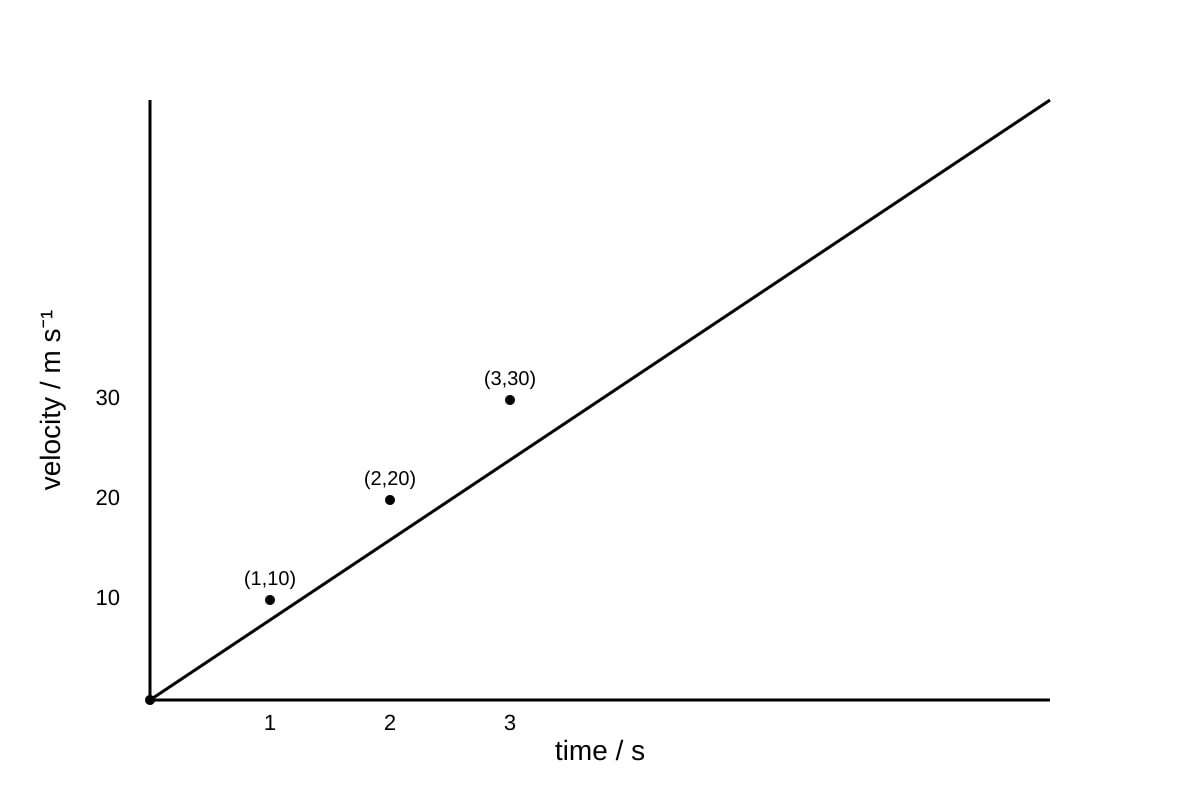
Generated graph for Q13.
-
A person of mass 60 kg climbs a staircase of height 4 m in 8 s. Calculate the power developed. [3]
-
Two forces of 3 N and 4 N act at right angles to each other. Find the magnitude of their resultant. [2]
Section C (Questions 16–20, 31 marks)
- A ring of mass 2.0 kg is suspended by two strings from a horizontal rod. String A makes 50° with the horizontal, string B makes 60° with the horizontal. Calculate the tension in each string. [4]
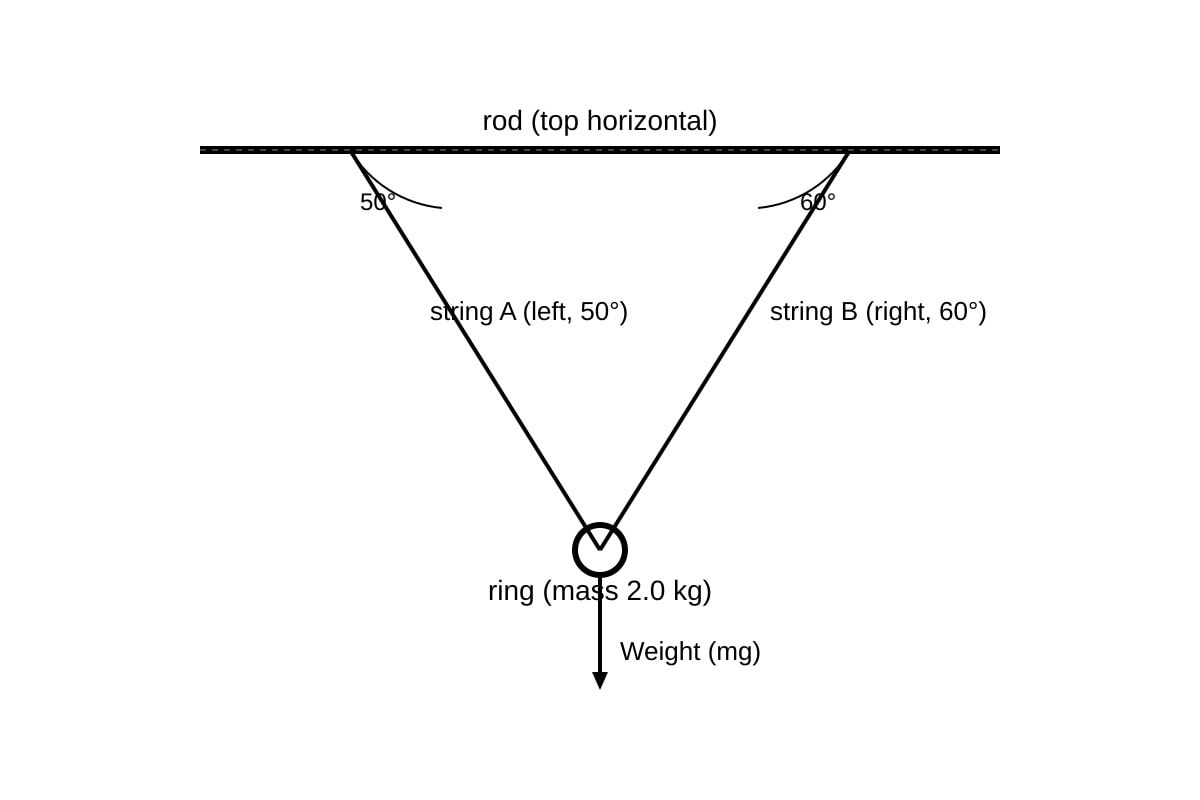
Generated diagram for Q16.
-
A block of mass 4 kg is pushed along a horizontal surface with a force of 20 N. Friction is 4 N.
(a) Calculate the acceleration. [2]
(b) Calculate the distance moved in 5 s from rest. [2]
(c) State Newton’s first law. [1]
-
A car of mass 1000 kg moving at 20 m s−1 is brought to rest in 10 s by a constant braking force.
(a) Calculate the deceleration. [2]
(b) Calculate the braking force. [2]
(c) Calculate the distance travelled during braking. [2]
-
Explain why a low centre of gravity and a wide base increase stability. [4]
-
A metal cylinder has mass 0.8 kg and base area 0.02 m2. It stands on a table.
(a) Calculate its weight. [1]
(b) Calculate the pressure it exerts on the table. [2]
(c) If the same cylinder is placed on its side reducing contact area to 0.01 m2, what is the new pressure? [2]
(d) State one real-life application of high pressure from small area. [1]
End of Paper