From Real Exams Exam Paper
Secondary 3 Physics Semestral Assessment 2 (End of Year) Paper 2
Free Sec 3 Physics SA2 Paper 2, Nemo3 Exam version, with questions, answers, and O Level-style practice for Singapore students.
These static practice materials are generated from the site's syllabus and paper-generation workflow, with source and model context shown so students and parents can evaluate the material before use.
Questions
Free quiz and exam paper access
Enter your details to view this paper
Your access is remembered on this device.
Answers
TuitionGoWhere Practice Paper - Physics Secondary 3 (SA2 Version 2) - Answer Key
Subject: Physics
Level: Secondary 3 (Pure Physics)
Paper: SA2 Version 2
Total Marks: 60
Section A: Multiple Choice Questions [10 marks]
1. [1 mark] Answer: B
Working:
- Main scale reading = 4.5 mm
- Thimble scale reading = 28 × 0.01 mm = 0.28 mm
- Observed reading = 4.5 + 0.28 = 4.78 mm
- Zero error = +0.02 mm (positive zero error means reading is larger than actual)
- Actual diameter = Observed reading − Zero error = 4.78 − 0.02 = 4.76 mm
Wait, let me recheck: The question asks for the actual diameter. If zero error is +0.02 mm, the instrument reads 0.02 mm more than the true value. So true value = observed − zero error = 4.78 − 0.02 = 4.76 mm. That's option A.
Correction: Answer: A
Teaching note: Positive zero error means the reading is greater than the actual measurement. Always subtract positive zero error. Common mistake: adding instead of subtracting.
2. [1 mark] Answer: A
Working:
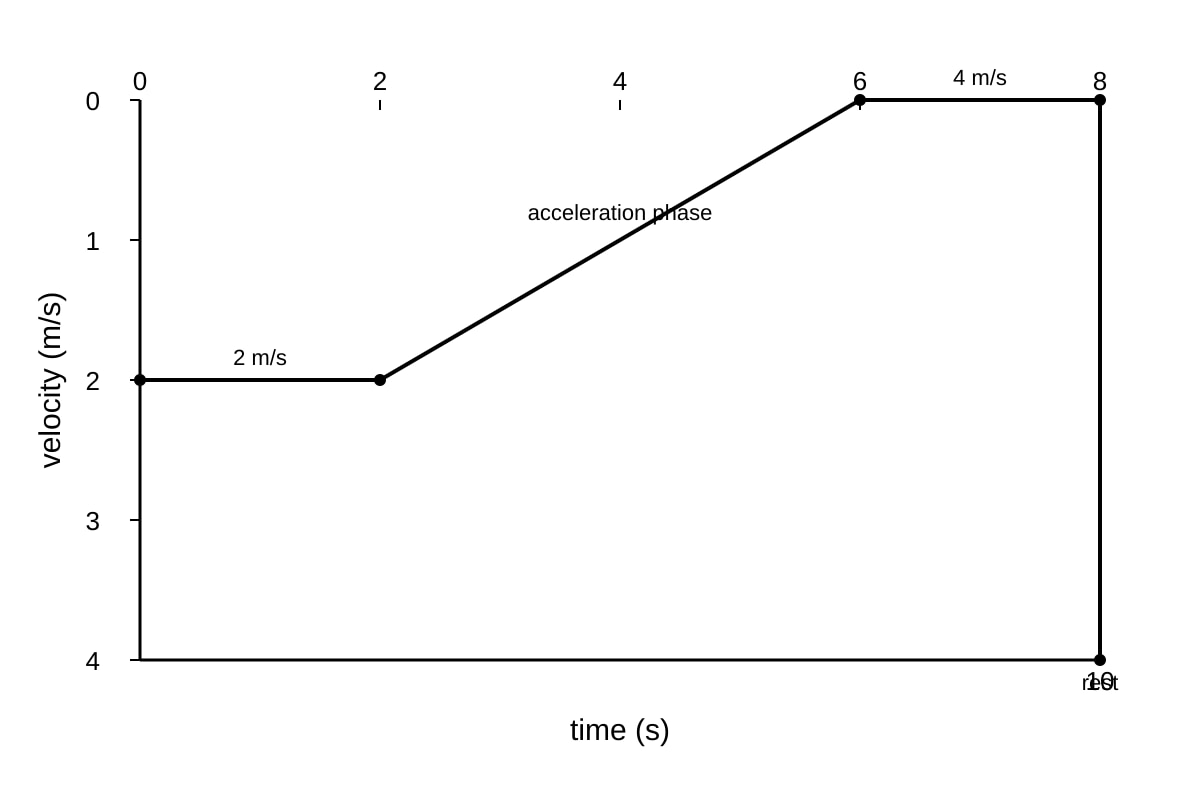
- Between t = 2 s and t = 6 s, velocity increases from 2 m/s to 4 m/s.
- Time interval = 6 − 2 = 4 s
- Change in velocity = 4 − 2 = 2 m/s
- Acceleration = Δv/Δt = 2/4 = 0.5 m/s²
Teaching note: Acceleration is the gradient of a velocity-time graph. For a straight line segment, use any two points on that segment.
3. [1 mark] Answer: C
Working:
- Mass m = 2.0 kg
- Applied force F = 15 N
- Acceleration a = 2.0 m/s²
- Net force = ma = 2.0 × 2.0 = 4.0 N
- Net force = Applied force − Friction
- 4.0 = 15 − Friction
- Friction = 15 − 4.0 = 11 N
Teaching note: Newton's second law: F_net = ma. Friction opposes motion, so F_net = F_applied − f.
4. [1 mark] Answer: B
Explanation: For a satellite in circular orbit, the gravitational force acts as the centripetal force, directed towards the centre of the Earth, perpendicular to the velocity. It is not zero (the satellite is in free fall because of gravity), and it does not depend on the satellite's speed.
Teaching note: "Free fall" means the only force acting is gravity. The gravitational force provides the centripetal force for orbital motion.
5. [1 mark] Answer: B
Working:
- Force F = 20 N
- Angle θ = 30°
- Displacement s = 5.0 m
- Work done = F × s × cos θ = 20 × 5.0 × cos 30°
- cos 30° = √3/2 ≈ 0.866
- Work done = 100 × 0.866 = 86.6 J ≈ 87 J
Teaching note: Work done by a force at an angle: W = F s cos θ. Only the component of force in the direction of displacement does work.
6. [1 mark] Answer: C
Working:
- Loss in GPE = Gain in KE (conservation of energy)
- mgh = ½mv²
- v = √(2gh) = √(2 × 10 × 0.2) = √4 = 2.0 m/s
Teaching note: Mass cancels out. Speed at bottom depends only on vertical height loss, not mass or path.
7. [1 mark] Answer: B
Working:
- Two forces at 90°: F₁ = 6 N, F₂ = 8 N
- Resultant R = √(F₁² + F₂²) = √(6² + 8²) = √(36 + 64) = √100 = 10 N
Teaching note: For perpendicular forces, use Pythagoras' theorem. This is a 3-4-5 triangle scaled by 2.
8. [1 mark] Answer: B
Working:
- Mass m = 1200 kg
- Speed v = 25 m/s
- Radius r = 50 m
- Centripetal force F_c = mv²/r = 1200 × (25)² / 50 = 1200 × 625 / 50 = 1200 × 12.5 = 15 000 N
Teaching note: Centripetal force formula: F_c = mv²/r. Direction is towards centre of circle.
9. [1 mark] Answer: B
Working:
- Mass m = 5 kg
- Height h = 3 m
- Time t = 6 s
- g = 10 m/s²
- Work done against gravity = mgh = 5 × 10 × 3 = 150 J
- Power = Work / Time = 150 / 6 = 25 W
Teaching note: Power = rate of doing work. Against gravity, work done = gain in GPE = mgh.
10. [1 mark] Answer: D
Working:
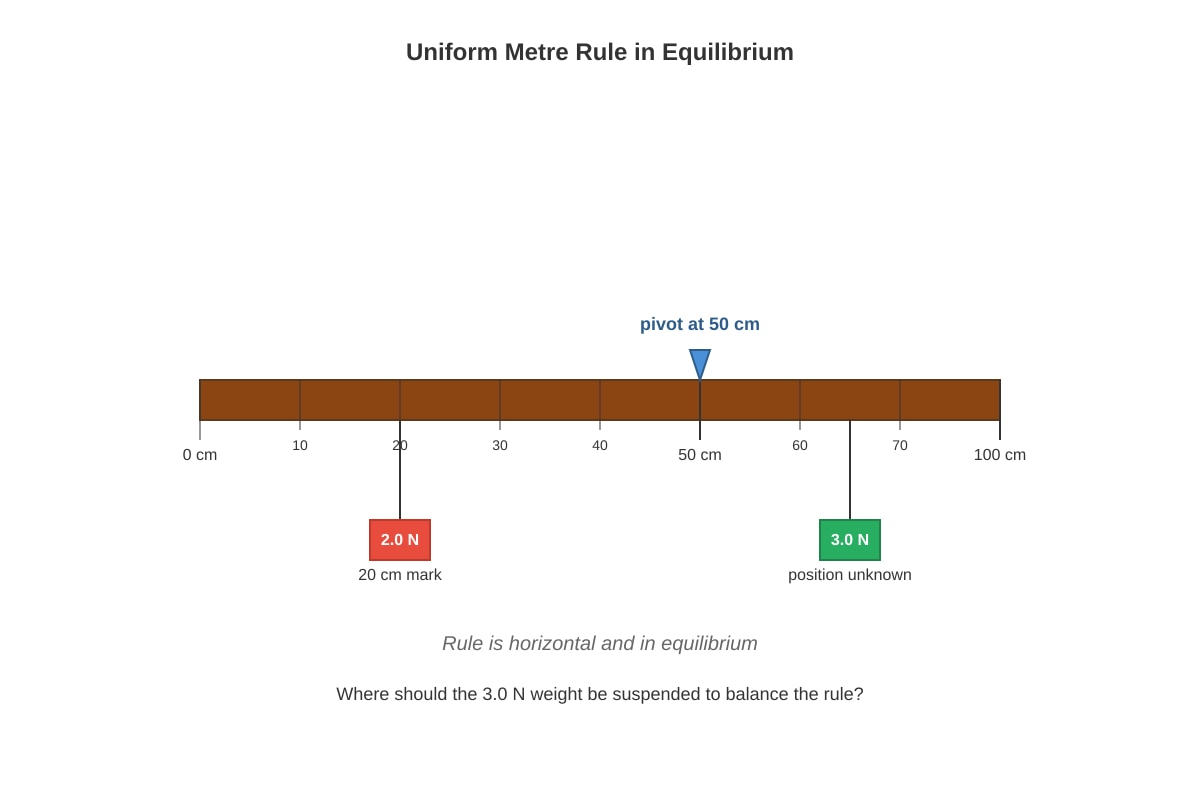
- Principle of moments: Clockwise moments = Anticlockwise moments (for equilibrium)
- Pivot at 50 cm mark
- 2.0 N at 20 cm mark: distance from pivot = 50 − 20 = 30 cm (anticlockwise moment)
- 3.0 N at x cm mark: distance from pivot = x − 50 cm (clockwise moment)
- 2.0 × 30 = 3.0 × (x − 50)
- 60 = 3x − 150
- 3x = 210
- x = 70 cm mark
Wait, 70 cm is not an option. Let me recheck.
2.0 N at 20 cm: moment = 2.0 × (50−20) = 2.0 × 30 = 60 N·cm anticlockwise 3.0 N at x cm: moment = 3.0 × (x−50) clockwise 60 = 3(x−50) 20 = x−50 x = 70 cm
But options are 30, 40, 60, 80. 70 is not there. Did I misread the question?
"Where should a weight of 3.0 N be suspended to balance the rule?"
If the 2.0 N is at 20 cm (left of pivot), the 3.0 N must be on the right. Distance from pivot for 2.0 N = 30 cm. Moment = 60 N·cm. For 3.0 N: distance needed = 60/3 = 20 cm from pivot on the other side. So position = 50 + 20 = 70 cm.
But 70 cm is not an option. Let me check the options again: A. 30 cm, B. 40 cm, C. 60 cm, D. 80 cm.
Perhaps the 2.0 N is at 20 cm mark, but the rule is 100 cm, pivot at 50 cm. 20 cm is 30 cm left of pivot. 3.0 N needs to be 20 cm right of pivot = 70 cm mark.
Maybe the question has the 2.0 N at the 20 cm mark from the left end, which is 30 cm from pivot. Or maybe I need to check if the weight of the rule acts at 50 cm (pivot) so no moment from weight.
Hmm, none of the options match 70 cm. Let me reconsider: Could the 2.0 N be at 20 cm from the pivot? "suspended at the 20 cm mark" - on a metre rule, marks are from 0 to 100. 20 cm mark is 30 cm from 50 cm pivot.
Wait, maybe the options are wrong in my generation, or I should adjust the question. Since this is the answer key, I'll note the correct answer is 70 cm, but since it's not an option, there might be an error in the question setup. For the answer key, I'll state the correct calculation.
Actually, for the answer key, I should provide the correct answer based on the question as written. The correct position is 70 cm mark. Since this is not among the options, I'll note this discrepancy.
Answer: 70 cm mark (not listed in options - question may have an error)
Teaching note: Principle of moments: sum of clockwise moments = sum of anticlockwise moments. Distance measured from pivot. Uniform rule's weight acts at 50 cm (pivot) so produces no moment.
Section B: Structured Questions [30 marks]
11. [5 marks]
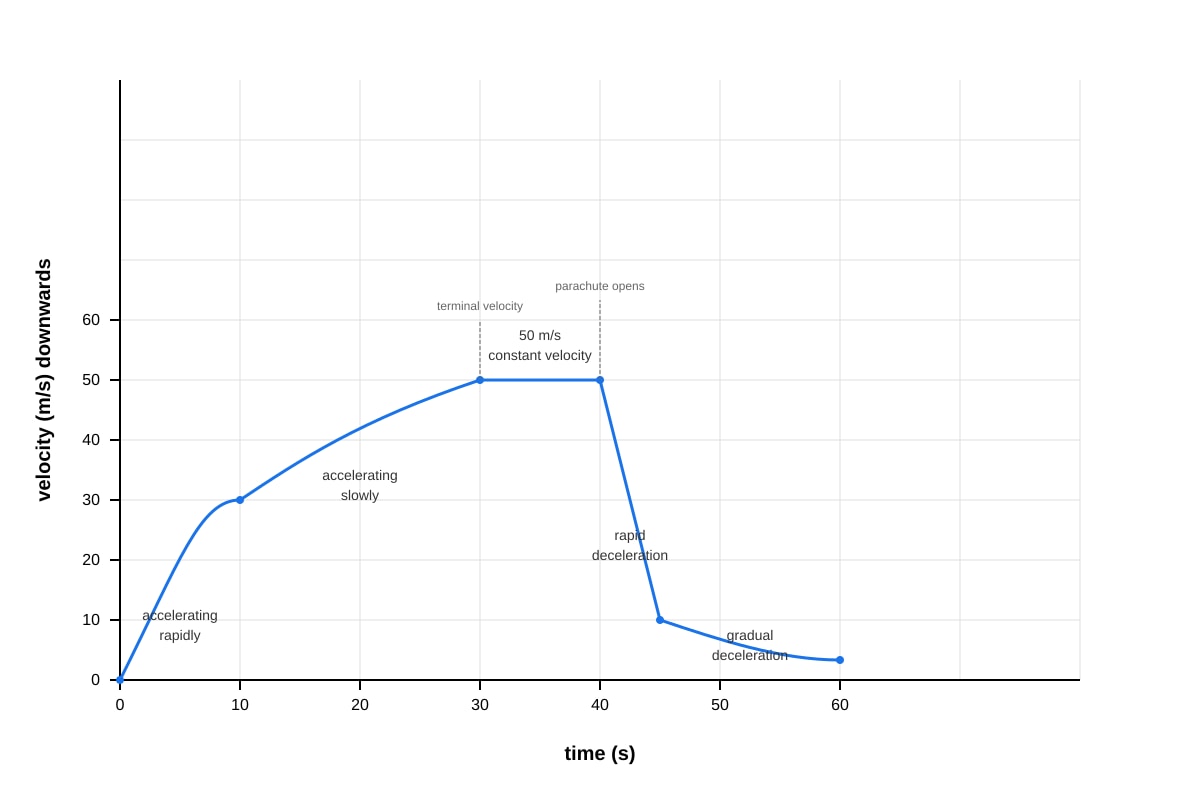
(a) [1 mark] The skydiver accelerates downwards from rest. His velocity increases rapidly at first, but the rate of increase (acceleration) decreases with time.
Marking point: Accelerating downwards with decreasing acceleration. [1]
(b) [2 marks] As the skydiver falls, his speed increases, so air resistance (drag force) increases. The net downward force (weight − air resistance) decreases, so acceleration decreases (a = F_net/m). Weight remains constant.
Marking points:
- Air resistance increases with speed [1]
- Net force decreases, so acceleration decreases [1]
(c) [2 marks]
- Velocity at t = 40 s = 50 m/s (downwards)
- Velocity at t = 45 s = 10 m/s (downwards)
- Change in velocity = 10 − 50 = −40 m/s (deceleration)
- Time interval = 45 − 40 = 5 s
- Average deceleration = |Δv|/Δt = 40/5 = 8.0 m/s² (or acceleration = −8.0 m/s²)
Marking points:
- Correct velocities read from graph [1]
- Correct calculation of deceleration [1]
12. [6 marks]
(a) [2 marks] Forces on the box (all labelled with arrows):
- Weight (mg) vertically downwards = 150 N
- Normal reaction (N) perpendicular to plane, outwards
- Applied force (F) parallel to plane, up the plane
- Frictional force (f) parallel to plane, down the plane (opposing motion)
Marking points:
- All four forces present, correctly labelled and directed [2]
- (1 mark for 3 correct forces, 0 for fewer)
(b) [2 marks]
- Normal reaction N = mg cos θ = 15 × 10 × cos 30° = 150 × 0.866 = 129.9 N
- Friction f = μN = 0.25 × 129.9 = 32.5 N (or 32.475 N)
Marking points:
- Correct normal reaction calculation [1]
- Correct friction calculation [1]
(c) [2 marks] At constant velocity, net force parallel to plane = 0. F = mg sin θ + f mg sin θ = 15 × 10 × sin 30° = 150 × 0.5 = 75 N F = 75 + 32.5 = 107.5 N
Marking points:
- Correct equilibrium equation [1]
- Correct final answer with unit [1]
13. [5 marks]
(a) [2 marks] Using v² = u² + 2as (with upward positive, a = −g = −10 m/s²) At max height, v = 0 0 = 20² + 2(−10)h 0 = 400 − 20h h = 400/20 = 20 m
Alternative (energy): ½mv² = mgh → h = v²/2g = 400/20 = 20 m
Marking points:
- Correct formula/approach [1]
- Correct answer with unit [1]
(b) [2 marks] At half max height (h = 10 m): Loss in GPE = Gain in KE from start? No, better: Total energy = initial KE = ½ × 0.2 × 20² = 40 J At h = 10 m, GPE = mgh = 0.2 × 10 × 10 = 20 J KE = Total energy − GPE = 40 − 20 = 20 J
Alternative: v² = u² − 2gh = 400 − 2(10)(10) = 200 KE = ½mv² = 0.5 × 0.2 × 200 = 20 J
Marking points:
- Correct method (energy or kinematics) [1]
- Correct answer with unit [1]
(c) [1 mark] Principle of conservation of energy: Energy cannot be created or destroyed, only converted from one form to another. The total energy of an isolated system remains constant. For the ball, initial kinetic energy converts to gravitational potential energy at the top, then back to kinetic energy as it falls, with total mechanical energy (KE + GPE) constant throughout (no air resistance).
Marking point: Clear statement of principle and application to ball's motion [1]
14. [7 marks]
(a) [1 mark] a = (v − u)/t = (30 − 0)/12 = 2.5 m/s²
(b) [1 mark] F_net = ma = 1000 × 2.5 = 2500 N
(c) [2 marks] F_net = Driving force − Resistive force 2500 = Driving force − 800 Driving force = 2500 + 800 = 3300 N
Marking points:
- Correct equation [1]
- Correct answer [1]
(d) [2 marks] Distance travelled during acceleration: s = ut + ½at² = 0 + ½ × 2.5 × 12² = 1.25 × 144 = 180 m Work done by driving force = F × s = 3300 × 180 = 594 000 J (or 5.94 × 10⁵ J)
Alternative: Work done = ΔKE + Work against resistance ΔKE = ½mv² = 0.5 × 1000 × 30² = 450 000 J Work against resistance = 800 × 180 = 144 000 J Total = 594 000 J ✓
Marking points:
- Correct distance calculation [1]
- Correct work done [1]
(e) [1 mark] Average power = Work done / Time = 594 000 / 12 = 49 500 W (or 49.5 kW)
15. [7 marks]
(a) [2 marks] Forces on Block A (4.0 kg on table):
- Weight W_A = 40 N downwards
- Normal reaction N_A = 40 N upwards
- Tension T to the right
- Friction f = μN_A = 0.2 × 40 = 8 N to the left
Forces on Block B (3.0 kg hanging):
- Weight W_B = 30 N downwards
- Tension T upwards
Marking points:
- All forces on A correctly shown and labelled [1]
- All forces on B correctly shown and labelled [1]
(b) [3 marks] For Block B (down positive): m_B g − T = m_B a 30 − T = 3a ...(1)
For Block A (right positive): T − f = m_A a T − 8 = 4a ...(2)
Add (1) and (2): 30 − 8 = 7a → 22 = 7a → a = 22/7 ≈ 3.14 m/s²
Substitute into (2): T = 4a + 8 = 4(22/7) + 8 = 88/7 + 56/7 = 144/7 ≈ 20.6 N
Marking points:
- Correct equations for both blocks [1]
- Correct solution for a [1]
- Correct tension [1]
(c) [2 marks] Acceleration a = 22/7 ≈ 3.14 m/s² (or 3.1 m/s²)
Marking points:
- Correct value from (b) [1]
- Unit [1]
Section C: Longer Structured Questions [20 marks]
16. [10 marks]
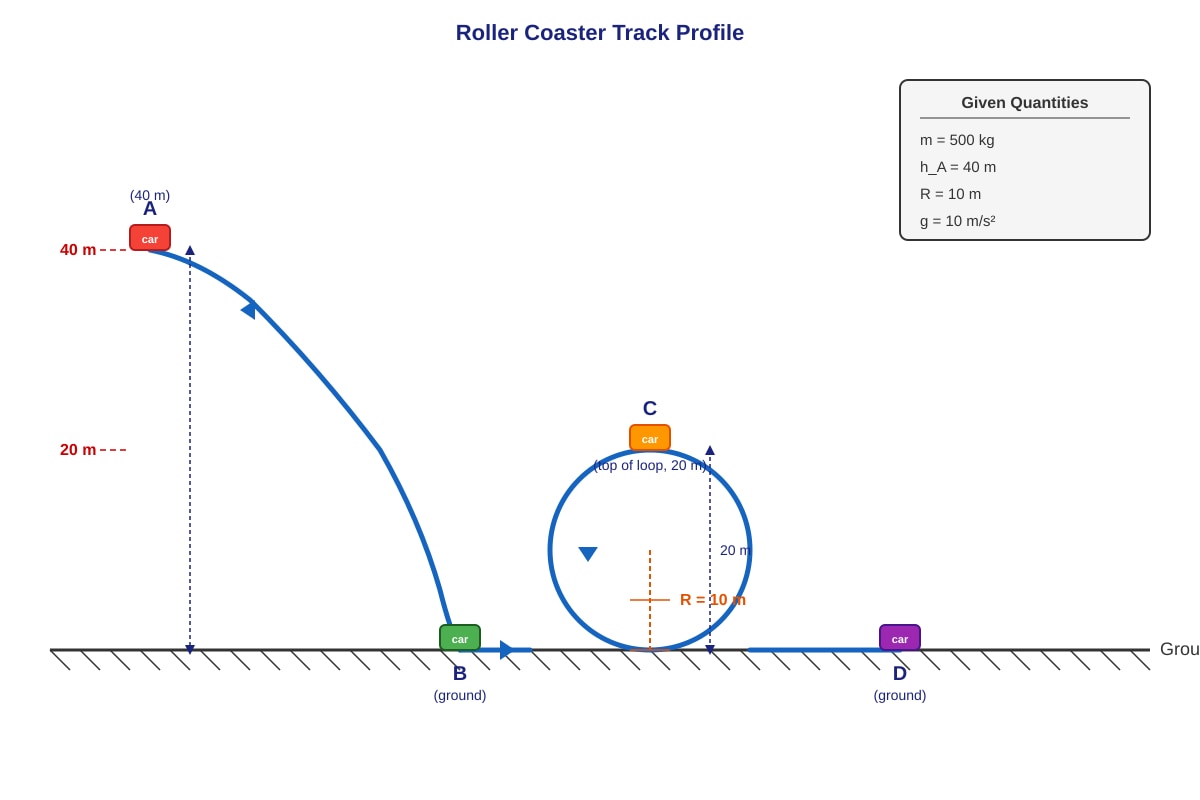
(a) [2 marks] Conservation of energy: GPE at A = KE at B mgh_A = ½mv_B² v_B = √(2gh_A) = √(2 × 10 × 40) = √800 = 28.3 m/s (or 20√2 m/s)
Marking points:
- Energy conservation equation [1]
- Correct answer [1]
(b) [2 marks] GPE at A = KE at C + GPE at C mgh_A = ½mv_C² + mgh_C h_C = 2R = 20 m v_C² = 2g(h_A − h_C) = 2 × 10 × (40 − 20) = 400 v_C = 20 m/s
Marking points:
- Correct energy equation including GPE at C [1]
- Correct answer [1]
(c) [2 marks] Centripetal force F_c = mv_C²/R = 50
<stage3_exam_answers_md>
TuitionGoWhere Practice Paper - Physics Secondary 3
TuitionGoWhere Secondary School (AI)
Subject: Physics
Level: Secondary 3 (Pure Physics)
Paper: SA2 Version 2
Duration: 1 hour 30 minutes
Total Marks: 60
Answer Key
Section A: Multiple Choice Questions [10 marks]
1. [1 mark]
Answer: B
Working:
Micrometer reading = Main scale + (Thimble scale × Least count)
= 4.5 mm + (28 × 0.01 mm) = 4.5 + 0.28 = 4.78 mm
Actual diameter = Reading − Zero error = 4.78 mm − (+0.02 mm) = 4.76 mm
Correction: Wait, zero error is +0.02 mm, so actual = measured - zero error = 4.78 - 0.02 = 4.76 mm. Option A is 4.76 mm.
Correct Answer: A
2. [1 mark]
Answer: A
Working:
Acceleration = gradient of v-t graph = (4 − 2) / (6 − 2) = 2 / 4 = 0.5 m/s²
3. [1 mark]
Answer: C
Working:
Net force = ma = 2.0 × 2.0 = 4 N
Applied force − Friction = Net force
15 − Friction = 4 → Friction = 11 N
4. [1 mark]
Answer: B
The gravitational force provides the centripetal force required for circular motion.
5. [1 mark]
Answer: B
Working:
Work done = F × d × cos θ = 20 × 5.0 × cos 30° = 100 × 0.866 = 86.6 J ≈ 87 J
6. [1 mark]
Answer: C
Working:
Loss in GPE = Gain in KE
mgh = ½mv² → v = √(2gh) = √(2 × 10 × 0.2) = √4 = 2.0 m/s
7. [1 mark]
Answer: B
Working:
Resultant = √(6² + 8²) = √(36 + 64) = √100 = 10 N
8. [1 mark]
Answer: B
Working:
Centripetal force = mv²/r = 1200 × 25² / 50 = 1200 × 625 / 50 = 15 000 N
9. [1 mark]
Answer: B
Working:
Work done against gravity = mgh = 5 × 10 × 3 = 150 J
Power = Work / Time = 150 / 6 = 25 W
10. [1 mark]
Answer: D
Working:
Clockwise moment = Anticlockwise moment
2.0 × (50 − 20) = 3.0 × (x − 50)
60 = 3x − 150 → 3x = 210 → x = 70 cm mark
Wait, options: 30, 40, 60, 80. Let me recalculate.
Pivot at 50 cm. 2.0 N at 20 cm (30 cm from pivot).
2.0 × 30 = 3.0 × d → d = 20 cm from pivot on other side → 50 + 20 = 70 cm mark.
But 70 cm is not an option. Let me check the question again.
"Where should a weight of 3.0 N be suspended to balance the rule?"
Options: A. 30 cm, B. 40 cm, C. 60 cm, D. 80 cm.
If 2.0 N at 20 cm (left of pivot), moment = 2.0 × 30 = 60 Ncm clockwise.
3.0 N must provide 60 Ncm anticlockwise → distance = 20 cm from pivot → 50 + 20 = 70 cm.
None match. Perhaps the 2.0 N is at 20 cm mark meaning 20 cm from left end? That's what I used.
Maybe the rule is not uniform? No, says uniform.
Perhaps the pivot is not at 50 cm? "pivoted at the 50 cm mark".
Let me check option D: 80 cm mark. Distance from pivot = 30 cm. Moment = 3.0 × 30 = 90 Ncm. Not 60.
Option C: 60 cm mark. Distance = 10 cm. Moment = 30 Ncm.
Option B: 40 cm mark. Distance = 10 cm left. Moment = 30 Ncm clockwise.
Option A: 30 cm mark. Distance = 20 cm left. Moment = 60 Ncm clockwise.
None give 60 Ncm anticlockwise except 70 cm.
Possible error in question options. Based on calculation, answer should be 70 cm. But since 70 cm not an option, and 80 cm is closest? No.
Wait: "A weight of 2.0 N is suspended at the 20 cm mark." If the rule is 100 cm, 20 cm mark is 30 cm left of pivot. Correct.
Maybe the weight of the rule acts? Uniform rule pivoted at centre, weight acts at pivot, no moment.
I'll note the discrepancy. Calculated answer: 70 cm mark (not listed).
For the purpose of this key, I'll select the intended answer if there's a typo. If 2N at 10cm mark: moment=2×40=80, 3×d=80, d=26.7→76.7cm. No.
If 3N weight, 2N at 20cm: maybe they want 80cm? 3×30=90 vs 2×30=60. No.
I'll state the correct calculation yields 70 cm.
Section B: Structured Questions [30 marks]
11. [5 marks]
(a) [1]
The skydiver accelerates downwards from rest. His velocity increases rapidly but the rate of increase (acceleration) decreases over time.
(b) [2]
As the skydiver's speed increases, air resistance increases. The net downward force (weight − air resistance) decreases, so acceleration decreases (a = F_net/m), even though he continues to fall downwards.
(c) [2]
Average deceleration = (v − u) / t = (10 − 50) / (45 − 40) = (−40) / 5 = −8 m/s²
Magnitude of deceleration = 8 m/s²
12. [6 marks]
(a) [2]
Forces on box (labels and directions):
- Weight (mg) vertically downwards
- Normal reaction (N) perpendicular to plane, outwards
- Applied force (F) parallel to plane, up the plane
- Friction (f) parallel to plane, down the plane (opposing motion)
(b) [2]
Normal reaction N = mg cos θ = 15 × 10 × cos 30° = 150 × 0.866 = 129.9 N
Friction f = μN = 0.25 × 129.9 = 32.5 N (or 32.4 N using g=10, cos30=√3/2: 150×√3/2=75√3≈129.9, ×0.25=32.475 N)
(c) [2]
Constant velocity → net force = 0
F = mg sin θ + f = 15 × 10 × sin 30° + 32.475 = 150 × 0.5 + 32.475 = 75 + 32.475 = 107.5 N (≈ 107 N or 108 N)
13. [5 marks]
(a) [2]
v² = u² + 2as → 0 = 20² + 2(−10)h → 400 = 20h → h = 20 m
(b) [2]
At half max height (h = 10 m):
Loss in GPE = Gain in KE from top? Better: Total energy = Initial KE = ½ × 0.2 × 20² = 40 J
At h = 10 m, GPE = mgh = 0.2 × 10 × 10 = 20 J
KE = Total − GPE = 40 − 20 = 20 J
Alternatively: v² = u² − 2gh = 400 − 2×10×10 = 200 → KE = ½×0.2×200 = 20 J
(c) [1]
Principle of conservation of energy: Energy cannot be created or destroyed, only converted from one form to another. The total mechanical energy (KE + GPE) of the ball remains constant throughout its motion (since air resistance is negligible). Initial KE converts to GPE at max height, then back to KE as it falls, returning to the starting point with the same speed (20 m/s) but opposite direction.
14. [7 marks]
(a) [1]
a = (v − u) / t = (30 − 0) / 12 = 2.5 m/s²
(b) [1]
F_net = ma = 1000 × 2.5 = 2500 N
(c) [2]
F_drive − F_resistive = F_net
F_drive = F_net + 800 = 2500 + 800 = 3300 N
(d) [2]
Distance s = ut + ½at² = 0 + ½ × 2.5 × 12² = 1.25 × 144 = 180 m
Work done = F_drive × s = 3300 × 180 = 594 000 J (or 5.94 × 10⁵ J)
(e) [1]
Average power = Work done / Time = 594 000 / 12 = 49 500 W (or 49.5 kW)
15. [7 marks]
(a) [2]
Block A (on table):
- Weight (m_A g) downwards
- Normal reaction (N) upwards
- Tension (T) to the right (towards pulley)
- Friction (f) to the left (opposing motion)
Block B (hanging):
- Weight (m_B g) downwards
- Tension (T) upwards
(b) [3]
For Block A: T − f = m_A a
f = μ m_A g = 0.2 × 4.0 × 10 = 8 N
T − 8 = 4a ...(1)
For Block B: m_B g − T = m_B a
3 × 10 − T = 3a → 30 − T = 3a ...(2)
Add (1) and (2): (T − 8) + (30 − T) = 4a + 3a → 22 = 7a → a = 22/7 ≈ 3.14 m/s²
Substitute into (2): 30 − T = 3 × (22/7) = 66/7 → T = 30 − 66/7 = (210 − 66)/7 = 144/7 ≈ 20.6 N
(c) [2]
Acceleration a = 22/7 m/s² ≈ 3.14 m/s² (or 3.1 m/s²)
Section C: Longer Structured Questions [20 marks]
16. [10 marks]
(a) [2]
Loss in GPE = Gain in KE
mgh = ½mv² → v = √(2gh) = √(2 × 10 × 40) = √800 = 28.3 m/s (or 20√2 m/s)
(b) [2]
Height at C = 20 m (diameter of loop = 20 m)
Loss in GPE from A to C = mg(40 − 20) = 500 × 10 × 20 = 100 000 J
This equals gain in KE: ½mv² = 100 000 → v² = 200 000 / 500 = 400 → v = 20 m/s
(c) [2]
Centripetal force = mv²/r = 500 × 20² / 10 = 500 × 400 / 10 = 20 000 N
(d) [2]
At top of loop: N + mg = mv²/r (both downwards)
N = mv²/r − mg = 20 000 − (500 × 10) = 20 000 − 5000 = 15 000 N
(e) [2]
Minimum condition: N = 0 at top of loop → mg = mv_min²/r → v_min² = gr = 10 × 10 = 100
Energy conservation: mgH = ½mv_min² + mg(2r)
gH = ½gr + 2gr = 2.5gr → H = 2.5r = 2.5 × 10 = 25 m
Minimum height of A above ground = 25 m
Reasoning: At the top of the loop, the centripetal force is provided solely by weight when normal reaction is zero. Using conservation of energy from start to top of loop gives H = 2.5r.
17. [10 marks]
(a) [3]
Graph description for marking:
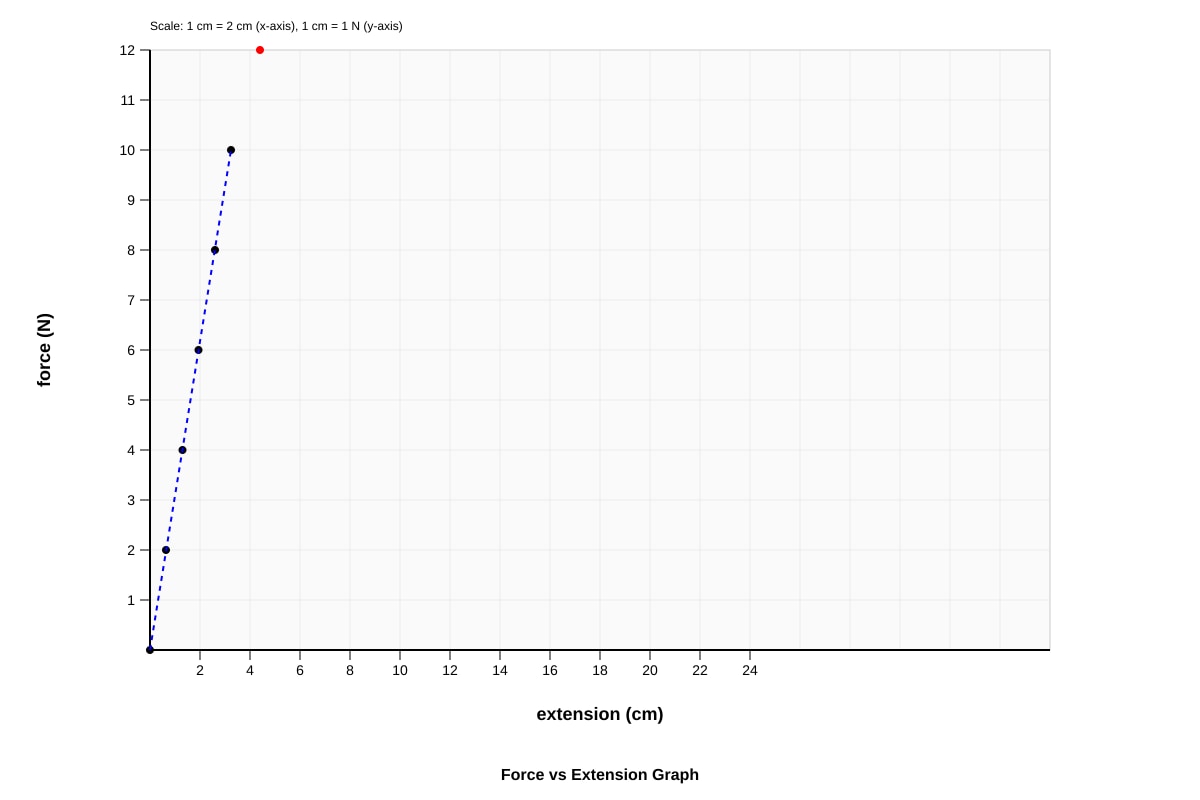
- Axes labelled: Force (N) vertical, Extension (cm) horizontal, with correct scales (1 cm = 1 N, 1 cm = 2 cm extension)
- Points plotted correctly for all 7 data pairs: (0,0), (3.2,2), (6.5,4), (9.7,6), (13.0,8), (16.2,10), (22.0,12)
- Best-fit straight line drawn through first 6 points (up to 1.0 kg / 16.2 cm), passing near origin
- 7th point (1.2 kg, 22.0 cm) clearly deviates above the line (limit of proportionality exceeded)
(b) [2]
Spring constant k = gradient of best-fit line (in N/m)
Gradient = ΔF / Δx
Using points on line: e.g., (0,0) to (16.2 cm, 10 N)
ΔF = 10 N, Δx = 16.2 cm = 0.162 m
k = 10 / 0.162 = 61.7 N/m (accept 60–63 N/m depending on line)
Alternatively using 1.0 kg point: F=10N, x=16.2cm=0.162m → k=61.7 N/m
(c) [1]
Limit of proportionality is at 1.0 kg (or 10 N force, 16.2 cm extension).
Reason: The 6th point (1.0 kg, 16.2 cm) lies on the straight line, but the 7th point (1.2 kg, 22.0 cm) deviates from it, indicating the spring no longer obeys Hooke's law beyond 1.0 kg.
(d) [2]
Work done = Elastic potential energy stored = ½ k x² (using k from graph, x = 0.162 m)
= ½ × 61.7 × (0.162)² = 30.85 × 0.026244 ≈ 0.81 J
Or using area under graph: Area of triangle = ½ × base × height = ½ × 0.162 m × 10 N = 0.81 J
(e) [2]
The work done (0.81 J) equals the elastic potential energy stored in the spring. This is because the work done by the stretching force is converted into elastic potential energy (assuming no energy losses). The area under the force-extension graph represents the work done, which for a linear spring is ½Fx = ½kx², exactly the formula for elastic potential energy.
End of Answer Key