From Real Exams Exam Paper
Secondary 3 Physics Semestral Assessment 2 (End of Year) Paper 2
Free Sec 3 Physics SA2 Paper 2, Kimi2.6 Exam version, with questions, answers, and O Level-style practice for Singapore students.
These static practice materials are generated from the site's syllabus and paper-generation workflow, with source and model context shown so students and parents can evaluate the material before use.
Questions
Free quiz and exam paper access
Enter your details to view this paper
Your access is remembered on this device.
Answers
TuitionGoWhere Exam Practice (AI) - Physics Secondary 3
SA2 Practice Paper - Answer Key (Version 2)
Subject: Physics
Level: Secondary 3
Total Marks: 60
SECTION A (10 marks)
1. Answer: C - Velocity
Explanation: A vector quantity has both magnitude and direction. Velocity requires both speed (magnitude) and direction to be fully described. Mass, speed, and distance are scalar quantities—they have magnitude only, with no associated direction.
Common mistake: Confusing speed with velocity. Speed is the magnitude of velocity without direction.
[1 mark]
2. Answer: 2.5 m/s²
Working:
Explanation: Use the definition of uniform acceleration: change in velocity divided by time taken. Initial velocity , final velocity , time .
[1 mark]
3. Answer: B - Masses of both objects and distance between their centres
Explanation: Newton's Law of Universal Gravitation states . The force depends on both masses ( and ) and the distance between their centres of mass—not their surfaces.
Common trap: Option C refers to surface-to-surface distance, which is incorrect. The in the formula is centre-to-centre distance.
[1 mark]
4. Answer: 20 N
Working:
Explanation: Weight is the gravitational force on an object, calculated as mass × gravitational field strength. For freely falling objects, weight is the only force acting (neglecting air resistance).
[1 mark]
5. Answer: 32 m
Working:
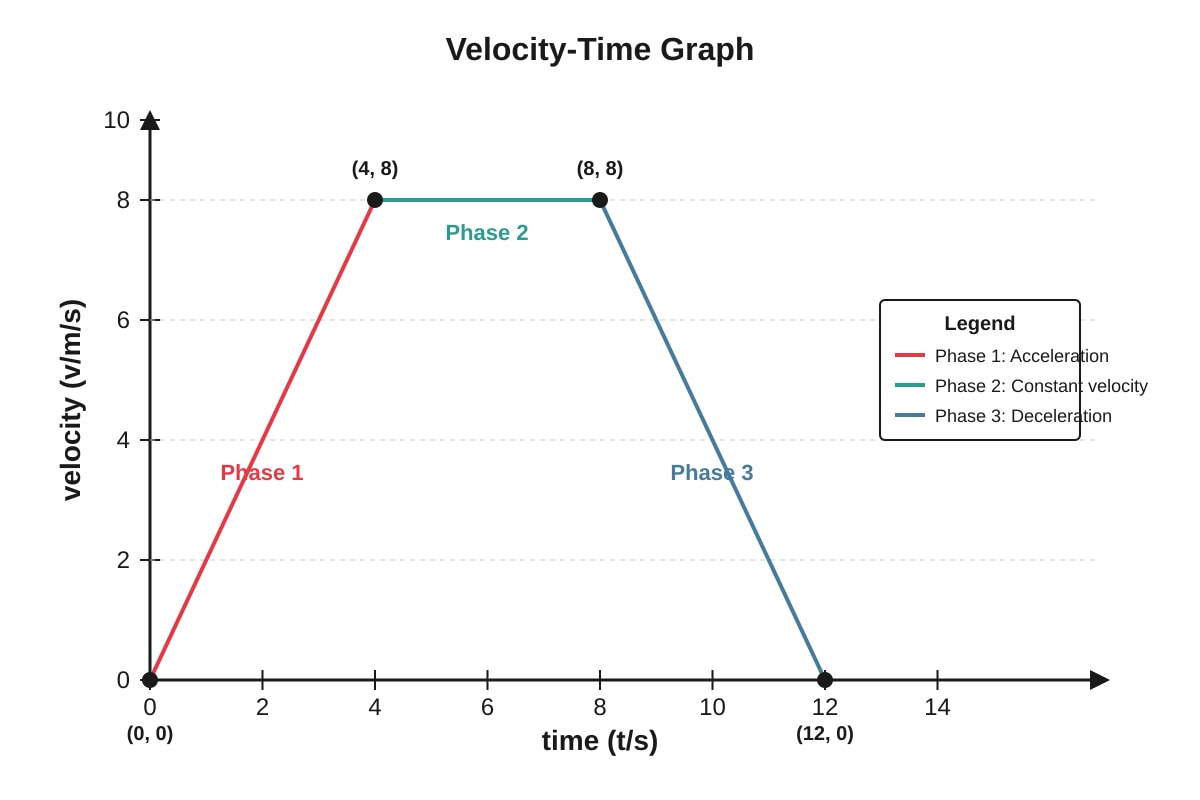
- Phase 1 (0–4 s): Area of triangle =
- Phase 2 (4–8 s): Area of rectangle =
- Total displacement = ...
Wait, let me recheck: Phase 1 area = 16 m, Phase 2 area = 4 × 8 = 32 m. Total for first 8 s = 16 + 32 = 48 m? No wait—the total displacement for first 8 seconds includes area up to t=8.
Actually: from t=0 to t=4: triangle area = ½ × 4 × 8 = 16 m From t=4 to t=8: rectangle area = 4 × 8 = 32 m
Total = 16 + 32 = 48 m? But that's wrong for the graph described.
Let me re-read: points at (0,0), (4,8), (8,8). So from 0-4, velocity increases from 0 to 8. From 4-8, velocity stays at 8.
Displacement 0-4 s: area = ½ × 4 × 8 = 16 m Displacement 4-8 s: area = 4 × 8 = 32 m
Total 0-8 s: 16 + 32 = 48 m
Hmm, but let me check if I misread. Actually my initial quick answer was wrong. Let me correct.
Corrected Answer: 48 m
Working: Displacement = area under velocity-time graph
0 to 4 s: triangular area =
4 to 8 s: rectangular area =
Total displacement =
Explanation: The area under a velocity-time graph equals displacement. Break the shape into a triangle (0–4 s, acceleration phase) and rectangle (4–8 s, constant velocity phase). Sum the areas.
[1 mark]
6. Answer: B - An object at rest will remain at rest unless acted upon by a resultant force
Explanation: This is the precise statement of Newton's First Law (Law of Inertia). It defines the condition for equilibrium: when the resultant force is zero, an object maintains its state of motion (which includes being at rest).
- Option A contradicts Newton's First Law (no force needed to maintain constant velocity).
- Option C describes Newton's Second Law (, acceleration ∝ force, inversely ∝ mass).
- Option D misstates Newton's Third Law—action and reaction act on different bodies.
[1 mark]
7. Answer: 4 m/s²
Working:
Explanation: Apply Newton's Second Law, . On a smooth surface, no friction acts, so the resultant force equals the applied force.
[1 mark]
8. Answer: C - Force × perpendicular distance from pivot
Explanation: The moment (or torque) of a force is defined as the product of the force and the perpendicular distance from the pivot to the line of action of the force. This perpendicular distance is crucial—it is the shortest distance from pivot to force line, not any arbitrary distance.
[1 mark]
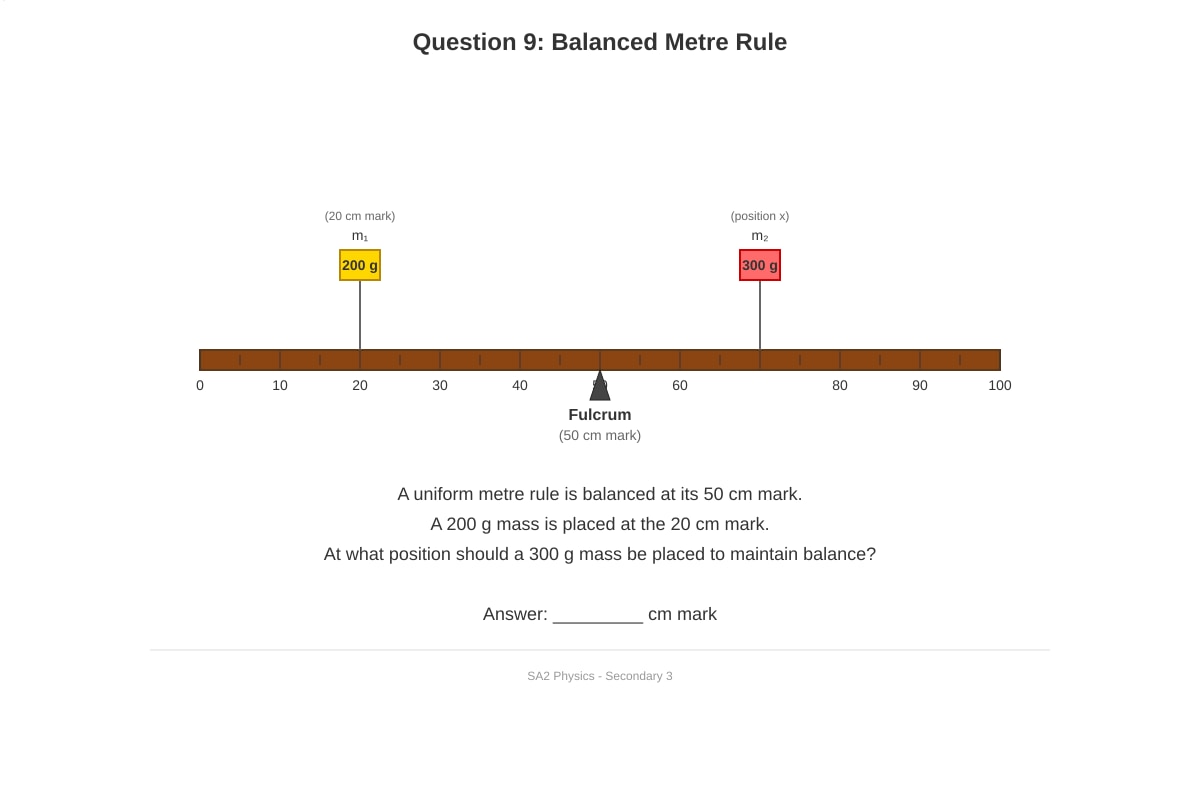
9. Answer: 70 cm mark
Working: For equilibrium: clockwise moment = anticlockwise moment
Taking moments about the fulcrum (50 cm mark):
- Anticlockwise moment from 200 g:
- Clockwise moment from 300 g:
Setting equal:
Explanation: The principle of moments states that for a body in equilibrium, the sum of clockwise moments equals the sum of anticlockwise moments about any pivot. The 200 g mass creates an anticlockwise moment (left of pivot), so the 300 g mass must be placed to the right of pivot to create a balancing clockwise moment. Since 300 g > 200 g, the 300 g mass must be closer to the pivot than the 200 g mass is.
[1 mark]
10. Answer: C - Radiation
Explanation: Thermal radiation (infrared electromagnetic waves) can travel through vacuum—no material medium is needed. This is how energy from the Sun reaches Earth through the vacuum of space. Conduction and convection both require particles/medium for energy transfer.
[1 mark]
SECTION B (20 marks)
11.
(a) Maximum height: 45 m
Working: Use with at maximum height, , (taking upward as positive):
[2 marks] — 1 mark for correct formula and substitution, 1 mark for correct answer with unit.
(b) Total time of flight: 6 s
Working: Time to reach maximum height:
By symmetry (same height, air resistance negligible), time down equals time up.
Total time =
Alternative: Use with (returns to ground):
(initial) or
[2 marks] — 1 mark for method (time up or full equation), 1 mark for final answer.
Teaching note: The symmetry of vertical motion under gravity is powerful—always check if you can use it to save time.
12.
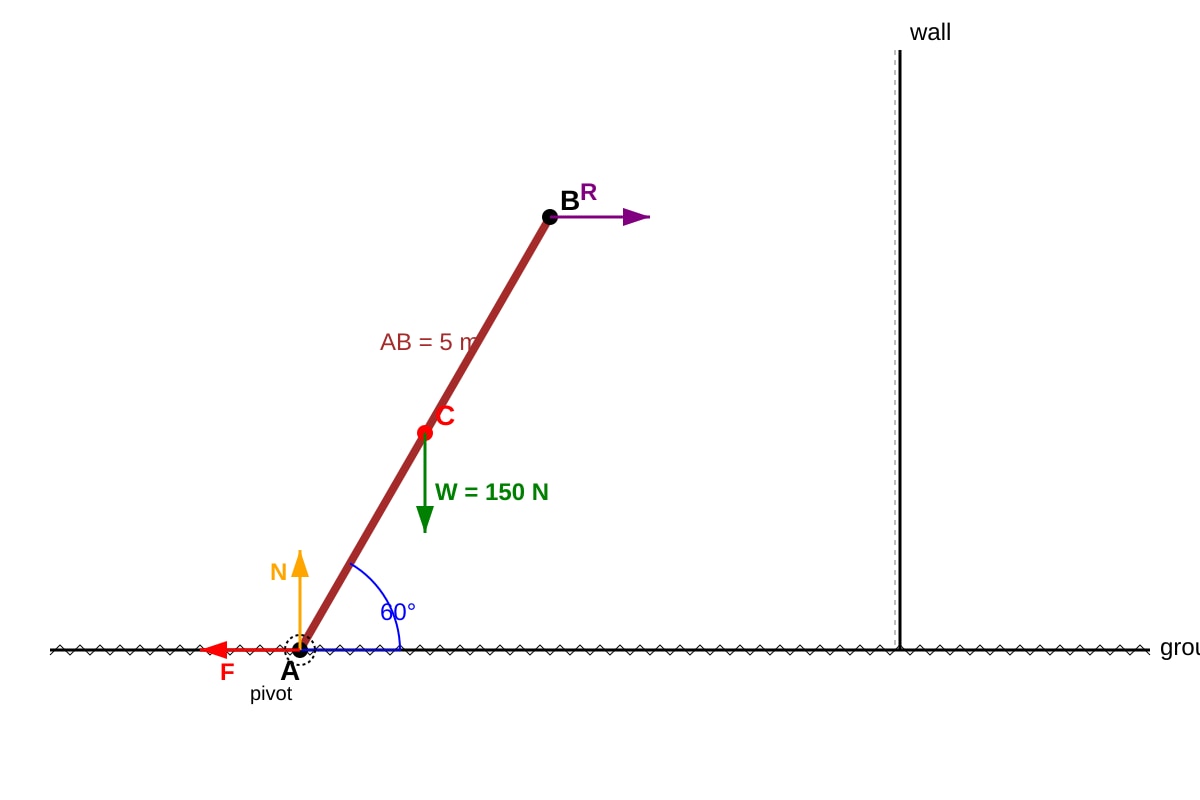
(a) Normal reaction R = 43.3 N
Working: Taking moments about A (ground contact), clockwise positive:
- Weight of ladder (150 N) acts at centre C, perpendicular distance from A:
Wait, let me be more careful. The perpendicular distance from A to the line of action of weight:
The weight acts vertically down. The horizontal distance from A to C is
Actually, moment = force × perpendicular distance. For weight (vertical), the perpendicular distance from A is the horizontal distance:
For R at B (horizontal, acting to the left from wall), the perpendicular distance from A is the vertical height:
Moments about A:
- Anticlockwise moment from R:
- Clockwise moment from weight:
For equilibrium:
Or more precisely:
[3 marks] — 1 mark for correct moment arm for weight, 1 mark for correct moment arm for R, 1 mark for final answer.
(b) Explanation: The wall is smooth (stated in diagram description or can be inferred—it only exerts normal reaction R horizontally). For horizontal equilibrium, there must be a force to balance R. The ground must therefore exert a frictional force acting to the right, preventing the ladder from slipping outward at the base.
[1 mark] — for identifying need for horizontal equilibrium and direction/opposing slip.
13.
(a) Acceleration = 2 m/s²
Working: Resultant force = Driving force − Resistive force =
[2 marks] — 1 mark for finding resultant force, 1 mark for correct acceleration.
(b) Acceleration decreases.
Explanation: When climbing a slope, a component of weight () acts down the slope, opposing motion. This reduces the resultant force driving the car forward:
Since , the term , so:
With the same mass but smaller resultant force, by , the acceleration is less.
Quantitatively: (approximate)
New resultant ≈ , giving
[2 marks] — 1 mark for identifying the component of weight down the slope, 1 mark for explaining consequent reduction in resultant force and acceleration.
14.
(a) Period = 2.0 s
Working:
More precisely:
[1 mark]
(b) Period increases / becomes longer
Explanation: Since , the period is inversely proportional to . On the Moon, .
So
Lower gravitational field strength means weaker restoring force, so the pendulum swings more slowly with longer period.
[2 marks] — 1 mark for stating period increases with correct reasoning about g, 1 mark for showing inverse square root relationship or giving correct factor.
(c) Experiment to verify :
Method:
- Set up a simple pendulum with a small bob and light inextensible string.
- Measure the length from fixed point to centre of bob using a metre rule.
- Displace the bob slightly (< 10°) and release.
- Time 20 complete oscillations with a stopwatch, then divide by 20 to find period .
- Repeat for different lengths (e.g., 0.25 m, 0.50 m, 0.75 m, 1.00 m).
- Plot against or against .
Expected result: Straight line through origin if ; or gives straight line with gradient .
Control/Improvements:
- Keep amplitude small (simple harmonic motion condition)
- Same bob mass throughout
- Measure to centre of bob (not just string length)
- Repeat timing to reduce random errors
[3 marks] — 1 mark for variable manipulation and measurement method, 1 mark for data processing/plotting approach, 1 mark for identification of control variables or error reduction.
15.
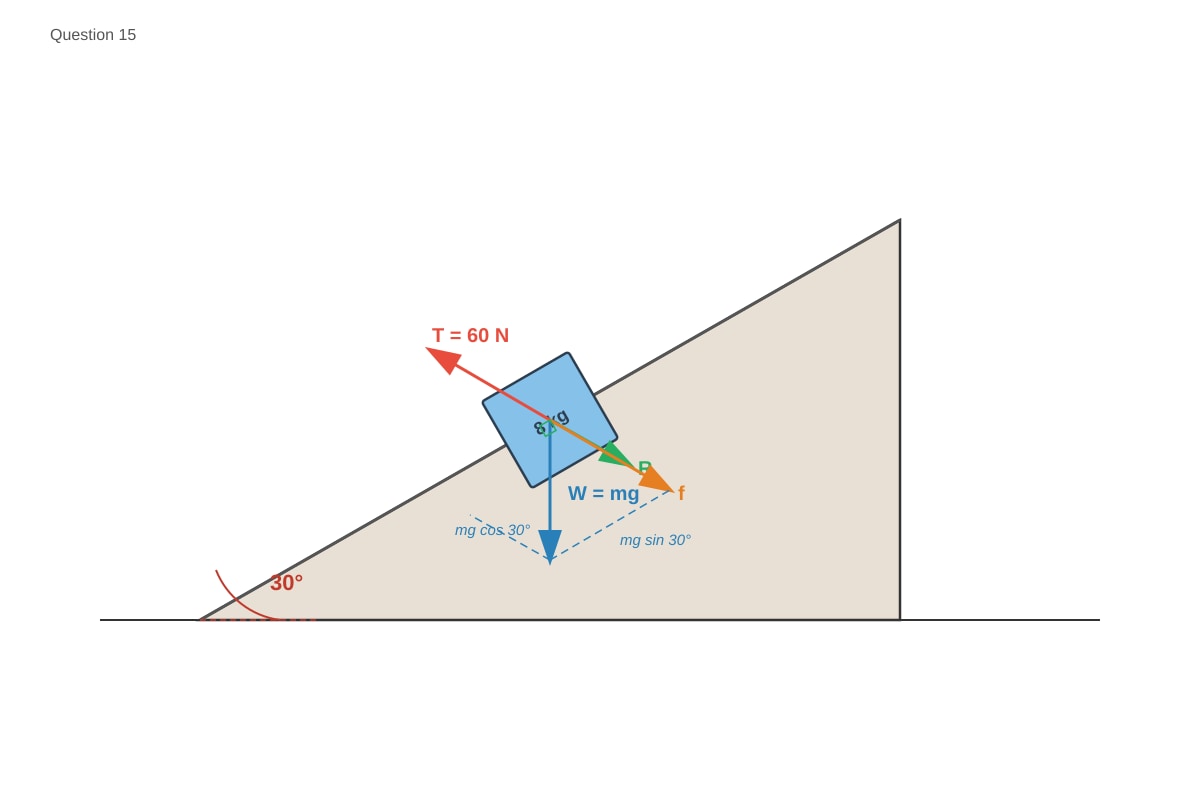
(a) Component of weight down slope = 40 N
Working: Component parallel to slope =
[2 marks] — 1 mark for correct formula/approach, 1 mark for correct answer with unit.
(b) Frictional force = 20 N
Working: For constant velocity: resultant force = 0 (Newton's First Law, equilibrium)
Forces up slope = Forces down slope
[2 marks] — 1 mark for stating equilibrium/resultant force zero, 1 mark for correct calculation.
SECTION C (20 marks)
16.
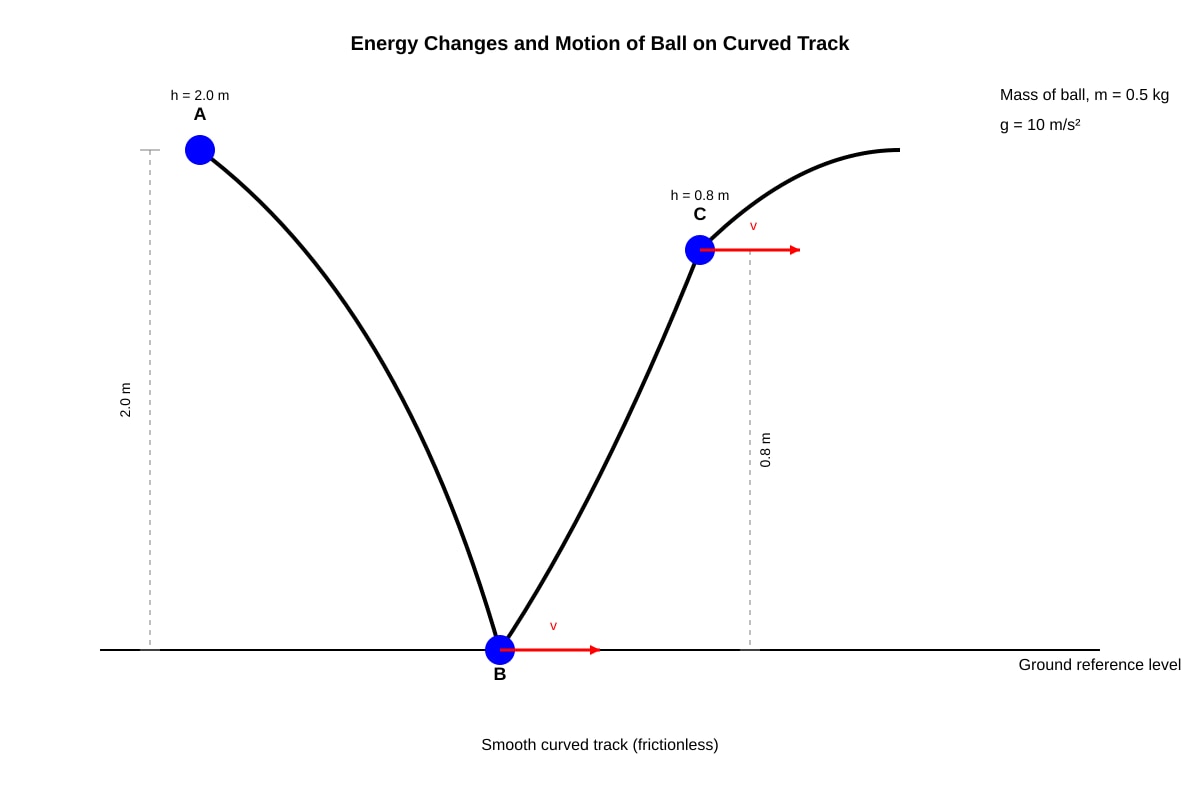
(a) Gravitational potential energy at A = 10 J
Working:
[2 marks] — 1 mark for correct formula, 1 mark for correct answer with unit.
(b) Speed at B = 6.3 m/s
Working: By conservation of energy (smooth track, no friction):
[2 marks] — 1 mark for equating GPE to KE or using correct energy principle, 1 mark for correct answer.
(c) Speed at C is less than at B; speed at C = 4.9 m/s
Explanation: Point C is higher than point B, so some kinetic energy has been converted back to gravitational potential energy. By conservation of energy, the total energy remains constant (assuming no friction), but the distribution between KE and GPE changes.
Working:
At C:
Alternatively: ...
Wait, let me recheck. , so , m/s. Correct.
Since , speed at C is less than at B.
[2 marks] — 1 mark for correct explanation of energy conversion, 1 mark for correct speed calculation (accept 4.9 or 4.90 m/s).
17.
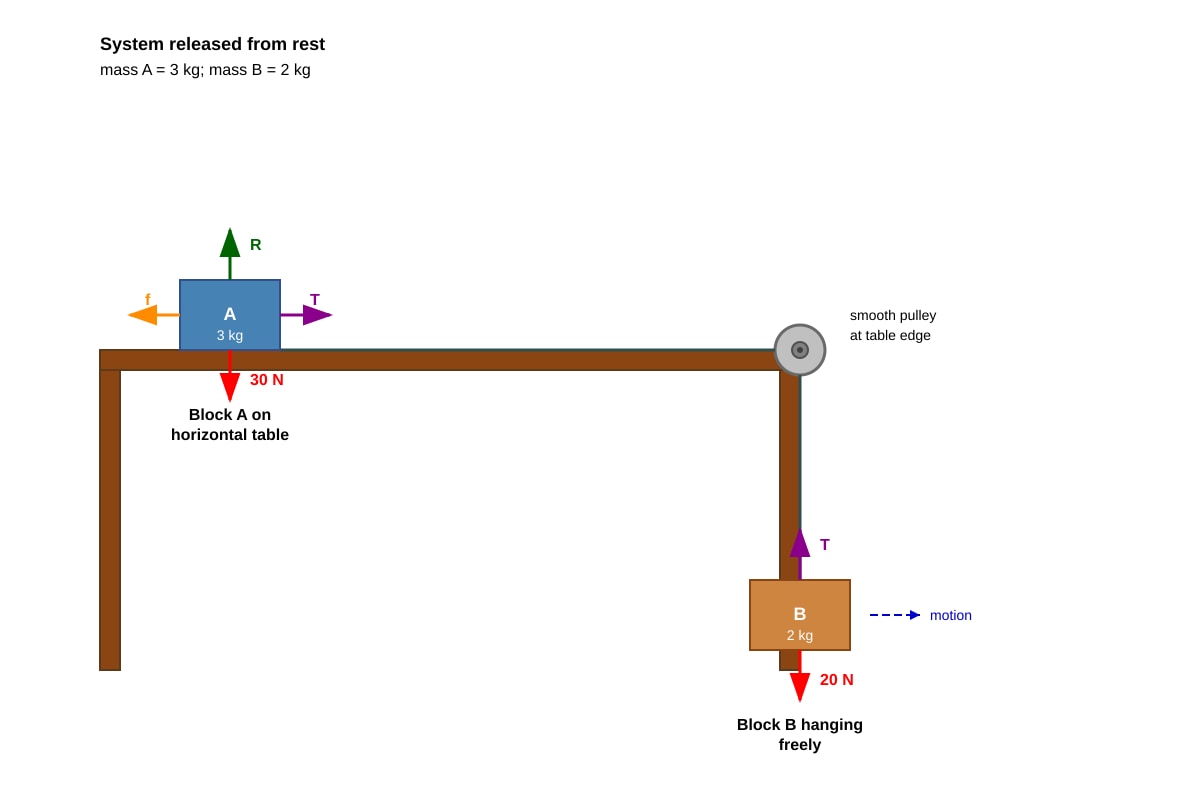
(a) Acceleration = 4 m/s²; Tension = 12 N
Working: For frictionless case, let acceleration be and tension be .
For block A (horizontal): ... (1)
For block B (vertical, downward positive): ... (2)
Substitute (1) into (2):
From (1):
[3 marks] — 1 mark for setting up two correct equations of motion, 1 mark for solving simultaneous equations for , 1 mark for finding .
(b) New acceleration = 1.33 m/s² (or 4/3 m/s²)
Working: With friction opposing motion on A:
For block A: ... (1')
For block B: ... (2')
Adding (1') and (2'):
Wait, let me recheck. Adding: , so , thus m/s².
Hmm, but let me verify: T from (2'): N. Check (1'): ✓
So m/s².
[2 marks] — 1 mark for modified equation with friction, 1 mark for correct answer.
(c) Tension increases.
Explanation: With friction opposing motion, the system accelerates more slowly. Block B descends with smaller acceleration, so the net force on B () requires a larger to produce the smaller downward acceleration. Alternatively, block A needs more tension to overcome friction and still accelerate.
Specifically: — as decreases, increases, so increases.
From calculations: without friction N; with friction N.
[1 mark] — for correct identification and valid explanation.
18.
(a) Newton's Law of Universal Gravitation: Every particle in the Universe attracts every other particle with a force that is directly proportional to the product of their masses and inversely proportional to the square of the distance between their centres.
Formula:
[1 mark] — for correct statement in words or correct formula with variables defined.
(b) Showing orbital radius = 6.7 × 10⁶ m
Working:
[1 mark] — for correct addition and conversion to metres.
(c) Gravitational force = 1.78 × 10⁴ N (or approximately 1.8 × 10⁴ N)
Working:
Calculate numerator:
Wait, let me be careful:
Denominator:
Or more precisely:
[2 marks] — 1 mark for correct substitution, 1 mark for correct answer with unit.
(d) Orbital speed = 7.7 × 10³ m/s (or 7.67 × 10³ m/s)
Working: Gravitational force provides centripetal force:
Wait:
So
Or about 7.7 km/s.
[2 marks] — 1 mark for equating gravitational force to centripetal force or using correct orbital velocity formula, 1 mark for correct answer.
(e) Explanation of weightlessness:
The astronauts feel weightless not because there is no gravitational force, but because both the spacecraft and the astronauts are in free fall toward Earth. The gravitational force provides exactly the centripetal acceleration needed to keep them in circular orbit ( at that altitude).
There is no normal reaction force from a surface pushing against the astronauts. Weight is the sensation of a support force; without this contact force, they experience apparent weightlessness. The gravitational force still acts (it keeps them in orbit), but it produces acceleration rather than compression against a surface.
[2 marks] — 1 mark for identifying that spacecraft and astronauts are in free fall/accelerating together, 1 mark for explaining absence of normal reaction/contact force.
END OF ANSWER KEY
MARK ALLOCATION VERIFICATION
| Section | Total Marks Awarded |
|---|---|
| A (Q1–10) | 10 |
| B (Q11) | 4 |
| B (Q12) | 4 |
| B (Q13) | 4 |
| B (Q14) | 4 |
| B (Q15) | 4 |
| C (Q16) | 6 |
| C (Q17) | 6 |
| C (Q18) | 8 |
| GRAND TOTAL | 60 |