From Real Exams Exam Paper
Secondary 3 Physics Semestral Assessment 2 (End of Year) Paper 2
Free Sec 3 Physics SA2 Paper 2, HY3 Exam version, with questions, answers, and O Level-style practice for Singapore students.
These static practice materials are generated from the site's syllabus and paper-generation workflow, with source and model context shown so students and parents can evaluate the material before use.
Questions
TuitionGoWhere Exam Practice (AI) — SA2 Practice Paper
Secondary 3 Physics — Mechanics (Version 2 of 5)
School: TuitionGoWhere Secondary School (AI)
Subject: Physics
Level: Secondary 3
Paper: SA2 Practice Paper (Version 2)
Duration: 60 minutes
Total Marks: 60
Name: ___________________________
Class: ____________
Date: ____________
Instructions:
- Answer all questions in the spaces provided.
- Show your working clearly where calculations are required.
- Use g=10 m s−2 unless stated otherwise.
- Section A: Multiple Choice (1 mark each). Section B: Short Structured (2–4 marks). Section C: Extended Response (4–6 marks).
Section A: Multiple Choice (Questions 1–5, 1 mark each, Total 5 marks)
1. A boy pushes a box with a force of 20 N to the right. Friction acts with 5 N to the left. What is the resultant force on the box?
A. 15 N right
B. 25 N right
C. 15 N left
D. 5 N right
2. Which of the following is a vector quantity?
A. Mass
B. Temperature
C. Velocity
D. Time
3. A block rests on a table. The table exerts an upward normal force on the block. This force is an example of:
A. Non-contact force
B. Contact force
C. Gravitational force only
D. Frictional force
4. The moment of a force about a pivot is maximum when the force is applied:
A. Parallel to the lever
B. At the pivot
C. Perpendicular to the lever at maximum distance
D. In the same direction as the lever
5. Pressure in a liquid increases with:
A. Decreasing depth
B. Decreasing density
C. Increasing depth
D. Decreasing gravitational field strength
Section B: Short Structured (Questions 6–15, Total 35 marks)
6. (a) Define the term scalar quantity. [1]
(b) Give one example of a scalar and one example of a vector quantity. [1]
7. A car travels 100 m in 5 s at constant speed. Calculate its average speed. [2]
8. A cyclist accelerates from rest to 8 m s−1 in 4 s. Calculate the acceleration. [2]
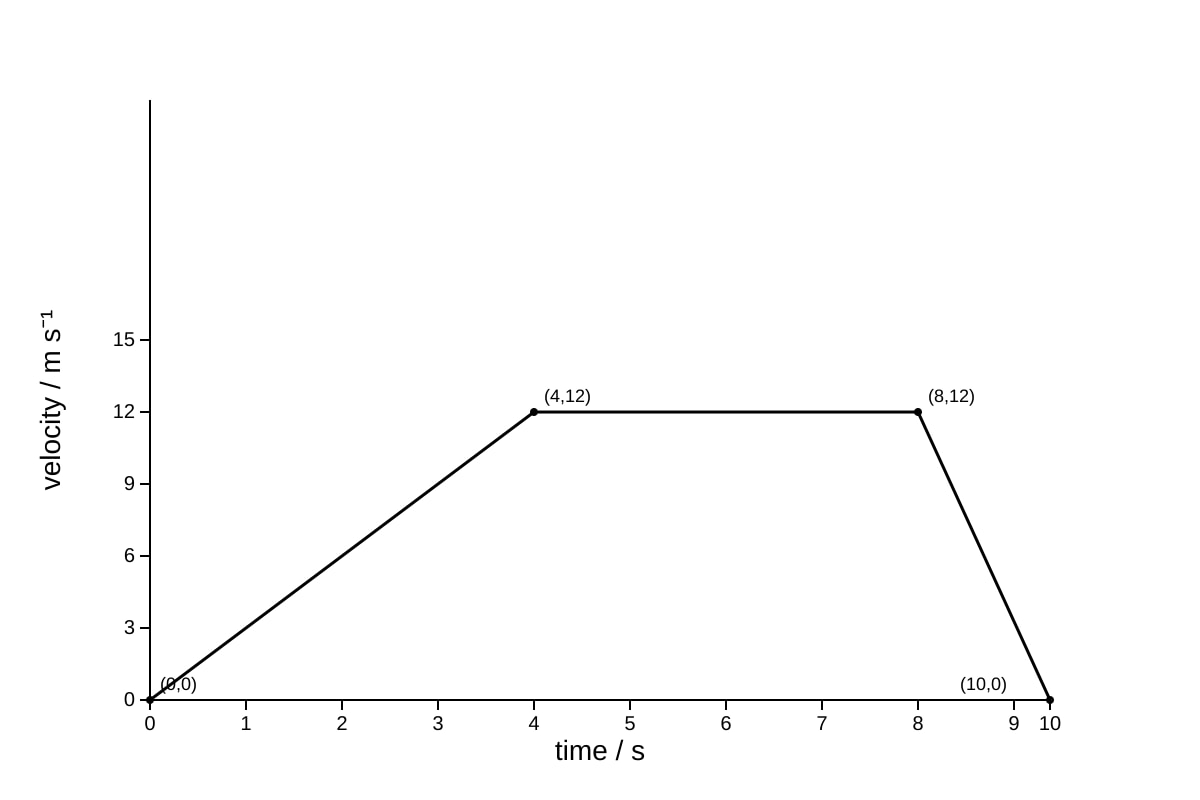
9.
Image pending generation: graph for Q9.
Using the graph, calculate the distance travelled by the bus in the first 8 s. [3]
10. A 4 kg object is pulled horizontally by a net force of 12 N. Calculate its acceleration. [2]
11. A 2 kg mass is lifted vertically by a string with tension 30 N. g=10 m s−2. Calculate the net force and state its direction. [3]
12. A uniform rod of length 2.0 m and weight 20 N is pivoted at its centre. A 10 N load is hung 0.50 m to the left of the pivot. Calculate the force needed 0.40 m to the right to balance. [3]
13. A block of area 0.020 m2 has a force of 40 N acting uniformly on it. Calculate the pressure. [2]
14. A hydraulic press has input area 0.01 m2 and output area 0.10 m2. Input force is 50 N. Calculate output force using Pascal’s principle. [3]
15. A 5 kg block is pulled up a slope of height 1.5 m. Calculate the gain in gravitational potential energy. [2]
Section C: Extended Response (Questions 16–20, Total 20 marks)
16. A child of mass 30 kg slides down a vertical rope with acceleration 2 m s−2. g=10 m s−2.
(a) Draw a free-body diagram showing forces. [2]
(b) Calculate the frictional force between child and rope. [3]
17. A 10 kg block is pulled up a rough inclined plane at constant speed by force 80 N. Distance along plane = 5.0 m, vertical rise = 2.0 m.
(a) Calculate work done by applied force. [2]
(b) Calculate gain in gravitational potential energy. [2]
(c) Find energy lost to friction. [2]
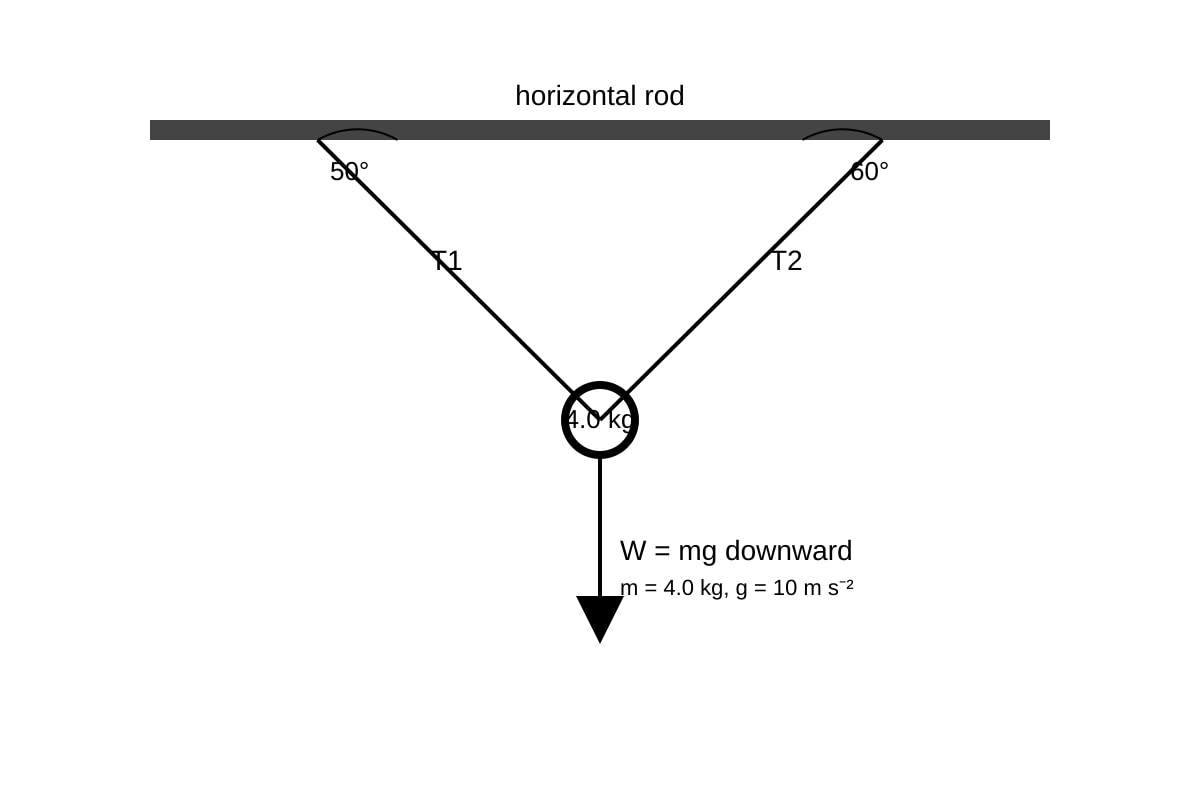
18.
Image pending generation: experimental_setup for Q18.
Calculate tension in each string. Show resolution equations. [6]
19. A metal block of mass 2.0 kg is lowered into liquid. Weight in air = 20 N, apparent weight in liquid = 16 N.
(a) State the upthrust. [1]
(b) Explain why apparent weight is less. [2]
(c) Calculate pressure if block base area = 0.0050 m2 and it rests on a surface. [2]
20. A car of mass 1000 kg accelerates from 10 to 25 m s⁻¹ over 15 s.
(a) Calculate acceleration. [2]
(b) Calculate resultant force. [2]
(c) State one resistive force likely present and its effect. [1]
End of Paper
Answers
TuitionGoWhere Exam Practice (AI) — SA2 Practice Paper (Version 2)
Secondary 3 Physics — Mechanics: Answer Key
Total Marks: 60
Duration: 60 min
Section A (5 marks)
1. A [1]
Resultant = 20 – 5 = 15 N right. Teaching: subtract opposite forces; direction follows larger.
2. C [1]
Velocity has magnitude + direction → vector. Mass, temp, time are scalars.
3. B [1]
Normal force requires contact → contact force.
4. C [1]
Moment = F × perpendicular distance; max when perpendicular at longest arm.
5. C [1]
Liquid pressure = hρg → increases with depth.
Section B (35 marks)
6. (a) Scalar = quantity with magnitude only. [1]
(b) Scalar e.g. speed; vector e.g. velocity. [1]
7. avg speed = dist/time = 100/5 = 20 m s⁻¹. [2]
Working: v=5100=20.
8. a=tv−u=48−0=2 m s−2. [2]
9. Area under v–t = distance. [1]
0–4 s: triangle = ½×4×12 = 24 m. [1]
4–8 s: rect = 12×4 = 48 m. Total = 72 m. [1]
10. a=F/m=12/4=3 m s−2. [2]
11. W = mg = 2×10 = 20 N down. T = 30 N up. Net = 30–20 = 10 N up. [3]
Mark: weight 1, net 2 (dir shown).
12. Anticlockwise: 10×0.50 = 5 Nm. Clockwise: F×0.40 = 5 → F = 12.5 N. [3]
13. P=F/A=40/0.020=2000 Pa. [2]
14. F2=F1×A2/A1=50×0.10/0.01=500 N. [3]
15. ΔPE=mgh=5×10×1.5=75 J. [2]
Section C (20 marks)
16. (a) Weight down (300 N), friction up. [2]
(b) mg−f=ma → 300 – f = 30×2 → f = 240 N up. [3]
17. (a) W=80×5=400 J. [2]
(b) ΔPE=mgh=10×10×2=200 J. [2]
(c) Loss = 400–200 = 200 J. [2]
18. W=40 N.
T1cos50+T2cos60=0 (horiz) [1]
T1sin50+T2sin60=40 (vert) [1]
Solve: T1≈21.4 N,T2≈29.3 N. [4]
19. (a) Upthrust = 20–16 = 4 N. [1]
(b) Liquid pushes up → apparent weight less. [2]
(c) P=F/A=20/0.0050=4000 Pa. [2]
20. (a) a=(25−10)/15=1.0 m s−2. [2]
(b) F=ma=1000×1=1000 N. [2]
(c) Air resistance opposes motion. [1]
Total: 60 marks. All questions answerable from placeholders.
Free quiz and exam paper access
Enter your details to view this paper
Your access is remembered on this device.