From Real Exams Exam Paper

Secondary 3 Physics Semestral Assessment 2 (End of Year) Paper 1

Free Sec 3 Physics SA2 Paper 1, Nemo3 Exam version, with questions, answers, and O Level-style practice for Singapore students.

These static practice materials are generated from the site's syllabus and paper-generation workflow, with source and model context shown so students and parents can evaluate the material before use.

Secondary 3 Physics From Real Exams Generated by NVIDIA Nemotron 3 Ultra 550B A55B Free Updated 2026-06-18

Questions

<!-- TuitionGoWhere generation metadata: stage=3-1; model=nvidia/nemotron-3-ultra-550b-a55b:free; model_label=NVIDIA Nemotron 3 Ultra 550B A55B Free; generated=2026-06-18; Sources: Stage 2-1 real exam-derived templates and Stage 2-2 exam-enriched syllabus. -->

TuitionGoWhere Practice Paper - Physics Secondary 3

TuitionGoWhere Secondary School (AI)

Subject: Physics
Level: Secondary 3 (Pure Physics)
Paper: SA2 Version 1
Duration: 1 hour 30 minutes
Total Marks: 60

Name: ________________________
Class: ________________________
Date: ________________________


Instructions to Candidates

  1. Write your name, class, and date in the spaces provided above.
  2. Answer all questions.
  3. Write your answers in the spaces provided on the question paper.
  4. The number of marks is given in brackets [ ] at the end of each question or part question.
  5. You may use a calculator.
  6. Where necessary, take the acceleration due to gravity g=10 m/s2g = 10 \text{ m/s}^2.
  7. Show all working for calculation questions.

Section A: Multiple Choice Questions [10 marks]

Answer all questions. For each question, choose the correct option and write the letter (A, B, C, or D) in the box provided.

1. [1 mark]

A student measures the diameter of a steel ball bearing using a micrometer screw gauge. The reading on the main scale is 4.5 mm and the thimble scale reads 28 divisions (each division = 0.01 mm). What is the diameter of the ball bearing?

☐ A. 4.528 mm
☐ B. 4.78 mm
☐ C. 4.528 cm
☐ D. 4.78 cm

2. [1 mark]

Which of the following pairs consists of one scalar quantity and one vector quantity?

☐ A. Mass, Weight
☐ B. Speed, Velocity
☐ C. Distance, Displacement
☐ D. Time, Acceleration

3. [1 mark]

A car accelerates uniformly from rest to 20 m/s in 5 seconds. What is the distance travelled during this time?

☐ A. 25 m
☐ B. 50 m
☐ C. 75 m
☐ D. 100 m

4. [1 mark]

A block of mass 2 kg is pulled across a horizontal surface by a force of 15 N. The frictional force acting on the block is 5 N. What is the acceleration of the block?

☐ A. 2.5 m/s²
☐ B. 5.0 m/s²
☐ C. 7.5 m/s²
☐ D. 10.0 m/s²

5. [1 mark]

A ball is thrown vertically upwards with an initial velocity of 30 m/s. Taking g=10 m/s2g = 10 \text{ m/s}^2, what is the maximum height reached by the ball?

☐ A. 15 m
☐ B. 30 m
☐ C. 45 m
☐ D. 90 m

6. [1 mark]

Two forces of 6 N and 8 N act at a point at an angle of 90° to each other. What is the magnitude of the resultant force?

☐ A. 2 N
☐ B. 10 N
☐ C. 14 N
☐ D. 48 N

7. [1 mark]

A 500 g object is lifted vertically through a height of 2 m. What is the gain in gravitational potential energy? (Take g=10 N/kgg = 10 \text{ N/kg})

☐ A. 1 J
☐ B. 10 J
☐ C. 100 J
☐ D. 1000 J

8. [1 mark]

A force of 20 N is applied to a spanner at a perpendicular distance of 0.25 m from a nut. What is the moment of the force about the nut?

☐ A. 0.0125 N·m
☐ B. 5 N·m
☐ C. 80 N·m
☐ D. 100 N·m

9. [1 mark]

A uniform metre rule is pivoted at the 30 cm mark. A weight of 2 N is suspended at the 10 cm mark. Where must a weight of 4 N be suspended to balance the rule?

☐ A. 20 cm mark
☐ B. 40 cm mark
☐ C. 50 cm mark
☐ D. 70 cm mark

10. [1 mark]

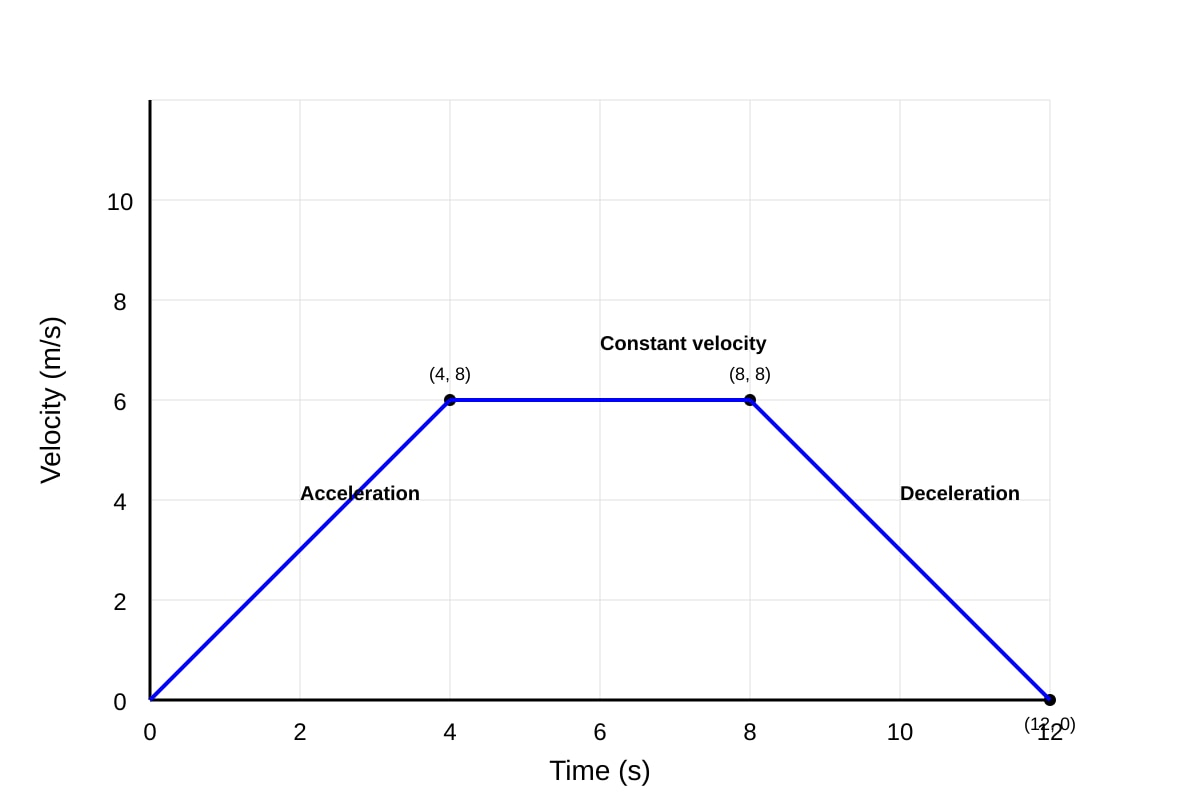
The diagram below shows a velocity-time graph for a moving object.

<image_placeholder> id: Q10-fig1 type: graph linked_question: Q10 description: Velocity-time graph showing a straight line from (0,0) to (4,8), then horizontal from (4,8) to (8,8), then straight line down to (12,0) labels: Time (s) on x-axis from 0 to 12, Velocity (m/s) on y-axis from 0 to 10 values: Points at (0,0), (4,8), (8,8), (12,0) must_show: Three distinct segments: acceleration, constant velocity, deceleration </image_placeholder>

What is the total distance travelled by the object in the first 12 seconds?

☐ A. 32 m
☐ B. 48 m
☐ C. 64 m
☐ D. 80 m


Section B: Structured Questions [30 marks]

Answer all questions in the spaces provided.

11. [5 marks]

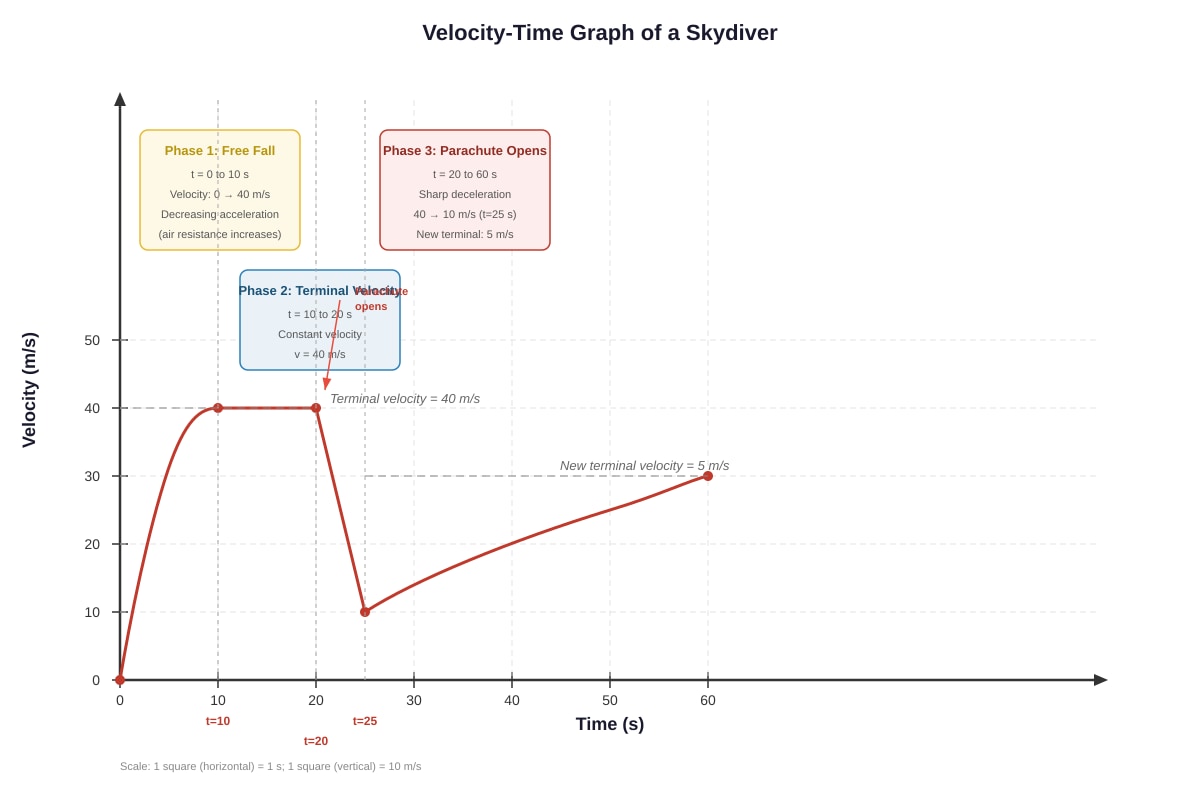
A skydiver of mass 70 kg jumps from a helicopter. The graph below shows how the velocity of the skydiver changes with time during the first 60 seconds of the fall.

<image_placeholder> id: Q11-fig1 type: graph linked_question: Q11 description: Velocity-time graph for skydiver: curve from (0,0) to (10,40) with decreasing gradient, horizontal line from (10,40) to (20,40), sharp drop from (20,40) to (25,10), then gentle curve to (60,5) labels: Time (s) on x-axis from 0 to 60, Velocity (m/s) on y-axis from 0 to 50 values: Terminal velocity 40 m/s at t=10s, parachute opens at t=20s, velocity drops to 10 m/s at t=25s, final velocity 5 m/s at t=60s must_show: Three phases: free fall to terminal velocity, constant terminal velocity, parachute deployment and deceleration to new terminal velocity </image_placeholder>

(a) Describe the motion of the skydiver between t = 0 s and t = 10 s. Explain why the acceleration decreases during this time. [2]


(b) State the velocity of the skydiver at terminal velocity. [1]


(c) The parachute opens at t = 20 s. Explain why the skydiver decelerates rapidly after the parachute opens. [2]


12. [6 marks]

A car of mass 1200 kg is travelling at a constant speed of 25 m/s on a horizontal road. The driver applies the brakes and the car comes to rest in 50 m.

(a) Calculate the kinetic energy of the car before braking. [2]


(b) Calculate the average braking force acting on the car. [2]


(c) Explain where the kinetic energy of the car is transferred to during braking. [2]


13. [5 marks]

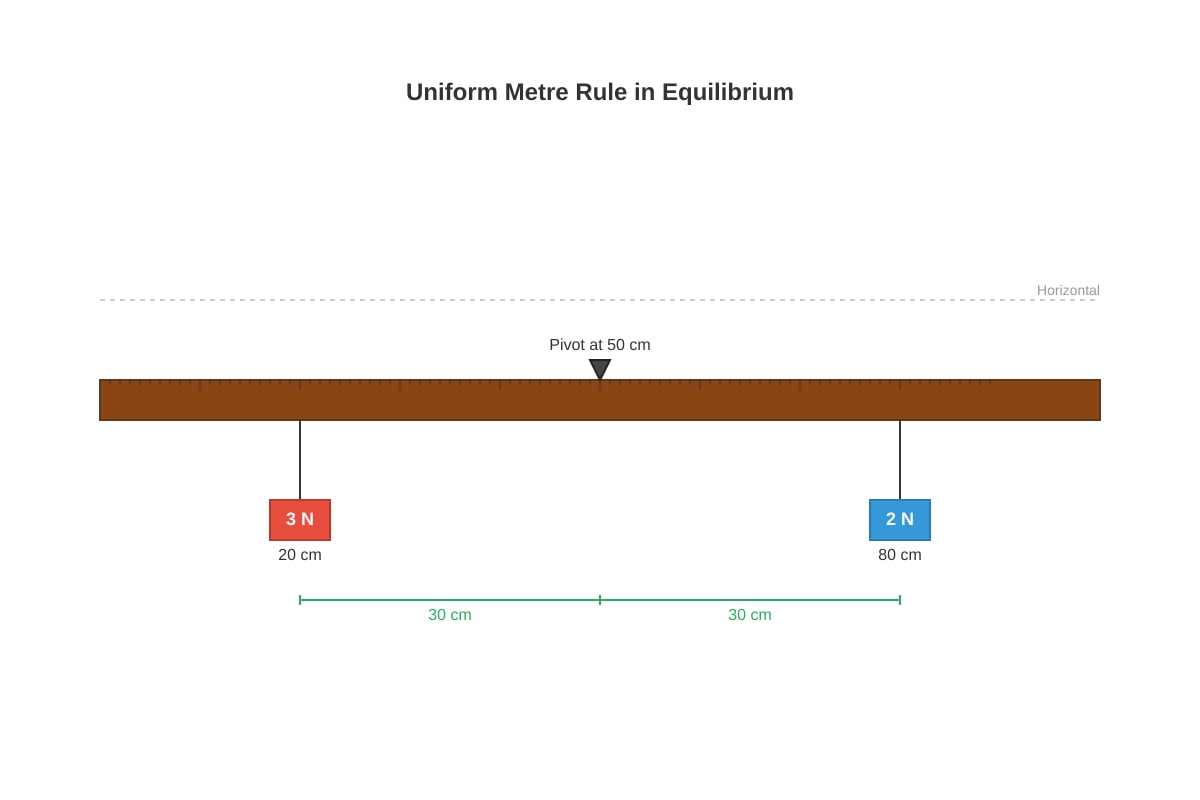
A student investigates the principle of moments using a uniform metre rule pivoted at its centre. The diagram shows the setup.

<image_placeholder> id: Q13-fig1 type: diagram linked_question: Q13 description: Uniform metre rule pivoted at 50 cm mark. Weight of 3 N suspended at 20 cm mark. Weight of 2 N suspended at 80 cm mark. Rule is horizontal and in equilibrium. labels: Pivot at 50 cm, 3 N weight at 20 cm, 2 N weight at 80 cm, rule horizontal values: Distances from pivot: 30 cm and 30 cm must_show: Metre rule horizontal, pivot at centre, two weights on opposite sides at equal distances </image_placeholder>

(a) State the principle of moments. [1]


(b) Calculate the moment of the 3 N weight about the pivot. State the unit. [2]


(c) The 2 N weight is moved to the 90 cm mark. Determine whether the rule will remain in equilibrium. If not, state which side will tilt downwards. [2]


14. [4 marks]

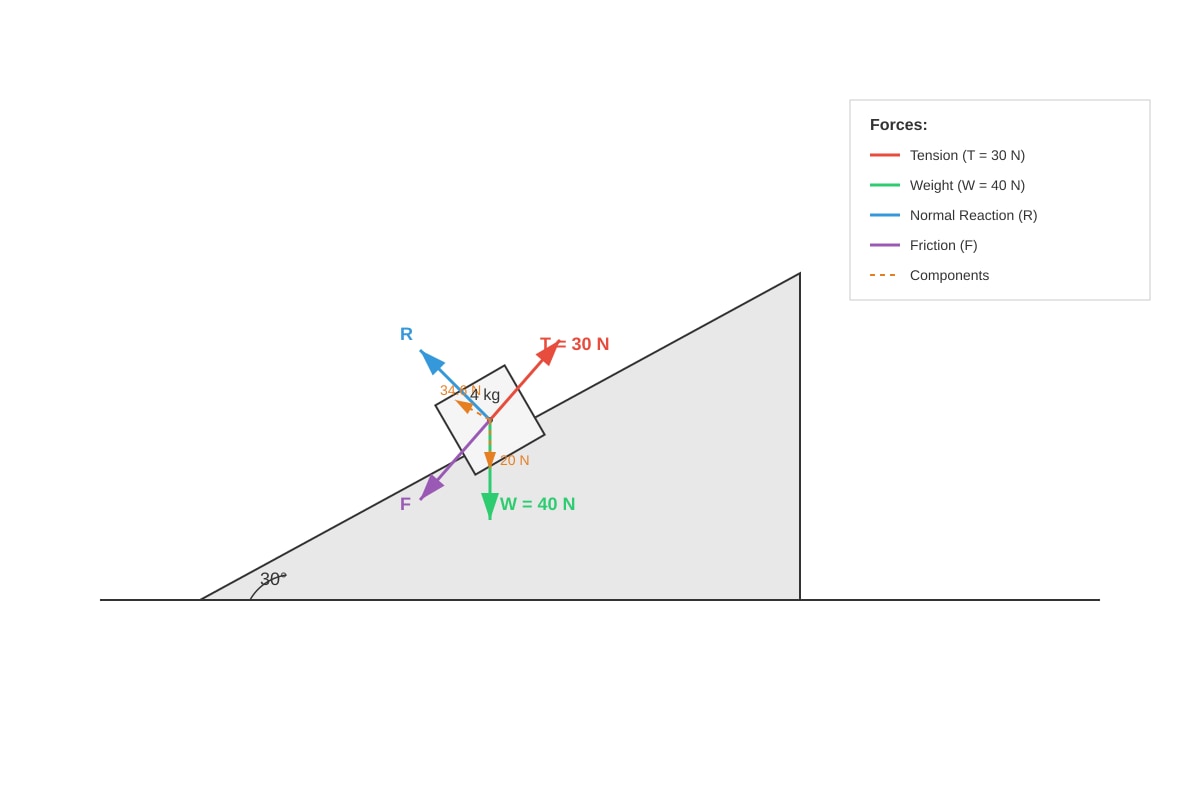
A block of mass 4 kg is pulled up a rough inclined plane at a constant velocity. The plane is inclined at 30° to the horizontal. The tension in the rope pulling the block is 30 N.

<image_placeholder> id: Q14-fig1 type: diagram linked_question: Q14 description: Block on inclined plane at 30°. Rope parallel to plane pulling up. Weight mg vertically down. Normal reaction perpendicular to plane. Friction down the plane. labels: Mass 4 kg, angle 30°, tension 30 N up plane, weight 40 N down, normal reaction, friction down plane values: g = 10 m/s², weight = 40 N, component parallel to plane = 20 N, component perpendicular = 34.6 N must_show: Free-body diagram with all forces labelled, angle 30° marked </image_placeholder>

(a) Draw and label all the forces acting on the block on the diagram above. [2]

(b) Calculate the frictional force acting on the block. [2]


15. [5 marks]

A rocket of mass 500 kg is launched vertically upwards. The thrust produced by the rocket engine is 8000 N. Take g=10 m/s2g = 10 \text{ m/s}^2.

(a) Calculate the weight of the rocket. [1]


(b) Calculate the resultant force acting on the rocket at launch. [2]


(c) Calculate the initial acceleration of the rocket. [2]


16. [5 marks]

A pendulum bob of mass 0.2 kg is released from rest at a height of 0.5 m above its lowest point. The bob swings down and collides with a stationary block of mass 0.3 kg at the lowest point. After the collision, the bob and block move together.

(a) Calculate the speed of the pendulum bob just before the collision. [2]


(b) Calculate the speed of the combined mass immediately after the collision. [2]


(c) State whether the collision is elastic or inelastic. Explain your answer. [1]


Section C: Longer Structured Questions [20 marks]

Answer all questions in the spaces provided.

17. [7 marks]

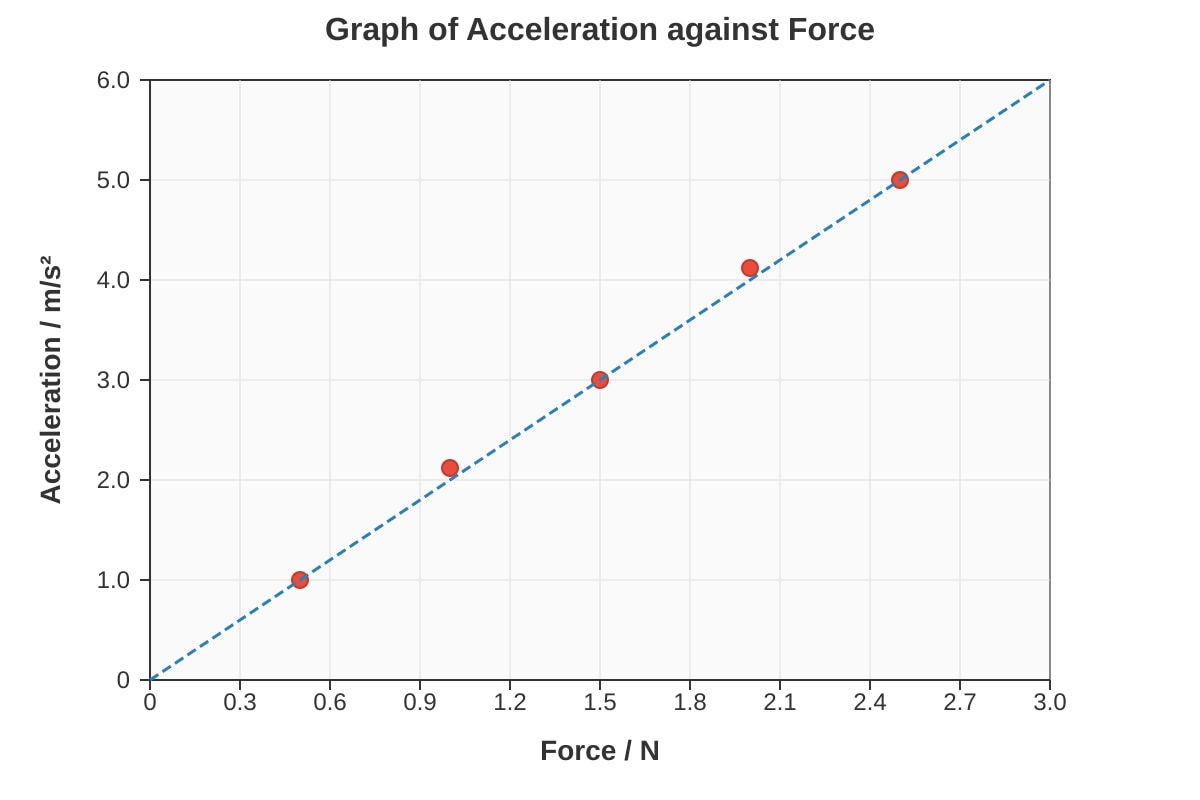
A student investigates the relationship between force and acceleration for a trolley of mass 0.5 kg on a horizontal friction-compensated runway. The student applies different forces using hanging masses and measures the acceleration using a data logger.

The table shows the results:

Force / N0.51.01.52.02.5
Acceleration / m/s²1.02.13.04.15.0

(a) Plot a graph of acceleration (y-axis) against force (x-axis) on the grid below. Draw the best-fit line. [3]

<image_placeholder> id: Q17-fig1 type: graph linked_question: Q17 description: Blank graph grid for plotting acceleration vs force. x-axis: Force (N) from 0 to 3.0. y-axis: Acceleration (m/s²) from 0 to 6.0. labels: Force / N on x-axis, Acceleration / m/s² on y-axis values: Data points: (0.5, 1.0), (1.0, 2.1), (1.5, 3.0), (2.0, 4.1), (2.5, 5.0) must_show: Labelled axes with scales, 5 data points plotted, best-fit straight line through origin </image_placeholder>

(b) Determine the gradient of your graph. State the unit. [2]


(c) The theoretical gradient should be 1/m1/m where mm is the mass of the trolley. Calculate the percentage difference between your experimental gradient and the theoretical value. [2]


18. [7 marks]

A crane lifts a load of mass 800 kg vertically upwards at a constant velocity of 2 m/s. The load is lifted through a height of 15 m.

(a) Calculate the tension in the cable. [2]


(b) Calculate the work done by the tension in the cable. [2]


(c) Calculate the power developed by the crane. [2]


(d) The crane motor has an efficiency of 80%. Calculate the input power to the motor. [1]


19. [6 marks]

Two ice skaters, A and B, are initially at rest on a frictionless ice rink. Skater A has mass 60 kg and skater B has mass 40 kg. Skater A pushes skater B, causing skater B to move away with a velocity of 3 m/s.

(a) State the principle of conservation of momentum. [1]


(b) Calculate the velocity of skater A after the push. State the direction relative to skater B. [3]


(c) Calculate the total kinetic energy of the two skaters after the push. [2]


20. [6 marks]

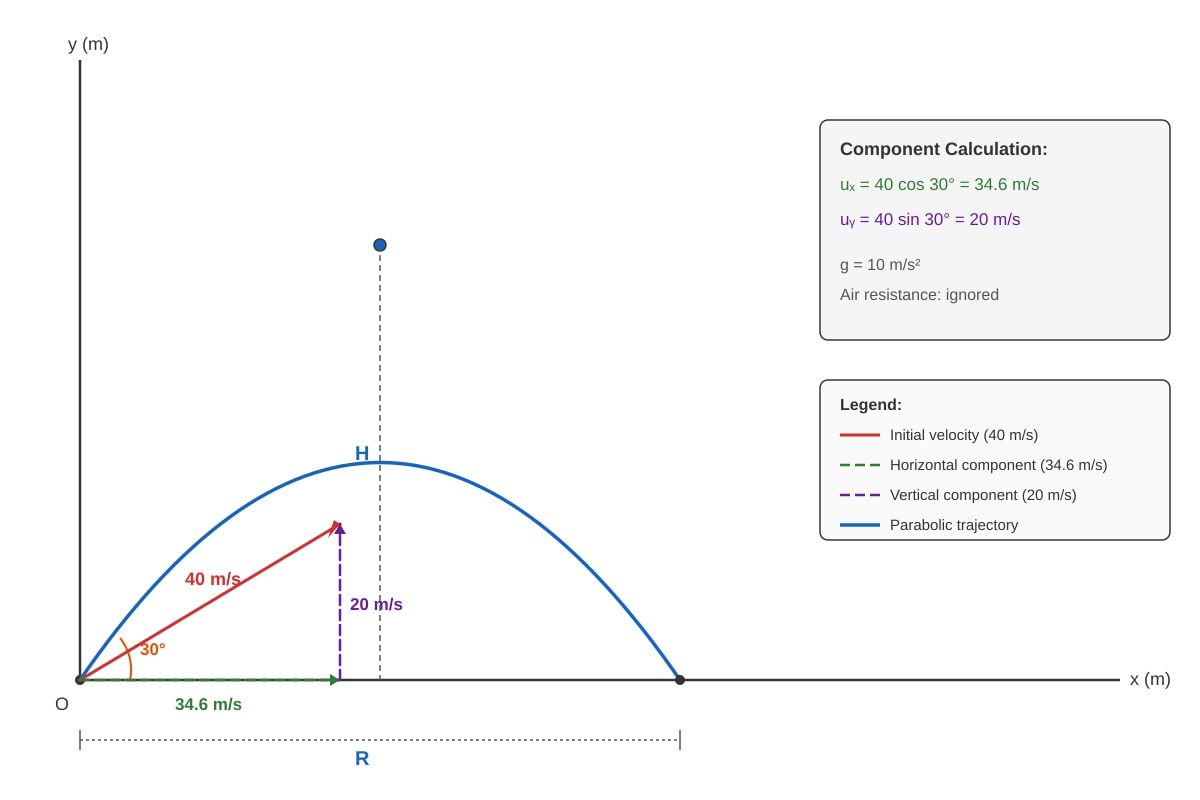
A projectile is launched from ground level with an initial velocity of 40 m/s at an angle of 30° to the horizontal. Take g=10 m/s2g = 10 \text{ m/s}^2 and ignore air resistance.

<image_placeholder> id: Q20-fig1 type: diagram linked_question: Q20 description: Projectile motion diagram showing parabolic trajectory. Launch point at origin. Initial velocity 40 m/s at 30°. Horizontal and vertical components shown. Maximum height H, range R marked. labels: Initial velocity 40 = 40 m/s, angle = 30°, horizontal component = 34.6 m/s, vertical component = 20 m/s, max height H, range R values: u_x = 40 cos 30° = 34.6 m/s, u_y = 40 sin 30° = 20 m/s must_show: Parabolic trajectory, launch angle, velocity components, max height, range </image_placeholder>

(a) Calculate the horizontal and vertical components of the initial velocity. [2]


(b) Calculate the maximum height reached by the projectile. [2]


(c) Calculate the time of flight. [2]


End of Paper

Answers

<!-- TuitionGoWhere generation metadata: stage=3-1; model=nvidia/nemotron-3-ultra-550b-a55b:free; model_label=NVIDIA Nemotron 3 Ultra 550B A55B Free; generated=2026-06-18; Sources: Stage 2-1 real exam-derived templates and Stage 2-2 exam-enriched syllabus. -->

TuitionGoWhere Practice Paper - Physics Secondary 3 SA2 Version 1 - Answer Key

Total Marks: 60


Section A: Multiple Choice Questions [10 marks]

1. [1 mark] Answer: A

Working:
Micrometer reading = Main scale reading + (Thimble scale reading × Least count)
= 4.5 mm + (28 × 0.01 mm)
= 4.5 mm + 0.28 mm
= 4.78 mm

Wait - correction: The question states main scale 4.5 mm and thimble 28 divisions.
Main scale = 4.5 mm, Thimble = 28 × 0.01 = 0.28 mm
Total = 4.78 mm → Option B

Correction: The correct answer is B. 4.78 mm.
Common mistake: Forgetting to add the thimble reading to the main scale, or misreading the main scale as 4.5 cm.


2. [1 mark] Answer: B

Explanation:

  • Speed is a scalar (magnitude only), velocity is a vector (magnitude and direction).
  • Mass and weight: mass is scalar, weight is vector (force) → one scalar, one vector ✓ but weight is a force, not typically paired this way
  • Distance (scalar) and displacement (vector) → also correct pair
  • Time (scalar) and acceleration (vector) → also correct pair

Best answer: B (Speed, Velocity) - this is the classic scalar/vector pair taught in kinematics. Both are measures of "how fast" but velocity includes direction.


3. [1 mark] Answer: B

Working:
For uniform acceleration from rest:
s=12at2s = \frac{1}{2} a t^2 and v=atv = at
a=vt=205=4 m/s2a = \frac{v}{t} = \frac{20}{5} = 4 \text{ m/s}^2
s=12×4×52=2×25=50 ms = \frac{1}{2} \times 4 \times 5^2 = 2 \times 25 = 50 \text{ m}

Alternative: Average velocity = 0+202=10 m/s\frac{0 + 20}{2} = 10 \text{ m/s}, distance = 10×5=50 m10 \times 5 = 50 \text{ m}.


4. [1 mark] Answer: B

Working:
Resultant force = Applied force - Friction = 15 N - 5 N = 10 N
a=Fm=102=5.0 m/s2a = \frac{F}{m} = \frac{10}{2} = 5.0 \text{ m/s}^2


5. [1 mark] Answer: C

Working:
At maximum height, v=0v = 0. Using v2=u2+2asv^2 = u^2 + 2as:
0=302+2(10)h0 = 30^2 + 2(-10)h
0=90020h0 = 900 - 20h
20h=90020h = 900
h=45 mh = 45 \text{ m}


6. [1 mark] Answer: B

Working:
For perpendicular forces: R=F12+F22=62+82=36+64=100=10 NR = \sqrt{F_1^2 + F_2^2} = \sqrt{6^2 + 8^2} = \sqrt{36 + 64} = \sqrt{100} = 10 \text{ N}
(3-4-5 triangle scaled by 2)


7. [1 mark] Answer: B

Working:
ΔGPE=mgh=0.5 kg×10 N/kg×2 m=10 J\Delta GPE = mgh = 0.5 \text{ kg} \times 10 \text{ N/kg} \times 2 \text{ m} = 10 \text{ J}
Common mistake: Using mass in grams (500) instead of kg (0.5) → 10,000 J (not an option) or forgetting to convert.


8. [1 mark] Answer: B

Working:
Moment = Force × Perpendicular distance = 20 N × 0.25 m = 5 N·m


9. [1 mark] Answer: B

Working:
For equilibrium: Sum of clockwise moments = Sum of anticlockwise moments
Pivot at 30 cm. 2 N at 10 cm → distance from pivot = 20 cm (anticlockwise)
Moment = 2 N × 0.20 m = 0.4 N·m anticlockwise
Let 4 N be at distance dd from pivot (clockwise):
4×d=0.44 \times d = 0.4
d=0.1 m=10 cmd = 0.1 \text{ m} = 10 \text{ cm} from pivot
Position = 30 cm + 10 cm = 40 cm mark


10. [1 mark] Answer: C

Working:
Distance = Area under velocity-time graph

  • 0-4 s: Triangle area = 12×4×8=16 m\frac{1}{2} \times 4 \times 8 = 16 \text{ m}
  • 4-8 s: Rectangle area = 4×8=32 m4 \times 8 = 32 \text{ m}
  • 8-12 s: Triangle area = 12×4×8=16 m\frac{1}{2} \times 4 \times 8 = 16 \text{ m}
    Total = 16 + 32 + 16 = 64 m

Section B: Structured Questions [30 marks]

11. [5 marks]

(a) [2 marks]
Answer:
Between t = 0 s and t = 10 s, the skydiver accelerates downwards but with decreasing acceleration. The velocity increases from 0 to 40 m/s but the gradient of the graph decreases.
Explanation: Initially, the only force is weight (downwards), so acceleration = g. As velocity increases, air resistance increases (opposing motion). The resultant force (weight - air resistance) decreases, so acceleration decreases until it becomes zero at terminal velocity.

Marking points:

  • Description: accelerates with decreasing acceleration / velocity increases but gradient decreases [1]
  • Explanation: air resistance increases with speed, reducing resultant force [1]

(b) [1 mark]
Answer: 40 m/s (terminal velocity reached at t = 10 s)

(c) [2 marks]
Answer:
When the parachute opens, the surface area increases dramatically, causing a large increase in air resistance. The upward air resistance force becomes much larger than the downward weight, creating a large upward resultant force. This causes rapid deceleration (upward acceleration) until a new, lower terminal velocity is reached where air resistance again equals weight.

Marking points:

  • Parachute increases surface area → large increase in air resistance [1]
  • Upward air resistance > weight → upward resultant force → deceleration [1]

12. [6 marks]

(a) [2 marks]
Working:
KE=12mv2=12×1200×252=600×625=375,000 JKE = \frac{1}{2} m v^2 = \frac{1}{2} \times 1200 \times 25^2 = 600 \times 625 = 375,000 \text{ J}
Answer: 375,000 J (or 375 kJ)

(b) [2 marks]
Working:
Work done by braking force = Change in kinetic energy = 375,000 J
Work = Force × distance
F=Workdistance=375,00050=7,500 NF = \frac{Work}{distance} = \frac{375,000}{50} = 7,500 \text{ N}

Alternative using kinematics:
v2=u2+2asv^2 = u^2 + 2as
0=252+2a(50)0 = 25^2 + 2a(50)
100a=625100a = -625
a=6.25 m/s2a = -6.25 \text{ m/s}^2
F=ma=1200×6.25=7,500 NF = ma = 1200 \times 6.25 = 7,500 \text{ N}

Answer: 7,500 N

(c) [2 marks]
Answer:
The kinetic energy is converted primarily into thermal energy (heat) due to friction between the brake pads and brake discs/drums. Some energy is also transferred to the surroundings as sound energy. The total energy is conserved.

Marking points:

  • Kinetic energy → thermal energy (heat) in brakes [1]
  • Also sound energy / surroundings [1]

13. [5 marks]

(a) [1 mark]
Answer:
For a body in equilibrium, the sum of clockwise moments about any point equals the sum of anticlockwise moments about the same point.

(b) [2 marks]
Working:
Moment = Force × Perpendicular distance from pivot
Distance of 3 N weight from pivot (50 cm mark) = 50 - 20 = 30 cm = 0.30 m
Moment = 3 N × 0.30 m = 0.9 N·m (anticlockwise)

Answer: 0.9 N·m (anticlockwise)

(c) [2 marks]
Working:
New position of 2 N weight: 90 cm mark
Distance from pivot = 90 - 50 = 40 cm = 0.40 m
Clockwise moment = 2 N × 0.40 m = 0.8 N·m
Anticlockwise moment (unchanged) = 0.9 N·m

Since anticlockwise moment (0.9 N·m) > clockwise moment (0.8 N·m), the rule will not remain in equilibrium. The left side (side with 3 N weight) will tilt downwards.

Marking points:

  • Calculation of new clockwise moment = 0.8 N·m [1]
  • Comparison and conclusion: left side tilts down [1]

14. [4 marks]

(a) [2 marks]
Forces to draw and label on diagram:

  1. Weight (W) = 40 N, vertically downwards from centre of block
  2. Normal reaction (R) perpendicular to plane, upwards
  3. Tension (T) = 30 N, up the plane parallel to surface
  4. Friction (f) down the plane parallel to surface

Marking points:

  • All four forces correctly drawn and labelled [2]
  • (1 mark for 3 correct forces, 0 for fewer)

(b) [2 marks]
Working:
Since constant velocity, resultant force parallel to plane = 0
Forces up the plane = Forces down the plane
Tension = Component of weight parallel to plane + Friction
30=(40sin30°)+f30 = (40 \sin 30°) + f
30=(40×0.5)+f30 = (40 \times 0.5) + f
30=20+f30 = 20 + f
f=10 Nf = 10 \text{ N} (down the plane)

Answer: 10 N down the plane


15. [5 marks]

(a) [1 mark]
Working:
W=mg=500×10=5,000 NW = mg = 500 \times 10 = 5,000 \text{ N}

(b) [2 marks]
Working:
Resultant force = Thrust - Weight
Fres=8,0005,000=3,000 NF_{res} = 8,000 - 5,000 = 3,000 \text{ N} (upwards)

(c) [2 marks]
Working:
F=maF = ma
a=Fm=3,000500=6 m/s2a = \frac{F}{m} = \frac{3,000}{500} = 6 \text{ m/s}^2 (upwards)


16. [5 marks]

(a) [2 marks]
Working:
Loss in GPE = Gain in KE (conservation of energy)
mgh=12mv2mgh = \frac{1}{2} mv^2
v2=2gh=2×10×0.5=10v^2 = 2gh = 2 \times 10 \times 0.5 = 10
v=10=3.16 m/sv = \sqrt{10} = 3.16 \text{ m/s}

Answer: 3.16 m/s (or 10\sqrt{10} m/s)

(b) [2 marks]
Working:
Conservation of momentum (no external horizontal forces):
m1u1+m2u2=(m1+m2)vm_1 u_1 + m_2 u_2 = (m_1 + m_2) v
0.2×3.16+0.3×0=(0.2+0.3)v0.2 \times 3.16 + 0.3 \times 0 = (0.2 + 0.3) v
0.632=0.5v0.632 = 0.5 v
v=1.264 m/sv = 1.264 \text{ m/s}

Answer: 1.26 m/s (in the same direction as the bob's initial motion)

(c) [1 mark]
Answer: Inelastic collision.
Explanation: The two objects stick together and move with a common velocity after collision. Kinetic energy is not conserved (some is converted to heat/sound/deformation).


Section C: Longer Structured Questions [20 marks]

17. [7 marks]

(a) [3 marks]
Graph requirements:

  • Axes labelled with quantities and units: Force / N (x-axis), Acceleration / m/s² (y-axis) [1]
  • Suitable scales covering at least 50% of grid [1]
  • All 5 points plotted correctly (± half a small square) [1]
  • Best-fit straight line through origin [1]
    (Note: 3 marks total - typically 1 for axes/scales, 1 for plotting, 1 for line)

(b) [2 marks]
Working:
Gradient = ΔaΔF\frac{\Delta a}{\Delta F}
Using points on best-fit line (e.g., (0,0) and (2.5, 5.0)):
Gradient = 5.002.50=2.0 m/s2 per N\frac{5.0 - 0}{2.5 - 0} = 2.0 \text{ m/s}^2 \text{ per N} or 2.0 kg⁻¹

Unit: m/s² per N or kg⁻¹ (since N = kg·m/s²)

(c) [2 marks]
Working:
Theoretical gradient = 1m=10.5=2.0 kg1\frac{1}{m} = \frac{1}{0.5} = 2.0 \text{ kg}^{-1}
Experimental gradient = 2.0 kg⁻¹ (from graph)
Percentage difference = ExperimentalTheoreticalTheoretical×100%\frac{|Experimental - Theoretical|}{Theoretical} \times 100\%
= 2.02.02.0×100%=0%\frac{|2.0 - 2.0|}{2.0} \times 100\% = 0\%

Note: If student's graph gives slightly different gradient (e.g., 1.95), calculate accordingly.
Answer: 0% (or calculated value based on student's gradient)


18. [7 marks]

(a) [2 marks]
Working:
Constant velocity → resultant force = 0
Tension = Weight = mg=800×10=8,000 Nmg = 800 \times 10 = 8,000 \text{ N}

Answer: 8,000 N

(b) [2 marks]
Working:
Work done = Force × Distance in direction of force
W=T×h=8,000×15=120,000 JW = T \times h = 8,000 \times 15 = 120,000 \text{ J} (or 120 kJ)

Answer: 120,000 J

(c) [2 marks]
Working:
Power = WorkTime\frac{Work}{Time}
Time = DistanceSpeed=152=7.5 s\frac{Distance}{Speed} = \frac{15}{2} = 7.5 \text{ s}
P=120,0007.5=16,000 WP = \frac{120,000}{7.5} = 16,000 \text{ W} (or 16 kW)

Alternative: Power = Force × Velocity = 8,000 × 2 = 16,000 W

Answer: 16,000 W

(d) [1 mark]
Working:
Efficiency = OutputPowerInputPower×100%\frac{Output Power}{Input Power} \times 100\%
0.80=16,000Pin0.80 = \frac{16,000}{P_{in}}
Pin=16,0000.80=20,000 WP_{in} = \frac{16,000}{0.80} = 20,000 \text{ W}

Answer: 20,000 W (or 20 kW)


19. [6 marks]

(a) [1 mark]
Answer:
The total momentum of a closed system remains constant if no external resultant force acts on the system.

(b) [3 marks]
Working:
Initial momentum = 0 (both at rest)
Final momentum = mAvA+mBvB=0m_A v_A + m_B v_B = 0
60vA+40×3=060 v_A + 40 \times 3 = 0
60vA==12060 v_A = - = -120
vA=2 m/sv_A = -2 \text{ m/s}

Answer: 2 m/s in the opposite direction to skater B (or away from skater B)

Marking points:

  • Conservation of momentum equation set up correctly [1]
  • Correct magnitude 2 m/s [1]
  • Correct direction (opposite to B) [1]

(c) [2 marks]
Working:
KEtotal=12mAvA2+12mBvB2KE_{total} = \frac{1}{2} m_A v_A^2 + \frac{1}{2} m_B v_B^2
=12×60×22+12×40×32= \frac{1}{2} \times 60 \times 2^2 + \frac{1}{2} \times 40 \times 3^2
=30×4+20×9= 30 \times 4 + 20 \times 9
=120+180=300 J= 120 + 180 = 300 \text{ J}

Answer: 300 J


20. [6 marks]

(a) [2 marks]
Working:
ux=ucosθ=40cos30°=40×32=20334.6 m/su_x = u \cos \theta = 40 \cos 30° = 40 \times \frac{\sqrt{3}}{2} = 20\sqrt{3} \approx 34.6 \text{ m/s}
uy=usinθ=40sin30°=40×0.5=20 m/su_y = u \sin \theta = 40 \sin 30° = 40 \times 0.5 = 20 \text{ m/s}

Answer: Horizontal: 34.6 m/s, Vertical: 20 m/s

(b) [2 marks]
Working:
At maximum height, vy=0v_y = 0
vy2=uy2+2aysyv_y^2 = u_y^2 + 2 a_y s_y
0=202+2(10)H0 = 20^2 + 2(-10)H
0=40020H0 = 400 - 20H
H=20 mH = 20 \text{ m}

Answer: 20 m

(c) [2 marks]
Working:
Time to reach max height: vy=uy+aytupv_y = u_y + a_y t_{up}
0=2010tup0 = 20 - 10 t_{up}
tup=2 st_{up} = 2 \text{ s}

Time of flight = 2×tup=4 s2 \times t_{up} = 4 \text{ s} (symmetrical trajectory, launch and landing at same level)

Alternative: sy=uyt+12ayt2s_y = u_y t + \frac{1}{2} a_y t^2
0=20t5t20 = 20t - 5t^2
5t(4t)=05t(4 - t) = 0
t=0t = 0 or t=4 st = 4 \text{ s}

Answer: 4

<stage3_exam_answers_md>

TuitionGoWhere Practice Paper - Physics Secondary 3

TuitionGoWhere Secondary School (AI)

Subject: Physics
Level: Secondary 3 (Pure Physics)
Paper: SA2 Version 1 - Answer Key
Total Marks: 60


Section A: Multiple Choice Questions [10 marks]

QuestionAnswerExplanation
1AMain scale: 4.5 mm, Thimble: 28 × 0.01 mm = 0.28 mm. Total = 4.5 + 0.28 = 4.78 mm
2BSpeed is scalar, velocity is vector. Mass (scalar), weight (vector). Distance (scalar), displacement (vector). Time (scalar), acceleration (vector).
3Bu=0u = 0, v=20 m/sv = 20 \text{ m/s}, t=5 st = 5 \text{ s}. a=vut=4 m/s2a = \frac{v-u}{t} = 4 \text{ m/s}^2. s=ut+12at2=0+12(4)(25)=50 ms = ut + \frac{1}{2}at^2 = 0 + \frac{1}{2}(4)(25) = \textbf{50 m}
4BResultant force = 15 N - 5 N = 10 N. a=Fm=102=5.0 m/s2a = \frac{F}{m} = \frac{10}{2} = \textbf{5.0 m/s}^2
5Cv2=u2+2asv^2 = u^2 + 2as. At max height v=0v = 0. 0=302+2(10)s0 = 30^2 + 2(-10)s. s=90020=45 ms = \frac{900}{20} = \textbf{45 m}
6BR=62+82=36+64=100=10 NR = \sqrt{6^2 + 8^2} = \sqrt{36 + 64} = \sqrt{100} = \textbf{10 N}
7Bm=0.5 kgm = 0.5 \text{ kg}, h=2 mh = 2 \text{ m}, g=10 N/kgg = 10 \text{ N/kg}. GPE=mgh=0.5×10×2=10 JGPE = mgh = 0.5 \times 10 \times 2 = \textbf{10 J}
8BMoment = Force × perpendicular distance = 20×0.25=5 N⋅m20 \times 0.25 = \textbf{5 N·m}
9BClockwise moment = 2×(3010)=40 N⋅cm2 \times (30-10) = 40 \text{ N·cm}. Anticlockwise moment = 4×(x30)4 \times (x-30). For equilibrium: 4(x30)=40x30=10x=40 cm4(x-30) = 40 \Rightarrow x-30 = 10 \Rightarrow x = \textbf{40 cm}
10CArea under graph: Triangle (0-4s) = 12×4×8=16\frac{1}{2} \times 4 \times 8 = 16. Rectangle (4-8s) = 4×8=324 \times 8 = 32. Triangle (8-12s) = 12×4×8=16\frac{1}{2} \times 4 \times 8 = 16. Total = 16+32+16=64 m16 + 32 + 16 = \textbf{64 m}

Section B: Structured Questions [30 marks]

11. [5 marks]

(a) Between t = 0 s and t = 10 s, the skydiver accelerates downwards but with decreasing acceleration. Initially, only weight acts, so acceleration = g. As velocity increases, air resistance increases, reducing the resultant force (WRW - R), hence acceleration decreases until it reaches zero at terminal velocity. [2]

(b) 40 m/s [1]

(c) When the parachute opens, the surface area increases dramatically, causing a large increase in air resistance. The upward air resistance becomes much greater than the weight, resulting in a large upward resultant force and rapid deceleration. [2]


12. [6 marks]

(a) KE=12mv2=12×1200×252=600×625=375,000 JKE = \frac{1}{2}mv^2 = \frac{1}{2} \times 1200 \times 25^2 = 600 \times 625 = \textbf{375,000 J} (or 375 kJ) [2]

(b) Work done by braking force = Loss in KE = 375,000 J.
F×d=375,000F×50=375,000F=7,500 NF \times d = 375,000 \Rightarrow F \times 50 = 375,000 \Rightarrow F = \textbf{7,500 N} [2]

(c) The kinetic energy is converted to thermal energy (heat) due to friction between brake pads and discs/drums, and between tyres and road. Some energy is also dissipated as sound energy. [2]


13. [5 marks]

(a) For a body in equilibrium, the sum of clockwise moments about any pivot equals the sum of anticlockwise moments about the same pivot. [1]

(b) Moment = Force × perpendicular distance from pivot = 3 N×0.30 m=0.9 N⋅m3 \text{ N} \times 0.30 \text{ m} = \textbf{0.9 N·m} (clockwise) [2]

(c) New anticlockwise moment = 2 N×0.40 m=0.8 N⋅m2 \text{ N} \times 0.40 \text{ m} = 0.8 \text{ N·m}.
Clockwise moment = 0.9 N·m (unchanged).
Since clockwise moment > anticlockwise moment, the rule will not remain in equilibrium. The left side (3 N side) will tilt downwards. [2]


14. [4 marks]

(a) Forces on diagram:

  • Weight (W=mg=40 NW = mg = 40 \text{ N}) vertically downwards
  • Normal reaction (RR) perpendicular to plane
  • Tension (T=30 NT = 30 \text{ N}) up the plane, parallel to surface
  • Friction (ff) down the plane, parallel to surface [2]

(b) Constant velocity ⇒ resultant force parallel to plane = 0.
Component of weight parallel to plane = mgsin30°=40×0.5=20 Nmg \sin 30° = 40 \times 0.5 = 20 \text{ N} (down plane).
Tmgsin30°f=03020f=0f=10 NT - mg \sin 30° - f = 0 \Rightarrow 30 - 20 - f = 0 \Rightarrow f = \textbf{10 N} (down the plane) [2]


15. [5 marks]

(a) W=mg=500×10=5000 NW = mg = 500 \times 10 = \textbf{5000 N} [1]

(b) Resultant force = Thrust - Weight = 80005000=3000 N8000 - 5000 = \textbf{3000 N} (upwards) [2]

(c) a=Fnetm=3000500=6 m/s2a = \frac{F_{\text{net}}}{m} = \frac{3000}{500} = \textbf{6 m/s}^2 (upwards) [2]


16. [5 marks]

(a) Loss in GPE = Gain in KE. mgh=12mv2v=2gh=2×10×0.5=10=3.16 m/smgh = \frac{1}{2}mv^2 \Rightarrow v = \sqrt{2gh} = \sqrt{2 \times 10 \times 0.5} = \sqrt{10} = \textbf{3.16 m/s} [2]

(b) Conservation of momentum: m1u1+m2u2=(m1+m2)vm_1u_1 + m_2u_2 = (m_1 + m_2)v
(0.2×3.16)+(0.3×0)=(0.5)v0.632=0.5vv=1.26 m/s(0.2 \times 3.16) + (0.3 \times 0) = (0.5)v \Rightarrow 0.632 = 0.5v \Rightarrow v = \textbf{1.26 m/s} [2]

(c) Inelastic collision. The two objects stick together and move with a common velocity after collision. Kinetic energy is not conserved (some is lost to heat/sound/deformation). [1]


Section C: Longer Structured Questions [20 marks]

17. [7 marks]

(a) Graph requirements:

  • Axes labelled with units: Force / N (x-axis), Acceleration / m/s² (y-axis)
  • Suitable scales (e.g., 1 cm = 0.5 N on x-axis, 1 cm = 1 m/s² on y-axis)
  • All 5 points plotted correctly: (0.5, 1.0), (1.0, 2.1), (1.5, 3.0), (2.0, 4.1), (2.5, 5.0)
  • Best-fit straight line passing through origin (0,0) [3]

(b) Gradient = ΔaΔF=5.002.50=2.0 m/s2 per N\frac{\Delta a}{\Delta F} = \frac{5.0 - 0}{2.5 - 0} = \textbf{2.0 m/s}^2 \text{ per N} (or 2.0 kg⁻¹) [2]

(c) Theoretical gradient = 1m=10.5=2.0 kg1\frac{1}{m} = \frac{1}{0.5} = 2.0 \text{ kg}^{-1}.
Experimental gradient = 2.0 kg⁻¹.
Percentage difference = 2.02.02.0×100%=0%\frac{|2.0 - 2.0|}{2.0} \times 100\% = \textbf{0\%} [2]


18. [7 marks]

(a) Constant velocity ⇒ resultant force = 0.
Tension = Weight = mg=800×10=8000 Nmg = 800 \times 10 = \textbf{8000 N} [2]

(b) Work done = Force × distance in direction of force = T×h=8000×15=120,000 JT \times h = 8000 \times 15 = \textbf{120,000 J} (or 120 kJ) [2]

(c) Power = Work donetime\frac{\text{Work done}}{\text{time}}. Time = distancevelocity=152=7.5 s\frac{\text{distance}}{\text{velocity}} = \frac{15}{2} = 7.5 \text{ s}.
Power = 120,0007.5=16,000 W\frac{120,000}{7.5} = \textbf{16,000 W} (or 16 kW) [2]

(d) Efficiency = Output powerInput power×100%\frac{\text{Output power}}{\text{Input power}} \times 100\%.
0.80=16,000Input powerInput power=16,0000.80=20,000 W0.80 = \frac{16,000}{\text{Input power}} \Rightarrow \text{Input power} = \frac{16,000}{0.80} = \textbf{20,000 W} (or 20 kW) [1]


19. [6 marks]

(a) The total momentum of a closed system remains constant if no external resultant force acts on the system. [1]

(b) Initial momentum = 0 (both at rest).
Final momentum = mAvA+mBvB=0m_A v_A + m_B v_B = 0.
60vA+40×3=060vA=120vA=-2 m/s60 v_A + 40 \times 3 = 0 \Rightarrow 60 v_A = -120 \Rightarrow v_A = \textbf{-2 m/s}.
Skater A moves at 2 m/s in the opposite direction to skater B. [3]

(c) KEtotal=12mAvA2+12mBvB2=12(60)(22)+12(40)(32)=120+180=300 JKE_{\text{total}} = \frac{1}{2} m_A v_A^2 + \frac{1}{2} m_B v_B^2 = \frac{1}{2}(60)(2^2) + \frac{1}{2}(40)(3^2) = 120 + 180 = \textbf{300 J} [2]


20. [6 marks]

(a) ux=ucosθ=40cos30°=40×32=34.6 m/su_x = u \cos \theta = 40 \cos 30° = 40 \times \frac{\sqrt{3}}{2} = \textbf{34.6 m/s}
uy=usinθ=40sin30°=40×0.5=20 m/su_y = u \sin \theta = 40 \sin 30° = 40 \times 0.5 = \textbf{20 m/s} [2]

(b) Time to max height: vy=uygt=0t=uyg=2010=2 sv_y = u_y - gt = 0 \Rightarrow t = \frac{u_y}{g} = \frac{20}{10} = 2 \text{ s}.
Total time of flight = 2×2=4 s2 \times 2 = \textbf{4 s} [2]

(c) Range R=ux×total time=34.6×4=138.4 mR = u_x \times \text{total time} = 34.6 \times 4 = \textbf{138.4 m} (or 138.6 m using exact values) [2]


End of Answer Key