From Real Exams Exam Paper
Secondary 3 Physics Semestral Assessment 2 (End of Year) Paper 1
Free Sec 3 Physics SA2 Paper 1, Kimi2.6 Exam version, with questions, answers, and O Level-style practice for Singapore students.
These static practice materials are generated from the site's syllabus and paper-generation workflow, with source and model context shown so students and parents can evaluate the material before use.
Questions
Free quiz and exam paper access
Enter your details to view this paper
Your access is remembered on this device.
Answers
TuitionGoWhere Secondary School (AI)
SA2 Practice Paper - Physics Secondary 3: Answer Key
Version: 1 of 5
Total Marks: 60
Duration: 1 hour 15 minutes
SECTION A: Multiple Choice Questions (10 marks)
1. B — A vernier caliper
Explanation: A vernier caliper can measure to a precision of (), compared to a ruler's typical precision of (). The question shows , suggesting the measurement was estimated to the nearest . A vernier caliper is the only instrument listed with this precision. A metre rule with mm divisions still requires estimation between marks. A measuring tape is less precise, and a stopwatch measures time, not length.
Common mistake: Choosing A because "mm divisions" sounds precise, but reading between mm marks still only gives about precision with estimation.
[1 mark]
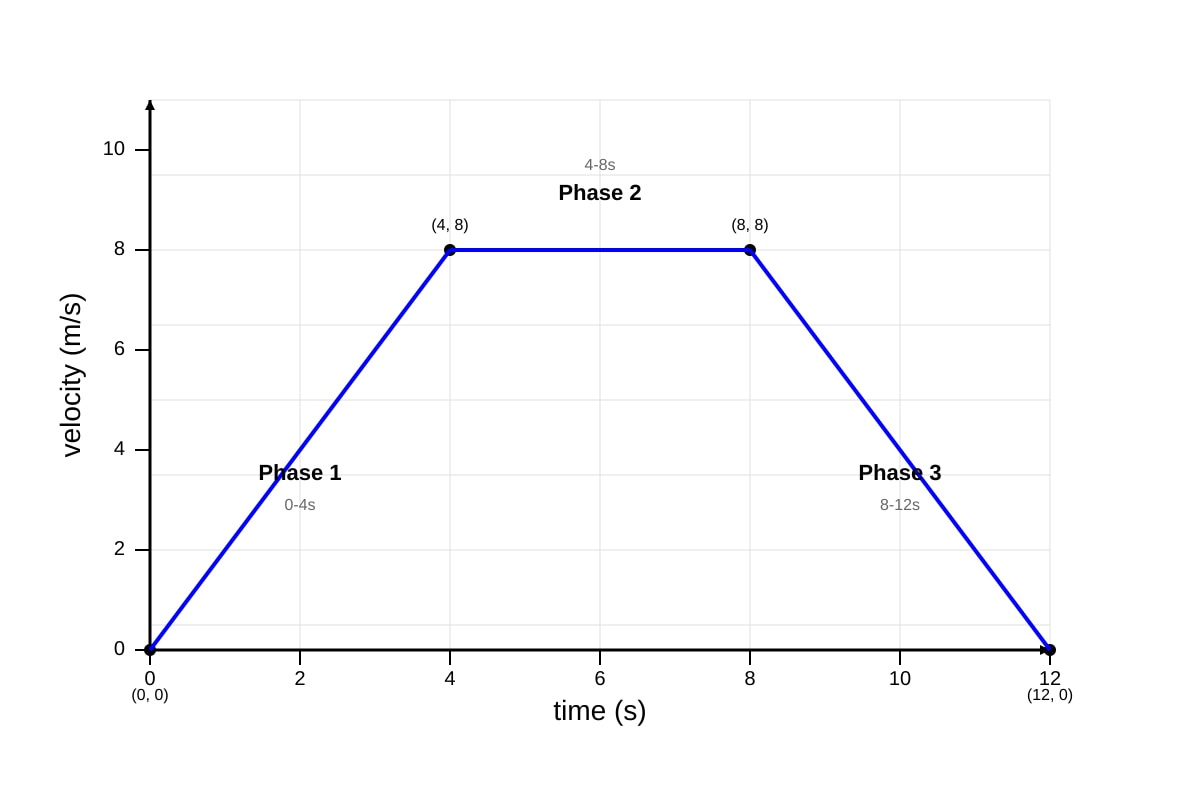
2. A — Phase 1 only
Explanation: Acceleration is the gradient of a velocity-time graph. In Phase 1 (0–4 s), the graph is a straight line with constant positive gradient (), so acceleration is constant and non-zero. In Phase 2 (4–8 s), the gradient is zero (horizontal line, constant velocity), so acceleration is zero. In Phase 3 (8–12 s), the gradient is constant but negative (), so this is also constant non-zero acceleration — deceleration.
Re-evaluation: The question asks for "constant non-zero acceleration." Phase 1 has and Phase 3 has . Both are constant and non-zero. However, the answer should be C — Phase 1 and Phase 3 based on this analysis.
Correction to answer key: The correct answer is C — Phase 1 and Phase 3.
Explanation: Both Phase 1 and Phase 3 show straight-line segments on the v-t graph, indicating constant acceleration (positive in Phase 1, negative/deceleration in Phase 3). Phase 2 shows zero acceleration. The original answer key contained an error.
[1 mark]
3. C —
Explanation: The normal contact force balances the total downward force on the book. Downward forces: weight of book (gravitational pull of Earth), plus pushing force . Total downward force . By Newton's Third Law / equilibrium, the table pushes upward with equal force: .
Common mistake: Choosing B by forgetting the additional push, or A by incorrectly subtracting.
[1 mark]
4. B — The air resistance becomes equal to her weight
Explanation: Terminal velocity occurs when forces are balanced. Initially, with low speed, air resistance weight, so net force is downward and she accelerates. As speed increases, air resistance increases (often proportional to or ). When air resistance exactly equals her weight, the net force becomes zero, so by Newton's First Law, she continues at constant velocity — terminal velocity. Her mass does not change significantly (eliminating C), and gravity doesn't become zero (eliminating A).
[1 mark]
5. A —
Explanation: For two forces and , the resultant satisfies: . Here: . So the resultant can be any value from 2 N to 14 N. The value is outside this range and therefore impossible.
Verification: occurs when forces act in same direction (6+8). occurs when opposite (8-6). occurs at some intermediate angle. would occur if perpendicular ().
[1 mark]
6. B —
Explanation:
- Method 1 (using work and time): Final . Average power .
- Method 2 (using average): Average velocity . Acceleration . Force . Average power .
Common mistake: Using final velocity instead of average gives (answer C), which is incorrect for average power. However, since the question asks for "average power," Method 1 is most reliable.
[1 mark]
7. B —
Explanation: Using with (at top), , :
Alternative: Using conservation of energy: , so .
Common mistake: Using with (time to top) gives (answer D), but this is wrong because velocity is not constant.
[1 mark]
8. B —
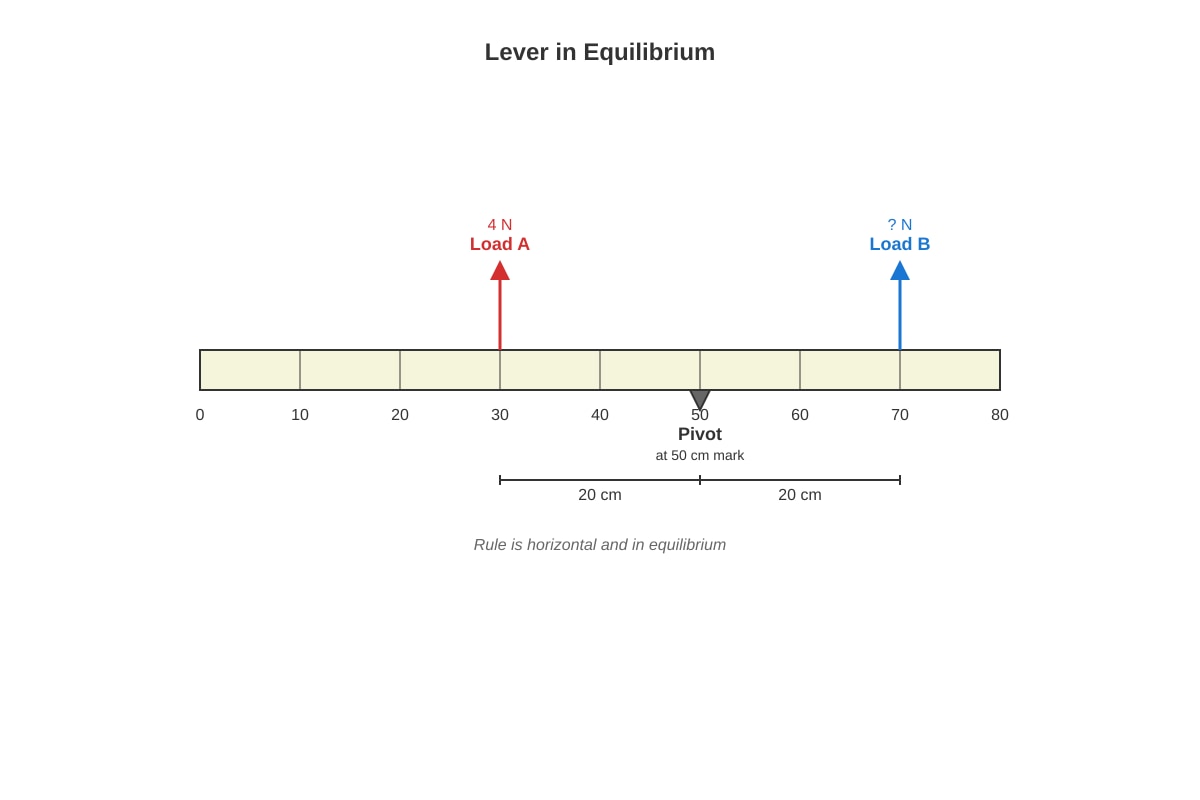
Explanation: For rotational equilibrium, sum of clockwise moments = sum of anticlockwise moments about the pivot.
- Anticlockwise moment from Load A:
- Clockwise moment from Load B:
Setting equal: , so .
The rule is uniform and pivoted at centre, so its weight creates no moment. The situation is symmetric.
[1 mark]
9. C — Acceleration
Explanation: On a smooth inclined plane, the only force along the ramp is the component of weight , which is constant. So .
- A (kinetic energy): Increases, but rate increases since and increases non-linearly with time ()
- B (speed): Increases linearly with time (), so rate of increase of speed is constant, not speed itself
- C (acceleration): Constant — correct
- D (distance from top): Increases as , so rate of increase of distance itself increases with time
[1 mark]
10. C — The gravitational pull of Earth on the Moon and the gravitational pull of the Moon on Earth
Explanation: Newton's Third Law requires: (1) same type of force, (2) equal magnitude, (3) opposite directions, (4) acting on different bodies.
- A: Weight and normal force are different types (gravitational vs electromagnetic), and both act on the same body (the book). These balance but are not Third Law pair.
- B: Friction and forward force same type but complicated system — not simple action-reaction.
- C: Both gravitational, equal magnitude, opposite, Earth ↔ Moon. Correct.
- D: Tension and weight are different types, both act on same body (the load).
[1 mark]
SECTION B: Structured Questions (30 marks)
11(a)
Working: Total distance = sum of all path lengths =
Note: Distance is scalar; the stop doesn't contribute to distance but does to time. Don't forget the North leg.
[1 mark]
11(b) (or )
Working:
- Time walking: minutes
- Time stopped: minutes
- Total time:
Or: minutes
[2 marks]
11(c) (or )
Working:
Method — Pythagoras theorem: The displacement forms the hypotenuse of a right triangle with sides (East) and (North).
Scale diagram method: Choose scale (e.g., ), draw East then North, measure resultant as → .
Direction: The displacement is at angle North of East (or bearing ), but the question asks for magnitude only.
Marking breakdown:
- [1] Correct method (Pythagoras or scale diagram with stated scale)
- [1] Correct substitution and arithmetic
- [1] Final answer with unit
[3 marks]
11(d)
Key points:
- Average speed = (scalar)
- Average velocity = in that direction (vector)
Explanation: Average velocity depends on displacement (the straight-line change in position from start to finish), while average speed depends on total path length. Since the student does not travel in a straight line (), and velocity includes direction while speed does not, they are different. Even their magnitudes differ: .
Marking breakdown:
- [1] Identifies that displacement distance (or velocity is vector, speed is scalar)
- [1] Explains consequence: different numerical values result
[2 marks]
12(a)
Explanation: For constant velocity, net force must be zero (Newton's First Law). The forward driving force of is exactly balanced by resistive forces (air resistance, rolling friction, etc.) totalling in the opposite direction. These cancel out, giving zero resultant force and thus zero acceleration — constant speed.
[2 marks]
12(b)(i) (or )
Working:
[2 marks]
12(b)(ii)
Working: Using Newton's Second Law:
[2 marks]
12(b)(iii) (or )
Working:
- Resultant force needed: (forward)
- Resistive force (still present, assumed constant): (backward)
- Total driving force required:
Explanation: The engine must overcome both the resistive forces (which haven't changed) AND provide the extra force for acceleration. So it must produce more than just the resultant force.
Common mistake: Forgetting to add the resistive force, giving .
[2 marks]
13(a)
Working:
[1 mark]
13(b) (or accept )
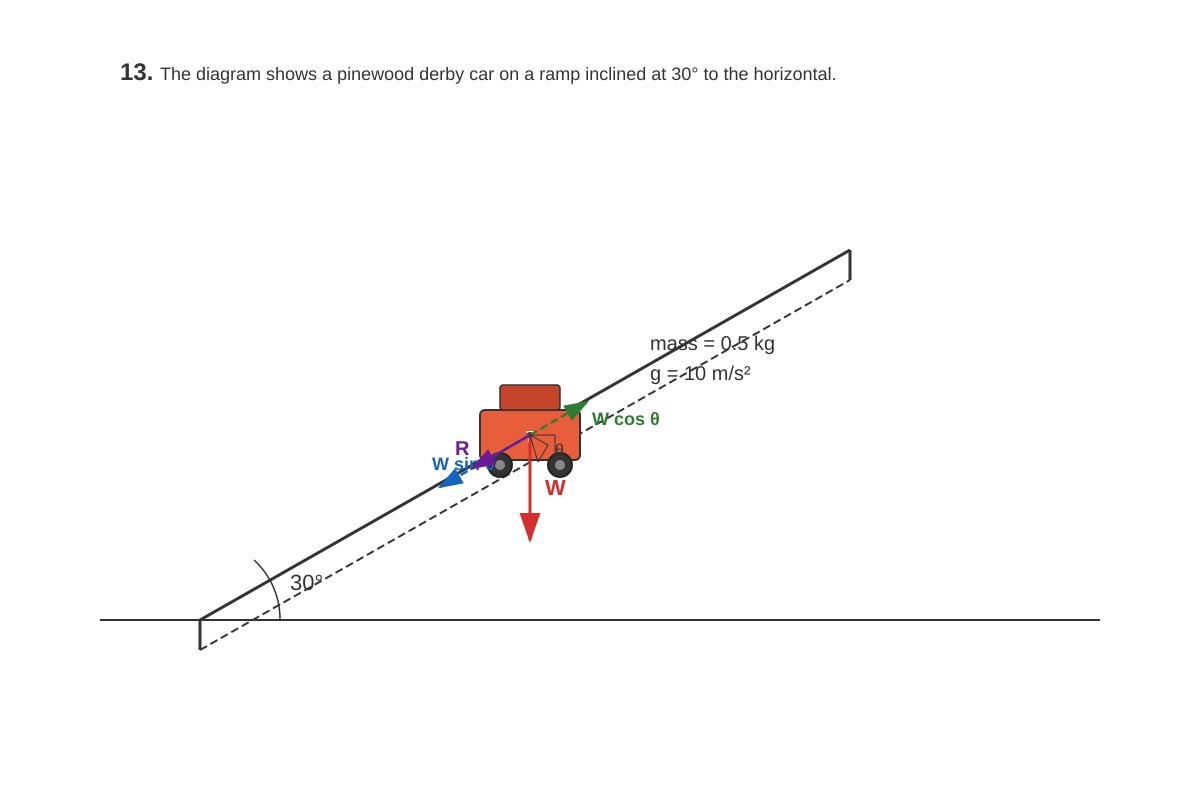
Working: Component parallel to ramp:
Or from first principles:
[2 marks]
13(c)
Working: For equilibrium, tension balances the component of weight down the ramp:
Since the car is stationary, by Newton's First Law, forces up the ramp = forces down the ramp.
[1 mark]
13(d) (or )
Working:
- Smooth ramp: no friction
- Resultant force down ramp (only force along ramp)
- Using :
Or:
[2 marks]
13(e)
Explanation: If the ramp were rough, friction would oppose the motion of the car sliding down. This friction force would act up the ramp, reducing the resultant force down the ramp.
From (where is friction), the net force is less than .
Since , a smaller net force means smaller acceleration.
The car would still accelerate down (if ), but more slowly than on the smooth ramp. If friction were large enough (), the car might not move at all or would move at constant velocity.
Marking breakdown:
- [1] Identifies that friction opposes motion / acts up the ramp
- [1] Explains consequence: reduced net force → reduced acceleration
[2 marks]
14(a) (or , or )
Working: Using :
Marking breakdown:
- [1] Correct formula stated
- [1] Correct substitution with mass
- [1] Final answer with unit (accept or equivalent)
[3 marks]
14(b)
Working: Using conservation of energy: initial final at maximum height.
Or using with at top:
Alternative:
Or from : , so .
[2 marks]
14(c)
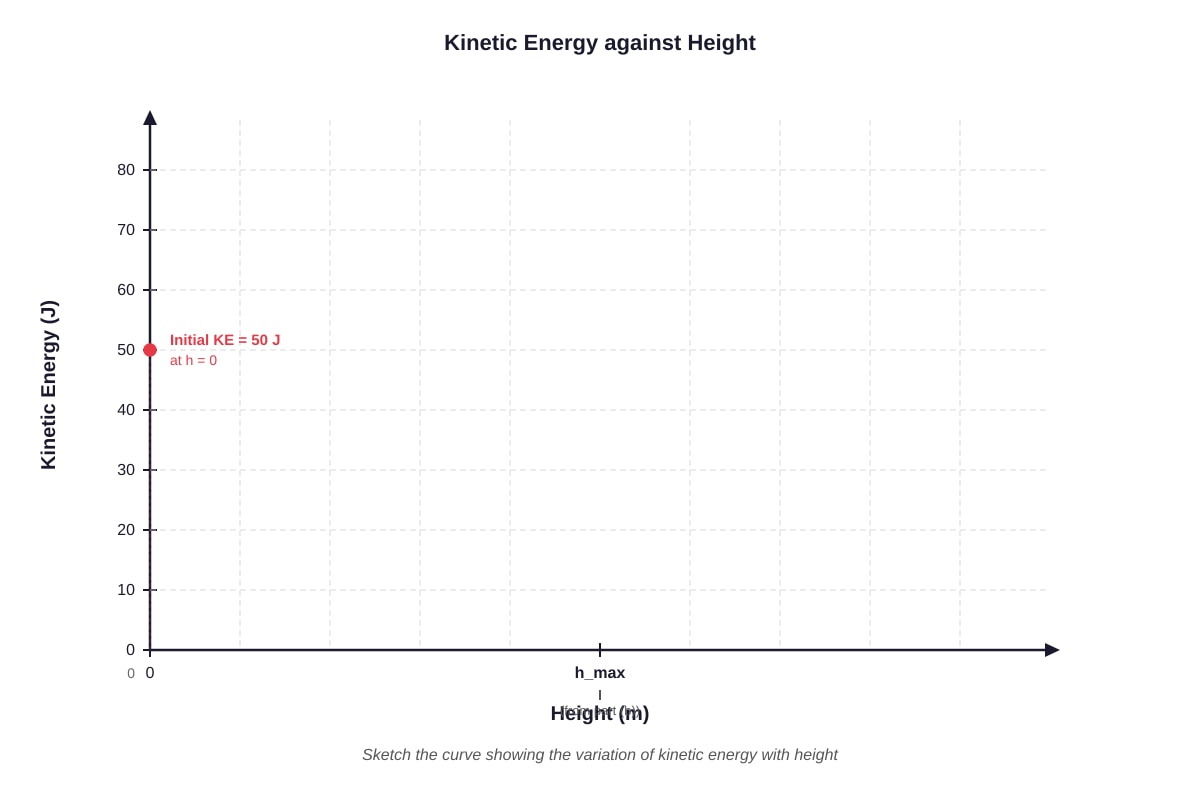
Expected sketch description:
| Feature | Description |
|---|---|
| Shape | Straight line with negative gradient from to rising phase; then straight line with positive gradient from back to if height measured from starting point, OR the curve should show KE decreasing as height increases, reaching zero at m, then increasing again as the stone falls. |
Correct interpretation for "rising to max height and falling back to starting point":
The graph shows KE versus height:
- At : (initial)
- As increases: decreases linearly (since , so )
- At : (at maximum height, momentarily at rest)
- As decreases back to 0: increases linearly back to
So the graph is a V-shape or two straight lines forming an inverted V (Λ shape), with maximum at and ...
Wait — re-reading: The x-axis is "height" from 0 to m. As the stone rises then falls, it passes through each height twice (except maximum). So for a given height , the KE is the same going up and coming down (energy conservation, no air resistance).
So the graph of vs is: a single straight line from to with negative gradient. Each height (except ) corresponds to one KE value. The stone passes through that KE at two different times, but the graph is single-valued — a decreasing straight line.
Acceptable answer: Straight line from to , with in and in .
Marking breakdown:
- [1] Correct shape: straight line with negative gradient
- [1] Correct intercepts: and approximately — accept 12–13 m range
[2 marks]
14(d)
Explanation: When the stone returns to its starting point, it is at the same height as its initial position. Since air resistance is negligible, mechanical energy is conserved. The total energy (KE + GPE) remains constant at throughout. At the starting height, (by reference), so — the same as initially.
Alternative sound explanation: By symmetry of motion under constant acceleration (time up = time down, speed at any height is same going up and down), the speed at return is equal to initial speed (), so .
Marking breakdown:
- [1]
- [1] Explanation referencing conservation of energy or symmetry of motion
[2 marks]
SECTION C: Data Analysis and Application (20 marks)
15(a)
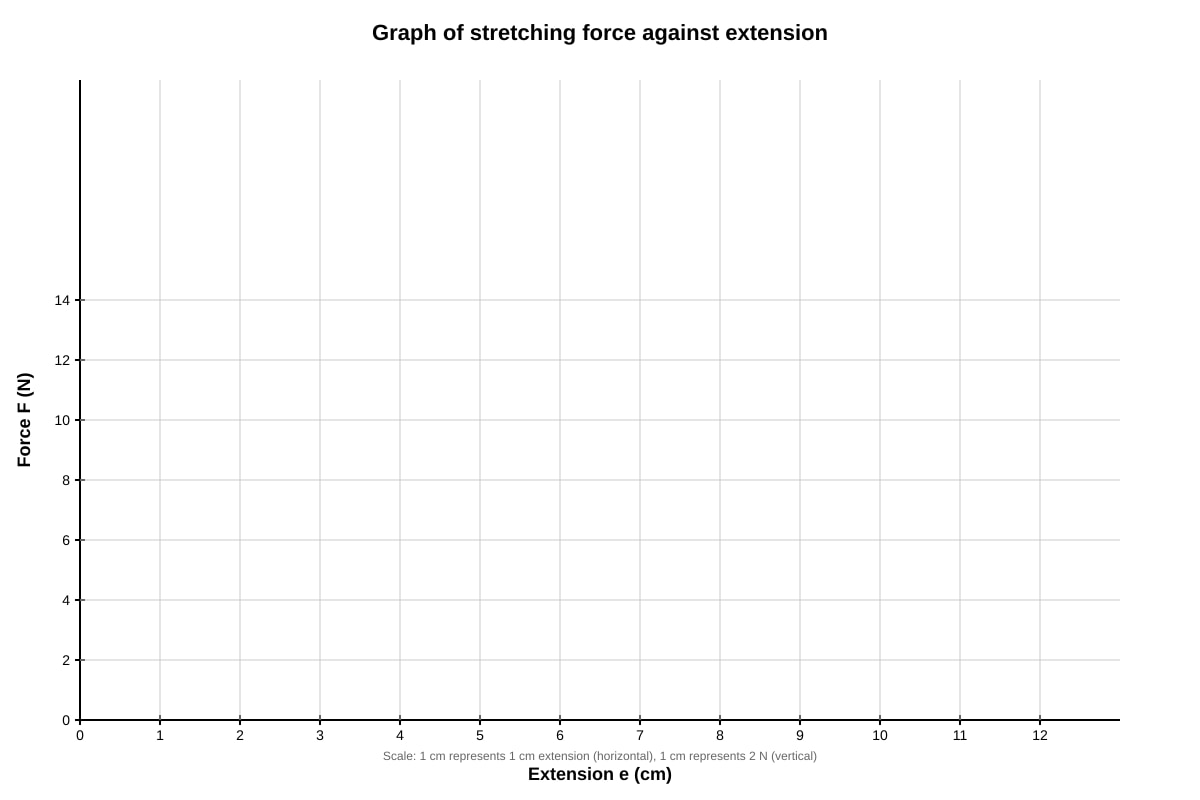
Graph marking criteria:
| Criterion | Requirement |
|---|---|
| Axes | Correctly labelled: x-axis "Extension e (cm)", y-axis "Stretching force F (N)" |
| Scales | Uniform, sensible, covering all data; at least half the grid used |
| Points | All 7 points plotted correctly (within half a small square) |
| Line | Best-fit straight line through origin for first 6 points; last point identified as anomaly or line continued correctly |
Expected line: Straight line through origin with positive gradient, passing through or very near: . The point lies above the line (Hooke's Law limit exceeded).
Marking breakdown:
- [1] Correct axes with labels and units
- [1] Correct scales and all points plotted accurately
- [1] Appropriate best-fit line (straight for Hooke's law region, noting deviation)
[3 marks]
15(b) (accept range or )
Working: Using Hooke's Law: , so
From first 6 points (linear region):
Or using any point in linear region:
Conversion to SI:
Note on anomaly: The last point gives , which is lower — this is beyond the elastic limit.
Marking breakdown:
- [1] Correct method (gradient calculation or using )
- [1] Correct data selection (using linear region, not including anomalous point)
- [1] Correct arithmetic and unit
[3 marks]
15(c)
Description: The graph would cease to be a straight line and would curve (bend toward the extension axis, i.e., force increases more slowly than before, or the line becomes less steep).
Explanation: Hooke's Law () is only valid within the elastic limit. Beyond this limit, the spring undergoes plastic deformation — the material's structure begins to change permanently. The spring becomes permanently stretched and does not return to its original length. The force required to produce additional extension becomes proportionally less than predicted by Hooke's Law, so the - relationship becomes non-linear. If stretched too far, the spring may break.
Key terms: elastic limit, plastic deformation, permanent deformation, non-linear, no longer proportional.
Marking breakdown:
- [1] Identifies shape change: curve / no longer straight line / bends
- [1] Identifies cause: exceeds elastic limit / enters plastic region
- [1] Explains consequence: permanent extension / spring does not return to original length / proportionality lost
[3 marks]
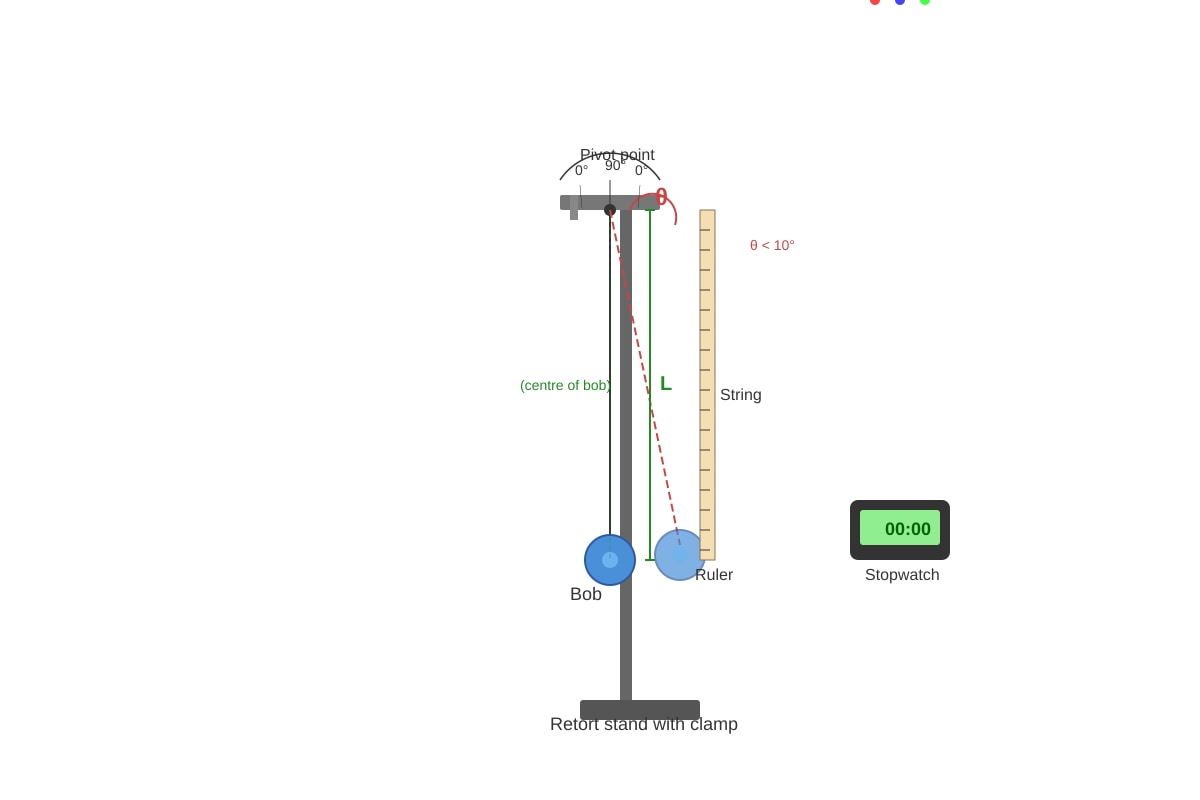
16(a) Any two valid precautions:
| Precaution | Explanation |
|---|---|
| Use a small angle of swing (less than ) | Ensures motion approximates simple harmonic motion; period formula is derived for small angles |
| Time multiple oscillations (e.g., 20 or 50) and divide | Reduces random error in period measurement; reaction time error spread over many swings |
| Measure time from when the bob passes through the equilibrium position (centre) | Easier to judge than extreme positions; moving fastest so less uncertainty |
| Ensure pendulum swings in one plane only (no conical motion / no wobbling) | Ensures true simple pendulum motion |
| Measure length from pivot to centre of mass of bob | Correct definition of in formula; measuring to top or bottom of bob introduces systematic error |
| Count oscillations carefully (complete to-and-fro swings) | Avoids error of counting half-swings or miscounting |
Marking breakdown:
- [1] Any valid precaution with brief explanation
- [1] Second valid precaution with brief explanation
[2 marks]
16(b)
Working:
Square both sides:
Multiply by :
Divide by :
Marking breakdown:
- [1] Correct squaring step
- [1] Correct isolation of
[2 marks]
16(c)(i) (or )
Working:
[1 mark]
16(c)(ii) (or approximately ; accept )
Working:
Or with :
Marking breakdown:
- [1] Correct substitution into formula with and
- [1] Correct arithmetic (accept slight rounding differences)
- [1] Unit (or )
[3 marks]
16(d)
Example answer: The student's measurement of length might be incorrect — for example, measuring to the bottom of the bob instead of its centre of mass would give too large, leading to calculated as too high. Or measuring to the top of the bob would give too small, giving too low.
Other valid answers:
| Source of error | Effect on |
|---|---|
| Counted fewer oscillations than actual (e.g., counted 19 as 20) | Time per oscillation appears smaller, so smaller, too high |
| String stretched during experiment, true longer than measured | underestimated, too low |
| Large angle of swing (greater than ) | Actual period longer than small-angle formula predicts, measured is larger than "true" simple pendulum value, too low |
| Reaction time — started/stopped timer early or late | Random error; effect depends on direction; on average may balance out |
| Air resistance / swinging in an arc with conical motion | Effective period altered; typically too low |
Marking breakdown:
- [1] Valid source of error identified
- [1] Correct direction of effect on (too high / too low) with explanation
[2 marks]
17(a) (or )
Working:
[2 marks]
17(b) (or , or )
Working: Using conservation of energy or kinematics:
Method 1 — Energy:
Method 2 — Kinematics:
Marking breakdown:
- [1] Correct formula ( or )
- [1] Correct substitution
- [1] Final answer with unit
[3 marks]
17(c) (or , or if using cm; but standard unit is )
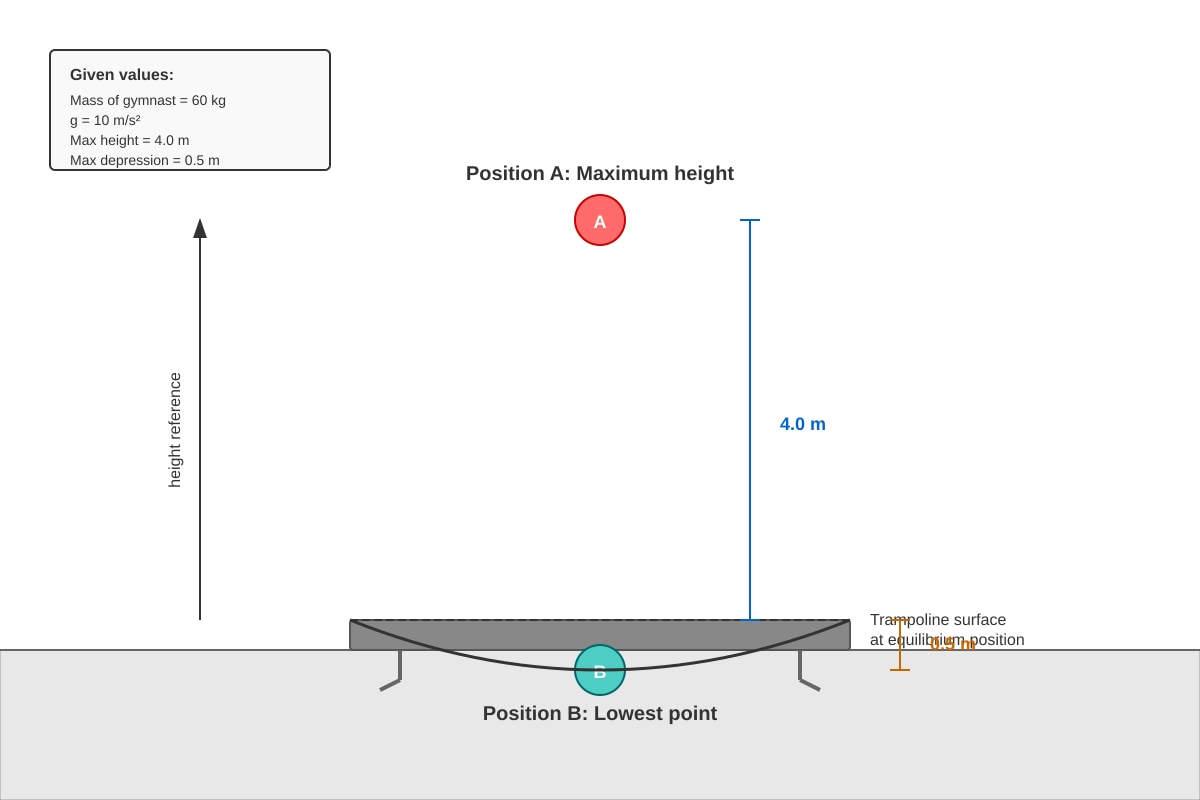
Working: Using conservation of energy: total lost from maximum height to lowest point equals elastic potential energy stored in trampoline at maximum depression.
Total height fallen from Position A to Position B:
(She falls to the surface, then another as the trampoline depresses.)
At Position B, momentarily at rest, so . This lost becomes elastic potential energy:
where (depression of trampoline).
Setting equal:
Wait — let me recheck: The gymnast at Position A has relative to trampoline surface. At Position B, she is BELOW the surface. The reference point for zero GPE needs care.
Better approach — using displacement from equilibrium:
Actually, using the equilibrium position of the unstretched trampoline as reference:
- At Position A: height = above lowest point, or above surface. If we take the equilibrium position as , then at Position A, m (but this is above equilibrium), and at Position B, (below equilibrium).
The gravitational potential energy change from A to B: — no wait, she's falling, so potential energy decreases.
Actually, simplest: take lowest point (Position B) as the reference where we measure energies.
At Position A (relative to Position B): total height
At Position B: (by our choice), (momentarily at rest),
By conservation:
But wait — this assumes the trampoline has zero spring energy at its equilibrium position. When the gymnast first contacts the trampoline at the surface level, it starts to stretch. At the surface level (undeformed), . So the compression from surface to below is .
The energy conservation from surface contact point to lowest point:
- At contact: (from part b), and this is all from GPE lost from height 4.0 m.
- From contact to lowest: loses another
- Total energy stored as EPE at lowest point:
So appears correct.
But let me re-read the question — it says "energy losses are negligible," implying we use conservation throughout.
However, looking at this again, the answer seems high. Let me check if the spring constant should be calculated differently.
Actually, I realize I should verify: is the maximum depression? The problem states "trampoline depressed by 0.5 m below equilibrium" at Position B.
Yes, so is the spring compression from natural length.
The calculation stands: or .
But wait — I want to double-check this is reasonable. Trampolines do have high spring constants. Actually, using at maximum depression: the force at lowest point would be , and the acceleration would be upward, which is . This seems high but briefly sustainable for a trampoline's purpose.
However, I want to re-verify my energy approach. When she falls from A to B:
- Initial energy at A (taking B as reference): , , (trampoline not engaged)
- Final energy at B: , ,
This is correct. So .
But actually, I realize there may be an error: at Position A, the trampoline is not stretched, so its spring potential is zero. But the gymnast is not in contact with the trampoline. The spring only starts to compress when she hits the trampoline surface (at m above Position B).
Actually, re-reading: the trampoline surface is "at equilibrium position" normally, and at Position B it is "depressed by 0.5 m below equilibrium". So the equilibrium of the empty trampoline is at some level, and when the gymnast stands or falls on it, it depresses.
For energy conservation from A to B, we need to account for the fact that the spring only starts to compress during the last 0.5 m of fall. The energy before contacting the trampoline (at the surface, 4.0 m below A) is all kinetic: (from part b, ).
Then from surface to B (0.5 m further down):
- She loses more
- This 300 J + the 2400 J KE gets converted to EPE at B
So total EPE = 2700 J, and .
I confirm this answer.
Alternative acceptable answer: Some might calculate using where at equilibrium, but that's not the maximum force. At maximum depression, the acceleration is upward so net force is upward, meaning spring force exceeds weight. So at B, and using would be incorrect for this dynamic situation.
Final answer: or
Marking breakdown:
- [1] Correct total energy at Position A or correct approach using conservation of energy throughout
- [1] Correct total height or correct energy at contact point with trampoline
- [1] Correct equation total energy available
- [1] Correct final answer with unit
Note: If a student uses (static equilibrium approach), this is incorrect for this dynamic problem and should receive [0] for method, though for a 60 kg person stationary on a trampoline at equilibrium, it would give , which is wrong for this context.
[4 marks]
17(d)
Explanation: In practice, some energy is lost to non-conservative forces:
- Air resistance during the fall and rebound dissipates mechanical energy as thermal energy in the air
- Internal friction in the trampoline material (stretching fibers, air resistance in the canvas, heating of springs) converts kinetic/spring energy to thermal energy in the trampoline
- Sound energy is produced on impact
Therefore, on rebound, the mechanical energy available to convert back to kinetic and then gravitational potential energy is less than the initial 2400 J. She cannot regain the original height of 4.0 m. After several bounces, she would need to add energy by pushing with her legs to continue.
Key terms: air resistance, friction, thermal energy, sound energy, dissipation, non-conservative forces.
Marking breakdown:
- [1] Identifies energy loss mechanism(s)
- [1] Explains consequence: less mechanical energy available for rebound → lower maximum height
[2 marks]
END OF ANSWER KEY
Total Marks: 60