TuitionGoWhere Practice Paper - Physics Secondary 3
School: TuitionGoWhere Secondary School (AI)
Subject: Physics
Level: Secondary 3
Paper: SA2 Practice Paper (Version 1 of 5)
Duration: 75 minutes
Total Marks: 60
Name: ________________________
Class: ________
Date: ____________
Instructions:
- Answer all questions in the spaces provided.
- Show your working clearly where calculation is required.
- Use g=10 m s−2 unless stated otherwise.
- Section A: Multiple Choice (10 questions, 1 mark each).
Section B: Structured Questions (6 questions, 3–4 marks each).
Section C: Free Response (4 questions, 4–5 marks each).
- Total marks = 60.
Section A: Multiple Choice (10 marks)
1. Which of the following quantities is a vector?
A. Speed
B. Distance
C. Mass
D. Force
2. A car travels 100 m north in 5 s at constant speed. What is its velocity?
A. 20 m s−1
B. 20 m s−1 north
C. 500 m s−1 north
D. 0.05 m s−1
3. A block of mass 2 kg is pushed with a net force of 6 N. What is its acceleration?
A. 3 m s−2
B. 12 m s−2
C. 0.33 m s−2
D. 8 m s−2
4. The moment of a force about a pivot is calculated as:
A. Force ÷ distance
B. Force × perpendicular distance
C. Force + distance
D. Force × parallel distance
5. Pressure in a liquid increases with:
A. Decreasing depth
B. Decreasing density
C. Increasing depth
D. Constant temperature only
6. A boy of mass 50 kg climbs 4 m vertically. Gain in gravitational potential energy is:
A. 200 J
B. 2000 J
C. 500 J
D. 20 J
7. Two forces of 3 N and 4 N act at right angles. Resultant force is:
A. 1 N
B. 7 N
C. 5 N
D. 12 N
8. A falling object reaches terminal velocity when:
A. Air resistance is zero
B. Weight is greater than air resistance
C. Air resistance equals weight
D. Acceleration is maximum
9. The formula for Newton's law of gravitation is F=r2Gm1m2. What does r represent?
A. Radius of larger mass
B. Distance between centres of masses
C. Sum of radii
D. Surface distance
10. Work done is zero when:
A. Force is large
B. Distance moved is zero
C. Object is heavy
D. Speed is constant
Section B: Structured Questions (21 marks)
11. (a) Define scalar and vector quantities. Give one example of each. [2]
(b) A student walks 3 m east then 4 m north. Find the resultant displacement. [2]
12. A child of mass 30 kg slides down a vertical rope with acceleration 2 m s−2. Find the frictional force between child and rope. [3]
13. A block of mass 5 kg is pulled up a rough inclined plane at constant speed by a force of 40 N. Distance moved along plane = 2 m, vertical height gain = 1 m. Calculate:
(a) Work done by applied force [1]
(b) Gain in gravitational potential energy [1]
(c) Work done against friction [1]
14.
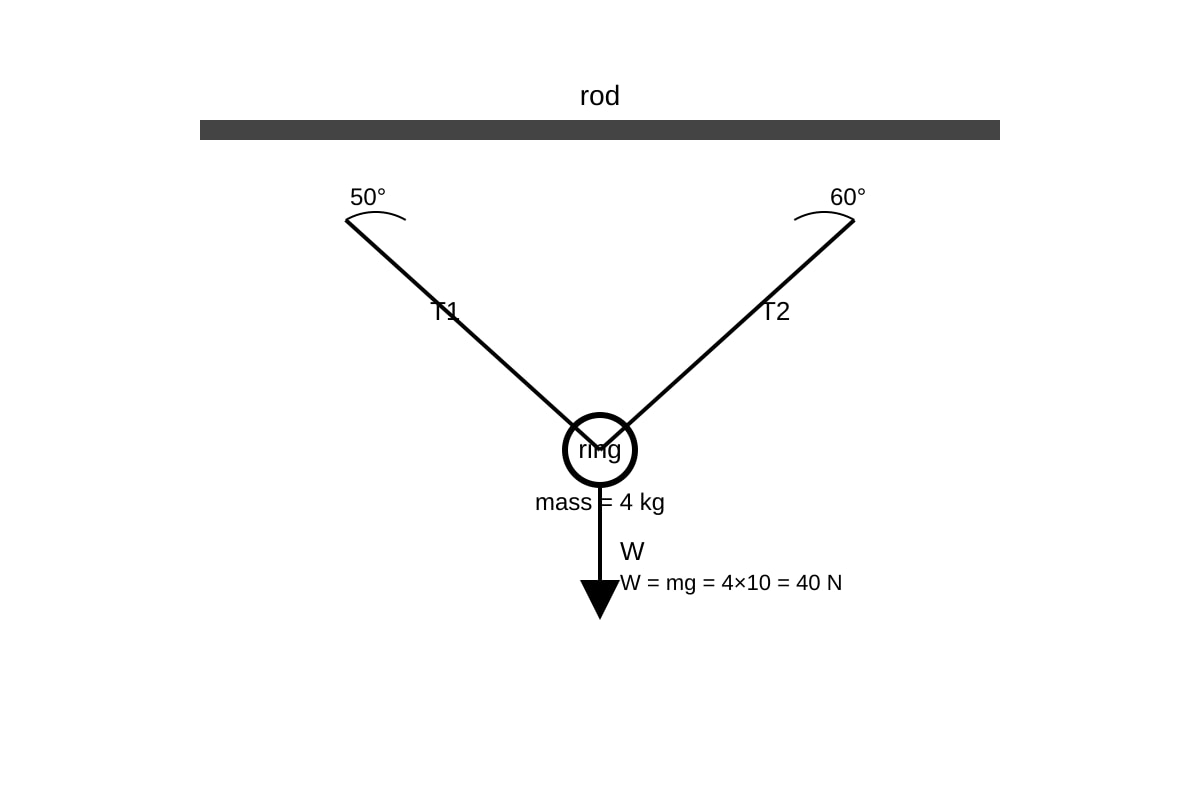
Generated diagram for 14.
A ring of mass 4 kg is supported by two strings as shown. Calculate tensions T1 and T2. [4]
15. A hydraulic press has input area 0.01 m2 and output area 0.1 m2. A force of 20 N is applied at input. Find output force. [3]
16. A car accelerates from rest to 20 m s−1 in 10 s.
(a) Calculate acceleration. [1]
(b) If mass is 800 kg, find net force. [2]
(c) State Newton's first law. [1]
Section C: Free Response (29 marks)
17. A ball is thrown vertically upward with initial speed 15 m s−1.
(a) Find maximum height reached. [2]
(b) Time to return to start. [2]
(c) Sketch velocity-time graph and label axes. [2]
Generated graph for 17.
18. Explain using free-body diagrams and Newton's laws how a book rests on a table without accelerating. Include force magnitudes if book mass is 2 kg. [5]
19. A wooden block of mass 10 kg is on a slope of angle 30° to horizontal. Coefficient of friction ignored for sliding component.
(a) Find component of weight down slope. [2]
(b) If friction is 30 N up slope and block accelerates down, find acceleration. [3]
20. A 60 kg athlete runs up 12 m staircase in 8 s.
(a) Calculate gain in GPE. [2]
(b) Calculate useful power. [2]
(c) If total energy used is 12000 J, find efficiency. [1]