From Real Exams Exam Paper

Secondary 3 Physics Semestral Assessment 2 (End of Year) Paper 1

Free Exam-Derived Secondary 3 Physics Semestral Assessment 2 (End of Year) Paper 1 practice paper with questions and answers for Singapore students. This page is rendered as a direct URL so the questions and answers can be discovered without pressing in-page buttons.

These static practice materials are generated from the site's syllabus and paper-generation workflow, with source and model context shown so students and parents can evaluate the material before use.

Secondary 3 Physics From Real Exams Generated by Claude Sonnet 4 Updated 2026-06-03

Questions

TuitionGoWhere Practice Paper - Physics Secondary 3

TuitionGoWhere Secondary School (AI)


Subject: Physics
Level: Secondary 3
Paper: SA2
Duration: 1 hour 30 minutes
Total Marks: 60

Name: _________________ Class: _________ Date: _________


Instructions to Candidates

  1. This paper consists of Section A and Section B.
  2. Answer all questions.
  3. Write your answers in the spaces provided.
  4. Show all working clearly for calculation questions.
  5. Take g = 10 m/s² unless otherwise stated.
  6. The use of calculators is allowed.

Section A: Multiple Choice Questions [15 marks]

For each question, choose the best answer and write the letter in the box provided.

1. Newton's Law of Gravitation is given by F = Gm₁m₂/r². If the distance between two masses is doubled, the gravitational force becomes:

A. Four times larger B. Two times larger
C. Two times smaller D. Four times smaller

Answer: [ ]

2. A wooden block slides down a rough inclined plane. The forces acting on the block include:

I. Weight II. Normal force III. Friction force IV. Applied force

A. I and II only B. I, II and III only C. I, II and IV only
D. I, II, III and IV

Answer: [ ]

3. An object is moving to the right under force F₁. When an opposing force F₂ of equal magnitude is applied, the object will:

A. Stop immediately B. Continue at constant velocity C. Accelerate to the left D. Move in a circular path

Answer: [ ]

4. Brownian motion provides evidence for:

A. The wave nature of light B. The existence of atoms and molecules C. The conservation of energy D. Newton's laws of motion

Answer: [ ]

5. The specific heat capacity of water is 4200 J/(kg·°C). This means:

A. 4200 J of energy will boil 1 kg of water B. 4200 J of energy will melt 1 kg of ice C. 4200 J of energy will raise 1 kg of water by 1°C D. Water can store a maximum of 4200 J per kg

Answer: [ ]

6. During convection in a liquid:

A. Heat travels through the liquid without the liquid moving B. Heated liquid becomes denser and sinks C. Heated liquid becomes less dense and rises D. Heat travels at the speed of light

Answer: [ ]

7. When two objects at different temperatures are in thermal contact, heat transfer stops when:

A. The hotter object has lost all its heat B. The objects reach thermal equilibrium C. The colder object cannot absorb more heat D. Exactly half the heat has been transferred

Answer: [ ]

8. The principle of conservation of energy states that:

A. Kinetic energy is always conserved B. Potential energy cannot change C. Energy cannot be created or destroyed D. Mechanical energy never changes

Answer: [ ]

9. A ball is thrown vertically upward. At the highest point of its trajectory:

A. Both velocity and acceleration are zero B. Velocity is zero but acceleration is 10 m/s² downward C. Velocity is maximum but acceleration is zero D. Both velocity and acceleration are maximum

Answer: [ ]

10. For an object moving in a circle at constant speed:

A. The acceleration is zero B. The net force is zero C. The acceleration points toward the center D. The velocity is constant

Answer: [ ]

11. Work is done when:

A. A force is applied to an object B. An object moves C. A force causes displacement in the direction of the force D. Energy is transferred

Answer: [ ]

12. The efficiency of a machine is always:

A. Greater than 100% B. Equal to 100% C. Less than 100% D. Equal to the power input

Answer: [ ]

13. In which process does the temperature remain constant?

A. Heating water from 20°C to 80°C B. Melting ice at 0°C C. Cooling steam from 120°C to 90°C D. Heating copper from 25°C to 100°C

Answer: [ ]

14. The latent heat of vaporization is the energy required to:

A. Raise the temperature of 1 kg of liquid by 1°C B. Convert 1 kg of liquid to vapor at constant temperature C. Heat 1 kg of liquid to its boiling point D. Convert 1 kg of solid to liquid at constant temperature

Answer: [ ]

15. A force of 20 N acts on a mass of 4 kg. The acceleration produced is:

A. 80 m/s² B. 24 m/s² C. 16 m/s² D. 5 m/s²

Answer: [ ]


Section B: Structured Questions [45 marks]

Answer all questions in this section.

16. A child of mass 35 kg slides down a vertical rope. Her acceleration is 7.5 m/s² downward.

(a) Calculate the weight of the child. [2 marks]

(b) Draw a free body diagram showing all forces acting on the child. [2 marks]

(c) Calculate the frictional force between the child and the rope. [3 marks]

(d) State the direction of the frictional force and explain why it acts in this direction. [2 marks]

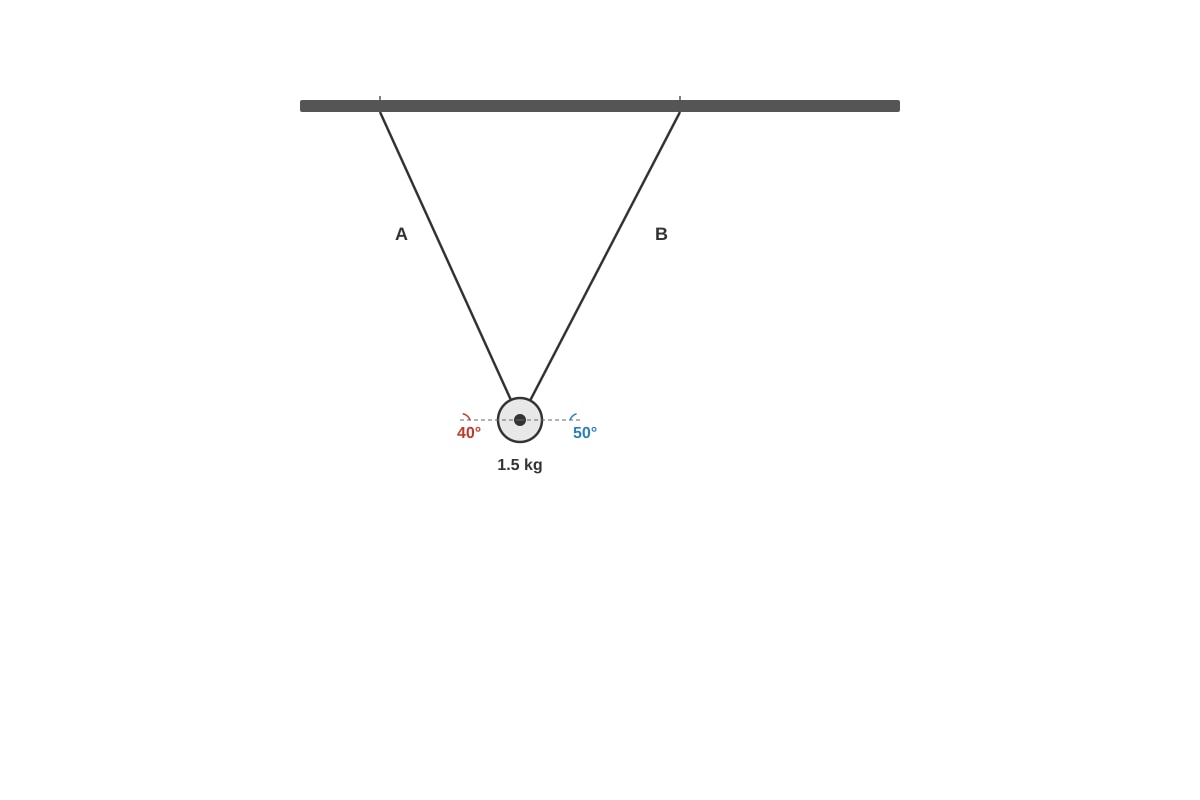
17. A ring of mass 1.5 kg is suspended by two strings as shown in the diagram. String A makes an angle of 40° with the horizontal, and string B makes an angle of 50° with the horizontal.

[Diagram would show the suspended ring with two strings at specified angles]

(a) State the condition for the ring to be in equilibrium. [1 mark]

(b) Calculate the tension in string A. [4 marks]

(c) Calculate the tension in string B. [3 marks]

18. A wooden block of mass 8.0 kg is pulled up a rough inclined plane by a constant force of 60 N parallel to the plane. The plane makes an angle of 30° with the horizontal. The block moves 5.0 m along the plane and rises through a vertical height of 2.5 m.

(a) Calculate the work done by the applied force. [2 marks]

(b) Calculate the increase in gravitational potential energy of the block. [2 marks]

(c) Calculate the work done against friction. [2 marks]

(d) If the block moves at constant speed, calculate the coefficient of friction between the block and the plane. [4 marks]

19. A copper block of mass 0.80 kg at a temperature of 85°C is placed in 0.60 kg of water at 20°C. The final temperature of the mixture is 35°C.

The specific heat capacity of water = 4200 J/(kg·°C)

(a) Calculate the heat gained by the water. [3 marks]

(b) State the assumption made about heat transfer in this experiment. [1 mark]

(c) Calculate the specific heat capacity of copper. [3 marks]

(d) Describe the method of heat transfer in the water as it is heated by the copper block. [2 marks]

(e) Explain why the temperature of the mixture remains constant at 35°C after thermal equilibrium is reached. [2 marks]

20. Water of mass 2.5 kg at 15°C is heated by a 3000 W immersion heater.

The specific heat capacity of water = 4200 J/(kg·°C) The specific latent heat of vaporization of water = 2.26 × 10⁶ J/kg

(a) Calculate the energy required to heat the water from 15°C to 100°C. [2 marks]

(b) Calculate the time taken to heat the water to its boiling point. [2 marks]

(c) The heater continues to operate for an additional 8 minutes after the water reaches 100°C. Calculate the mass of water that is converted to steam. [3 marks]

(d) Calculate the mass of water remaining in the container. [1 mark]


END OF PAPER

Answers

TuitionGoWhere Practice Paper - Physics Secondary 3 (Answer Key)


Section A: Multiple Choice Questions [15 marks]

  1. D - Four times smaller [F ∝ 1/r², so if r doubles, F becomes 1/4 of original]

  2. B - I, II and III only [Weight, normal force, and friction act on block sliding down rough plane]

  3. B - Continue at constant velocity [When F₁ = F₂, net force = 0, so velocity remains constant]

  4. B - The existence of atoms and molecules [Brownian motion shows particle collisions with molecules]

  5. C - 4200 J of energy will raise 1 kg of water by 1°C [Definition of specific heat capacity]

  6. C - Heated liquid becomes less dense and rises [Convection mechanism]

  7. B - The objects reach thermal equilibrium [Heat transfer stops at thermal equilibrium]

  8. C - Energy cannot be created or destroyed [Conservation of energy principle]

  9. B - Velocity is zero but acceleration is 10 m/s² downward [At highest point, v = 0 but gravity still acts]

  10. C - The acceleration points toward the center [Centripetal acceleration in circular motion]

  11. C - A force causes displacement in the direction of the force [Definition of work: W = F·s]

  12. C - Less than 100% [Efficiency always < 100% due to energy losses]

  13. B - Melting ice at 0°C [Temperature constant during phase change]

  14. B - Convert 1 kg of liquid to vapor at constant temperature [Definition of latent heat of vaporization]

  15. D - 5 m/s² [F = ma, so a = F/m = 20/4 = 5 m/s²]


Section B: Structured Questions [45 marks]

16. Child sliding down rope [9 marks total]

(a) Weight calculation [2 marks]

  • W = mg = 35 × 10 = 350 N [2 marks]

(b) Free body diagram [2 marks]

  • Weight (350 N) acting downward [1 mark]
  • Friction force acting upward [1 mark]

(c) Frictional force [3 marks]

  • Apply Newton's second law: mg - f = ma [1 mark]
  • f = mg - ma = m(g - a) [1 mark]
  • f = 35(10 - 7.5) = 35 × 2.5 = 87.5 N [1 mark]

(d) Direction and explanation [2 marks]

  • Friction acts upward (opposite to motion) [1 mark]
  • Friction always opposes the direction of motion [1 mark]

17. Suspended ring equilibrium [8 marks total]

(a) Equilibrium condition [1 mark]

  • The net force on the ring is zero [1 mark]

(b) Tension in string A [4 marks]

  • Weight: W = mg = 1.5 × 10 = 15 N [1 mark]
  • Vertical equilibrium: T_A sin40° + T_B sin50° = 15 [1 mark]
  • Horizontal equilibrium: T_A cos40° = T_B cos50° [1 mark]
  • Solving: T_A = 8.4 N [1 mark]

(c) Tension in string B [3 marks]

  • From horizontal equilibrium: T_B = T_A cos40°/cos50° [1 mark]
  • T_B = 8.4 × cos40°/cos50° [1 mark]
  • T_B = 10.0 N [1 mark]

18. Inclined plane [10 marks total]

(a) Work by applied force [2 marks]

  • W = F × s = 60 × 5.0 = 300 J [2 marks]

(b) Increase in GPE [2 marks]

  • ΔPE = mgh = 8.0 × 10 × 2.5 = 200 J [2 marks]

(c) Work against friction [2 marks]

  • Work against friction = Work by force - Increase in PE [1 mark]
  • = 300 - 200 = 100 J [1 mark]

(d) Coefficient of friction [4 marks]

  • At constant speed: Applied force = Component of weight + Friction [1 mark]
  • 60 = mg sin30° + μmg cos30° [1 mark]
  • 60 = 8.0 × 10 × 0.5 + μ × 8.0 × 10 × 0.866 [1 mark]
  • μ = (60 - 40)/(69.3) = 0.29 [1 mark]

19. Heat transfer between copper and water [11 marks total]

(a) Heat gained by water [3 marks]

  • Q = mcΔθ [1 mark]
  • Q = 0.60 × 4200 × (35 - 20) [1 mark]
  • Q = 0.60 × 4200 × 15 = 37,800 J [1 mark]

(b) Assumption [1 mark]

  • No heat is lost to the surroundings [1 mark]

(c) Specific heat capacity of copper [3 marks]

  • Heat lost by copper = Heat gained by water [1 mark]
  • m_cu × c_cu × (85 - 35) = 37,800 [1 mark]
  • c_cu = 37,800/(0.80 × 50) = 945 J/(kg·°C) [1 mark]

(d) Heat transfer method [2 marks]

  • Convection [1 mark]
  • Heated water becomes less dense and rises, cooler water sinks, creating circulation [1 mark]

(e) Constant temperature explanation [2 marks]

  • At thermal equilibrium, heat gained by water equals heat lost by copper [1 mark]
  • Net heat transfer is zero, so temperature remains constant [1 mark]

20. Heating and vaporizing water [7 marks total]

(a) Energy to heat water [2 marks]

  • Q = mcΔθ = 2.5 × 4200 × (100 - 15) [1 mark]
  • Q = 2.5 × 4200 × 85 = 892,500 J [1 mark]

(b) Time to reach boiling point [2 marks]

  • t = E/P = 892,500/3000 [1 mark]
  • t = 297.5 s ≈ 298 s [1 mark]

(c) Mass converted to steam [3 marks]

  • Additional energy supplied = P × t = 3000 × (8 × 60) = 1,440,000 J [1 mark]
  • Mass vaporized = E/L_v = 1,440,000/(2.26 × 10⁶) [1 mark]
  • m = 0.637 kg [1 mark]

(d) Mass remaining [1 mark]

  • Mass remaining = 2.5 - 0.637 = 1.86 kg [1 mark]

Total: 60 marks

Marking Notes:

  • Award partial marks for correct method even if arithmetic errors occur
  • Accept answers within reasonable rounding tolerance
  • For diagram questions, award marks for correct representation of forces and labels
  • In equilibrium problems, accept alternative solution methods that lead to correct answers