AI Generated Quiz
Secondary 3 History Source Based Skills Quiz
Free Sec 3 History Source Based Skills quiz, Kimi2.6 AI version, with questions, answers, and O Level-style practice for Singapore students.
These static practice materials are generated from the site's syllabus and paper-generation workflow, with source and model context shown so students and parents can evaluate the material before use.
Questions
Free quiz and exam paper access
Enter your details to view this paper
Your access is remembered on this device.
Answers
Secondary 3 History Quiz - Source Based Skills — Answer Key
Total Marks: 60
Section A: Source Comprehension and Inference
Question 1 [3 marks]
Answer: Two groups are:
- Chinese labourers / coolie workers [1 mark]
- The British / colonial officials [1 mark]
Teaching note: Source A explicitly mentions "Chinese labourers, recruited through the coolie trade" as the workforce, and refers to "we" (British colonial administration) and "The Resident system." The British are involved as organisers and beneficiaries of the mining system. Local Malays are mentioned but explicitly stated as not being involved in mine labour.
Common mistake: Answers citing "local Malays" are incorrect—Source A states Malays "would find [conditions] unacceptable" and were not part of the workforce.
Question 2 [3 marks]
Answer: Source A suggests the British viewed Malay workers as unsuitable for hard labour [1 mark]. Evidence: "these workers endure hardship that local Malays would find unacceptable" [1 mark], implying British belief that Malays were less willing or able to tolerate difficult conditions compared to Chinese labourers [1 mark].
Teaching note: This reveals racial stereotyping in colonial labour policy. The British assessed ethnic groups through perceived economic utility, assigning Chinese to dangerous extractive industries while reserving other roles (administrative, agricultural) for Malays. The wording "would find unacceptable" positions British judgment as objective fact rather than prejudice.
Question 3 [3 marks]
Answer: Two effects:
- Harsh occupation, forced labour, and food shortages / suffering of population [1 mark]
- Shattered myth of white/European invincibility [1 mark]
- Accelerated demands for independence after 1945 [1 mark]
(Any two effects for full marks)
Teaching note: Source B presents a balanced account—immediate negative consequences plus longer-term political consequences. The "Death Railway" refers to the Burma-Thailand railway construction using POWs and forced Asian labour.
Marking note: "End of European colonial rule" is a cause/context, not an effect. Do not reward.
Question 4 [4 marks]
Answer: Source B does NOT entirely support a purely negative view [1 mark]. While it describes harsh realities (forced labour, food shortages, Death Railway) [1 mark], it also notes positive consequences: shattering European prestige and accelerating independence movements [1 mark]. The phrase "Yet the defeat of European powers" signals a turning point in interpretation [1 mark].
Teaching note: This tests ability to detect nuance in sources. The contrastive "Yet" is crucial—it marks a pivot from negative description to acknowledging unintended positive outcomes. Historians call this "ironic consequence": actions with harmful intent producing beneficial long-term results.
Marking descriptors:
- Level 1 (1–2 marks): Identifies only negative aspects OR only positive aspects without addressing "how far"
- Level 2 (3–4 marks): Balanced answer weighing both sides with explicit source evidence
Question 5 [2 marks]
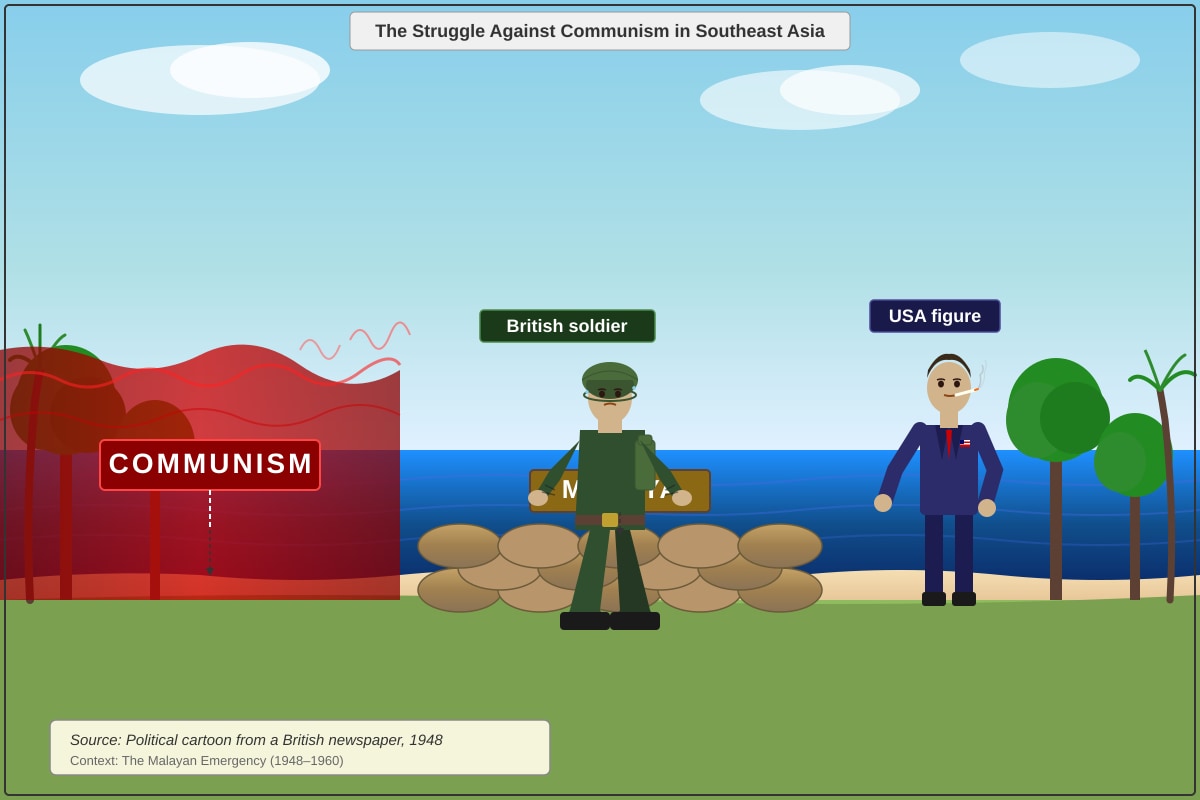
Answer: The cartoonist conveys that Britain was actively containing/ resisting communist expansion in Southeast Asia [1 mark], specifically in Malaya, with American support or interest [1 mark].
Teaching note: The visual metaphor of a "tide" suggests communism as an overwhelming, natural force requiring containment. The soldier's strained posture implies difficulty. The USA observer indicates this was part of broader Cold War context—Britain acting as frontline defender with American backing, prefiguring later "domino theory" thinking.
Expected visual interpretation: British soldier → active resistance; sandbag wall "MALAYA" → specific geographical commitment; tide "COMMUNISM" → threatening, expanding force; USA figure → superpower interest, alliance dimension.
Section B: Source Comparison and Cross-Referencing
Question 6 [3 marks]
Answer: One clear difference:
- Source D presents Indonesian nationalism as strong, popular, and unified ("one nation, one people") [1 mark]
- Source E dismisses it as "exaggerated," representing only "a handful of educated Javanese agitators" [1 mark]
- Source D sees colonialism as divisive; Source E portrays Dutch rule as beneficial ("order and progress") [1 mark]
(Award 2 marks for identifying difference in both description + assessment; 3 marks for complete contrast across both sources)
Teaching note: This demonstrates "accidental testimonies"—sources created for different purposes revealing conflicting perspectives. Sukarno's speech purpose: mobilise unity. Governor's memoir purpose: defend colonial record. Neither is purely "true" or "false"; each serves interests of its creator.
Question 7 [4 marks]
Answer: Source E has limited reliability [1 mark]. As a colonial governor's memoir, it was written to defend Dutch colonial policy and personal reputation [1 mark]. It underestimates nationalist sentiment by claiming agitators are "unrepresentative" [1 mark]. However, it does reveal authentic Dutch colonial mindset—genuine belief in colonial "progress" and dismissal of indigenous political agency [1 mark]. Own knowledge: the Ethical Policy (1901) did create educated elite who became nationalists; Dutch consistently underestimated nationalism until forced out (1945–1949).
Teaching note: Reliability assessment requires evaluating both intentional bias (governor protecting legacy) and unintentional revelation (genuine colonial arrogance). The "Ethical Policy" paradoxically created the educated class that demanded independence—Source E's "evidence" of Dutch achievement actually explains nationalist emergence.
Marking descriptors:
- Level 1 (1–2 marks): Generic reliability statement without source specifics or own knowledge
- Level 2 (3–4 marks): Analyses nature/origin, identifies specific bias, connects to historical context
Question 8 [4 marks]
Answer: They fundamentally disagree about Dutch impact [1 mark]. Source D claims Dutch rule was divisive—"divided us for too long" by ethnicity, religion, class [1 mark]. Source E claims Dutch rule brought "order and progress" through infrastructure and "raised living standards" [1 mark]. However, both acknowledge Dutch actions had significant impact on Indonesian society [1 mark], though evaluating it oppositely.
Teaching note: This is "agreement on facts, disagreement on evaluation." Both note Dutch administrative and social interventions; they differ on whether these were beneficial. This connects to historical concept of "change and continuity"—Dutch definitely changed Indonesia; whether this was "progress" is contested.
Question 9 [3 marks]
Answer: Two inferences:
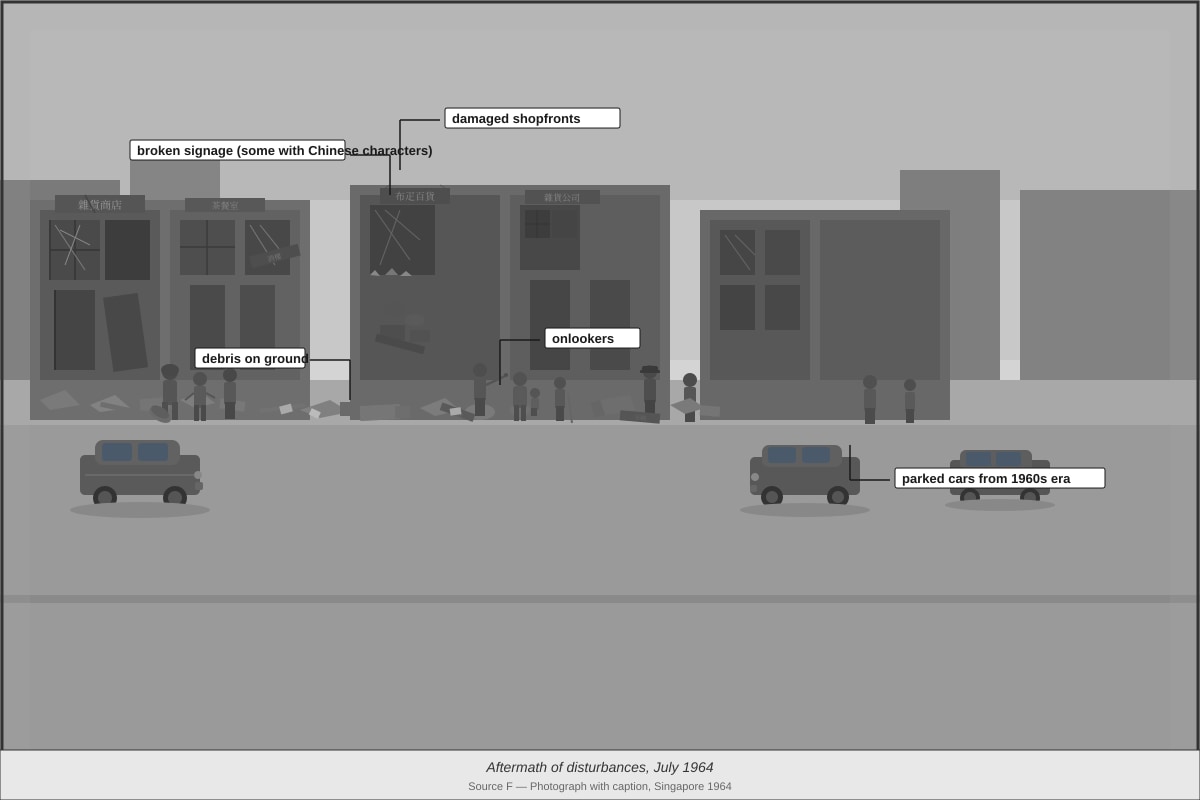
- There was serious violence/destruction in Singapore in 1964 [1 mark] (evidence: damaged shops, debris)
- The violence had communal/racial dimensions [1 mark] (evidence: onlookers appear multi-racial, suggesting communal tension; Chinese signage suggests affected area was Chinese community)
- The events were significant enough to be photographically documented [1 mark] (caption suggests official or journalistic recording)
(Any two inferences with evidence for full marks)
Teaching note: July 1964 race riots between Chinese and Malays were pivotal in Singapore-Malaysia merger breakdown. The photograph's "aftermath" framing—destruction without visible action—requires inferring preceding violence. Caption brevity ("disturbances") is euphemistic official language; photographers' presence suggests newsworthiness.
Expected visual interpretation: Damaged shopfronts with Chinese characters → targeted Chinese businesses; multi-racial onlookers → communal nature of violence; 1960s vehicles → temporal verification.
Question 10 [6 marks]
Answer: Source F is moderately useful with significant limitations [1 mark]. Usefulness: It provides visual evidence of physical destruction in 1964 [1 mark]; demonstrates scale and location of violence [1 mark]; its dating and captioning suggest official documentation. Limitations: It captures only aftermath, not causes or full context [1 mark]; single image may not represent all riot locations or experiences [1 mark]; caption euphemism ("disturbances") understates severity— photographer/editors may have editorial choices [1 mark]. Own knowledge: Must combine with other sources to understand 1964 riots as part of Singapore-Malaysia political crisis.
Teaching note: Visual source evaluation requires same rigour as textual sources. Photos appear "objective" but involve selection (what to frame, when to shoot), editorial decisions (captioning, publication), and cannot show invisible factors (causes, motivations, unseen locations). Historians triangulate visual with oral, documentary, and statistical evidence.
Marking descriptors:
- Level 1 (1–2 marks): Generic "useful because it's a photograph" without specific analysis
- Level 2 (3–4 marks): Identifies some utility and some limitation with partial own knowledge
- Level 3 (5–6 marks): Balanced assessment weighing different types of usefulness, explicit limitations, and integration with own knowledge
Section C: Source Evaluation and Weight of Evidence
Question 11 [2 marks]
Answer: Two priorities:
- Maintaining order/control without provoking anti-colonial sentiment [1 mark]
- Preventing radicals/communists from gaining strength [1 mark]
- Negotiating transition to self-government on British terms [1 mark]
(Any two for full marks)
Teaching note: "The narrative of colonial oppression must not be fed" reveals sophisticated understanding of propaganda and legitimacy—British concern was not merely order but controlling how actions were interpreted. "Strategic interests in Southeast Asia" references Cold War context where colonial retreat must not benefit communists.
Question 12 [4 marks]
Answer: Source G may be less reliable because: it is confidential government communication designed to control events, not record truth objectively [1 mark]; it reveals what British wanted to happen ("authorized," "must not be fed") rather than what actually occurred [1 mark]; its concern with "narrative" shows awareness of image-management [1 mark]; governors receiving orders may modify or selectively implement directives [1 mark]. It is reliable for British intentions but unreliable for on-ground reality.
Teaching note: Confidential documents seem "authentic" but are performative—they create paper trails for accountability, shape recipient behaviour, and reflect sender's desired self-image. This telegram's explicit concern with narrative control undermines its reliability as neutral evidence even as it reveals sophisticated colonial public relations.
Question 13 [3 marks]
Answer: Two reasons:
- Desire for independence/merdeka from British colonial rule [1 mark]
- Belief in socialist/equitable society ("fair to all races") [1 mark]
- Personal experience of exploitation as rubber tapper/worker [1 mark]
- Ethnic/communal solidarity with fellow exploited workers [1 mark]
(Any two with evidence from source for full marks)
Teaching note: Source H reveals multiple motivations—nationalist, ideological, economic—that complicate simple "communist=terrorist" narrative. The speaker's retrospective "on the wrong side of history" framing (1990 interview) shows awareness of Cold War victory narrative, possibly shaping memory.
Question 14 [4 marks]
Answer: Source H has advantages and limitations [1 mark]. Advantages: Eyewitness/ participant account with direct experience of jungle warfare and MCP [1 mark]; provides "from below" perspective absent from official sources [1 mark]. Limitations: Created 40+ years after events—memory decay, hindsight bias [1 mark]; retrospective framing ("wrong side of history") may reshape past motivations [1 mark]; single perspective cannot represent all MCP members' diverse motivations [1 mark]. Best used with corroborating documentary sources.
Teaching note: Oral history—the "history of the voiceless"—came to prominence from 1960s social history movement. Its value is experiential richness; its danger is temporal distance, ego-ideal consistency (recalling self flatteringly), and survival bias (only survivors interviewed). The 1990 interview date places it after Cold War ended, potentially affecting willingness to speak.
Question 15 [2 marks]
Answer: One trend: Chinese proportion remained largest but fluctuated slightly (75–78%) [1 mark]; OR increasing Malay proportion (12% to 14.8%) [1 mark]; OR declining "Others" category as ethnic classification became more defined [1 mark]; OR overall population growth while maintaining Chinese majority dominance [1 mark].
Teaching note: These census figures undergird PAP's multiracial policy and electoral calculations. The relatively stable Chinese super-majority with slowly growing Malay minority shaped policies from housing quotas (HDB ethnic integration) to education (bilingual policy) to national service.
Section D: Synthesis and Critical Analysis
Question 16 [2 marks]
Answer: Two reasons from Source J:
- Incompatible visions: "Malay ultras wanted Malay-dominated state" vs "Malaysian Malaysia" with equal rights [1 mark]
- 1964 race riots demonstrated unworkability of merger [1 mark]
- British military withdrawal removing economic prop [1 mark]
- Singapore's vulnerable position with no natural resources [1 mark]
(Any two for full marks)
Question 17 [3 marks]
Answer: Source K blames Singapore's PAP specifically [1 mark]: "interference in Malayan politics," challenging Malay special rights, "provoke communal tensions" [1 mark]. It presents separation as active federal decision ("we expelled") for national unity, not mutual failure [1 mark]. Source J emphasises structural incompatibility and Kuala Lumpur's racial policy; Source K emphasises Singapore's political transgressions.
Teaching note: This is classic "blame attribution" divergence in historical accounts. Lee's memoir (written with hindsight of Singapore's success) frames separation as liberation from impossibility; Malaysian government source defends decision as necessary discipline. Both serve political purposes.
Question 18 [3 marks]
Answer: Neither is fully reliable; both are partisan [1 mark]. Source J is memoir written with Singapore's success known, potentially selective or self-justifying [1 mark]. Source K is official document defending federal government's decision, minimising own role in creating conditions [1 mark]. Most balanced approach: use both, compare with third-party sources (British diplomatic records, contemporary newspapers).
Teaching note: Reliability is not binary "reliable/unreliable" but continuum with specific strengths/weaknesses. Memoirs offer insight into decision-making psychology but distort with hindsight; official documents reveal institutional priorities but minimise responsibility. Triangulation—comparing multiple biased sources—is essential historical method.
Question 19 [3 marks]
Answer: Two changes with evidence:
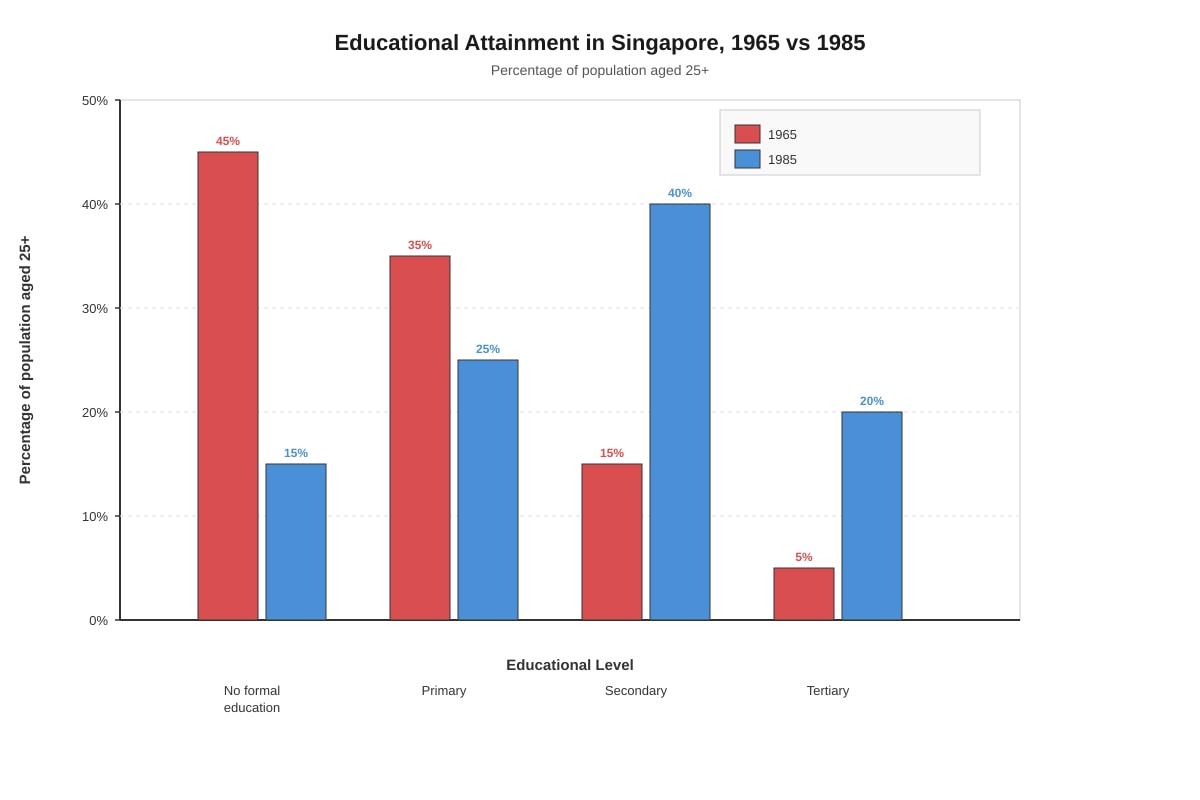
- Dramatic decline in "no formal education" from ~45% to ~15% [1 mark]
- Major increase in secondary education from ~15% to ~40% [1 mark]
- Tertiary education quadrupled from ~5% to ~20% [1 mark]
- Primary education proportion declined as more progressed to higher levels [1 mark]
(Any two changes with specific percentage evidence for full marks)
Teaching note: These figures represent PAP's massive investment in human capital as Singapore's only resource. The 1965–1985 period covers first-generation nation-building, economic transformation from entrepôt to manufacturing to services, and deliberate skills-creation strategy.
Expected visual interpretation: Bar chart must show dramatic convergence—1965 bars heavily weighted toward "No formal," 1985 bars toward "Secondary" and "Tertiary." The visual "crossover" between categories is the key historical story.
Question 20 [2 marks]
Answer: One limitation:
- Shows only educational attainment, not economic output/productivity [1 mark]
- Does not reveal quality of education or relevance to employment needs [1 mark]
- Static snapshot of age 25+ misses younger cohorts still in education [1 mark]
- Percentages mask absolute numbers and immigration effects [1 mark]
- Cannot show causation—education may follow rather than lead economic growth [1 mark]
(Any one well-developed limitation for 2 marks)
Teaching note: Correlation ≠ causation is fundamental to historical and social science reasoning. Singapore's economic development (GDP growth, industrial diversification, financial sector emergence) requires additional evidence—trade statistics, employment data, company records—to establish education's specific contribution.
END OF ANSWER KEY