AI Generated Quiz
Secondary 3 History Singapore Southeast Asia Quiz
Free Sec 3 History Singapore SEA quiz, Kimi2.6 AI version, with questions, answers, and O Level-style practice for Singapore students.
These static practice materials are generated from the site's syllabus and paper-generation workflow, with source and model context shown so students and parents can evaluate the material before use.
Questions
Free quiz and exam paper access
Enter your details to view this paper
Your access is remembered on this device.
Answers
Secondary 3 History Quiz — Singapore Southeast Asia: Answer Key
Total Marks: 40 marks
Section A: Source-Based Skills (10 marks)
Question 1 (2 marks)
Answer:
- Singapore has a capacious harbour capable of containing the largest fleet / deep water suitable for large ships (1 mark)
- It is conveniently situated at the extremity of the Straits of Malacca, making it attractive for trade / strategically located on major trade route (1 mark)
Teaching note: Raffles emphasises practical geographical advantages. The "extremity" refers to the southern tip of the Malay Peninsula, controlling the narrow passage between Malaya and Sumatra that all ships travelling between India and China had to pass.
Question 2 (2 marks)
Answer: British strategic interest is shown by:
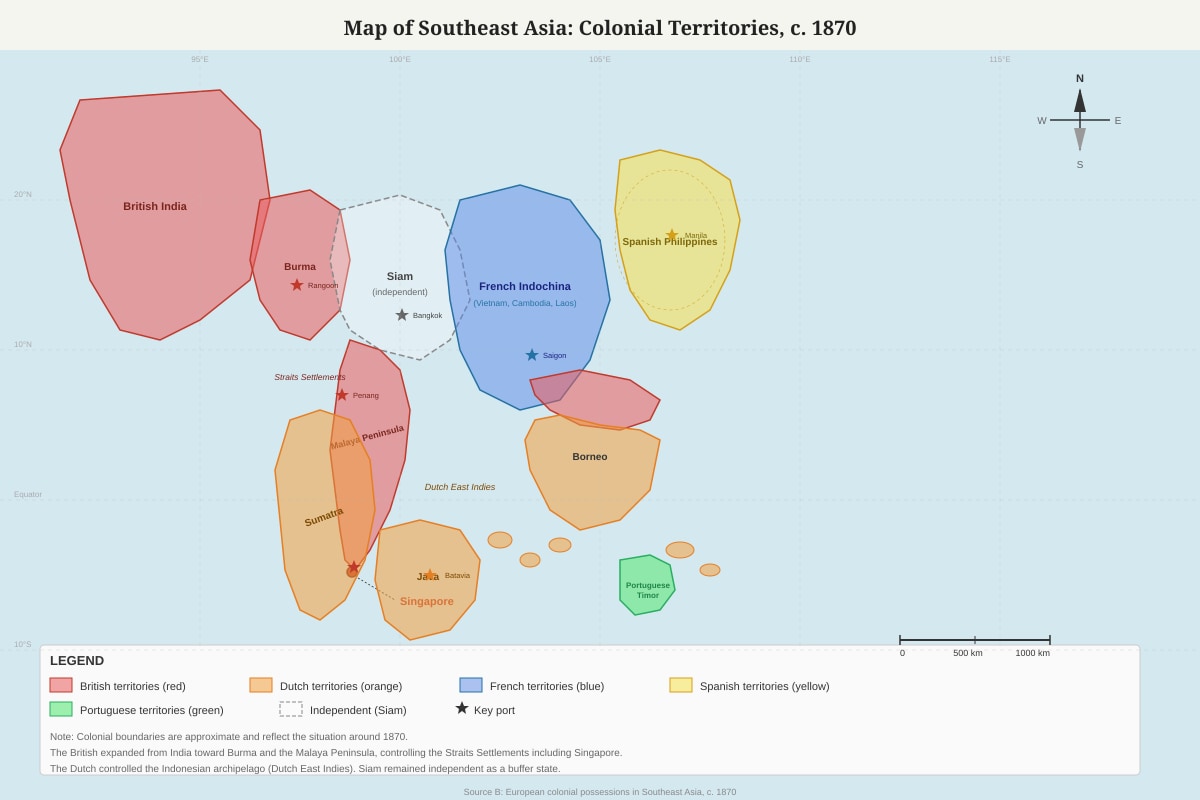
- Singapore's position at the southern tip of the Malaya Peninsula (1 mark), controlling the entrance/exit to the Straits of Malacca, a vital sea lane connecting Indian Ocean and South China Sea (1 mark)
- The map shows British territories (red) expanding from India toward Burma and the Straits Settlements, with Singapore as the easternmost point of this strategic chain (alternative valid answer)
Teaching note: The map demonstrates how Singapore completed British control of a continuous arc from India through Burma and Malaya. The Straits of Malacca was the " chokepoint" of Eastern trade — whoever controlled Singapore controlled access to the entire route between Europe and East Asia.
Question 3 (2 marks)
Answer: Source C suggests British motives were:
- To secure communications with Australia and New Zealand — maintaining imperial connections with white settler dominions (1 mark)
- To deter any rising naval power — specifically Japan, which was expanding its navy and territorial ambitions in the early 20th century (1 mark)
Teaching note: By 1921, Britain's "two-power standard" (matching any two other navies) was under strain. The Singapore naval base, completed in 1938, was designed so that a British fleet could be sent quickly to address threats in East Asia without permanent stationing there — the "Singapore strategy."
Question 4 (2 marks)
Answer: Similarity: Both sources present British interests in Singapore as strategic and commercial rather than benevolent or civilising (1 mark). Source A emphasises trade attraction and harbour facilities; Source C emphasises military securing of empire and deterrence (1 mark for specific evidence from both).
Alternative valid similarity: Both suggest British presence is defensive/preemptive against rivals — Source A mentions the Dutch won't contest occupation; Source C mentions deterring rising powers.
Teaching note: This reflects the historiographical debate about imperialism. Classical accounts stressed "duty" and "civilising mission"; these sources reveal hard-nosed strategic calculation. Raffles wrote privately to a minister, so had less need for public justification.
Question 5 (2 marks)
Answer: Reliability assessment (1 mark for judgement with supporting reason):
Reliable in some ways because: Raffles was directly involved in establishing Singapore; the letter is contemporary to events (1819); written privately to a government minister rather than for public propaganda, suggesting frankness.
Limited reliability because: Raffles had vested interest in justifying his actions — he conducted the negotiation without full prior authorisation and needed to persuade London; he may downplay Dutch objections; we lack the Dutch perspective on whether they would "readily contest" occupation.
Full marks for answer that demonstrates awareness of both utility and limitations. (2 marks for balanced assessment with evidence; 1 mark for partial or one-sided answer)
Teaching note: This introduces students to "provenance" analysis — who wrote it, when, why, and for whom. Raffles was a romantic imperialist but also a practical administrator who exceeded his instructions. The letter is valuable precisely because it reveals how he framed his unauthorised action to superiors.
Section B: Knowledge and Understanding (20 marks)
Question 6 (1 mark)
Answer: 30 January 1819 (accept January 1819)
Teaching note: Raffles anchored in Singapore on 28 January, concluded a preliminary agreement with Temenggong Abdul Rahman and Sultan Hussein Shah of Johor on 30 January, and raised the British flag. The formal treaty was 6 February 1819.
Question 7 (1 mark)
Answer: Sultan Hussein Shah (of Johor) / Temenggong Abdul Rahman (either acceptable; both were involved)
Teaching note: Raffles exploited a succession dispute in the Johor Sultanate. The legitimate sultan, Tengku Long, was in Riau; Raffles recognised Hussein (who was with the Temenggong in Singapore) in exchange for treaty concessions. This was controversial — the Dutch recognised the Riau sultanate.
Question 8 (1 mark)
Answer: Spices (specifically nutmeg and cloves from the Moluccas/Spice Islands; also accept pepper or tin if linked to Sumatra or Malay Peninsula)
Teaching note: The Dutch VOC (Vereenigde Oostindische Compagnie) had monopolised spice production through the "extirpation" policy — destroying nutmeg trees outside their control. British encroachment in the Straits of Malacca threatened this monopoly, motivating the 1824 treaty.
Question 9 (2 marks)
Answer: The Anglo-Dutch Treaty of 1824 was significant because:
- Britain withdrew from Sumatra and recognised Dutch control over the Indonesian archipelago / Dutch sphere (1 mark)
- The Netherlands ceded Malacca to Britain and recognised British control of Singapore / agreed to separate spheres of influence in Southeast Asia (1 mark)
Teaching note: This treaty formalised the division of maritime Southeast Asia that lasted until Japanese invasion in 1942. It prevented Anglo-Dutch naval conflict and allowed Britain to focus northward while the Dutch consolidated in the archipelago. The "line" through the Straits became a rough boundary.
Question 10 (2 marks)
Answer: Any two from:
- Created a free port with minimal tariffs, attracting merchants from across Asia (1 mark)
- Developed entrepôt trade — importing raw materials from Southeast Asia and exporting manufactured goods from Europe/India (1 mark)
- Established banking and financial services to support commercial activity (1 mark)
- Built infrastructure — roads, godowns (warehouses), harbour facilities (1 mark)
Teaching note: Singapore's "free port" status (established 1819, formalised 1826) was distinctive in a region of monopoly companies. Merchants of any nationality could trade without paying Customs duties on transhipment goods — this attracted the "junk trade" from China and regional Bugis, Arab, and Indian networks.
Question 11 (2 marks)
Answer: The Naning War (1831–1832) was fought when British administrators in Malacca attempted to impose direct control over Naning, a district that had previously paid tribute to the Dutch but claimed autonomy under local Malay leadership (chief Dol Said) (1 mark).
It revealed that British expansion faced local resistance and that British claims to authority based on treaty transfers (from Dutch to British) did not automatically translate into effective control on the ground (1 mark).
Teaching note: This was an early warning of the "paper empire" problem. The British "won" but at disproportionate cost, leading to more gradual, indirect rule in subsequent decades. Dol Said became a resistance hero in Malaysian nationalist historiography.
Question 12 (2 marks)
Answer: Britain established the Straits Settlements in 1826 to:
- Unite Singapore, Malacca, and Penang under single administration for efficiency and economies of scale (1 mark)
- Reduce administrative costs by ending separate management of three small but strategically linked possessions (1 mark)
- Create stronger coordinated presence against Dutch regional influence (alternative valid point)
Teaching note: Initially under Bengal Presidency (1826–1867), then Crown Colony status from 1867. The Settlements were multicultural from inception: Penang had Chinese, Indian, and Malay populations; Malacca had Portuguese Eurasian and Malay communities; Singapore became the dominant centre.
Question 13 (2 marks)
Answer: The Suez Canal opening (1869) affected Singapore by:
- Reducing sailing time between Europe and Asia from months to weeks, increasing the volume of trade passing through Singapore (1 mark)
- Making Singapore more central to steamship routes that required coaling stations; Singapore became a key refuelling point (1 mark)
- Intensifying British imperial control as communication with London became faster (alternative valid point)
Teaching note: The canal shifted the global geography of trade. Previously, Cape Route ships might stop at multiple ports; post-Suez, the "main road" of empire ran through the Mediterranean, Red Sea, Indian Ocean, and Strait of Malacca. Singapore's position as the eastern gate became more valuable.
Question 14 (2 marks)
Answer: The Resident System involved:
- Britain appointing a British "Resident" to advise the Malay Sultan on all matters except Malay religion and custom (1 mark)
- The Resident effectively controlling state administration, revenue, and foreign relations while maintaining the symbolic position of the Sultan (1 mark)
Teaching note: Developed first in Perak (1874, Pangkor Treaty), then extended to Selangor, Negeri Sembilan, and Pahang — forming the Federated Malay States (1895). This "indirect rule" preserved Malay aristocratic prestige while ensuring British economic and strategic control. Historians debate how "advisory" the Residents actually were.
Question 15 (2 marks)
Answer: British policies differed in that:
- Chinese immigrants were initially tolerated/encouraged as labourers and traders essential to economic development; later regulated through immigration controls and the Protectorate of Chinese (1867) to manage secret societies (1 mark)
- Malay inhabitants were generally preserved in rural agricultural roles with limited urban migration; British feared disrupting traditional society and preferred to use imported labour for new industries (1 mark)
Teaching note: This created the plural society pattern — different ethnic groups in different economic sectors, with limited integration. The Chinese dominated commerce and urban labour; Malays remained in village agriculture; Indians were imported for plantation and manual labour. British "divide and rule" was partly deliberate, partly emergent fromconomic pragmatism.
Section C: Historical Reasoning (10 marks)
Question 16 (1 mark)
Answer: Dramatic/rapid increase / exponential growth / rose more than twenty-fold (from about 10,000 to over 227,000)
Teaching note: The data reveals immigration-driven growth rather than natural increase. High male-to-female ratios in early immigrant communities meant low birth rates; population growth came overwhelmingly from new arrivals, especially from South China and South India.
Question 17 (2 marks)
Answer: The Chinese population grew most dramatically because:
- Immigration push factors: Poverty, overpopulation, and political disorder in Southern China (especially after Taiping Rebellion, 1850–1864) drove emigration (1 mark)
- Singapore pull factors: Free port status created employment in trade, commerce, and later processing; Chinese merchant networks (dialect/kinship based) facilitated chain migration; colonial labour needs attracted Chinese as coolies and traders (1 mark)
Teaching note: The data shows Chinese becoming majority by 1840 and overwhelming majority by 1901. "Pull" specifically includes the credit-ticket system, clan associations (huiguan), and opium farming revenue that made Chinese communities economically valuable to colonial government.
Question 18 (2 marks)
Answer: The relative Malay decline (from 43% in 1824 to 16% in 1901) suggests:
- Social marginalisation — Malays were not drawn into immigrant-driven economic sectors; remained in traditional fishing and small-scale agriculture while commercial opportunities went to immigrant groups (1 mark)
- Emergence of ethnic hierarchy — colonial Singapore's modernity was immigrant-built, creating potential for future inter-ethnic tension and different political claims to "belonging" (1 mark)
Teaching note: This demographic shift has lasting consequences. Malays in Singapore today are a recognised indigenous minority with constitutional protections. The historical pattern of "Malays in villages, Chinese in cities" shaped educational and employment policies after independence.
Question 19 (3 marks)
Answer:
Strongly supports / partially supports with qualification:
Supports: Chinese formed 72% of population by 1901 (164,581 of 227,592); absolute numbers increased fifty-fold; Chinese dominated commercial and labour sectors that defined Singapore's function as port city (1 mark)
However/Qualification: "Primarily" requires caution. The table shows multi-ethnic composition persisted — Indians/Others remained significant (12%, nearly 27,000); Malays maintained absolute growth; colonial administration was British, not Chinese; Chinese community was itself divided by dialect (Hokkien, Teochew, Cantonese, Hakka) and not politically unified (1 mark)
Conclusion: The source supports that Chinese were numerically and economically dominant by 1901, but "society" implies more than numbers — political control, cultural hegemony, and social integration remained contested and multi-layered (1 mark for reasoned judgement)
Alternative conclusion: If student argues "fully supported" with strong quantitative evidence, or "only partially" with emphasis on continuing pluralism, either is valid if argued with data.
Marking descriptor: 3 marks = balanced use of data with clear evaluative conclusion; 2 marks = one-sided but supported; 1 mark = descriptive use of data without evaluation.
Question 20 (2 marks)
Answer:
Agree to considerable extent:
- Transformation evident: population growth, infrastructure, commercial networks, global connectivity, modern administration (1 mark)
- Costs evident: displacement of Orang Laut and indigenous inhabitants; exploitation of immigrant labour (coolie system); social fragmentation; colonial governance that prioritised imperial interests over welfare; racial classification systems that hardened ethnic boundaries (1 mark)
Qualification/Nuance:
- "Progress" assumes modernization theory; alternative view sees destructive disruption of sustainable local systems
- "Local populations" includes multiple groups with different experiences: Malays lost relative position; Chinese coolies suffered high mortality; Indians faced indenture; only some merchant elites benefited
Marking descriptor: 2 marks = acknowledges both transformation and cost with specific evidence; 1 mark = one-sided or generic; 0 marks = no relevant knowledge.
Teaching note: This is a synoptic question requiring integration of sources and own knowledge. The "cost" dimension connects to postcolonial critiques of empire and Singapore's own national narrative of triumph-over-adversity. Students should avoid simplistic celebration or condemnation.
END OF ANSWER KEY