AI Generated Quiz
Secondary 3 History Historical Concepts Quiz
Free Sec 3 History Historical Concepts quiz, Kimi2.6 AI version, with questions, answers, and O Level-style practice for Singapore students.
These static practice materials are generated from the site's syllabus and paper-generation workflow, with source and model context shown so students and parents can evaluate the material before use.
Questions
Free quiz and exam paper access
Enter your details to view this paper
Your access is remembered on this device.
Answers
Secondary 3 History Quiz — Answer Key: Historical Concepts
Total: 40 marks
Section A: Multiple Choice (8 marks)
| Question | Answer | Explanation |
|---|---|---|
| 1 | B) Causation | Causation specifically examines why events occurred (causes) and what resulted (consequences). Chronology (A) is about sequence; Significance (C) assesses importance; Diversity (D) recognises varied experiences. |
| 2 | C) Significance | The historian judges importance by criteria like duration, geographical reach, and depth of impact — key measures of significance. Change and Continuity (B) would examine what transformed or persisted, not why one event matters more. |
| 3 | A) Accounts | Different textbooks represent different historical accounts — constructed narratives by historians with varying emphases. This is not merely causation (C), which focuses on why events happened, not on historiographical differences. |
| 4 | A) Change and Continuity | The student identifies both change (women's suffrage) and continuity (education system), avoiding a simplistic "everything changed" conclusion. |
| 5 | B) Historical Empathy | Understanding actions within their historical context — without necessarily agreeing — requires examining contemporary perspectives, pressures, and worldviews. This is not diversity (C), which compares different groups' experiences. |
| 6 | A) Evidence | Using multiple source types (quantitative data, media, oral testimony) demonstrates how historians build arguments through evidence. |
| 7 | B) Recognising that Malay, Chinese, Indian, and Eurasian communities experienced decolonisation differently | Diversity explicitly acknowledges varied experiences across social groups. Timeline comparison (A) is chronology; duration (C) is chronology; importance ranking (D) is significance. |
| 8 | B) Chronology | The sequence of dated events arranged in order demonstrates chronology — understanding when events happened in relation to each other. |
Section A Total: 8 marks
Section B: Short Answer (12 marks)
9. Define Causation and explain its importance for WWII [2 marks]
- Definition: Causation is the historical concept that examines why events happened (causes) and their results (consequences/ effects). [1 mark]
- Importance for WWII: It helps historians distinguish between long-term causes (e.g., Treaty of Versailles, 1919), short-term triggers (e.g., invasion of Poland, 1939), and consequences (e.g., Cold War division of Europe, decolonisation). Without causation, students would merely list events without understanding relationships between them. [1 mark]
Marking note: Accept "causes and effects" or "reasons and results" as equivalent. Must mention both causes AND consequences for full definition mark.
10. Primary vs. secondary evidence with examples [3 marks]
- Primary evidence is created during the period being studied, by people who experienced or witnessed events. [0.5 mark] Example: A diary entry by a Singaporean interned at Sime Road Camp during the Japanese Occupation; or a Kempeitai propaganda poster from 1942. [0.5 mark]
- Secondary evidence is created after the period, by people who did not experience events directly. [0.5 mark] Example: A 2010 academic article analysing death rates during the Occupation; or a documentary made in 1985 interviewing survivors. [0.5 mark]
- Distinction importance: Primary sources offer immediacy but may be biased or limited in perspective; secondary sources offer analysis and context but depend on the historian's interpretation of evidence. [1 mark]
Marking note: Examples must be specifically tied to the Japanese Occupation of Singapore. Generic examples (e.g., "a book about WWII") without Singapore context lose the example marks.
11. Another reason for Cold War significance [2 marks]
Accept any valid criteria of significance:
- Duration: It shaped global politics for over four decades (1947–1991), affecting multiple generations. [2 marks]
- Global reach: It influenced events on every continent through proxy wars, alliances, and arms races. [2 marks]
- Consequences for ordinary people: It produced nuclear anxiety, space race investment, and affected domestic policies (e.g., McCarthyism, socialist movements). [2 marks]
- Lasting effects: Post-Cold War borders, NATO expansion, and ongoing tensions (e.g., Korean division) continue to shape today's world. [2 marks]
Marking note: Must use explicit significance language (duration, relevance to today, number affected, depth of impact). Merely stating "it was important" without criteria earns 0 marks.
12. How Change and Continuity prevents oversimplification [2 marks]
- It forces historians to examine both what transformed and what persisted, rather than assuming complete transformation or total stasis. [1 mark]
- Example: Post-independence Singapore saw dramatic political change (sovereignty, PAP government) but economic continuity (entreport trade, reliance on global markets). Recognising both prevents the false conclusion that 1965 marked a total break with the past. [1 mark]
Marking note: Must explain the methodological value — how the concept shapes historical thinking — not merely give an example.
13. Why historians produce different Accounts [1 mark]
Accept any valid reason:
- They use different evidence or sources;
- They have different purposes or audiences (e.g., nationalist vs. internationalist);
- They hold different theoretical perspectives (e.g., Marxist vs. liberal);
- They were writing in different periods with different access to archives.
14. Diversity and Merger/Separation experiences [2 marks]
- Malay community: Many supported merger with Malaysia due to ethnic solidarity with Malay-majority Malaysia; some faced displacement from government positions after separation. [1 mark]
- Chinese community: Divided — some welcomed merger's anti-communist crackdown; others (left-wing) opposed it; after separation, Chinese-educated groups faced reduced status with emphasis on English. [1 mark]
- Indian and minority communities: Generally more ambivalent, concerned about citizenship rights and economic security in both scenarios. [1 mark]
Marking note: Any two distinct ethnic perspectives with differentiated experiences earns full marks. Must show awareness that "Singaporeans" did not have uniform experiences.
Section B Total: 12 marks
Section C: Source-Based and Extended Response (20 marks)
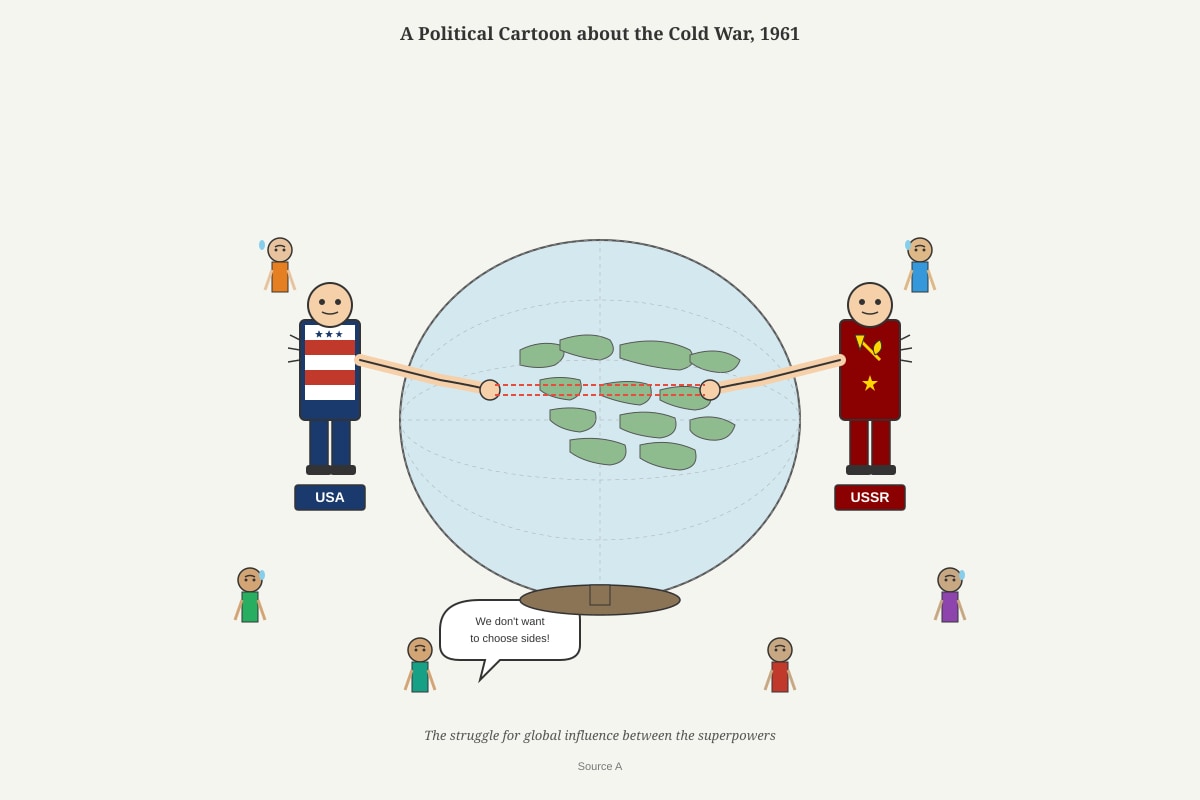
15. Source A — Cold War political cartoon
(a) Concept identification and explanation [3 marks]
- Concept: Causation, Significance, or Change and Continuity all partially fit; best answer is Causation or Evidence depending on argument. Most likely intended: Causation (showing causes of tension) OR the cartoon as Evidence of contemporary perceptions. [1 mark]
- Feature and link: The arm-wrestling figures show superpowers competing for global influence without direct war — illustrating how ideological competition (cause) created bipolar tension (effect). OR: The small nations' anxiety shows the consequence of superpower rivalry for non-aligned states. [2 marks]
Acceptable alternative: Significance — the visual scale suggests this rivalry dominated international relations for decades, affecting all regions.
Marking descriptors:
- Level 1 (1 mark): Identifies concept without linking to source feature
- Level 2 (2 marks): Identifies concept and describes source feature but weak link
- Level 3 (3 marks): Precise concept identification with explicit source feature and clear conceptual explanation
(b) Significance of the cartoon as evidence [2 marks]
- As a 1961 primary source, it captures contemporary perception of superpower confrontation — significance of immediacy. [1 mark]
- For historians, it illustrates how the Cold War was represented and understood at the time, showing popular anxiety about proxy conflicts and nuclear threat — significance for understanding public opinion, not just diplomatic documents. [1 mark]
- Alternatively: Its global imagery shows the geographical reach of Cold War significance, affecting nations beyond Europe and North America.
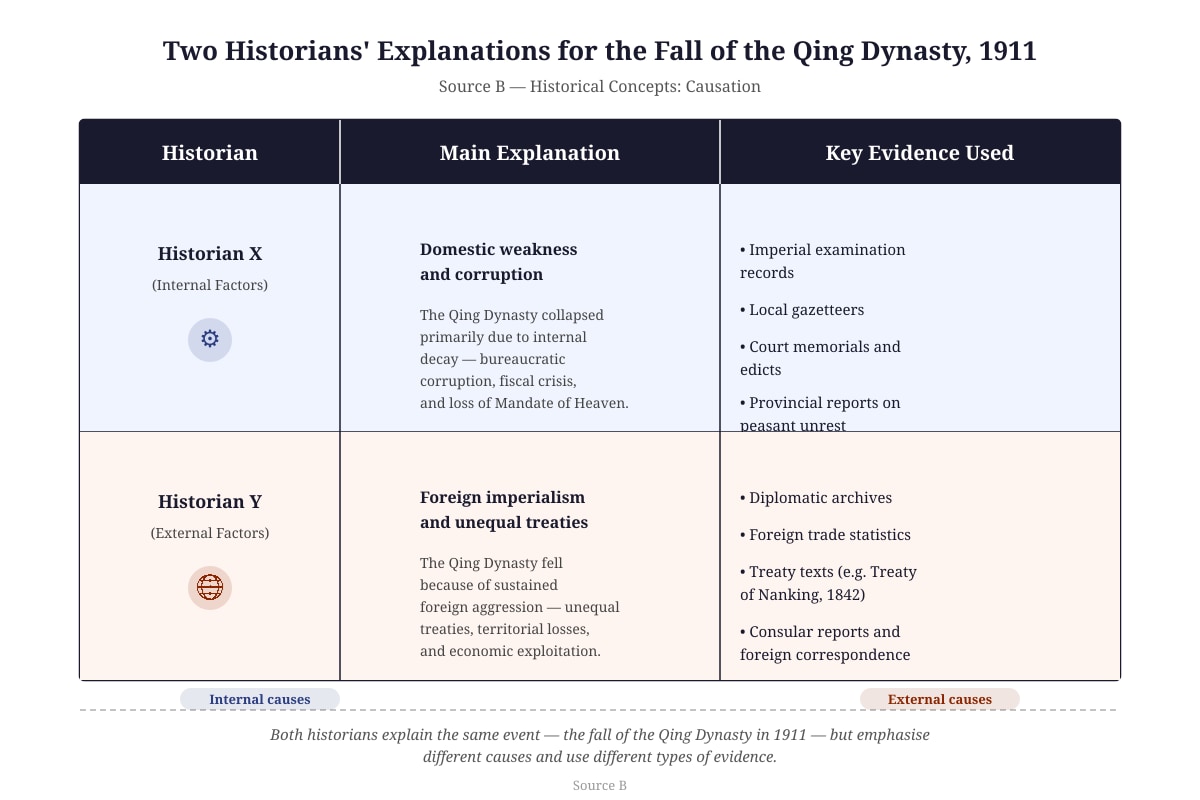
16. Source B — Qing Dynasty historians
(a) Concept: Accounts [1 mark]
Both historians study the same event (1911 fall of Qing) but construct different explanations — this demonstrates Accounts.
(b) Why different conclusions using Evidence [3 marks]
- Different evidence types: Historian X uses local Chinese sources (examination records, gazetteers) pointing to internal decay; Historian Y uses international archives and trade data pointing to foreign pressure. [1 mark]
- Evidence silences: Each archive preserves different voices — local records may understate foreign impact; diplomatic archives may ignore rural conditions. [1 mark]
- Selection and weighting: Historians must select from incomplete records; their choice of what counts as "key evidence" shapes their conclusions. Neither is simply wrong; each account reflects the evidence they prioritised and what their sources could reveal. [1 mark]
Marking note: Must explicitly address the evidence concept — not just "they had different opinions."
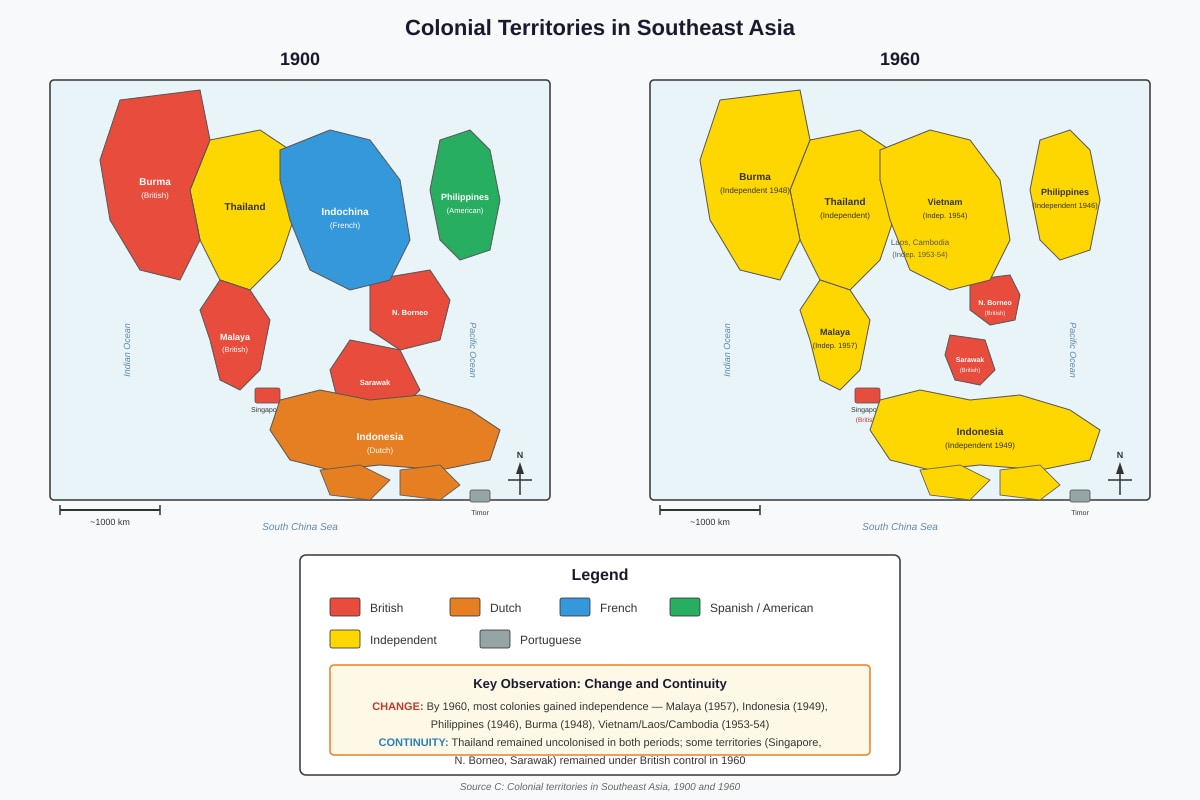
17. Source C — Colonial map
(a) Change and Continuity [3 marks]
- Change: Dramatic reduction in colonial territory — by 1960, most Southeast Asian states independent (e.g., Indonesia 1949, Malaya 1957, Philippines 1946) compared to near-total European control in 1900. [1 mark]
- Continuity: Thailand remained uncolonised in both periods; some economic ties to former colonial powers persisted even after political independence. [1 mark]
- Conceptual application: Recognising both prevents assuming total transformation; decolonisation was politically revolutionary but economically and culturally uneven. [1 mark]
Marking descriptors: Must cite specific evidence from map for each point.
(b) Chronology essential for this source [2 marks]
- The 60-year gap is meaningless without knowing when specific territories became independent — chronology reveals whether decolonisation was sudden (post-WWII wave) or gradual. [1 mark]
- Without chronological precision, historians might misattribute causes — e.g., confusing Japanese occupation effects (1942–1945) with post-war nationalist movements (1945–1960s). Chronology helps sequence causes and distinguish phases of change. [1 mark]
18. Evaluate claim that history is mere memorisation [4 marks]
| Level | Marks | Descriptor |
|---|---|---|
| L3 | 4 | Two concepts clearly applied to show why concepts transform 'memorisation' into analysis; explicit evaluation of claim's weakness |
| L2 | 2–3 | Two concepts mentioned with some application; limited evaluation of claim |
| L1 | 1 | One concept or descriptive treatment; no evaluation |
Exemplar response structure:
Concept 1: Causation [1–2 marks] Memorisation only records that WWII occurred in 1939; causation explains why — distinguishing Treaty of Versailles (long-term) from invasion of Poland (short-term). This produces explanatory knowledge, not just factual recall.
Concept 2: Evidence [1–2 marks] Memorisation accepts single 'facts'; evidence requires evaluating source reliability, bias, and gaps. For example, Japanese Occupation narratives differ between colonial officials, war crimes tribunals, and ordinary Singaporeans. Evidence-concept forces critical assessment, not passive acceptance.
Evaluation: The claim confuses history with chronology alone. Concepts transform facts into arguments, showing how historians construct knowledge rather than simply record it.
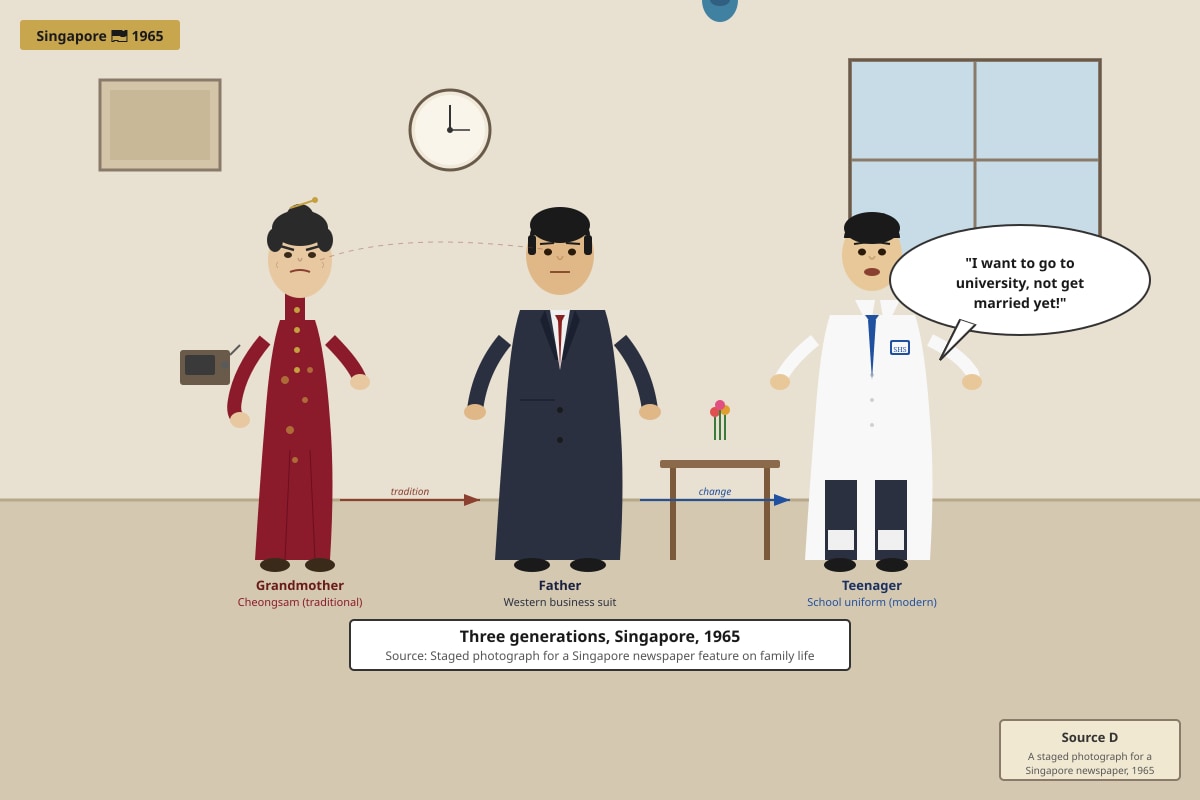
19. Source D — Three generations photograph
(a) Two concepts with explanations [4 marks]
Concept 1: Change and Continuity [2 marks]
- The clothing contrast (cheongsam vs. Western suit vs. school uniform) visually represents societal transformation — Westernisation, modern education, shifting gender roles. [1 mark]
- Yet the family structure itself (three generations cohabiting) shows continuity with Chinese familial values; the photograph captures negotiation between tradition and modernity, not simple replacement. [1 mark]
Concept 2: Diversity OR Historical Empathy [2 marks]
- Diversity: The grandmother's disapproval vs. teenager's ambition shows generational diversity within one ethnicity; not all Chinese Singaporeans responded identically to 1965's challenges. [2 marks]
- Historical Empathy: Understanding the grandmother's perspective requires recognising her values formed in pre-war, possibly conservative China; her disapproval reflects genuine cultural investment, not mere 'backwardness'. The teenager's aspiration reflects new educational and economic opportunities of independent Singapore. [2 marks]
Alternative Concept 2: Significance
- 1965 as independence year is visually foregrounded; the photographer selected this moment to symbolise national transformation through family narrative, showing how significance is constructed for public audience. [2 marks]
20. Essay: Three concepts enriching historical understanding [8 marks]
| Level | Marks | Descriptor |
|---|---|---|
| L4 | 7–8 | Three distinct concepts applied to one topic with clear interconnection; explicit argument about richer understanding; specific evidence; evaluative conclusion |
| L3 | 5–6 | Three concepts applied with adequate evidence; some interconnection; limited evaluation |
| L2 | 3–4 | Two concepts or three superficially treated; mainly descriptive |
| L1 | 1–2 | One concept or irrelevant treatment; no coherent topic focus |
Exemplar structure using Japanese Occupation of Singapore (1942–1945):
Introduction [1 mark] State topic and thesis: No single concept can capture the complexity of the Occupation; combined application produces layered understanding.
Causation [2 marks]
- Distinguishes immediate trigger (British defeat, February 1942) from long-term causes (colonial unpreparedness, Japanese Greater East Asia Co-Prosperity Sphere ideology) from consequences (local political awakening, anti-colonial nationalism).
- Shows why the Occupation happened and transformed Singapore, not merely that it happened.
Evidence [2 marks]
- Evaluating Syonan Shimbun (Japanese-controlled newspaper) against oral histories from Sook Ching survivors reveals contradictory narratives about 'liberation' vs. atrocity.
- Demonstrates how historians construct knowledge through source criticism, not passive acceptance of single narratives.
Diversity [2 marks]
- Chinese community faced Sook Ching massacres; Malay communities experienced varied treatment; Eurasians and Europeans endured internment; Indian National Army recruits had complex motivations.
- Prevents homogenised 'Singaporean experience'; shows how Occupation's impact was differentiated by ethnicity, class, and gender.
Synthesis [1 mark] Causation explains structural forces; evidence reveals how we know what happened; diversity ensures we recognise multiple experiences. Together they transform a simple story of 'Japanese invasion' into a nuanced analysis of war, memory, and social fracture — impossible with any single concept alone.
Marking note: Accept any syllabus topic with equivalent conceptual depth. Must show explicit interconnection between concepts, not merely treat each separately.
Section C Total: 20 marks
GRAND TOTAL: 40 MARKS