AI Generated Quiz
Secondary 3 History Historical Concepts Quiz
Free Sec 3 History Historical Concepts quiz, HY3 AI version, with questions, answers, and O Level-style practice for Singapore students.
These static practice materials are generated from the site's syllabus and paper-generation workflow, with source and model context shown so students and parents can evaluate the material before use.
Questions
Secondary 3 History Quiz - Historical Concepts
Name: ___________________________
Class: ___________________________
Date: ___________________________
Score: _______ / 40
Duration: 50 minutes
Total Marks: 40
Instructions:
- This quiz tests your understanding of Historical Concepts from the Secondary 3 History syllabus.
- Answer all 20 questions.
- Section A: Multiple-choice (1 mark each). Section B: Short structured questions (2 marks each). Section C: Source-based and extended response (3–4 marks).
- Write your answers in the spaces provided.
Section A: Understanding Key Concepts (Questions 1–5)
1 mark each
1. Which historical concept refers to understanding the sequence and timeline of events?
A. Causation
B. Chronology
C. Significance
D. Diversity
2. The concept of evidence in History primarily involves:
A. Memorising dates of battles
B. Analysing sources to support interpretations
C. Writing fictional accounts
D. Comparing climate data
3. Recognising that different historians may construct different versions of the same event is an example of the concept of:
A. Accounts
B. Change and Continuity
C. Historical Empathy
D. Chronology
4. Assessing why an event, person, or development mattered in the past is the concept of:
A. Causation
B. Significance
C. Evidence
D. Diversity
5. Understanding the actions of people in the past within their own context relates to:
A. Historical Empathy
B. Chronology
C. Accounts
D. Change and Continuity
Section B: Applying Concepts (Questions 6–15)
2 marks each
6. Explain the difference between change and continuity in historical analysis.
7. Give one example of causation from the rise of Nazi Germany (from your syllabus).
8. Why is evidence important when studying the extension of European control in Southeast Asia?
9. What does diversity mean when studying historical experiences? Provide one example.
10. A historian says the Treaty of Versailles was a cause of WWII. Which concept is she using? Explain briefly.
11. State one way chronology helps students understand the fall of Southeast Asia in 1942.
12. Explain how historical empathy can change our view of Japanese militarism in the 1930s.
13. Identify a continuity in British Malaya from the 1870s to 1920s (e.g. economy, society).
14. Why might two accounts of the same event (e.g. Pearl Harbor) differ? Use the concept of accounts.
15. How can significance be judged for the Atomic bombs on Hiroshima and Nagasaki?
Section C: Source-Based and Extended Response (Questions 16–20)
3–4 marks each
16. Read the source below.
"The British came for tin and rubber. They built railways and brought in Chinese and Indian workers. By 1920, Malaya was a plural society." – Adapted from a secondary school text
Using the concept of evidence, explain what this source shows about British Malaya. [3 marks]
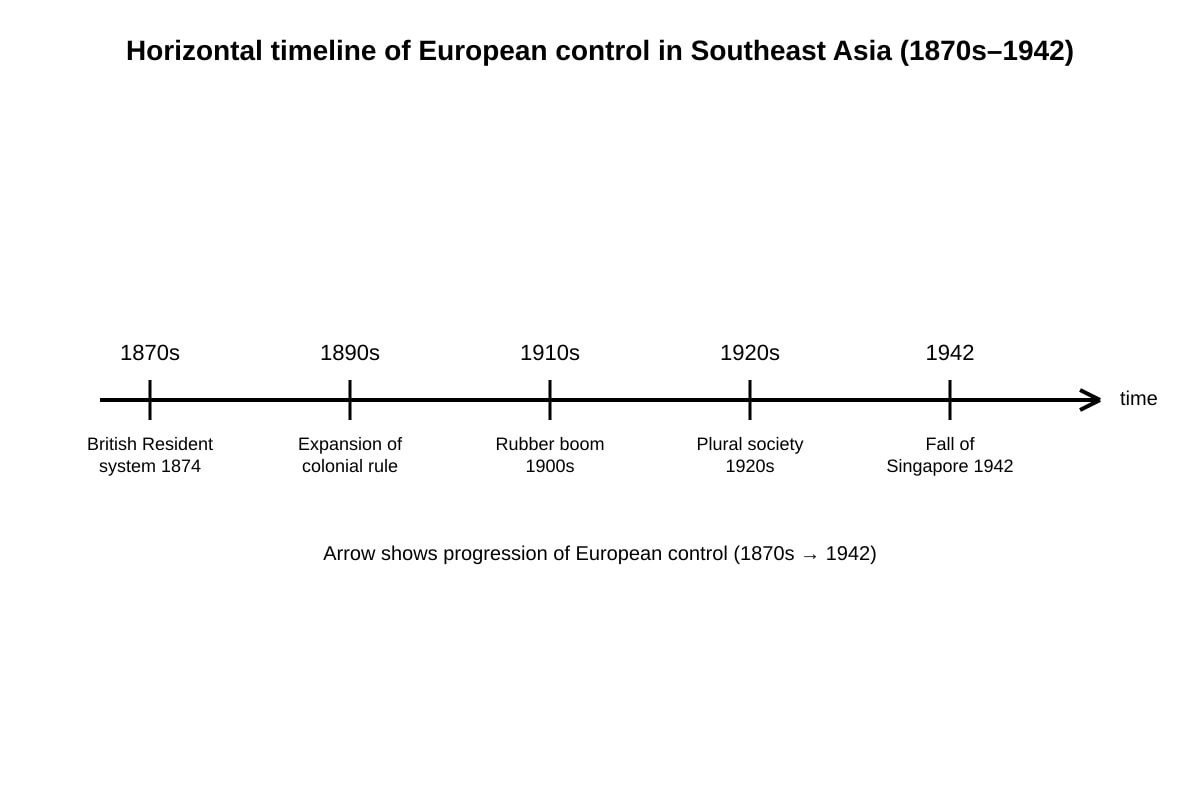
17. Study the timeline below.
Image pending generation: diagram for Q17.
Using chronology, describe the order of two developments shown. [3 marks]
18. "The Great Depression caused the Nazis to rise." Using causation and change and continuity, explain this statement with two points. [4 marks]
19. Two historians write differently about Hitler's appeal. One says it was economic; the other says propaganda. Using accounts and evidence, explain how to compare them. [3 marks]
20. Using significance and historical empathy, assess why the Paris Peace Conference (1919) mattered to Germans. [4 marks]
Answers
Secondary 3 History Quiz - Historical Concepts (Answer Key)
Total Marks: 40
Duration: 50 minutes
Section A (1 mark each)
1. B – Chronology
Teaching note: Chronology is the concept of placing events in time order. Causation is about why things happened; significance is about importance; diversity is about varied experiences.
2. B – Analysing sources to support interpretations
Teaching note: Evidence means using primary/secondary sources to build historical claims. Not just dates or fiction.
3. A – Accounts
Teaching note: Accounts recognises historians' interpretations differ due to perspective or available evidence.
4. B – Significance
Teaching note: Significance judges why something mattered; causation is about causes/consequences.
5. A – Historical Empathy
Teaching note: Empathy means seeing past actions in their context, not by modern standards.
Section B (2 marks each)
6. Change = what became different; Continuity = what stayed the same. [2]
Teaching: E.g. in Malaya, economy changed to export crops (change) but local rulers remained symbolic (continuity).
7. Example: Great Depression → Nazi rise. [2]
Teaching: Causation: economic crisis weakened Weimar, boosted extremist support.
8. Evidence helps verify claims about colonial impact using sources. [2]
Teaching: Without evidence, we rely on opinion; sources show migrant numbers, laws, etc.
9. Diversity = different groups' experiences. Example: migrants vs local rulers in Malaya. [2]
Teaching: Shows history is not one story.
10. Causation. [1] Treaty caused later war via resentment. [1]
Teaching: Links cause (Versailles) to effect (WWII).
11. Shows Fall of SG came after expansion. [2]
Teaching: Chronology reveals build-up before 1942.
12. Empathy shows Japan acted from insecurity, not just aggression. [2]
Teaching: Contextualises militarism.
13. Continuity: export economy remained. [2]
Teaching: Rubber/tin persisted across period.
14. Accounts differ due to perspective/sources. [2]
Teaching: US vs Japan records differ.
15. Significance: ended war, started nuclear age. [2]
Teaching: Judged by impact.
Section C
16. [3] Evidence shows British economic motive (tin/rubber) and social change (plural society). 1 mark each point + use of concept.
Teaching: Source is evidence of colonial transformation.
17. [3] Chronology: 1874 Resident system → 1920s plural society → 1942 Fall. Any two in order = 3 marks (1.5 each).
Visual: Timeline must show dates.
18. [4] Causation: Depression caused unrest (2). Continuity: anti-democratic feeling persisted (2).
Teaching: Links concepts.
19. [3] Accounts: diff views. Evidence: check sources for each claim (1+2).
Teaching: Compare with evidence.
20. [4] Significance: reshaped Europe (2). Empathy: Germans felt humiliated (2).
Teaching: Both concepts required.
Free quiz and exam paper access
Enter your details to view this paper
Your access is remembered on this device.